INTRODUCTION
Psychosocial care is accepted as an integral component of quality cancer care (Adler & Page, Reference Adler and Page2008; Jacobson & Wagner, Reference Jacobsen and Kadlubek2012). Yet, lack of integration of assessment of psychological distress in routine clinical practice has led to unmet patient needs, contributing to lower satisfaction with care, poorer self-management, and a negative effect on quality of life (Carlson et al., Reference Carlson, Waller and Groff2012; Fann et al., Reference Fann, Ell and Sharpe2012). More than a decade ago, the National Comprehensive Cancer Network (NCCN) proposed screening guidelines for distress and support has emerged for distress screening to be the sixth vital sign in clinical practice (Bultz & Johansen, Reference Bultz and Johansen2011; Carlson et al., Reference Carlson, Waller and Groff2012). Most recently, the Commission on Cancer has included psychosocial distress screening as one of the new patient-centered standards (Commission on Cancer, 2012; Fashoyin-Aje, Reference Fashoyin-Aje, Martinez and Dy2012), which includes indicators for documentation of screening and action taken by the provider, if distress was reported.
The incidence of psychosocial distress has been reported in 20–35% of patients studied (Frost et al., Reference Frost, Zevon and Gruber2011; Kendall et al., Reference Kendall, Glaze and Oakland2011; Knobf, Reference Knobf2011; Mitchell, 2007). Many of these studies have evaluated screening specifically for psychological distress, defined as anxiety, and depression (Hegel et al., Reference Hegel, Collins and Kearing2008; Mehnert & Koch, Reference Mehnert and Koch2008; Sollner et al., Reference Sollner, Maislinger and Konig2004), but distress reported by cancer patients is recognized as much more broad than emotional distress and includes distress related to physical symptoms and practical issues of managing everyday life (Beesley et al., Reference Beesley, Eakin and Stegnina2008; Hewitt et al., Reference Hewitt, Herdman and Holland2004; Fashoyin-Aje, Reference Fashoyin-Aje, Martinez and Dy2012; Frost et al., Reference Frost, Zevon and Gruber2011). While there is consensus that psychosocial distress screening is important to help identify patient needs, there are challenges to integrating distress screening into practice. At the provider level, time, reluctance, limited awareness of clinical practice guidelines, and lack of training have been cited as barriers (Fann et al., Reference Fann, Ell and Sharpe2012; Mitchell et al., Reference Mitchell, Kaar and Coggan2008). At the institutional level, low priority, fragmented or poorly coordinated psychosocial services, and ineffective communication across clinical settings are cited (Fann et al., Reference Fann, Ell and Sharpe2012). In addition, there are many unanswered questions about the best instrument to use, how to determine the presence or level of distress, and when and how often to screen. Despite these challenges, implementation of psychosocial screening has been identified as a practice standard and we need to identify strategies to integrate distress screening into routine clinical practice (Carlson et al., Reference Carlson, Waller and Mitchell2012; Fashoyin-Aje, Reference Fashoyin-Aje, Martinez and Dy2012; Jacobsen & Wagner, Reference Jacobsen and Kadlubek2012).
The purpose of this quality improvement project was to evaluate the feasibility of implementing psychosocial distress screening in the Breast Center at Smilow Cancer Hospital at Yale New Haven.
METHODS
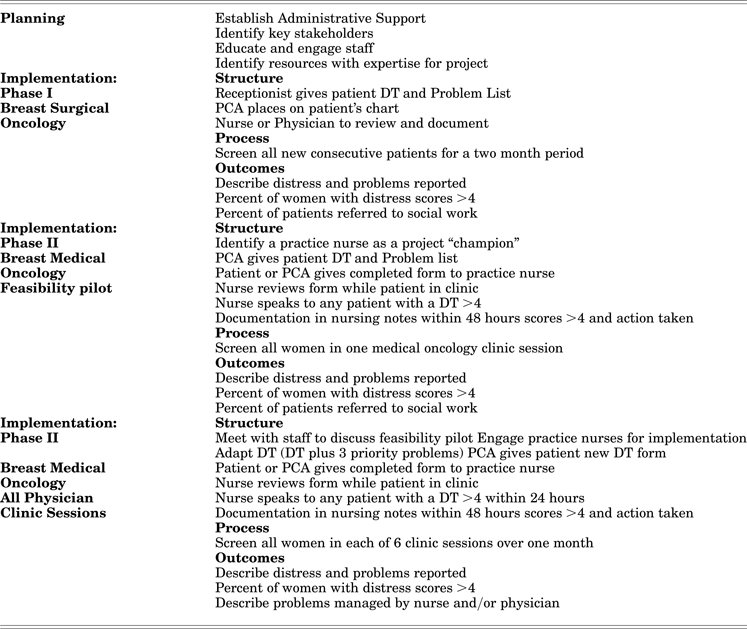
The first step in the project was to establish administrative support, educate and engage Breast Center staff, identify stakeholders and persons with expertise in the conduct of evidence based initiatives. The Breast Center Director was in full support of the project and the Chair of the Psychosocial Advisory Committee and faculty with expertise in quality improvement and evidence based practice projects held several meetings with social work and nursing staff to determine the implementation approach. A two-phase implementation approach was agreed upon with Phase I screening new patients in Breast Surgical Oncology, and Phase II screening of patients with breast cancer in Breast Medical Oncology. This quality improvement project was based on the classic model by Donabedian (Reference Donabedian1980) of structure (personnel, resources), process (screening of patients), and outcomes (percent of women screened with distress scores >4 on a scale of 1–10 and percent of women referred) (Table 1).
Planning and implementation of psychosocial distress screening

Phase I Implementation: Breast Surgical Oncology
Decisions on the structure and process for the implementation included distribution of the NCCN distress thermometer (DT) and problem checklist to all new patients in Breast Surgical Oncology over a 2 month period. The receptionist gave the patient the form to complete, the patient care assistant (PCA) placed it in the patient's chart for review by the surgeon or nurse. Resources to evaluate the implementation included two nurse researchers. Following evaluation, results were presented to the Breast Center Director and the social work and nursing staff. A plan for psychosocial screening in routine practice was discussed and consensus reached among staff.
Phase II Implementation: Breast Medical Oncology
Based on unique characteristics of the Breast Medical Oncology service and the nursing care delivery model, one practice nurse was identified to work with the Breast Center Program Manager and nurse researcher to determine the structure and process for the project and act as a “champion” and liaison to the nursing and physician staff (Rosswurm & Larrabee, Reference Rosswurm and Larabee1999). For Phase II implementation, we decided that (1) we would establish feasibility by screening all patients in one clinic session and evaluate the process prior to the goal of screening patients in each of six breast medical oncologists' clinic sessions (2) the PCA would give the form to the patient, (3) the PCA or patient would give the form to the practice nurse, (4) the practice nurse would review all distress screenings, speak to any patient with a score > 4 and document in nursing notes within 48 hours, and (5) referral would be made based on the problem(s) as source of distress. Resources to evaluate the project were a nurse researcher and the clinical Program Manager. Following evaluation, results were presented to the Breast Medical Oncology staff. Decisions for full implementation in practice to meet the new Commission on Cancer standard for psychosocial distress (screening, documentation and action plan) were deferred due to an institution wide implementation of a new electronic medical record system.
Results: Phase I Implementation Breast Surgical Oncology
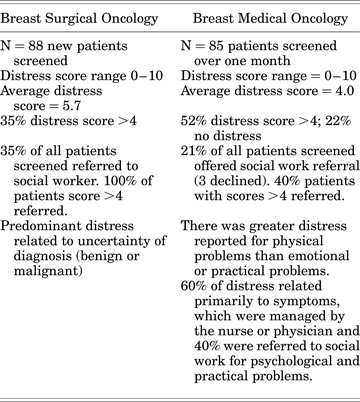
Over a 2 month period, 88 consecutive patients in Breast Surgical Oncology were screened. The average distress score was 5.7 with 77% of women indicating their distress in both physical and emotional problem areas. Thirty-five percent of women (N = 31) reported distress scores >4 on the distress thermometer and all of those women were referred to the social worker in the Breast Center (Table 2). The predominant psychological distress was related to uncertainty of diagnosis for those who had yet to receive a definitive diagnosis of their biopsy results. Based on the resolution of distress associated with a benign diagnosis, it was agreed that psychosocial distress screening would target patients diagnosed with breast cancer. Decisions for implementation of psychosocial distress screening in routine practice were made based on staffing resources. There are two Breast Surgical Nurse Coordinators who manage every patient and a dedicated social worker in the Breast Center. It was agreed that the Nurse Coordinator would review distress screenings of all patients diagnosed with breast cancer and make the appropriate decisions for managing the problem or referral to an appropriate provider.
Psychosocial distress screening outcomes
Results: Phase II Implementation Breast Medical Oncology
To establish feasibility, the DT and problem list were completed by patients in one Medical Oncology physician clinic. A total of 22 women diagnosed with breast cancer completed the screening. Average age was 52.3 years (range 39–70) and distress scores ranged from 0–8 with an average distress score of 3.9. Slightly more than half of the women (54%) scored >4 on the DT and 50% of those were referred (5 = social worker, 23% psychological (e.g., depression, fears) and 27% practical (e.g., insurance, family). The nursing note section of the record was used to document the screening and action taken. Results were shared with the Breast Center staff. As the DT with problem list does not associate the distress score with specific problems, and we learned that women often reported multiple problems, yet they were not all contributing to distress, we adapted the form to include the DT and asked the patient to write down up to 3 priority distressful problems. Screening was then carried out in each of the six physician clinics for broader implementation and included practice nurses in addition to the “champion” nurse on the project. Over one month, 63 women completed distress screening. Distress scores ranged from 0–10 with an average score of 4.3. No distress was reported by 22% of patients and 51% scored >4 on the DT. Of the 32 patients who scored >4, 60% were managed by the nurse or physician for problems primarily related to symptom management and 40% were offered a referral to the social worker for problems such as finances, stress, work, and family issues.
CONCLUSION AND DISCUSSION
In summary, 173 women in our Breast Center completed psychosocial distress screening with 35%–50% of women reporting a distress score >4 on the 0–10 DT. The distress in patients screened in Breast Surgical Oncology (N = 88) was related to uncertainty for those who had not yet received a definitive diagnosis and for others, response to the diagnosis of breast cancer and decision making process for therapy. In a review of 30 studies, anxiety was identified as the predominant distress response in women during the diagnostic phase of breast care (Montgomery & McCrone, Reference Montgomery and McCrone2010). The reported distress was identified as symptom management problems, addressed by the physician or nurse and 40% were psychological or practical problems indicating a social work referral. We learned the need to adapt psychosocial screening to the population at risk and available staff resources. In Breast Surgical Oncology, there are two Nurse Coordinators and a dedicated social worker. The pilot had the receptionist give the DT to the patient and the PCA put it in the patient's chart for physician review. After sharing the evaluation of the pilot implementation with staff, it was determined that the PCA would give the DT to the patients and the Nurse Coordinators would review the screening and document it in the record. In Breast Medical Oncology, the process of the DT given by the PCA, returned to the nurse during the clinic session, a discussion initiated by the nurse with patients for scores >4, documentation by the practice nurse within 48 hours of the screening and action taken was concluded as feasible.
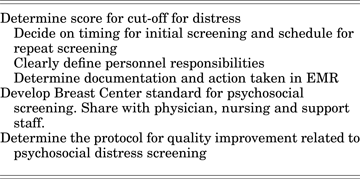
Several decisions need to be made by staff prior to implementation into everyday clinical practice (Table 3): score for cut-off to review and refer; timing of initial versus repeat screening; definition of personnel tasks and responsibilities; documentation of screening score and action taken in new electronic medical record (EMR) system; and a quality improvement protocol to audit implementation. The NCCN recommends a cut-off score of 4 as an indicator for distress, yet others have reported scores as high as 7 as a sensitive cut-off measure, especially for psychological distress (Hegel et al., Reference Hegel, Collins and Kearing2008). The Commission on Cancer's new standard requires screening at least once (Fashoyin-Aje, Reference Fashoyin-Aje, Martinez and Dy2012), yet the importance of distress screening across the cancer trajectory especially at transition times such as diagnosis, active therapy, end of therapy for survivors, recurrence and disease progression is essential (Fann et al., Reference Fann, Ell and Sharpe2012; Fashoyin-Aje, Reference Fashoyin-Aje, Martinez and Dy2012). Education and engagement of staff are critical in defining individual responsibilities yet we must foster collective accountability. We learned that PCAs need a better understanding of the rationale for screening and perhaps some coaching to improve interactions with the patient about the screening form. A new electronic medical record system has very recently undergone an institution-wide implementation. As the experience of the nursing staff grows with the new EMR system, they will be invaluable in guiding us in the decision making for documentation of screening, action taken by the nurse or physician and referral to another provider, if indicated. Finally, decisions about audit and ongoing quality improvement are needed to monitor screening over time, utilization of resources, patient outcomes, and patient satisfaction with care. Similar to the findings from our project, distress was not related solely to emotional problems but also as a response to experiencing and managing physical symptoms (Frost et al., Reference Frost, Zevon and Gruber2011; Villhauer, 2008). Identifying distress related to physical and psychological symptoms and social problems guides interventions toward improving a patient's well-being and quality of life (Jacobson & Wagner, 2012). We were able to identify problems and appropriately manage based on the source of the problem causing distress There is strong consensus that psychosocial screening needs to be integrated in routine clinical practice to achieve the goal of patient centered high quality cancer care (Carlson et al., Reference Carlson, Waller and Mitchell2012). Thus, it is incumbent on providers to identify strategies to implement screening and explore approaches that will facilitate this important quality indicator of care (Jacobsen et al., Reference Jacobsen, Shibata and Siegel2011; Jacobsen & Kadlubek, Reference Jacobsen and Wagner2010).
Decision making and process for integration into routine practice
ACKNOWLEDGEMENTS
Pamela Christman, RN, CNII and Lynn-Ann Selezan, RN, CNIII, the practice nurses who carried out the implementation of the distress screening; Catherine Lyons, RN, MS, NEA-BC Clinical Program Director/Director of Oncology Nursing, Smilow Cancer Hospital at Yale New Haven for her administrative support; and all the patients in the Breast Center who supported this effort.