Historical demography has attracted much attention in recent years, as economists have begun to incorporate demographic behavior into theories of long-run growth. Several recent contributions to this literature focus on household formation patterns, arguing that the explanation for western economic success was the European Marriage Pattern (henceforth EMP), a demographic system involving late marriage for women (above 23–24 years), high proportions never marrying (above c. 10–15 percent), and predominantly nuclear families (above c. 80 percent).Footnote 1 The EMP was originally put forward by John Hajnal (Reference Hajnal, Glass and Eversley1965, 1Reference Hajnal982, 1Reference Hajnal, Wall, Robin and Laslett983) not as a cause of economic success, but as an empirical regularity—a demographic pattern that could be observed across Europe west of an imaginary line from St. Petersburg to Trieste. Between the 1960s and the 1990s scholars occasionally speculated about links between the EMP and economic growth (Landes Reference Landes1969; Todd Reference Todd1983; Laslett Reference Laslett, Baechler, Hall and Mann1988; Solar Reference Solar1995), but the vast bulk of research on the EMP was empirical, investigating its prevalence, functioning, and social context. A number of recent works, however, argue that the EMP played a major causal role in European economic growth (Greif Reference Greif2006; Greif and Tabellini Reference Greif and Guido2010; De Moor and Van Zanden Reference De Moor and Jan Luiten van2010; Foreman-Peck Reference Foreman-Peck2011; Voigtländer and Voth Reference Voigtländer and Hans-Joachim2006, 2Reference Voigtländer and Hans-Joachim013).
Proponents of this argument hold that the EMP was crucial for the “Great Divergence” between Europe and the rest of the world, particularly China (Greif Reference Greif2006; Greif and Tabellini Reference Greif and Guido2010; De Moor and Van Zanden Reference De Moor and Jan Luiten van2010; Voigtländer and Voth Reference Voigtländer and Hans-Joachim2006). They also argue that the EMP can explain the “Little Divergence” between northwest Europe and the rest of the continent after the Black Death (De Moor and Van Zanden Reference De Moor and Jan Luiten van2010; Voigtländer and Voth Reference Voigtländer and Hans-Joachim2006; Foreman-Peck Reference Foreman-Peck2011). Some contend that the EMP can be found in its most “pure” or “extreme” manifestation in England and the Low Countries in the early modern period, where it is supposed to have been central to these societies' successful economic growth and, in the case of England, early industrialization (De Moor and Van Zanden Reference De Moor and Jan Luiten van2010, p. 4; Voigtländer and Voth Reference Voigtländer and Hans-Joachim2006, pp. 323, 348). As we discuss in later sections of this article, the different proponents of this view emphasize different (though often overlapping) causal mechanisms, variously arguing that the EMP benefited economic growth by improving women's position, increasing human capital investment, adjusting population growth to economic trends, sustaining beneficial cultural norms, or fostering corporative institutions. But all contend that the EMP played a central role in European economic growth in the centuries before and during industrialization.
These are strong claims and, if true, would have far-reaching implications for growth theories and policy interventions. It is therefore important to establish whether these arguments can be justified. This article presents the results of a quantitative analysis of over four thousand observations of demographic behavior, covering marriage age, lifetime celibacy, and family complexity, in more than thirty European societies between 1500 and 1900, drawn from 365 publications in historical demography. We use these data, together with research on the interaction between demography and the economy across early modern Europe, to investigate recent claims that the EMP was the key to economic growth. Our findings cast serious doubt on the idea that this demographic system can be used to explain European economic success. Rather, they indicate strongly that the causes of historical economic growth must be sought in other factors.
The article begins, in Section 2, by presenting our large data set drawn from the historical demography literature, which we use in Section 3 to investigate whether the most “pure” or “extreme” manifestations of the EMP were indeed found in those European societies where economic growth was rapid and industrialization was early. Section 4 turns to the first of several mechanisms by which the EMP is supposed to have caused economic growth, by guaranteeing women a high economic status. A second causal mechanism is explored in Section 5, which assesses the relationship between the EMP, human capital investment, and early modern growth. Section 6 examines the argument that the EMP encouraged faster economic growth in England (or Europe) by ensuring better demographic responsiveness to economic conditions. Section 7 investigates the idea that the EMP was associated with distinctively European cultural beliefs that contributed to European economic success. Section 8 draws together the implications of our findings for understanding the demographic and institutional bases for long-term economic growth.
A Data Set on European Historical Demography
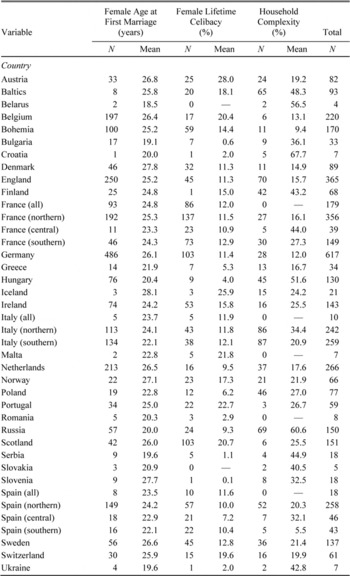
Fortunately, there is abundant evidence on demographic behavior across premodern Europe. From 365 research studies in European historical demography (listed in the Online Appendix), we have compiled a data set of 4,705 observations of demographic behavior and family forms. As Table 1 shows, these data comprise 2,622 observations of female age at first marriage, 1,172 observations of female lifetime celibacy, and 911 observations of the kin complexity of households, covering 39 European countries between the early sixteenth and the late nineteenth century. Our data set is thus an order of magnitude larger than the most sizable previous compilations: the 83 household complexity rates for 11 European societies presented by Peter Laslett (1977); the 52 household complexity rates for 12 European societies published by Brian Bradley and Franklin Mendels (Reference Bradley and Franklin1978); the 139 female marriage ages for seven western European societies assembled by Michael Flinn (Reference Flinn1981); or the 71 female celibacy rates for 3 eastern-central European societies compiled by Markus Cerman (Reference Cerman, Wall, Hareven and Ehmer2001). The size and comprehensive coverage of our data set provide a robust basis for assessing recent theories about the EMP.
DESCRIPTIVE STATISTICS FOR REGRESSION VARIABLES


Notes:
Household complexity = kin complexity of households (types 4 and 5 in Laslett-Hammel classification).
Baltics = Estonia, Latvia, Lithuania (hypothesis testing showed no significant demographic differences).
Date approximate = date reported with some degree of approximation (e.g., “mid-eighteenth century”).
Nation = unit of observation is an entire country.
Region = unit of observation is province, district, feudal estate, or other subnational unit.
Community = unit of observation is single city, town, village, hamlet, or other settlement.
Group = unit of observation is subgroup of larger population (stratum, religion, occupation, wealth-group, etc.).
City = settlement(s) with urban status and population over 10,000.
Small town = settlement(s) with urban status and population 2,000–10,000.
Village/rural = settlement(s) lacking urban status and/or with population under 2,000.
Mixed rural/urban = population combining inhabitants of urban and rural settlements.
Monograph = observation derived from book reporting author's own research findings.
Journal article = observation derived from journal article reporting author's own research findings.
Working paper = observation derived from working paper or unpublished dissertation reporting author's own research findings.
Volume chapter = observation derived from chapter in edited volume reporting author's own research findings.
Secondary source = observation reported in a secondary source by author other than original researcher.
AFM reconstitution = marriage age calculated from registers of vital events using family reconstitution.
AFM census = marriage age calculated from census using Hajnal's SMAM method.
AFM other = marriage age calculated using other sources/methods (marriage licenses, inventories, etc.).
AFM unknown method = marriage age calculated using unreported sources/methods.
Celibacy deaths = celibacy calculated from burial registers using marital status at death.
Celibacy census = celibacy calculated from censuses using marital status at post-reproductive ages.
Celibacy other = celibacy calculated using other sources/methods (inventories, court records, etc.).
Celibacy unknown method = celibacy calculated using unreported sources/methods.
Sources:
The 365 research studies in historical demography (see the text and the Online Appendix).
These recent theories largely focus on cross-cultural rather than chronological differences after the Black Death.Footnote 2 Our multivariate analyses, by contrast, use century dummies to ensure that apparent country differences are not merely reflecting biased availability of data for different societies at different periods. Studies in historical demography report their findings for different time periods depending on survival of archival sources, hypotheses to be tested, and analytical convenience. Without access to the underlying data, our compilation could not impose a standardized periodization. Some observations in the data set thus refer to individual years, others to single decades, quarter-centuries, or centuries, and still others to irregular periods determined by documentary survival or other factors. For all research studies used, all observations for all periods reported were included in the data set, regardless of the length of the periods. In the multivariate analysis below, we discuss broad changes over time for Europe as a whole, though space constraints in this article preclude detailed discussion of the separate chronological trajectories of different demographic indicators in different countries.
Before the nineteenth century, national-level statistics are rare, so our data are drawn from studies carried out at different levels of aggregation, with only 11 percent of observations at the level of entire countries, 26 percent at the level of regions (provinces, administrative districts, feudal estates, clusters of settlements for which archival sources survive), and 53 percent at the level of individual communities (cities, towns, villages, hamlets).Footnote 3 The remaining 10 percent of observations referred to particular social strata (wealthy, middling, poor), occupational groups (sharecroppers, merchants, craftsmen, factory workers), religious confessions (Protestants, Catholics, Orthodox Christians), or places of origin (migrants, natives, migrants' spouses). All data were coded for unit of observation so that the multivariate analyses could control for potential biases.
Documentary sources and hence data availability in historical demography also differ considerably between cities, towns and villages. Urban centers were better (and differently) documented than villages, even though villagers made up a large majority of European populations throughout most of the period under analysis. To control for biases that might be imparted by such differences in documentation, all data were coded for whether they referred to large cities (about 8 percent of observations), small towns (11 percent), villages (53 percent), or mixed populations of villagers and townspeople (27 percent).
A survey such as ours must take into account potential publication bias: the possibility that the form in which research findings are disseminated is correlated with their content. Unpublished studies may be less reliable because they have not been able to achieve publication, but may also be more representative since their results have not been censored by an established consensus. Different types of published study may reflect differing degrees and types of peer review. To control for the possibility that published studies are not representative of all valid studies undertaken, or that type of publication may cause other forms of sample selection bias, we coded all data according to whether they were presented as the original research of the author in a journal article (48 percent of our observations), a monograph (18 percent), a volume chapter (7 percent), an unpublished working paper or dissertation (under 3 percent), or alternatively were reported as another author's finding in a secondary source (25 percent of observations); we regarded it as important to include data from secondary sources so as to overcome any selection bias towards national languages and literatures with which we were more familiar.
We also took account of the potential for differing sources and methods to bias historical demographic results (for important reflections on this issue, see Ruggles 1999). For age at first marriage, each observation was coded according to whether it was calculated by applying the method of family reconstitution to registers of vital events (which was the case with 47 percent of observations), by using Hajnal's Singulate Mean Age at Marriage (SMAM) method on census-type listings (19 percent), by other recorded sources and methods such as ages reported in marriage licenses or marriage contracts (11 percent), or by unreported sources and methods (which was the case for 22 percent of observations, mainly those from secondary studies). For female lifetime celibacy, each observation was coded according to whether it was calculated from marital status at death using burial registers (33 percent of observations), marital status in post-reproductive age-groups using census-type listings (60 percent), other recorded sources and methods such as biographical details in court records or probate inventories (less than 5 percent), or not reported at all (just over 2 percent of observations, mainly from secondary studies).
In this article, we use these data to explore recent claims that the most successful early modern economies, England and the Netherlands, had the most pure or extreme manifestation of the EMP, since this empirical assertion is widely adduced as demonstrating the causal effect of the EMP on economic growth. We list the research studies on which the data set is based in an Online Appendix, to facilitate further consultation by other scholars.
Multivariate Analysis of European Marriage Patterns
If the EMP was responsible for economic growth, one would expect to find it in rich and rapidly growing economies and not in poor and slowly growing ones. This is precisely the argument advanced by the recent literature, which claims that the EMP was a distinctive characteristic of the Netherlands, the miracle economy of Europe up to c. 1670, and England, which grew rapidly after c. 1700 and experienced the first Industrial Revolution after c. 1780. According to Tine de Moor and Jan Luiten van Zanden (Reference De Moor and Jan Luiten van2010, p. 4), for instance, the EMP emerged “in the North Sea area—in England and the Low Countries in particular—and it was … the long-term dynamism of this structure which helps to explain the long-term success of this region in the world economy of the early modern period.” In this account, the “core area” of the EMP consisted of Flanders, the coastal Netherlands, and eastern England, while a less “pure” manifestation of the pattern was found in the wider North Sea area. Nico Voigtländer and Hans-Joachim Voth (Reference Voigtländer and Hans-Joachim2006, pp. 323, 348) adopt the even more restrictive view that “England practiced an extreme form of the ‘European marriage pattern'”; this, they claim, created the “low-pressure” demographic conditions for England's economic superiority compared to China, southern and eastern Europe, and even France.
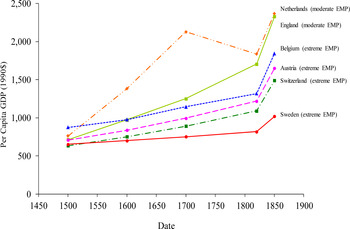
England and the Netherlands certainly displayed early and rapid economic growth by European standards. Macroeconomic estimates for Europe before 1800 have many recognized weaknesses, and lack the precision, coverage, and degree of disaggregation required to attach them to observations in our data set. However, the series compiled by Angus Maddison is widely used as a basis for rough comparisons across national units (see the data and documentation available online at http://www.ggdc.net/maddison/maddison-project/home.htm). Figure 1 shows the Maddison estimates of per capita GDP in a number of northwest European societies during the 350 years after 1500, the period during which the EMP is supposed to have played a causal role in economic growth. Per capita GDP in England and the Netherlands clearly surpassed that in the other countries shown in Figure 1, and indeed all the other countries for which Maddison provides estimates between 1500 and 1850. Future research studies will certainly improve these estimates in detail, but seem unlikely to cast doubt on English and Dutch economic primacy; indeed, recent revisions increase the lead of the Netherlands over other European economies before 1820 (Bolt and Van Zanden Reference Bolt and Jan Luiten van2013). Without question, England and the Netherlands had the most successful economies in Europe throughout the early modern period.
PER CAPITA GDP AND EXTREMENESS OF THE EUROPEAN MARRIAGE PATTERN, 1500–1850

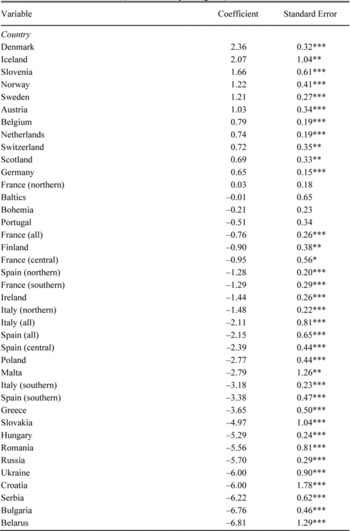
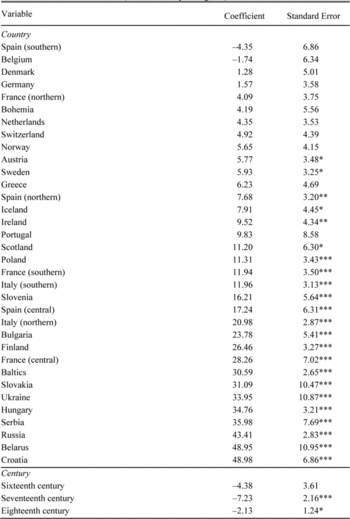
But did they manifest a more “pure” or “extreme” form of the EMP? Hardly. Table 2 presents a multivariate analysis of the 2,622 observations of female age at first marriage for the 39 European societies in our data set. It covers the four centuries between c. 1500 and c. 1900, the period during which, it is claimed, the exceptional strength of the EMP in England and the Netherlands played a causal role in their economic success. The regression confirms the importance of controlling for time in cross-cultural analyses of demographic behavior, since it reveals a significant rise in marriage age between the sixteenth and the nineteenth century.Footnote 4
The regression also confirms the importance of controlling for characteristics of the underlying research studies. Hypothesis testing on the results in Table 2 reveals that community- and group-level studies reported significantly (though only slightly) higher marriage ages than national or regional ones, and that big cities reported higher marriage ages than small towns but lower ones than villages. Reassuringly, however, unpublished findings on female marriage age were not significantly different from published ones, journal articles were no different from other publications, and family reconstitutions of vital registers did not yield marriage ages significantly different from applying Hajnal's SMAM method to censuses.
FEMALE AGE AT FIRST MARRIAGE: REGRESSION RESULTS (omitted country is England)


* Significant at the 0.10 level.
** Significant at the 0.05 level.
*** Significant at the 0.01 level.
Notes:
N = 2,622. Adj. R 2 = 0.5227.
Variable definitions: See Table 1.
Country: omitted category is England. Century: omitted category is nineteenth.
Unit of observation: omitted category is nation. Rural/urban: omitted category is city.
Publication type: omitted category is journal article.
Sources and methods: omitted category is AFM reconstitution.
Constant is the overall effect of all the omitted categories (England, nineteenth century, nation, city, journal article, AFM reconstitution).
Sources:
The 365 research studies in historical demography (see the text and the Online Appendix).
Controlling for all these study characteristics, there were indeed significant differences in marriage age across countries. These differences present a more complex picture than any of the “lines” or “zones” which Hajnal or other researchers have hitherto been in a position to map out. Although the country differences in Table 2 are broadly consistent with Hajnal's proposition of earlier female marriage, on average, in eastern and southern than in western and northern Europe, they also reveal societies with late (sometimes extremely late) female marriage in Slavic Europe (such as Slovenia and Bohemia), societies with early marriage in the zone west of the Hajnal line (such as parts of France), and highly significant differences inside countries (for example, between northern, central, and southern regions of France, Spain, and Italy).
Most seriously for the recent literature on the EMP, the results in Table 2 decisively refute the idea that economically successful England and the Low Countries had the most “pure” or “extreme” form of the EMP. Table 2 lists European countries in descending order of compliance with the EMP according to women's marriage age, with England as the omitted category. Thus, for instance, the coefficient for Denmark shows that its female age at first marriage was 2.36 years higher than England's, controlling for time period, unit of observation, settlement size, publication type, and sources and methods used; and that this difference compared to England is significant at the 0.01 level. As Table 2 shows, female age at first marriage in England was significantly lower than that of 11 countries and was not significantly different from 4 others, demonstrating that its marriage pattern was moderate rather than “extreme” by European standards. All 11 countries whose female marriage age significantly exceeded England's industrialized later than England, and all but the Netherlands had slower economic growth throughout the early modern period. The Netherlands, with rapid economic growth at least until 1670 and high per capita incomes for much longer, had female marriage age significantly lower than much poorer Denmark and Sweden, and not significantly different from slow-growing Iceland, Norway, Slovenia, Austria, Switzerland, Scotland, Germany, and the Baltic countries. Among the 39 European societies listed in Table 2, some 15 complied with a strict definition of the EMP in the sense of having female marriage age over c. 25 years (Fauve-Chamoux Reference Fauve-Chamoux, Kertzer and Barbagli2001, pp. 224–25). Among these countries, the extremes of late female marriage age are dominated by Scandinavia, Scotland, and central and eastern-central Europe (Switzerland, Germany, Austria, Slovenia), not by England or the Netherlands.
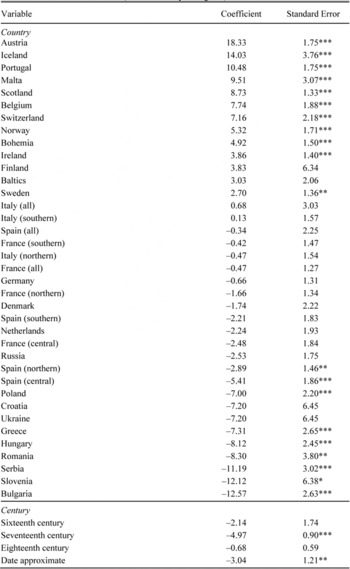
The analysis of female lifetime celibacy in Table 3 likewise finds that England and the Netherlands displayed a moderate rather than an extreme manifestation of the EMP. Again, the results demonstrate the importance of controlling for change over time, since celibacy was significantly lower in the seventeenth century than during any other part of the early modern period. Few study characteristics significantly affected the findings, though observations where date was approximated (fortunately less than 5 percent of the total) or which were derived from secondary sources (21 percent of the total) had significantly lower celibacy rates, while those giving no methods or sources had significantly higher ones.
Controlling for study characteristics and time period, we find differences across European societies which are statistically significant, but not consistent either with Hajnal's original division of Europe into discrete “zones” or with claims in the new literature that the most extreme values of female lifetime celibacy and thus the strongest manifestations of the EMP were to be found in the most economically successful societies. Counter to Hajnal's conjecture, high female lifetime celibacy (over c. 10–15 percent) can be observed not just in western Europe but also in several societies in the supposedly universally marrying Mediterranean (Malta, Portugal, Spain) and Slavic Europe (Bohemia). There were also significant differences in female celibacy inside particular countries (for example, Spain and France). Most seriously for the recent literature on the EMP, Table 3 shows that female lifetime celibacy in England was significantly lower than that of 11 European countries and not significantly different from 15 others. Again, England's marriage pattern was moderate rather than “extreme” by European standards. All 11 countries with significantly higher female celibacy industrialized later than England, as did the 15 from which its celibacy rate did not significantly differ. Female celibacy in the Netherlands was lower than in 12 European societies and not significantly different from at least as many others. Among the 37 European societies analyzed in Table 3, the extremes of female celibacy are found not in England and the Netherlands but in Scandinavia, Scotland, and central and eastern-central Europe (Austria, Switzerland, Bohemia), as well as two Latin countries, Portugal and Malta.
FEMALE LIFETIME CELIBACY: REGRESSION RESULTS (omitted country is England)


* Significant at the 0.10 level.
** Significant at the 0.05 level.
*** Significant at the 0.01 level.
Notes:
N = 1,172. Adj. R 2 = 0.3629. Variable definitions: See Table 1. Omitted categories as for Table 2, except for sources and methods, where omitted category is celibacy deaths. Constant is the overall effect of all the omitted categories (England, nineteenth century, nation, city, journal article, celibacy deaths).
Sources:
The 365 research studies in historical demography (see the text and the Online Appendix).
The recent literature also portrays a third feature of the EMP—the predominance of nuclear families—as explaining Europe's economic success compared to the rest of the world. According to one version of this view, by the late medieval period, “[l]arge kinship groups remained only on Europe's social and geographical margins (e.g., Scotland)” (Greif and Tabellini Reference Greif and Guido2010, p. 137). Other variants argue that it was specifically the “North Sea area” (the Low Countries and England) where an unusually “pure” form of the EMP caused an extreme prevalence of neolocal marriages and nuclear families, which in turn generated corporative welfare and insurance institutions that benefited economic growth (De Moor and Van Zanden Reference De Moor and Jan Luiten van2010, pp. 23–25).
The first view, according to which extended families and large kinship organizations were absent from Europe after the medieval period except on the social and geographical periphery, is decisively refuted by our 911 observations of household complexity covering 34 European societies. The unconditional averages in Table 1 already show that complex households containing kin outside the nuclear family were quite uncommon (below c. 20 percent of the total) in a wide variety of early modern societies, including southern Spain, Greece, Bohemia, Denmark, Germany, northern France, and England, but quite widespread (above c. 40 percent of the total) in societies as various as central France, Finland, the Baltic countries, Hungary, and Russia. The multivariate analysis in Table 4 confirms this extremely wide range of variation, even controlling for time period and study characteristics. The societies on the margins of Europe were not the ones in which high kin complexity survived into the early modern period: geographically peripheral Scandinavia, Bohemia, Greece, and southern Spain had unusually low levels of kin complexity by European standards, and peripheral Scotland had very moderate kin complexity. Northern Italy, by contrast, was one of the most successful European economies in the late medieval period, with estimated per capita GDP higher than England's in 1600 and still almost equal to England's in 1700; at the same time, it had one of the highest levels of household kin complexity in Europe (as shown in Table 4), as well as early female marriage and low celibacy (as shown in Tables 2–3).Footnote 5 Counter to the recent literature, therefore, complex-family households survived in a considerable number of European societies after the medieval period, including in core regions such as central France and prosperous northern Italy. Conversely, low kin complexity could also be observed across early modern Europe in a wide variety of societies, many of them characterized by low per capita GDP, slow economic growth, and late industrialization.
Our data on the kin complexity of European households also refute the second claim in the recent literature, namely that the nuclear family component of the EMP took its purest manifestation in economically successful England and the Low Countries. Among the 34 societies compared in Table 4, there was a large group of 15 whose levels of household complexity were not significantly different from one another. This group included England, the Netherlands and Belgium, but also encompassed southern Spain, Denmark, Germany, northern France, Bohemia, Switzerland, Norway, Austria, Sweden, Greece, Iceland, Portugal and Scotland. These findings, based on over nine hundred observations of kin complexity over a period of four centuries, do not support the idea that the distinctive economic success enjoyed by England and the Netherlands can be ascribed to their having a particularly “pure” manifestation of the predominance of nuclear families under the EMP.
HOUSEHOLD COMPLEXITY: REGRESSION RESULTS (omitted country is England)


* Significant at the 0.10 level.
** Significant at the 0.05 level.
*** Significant at the 0.01 level.
Notes:
Sources:
The 365 research studies in historical demography (see the text and the Online Appendix).
Table 4 also reaffirms the importance of examining change over time, not just differences among countries. Hypothesis testing of the coefficients on the century variables shows that controlling for other variables in the regression, European household complexity rose significantly between the seventeenth and the eighteenth century, and rose again, with marginal statistical significance, between the eighteenth and the nineteenth. Contrary to the idea that a more accentuated compliance with the EMP was associated with growth of the economy, the 34 European societies represented in Table 4 were moving further away from extreme compliance with the EMP as their economies grew across the early modern period.
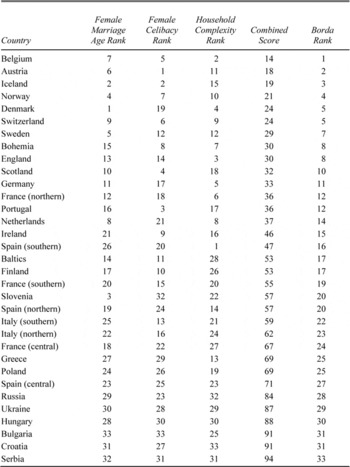
Table 5 presents the results of a Borda ranking of the 33 European societies which appear in all three of Tables 2–4. Societies are ranked according to the three EMP criteria—female marriage age, female celibacy, and household complexity—based on the coefficients on the relevant country variables in Tables 2–4.Footnote 6 The first finding to emerge from Table 5 is that strong manifestations of the three components of the EMP were not invariably associated with one another. The Spearman correlation coefficients between the marriage age rank and the two other ranks were both 0.61, and only 0.45 between the celibacy and the household structure rank. No country topped the ranking on more than one criterion out of the three.
BORDA RANKING OF COUNTRIES ACCORDING TO EXTREMENESS OF EUROPEAN MARRIAGE PATTERN

Notes:
Ranking is based on the coefficients in Tables 2–4; since hypothesis-testing showed that countries do not fall into discrete sets, the value of the estimated coefficient is used, regardless of whether it is statistically significantly different from adjacent coefficients. Ranking covers all countries in the data set for which there are observations on all three measures of the European Marriage Pattern (female marriage age, female lifetime celibacy, and household structure).
Sources:
The 365 research studies in historical demography (see the text and the Online Appendix).
The combined Borda ranking in column 6 provides a clear confirmation that the economic success stories, England and the Netherlands, had moderate rather than extreme demographic patterns. Among the 33 societies in Table 5, England lay about one-quarter of the way down the ranking, and the Netherlands two-fifths of the way. Although the imperfect correlation among the three demographic benchmarks militates against unambiguous categorizations, the first 15 societies in the Table 5 ranking would be generally accepted as ones in which the EMP prevailed. Among these 15 societies manifesting the EMP, England lay squarely in the middle, sharing 8th position with Bohemia, a poor and slow-growing eastern-central European economy which was subject to the “second serfdom” until the late eighteenth century.Footnote 7 The Netherlands, whose economic success exceeded that of all other European countries save England, lay at rank 14, and thus towards the bottom of the 15 societies in Table 5 that manifested the EMP. Whatever definition of “pure” or “extreme” one adopts for the EMP, England and the Netherlands do not meet it. The extreme manifestations of the EMP were found in the German-speaking lands and Scandinavia, which experienced slow early modern growth and relatively late industrialization.
The historical demographic data, then, fail to support central empirical claims advanced in the recent EMP literature. Counter to the idea that the EMP explains the “Great Divergence” between Europe and the rest of the world, late marriage, high celibacy, and nuclear families were not universal within “Europe.” In core areas, including central France and northern Italy, women married early and universally, and extended families were widespread. In industrializing England during its fastest economic growth, demographic patterns moved further away from the EMP as marriage ages fell and household complexity rose (Anderson 1971; Wrigley and Schofield Reference Wrigley and Schofield1981). Late marriage, high celibacy, and nuclear families are therefore not plausible explanations for the Great Divergence. Nor do the data support using the EMP to explain English and Dutch economic primacy. Late marriage, high celibacy, and low kin complexity characterized huge swathes of Europe, extending even to societies under the second serfdom. Far from being extreme cases of the EMP, England and the Netherlands manifested moderate demographic patterns. The extremes were found in Scandinavian and central European economies which were much poorer and grew more slowly. Early modern Europe, it appears, had a number of different marriage patterns. The empirical regularity of late marriage, high celibacy, and low kin complexity which Hajnal called the EMP was not monolithic, but rather was subject to many gradations along its different components in different societies. Moreover, this demographic pattern was compatible with a wide range of economic and institutional outcomes.
We turn now to the causal mechanisms through which the EMP is supposed to have bolstered economic development. Examining these mechanisms can help us better understand why scholars have posited a causal relationship between the EMP and economic success. Moreover, the qualitative evidence and other analytical approaches used to construct these causal accounts may reveal better empirical support for them. Furthermore, investigating the causal mechanisms involved can shed light on the endogeneity problems raised by the EMP literature, making clearer the ways in which demographic decisions are taken simultaneously with other economic and social choices.
Women's Position
A first causal mechanism adduced in the recent literature places women's economic position at center stage. England and the Netherlands grew more rapidly, it is argued, because their strong versions of the EMP weakened patriarchal authority over daughters, reduced son preference, improved women's property rights, encouraged female labor force participation, empowered widows, and created spousal equality, all of which fuelled economic growth (De Moor and Van Zanden Reference De Moor and Jan Luiten van2010). In other variants, women's superior position under the EMP made fertility responsive to economic signals, ensuring capital accumulation which in turn caused growth (Voigtlander and Voth Reference Voigtländer and Hans-Joachim2006, 2Reference Voigtländer and Hans-Joachim013). In still other versions, women's superior position under the EMP increased human capital investment and fuelled subsequent growth (Foreman-Peck Reference Foreman-Peck2011).
This raises the issue of endogeneity. On the one hand, the EMP is supposed to have created a better economic position for women. But on the other, greater female autonomy is supposed to have given rise to the EMP. Moreover, both marriage patterns and women's position are ascribed to underlying factors such as cultural attitudes, the Black Death, and pastoral agriculture. Among these, only the Black Death can be regarded as a plausibly exogenous factor. Yet even this assumption is weakened by the fact that the occurrence of plague was influenced by underlying demographic and economic conditions, including urbanization, agricultural performance, nutritional status, warfare, and long-distance trade (Brenner Reference Brenner1976, 1Reference Brenner982; Pamuk Reference Pamuk2007). Furthermore, the causal influence of the Black Death in the context of the EMP is questionable, since the epidemic raged throughout Europe and the Near East, but was followed by very different patterns of marriage, gender relations, and economic growth in different societies, which can in turn be traced back to preexisting social and institutional differences (Brenner Reference Brenner1976, 1Reference Brenner982; Pamuk Reference Pamuk2007). The evident endogeneity of the different variables limits the scope of these claims to the merely descriptive assertion that the EMP was associated with a higher status for women, with concomitant economic benefits.
Moreover, even this assertion is at odds with the evidence. The women's history literature suggests that women had a relatively good economic position in some societies with the EMP and a comparatively bad one in others. England and the Netherlands are certainly regarded as having endowed women with a favorable economic position compared to other European societies (for overviews of a vast literature, see Laurence Reference Laurence, Kloek, Teeuwen and Huisman1994; Prior Reference Prior, Kloek, Teeuwen and Huisman1994; Dekker Reference Dekker1998; De Vries and Van der Woude Reference De Vries and Ad van der1997, pp. 598–601; Ogilvie Reference Ogilvie2003, pp. 344–51). But England and the Netherlands were also distinctive in their per capita incomes (as Figure 1 shows) and many other respects: their factor prices, resource endowments, geopolitical position, trade participation, parliaments, legal systems, financial arrangements, and early liberalization of manorial, communal, and corporative institutions, have all been adduced as causes of their early economic success (for recent contributions, see Allen Reference Allen2009; Mokyr Reference Mokyr2009; McCloskey Reference McCloskey2010; De Vries and Van der Woude Reference De Vries and Ad van der1997; Van Zanden and Van Leeuwen Reference Van Zanden and Bas van2012). The long-running discussion about what caused English and Dutch distinctiveness, whether in economic growth or gender issues, cannot be simplified away by invoking a feature such as the EMP which, as we have seen, England and the Netherlands shared with many other societies in western, Nordic, central, and eastern-central Europe whose economies grew slowly and industrialized late.
Outside these two precociously advanced market economies, women had a much worse economic position. In Germany, Scandinavia, France, and many other regions, as historians of crafts and commerce have found, the EMP prevailed but women's participation in many occupations was significantly restricted by guilds of craftsmen, retailers, and merchants (Manninen Reference Manninen1984; Wiesner Reference Wiesner1986, 1Reference Wiesner989, 2Reference Wiesner000; Collins Reference Collins1989; Coffin Reference Coffin1994; Ogilvie Reference Ogilvie1997, 2Reference Ogilvie003, 2Reference Ogilvie004, 2Reference Ogilvie010; Hafter Reference Hafter2007; Lanza Reference Lanza2007). Yet these are the precise corporative institutions which some of the new literature regards as a beneficial offshoot of the EMP (Greif Reference Greif20061; De Moor and Van Zanden Reference De Moor and Jan Luiten van2010). In many regions of Switzerland, Germany, and France, as local studies indicate, the EMP prevailed but women's work, wages, property rights, and in some cases even their consumption choices, were restricted by local communities —again, by corporative institutions (Ogilvie Reference Ogilvie1997, 2Reference Ogilvie003, 2Reference Ogilvie004, 2Reference Ogilvie010; Dürr Reference Dürr1995; Ryter Reference Ryter and Gerhard1997; Hafter Reference Hafter2007; Ulbrich Reference Ulbrich1999). Among servants and laborers, the female-male wage ratio lay between 0.6 and 0.7 in early modern England and the Netherlands, but was as low as 0.4 in regions of Germany where wage ceilings and employment restrictions were enforced against women workers—again, by guilds and local communities (Ogilvie Reference Ogilvie2003, 2Reference Ogilvie004; Van Zanden Reference Van Zanden2011). In the Netherlands, self-employed spinners earned competitive piece-rates high enough to attract even male workers (Van Nederveen Meerkerk Reference Van Nederveen Meerkerk2010), but in the German territory of Württemberg, where an extreme form of the EMP prevailed (Guinnane and Ogilvie Reference Guinnane and Sheilagh2014), guilds allied with community institutions to cap spinners' rates, pushing them to the subsistence margins; among men, only the handicapped worked as spinners (Ogilvie Reference Ogilvie1997, 2Reference Ogilvie003, 2Reference Ogilvie004). In Bohemia, where the EMP was as “pure” as in England, female household headship was low, girls could not inherit, and serf communes collaborated with landlords to harass economically independent women (Ogilvie and Edwards Reference Ogilvie and Edwards2000).
Whether women enjoyed economic autonomy under any demographic system depended on the balance of power among other institutions. Strong guilds that excluded women from formal training and employment existed both in northern Italy (in the absence of the EMP) and in Germany (in its presence). Weaker guilds imposing looser constraints on women's work existed both in eastern Europe (in the absence of the EMP) and in England and the Netherlands (in its presence) (Ogilvie Reference Ogilvie2003). Village communities that limited female autonomy were strong in both Russia (outside the EMP) and Germany or Bohemia (where the EMP prevailed) (Ogilvie Reference Ogilvie1997, 2Reference Ogilvie003, 2Reference Ogilvie004, 2Reference Ogilvie010; Dennison and Ogilvie 2007; Dennison Reference Dennison2011). Corporative institutions played a central role in constraining women's economic activities, but show no systematic relationship with the EMP, counter to the recent literature. Where such institutions were strong, the mere prevalence of the EMP did not guarantee female autonomy.
There were also societies where the EMP did not prevail, but indicators of female autonomy reached similar levels to those where it did. The female household headship rate, for instance, is one of the few available quantitative indicators of female autonomy in premodern societies. Female headship of 10–15 percent was typical of early modern western Europe, where it was often quantitatively associated with other measures of women's economic autonomy (Ogilvie and Edwards Reference Ogilvie and Edwards2000; Van den Heuvel and Ogilvie Reference Van den Heuvel and Sheilagh2013). But non-EMP societies could also have high female headship, together with large numbers of female laborers and servants, as shown by parts of nineteenth-century Russia (Dennison Reference Dennison2011, pp. 78–79, 160–71). As such findings indicate, women supported households and participated in the labor force under many different demographic systems. What mattered for female autonomy and any resulting economic benefits was not solely marriage or household patterns, but what kinds of work women were allowed to do and what wages they were allowed to earn. These in turn were strongly influenced by nonfamilial institutions—communes, guilds, manorial systems, the church, the state—which regulated women's economic options.
European women's economic position fluctuated significantly across time, even while the EMP remained relatively stable. In agriculture, for instance, changes in technology, farm size, labor demand, and rural institutions reduced Dutch and English women's wages between the sixteenth and the eighteenth century—precisely the period when the EMP is supposed to have fuelled Dutch and English economic success (Snell Reference Snell1981; Burnette Reference Burnette2008; Langdon Reference Langdon2010; Van Zanden Reference Van Zanden2011). In industry and commerce, guilds intensified restrictions on women's activities between the late Middle Ages and the eighteenth century in many European societies; the EMP provided no protection against this intensification, which depended rather on the balance of power between guilds and other institutions in different societies (Wiesner Reference Wiesner1989, 2Reference Wiesner000; Bennett Reference Bennett1993; Ogilvie Reference Ogilvie2003, 2Reference Ogilvie004, 2Reference Ogilvie010; Van Nederveen Meerkerk Reference Van Nederveen Meerkerk2006, 2Reference Van Nederveen Meerkerk010; Van den Heuvel Reference Van den Heuvel2007; Ogilvie, Küpker, and Maegraith Reference Ogilvie, Markus and Janine2011).
Available evidence does not support the idea that women's status was determined exogenously by the household formation system, whether the EMP or any other. Rather, women decided when and whether to marry jointly with their other economic options. These options were strongly influenced by nonfamilial institutions constraining female labor force participation, earnings, property rights, market access, consumption, and legal autonomy.Footnote 8 Such institutions were often manipulated in favor of male insiders, but to differing degrees in different societies—regardless of whether the EMP prevailed. Female empowerment indeed typically benefits economic development. But there is little evidence that female empowerment in early modern Europe was primarily influenced by the marriage system rather than by wider social and institutional constraints.
Human Capital Investment
Human capital investment is a second mechanism by which the EMP is supposed to have caused European economic growth. In one version, the EMP led to more schooling, apprenticeship, servant training, literacy, numeracy, and gender parity in education; in turn, “the comparatively high investment in human capital formation in the North Sea area in this period formed the necessary basis for the rapid growth of its economy in the seventeenth and eighteenth centuries” (De Moor and Van Zanden Reference De Moor and Jan Luiten van2010, p. 23). Another variant argues that nineteenth-century western European economic growth is explained by the emergence of the EMP after the Black Death, 600 years earlier: “the lower time cost and general price of investing in ‘child quality' of better informed mothers stimulated investment in human capital, which in turn eventually raised outputs and incomes” (Foreman-Peck Reference Foreman-Peck2011, p. 293). Still other versions contend that Europe developed faster than China after the ninth century because the European nuclear family fostered corporative institutions such as guilds, cities, and universities, which created and diffused knowledge (Greif Reference Greif2006; Greif and Tabellini 2012).
A first issue raised by these arguments concerns the logic behind families' investment in education. Parents will invest in their offspring's education (as opposed to buying it as a consumption good) if such investment promises a positive return. This incentive can work in two ways. First, parents may expect to share returns from their offspring's education via transfers from the offspring in adulthood. But this runs counter to a basic feature of the EMP, that net intergenerational wealth flow runs from parents to children: offspring leave home early, form independent households on marriage, often emigrate, and seldom remit earnings (Caldwell Reference Caldwell1976). A family system with these characteristics creates disincentives to invest in offspring's human capital since parents cannot expect to share the returns.
Second, altruism may motivate parents to invest in their offspring's education: the offspring's expected future well-being increases parents' own well-being. But this incentive depends on whether occupations requiring education and training are open to offspring. Parents will invest in daughters' education (as opposed to buying it as a consumption good) if females are allowed to do work that requires skills, instead of being institutionally excluded from such occupations. Even to motivate sons' education, skilled occupations must be open to all capable entrants. But access to skilled occupations in preindustrial Europe did not depend on the marriage system, whether the EMP or any other. Rather, it depended on institutions regulating labor markets: craft guilds, merchant associations, urban privileges, village communities, and serfdom. As discussed earlier, women were institutionally permitted to practice skilled occupations (such as crafts and commerce) only in some societies with the EMP, specifically the Netherlands and England, and even there guilds often restricted female work (Van den Heuvel Reference Van den Heuvel2007; Van Nederveen Meerkerk Reference Van Nederveen Meerkerk2010; Van den Heuvel and Ogilvie Reference Van den Heuvel and Sheilagh2013). In other EMP societies, such as Germany, Scandinavia, and France, guilds excluded many females (and “outsider” males) from skilled crafts and trades. This reduced incentives to invest in daughters' education, although better-off parents still purchased it as a consumption good. The EMP by itself cannot have been crucial in creating incentives for female education since the EMP existed, as we have seen, both in societies where skilled occupations were comparatively open to women and in those where coercive institutions excluded them more thoroughly. What decided whether women learned vocational skills were barriers to entry imposed by corporative institutions seeking economic rents for insiders by restricting low-cost competitors.
A deeper issue is the endogeneity of all the variables. On the one hand, the EMP is supposed to have caused high human capital investment: this is central to the argument that the EMP contributed to growth. But on the other, the rewards provided by high English and Dutch wages are supposed to have motivated workers to invest in skills, thereby increasing marriage ages and celibacy rates. Underlying variables—European culture, the Black Death, pastoral specialization—are also adduced as causes of both the EMP and human capital investment. Once again, the Black Death emerges as the only arguably exogenous variable, and yet both its exogeneity and its causal influence on the EMP seem doubtful given its divergent occurrence and impact in different societies (Brenner Reference Brenner1976, 1Reference Brenner982; Pamuk Reference Pamuk2007). The endogeneity of all variables again reduces the scope of the claims simply to the descriptive assertion that the EMP was associated with higher human capital investment, which in turn caused economic growth.
HUMAN CAPITAL LEVELS IN EUROPEAN ECONOMIES BEFORE AND DURING INDUSTRIALIZATION

Notes:
School enrollment: pupils enrolled in primary schools, per 1,000 children aged 5–14. Literacy: percent of adults who could sign their name.
Numeracy: estimates based on age-heaping in census-type listings.
England = England and Wales for primary enrollment; UK for numeracy.
Sources:
School enrollment: Lindert (Reference Lindert2004, pp. 91–92, Table 5.1).
Numeracy: A'Hearn, Baten, and Crayen (Reference A'Hearn, Jörg and Dorothee2009).
Literacy: Reis (Reference Reis, Allen, Bengtsson and Dribe2005, p. 203, Table 8.2).
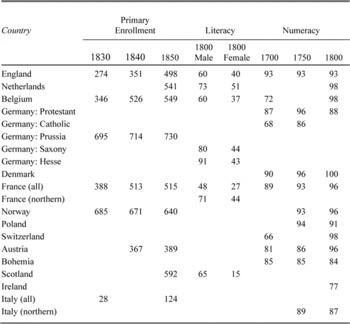
But the descriptive assertion itself is problematic. Table 6 presents human capital indicators for eighteenth- and nineteenth-century Europe. These show that education levels varied hugely across EMP societies. This is not surprising, since the family was not the only, or the main, institution affecting education. Schooling, literacy, and numeracy were strongly influenced by other institutions: market, church, state, community, and guild. This wider institutional framework varied substantially across EMP societies. In some, such as Germany and Scandinavia, the church allied with the state and local communities to enforce compulsory schooling, leading to the high literacy and enrollment levels shown in Table 6. In other EMP societies, such as England, these institutional pressures were weaker, resulting in much lower schooling and literacy. Numeracy was typically learned informally in response to market demand, explaining why England, with its mediocre enrollment and literacy rates, had numeracy similar to more institutionally regulated societies such as Germany or Scandinavia.
Nor is it clear that human capital investment caused European economic growth before and during industrialization. As Figure 1 shows, England experienced rapid economic growth in the early modern period; it industrialized before any other society. Yet schooling and literacy stagnated there during the “long eighteenth century” and were not high by European standards until well into the nineteenth. Economic historians who differ on other explanatory issues concur that education played hardly any role in English industrialization (Mokyr Reference Mokyr2009; Allen Reference Allen2009; McCloskey Reference McCloskey2010). In 1800 literacy for both sexes in England was lower than in the German states of Hesse and Saxony, the Netherlands, and northern France, much slower-growing economies; male literacy was lower in England than in Scotland (Reis Reference Reis, Allen, Bengtsson and Dribe2005, Table 8.2). In 1830–1850 school enrollment was lower in England than in the Netherlands, Belgium, France, Prussia, Norway, or Scotland, all much slower-growing economies (Lindert Reference Lindert2004, Table 5.1). In numeracy, England's relative disadvantage was less pronounced, but in 1750 it lay below that in Denmark, Protestant Germany, and even Poland; in 1800 it was still lower than that of many poorer and slower- growing economies, including Austria, Belgium, Denmark, France, the Netherlands, Norway, and Switzerland (A'Hearn, Baten, and Crayen Reference A'Hearn, Jörg and Dorothee2009, Table 4). As these figures show, many European societies with high educational levels had slow economic growth. The Netherlands had high enrollment, literacy, and numeracy, but after the end of its seventeenth-century Golden Age its economy stagnated (as Figure 1 illustrates), and it industrialized late.Footnote 9 German territories had higher enrollment and literacy than England or the Low Countries, but stagnated throughout the early modern period and did not industrialize until after c. 1840. A similar pattern is found in Scandinavia, with high enrollment and literacy, but slow growth and late industrialization (Skovgaard-Peterson Reference Skovgaard-Petersen1990; Johansson Reference Johansson, Graff, Mackinnon and Sandin2009).
Education levels thus varied greatly among EMP countries in a way that was not correlated with their economic performance in the early modern period. Nonetheless, it might be argued that there must have been some relationship between the three variables because education and income levels were, on average, higher in societies with the EMP than in those with “Mediterranean” or “Slavic” marriage patterns. But southern and eastern Europe differed from north-western Europe not just in their marriage patterns but also in many other economic, social, and institutional characteristics which affect both education and growth. Furthermore, as economic theory recognizes, one reason it is difficult to establish that education causes growth is endogeneity: improving education may increase incomes, but rising incomes increase consumption of education as a normal good. Regardless of the reasons for greater prosperity in northwest Europe, one would expect to see people there consuming (as opposed to investing in) more education.
In many early modern European societies, educational investments were imposed by coercive institutions to serve elite interests rather than being chosen by ordinary people to improve their own or their children's economic productivity. It is therefore unsurprising that no causal relationship between demographic patterns, educational indicators, and economic performance emerges in Europe before the late nineteenth century.
Demographic Responsiveness to Economic Conditions
A third way the EMP is held to have contributed to economic growth is its restriction of marriage to those who could establish an independent household. This, it is argued, was necessary for ensuring that population growth responded to economic conditions. In parts of the recent EMP literature, such demographic responsiveness to economic trends is regarded as contributing to growth indirectly, via its effect on the two mechanisms already discussed: women's economic status (De Moor and Van Zanden 2011, pp. 18, 27) and human capital investment (Foreman-Peck Reference Foreman-Peck2011, pp. 293, 299–301). But other parts of the new literature portray demographic responsiveness as a primary and direct cause of economic growth, by ensuring capital accumulation: population growth slowed when the economy was doing poorly, ensuring that per capita incomes were high enough for capital accumulation to continue, but accelerated when the economy did well, generating more savers whose larger aggregate capital accumulation created positive externalities for growth via technological innovation. According to this view, England's “extreme” form of the EMP gave it two key advantages over other countries in accumulating capital. Before 1700, it is claimed, England started with a “better” demographic regime, resulting in higher initial incomes and larger initial capital externalities. Then after 1700 English population growth responded more sensitively to economic trends, guaranteeing continual capital accumulation with concomitant growth externalities (Voigtländer and Voth Reference Voigtländer and Hans-Joachim2006).
But how well do these arguments hold up empirically? A first empirical concern is that no factual support is offered for the idea that it was capital accumulation that caused England's economic success. This is merely maintained as a theoretical assumption, without reference to the literature on English economic growth, which does not assign capital accumulation an important role (Mokyr Reference Mokyr2009; Allen Reference Allen2009; McCloskey Reference McCloskey2010).
A second issue is the elision between England and Europe. Voigtländer and Voth, for instance, present simulations showing that if England had had high and economically unresponsive population growth (as they assume China's to have been), its economy would have collapsed. This, they contend, “underlines the crucial importance of fertility limitation as part of Europe's unique demographic regime” (Voigtländer and Voth Reference Voigtländer and Hans-Joachim2006, p. 346). But “Europe” did not have a unique demographic regime, as Tables 2–4 show. Rather, it had a multiplicity of different regimes. Some of these involved early female marriage, low female celibacy, and high household complexity, similar to what is known of preindustrial Chinese demography (Lee and Feng 1999; Caldwell Reference Caldwell, Liu, Lee and Reher2001). Since the EMP did not prevail all over Europe, any argument concerning possible demographic influences on economic divergence between Europe and China must refer to marriage patterns in a carefully differentiated way.
In tacit acknowledgement that Europe did not have a monolithic demographic regime that distinguished it from China, Voigtländer and Voth assert that the growth benefits of the European demographic regime were limited to England, because it had an “extreme form” of the EMP; nearby France lacked this regime, they claim, which is why its economy fell behind (Voigtländer and Voth Reference Voigtländer and Hans-Joachim2006, pp. 323, 343–45). But the simulations purporting to demonstrate this conclusion rely on two unsupported assumptions about demographic differences between England and France.
The first is that demographic “starting conditions” differed between the two countries. In England, it is argued, “the demographic regime propped up initial incomes” before 1700, creating greater scope for the capital externality to work; in France, by contrast, these starting conditions were lacking, so the economy grew more slowly (Voigtländer and Voth Reference Voigtländer and Hans-Joachim2006, pp. 321–22). But no empirical support is provided for the assertion that it was demography that caused incomes to be higher in England than France before 1700, and indeed this seems an open question, given the many other differences between the two countries in factors affecting per capita income. Nor is evidence provided to support the claimed difference between pre-1700 English and French demography. Northern France manifested the EMP from a very early date (Perrin Reference Perrin1963) and did not differ significantly from England in marriage age, lifetime celibacy, or household structure across the entire early modern period (as Tables 2–4 show). Population growth before 1700 was very moderate across all of France (Dupâquier Reference Dupâquier, Bardet and Dupâquier1997) and Voigtländer and Voth themselves assume a low initial French population growth rate of 0.32 percent p.a. (2Reference Voigtländer and Hans-Joachim006, p. 344). This makes it unlikely that a claimed difference in demographic regime between France and England explains the two countries' gap in per capita income in 1700 which, in the simulations, drives much of the subsequent divergence in their growth trajectories.
The second demographic assumption driving divergent growth rates in these simulations is that fertility was constant in France but economically elastic in England. French population growth consequently failed to decelerate when the economy flagged and failed to accelerate when the economy flourished, precluding the virtuous growth circle via more capital accumulation that was guaranteed by demographic responsiveness in England (Voigtländer and Voth Reference Voigtländer and Hans-Joachim2006, p. 345). But this assumption is not consistent with findings in the large literature on demographic responsiveness to economic signals. David Weir (Reference Weir1984) showed that “at no time between 1670 and 1830 were marriages less responsive to economic conditions in France than in England.” The causes of the gap between French and English growth performance, he concluded, “are not to be found in difference of demographic behavior” (pp. 43–44). In Germany, the elasticity of fertility with respect to economic signals was higher than in England, though slightly lower than in France, throughout the eighteenth century (Guinnane and Ogilvie Reference Guinnane and Sheilagh2008). In an analysis of nine early modern European economies, the response of fertility to a one-standard-deviation change in grain prices was weaker in England than in societies such as Austria, Sweden, Belgium, and the Netherlands, where economic growth was slower, or in Tuscany, where the EMP did not prevail (Galloway Reference Galloway1988). In China, where the EMP also did not prevail, recent studies show that eighteenth-century fertility rates responded to changes in grain prices (Wang, Campbell, and Lee Reference Wang, Cameron, James, Tsuya, Wang and Alter2010; Campbell and Lee Reference Cameron, Lee, Kurosu, Bengtsson and Campbell2010, pp. 107–11). For England itself, several studies have found that fertility became less responsive to economic signals around 1750, at the precise period that the English economy began to grow faster and diverge most from other western European economies (Galloway Reference Galloway1988; Nicolini Reference Nicolini2007; Crafts and Mills Reference Crafts and Terence2009).Footnote 10
Demographic responsiveness to economic conditions thus did not depend solely on the EMP and can be observed in some societies in which the EMP did not prevail. It was also less extreme in England than in a number of slower-growing European economies. Therefore it makes little sense to attribute any growth gap between England and other economies to the EMP or the way it may have mediated population responses to economic signals.
Cultural Norms
Many proponents of the view that the EMP explains economic growth maintain that it was associated with cultural norms that further contributed to economic success. One variant emphasizes putative specificities of English culture: “social and cultural norms limited fertility in early modern England in a way that few other societies did” (Voigtländer and Voth Reference Voigtländer and Hans-Joachim2006, p. 323). However, these are difficult claims to sustain empirically. The idea that England had distinctive cultural norms is vigorously debated among historians, and no study has presented evidence that English culture gave unusual emphasis to fertility limitation.Footnote 11
An older literature occasionally speculated that economic growth was favored by a Weberian Protestant culture that valued rational control of fertility (Landes Reference Landes1969). Even that literature, however, was aware that fertility lay below the biological maximum not just in England but across large swathes of premodern Europe and indeed in non-European cultures such as Japan (Landes Reference Landes1969, p. 22 n. 2). With regard to Weber, moreover, historical demographic research long ago demonstrated that the fertility-controlling practices of late marriage and high lifetime celibacy were widespread in Catholic as well as Protestant Europe, as shown by the results for Catholic Belgium, Austria, northern France, Bohemia, and Slovenia in Tables 2–3 above, as well as the notably high marriage age and celibacy in German Catholic states such as Bavaria (Guinnane and Ogilvie Reference Guinnane and Sheilagh2014, pp. 79, 110).
Other variants of the recent literature relate the EMP and its putative economic benefits to cultural norms propagated by medieval Christianity. One account holds that in Europe by the ninth century, “tribal tendencies were gradually undone by the church which, in addition to generalized morality, advanced a marriage dogma that undermined large kinship organizations” (Greif and Tabellini Reference Greif and Guido2010, p. 137). The resulting combination of nuclear families and corporative institutions supposedly fostered additional growth-inducing beliefs and norms, including “the rule of law, the legitimacy of majority rule, respect for minority rights, individualism, and trust among non-kin” (Greif Reference Greif2006, p. 311). Another variant holds that the EMP and its economic benefits arose from, and helped to sustain, medieval Christian norms of consensual marriage and gender parity. Having once arisen, the EMP then helped sustain these norms, in contrast to less benign cultural norms sustained by non-European marriage patterns in eastern Europe or China (De Moor and Van Zanden Reference De Moor and Jan Luiten van2010, pp. 1, 4–7; Van Zanden Reference Van Zanden2011, p. 333).
A first problem with these claims is that they provide no evidence on how medieval Christian dogmas were implemented in practice. The relevant literature, by contrast, strongly emphasizes the role played by social institutions other than the family and the church in the widely varying enforcement of medieval ecclesiastical provisions concerning demographic matters. Peter Biller (Reference Biller2001), for instance, points out that lay society shaped religious views on demographic issues very differently in different parts of medieval Europe. Lloyd Bonfield (Reference Bonfield, Kertzer and Barbagli2001) finds that the medieval church could only implement theologically inspired marriage formation rules by allying with local institutions and interests. Charles Donahue (Reference Donahue1983, 2Reference Donahue008) observes significant differences across medieval Western Europe in enforcement of religious norms about marriage, which he ascribes to differences in legal systems, property rights, and other institutions.
A second problem with linking the EMP to medieval Christian norms —whether of generalized morality, consensual marriage, or fertility control—is that marriage practices and kinship complexity varied enormously across Christian Europe. As Tables 2–4 illustrate, the EMP was not, and did not become, the prevalent family system in those parts of Europe where the church was strongest. Italy, for instance, was undisputedly and enduringly influenced by the Catholic Church whose seat was in Rome, yet many Italian regions had early female marriage, low female celibacy, and high kin complexity. In Spain, church regulation of marriage and sexuality had observable effects on nuptiality and fertility, yet church teachings were compatible with a “European” marriage pattern in some regions of Spain and a “non-European” pattern in others (Pérez Moreda Reference Vincente, Bardet and Dupâquier1997; Reher Reference Reher1998a, Reference Reher1998b). The same was true of Portugal, strongly Catholic, but with a mixture of “European” and “non-European” marriage patterns (Sonnino Reference Sonnino, Bardet and Dupâquier1997; Michelotto 2011).
The wide variation in demographic behavior within ethnically and linguistically homogeneous regions casts further doubt on the idea that the EMP was associated with the beliefs and values of particular cultures. In southern Europe, historians have identified “two different family systems in the northern and southern regions of Iberia, and no less than three in Italy” (Viazzo Reference Viazzo2003, p. 122). In the countryside around Bologna, sharecropping farmers lived in predominantly complex (“non-European”) households while their neighbors who were agricultural laborers lived in predominantly nuclear-family (“European”) households (Kertzer Reference Kertzer, Kertzer and Barbagli2002). Within France, as Tables 2–4 show, marriage age, celibacy, and the balance between nuclear and extended families differed substantially between the south and north of the country. Across Spain, as well, marriage patterns and household structure varied greatly: within the same early modern Catalan community, for instance, household complexity was a “European” 15 percent among landless villagers but a “non-European” 50 percent among large peasant farmers (Kertzer Reference Kertzer, Kertzer and Barbagli2002; Reher Reference Reher, Bardet and Dupâquier1997). Hungary had regions dominated by nuclear families alongside ones where extended families predominated (Andorka and Faragó Reference Andorka, Tamás, Wall, Robin and Laslett1983). In Sweden, communities with only 10 percent complex households existed alongside others with 25 percent (Egherbladh 1989). European Russia, likewise, manifested diverse marriage patterns and family forms across culturally identical communities (Dennison Reference Dennison2011).
It is difficult, therefore, to find empirical support for the notion that the EMP was caused by, or sustained, distinctive cultural norms. There was no systematic relationship between the teachings of the church on the one hand and marriage age, lifetime celibacy, or household complexity on the other. The extent to which the church was able to implement its ideology depended on the institutional characteristics of each European society. Strongly religious European societies included those with early marriage, low celibacy, and extended-family households as well as those with extreme forms of the EMP. The widely variegated distribution of European marriage patterns, shown in Tables 2–4, is not consistent with any notion of a distinctive culture—whether of fertility control, generalized morality, or gender parity—let alone one that accounts for European economic growth.
CONCLUSION
The evidence presented in this article implies a new view of the interaction between demographic and economic decisions. That economists and economic historians have turned their attention to demographic behavior is a positive development (Guinnane 2012; Galor Reference Galor2011; Acemoglu Reference Acemoglu2009). But recent attempts to attribute European economic success to the EMP cannot be sustained empirically or theoretically. The EMP did not prevail throughout Europe, or even throughout the core of Europe. The three key components of the EMP were not invariably associated with one another. Where the components of the EMP did coincide in their most “pure” form, economic growth was slower and industrialization later than in societies where the EMP took less extreme manifestations. Conversely, those European economies that grew fastest had moderate demographic patterns and, at least in the case of England, moved further away from the EMP in the century before industrialization and during the Industrial Revolution itself.
Available evidence suggests that whether a society experienced economic growth depended not on its marriage or family pattern, but on wider characteristics of its economy and institutional framework. In early modern England, the EMP existed within a framework of reasonably well-functioning factor markets and relative economic freedom for women; economic growth was usually positive and ultimately spectacular. In the early modern Netherlands, the EMP initially existed in a similar framework of lively factor markets and successful economic growth; but later the economy stagnated and industrialization came late, for reasons that are still vigorously debated. In German-speaking central Europe and the Czech lands, the EMP existed in a more coercive framework of interlinked factor markets, mobility restrictions (including, in some areas, serfdom), and corporative barriers to entry (for most women and many men); economic growth remained slow until these institutional obstacles were removed. In parts of southern Europe, nuclear-family households were formed at marriage, but female marriage age, celibacy, and labor force participation were low. In other southern European societies, female marriage age and celibacy were high but women's work was severely constrained by nonfamilial institutions. In many parts of the Mediterranean region, economic growth was strong before c. 1500 and unimpressive thereafter. Under serfdom in Russia, at least in some regions, female labor force participation was high and substantial proportions of women remained unmarried, but complex households were still widespread; both male and female serfs grappled with daunting institutional constraints; economic growth was slow.
What is needed is a theoretically coherent and empirically satisfactory account of how particular aspects of the EMP were connected to the wider institutional context, and which demographic and institutional features were responsible for which economic outcomes. We would speculate, based on current scholarship, that the demographic practices highlighted in the EMP were only possible within a wider social framework of strong nonfamilial institutions that could substitute for familial labor, insurance and welfare services that were unavailable to unmarried individuals and fragile nuclear families. However, it was not inevitable that this wider framework should consist of institutions that also benefited the economy, such as well-functioning factor markets or impartial legal systems, instead of those with more ambiguous growth effects such as serfdom, guilds, communities, religious bodies, or absolutist states. Future research, we suggest, must place at the center of analysis the nonfamilial institutions that circumscribed both demographic and economic decisions during European economic development.