Introduction
Fowl typhoid caused by Salmonella enterica serovar Gallinarum is one of the most important bacterial diseases of poultry. This infection is distributed and found worldwide, including in India. The epidemiology of fowl typhoid and pullorum disease caused by Salmonella gallinarum and Salmonella pullorum, respectively, in poultry are known to be closely associated with infected poultry eggs, particularly with regard to its transmission from one generation to the next.
Salmonella enterica serovar Gallinarum infections have been reported from time to time in many parts of the world by various workers, notably, Glover and Handerson (Reference GLOVER and HANDERSON1946) from Canada; Smith and Buxton (Reference SMITH and BUXTON1951) from England and; Grimes and Simmons (Reference GRIMES and SIMMONS1972) Australia. In Nigeria, various serotypes of Salmonella species have been isolated from apparently healthy chickens with a carrier rate of 1.3% as reported by Falade and Ehizokhale (Reference FALADE and EHIZOKHALE1981). The Salmonella enterica serovar Gallinarum infection in India became prominent when it was recorded as the commonest Salmonella of avian origin at the National Salmonella Centre at Indian Veterinary Research Institute IVRI, Izatnagar. The organism has been isolated from almost all the States of India including Assam, Gujarat, Karnataka, Maharashtra, West Bengal, Orrisa, Tamil Nadu, Uttar Pradesh, Punjab, Haryana, Chandigarh etc. (Gupta and Verma, Reference GUPTA and VERMA1989, Reference GUPTA and VERMA1990). The disease has been largely under control in Australia, North America, and most European countries, but it is still of considerable economic significance in those countries which are beginning to intensify their poultry industry e.g. in Latin America, South America, the Middle East, the Indian subcontinent and parts of Africa (Shivaprasad, Reference SHIVAPRASAD2000). A total of 23 Salmonella isolates were recovered from different disease outbreaks in different geographical locations of Karnataka, Maharashtra and Tamilnadu (Prakash et al., Reference PRAKASH, KRIHNAPPA, MUNIYAPPA and KUMAR2005).
Realising its wide prevalence and zoonotic importance, the present investigation was undertaken to study the prevalence of Fowl Typhoid (FT) and other Salmonellae in broilers in Haryana for the past four years (2005-2008) and to establish the role of hatcheries in spreading the Salmonella infection to different poultry farms along with the information regarding the prevalence of Salmonella infection present in different hatcheries of Northern India.
Recording of outbreaks in Haryana
Data in relation to FT outbreaks in broiler chicken were collected from the Disease Investigation Laboratory, Department of Veterinary Epidemiology and Preventive Medicine, CCS HAU, Hisar. The data for the period January, 2005 to December, 2008 was obtained for Hisar and its adjoining districts viz. Jind, Bhiwani, Sirsa, Fatehabad and Rohtak. Detailed information obtained from each flock included: clinical signs and symptoms; total population of flock; number of birds affected; number of birds dead; age of affected birds; source of chicken/ name of hatchery; location of farm and season. The history of heavy mortality and gross pathological changes in dead birds of each flock were recorded to diagnose the disease. Confirmatory diagnosis was done by isolating and studying culture characteristics, biochemical tests, and serotyping.
Outbreaks over a four-year period in Haryana
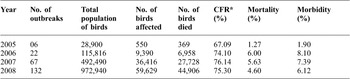
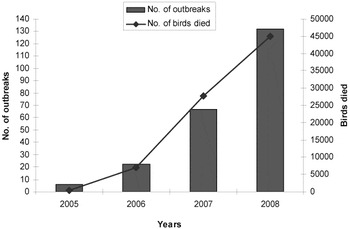
A total of 227 outbreaks of FT were recorded in poultry during the period from January 2005 to December 2008 (Table 1 and Figure 1). There has been steep rise in the number of outbreaks during these four years. During this period, FT affected 105,985 birds with death of 79,961 birds in total. The morbidity ranged from 1.9-8.1% in different years, whereas mortality ranged from 1.3- 6.0%. The case fatality rate due to the disease during this four-year period ranged from 67 to 76%.
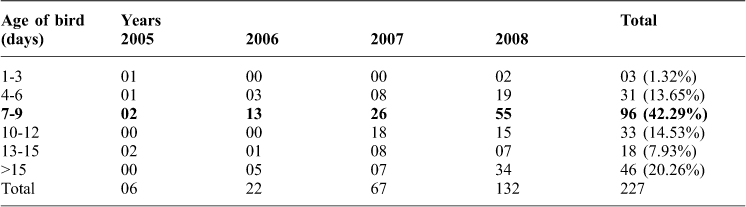
The increase in the number of outbreaks over the years indicates that FT is emerging as a major disease of poultry in Haryana State. Sharma and Kaushik (Reference SHARMA and KAUSHIK1986) reported that FT was the most important bacterial disease and that a dramatic increase in the incidence of Salmonella gallinarum infection had been seen in various parts of India. In a study, birds were divided in six age groups (age in days) viz. 1-3 (A), 4-6 (B), 7-9 (C), 10-12 (D), 13-15 (E), and > 15 (F) (Table 2).
Year wise distribution of FT outbreaks.

*CFR= Case Fatality Rate
Period Prevalence of FT outbreaks in Haryana.

Age-wise distribution of outbreaks of FT in different years.

F cal =3.38; F tab =2.90 (Friedman test)
So outbreaks in different age groups are significantly different
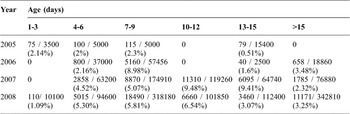
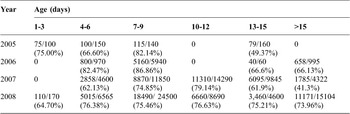
A minimum of three outbreaks were recorded in age group of 1-3 days (A) in all the four years. Maximum numbers of outbreaks i.e. 96 cases were reported in the age group of 7-9 days (C) during the past four years. No of outbreaks in different age groups were significantly different. Mortality pattern for the different age groups (Table 3) was variable in different years. During the year 2006, maximum mortality (8.98%) was reported in the age group C while in the year 2007 mortality was highest in age group D (9.48%), followed by age group E (9.41%). In 2008, mortality was nearly same in age groups B, C and D ranging from 5.30-6.54%. Mortality at the rate of 4.6% in 2008 resulted in death of 44,906 birds with an estimated economic loss of Re 0.9 million (US$ 20,000 approximately) due to mortality alone indicating the economic importance of the disease.
Age-wise mortality due to FT in different years.

Note: Figures given in the table above are the number of deaths/total bird population (%mortality)
The case fatality rate (CFR) due to this disease ranged from 74.85% to 86.86% in the age group C during all four years (Table 4). During the years 2005 and 2006, case fatality rate was highest in age group C (82.14% and 86.86%, respectively) while in the years 2007 and 2008 maximum case fatality rate was reported in age group D (79.14% and 76.63%, respectively).
Age wise case fatality rate due to FT in different years.

Note: Figures given in the table above are the number of deaths/ number of affected birds (% case fatality).
From these data, it can be concluded that maximum mortality and case fatality rate were found in chicks of 1-2 weeks of age. Kaushik et al., (Reference KAUSHIK, SINGH, KUMAR and KULSHRESHTHA1988) observed maximum outbreaks of FT in chicks day old to four weeks in Haryana with mortality ranging from 2.1 to 78.3%. Hafeji et al. (Reference HAFEJI, JOSHI, PRAJAPATI, DAVE, GHODASARA and ROY. A.2000) observed an average of 8.29% mortality with highest mortality on the 12th day of age.
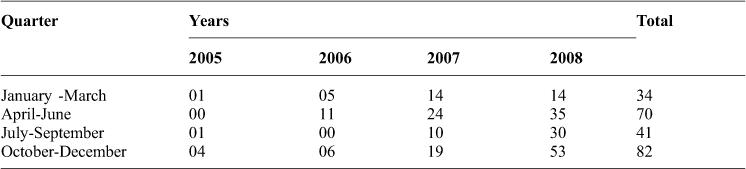
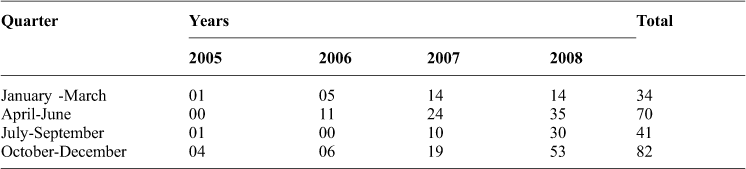
Each year was divided into 4 quarters viz. Jan.-March (A), April-June (B), July-Sept. (C) and Oct.-Dec. (D). B and D comprised the seasons with extreme weather conditions with maximum and minimum temperature respectively. The disease was recorded in all the quarters with maximum number of 82 outbreaks in quarter D, followed by 70 in quarter B, 41 in quarter C and 34 in quarter A respectively (Table 5). Both the quarters, i.e. B and D, of the year are characterised by extremes of weather conditions i.e. maximum and minimum temperatures, which might cause stress to the birds, lowering host resistance and making them more susceptible to the infection.
Temporal (Quarter wise) distribution of outbreaks of FT in different years.
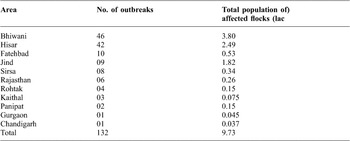
With a total population of 0.97 million birds in affected flocks in different regions of Haryana and adjoining areas, the highest number of outbreaks were recorded in Bhiwani district (46) with a total population of 0.38 million, followed by Hisar (42) outbreaks having total population of 0.24 million. It might be because large numbers of farms are located in these two districts and they procure their day old chicks mainly from hatcheries located in Jind district. Six outbreaks from adjoining areas of Rajasthan were also reported giving a picture of wide spread nature of the disease (Table 6).
Spatial distribution of FT outbreaks with total population of affected flocks during the year 2008.

Retrospective analysis of data of 48 hatcheries for the last four years revealed that in chicks originating from Hatchery A (in Jind) in 2007 showed only 4 outbreaks while in 2008 there was sudden increase in number and 36 outbreaks were reported. However, during the previous 2 years (2005 and 2006), no outbreak was recorded from the same source.
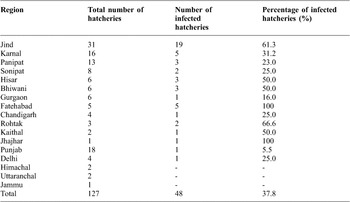
From Hatchery B (in Jind), 3 outbreaks in 2007 and 5 outbreaks in 2008 were recorded. Hatchery C (in Panipat) showed a different pattern with 1 outbreak in 2006, 13 outbreaks in 2007 and only 2 outbreaks in 2008. Another hatchery D from Jind recorded 2 outbreaks in 2007 and 10 outbreaks in 2008. In North India, there are a total of 127 hatcheries, out of which 31 are present in district Jind of Haryana, followed by Punjab (18) and Karnal (16) (Table 7).
By analysing the data regarding the prevalence of Salmonella infection in hatcheries, it was found that 19 hatcheries (61.3%) in district Jind harbour the infection, while 5 hatcheries from each Karnal and Fatehabad harbour infection. More than one third (37.8%) of hatcheries were found to be infected with Salmonella infection, which is an alarming situation for the region. The present study revealed that hatcheries play a very significant role in spreading the Salmonella infection. It was found that a single source of infection (Hatchery A) was responsible for spreading the Salmonella infection to different farms of different regions at a fast pace, thus posing a great threat to the industry. This observation was supported by the fact that the disease is vertically transmitted and can spread from a single source of infection i.e. from parent birds to newly hatched chicks, which are sold to different areas’ farms.
Prevalence of Salmonella infection in hatcheries from North India.