Statement of Research Significance
Research Question(s) or Topic(s): Can existing measures of daily functioning be adapted in a framework that allows us to evaluate new technological demands in daily life while flexibly linking to heritage measures so that we do not discard information available from large cohorts? Main Findings: New technologically focused assessment was successfully linked with a commonly used heritage measure. This expanded measure was both more sensitive to milder functional change and possessed a higher ceiling to capture more severe functional change. Study Contributions: We offer a new expanded functional instrument, as well as a framework for harmonizing technological and traditional items so that our measurement systems can more flexibly respond to changes in daily demands of individuals affected by neurocognitive disorders.
Introduction
Instrumental activities of daily living (iADLS) refer to a range of skills and tasks pertinent to maintaining one’s independence in the community (Katz, Reference Katz1983). Common measures of iADLs, such as the Functional Activities Questionnaire (FAQ), assess tasks such as balancing a checkbook, attending to printed media, and physically shopping (Pfeffer et al., Reference Pfeffer, Kurosaki, Harrah, Chance and Filos1982). Alzheimer’s disease-related dementias (ADRD) tend to incrementally reduce an individuals’ independence for iADLs over the disease course, with subtle changes being noted in the mild cognitive impairment stages or perhaps even earlier (e.g., transitional cognitive decline; Libon et al., Reference Libon, Emrani, Matusz, Wasserman, Perweiler, Ginsberg, Powell, Bezdicek, Swenson and Schmitter-Edgecombe2023), and dependence in complex daily tasks being definitional of dementia (Dubbelman et al., Reference Dubbelman, Jutten, Tomaszewski Farias, Amariglio, Buckley, Visser, Rentz, Johnson, Properzi, Schultz, Donovan, Gatchell, Teunissen, Van Berckel, Van der Flier, Sperling, Papp, Scheltens and Marshall2020). As recent ADRD research has focused on unraveling the biological underpinnings of the disease with the concomitant introduction of new therapeutic agents and preclinical staging (Budd Haeberlein et al., Reference Budd Haeberlein, Aisen, Barkhof, Chalkias, Chen, Cohen, Dent, Hansson, Harrison, von Hehn, Iwatsubo, Mallinckrodt, Mummery, Muralidharan, Nestorov, Nisenbaum, Rajagovindan, Skordos, Tian and Sandrock2022; Jack et al., Reference Jack, Bennett, Blennow, Carrillo, Dunn, Haeberlein, Holtzman, Jagust, Jessen, Karlawish, Liu, Molinuevo, Montine, Phelps, Rankin, Rowe, Scheltens, Siemers, Snyder and Silverberg2018, Reference Jack, Andrews, Beach, Buracchio, Dunn, Graf, Hansson, Ho, Jagust, McDade, Molinuevo, Okonkwo, Pani, Rafii, Scheltens, Siemers, Snyder, Sperling, Teunissen and Carrillo2024; Mintun et al., Reference Mintun, Lo, Duggan Evans, Wessels, Ardayfio, Andersen, Shcherbinin, Sparks, Sims, Brys, Apostolova, Salloway and Skovronsky2021; van Dyck et al., Reference van Dyck, Swanson, Aisen, Bateman, Chen, Gee, Kanekiyo, Li, Reyderman, Cohen, Froelich, Katayama, Sabbagh, Vellas, Watson, Dhadda, Irizarry, Kramer and Iwatsubo2023), these advances have increasingly pushed questions about measurement of functional activities back into the scientific mainstream. For example, to what extent do new therapeutics improve real-world functioning in those with ADRD (Aljuhani et al., Reference Aljuhani, Ashraf and Edison2024; Angioni et al., Reference Angioni, Cummings, Lansdall, Middleton, Sampaio, Gauthier, Cohen, Petersen, Rentz, Wessels, Hendrix, Jessen, Carrillo, Doody, Irizarry, Andrews, Vellas and Aisen2024)? How much functional difficulty distinguishes transitional cognitive decline from mild cognitive impairment and mild dementia (Jack et al., Reference Jack, Andrews, Beach, Buracchio, Dunn, Graf, Hansson, Ho, Jagust, McDade, Molinuevo, Okonkwo, Pani, Rafii, Scheltens, Siemers, Snyder, Sperling, Teunissen and Carrillo2024; Kiselica et al., Reference Kiselica, Kaser and Benge2021)?
As biomarkers, updated definitional schemas, and new treatments are fundamentally changing the ADRD clinical research enterprise, we would argue even larger shifts are happening to the instrumental daily activity demands in the 21st century (Benge et al., Reference Benge, Aguirre, Scullin, Kiselica, Hilsabeck, Paydarfar, Thomaz and Douglas2024; Benge & Scullin, Reference Benge and Scullin2025), driven in no small part by the pervasive role of digital technologies in daily life. For example, online banking and financial management tasks are increasingly performed in digital rather than analog format (Zhang et al., Reference Zhang, Morris, McNiel and Binder2023), technology-enabled navigation systems are used by older adults find their way around in the community (Crane et al., Reference Crane, Moored, Rosso and Carlson2023), and social interactions are mediated by texting and online platforms (Anderson, Reference Anderson2017). Beyond digital approaches to more traditional daily tasks, new categories of digital activities such as texting, emailing, and internet navigation have moved from “luxury” functioning to critical for engaging with healthcare, social networks, and commerce (Rogers et al., Reference Rogers, Mitzner and Bixter2020). These shifts directly impact those with ADRD, as our recent work has demonstrated that technological iADLs are endorsed as applicable in over 80% of those presenting for geriatric cognitive disorder evaluations, and difficulties with digital activities show comparable sensitivity and specificity to traditional iADLs (Benge et al., Reference Benge, Ali, Chandna, Rana, Mis, González, Kiselica, Scullin and Hilsabeck2024).
Thus, for those interested in understanding, assessing, and ultimately improving daily functioning in those with ADRD, these technological trends should not be considered historical oddities. Daily activity performance is a critical endpoint for clinical trials, and maintaining independence is a critical goal for those living with ADRD (Tochel et al., Reference Tochel, Smith, Baldwin, Gustavsson, Ly, Bexelius, Nelson, Bintener, Fantoni, Garre-Olmo, Janssen, Jindra, Jørgensen, McKeown, Öztürk, Ponjoan, Potashman, Reed and Roncancio-Diaz2019). Further, daily activity demands vary by broader contextual factors (González & Benge, Reference González and Benge2024), which simultaneously impact risk of ADRD and the adoption of daily technologies (Charness & Boot, Reference Charness and Boot2022). Such uneven implementation of technology in daily life and varied approaches to iADLs means there is no one-size-fits-all, universally applicable measure of daily activities. Finally, the evolving pace of daily tasks and the technologies that underpin them show no sign of slowing: artificial intelligence is increasingly changing our interactions with the environment (Berretta et al., Reference Berretta, Tausch, Ontrup, Gilles, Peifer and Kluge2023), self-driving technologies continue their progress toward mainstream use (Abdel-Aty & Ding, Reference Abdel-Aty and Ding2024), and immersive augmented digital platforms for interaction and commerce continue to progress (Hoffmann & Mai, Reference Hoffmann and Mai2022). In sum, daily activities have changed, likely will continue to change, and vary significantly person to person. Thus, we argue that daily activity instruments cannot be static either (Benge et al., Reference Benge, Aguirre, Scullin, Kiselica, Hilsabeck, Paydarfar, Thomaz and Douglas2024).
In the face of such challenges, groups have developed focused technology questionnaires or otherwise novel instruments to quantify daily technology patterns (Rosenberg et al., Reference Rosenberg, Nygård and Kottorp2009; Sikkes et al., Reference Sikkes, Knol, Pijnenburg, de Lange-de Klerk, Uitdehaag and Scheltens2013). These approaches are laudable and warrant more consideration in neuropsychological practice and research. However, there is also a need to harmonize measures with ongoing, large-scale longitudinal studies (Shaaban et al., Reference Shaaban, Tudorascu, Glymour, Cohen, Thurston, Snyder, Hohman, Mukherjee, Yu and Snitz2022), and there is potential risk from throwing out legacy instruments for wholescale use of new instruments. For example, even if they do not capture new technological activities, some existing measures, such as the FAQ, are well-developed with strong psychometric properties (González et al., Reference González, Gonzales, Resch, Sullivan and Soble2022). Further, knowledge about the functional ramifications of cognition (Benge et al., Reference Benge, Artz and Kiselica2020), behavioral-psychological symptoms (González et al., Reference González, Finley, Patel and Soble2025), diagnostic algorithms (González et al., Reference González, Gonzales, Jennette, Soble and Fongang2021), as well as neurodegeneration and other biomarkers (Okonkwo et al., Reference Okonkwo, Alosco, Jerskey, Sweet, Ott and Tremont2010; Trzepacz et al., Reference Trzepacz, Hochstetler, Wang, Yu, Case, Henley, Degenhardt, Leoutsakos and Lyketsos2016; Vassilaki et al., Reference Vassilaki, Aakre, Kremers, Mielke, Geda, Machulda, Knopman, Coloma, Schauble, Vemuri, Lowe, Jack, Petersen and Roberts2018) has been based on these legacy instruments.
Development of a flexible and adaptable iADL measurement system which bridges the gap between legacy instrumentation and novel or altered items can be accomplished with modern psychometric frameworks such as item response theory (IRT). Such techniques are broadly used in other large-scale instrument development projects (Choi et al., Reference Choi, Podrabsky, McKinney, Schalet, Cook and Cella2015; Monsell et al., Reference Monsell, Dodge, Zhou, Bu, Besser, Mock, Hawes, Kukull, Weintraub, Ferris, Kramer, Loewenstein, Lu, Giordani, Goldstein, Marson, Morris, Mungas, Salmon and Welsh-Bohmer2016), but have had only limited use with iADL measures to date. IRT approaches are attractive as they simultaneously allow for development of robust item banks that can be adapted to an individual’s ability level, allow for understanding of how items perform across varying levels of underlying ability levels, allow for estimation of individual’s ability level in the absence of complete data, facilitate creation of alternative and brief forms, and allow for more precise understanding of how adding items changes test information (de Ayala, Reference de Ayala2022).
In this manuscript, we implemented IRT to address three clinically utilitarian aims:
-
1. Does the addition of technology-related iADLs to a heritage measure provide additional information about daily functioning in those with ADRD? We hypothesize that the use of technology items will increase the overall information obtained in iADL assessments.
-
2. Which technology-related daily activities may be most informative at the early stages of functional impairment? Prior research suggests ADRD can both make some daily technology tasks harder (Malinowsky et al., Reference Malinowsky, Kottorp, Wallin, Nordlund, Björklund, Melin, Pernevik, Rosenberg and Nygård2017), yet technology may also serve a compensatory role in automating activities, potentially facilitating functional independence (Benge & Scullin, Reference Benge and Scullin2025). We thus hypothesize that technological iADLs will assess the full range of functional impairments, providing useful information in both earlier (less functional decline) and later (more functional decline) ranges of the functional impairment spectrum.
-
3. Are technology-related daily activities strongly related enough to traditional activities to allow linking? As daily activities will continue to grow and develop, we aimed to implement psychometric approaches to link novel item pools with legacy instruments as a proof of concept for evolving activity scales.
Method
Sample
The primary development sample was compiled from adults over the age of 65 participating in a smartphone-enabled passive sensing and cognition study (n = 22; Shen et al., Reference Shen, Park, Huang, Benge, Rousseau, Lester-Smith and Thomaz2025) as well as a sample referred for neuropsychological evaluations in an academic medical center’s memory disorders clinic (n = 242, Benge et al., Reference Benge, Ali, Chandna, Rana, Mis, González, Kiselica, Scullin and Hilsabeck2024). For all participants, semi-structured clinical interview, collateral reports of daily functioning, and norm-referenced neuropsychological evaluations were used to stratify participants into three clinical stages (cognitively normal, mild cognitive impairment, or mild dementia) according to the global deterioration scale staging schema (Reisberg et al., Reference Reisberg, Ferris, de Leon and Crook1982). For the smartphone sensing study, participants were classified based upon neuropsychologist’s review of all case data; biomarkers and imaging were not available for review. For the clinical sample, diagnoses were made in consensus conference using neuropsychological data, clinical interview, behavioral neurology evaluation, imaging, and social work collateral interview. The sample was accrued over approximately 3 years, with published diagnostic guidelines (Albert et al., Reference Albert, DeKosky, Dickson, Dubois, Feldman, Fox, Gamst, Holtzman, Jagust, Petersen, Snyder, Carrillo, Thies and Phelps2011; McKhann et al., Reference McKhann, Knopman, Chertkow, Hyman, Jack, Kawas, Klunk, Koroshetz, Manly, Mayeux, Mohs, Morris, Rossor, Scheltens, Carrillo, Thies, Weintraub and Phelps2011) being used at the time of the diagnoses.
To facilitate robust linking between traditional and expanded measures, the development sample was supplemented with National Alzheimer’s Coordinating Center (NACC) data. Inclusion criteria were presence of a collateral to complete functional ratings during an initial visit to an Alzheimer’s Disease Research Center (ADRC) between June 2005 and June 2023. All primary study activities and ADRC contribution from 46 sites to NACC were IRB approved. All participants across samples consented to participation, and research was completed in accordance with the Helsinki Declaration.
Instruments
The FAQ is a 10-item scale where independence in a range of daily tasks is rated by a knowledgeable collateral on a scale from 0 (normal performance) to 3 (fully dependent) (Pfeffer et al., Reference Pfeffer, Kurosaki, Harrah, Chance and Filos1982). The rater can also indicate “not applicable” or “don’t know” for activities the individual never completed or for which the rater has insufficient information, respectively. The FAQ is a well-validated clinical instrument, with extensively documented psychometric properties, including unidimensionality and IRT parameterization (González et al., Reference González, Gonzales, Resch, Sullivan and Soble2022).
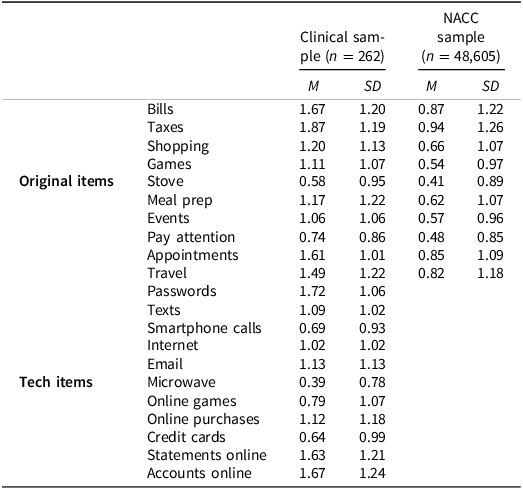
Technological FAQ items were generated as described in a prior study (Benge et al., Reference Benge, Ali, Chandna, Rana, Mis, González, Kiselica, Scullin and Hilsabeck2024) and consisted of 11 items that captured a range of digital daily activities (see Table 1 for item descriptions). The collateral raters for the traditional FAQ in the development sample used the same rating and applicability response scale; these items were administered after completion of the traditional FAQ. Items from both FAQs were also combined into a 21-item “Expanded FAQ.” The development sample completed all 21 items, whereas the NACC sample only completed the 10 traditional items.
Descriptive data for the Functional Activities Questionnaire (FAQ) and tech items across samples

Data analysis
On the traditional and technological FAQ, “not applicable” and “don’t know” responses were coded as missing but not imputed since prior research has indicating ADL applicability covaries systematically with demographic characteristics (González & Benge, Reference González and Benge2024), violating imputation’s missing at random assumption. Given this, missing data were handled with listwise deletion. Descriptives were implemented for items and scale totals. Scale reliability (with total omega, ω) for the traditional, technological, and expanded scales was also calculated to substantiate use of scale totals.
Confirmatory factor analysis (CFA) was run to determine unidimensionality using diagonally weighted least squares estimation for ordered polytomous indicators. Fit was evaluated with absolute (chi-square & standardized root mean squared residual [SRMR]), parsimony-corrected (root mean squared error of approximation [RMSEA]), and relative (comparative fit index [CFI] and Tucker-Lewis index [TLI]) indices. We used the following fit criteria: SRMR < 0.08 good, ≥ 0.08 bad; RMSEA < 0.06 good, 0.06–0.10 adequate, >0.10 bad; CFI/TLI > 0.95 good, 0.95–0.90 adequate, <0.90 bad (Brown, Reference Brown2015). Item response distributions, loadings, and variance statistics were also evaluated to determine appropriateness of model or whether response categories should be collapsed.
IRT parameters were derived using graded response modeling (GRM). This included discrimination and difficulty parameters for each response category, as well as item and total test information. This was performed on both the development sample for the technologically expanded FAQ, as well as NACC sample for the traditional FAQ. These parameters can be used to estimate an individual’s latent functional ability (i.e., theta).
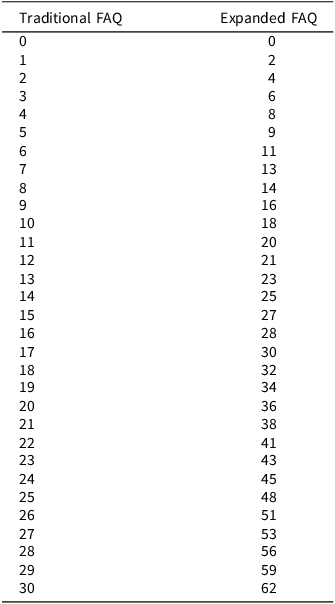
Nonparametric Spearman correlations among the traditional and technological scores were calculated to determine appropriateness of linking procedures. If correlations were optimal (r s > 0.70) IRT parameters were used to link the two measures using a nonequivalent groups anchor test (NEAT) design (de Ayala, Reference de Ayala2022). Traditional FAQ items were indicated as shared across measures and samples to use a Stocking-Lord NEAT procedure to estimate linking coefficients that allow transformation of theta estimates between the expanded and traditional FAQ derived from both development and NACC samples. To facilitate flexible linking in different settings, equipercentile methods were also implemented with frequency estimation for both the traditional and expanded FAQ in the development sample. These score frequency tables were then log-linearly smoothed to create a conversion table between traditional, technological, and expanded FAQ scores. A conversion table can be practically implemented with simple scale sums, instead of contending with the more complex calculation of theta for each individual, as is needed for the NEAT procedure.
Analyses were conducted in the R environment (version 4.4.2) with the tidyverse (2.0.0), psych (2.4.12), Hmisc (5.2–1), lavaan (0.6–19), ltm (1.2–0), equate (2.0.8), and plink (1.5–1) packages. Primary study data is available upon reasonable request, NACC data is available at https://www.naccdata.org, and study script can be referenced here: https://osf.io/de2nm/?view_only=4e2ead4425094f3ca040a0183bb53af2.
Results
Descriptive data of the sample and measures
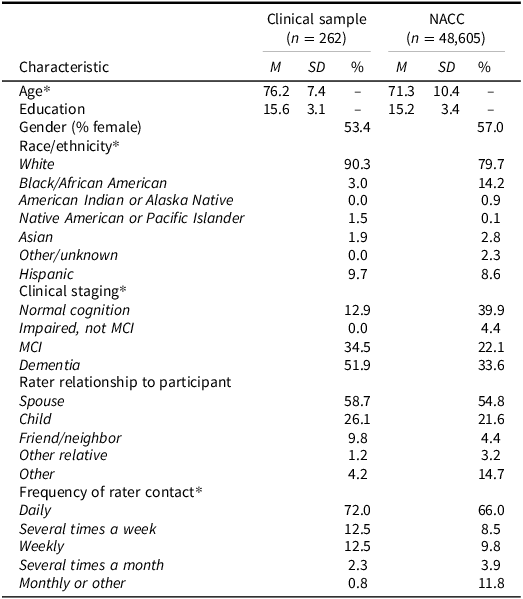
Clinical and descriptive data for the item development (n = 262) and NACC (n = 48,605) samples are found in Table 2. Table 1 provides descriptive information for the technological and traditional items. Of note, the NACC sample was younger, with varied ethnic-racial identity, less cognitively impaired, and had co-participants who spent less time with participants relative to the development sample. Both traditional and technological iADL items demonstrated excellent internal consistency (ωs = 0.94 & 0.96, respectively).
Demographic and descriptive characteristics of the samples

Note: * = Statistically significant (p < .05) differences across samples.
Confirmation of unidimensionality
CFA revealed mostly good unidimensional fit (χ 2 = 107.59, df = 189, p = 1.0; SRMR = 0.08; RMSEA < 0.01; CFI > 0.99; TLI > 0.99), save for the borderline SRMR value, suggesting all 21 items in the expanded FAQ could be construed as measuring a single construct with significant loadings of all items on the factor. As further evidence of unidimensionality, internal consistency of all 21 items was excellent (ω = 0.97). This pattern of results held when the least frequently applicable of the technological items, online games (rated as applicable in about half of the sample), was omitted from analyses.
Test and item information
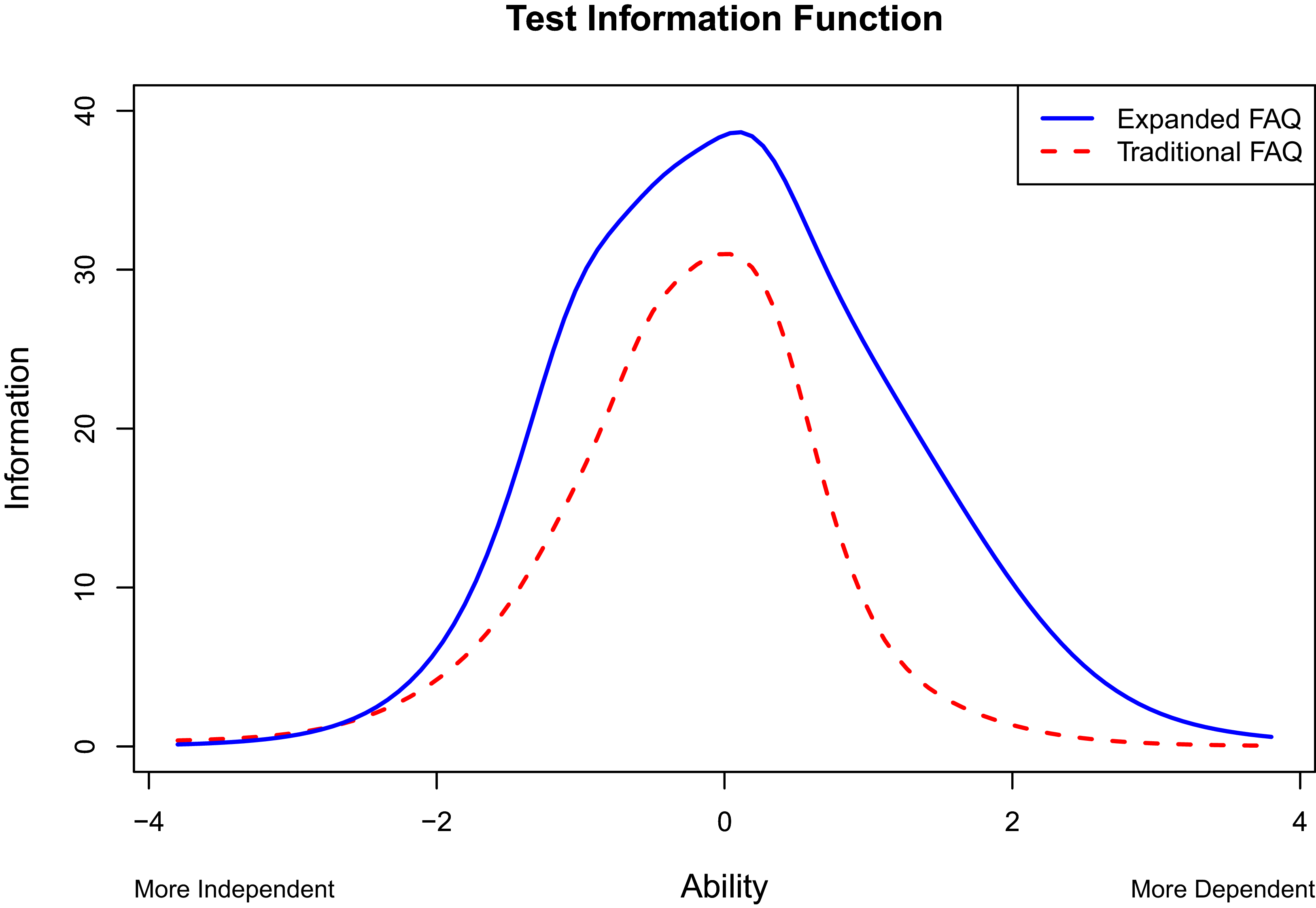
Information refers to the ability of a test, or item, to delineate a range of ability and distinguish between examinees of different ability levels (i.e., theta). Regarding test information, as visualized in Figure 1, adding technological items to the FAQ increased both the total information and range of information gleaned about iADLs relative to the traditional FAQ in isolation.
Test information curves for the traditional and expanded Functional Activities Questionnaire (FAQ). Note: Expanded Functional Activities Questionnaire (FAQ; blue solid line) includes both traditional (red dashed line) and tech FAQ item pool. In this case, higher ability indicates more functional dependence.

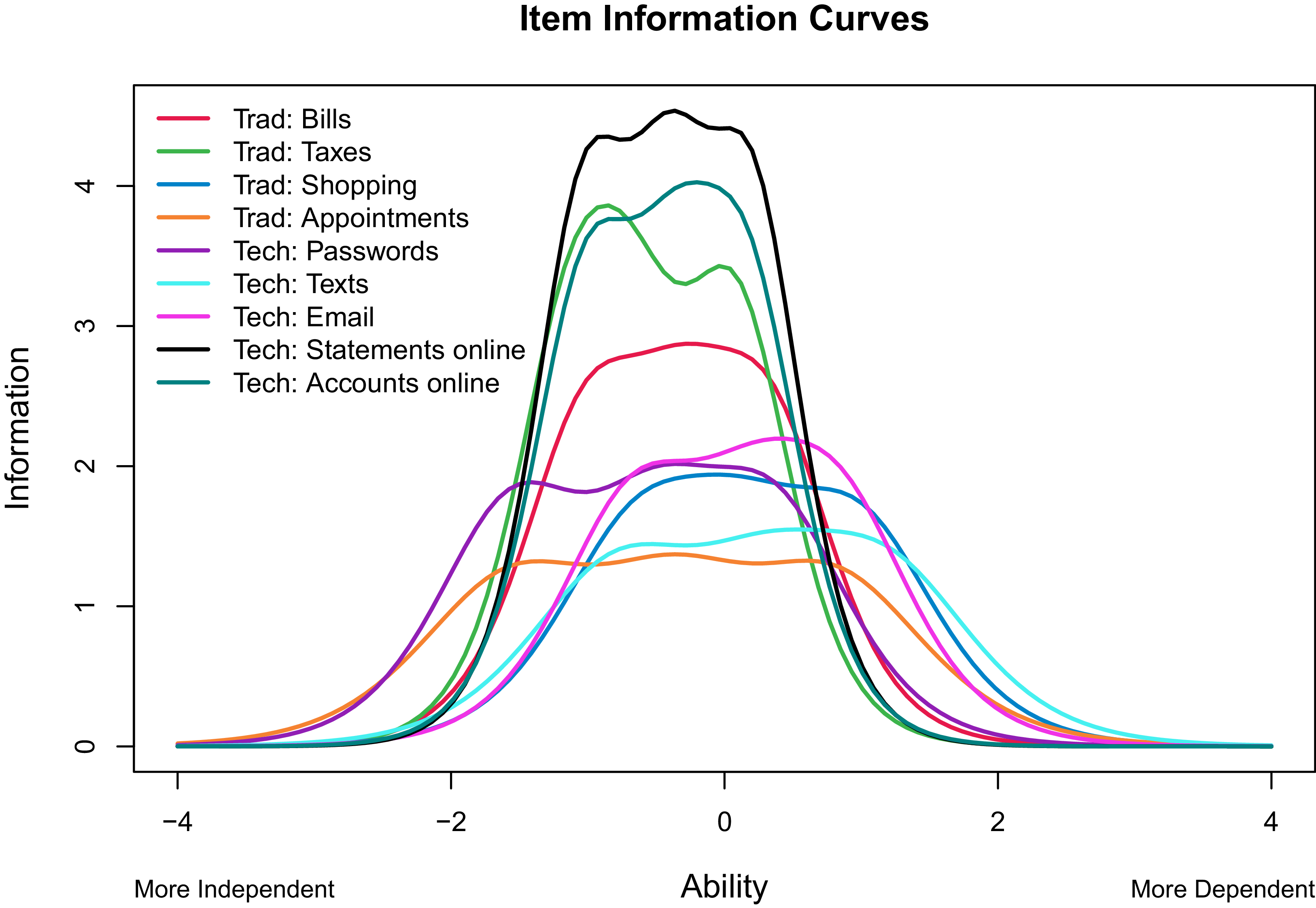
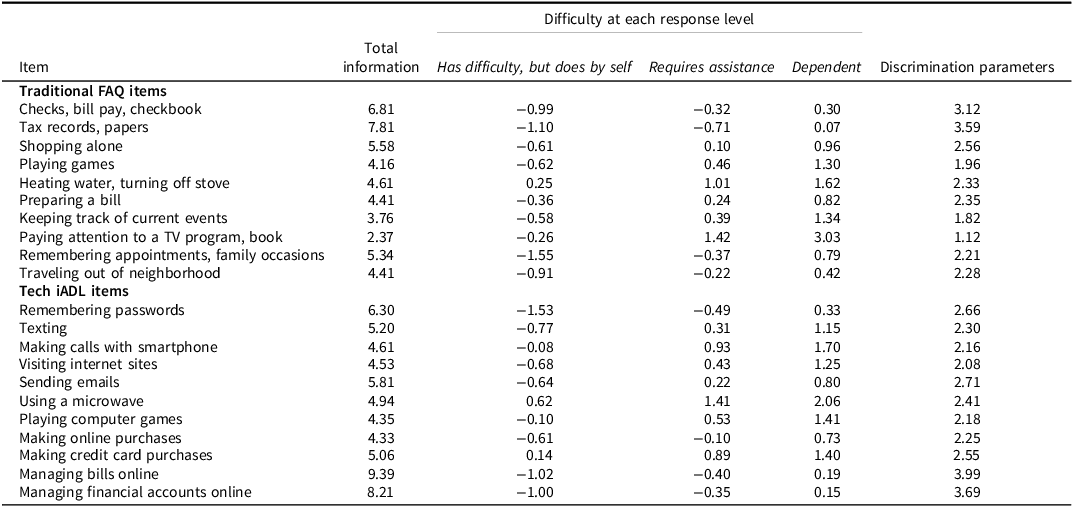
Regarding item information, as noted in Table 3 and illustrated in Figure 2, the items related to financial management, whether done traditionally (checkbook/bills, tax records) or technologically (e-bills, online financial management), were the most informative. Additional traditional items with higher information yield were shopping, and remembering appointments were the most informative. Additional technological items with more information were remembering passwords, texting, emailing, and making credit card purchases.
Item information curves for most informative items in expanded Functional Activities Questionnaire. Note: Plot of item information curves (IICs) for most informative items, including four from traditional FAQ and five from tech FAQ.

Information and item parameters

When considering items that are thematically similar across scales, technological financial management items were more informative than the traditional ones. Similarly, remembering passwords was slightly more informative than remembering appointments or family events.
Item parameters
Difficulty refers to what ability level is needed to have that item endorsed. For the purposes of this paper, iADL questions that demonstrate difficulty parameters at lower levels of disability (to the left of the × axis in Figure 2) are ones where caregivers notice changes with lesser degrees of functional impairment, and items where caregivers do not notice a loss of function until later global iADL impairments are to the right of the × axis in Figure 2.
Using the response option “has difficulty but does by self” as a marker for the most sensitive functional changes (i.e., those with lower theta), tax records and remembering appointments/family events emerged from the traditional FAQ item pool. From the technological item pool, changes in remembering passwords emerged as the earliest functional change, followed by online financial management tasks.
Conversely, using the “dependent” response option, we can model where along the functional continuum iADL’s best discriminate amongst more severe functional impairment. To this end, the traditional item “paying attention to a TV program or book” does not get endorsed as a “dependent” until late in the functional impairment course, while for the technological items, “using a microwave” is the tech behavior with the highest difficulty level.
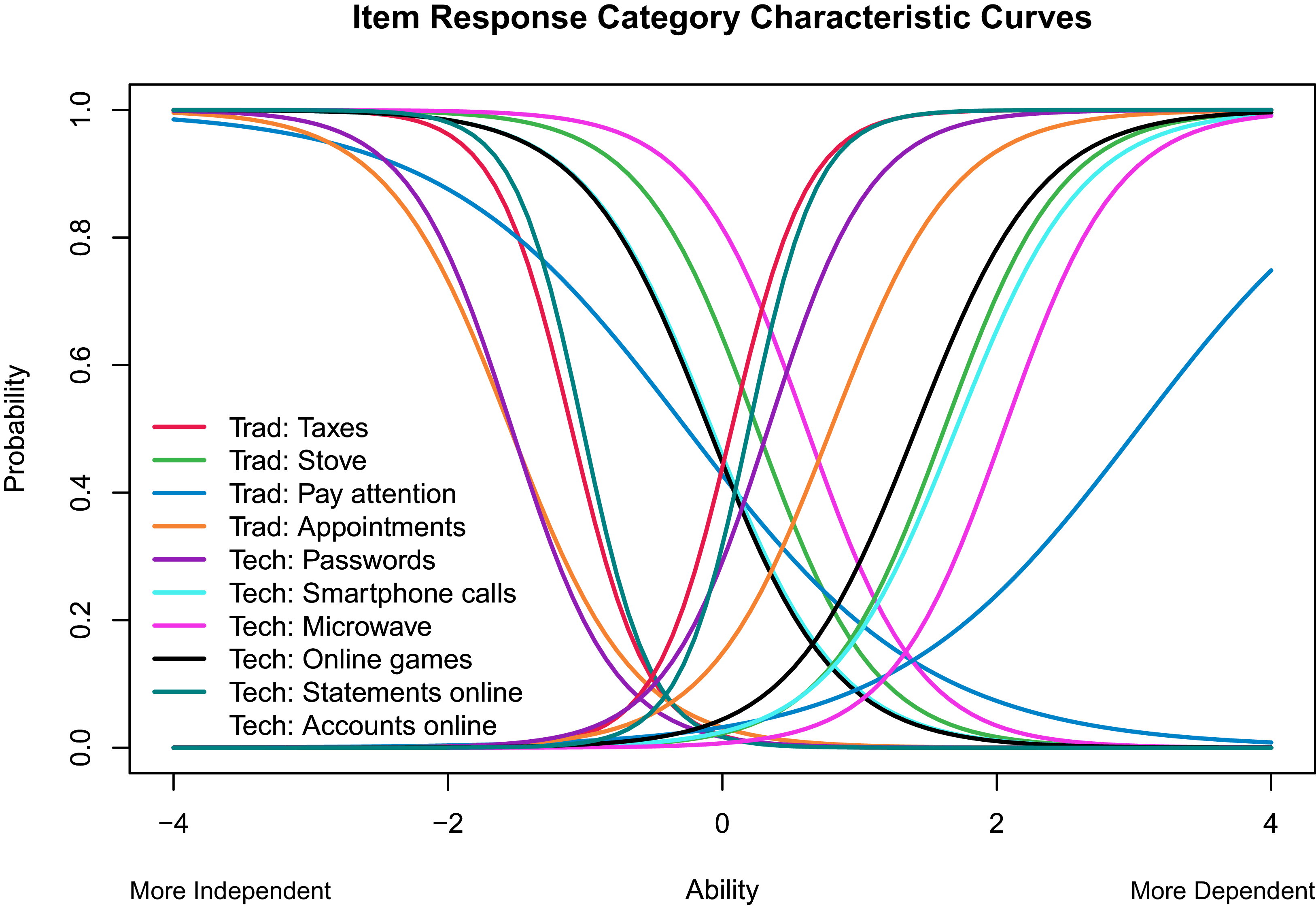
Discrimination refers to how well items distinguish between individuals around a given range of functional impairment. Items with high discrimination on the traditional FAQ included items pertaining to financial management (checkbook/bill pay). The technological versions of these items actually had slightly higher discriminating characteristics than their analog counterparts. Table 3 lists parameters for all items, and Figure 3 visualizes the item characteristic curves for the 10 items with highest and lowest difficulty and discrimination parameters.
Select item characteristic curves (ICCs) for “normal” and “dependent” responses on expanded Functional Activities Questionnaire (FAQ). Note: The five most sensitive items (#2 taxes, #9 remembering appointments, #11 remembering passwords, #20 online statement payment, #21 online account management) and five items that capture the greatest functional difficulty (#5 using stove, #8 attending to conversation, #13 smartphone calling, #16 microwave use, #17 online gaming) have ICCs visualized for the “normal” and “dependent” responses to visualize range of ability captured by expanded FAQ.

Linking and equating scales
The traditional and technological items had a strong correlation (r s = 0.79), supporting appropriateness of linking procedures. The IRT estimates from the NACC (Supplementary Table 1) and clinical-community samples were successfully linked with Stocking-Lord method. The resultant constants (A = −0.663783, B = −0.860992) can be used for linking equations to convert individual theta estimates (θ expanded = [-0.6638 × θ traditional ] −0.8610; θ traditional = [θ expanded + 0.8610] / −0.6638).
Furthermore, equipercentile linking was done to harmonize total raw scores between traditional FAQ (range = 0–30) and expanded FAQ (range = 0–63), as well as between traditional FAQ and tech FAQ. See Table 4 and Supplementary Table 2.
Equipercentile equatings for traditional and expanded FAQ

Discussion
This study evaluated the psychometric properties of a newly developed set of technological iADL items from an IRT framework, seeking to address several questions related to iADL assessment and its changes in the 21st century.
Does asking about daily technology use give new information about iADL status?
From a psychometric sense, our paper demonstrates that adding items that query technological daily activities adds additional information to the assessment of iADLs. These gains occur across the spectrum of disease severity, including earlier and later ends of the functional impairment dimension with several implications for neuropsychologists. Increasing information via technological iADL assessment does allow for better psychometric differentiation among various degrees of underlying functional impairment (de Ayala, Reference de Ayala2022). As intervention trials and updated diagnostic criteria focus more and more on pre- and earliest (i.e., transitional cognitive decline phases (Jack et al., Reference Jack, Andrews, Beach, Buracchio, Dunn, Graf, Hansson, Ho, Jagust, McDade, Molinuevo, Okonkwo, Pani, Rafii, Scheltens, Siemers, Snyder, Sperling, Teunissen and Carrillo2024) of the ADRD continuum (Sperling et al., Reference Sperling, Donohue, Raman, Rafii, Johnson, Masters, van Dyck, Iwatsubo, Marshall, Yaari, Mancini, Holdridge, Case, Sims and Aisen2023), such increases in information particularly in the mildest end of the functional impairment seem poised to be of greater import for assessment-oriented professionals. An alternative hypothesis, however, is that the increased information is attributable to having more items, although the increase at the ends of the ability spectrum may not have been as high as was observed in our sample.
Beyond psychometrics though, we believe asking about interfacing with technology provides additional information that is of relevant clinical use. For example, one of the motivating problems for this line of research was one we faced in clinic with ever-increasing frequency: caregivers querying about “how” they should be rating a traditional iADL item. If bills are on autopay, is the item applicable? Do we rate the individual for if they had to write a check? If they no longer write checks, should an item about check-writing be answered as if they were using a credit card? Specificity in what we are asking seems to increase face validity of items, and we suspect (though we need additional information to confirm this) reduces heterogeneity in item responses. Clearly, information, discrimination, and difficulty parameters differed between asking specifically about the digital technique vs. the traditional form of technology-related items, suggesting raters respond to these items differently, although additional work is needed to determine the clinical significance of this. Asking about digital technologies may also give insights for behaviors that can be leveraged for compensatory purposes, such as regular and relatively preserved smartphone use potentially raising the potential utility of smartphone-based compensatory strategies (Scullin et al., Reference Scullin, Jones, Phenis, Beevers, Rosen, Dinh, Kiselica, Keefe and Benge2022). Thus, psychometric and clinical factors may be important to consider when revising and optimizing iADL measures.
Which technology items may give earlier and later indications about functional changes?
For both traditional and technological iADLs, items tapping financial management were identified as uniquely informative early indicators of functional impairment. This suggests not just the importance of asking about finances in clinical practice but also gives further support for the idea that monitoring of digital financial activities may be an ecologically valid and sensitive measure of functional impairment (Wild et al., Reference Wild, Marcoe, Mattek, Sharma, Loewy, Tischler, Kaye and Karlawish2022). Beyond the realm of finance, difficulty remembering things like passwords in our sample was an informative and sensitive marker of earlier functional impairment, more so than the “remembering events” item in the traditional iADL items. In contrast, other technology items demonstrate changes only in later courses of the disease. For example, difficulties with using a microwave was not particularly informative until later in the functional impairment spectrum, even later than the traditional iADL item querying stove use.
We believe there are two points to be considered from this pattern. First, there will be some technologies that will over time emerge as sensitive early indicators of functional decline. We hypothesize that, in particular, activities that require an individual to keep track of dynamic changes (e.g., frequently changing passwords, user interface schemes, two factor authentication) independent of any automation, may potentially be the functional activities most likely to change early in the course of the disease. In contrast, technology-related ADLs that automate a task (e.g., a microwave that powers off on its own versus a stove that requires active monitoring) may give some degree of independence to individuals later in the functional decline spectrum. In this way, finding technologies that enable (and hinder) independence is important for neuropsychologists working in this area.
This poses broader question that the next generation of neuropsychologists will deal with: in an age of automation, how do we define functional independence? For example, if a person has resources to acquire and utilize a self-driving vehicle, automated medication dispensation, programmed event reminders, and automated financial transactions, are they living independently? How much compensatory behavior is “too much”? Understanding and operationalizing how compensatory behaviors versus independence are measured will likely prove useful for more accurately understanding the lived experience of those with ADRD in the next century (Weakley et al., Reference Weakley, Weakley and Schmitter-Edgecombe2019).
Linking, equating, and “future proofing” daily living assessments
As we note in the introduction, adapting iADL measures is not a problem that gets fixed one time, by one lab, for all time. While there is a need for new tools, there are marked advantages to building on legacy measures that facilitate the leveraging of big data. To this end, we provide a proof of concept in linking and equating expanded instruments. There are many other such approaches that warrant exploration in future studies (de Ayala, Reference de Ayala2022). For example, adaptive testing methods enabled by IRT allow for ability estimates based upon completed items only, allowing for the right mixture of legacy or tech-enabled items to be provided for a particular person without missing data barriers. Such approaches can also enable short form and longer, more detailed iADL assessment, or assessments tailored to particular ability levels such as early or late changes. In this manner, IRT approaches to iADL assessment can help to target a modern clinical and research space, keeping this critical patient-centered domain true to purpose. We provided proof-of-concept NEAT linking, which would be most utilitarian with a technology-facilitated approach to administration and calculation of individual ability. Until such a pipeline is finalized, we also provided equipercentile tables for more easily calculated raw scale totals.
Limitations and future directions
While the current results are promising, there are limitations to consider. First, we note to clinicians and researchers utilizing the linking and equating methods herein that our item development sample is limited in size and representativeness, and future work with broader and more diverse samples will inevitably change item parameter estimates. This was partially reflected in differences documented between the development and larger NACC sample. We ran a Monte Carlo simulation with the expanded FAQ according to recent recommendations (Schroeders & Gnambs, Reference Schroeders and Gnambs2025), which determined that parameter estimates were likely to be defensibly stable in our development sample, save for certain item discrimination parameters; at a sample size of 300, parameters estimate might have been more consistently stable. Second, we note that we did not explicitly address issues related to inapplicability or never used as they relate to this sample, and this as well as generational cohort factors warrant revisitation over time. In addition, we note that the technological iADLs assessed are not all-inclusive. Items related to two-factor authentication, GPS use for navigation, and AI-enabled tool use are all examples of digital technologies either in use or on the rise currently, which are conspicuously absent from our item pool. In this way, our approach is a beginning and not an end.
We do believe this approach points to other future directions. For example, while observer assessment of these digital daily activities seems informative, we need to understand how collateral observations may relate to, or complement, actual digital biomarkers. In addition, focused efforts on iADL item development, particularly in underserved populations, is needed to build adaptable instruments applicable to all. We also note that validation of IRT-informed functional scoring metrics is needed to determine the validity and utility of such approaches. Harmonizing heritage activities with a changing world will be an ongoing journey, and this manuscript charts one path that can be embarked upon.
Supplementary material
The supplementary material for this article can be found at https://doi.org/10.1017/S135561772510163X.
Acknowledgements
None.
Funding statement
Data collection and analyses were supported by the Alzheimer’s Association Research Grant (AARG-22-924771) and the National Institutes of Health (R01AG077017). Portions of this data were presented previously at the Alzheimer’s Association International Conference. The NACC database is funded by NIA/NIH Grant U24 AG072122. NACC data are contributed by the NIA-funded ADRCs: P30 AG062429 (PI James Brewer, MD, PhD), P30 AG066468 (PI Oscar Lopez, MD), P30 AG062421 (PI Bradley Hyman, MD, PhD), P30 AG066509 (PI Thomas Grabowski, MD), P30 AG066514 (PI Mary Sano, PhD), P30 AG066530 (PI Helena Chui, MD), P30 AG066507 (PI Marilyn Albert, PhD), P30 AG066444 (PI David Holtzman, MD), P30 AG066518 (PI Lisa Silbert, MD, MCR), P30 AG066512 (PI Thomas Wisniewski, MD), P30 AG066462 (PI Scott Small, MD), P30 AG072979 (PI David Wolk, MD), P30 AG072972 (PI Charles DeCarli, MD), P30 AG072976 (PI Andrew Saykin, PsyD), P30 AG072975 (PI Julie A. Schneider, MD, MS), P30 AG072978 (PI Ann McKee, MD), P30 AG072977 (PI Robert Vassar, PhD), P30 AG066519 (PI Frank LaFerla, PhD), P30 AG062677 (PI Ronald Petersen, MD, PhD), P30 AG079280 (PI Jessica Langbaum, PhD), P30 AG062422 (PI Gil Rabinovici, MD), P30 AG066511 (PI Allan Levey, MD, PhD), P30 AG072946 (PI Linda Van Eldik, PhD), P30 AG062715 (PI Sanjay Asthana, MD, FRCP), P30 AG072973 (PI Russell Swerdlow, MD), P30 AG066506 (PI Glenn Smith, PhD, ABPP), P30 AG066508 (PI Stephen Strittmatter, MD, PhD), P30 AG066515 (PI Victor Henderson, MD, MS), P30 AG072947 (PI Suzanne Craft, PhD), P30 AG072931 (PI Henry Paulson, MD, PhD), P30 AG066546 (PI Sudha Seshadri, MD), P30 AG086401 (PI Erik Roberson, MD, PhD), P30 AG086404 (PI Gary Rosenberg, MD), P20 AG068082 (PI Angela Jefferson, PhD), P30 AG072958 (PI Heather Whitson, MD), P30 AG072959 (PI James Leverenz, MD).
Competing interests
None.