Introduction
Meat chickens (Gallus gallus domesticus) are grown commercially in fully-housed, free-range and organic systems. Eighty percent of global production and 92-95% of European and other developed country systems use conventional, fully-housed systems (ACMF, 2009a). Compared with other animal farming methods, this system of production is most removed from the natural environment of the progenitors of the modern commercial animal, in this case Gallus gallus jungle fowl (Liu et al., Reference LIU, WU, YAO, MIAO, LUIKART, BAIG, BEJA-PEREIRA, DING, PALANICHAMY and ZHANG2006), when considering stocking density, group size and environmental control.
In conjunction with modifications to indoor environment systems and nutrition, the conventional meat chicken is selectively bred to achieve commercially-important targets, especially efficient feed conversion and rapid growth rate, with approximately 3 kg of feed producing a 2 kg meat chicken in 35 days (Julian, Reference JULIAN1998; Halevy et al., Reference HALEVY, YAHAV and ROZENBOIM2006). The conventional, fully-enclosed broiler house can be considered as essentially a ‘closed system’ (Kratz et al., Reference KRATZ, ROGASIK and SCHNUG2004). That is, in addition to the selective genetics introduced, the inputs of a formulated grain-based diet, artificial lighting, water, and a suitable litter or ground substrate are carefully managed in an artificial environment to generate a consistent supply of inexpensive meat.
The drive towards factory-line efficiencies in terms of costing and supply for conventional chicken meat production often extends to the control of the resource supply chain in a process termed ‘vertical integration’, whereby a single company or integrator controls breeding, hatching, milling and supply of feed and medication, and transport and slaughter of the poultry (Kvaløy and Tveterå, Reference KVALØY and TVETERÅ2008). The actual management or ‘grow-out’ of the meat chickens, including labour practices, is usually outsourced to farm owners supplying housing, equipment and labour, or contracted stockpersons with a tenancy agreement on the farm. In countries where they exist, stocking densities and most other welfare-related aspects of management are determined by codes of practice or other forms of regulatory or quasi-regulatory control.
Key distinctions between regional approaches to meat chicken welfare arise not only from climatic differences - that is, temperature, humidity, and the attendant influence on litter materials, grain types and water quality - but also from differences in market culture arising from the association with vertical integration. Recent media publicity concerning meat chicken welfare in the UK and other European nations has encouraged consumers to purchase free-range and organic poultry (Sørensen et al., Reference SØRENSEN, EDWARDS, NOORDHUIZEN and GUNNARSSON2006). The free-range chicken component of the Australian meat chicken industry is also expanding rapidly, from 4% in 2007 to an estimated 9% by the end of 2009 (ACMF, 2009b). The difference in the market dominance of meat chicken companies also creates a difference in welfare approaches between regions. In Europe the largest company supplies less than 8% of the market, and the top ten companies together supply almost 30% of the chicken meat consumed annually across Europe (Harris, Reference HARRIS2007). Research is largely funded through state government, European Union channels, with some input from welfare groups such as RSPCA. In contrast to this, in Australia two companies (Ingham's Enterprises and Baiada Poultry) together supply over 80% of the current domestic market – both conventional and free-range meat chickens combined (ACMF, 2009b), creating a duopoly that restricts competition for market share. This dominance influences the type of research funded and level of support, since it is mainly funded by the companies concerned with some matched government funding. Identifying the total funding provided for meat chicken welfare research is extremely difficult, depending in particular on the definition of welfare research employed. For example, although in Australia approximately AU $75 million has been provided to develop poultry research from 2003 to 2010, the estimate by the Australian Animal Welfare Strategy of $70000 per annum. supporting welfare research ignores funds spent in improving disease control and nutrition (Anon, Reference ANON2010). Ten funded projects have been identified as related specifically to ‘welfare’ but aspects of many others include elements of meat chicken welfare. An evaluation of relative input into welfare research is therefore better achieved by comparing published output on meat chicken welfare, which is attempted below.
The main benefit of vertical integration is that there is greater control of the interacting processes in the food chain; changes to industry minimum standards can be rapidly implemented and effectively monitored. For example in Australia average meat chicken mortalities are under 2% (Barnett and Glatz, Reference BARNETT and GLATZ2004), which is less than the reported range in the EU of 4 to 7% (SCAHAW, 2000). Similar mortality data are elusive from New Zealand and the US, where the degree of vertical integration is high, but has been assumed to be approximately 4% (Bagshaw et al., Reference BAGSHAW, MATTHEWS and ROGERS2006).
A negative impact of vertical integration on meat chicken welfare in the US (where the top ten companies supply over 60% of the domestic market), Australia and New Zealand (where three companies supply over 98% of the domestic market, Morris, Reference MORRIS2009) stems from the limited competition within the industry. In these countries, which all utilise industry self-regulation, research, research funding and political legislation is directed towards aspects of animal welfare that link directly to profitability, such as mortality and health, and performance. Comparatively little attention is paid to the mental or affective state of the animal and meat chicken welfare research published in international peer-reviewed journals focuses almost exclusively on outcome-based measures of health (Barnett and Glatz, Reference BARNETT and GLATZ2004). The majority of studies of welfare that incorporate measures of meat chicken behaviour and cognitive function are conducted in the UK and their trading partners (Abeyesinghe et al., Reference ABEYESINGHE, NICOL, HARTNELL and WATHES2005). There is comparatively more behavioural research conducted in the US in relation to meat chicken welfare, where market consolidation is comparatively less than that experienced in Australia and New Zealand. A recent survey of Canadian poultry welfare research (Anon) has demonstrated that, apart from research focused on health, little welfare research is conducted, even though there are substantial facilities in several institutions. A considerable degree of autonomy is afforded to university academics in their choice of research topics, and the prominence of poultry welfare research in any country is likely to depend to some extent on the interests of the small number of individuals involved in animal welfare and poultry research.
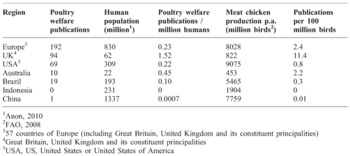
An ISI Web of Science search for ‘meat chicken or broiler’ and ‘welfare or wellbeing’ in journal articles’ abstract or title, together with key meat chicken or animal welfare article producing countries reveals the regionalisation of scientific research (Table 1). We do not include industry or other funded final reports because these are not peer-reviewed and are often of limited access. Our survey demonstrates that in the 57 countries of Europe there was a particularly high output of welfare publications, both in relation to the human population and meat chicken production. A large proportion of these came from the United Kingdom. The USA had a similar publication rate to Europe, relative to human population, but had a relatively low publication rate relative to the size of its meat chicken industry. Australia had a higher rate of publication than Europe relative to human population but one which was similar relative to their bird population. Moreover, those papers relating to meat chicken welfare in Australia consist either of advances in the field of tunnel ventilation of broiler houses, or are reviews of studies conducted overseas, which are usually more frequently cited than original research articles therefore explaining a relatively high citation rate for Australian articles. Three other major producers in the world, Brazil, Indonesia and China all had very low levels of publication relative to either human or meat chicken populations, although the importance of providing high welfare standards appears to be recognised in Brazil at least (Mollo et al., Reference MOLLO, VENDRAMETTO and OKANO2009). Research in these countries is more likely to be focused on production benefits, for example the recent research to elucidate the impact of high vehicle temperatures on the meat quality of broilers in Brazil (Simoes et al., Reference SIMOES, OBA, MATSUO, ROSSA, SHIMOKOMAKI and IDA2009).
This evidence suggests that welfare research in meat chickens is not dependent on chicken meat production levels but rather on the level of concern for animal welfare in the country, which is particularly high in the United Kingdom (Meng et al., Reference MENG, HAO, HOU, ILLMANNOVÁ, ALONSO, HANLON, ALDAVOOD, CHOE, LEE, HANDZISKA, KJASTAD, LUND, OLSSON, REHN, KEELING, PELAGIC, KENNEDY and PHILLIPS2009). In theory at least, this concern is responded to by government, which makes funding available for the research.
Publications including the terms (meat chicken or broiler) and (welfare or wellbeing) in the ISI Web of Science, all years.

1Anon, Reference ANON2010
2FAO, Reference FAO2008
357 countries of Europe (including Great Britain, United Kingdom and its constituent principalities)
4Great Britain, United Kingdom and its constituent principalities
5USA, US, United States or United States of America
The major meat chicken producers of the world (USA, Brazil and China) differ from the European Union in their low level of regulation of the welfare aspects of chicken production (Van Horne and Achterbosch, Reference VAN HORNE and ACHTERBOSCH2008). In the United Kingdom, the RSPCA takes an increasingly active role in developing and administering an audit system (RSPCA, Reference RSPCA2006). In the EU, a Council Directive for Meat Chicken Welfare was passed recently (EUCD, 2007), which sets the basic requirements, for all holdings of chickens kept for meat production (Veissier et al., Reference VEISSIER, BUTTERWORTH, BOCK and ROE2008). This Directive has been criticised by activist groups as ‘failing to provide any significant welfare requirements on the industry’, whilst providing a ‘cloak of legislative respectability’ (Stevenson, Reference STEVENSON2009). However, maximum stocking densities are, for the first time, mandated. The European states raising the greatest objections to the stocking density regulations when in draft form (SCAHAW, 2000) were France, Poland, the Czech Republic, Hungary, Slovakia and Romania – the states with most vertical integration of their industries. In the United States of America many State animal cruelty legislation excludes farm animals, but the National Chicken Council has issued voluntary animal welfare guidelines. In China and Brazil there is no effective legislation governing the welfare of meat chickens, but this is closely related to these countries’ poor economic state (Van Horne and Achterbosch, Reference VAN HORNE and ACHTERBOSCH2008). Australia too has a low level of legislative control relative to its economic position (Van Horne and Achterbosch, Reference VAN HORNE and ACHTERBOSCH2008). Minimum standards are provided by a Model Code of Practice, which is intended to develop and promote sustainable, innovative and profitable meat chicken production (PISC, 2002). It is supported by animal welfare and cruelty legislation in the States and Territories of Australia, some of which adopt specific compulsory provisions from the Code. For example the Queensland Animal Care and Protection Act of 2002 mandates maximum permitted stocking densities, as well as feed, water and inspection requirements. Apart from these provisions, compliance with the provisions of the Code is not compulsory but can be taken as evidence that those in charge have complied with their duty of care under the relevant legislation. Voluntary audit schemes on a wide range of welfare issues have been devised for Australian production systems (Barnett and Glatz, Reference BARNETT and GLATZ2004).
Genetic basis of the industries
There are two main conventional meat chicken strains of commercial significance in the major producing countries of the world: the Ross bird (a European variety purchased from pedigree stock under licence from the Aviagen Company to Ingham's Enterprises) and the Cobb bird (an American variety from Tyson Foods, licensed to Baiada Poultry). These strains dominate the production systems in the USA and Australia. Meat chicken companies in the EU use predominately Ross, Cobb and the slower-growing Hubbard strains (Brown et al., Reference BROWN, NUTE, BAKER, HUGHES and WARRISS2008). In Australia, the Cobb 500 bird purchased by Inghams Enterprises has been crossed to improve leg strength and avert the deformity problems encountered with the Cobb 500 pedigree (McKenzie and Walsh, Reference MCKENZIE and WALSH2009). The welfare of meat chicken breeders is not adequately addressed in Australian (PISC, 2002) or European (EUCD, 2007) standards, even though this has a direct influence on the adaptability and survivability of the young meat chicken (Leone and Estévez, Reference LEONE and ESTÉVEZ2008c). As well as genetic issues, the necessity for beak trimming of breeders to avoid trauma as they mature sexually gives cause for concern, even though when performed by skilled personnel on the day of hatch, it causes little measurable effect on performance (Henderson et al., Reference HENDERSON, BARTON, WOLFENDEN, HIGGINS, HIGGINS, KUENZEL, LESTER, TELLEZ and HARGIS2009). Dubbing is a controversial practice that involves removal of the comb of breeders to reduce damage during aggression, which is outlawed in some countries. Identification methods may also be a cause for concern.
Key welfare issues
growth rates
Until mid 20th C chicken meat and eggs were derived from ‘utility’ chicken breeds (e.g. Orpington and Sussex breeds in the UK, Australorp in Australia), after which there was selection of specific characteristics to develop the modern layer and meat chicken breeds. Of the latter, ‘fast’ and ‘slow’ growing lines have been identified, which reach a dressed weight of 2 kg at 35 to 55 days or 65 to 81 days, respectively (Bokkers and Koene, Reference BOKKERS and KOENE2003). Fast-growing lines can further be separated into ‘standard’ lines selected for body weight, or a ‘heavy’ line for rapid growth and breast meat yield (Berri et al., Reference BERRI, DEBUT, SANTÉ-LHOUTELLIER, ARNOULD, BOUTTEN, SELLIER, BAÉZA, JEHL, JÉGO, DUCLOS and LE BIHAN-DUVAL2005). In a novel venture for accreditation programmes, the RSPCA Freedom Foods standards in the UK have restricted growth rate potential to 45 g/d (RSPCA, Reference RSPCA2006).
The rapid growth rate of standard meat chickens is linked with a series of physiological problems leading to higher mortality during grow-out (Julian, Reference JULIAN2005). Breast muscle is the major target tissue, undergoing skeletal myocyte hypertrophy with satellite cell proliferation and differentiation, causing imbalances in bone and cardiac physiology (Halevy et al., Reference HALEVY, YAHAV and ROZENBOIM2006). This corresponds with limb deformations and cardiovascular disease, including sudden death syndrome (Bessei, Reference BESSEI2006), pulmonary hypertension syndrome (ascites: Julian, Reference JULIAN1998; Baghbanzadeh and Decuypere, Reference BAGHBANZADEH and DECUYPERE2008), and leg disorders including tibial dyschondroplasia, varus/valgus deformations, crooked toes, and femoral head necrosis (Bessei, Reference BESSEI2006). Fast growing chickens, with increased heart abnormalities, tendon degeneration, scoliosis and rotated tibia, spend more time sitting on the floor and less time on perches, walking and scratching, compared with slow growing chickens, and corresponding mortality rates for fast and slow growing birds of 2 and 15%, respectively (Bokkers and Koene, Reference BOKKERS and KOENE2003).
Genetic selection has contributed approximately 50 to 60% of the increased growth rates observed in conventional meat chickens, with 20 to 25% estimated due to improvements in nutrition and the remainder contributed by improvements in housing and husbandry techniques (Pollock, Reference POLLOCK1999). Non-specific factors governing the growth rate of conventional meat chickens include: breed (e.g. between Ross and Cobb birds); age (growth rates decrease after 32 to 35 days); gender (males grow faster); and age of parent flock (ageing flocks produce bigger eggs and the chicks from larger eggs grow faster) (Cangar et al., Reference CANGAR, AERTS, VRANKEN and BERCKMANS2008).
The growing market share in the EU and US of free-range (including organic) chicken meat has led to the development of slower-growing lines such as the Ross Rowan and Cobb-Sasso by those trans-national companies dominating the conventional chicken meat market (Aviagen and Tyson Foods, respectively). These slower lines take 50 to 100% longer to reach the grow-out target weights of their fast-growing counterparts and are better suited to free-range conditions (Fanatico et al., Reference FANATICO, PILLAI, HESTER, FALCONE, MENCH, OWENS and EMMERT2008). Slower growing lines of meat chickens have been developed independently in the EU, with the market there dominated by the Label Rouge and Sasso companies (Fumiere et al., Reference FUMIERE, DUBOIS, GREGOIRE, THEWIS and BERBEN2003).
Although fast-growing lines are bred specifically for fully-housed systems they can also be used in free-range systems (Dawkins et al., Reference DAWKINS, DONNELLY and JONES2004; Jones et al., Reference JONES, FEBER, HEMERY, COOK, JAMES, LAMBERTH and DAWKINS2007). The commercial returns from moving out of conventional into free-range systems are limited for growers, due to the greater economy of scale facilitated by fast-growing strains stocked at maximum legal density with little detriment to meat quality (Meluzzi et al., Reference MELUZZI, FABBRI, FOLEGATTI and SIRRI2008; Buijs et al., Reference BUIJS, KEELING, RETTENBACHER, VAN POUCKE and TUYTTENS2009). Fast-growing strains encounter fewer metabolic problems when reared in a free-range system than in the fully-housed system, but it takes longer to reach market weight (Fanatico et al., Reference FANATICO, PILLAI, HESTER, FALCONE, MENCH, OWENS and EMMERT2008). In free-range systems they do, however, have higher cumulative mortality and physiological problems than slower-growing strains (Dawkins et al., Reference DAWKINS, COOK, WHITTINGHAM, MANSELL and HARPER2003; Dawkins et al., Reference DAWKINS, DONNELLY and JONES2004; Jones et al., Reference JONES, DONNELLY and STAMP DAWKINS2005; Jones et al., Reference JONES, FEBER, HEMERY, COOK, JAMES, LAMBERTH and DAWKINS2007).
Growth rates of fast-growing strains can be controlled by two main methods that prevent the welfare problems and mortality typically encountered by weeks five and six of the grow-out period
feed quantity and quality restriction
Feed and clean water is usually available to meat chickens 24 hours a day, although some operators make feed available at specific 'meal times' only, which may stimulate better digestion, improve bone strength and prevent birds from becoming obese (Petek et al., Reference PETEK, SÖNMEZ, YILDIZ and BASPINAR2005). Feed quantity restriction is a common practice in the US but generally not acceptable in EU and Australian meat chicken systems, with the exception of meat chicken breeders (Mench, Reference MENCH2002). Feed restriction can reduce health problems by reducing growth rates (Bizeray et al., Reference BIZERAY, LETERRIER, CONSTANTIN, PICARD and FAURE2002a) and abdominal fat (Plavnik and Balnave, Reference PLAVNIK and BALNAVE1992), but results in birds being chronically hungry, whether they are restricted in quantity or quality of their diet (Mench, Reference MENCH2002). In conventional chicken meat programmes, the type and composition of the feed pellets are changed through the grow-out period to accommodate and control muscle yield, as ‘grower’ and ‘finisher’ pellets. In particular manipulation of protein and carbohydrate composition of high and low nutritional or energy densities in feed pellets can modulate weight gain over the grow-out period (Fanatico et al., Reference FANATICO, PILLAI, HESTER, FALCONE, MENCH, OWENS and EMMERT2008).
lighting regimes to govern activity and metabolism
Feed intake in the first week of life is crucial to growth rate-related welfare issues before the end of the grow-out period (Sandilands et al., Reference SANDILANDS, TOLKAMP, SAVORY and KYRIAZAKIS2006). Chicks have limited ability to thermoregulate and are provided additional heating from a continuous light source. In large sheds forced-air furnaces and radiant heating are the two basic methods of providing heat to young chicks. Hot air rises and ceiling fans are used to reduce the temperature differential between the floor and ceiling in the house. Side wall inlets (mini-vents) are used to bring in air from outside directed toward the ceiling and then push the hot air produced by the furnace to the floor. Radiant heaters provide heat in the form of infra red light to objects instead of the air. Chicks can locate the desired temperature by moving to the appropriate microclimate.
Whilst heating issues in countries with hot climates, such as Australia, are generally solved by the use of radiant heat sources, in Europe and other colder climates sophisticated systems of microclimate control using force-air furnaces, ceiling fans, and heat-exchanging air vents are employed. Increasing light intensity in early life stimulates activity, to support activity-related bone growth and facilitate muscle growth over the final weeks of grow-out, when the lighting intensity is usually reduced (Alvino et al., Reference ALVINO, ARCHER and MENCH2009). A lighting pattern is necessary that has at least 8 hours of near-darkness (less than 5 lux) to encourage normal diurnal rhythms (Alvino et al., Reference ALVINO, ARCHER and MENCH2009).
environment
The floor
The material utilised on the floor as an absorbent and for bedding is dependent on locally-available materials, stocking density and risk of disease transmission. For example in Australia, the normal system employed for growing meat chickens is a deep litter system approximately 50 mm deep, using wood shavings, rice hulls, sawdust or less frequently chopped wheat stalk. The condition of the litter is crucial to the welfare of the meat chickens as it retains the waste solids: too dry and dust can cause respiratory problems, too moist and contact dermatitis, hock burn and viral, bacterial and mycoplasmic infections thrive (Buijs et al., Reference BUIJS, KEELING, RETTENBACHER, VAN POUCKE and TUYTTENS2009).
The aerial environment
The housing temperature and humidity conditions are usually controlled via a range of ventilation systems (i.e. tunnel ventilation and extractors, evaporative coolers, fans, and breeze ways in older meat chicken houses) in an attempt to prevent accumulation of pathogens, moisture, dust, ammonia and other noxious gases. Thus, nutrition, lighting, litter quality, temperature and humidity, air quality, and stocking density are all interrelated environmental variables which impact on the health and welfare of the fully-housed meat chickens. The use of modelling techniques to understand the interactions between these variables has advanced significantly, and there is an advantage to monopolies or oligopolies in the application of new technologies to regulate internal pollution. Increased importance of this issue is anticipated due to the escalating cost of heating chicken houses, reduced availability of high protein feed for feeding to meat chickens as a result of global food shortages, the human health impacts of pathogen contamination of chickens, e.g. by Campylobacter spp., the potential for impact of odours from chicken sheds on human populations in the vicinity and the high welfare impact of pollution of the microenvironment in the meat chicken shed.
nutrition
Providing a cost-effective supply of feed for meat chickens mainly relies on types of grain, especially wheat, which are locally available. Wheat varieties that are comparatively hard-grained with high levels of protein, for example those used in Australia, possess more digestible carbohydrates, in contrast to European varieties (Carré et al., Reference CARRÉ, MIGNON-GRASTEAU, PÉRON, JUIN and BASTIANELLI2007). Microbial digestion and uptake in the lower gut are enhanced by the addition of whole and hard grains in the pellet feed, which contribute to development and health of the gizzard and have beneficial effects on gut motility and biota. Choice is normally eliminated in intensive systems, but if birds are provided with a choice of high protein or energy feeds they do not maximise either growth or feed efficiency, and end up 15% lighter than those on a conventional single feed programme (Siegel et al., Reference SIEGEL, PICARD, NIR, DUNNINGTON, WILLEMSEN and WILLIAMS1997). This suggests that single diets developed to maximise growth and feed conversion may not reflect the biological needs of meat chickens (Leeson and Caston, Reference LEESON and CASTON1993; Cerrate et al., Reference CERRATE, WANG, COTO, YAN and WALDROUP2007). If given unrestricted access to a single feed, they over eat, with the enzyme AMP-activated protein kinase implicated in deficient cellular metabolic regulation, in particular responses to fluctuations in the levels of cellular energy and other nutrients (Richards and Proszkowiec-Weglarz, Reference RICHARDS and PROSZKOWIEC-WEGLARZ2007).
lighting
A minimum of 4 lux is required to penetrate the skull and reach the pineal gland, which then suppresses the production and release of serotonin and melatonin (Brennan et al., Reference BRENNAN, HENDRICKS, EL-SHEIKH and MASHALY2002). Non-intestinal alkaline phosphatase activity is enhanced during dark periods (Hocking et al., Reference HOCKING, MAXWELL, ROBERTSON and MITCHELL2001), which are therefore required on a daily cycle (e.g. 20 h L: 4 h D) to stimulate immunological and bone growth functions. Low light levels provided on a continuous basis are probably deleterious to meat chicken welfare, for example, 2 lux (the Australian minimum standard 3 d after hatching (PISC, 2002)), in contrast to the EU Directive (EUCD, 2007), which requires a minimum of 20 lux. Low light intensity reduces activity (and hence food consumption) and increases lameness and aggression (Prayitno et al., Reference PRAYITNO, PHILLIPS and STOKES1997b), although there is little aggression seen in birds at this young age.
The usual pattern in light-proof meat chicken houses is 23 L:1 D, with the dark period provided to ensure that birds have experience of darkness and do not panic if power is lost in a 24 L regime, in which case they could crowd into corners and suffocate. Long daylengths lead to high feed intakes, which increase growth rate, and active birds, which reduces lameness (Classen and Riddell, 1990; Prayitno et al., Reference PRAYITNO, PHILLIPS and OMED1997a; Prayitno et al., Reference PRAYITNO, PHILLIPS and STOKES1997b). Intermittent cycles, e.g. 15 min/hour L have been used to increase feed intake (Rozenboim et al., Reference ROZENBOIM, ROBINZON and ROSENSTRAUCH1999) but have adverse effects on behaviour, such as reduced synchronisation of sleeping (Blokhuis, Reference BLOKHUIS1983).
Light intensity is usually set at about 38 lux for the first five days initially, to stimulate activity and eye development, and it is then reduced to improve the bird's ability to cope with the increasing stocking density. Red coloured light increases activity and reduces lameness (Prayitno et al., Reference PRAYITNO, PHILLIPS and OMED1997a; Prayitno et al., Reference PRAYITNO, PHILLIPS and STOKES1997b), and can reduce cannibalism if birds are unable to see blood on vent-pecked individuals (Schumaier et al., Reference SCHUMAIER, HARRISON and MCGINNIS1968), even though this is relatively rare compared to laying birds. Split-level lighting in houses might offer birds choices but could force some to dwell in areas which are inadequately lit as they trade off stocking density with preferred lighting level (Bizeray et al., Reference BIZERAY, ESTEVEZ, LETERRIER and FAURE2002b).
litter quality
Litter material selection is related to what is regionally available. Commonly selected materials in Europe include wheat stalks, which is chopped to improve drainage but is associated with leg problems (Knowles et al., Reference KNOWLES, KESTIN, HASLAM, BROWN, GREEN, BUTTERWORTH, POPE, PFEIFFER and NICOL2008), wood shavings and sawdust. The main litter substrates in hotter climates such as Australia are wood shavings, sawdust, sugarcane mulch and rice hulls. Chopped wheat stalks may be able if drought conditions preclude other litter types. The litter substrate is important to encourage a natural behavioural repertoire and physical activity: dust bathing, scratching and foraging behaviours.
Litter material is not cleaned or replaced during the grow-out period, and thus the physical qualities of the litter substrate and pervading housing conditions (i.e. temperature and humidity) together are crucial in controlling hygiene and pathogen load at high stocking densities. Continuously damp or wet litter leads directly to ammonia production (Bessei, Reference BESSEI2006; Haslam et al., Reference HASLAM, BROWN, WILKINS, KESTIN, WARRISS and NICOL2006), which is irritating to chickens’ eyes and respiratory systems at high concentrations (≥20 ppm: PISC, 2002). Prolonged contact with wet litter causes lesions on the chickens’ feet, hocks and breast, leading to meat quality degradation but also to impaired gait and reduced ambulatory activity. Contact dermatitis is the result of excessive sitting and poor litter quality (Haslam et al., Reference HASLAM, BROWN, WILKINS, KESTIN, WARRISS and NICOL2006; Meluzzi et al., Reference MELUZZI, FABBRI, FOLEGATTI and SIRRI2008; Buijs et al., Reference BUIJS, KEELING, RETTENBACHER, VAN POUCKE and TUYTTENS2009). Ammonia burns on the hocks, feet (pododermatitis) and breast are directly related to both activity rates and environmental factors such as litter quality and humidity (e.g. Dawkins et al., Reference DAWKINS, DONNELLY and JONES2004). Sitting and lying in fast-growing meat chickens increase with age from 75% in the first week to 90% at 5 weeks of age (Bessei, Reference BESSEI2006). The litter absorbs moisture away from wet areas to be dispersed via evaporation; housing humidity is therefore crucial to be controlled within a narrow range to prevent the litter from remaining damp or becoming too dry and dusty. In perchery systems, an effect of strain of bird on breast blister incidence have been detected, with the Labresse strain being more susceptible due to its reluctance to use perches than the i657 strain, and males more susceptible than females (Nielsen, Reference NIELSEN2004).
temperature and humidity
Meat chickens are produced across the world's climatic regions, demonstrating the ability of controlled environment housing to modulate conditions to make them suitable for rapid growth birds. Usually the principal meat chicken production regions reside close to the major population centres. For example in Australia they predominate on the eastern and south-eastern coast, occupying tropical savanna (Queensland), warm oceanic/humid subtropical (Queensland, New South Wales), Mediterranean (Western Australia and South Australia), and temperate oceanic (Victoria, Tasmania) climatic zones (Peel et al., Reference PEEL, FINLAYSON and MCMAHON2007; Voiceless, Reference VOICELESS2008). In Europe the principal countries producing meat chickens are in the cool temperate regions of France, United Kingdom, Spain and Germany (comprising 52% of total EU production), with lesser amounts from Poland, Italy and the Netherlands (25% of total EU production: Windhorst, Reference WINDHORST2008). The potential heat load is significantly greater in Australian than Europe. Indoor temperatures of over 30°C with relative humidity levels over 80% are particularly stressful to the chickens. Environmental relative humidity below 50% leads to an increase in airborne particulate matter, including dust and micro-organisms, increasing susceptibility to respiratory diseases. However, most intensive rearing environments have some air temperature and humidity control, such as tunnel ventilation systems. The provision of adequate ventilation provides not only the most effective method of controlling temperature within the house, but it also enables humidity control (Jones et al., Reference JONES, DONNELLY and STAMP DAWKINS2005). At high stocking densities the birds themselves prevent effective transfer of heat from the litter to the atmosphere, particularly in the late stages of growth restricting the ventilation system effectiveness (Bessei, Reference BESSEI2006). Furthermore, at high stocking densities increased moisture content of the litter enhances microbial activity and heat generation (Bessei, Reference BESSEI2006).
Thermoregulation in meat chickens towards the end of the grow-out period is complicated by high energy diets, relative inactivity of the chickens and their growth-related increase in stocking density. Fast-growing chickens are predisposed to becoming heat stressed and if temperature and humidity are inadequate they often pant. In extreme cases birds can die from heat exhaustion. Incubation temperature manipulation (warmer or cooler than the industry standard 37-39°C) and ambient temperature manipulation in the first week post-hatching enable chicks to adapt to a wider range of thermal conditions (Halevy et al., Reference HALEVY, KRISPIN, LESHEM, MCMURTRY and YAHAV2001; Lin et al., Reference LIN, JIAO, BUYSE and DECUYPERE2006). In elevated temperatures, ‘hot-incubated’ chicks reduce weight initially but compensate and regain weight over a few days, whereas normal-incubated chicks do not recover their weight loss, and have significantly higher mortality rate (Halevy et al., Reference HALEVY, KRISPIN, LESHEM, MCMURTRY and YAHAV2001).
stocking density, group and house size
These three factors interact to provide an environment which may impact on the chicken's degree of socialisation, inter-individual distance and locomotion (Leone and Estevez, Reference LEONE and ESTEVEZ2008a; Leone and Estevez, Reference LEONE and ESTEVEZ2008b). Dawkins et al. (Reference DAWKINS, DONNELLY and JONES2004) claimed that stocking density is not a major contributor to welfare status, but they only investigated a narrow range of densities, all greater than 30 kg/m2 (Broom and Fraser, Reference BROOM and FRASER2007). Over a broader range stocking density has the potential to affect both the link between the environment and welfare and the cognitive responses to other birds. Litter quality deteriorates and there is potential for adverse health consequences (see above). The interaction frequency with other birds is necessarily greater, which may cause stress as birds are unable to recognise conspecifics and vocalise more frequently to determine their position in the peck order. In addition, the opportunities to perform natural behaviours, such as wing flapping, are diminished. Locomotion and environmental exploration are inhibited, predisposing birds to contact dermatitis, and birds spend longer sleeping, congregate around feeders and become more fearful (Andrews et al., Reference ANDREWS, OMED and PHILLIPS1997). In a recent study, leg strength showed a major decrease as stocking densities increased from 6 to 23 kg/m2, hock dermatitis increased as densities increased from 35 to 56 kg/m2, and footpad dermatitis and fearfulness were increased at the highest density of 56 kg/m2 (Buijs et al., Reference BUIJS, KEELING, RETTENBACHER, VAN POUCKE and TUYTTENS2009). Thus different aspects of welfare are affected at different stocking densities and there is no clear cut-off point at which welfare suddenly deteriorates.
Group size has limited effects on meat chicken behaviour, which is probably because aggression is rare (Leone and Estevez, Reference LEONE and ESTEVEZ2008a; Leone and Estevez, Reference LEONE and ESTEVEZ2008b). However, of relevance to small scale production, the distance travelled is almost halved in groups of 10 or 20 compared with 30, when stocking density is controlled at 6.7 birds/m2 (Leone and Estevez, Reference LEONE and ESTEVEZ2008a; Leone and Estevez, Reference LEONE and ESTEVEZ2008b). This could predispose to lameness and is probably due to there being more free space and opportunities for environmental exploration in the large groups, since the birds aggregate into a small part of the broiler house for much of the time. Environmental enrichment also increases the opportunity for birds to explore and will bring most benefit to small groups of birds (Leone et al., Reference LEONE, ESTEVEZ and CHRISTMAN2007).
Some meat chicken production systems make use of barriers (approximately 0.5 to 0.75 m high) to divide houses. They are used in this way in Australia, helping to reduce congregation of the birds at the walls, making the distribution of the birds in the shed more even and improving individual animal ventilation and litter quality (Cornetto and Estevez, Reference CORNETTO and ESTEVEZ2001). In European meat chicken systems barriers are used at an early stage of life to separate males from females. Aggression is most common in open areas, demonstrating that walls give birds protection from each other (Pettit-Riley et al., Reference PETTIT-RILEY, ESTEVEZ and RUSSEK-COHEN2002). The greatest benefit of barriers in terms of increasing space utilisation is for small groups in large spaces, because they are not protected by the close proximity of other birds (Estevez, Reference ESTEVEZ2007).
enrichment
The conventional meat chicken housing system provides little opportunity for natural behaviours, in particular scratching, foraging, and dust-bathing. Possibilities to expand the birds’ behavioural repertoire include provision of perching materials, pecking objects and straw bales that provide not only perching space but also additional foraging material. No studies have yet demonstrated that on a commercial scale environmental enrichment is of significant benefit to the birds’ welfare. The aim of supplying perches (and sand box areas, Arnould et al., Reference ARNOULD, BIZERAY, FAURE and LETERRIER2004) is to disperse the chickens over a wide area and promote ambulation, thereby reducing both the incidence of leg disorders, and improving the quality of litter material to reduce the incidence of contact dermatitis, hock and breast burn.
The addition of extra floor space is by itself insufficient to disperse and encourage activity in meat chickens: at low stocking densities (2 birds/m2) chickens tend to rest in close proximity to the feeders and drinkers, whereas at high densities (15 birds/m2) birds spent most of their time lying away from the feeders and drinkers and had a greater incidence of footpad dermatitis (Arnould and Faure, Reference ARNOULD and FAURE2004). Stocking density did not affect time spent standing or moving or the incidence of structural leg problems. Other studies have demonstrated that locomotion above 400 m/day decreases leg abnormalities (Arnould et al., Reference ARNOULD, BIZERAY, FAURE and LETERRIER2004), and such locomotion enhancement and lameness reduction can be accomplished by provision of red lights (Prayitno et al., Reference PRAYITNO, PHILLIPS and STOKES1997b). Enrichment studies should focus on increasing locomotion.
Perches are usually provided about 25-30 cm off the floor and are constructed of wood (rectangular cross-sectional area, 3.5 cm x 2.5 cm), dowel, metal tubing, slats or wire netting. Utilisation rates are variable, with one study demonstrating 27% of chickens using perches at any one time, effectively reducing stocking density on the floor by almost one half (Hughes and Elson, Reference HUGHES and ELSON1977), and another just 11% even though stocking density was high (Martrenchar et al., Reference MARTRENCHAR, HUONNIC, COTTE, BOILLETOT and MORISSE2000). If use is infrequent and available floor space is reduced there is evidence that they increase levels of stress in the birds (Heckert et al., Reference HECKERT, ESTEVEZ, RUSSEK-COHEN and PETTIT-RILEY2002). There is greater use by females than males (Estevez et al., Reference ESTEVEZ, TABLANTE, PETTIT-RILEY and CARR2002). Two studies have found that perches reduce birds’ growth rate, especially at high stocking densities (Hughes and Elson, Reference HUGHES and ELSON1977; Martrenchar et al., Reference MARTRENCHAR, HUONNIC, COTTE, BOILLETOT and MORISSE2000), and two have found no effect on growth rate (Su et al., Reference SU, SØRENSEN and KESTIN2000; Estevez et al., Reference ESTEVEZ, TABLANTE, PETTIT-RILEY and CARR2002), with no apparent reason for the discrepancy in results. Perches do not reduce leg disorders, as evidenced by gait scores, measurements of tibial dyschondroplasia, curvature and breaking strength, foot and hock burn (Martrenchar et al., Reference MARTRENCHAR, HUONNIC, COTTE, BOILLETOT and MORISSE2000; Su et al., Reference SU, SØRENSEN and KESTIN2000), but they can reduce breast blisters by reducing ground contact (Nielsen, Reference NIELSEN2004).
Chickens cluster around straw bales and jump onto them to use them as perches, increasing activity in the form of walking and running and reducing sitting (Kells et al., Reference KELLS, DAWKINS and BORJA2001). Early experience of straw bales by the birds increases their levels of activity later. The value of straw bales as enrichment supports the contention that enrichment can not only reduce stimulus-specific fears but also anxiety, as evidenced by reduced flightiness in response to humans, and more exploratory behaviour, corresponding with greater activity scores (Jones, Reference JONES1998). The final possibility for enrichment, providing objects to peck, does not appear to have been tested empirically.
stockmanship
This is one of the most important factors in determining meat chicken mortality rates (Dawkins et al., Reference DAWKINS, DONNELLY and JONES2004), although it can be related to environmental variables (ammonia, humidity, temperature and stocking density). Regular positive handling of birds reduces fear and can increase growth rates of meat chickens, but is impractical for large flock sizes. Visual contact alone reduces fear and stress (Zulkifli et al., Reference ZULKIFLI, GILBERT, LIEW and GINSOS2002). Also potentially under stockperson control are air quality, which is related to litter moisture content; enrichment, as indicated above; thermal environment; food and water quality and quantity (in Australia a large percentage of drinking water supplied is groundwater, requiring analyses of mineral and pathogen contents).
depopulation practices
In the EU or US conventional meat chicken practices usually involve one or two depopulations (also termed thinning or multiple pick-ups) of the flock at the end of the grow-out period. In Australia and NZ, meat chickens typically undergo up to four depopulations which may occur at separate times, depending on need for light carcases with dressed weights of around 1.7 and 2.4 kg (i.e. 2.2 and 3 kg live weight) for major fast food chain and supermarket rotisserie markets, respectively, or heavy birds (i.e. 4 kg and above). The first harvest could occur at 30-35 days and the last at 55-60 days (ACMF, 2009a). The domestic market is not considered large enough to warrant complete depopulation of a shed, as often occurs in the EU and US markets.
Depopulating sheds allows more space for remaining birds and reduces the natural temperatures in the shed (ACMF, 2009a), helping to maintain litter hygiene. Negative consequences of multiple pick-ups include repeated trauma for those chickens collected at later times, deprivation of food for approximately seven hours prior to pick-up to reduce faecal waste contamination at the processing plant (de Graft-Hanson, Reference DE GRAFT-HANSON2003), disturbances and human contact in rest or darkened periods that may be unusual or stressful. To our knowledge, no studies have been performed to examine the performance effects on remaining chickens after a partial depopulation. The use of barrier systems may assist even distribution of meat chickens throughout the broiler house, also limiting flight to other areas of the flock. Nonetheless, despite low light levels in the house the depopulation procedure would be accompanied by unfamiliar torch lighting and staff, and distress vocalizations and wing flapping from inverted chickens. Injuries may occur during flight from the pick-up crews, although producers may be advised to mitigate these possibilities (e.g. in Australia: ACMF, 2009a). In hot climates chickens are often harvested at night as it is cooler and the birds are quieter. Where night or pre-dawn pick-ups are not possible, the shed lighting may bedimmed artificially and collection assisted with the use of torches or blue lighting that is not well perceived by the chickens, and may have a calming effect (Prayitno et al., Reference PRAYITNO, PHILLIPS and OMED1997a; Prayitno et al., Reference PRAYITNO, PHILLIPS and STOKES1997b; PISC, 2002). Meat chickens are usually caught by hand, with the use of mobile netting corrals that limit flight by chickens collected in small areas (PISC, 2002).Standards for handling birds (e.g. in Australia 5 per hand if less than 2 kg, 3-4 birds per hand over 2 kg, inverted and held by both legs) may not be conducive to subsequent good transport experiences of the bird (Delezie et al., Reference DELEZIE, LIPS, LIPS and DECUYPERE2006). Inverted handling increases fear (Delezie et al., Reference DELEZIE, LIPS, LIPS and DECUYPERE2006) and elevates plasma corticosterone concentrations (Kannan and Mench, Reference KANNAN and MENCH1996), indicating that birds are more stressed than non-inverted controls.
Transport and slaughter
Transport potentially presents both thermal and vibrational stresses to meat chickens. However, they do not appear to voluntarily avoid the experience of being vibrated (at 2 Hz, 1 ms-2) but do avoid high temperatures (40°C, relative humidity 21%) (MacCaluim et al., Reference MACCALUIM, ABEYESINGHE, WHITE and WATHES2003). Conditioning chickens to temperature extremes that might be encountered in the normal course of transport to the processing plant is possible but relatively unexplored.
differences in international transportation standards
Of all the major meat chicken producing countries, only in the European Union and Australia are there standards for transportation of poultry. In the USA federal legislation governing transport of farm animals excludes birds.
Extremes of temperature
In current Australian standards (PISC, 2002) there exists the requirement of the transport agent to consider the conditions of travel and to stock travel modules (or crates) to an appropriate density, compared with EU directive (EUCD, 2007) to maintain a constant and datalogged measurement system within the closed transport unit.
Transport units
Australian transport standards are currently optional (although mandated by some States and Territories for avoidance of extreme conditions including hail, snow, rain, direct sunlight, and radiant heat). However there are no ventilation specifications in Australia, whereas the EU Directive requires a minimum of 60 m3/h/KN of payload. In contrast to most European practice, Australia meat chicken producers usually transport during night hours to avoid sunlight (radiant heat) and traffic delays. Transporting during rest/sleep periods may also promote inactivity and reduce stress levels (PISC, 2002).
Container space
Maximum stock densities permitted in modules or crates are similar in Australian and EU standards; however density bands reflect differing marketing demands (e.g. Australia has weight divisions of 1.7 kg and 2.4 kg preferred for takeaway franchises and supermarket rotisserie markets).
Distance to slaughter
Most Australian grow-out farms are located within 100 km of processing plants, or within 2 h travel (ACMF, 2009a). The national transport standards stipulate a maximum of 24 h time off water (i.e. from pick-up to slaughter) before a rest break is required and water to be supplied to the chickens. Spent breeder meat chickens going to processing plants may travel further as new great grandparent and grandparent breeder farms are often in areas more isolated from the traditional poultry rearing areas to reduce the risk of exposure to diseases (ACMF, 2009a). Transport duration may be up to 26 hrs in case of broiler breeders; hence it is particularly important to pick birds up individually to prevent hip and leg injuries in older, heavy hens. This contrasts with the maximum 12 h limit imposed in the EU, together with compulsory use of a Global Positioning System and datalogger to record transport duration and distance (EUCD, 2007).
slaughter
As with transport, of all the major meat chicken producing countries only in the European Union and Australia are there standards for slaughter. In the USA federal legislation governing stunning of farm animals excludes birds.
Lairage
Australian standards stipulate lairage conditions that are similar to transport (i.e., birds must be protected from direct sunlight, radiant and reflected heat and adverse weather conditions such as rain or wind) with the additional precaution of the provision of holding areas cooled with the use of ventilation fans, fine misting water sprays and the use of tarpaulins and other curtain materials to reduce direct or incident sunlight. Regular hourly inspections of chickens remaining at lairage are requested of Australian processing plants. Similar precautions are not provided in the EU Directives.
Handling and shackling
In Australian standards (PISC, 2002) injured birds unloaded from crates are required to be euthanased immediately, killed by decapitation or transection of the spinal cord by cervical dislocation. These birds are rejected for human consumption, details are recorded by processing plant and the consignment accordingly downgraded. The catching and shackling of birds in a darkened, purpose-built zone is to be considered by the processing plant, but is recommended, not imperative in the Australian standards. Before stunning, birds should be suspended head downwards from shackle lines for a short time (preferably for a minimum of 30 seconds and no longer than three minutes for domestic fowl). Similar conventions are not outlined in EU Directive (EUCD, 2007). The stress of shackling experienced by conscious birds (Berri et al., Reference BERRI, DEBUT, SANTÉ-LHOUTELLIER, ARNOULD, BOUTTEN, SELLIER, BAÉZA, JEHL, JÉGO, DUCLOS and LE BIHAN-DUVAL2005) is anticipated to be removed by the possible use of gas stunning in a controlled atmosphere procedure in the future (McKeegan et al., Reference MCKEEGAN, ABEYESINGHE, MCLEMAN, LOWE, DEMMERS, WHITE, KRANEN, VAN BEMMEL, LANKHAAR and WATHES2007).
Methods of emergency slaughter must be provided to avoid serious welfare consequences during disease outbreaks. Slaughter on farm is preferred to avoid spread of the disease. Drowning the birds in carbon dioxide enriched foam or covering them with a polythene tent, which is then filled with CO2, are two possible techniques (Dawson et al., Reference DAWSON, BENSON, MALONE, ALPHIN, ESTEVEZ and VAN WICKLEN G.L.2006). Conventional killing methods, such as cervical dislocation, would require large numbers of people to depopulate an entire shed. Hatchery culling methods are contentious, since following sexing male birds are immediately killed in a macerator. Vent sexing involves potentially painful handling of the day-old chick (Cerit and Avanus, Reference CERIT and AVANUS2007). Female slaughter is an ethical issue as well as a welfare issue, because of the perceived waste of life. Early in ovo sexing is possible and is expected to soon become incorporated into industry practice (Kaleta and Redmann, Reference KALETA and REDMANN2008).
Religious slaughter also raises welfare issues, particularly if birds are not stunned before slaughter because of religious concerns. Stunning using the right voltage is compatible with obtaining effective exsanguination of the carcase, and therefore good meat quality; a beating heart is not necessary (Ali et al., Reference ALI, LAWSON, TAUSON, JENSEN and CHWALIBOG2007).
Conclusions
The meat chicken industries in the major producing countries differ in the degree of integration and competition, with that in Europe offering more competition but being less integrated than that in the United States of America and Australia. Production systems utilised in different regions are similar, with intensively-housed birds predominating, but there is a rapid increase in free range systems in regions with high levels of concern about animal welfare, e.g. in northern Europe. Meat chicken welfare regulations are greater in Europe than other regions, most of which have either no regulated standards or standards that are optional. Similarly, meat chicken welfare research activity in Europe is far greater than other countries, even considering their respectivemeat chicken populations. The welfare focus is biased to input-based or ‘health’ issues in the major producing countries, such as the USA and Brazil, rather than to output-based measures of the animals’ affective state, which are acknowledged in European standards. There are obvious climatic differences between regions, but mostly these are mitigated by adequate ventilation systems and precautions taken in harvesting and transporting birds. Thus the main welfare issues, at least for intensively-housed birds, are similar across the world: high stocking densities, rapid growing strains of birds and moist litter. Regulatory requirements for lighting and transport, in particular, are stringent in the EU. Welfare accreditation programmes are being developed to address the major welfare issues in Europe. These have been proposed in Australia but are yet to have any influence in other regions.
Acknowledgements
The authors are grateful to RSPCA Australia for discussion and funding of this review, and to Dr Marc Cooper, RSPCA UK, Dr Vivien Kite, Australian Poultry Industries Association, Drs Margaret Mackenzie and Andrew Walsh, Inghams Enterprises, Mr Steve Teitzell, Queensland Chicken Growers Association, for discussions.