Implications
Supplementation of Saccharomyces cerevisiae YST2 reduced enteric methane (CH4) production by 25% in pigs and the modes of action of YST2 on CH4 mitigation include increases O2 utilization to allow for a more favorable environment for volatile fatty acids (VFAs) production and lower pH, which restrains the growth of methanogens; shifts fermentation pattern toward propionogenesis, which compete with methanogens for the free H2 within the system; and increases the growth of acetogenic bacteria, that use H2 to produce acetate, which serves as another alternative sink for the free H2. Although pigs waste <0.5% of the dietary energy as CH4, because of its large global population, improving their feed energy utilization and reducing the negative impact of enteric CH4 on global warming warrants a clearer understanding.
Introduction
Anaerobic fermentation of structural carbohydrates in the gastrointestinal tract (GIT) of animals produces CH4, which accounts for about 2% to 12% of the feed gross energy depending on animal species, feeding levels, dietary composition, and nutrients digestibility (Johnson and Johnson, Reference Johnson and Johnson1995). Although methane emission represents a loss of <0.5% of dietary gross energy in pigs (Smith et al., Reference Smith, Martino, Cai, Gwary and Janzen2008) because of its large global population, understanding the ecology of gastrointestinal methanogens in pigs may lead to improving their feed utilization and reducing the negative impact of enteric methane on global warming.
Plant derived essential oils, high starch forages, monensin, supplemented enzyme additives, yeasts and direct feeding of microbes have been recommended to decrease CH4 emissions from enteric fermentation (Martin et al., Reference Martin, Morgavi and Doreau2010; Grainger and Beauchemin, Reference Grainger and Beauchemin2011). However, livestock producers are unlikely to adopt any strategies if they negatively affect productivity and profitability. Dietary supplementation of S. cerevisiae has been used to improve productivity in ruminants (Desnoyers et al., Reference Desnoyers, Giger-Reverdin, Bertin, Duvaux-Ponter and Sauvant2009; Robinson and Erasmus, Reference Robinson and Erasmus2009) and CH4 mitigation potential. Many commercial products are available, but their efficacy to mitigate CH4 emissions varied among strains. For example, McGinn et al. (Reference McGinn, Beauchemin, Coates and Colombatto2004) used a commercial yeast product and reported a 3% decrease in CH4 emission as a percentage of gross energy from beef cattle, Chung et al. (Reference Chung, Walker, McGinn and Beauchemin2011) supplemented a novel S. cerevisiae to nonlactating Holstein cows and reported a 7% decrease in CH4 emissions, Gong et al. (Reference Gong, Liao, Liang, Jahromi and Wang2013) reported a 25% decrease in CH4 abatement in vitro when corn-soybean based diet was supplemented with S. cerevisiae YST2, compared with a 10% decrease by a commercial S. cerevisiae product. The more than twofold CH4 reduction potential of YST2 warrants further evaluation as a CH4 mitigation agent. Therefore, the objectives of this study were to determine the efficacy and mode of action of S. cerevisiae YST2 on enteric CH4 mitigation in pigs.
Material and methods
Animal and feeding
Institutional guidelines for the care and use of animals were followed and that all experimental procedures involving animals were approved by South China Agricultural University Committee for Animal Experiments (approval ID: 201004152). A total of Duroc×Landrace×Yorkshire male finisher pigs (60±1 kg) were individually housed in identical 2×1×1.2 m open-circuit respiration chambers. Pigs were assigned randomly to two dietary groups namely: basal diet (Control; Supplementary Material Table S1) and treatment diet (basal diet supplemented with 3 g S. cerevisiae YST2 (1.8×10¹⁰ live cells/g) per kg diet). The above dosage of S. cerevisiae YST2 used in this study was estimated based on the predetermined survivability rate of the YST2 yeast cells in an acid and bile tolerance test. Briefly, yeast cells from 10 ml overnight cultures of YST2 (Gong et al., Reference Gong, Liao, Liang, Jahromi and Wang2013) were harvested by centrifugation using (5000 r.p.m. for 10 min at 4°C), washed three times with sterile phosphate buffered saline (PBS; per liter: KH2PO4, 0.24 g; KCl, 0.2 g; NaCl, 8.0 g; Na2HPO4, 1.44 g; pH 7.2) and re-suspended in sterile PBS at final concentration of 6 to 8 log colony-forming unites (CFUs) per milliliter. Re-suspended cells were then inoculated (1%) into PBS adjusted to pH 3 by 1 N HCl with 0.3% oxgall (treated group) and pH 7.2 without oxgall (control group). After 5 h incubation at 37°C, 100 µl of each suspension was spread on yeast extract peptone dextrose agar plates and incubated at 37°C for 24 h. After incubation, survivability of the strains was assessed by counting colonies on the plates to obtain CFUs per ml. The result showed that survivability of yeast colony of the treated group was 0.36 times (~1/3) that of the control group and based on the manufacturer’s recommendation that yeast supplementation in pigs’ diet should be at the rate of 100 g/100 kg diet (Angela Yeast Inc., Yichang, China) 3 g/kg dose of YST2 was used in the present study.
Diets were prepared and offered individually ad libitum, twice daily (0800 and 1600 h) at equal portions (2 kg/portion). For the treatment diet, yeast YST2 was added to the diet (6 g/2 kg) and thoroughly mixed before each feeding session. Feed residues were removed and weighed before the next morning feeding to calculate daily feed intake. Pigs were weighed after overnight fasting (feed and water) and before morning feeding at the end of the experiment. Clean drinking water was available to the animals at all time and the average temperature and relative humidity in the chambers during the experimental period were maintained at 24.5±0.1°C and 92±1%, respectively. The 32-day experiment consisted of 18 days of feeding, a 7-day digestibility trial, 4 days of adaptation in covered respiration chambers, and 3 days of gas measurements.
Digestibility trial
During the 7-day digestibility trial, daily fecal output of each pig was collected, weighed, sampled (~200 g), and stored immediately at −20°C, while another subsample was used for determination of dry matter (DM) (Helrick, Reference Helrick2000). Fecal samples were oven-dried at 60°C for 72 h and milled through a 1 mm sieve, and pooled by individual pig at 15% of daily fecal output to determine their NDF and ADF according to Van-Soest et al. (Reference Van-Soest, Robertson and Lewis1991).
Methane measurement
The respiration chambers used for this study were similar to those reported by Ji et al. (Reference Ji, Cao, Liao, Wu and Liang2011) with minor modifications (Cao et al., Reference Cao, Gong, Liao, Liang and Yu2013). The use of larger capacity electromagnetic air pumps (Type: Aco-012, Specifications: 210 l/min; Ri Sheng Group. Co. Ltd., Guangzhou, China) were used to increase the ventilation rate of the chambers to 80 to 100 l/min, which was measured using gas flow meters (Type: LZM-25, Specifications: 10 m3/h; NAVI Fluid Equipment, Guangzhou, China). There were two outlets for the exhausted air; the smaller outlet, calibrated for a flow rate of 15 l/min, was connected using plastic pipe to a gas collection bag (3 m3), and the remaining air was allowed to discharge through the larger outlet. The actual flow rates of air exhausted from each chamber were recorded every 30 min. The gas collection bag was used to continuously collect air sample throughout 24 h, for 3 consecutive days. At 2 hourly intervals, ~1 l of the air collected in the gas collection bag was transferred via a pump (Type: H-3020; Huada-Electron, Guangzhou, China) into a gas sample bag for determination of the concentration of CH4, before the remaining air inside the gas collection bag was emptied for the next collection. The above process was repeated 12 times, each day, for each chamber, over 3 days, for each pig. Recovery rate (R) of the gas measuring system was determined following similar procedure reported by Ji et al. (Reference Ji, Cao, Liao, Wu and Liang2011). Concentrations of CH4 were determined using a gas chromatograph (GC-2010; Shimadzu, Kyoto, Japan) as described by Gong et al. (Reference Gong, Liao, Liang, Jahromi and Wang2013).
The volume production of CH4 was calculated as:
 $${\rm V}_{{{\rm CH}_{{\rm 4}} }} \, {\equals}\, {\rm V}_{{{\rm STP}}} {\times}{\rm CH}_{4} {\rm ratio}\,{\rm in}\,{\rm air}\,{\rm sample}/{\rm R}$$
where VSTP is the volume of the outlet air, which was corrected to standard temperature (TSTP) and pressure (PSTP) as:
 $${\rm V}_{{{\rm STP}}} \, {\equals}\, {\rm P}_{{\rm 0}} {\rm V}_{{\rm 0}} {\rm T}_{{{\rm STP}}} /{\rm P}_{{{\rm STP}}} {\rm T}_{{\rm 0}} /{\rm R}$$
where P0 is the atmospheric pressure, V0 the gas volume under the experimental condition, and R the recovery rate of respective respiration chamber.
The mass production of CH4 was calculated as:
 $${\rm M}_{{{\rm CH}_{4} }} \left( {\rm g} \right)\, {\equals}\, {\rm V}_{{{\rm CH}_{{\rm 4}} }} {\times}\rho _{{{\rm CH}_{4} }} $$
where
 $$\rho _{{{\rm CH}_{{\rm 4}} }} $$
(g/l) is the density of CH4 at STP.
Sampling of large intestinal contents
Immediately after the experiment, the pigs were sacrificed for sampling of digesta content from the large intestine. Briefly, 2 h after morning feeding at ~20-min intervals, pigs were euthanized (5% sodium pentobarbital, 100 mg/kg BW). The digestive tract was immediately dissected and released from the mesentery, and the entire large intestine was immediately separated and sectioned (the open ends of each segment were tied with cotton thread to prevent digesta from flowing) into the following four segments: (1) cecum (from ileo-cecal junction to the ceco-colic junction), (2) upper colon (from ceco-colic junction to first half of the ascending colon), (3) lower colon (from second half of the ascending colon to the recto-sigmoid junction), and (4) rectum (from recto-sigmoid junction to anal canal).
Redox potential (Eh) of digesta from the above four segments was immediately determined by inserting the probe of portable oxidation-reduction potentiometer (Type: AZ 8601, AZ Instrument Corp., Taiwan, China) into middle of the digesta content and record the value when the reading is stabilized, followed by pH measurement (Type: AZ 8601). Beginning 5 cm from the anterior end of each of the four sections, ~4 to 6 cm of digesta content were immediately collected, and stored at −20°C for subsequent analysis of VFAs and DNA extractions.
For VFA analysis, intestinal digesta samples were pretreated with normal saline (2 ml normal saline dissolved 2 g fresh digesta and centrifuged for 10 min at 10 000 r.p.m./min), and then acidified with H3PO3 (0.2 ml 25% H3PO3, 0.2 ml 42 mmol/l crotonic acid as internal standard) and stored at −20°C before analysis using a gas chromatograph as described previously by Gong et al. (Reference Gong, Liao, Liang, Jahromi and Wang2013).
Methanogens belonging to the genus Methanobrevibacter, the dominant phylotype in pigs (Jensen, Reference Jensen1996; Luo et al., Reference Luo, Su, Wright, Zhang and Smidt2012; Su et al., Reference Su, Bian, Zhu, Smidt and Zhu2014), and acetogenic bacteria (i.e. acetogens) were quantified by determining the 16S ribosomal RNA (rRNA) genecopy numbers as described by Gong et al. (Reference Gong, Liao, Liang, Jahromi and Wang2013). Whole genomic DNA was extracted using QIAamp DNA Stool Mini Kit (Qiagen Inc., Valencia, CA, USA) and PCR amplification was performed with ABI 7500 Real-Time PCR Detection System (Applied BioSystems, Foster City, CA, USA) using SYBR® Premix Ex TaqTM (Perfect Real Time, Takara, Dalian, China). Primer sets specific for detection and enumeration of Methanobrevibacter and acetogenic bacteria were constructed according to Goberna et al. (Reference Goberna, Gadermaier, Garca, Wett and Insam2010) and López-Gutiérrez et al. (Reference López-Gutiérrez, Henry, Hallet, Martin-Laurent and Catroux2004), respectively. Expression of mcrA was quantified according to the method described by Guo et al. (Reference Guo, Liu, Lu, Zhu and Denman2008). The primer sequences for Methanobrevibacter, the mcrA gene, 16S rRNA gene, and the acetogensare shown in Supplementary Material Table S2. The real-time PCR reaction was performed in a total volume of 20 µl and final reaction mixtures contained 10 µl 2×SYBR Green qPCR Supermix (Bio-Rad, USA), 0.5 µl of each primer, 1 µl of DNA template (5 µl complementary DNA (cDNA)/acetogens) and 8 µl sterilize H2O (4 µl cDNA/acetogens). The PCR conditions were as follows: denaturing at 95°C for 2 min, followed by 40 cycles of denaturation at 95°C for 15 s, annealing at 54°C (60°C for cDNA/acetogens) for 30 s, and extension at 72°C for 30 s. At the melting curve detection stage, the temperature was increased from 60°C to 95°C at a rate of 0.3°C every 20 s.
Copy numbers for standard plasmid were calculated based on the following equation: copy number=(NL×A×10−9)/(660×n), where, NL is the Avogadro constant (6.02×10²³), A is the molecular weight of the molecule in the standard, and n is the length of the Amplicon (bp). The copy number of a targeted methanogens 16S rRNA gene per ml of sample was calculated using the following equation: copy number=(QM×V×DV)/M, where, QM is the quantitative mean copy number, V the volume of DNA subjected to analysis, DV the dilution volume of extracted DNA, and M the weight of sample used for DNA extraction. The PCR efficiency (E) was calculated as E=[10(−1/slope)−1]×100%. The data generated for reactions with efficiencies between 90 and 110% were used for further analysis. The
 $${\rm 2}^{{{\minus}\Delta \Delta C_{t} }} $$
methods were used for the expression analysis with 16S rRNA gene as the reference gene (Livak and Schmittgen, Reference Livak and Schmittgen2001).
Statistical analysis
The analysis of variance for this experiment using SAS examined the effects dietary treatments. The correlation of CH4 production and populations of Methanobrevibacter, acetogens, and mcrA gene expression were also analyzed. Differences between means were compared using Tukey’s test, and a two-tailed P-value of <0.05 was considered significant, and P values <0.10 were taken to indicate a tendency.
Results
Growth performance and apparent digestibility of nutrient
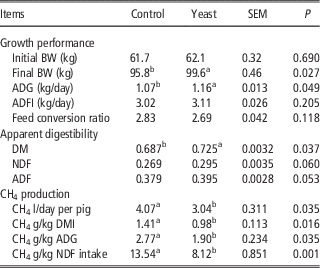
Supplementation of S. cerevisiae YST2 significantly increased final BW of the pigs (Table 1). Apparent DM digestibility of the yeast-supplemented diet was significantly higher than that for the control diet (P<0.05; Table 1), but no differences were observed in NDF (P=0.060) and ADF (P=0.053) digestibility between the supplemented and control groups.
Effect of dietary Saccharomyces cerevisiae supplementation on growth performance, apparent dry matter (DM) and fiber digestibility, and methane production in finisher pigs

ADG=average daily gain; ADFI=average daily feed intake; CH4=methane; DMI=dry matter intake.
a,bValues within a row with different superscripts differ significantly at P<0.05.
Methane production
Two-hourly CH4 emissions in YST2 yeast-supplemented pigs were consistently lower (~25%) than those in the control group throughout the day, averaging 3.04 and 4.07 l/pig per day, for the supplemented and control groups, respectively. The above data indicated that in pigs, YST2 supplementation decreased CH4 emission by ~25% (P=0.035; Table 1). The decrease in CH4 production in the YST2 supplemented pigs was higher than the control group when expressed relative to per kg DM intake (P=0.016) or NDF intake (P=0.001).
Fermentation characteristics
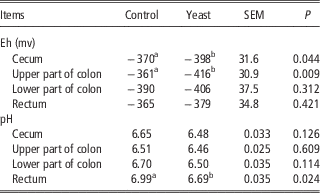
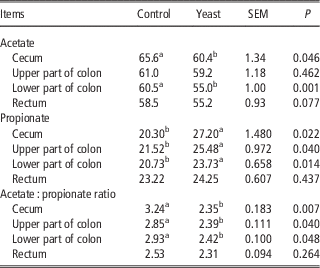
YST2 significantly decreased Eh value in the cecum and colon (Table 2), as well as pH value in the rectum (Table 2). Fermentation patterns were also significantly altered by yeast supplementation, which was reflected by the lower acetate and higher propionate molar proportion in cecum and the lower colon (P<0.05), and lower (P<0.05) acetate : propionate ratio (Table 3).
Effect of dietary Saccharomyces cerevisiae supplementation on redox potential (Eh) and pH values in digesta of the hindgut of finisher pigs

a,bValues within a row with different superscripts differ significantly at P<0.05.
Effect of dietary Saccharomyces cerevisiae supplementation on molar proportion of volatile fatty acid (mmol/100 mmol) in digesta of the hindgut of finisher pigs

a,bValues within a row with different superscripts differ significantly at P<0.05.
Methanobrevibacter, acetogens, and mcrA expression
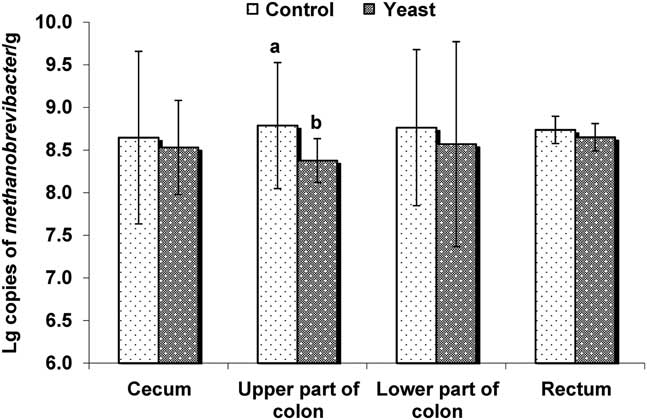
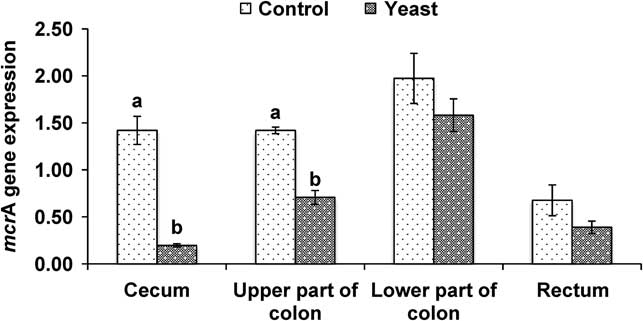
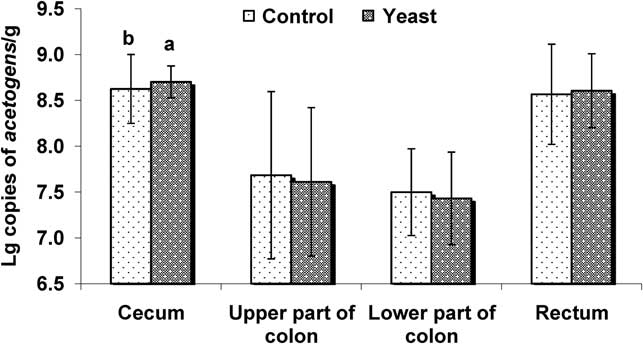
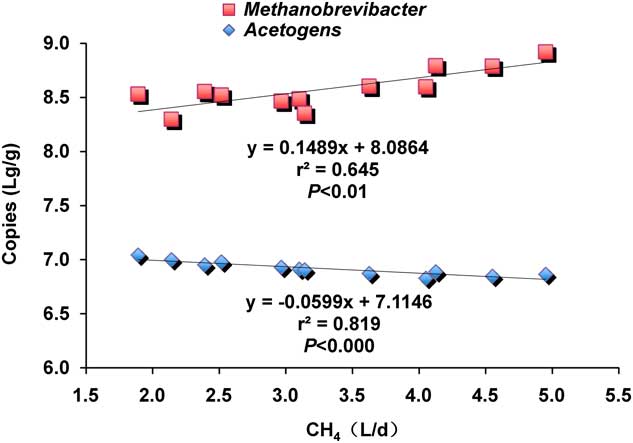
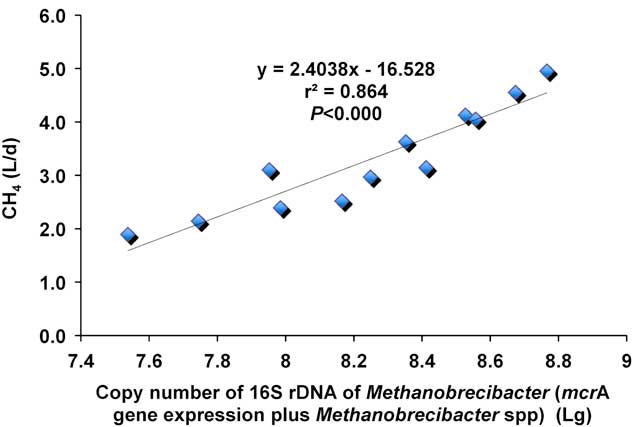
Gut microbiota were significantly influenced by S. cerevisiae YST2 supplementation. Yeast supplementation resulted in 61% decrease (P<0.01) in colonic Methanobrevibacter spp. (Figure 1), and a 19% increase (P<0.01) in the acetogenic community in the cecum (Figure 2). In addition, YST2 supplementation significantly decreased the expression of mcrA in the cecum by 86% and 50% in the upper colon (P<0.01; Figure 3). Correlation analysis performed using individual animal data showed positive relationships (P<0.001) between the copy number of Methanobrevibacter spp. with CH4 production (Figure 4) and expression of mcrA (Figure 5). However, an opposite relationship was recorded between methanogenesis and acetogenesis (P<0.001; Figure 4).
Effect of Saccharomyces cerevisiae on the population of Methanobrecibacter species in the large intestine of pigs.

Effect of Saccharomyces cerevisiae on the population of acetogens in different sections of large intestine of pigs. The error bars represent standard deviations. a,bIndicate differences between means within each intestinal section (P<0.01).

Effect of Saccharomyces cerevisiae on the relative expression of mcrA gene originated from methanogens in different sections of large intestine of pigs. The error bars represent standard deviations. a,bIndicate differences between means within each intestinal section (P<0.01).

Correlation between methane production and the population of Methanobrecibacter species and acetogens in the large intestine of pigs.

Correlation between methane production and copy number of 16S ribosomal DNA of Methanobrecibacter (mcrA gene expression plus Methanobrecibacter spp.).

Discussion
Enteric CH4 is an unavoidable natural process that may only be altered, but not eliminated. The present study showed that dietary S. cerevisiae YST2 supplementation decreased daily enteric CH4 emission in pigs by 25% (P<0.05), and the abatement was further when expressed in terms of per unit of DMI or NDF intake. Mitigation result from the present study is consistent with data from our previous in vitro study (Gong et al., Reference Gong, Liao, Liang, Jahromi and Wang2013).
Available data in the literature seemed to indicate that the CH4 mitigation efficacy of S. cerevisiae is strain specific (McGinn et al., Reference McGinn, Beauchemin, Coates and Colombatto2004) and CH4 abatement using yeasts reported so far for cattle were below 10% (Wallace and Newbold, Reference Wallace and Newbold1993; Chung et al., Reference Chung, Walker, McGinn and Beauchemin2011). To the best of our knowledge, we are unaware of any published data on pigs to validate the higher CH4 mitigation efficiency recorded in the present and our previous in vitro (Gong et al., Reference Gong, Liao, Liang, Jahromi and Wang2013) studies.
Across species, enteric CH4 production accounts for about 2% to 12% loss of feed gross energy (Johnson and Johnson, Reference Johnson and Johnson1995) while feed energy loss as CH4 in pigs is <0.5% (Smith et al., Reference Smith, Martino, Cai, Gwary and Janzen2008). Reducing this energy loss is a way to improve production efficiency in livestock (Shibata and Terada, Reference Shibata and Terada2010) and Intergovernmental Panel on Climate Change (IPCC) (Change, Reference Change1996) reported that appropriate measures to improve animal production could decrease total enteric CH4 emission by 10% to 30%. In the present study, supplementing YST2 resulted in the decreasing daily CH4 production by 25%, and due to the higher DM and NDF digestibility in the YST2 supplementation group, the decrease in daily CH4 production was even lower when expressed in terms of per unit digestible DM intake and NDF intake. This suggests that S. cerevisiae YST2 could be used to decrease enteric CH4 production in pigs and possibly in ruminant livestock as well. Interestingly, although the experimental period was short (32 days), YST2 supplemented pigs had a higher average daily gain (P<0.05) than the control pigs, suggesting that YST2 supplementation reduces loss of dietary energy resulting from lower enteric CH4 production.
The pH reflects the degradation of structural carbohydrates and absorption of VFA. Low pH favors the production of propionate over acetate, which in turn decrease CH4 generation (Kessel and Russell, Reference Kessel and Russell1996; Russell, Reference Russell1998). In addition, low pH is an indication of a superior VFA production, which may decrease the numbers of methanogens and protozoa, thereby decreasing CH4 production (Jones et al., Reference Jones, Nagle and Whitman1987; Nagaraja and Titgemeyer, Reference Nagaraja and Titgemeyer2007). Lana et al. (Reference Lana, Russell and Van-Amburgh1998) reported that enteric CH4 decreased as rumen pH decreased. This is in agreement with the present study, where mean intestinal pH of YST2 supplemented pigs was lower than that of the control. The lower pH value of the GIT digesta of the YST2 supplemented pigs could have partly contributed to the lower CH4 production.
Redox potential may provide a better insight into the mode of action of S. cerevisiae YST2 in the enteric fermentation. Low Eh values in the GIT may suggest more efficient oxygen (O2) removal within the system, thereby creating a more favorable anaerobic environment for the anaerobic bacteria to multiply. Published data of Eh are scarce because such measurements need strict anaerobic conditions (Marden et al., Reference Marden, Bayourthe, Enjalbert and Moncoulon2005). Our results showed that Eh in the cecum and upper colon of YST2 pigs was significantly decreased (P<0.05) by up to −55 mV. This suggests that efficient O2 removal in the GIT of YST2 pigs creates a more favorable anaerobic environment for anaerobic gut bacteria. In agreement with our result, when Newbold et al. (Reference Newbold, Wallace, Chen and McIntosh1995) supplemented the diet with two types of yeast strains (SCNCYC240 and NCYC1026) and a commercial product (Yea-Sacc) at 1.3 mg/ml, they reported a 46% to 89% increase in O2 consumption in the rumen.
Our present study showed that the decrease in CH4 production in YST2 supplemented pigs could also be because the yeast altered fermentation patterns by decreasing acetate and increasing propionate production. Methane production in rumen was reported to be positively correlated with the concentration of acetate and acetate : propionate ratio, but negatively correlated with propionate (Wang et al., Reference Wang, Wang and Zhou2009; Patra, Reference Patra2010). It has been shown that acetate and butyrate fermentation pathways produced a large amount of H2, which is used by methanogens for propionate production, and also needed by other bacteria, such as acetogens and sulfate-reducing bacteria (SRB). Recently published data from our laboratory group indicated that SRBs are present in very low densities (<105), whereas acetogens are present at densities >108 cells/g of dry weight (Moss et al., Reference Moss, Jouany and Newbold2000). This competition for the available H2 for the higher propionate production in the present study thus led to lower CH4 emissions in the YST2 supplemented pigs.
The decrease in CH4 production in S. cerevisiae YST2 pigs is further supported by the microbial enumeration results (Figure 1). As shown by the real-time PCR data, supplementation of YST2 significantly decreased the density of Methanobrevibacter species in the upper colon. Methanobrevibacter spp. were positively correlated with CH4 production (Figure 4), which is in agreement with Guo et al. (Reference Guo, Liu, Lu, Zhu and Denman2008) who reported a positive correlation between CH4 production and the density of methanogens.
The methanogen methyl coenzyme-M reductase (mcrA) gene is ubiquitous to methanogens, and is crucial to the terminal step of methanogenesis where it involves in the reduction of the methyl group bound to coenzyme-M (Ermler et al., Reference Ermler, Grabarse, Shima, Goubeaud and Thauer1997; Singh et al., Reference Singh, Pandya, Parnerkar, Tripathi and Ramani2010). Our results showed that mcrA expression was reduced in the cecum and colon along with the decrease in CH4 in the YST2 pigs. The mcrA expression was also positively correlated with Methanobrevibacter spp. (Figure 5).
In addition to methanogens, there are other hydrogen-utilizing bacteria, such as the acetogens, which can use hydrogen to produce acetic acid, providing an alternative route to eliminate hydrogen. Chaucheyras et al. (Reference Chaucheyras, Fonty, Bertin and Gout1995) investigated the effect of a live strain of S. cerevisiae on acetate and methane production by two hydrogenoustrophic microorganisms, an acetogen and a methanogen. They reported that yeast supplementation enhanced the hydrogen trophic metabolism of the acetogenic strain and its acetate production by more than fivefolds, while in a mixed culture of acetogens and methanogens, without supplementation of yeast, H2 was mainly used for CH4 production. In agreement with the above findings, our present study showed that S. cerevisiae YST2 supplementation enhanced acetogenesis in the cecum and lower part of the colon (Table 2), and significantly increased the number of acetogens (Figure 3) along with lowering of the methanogenic activity in the cecum (Figure 4).
Conclusions
Dietary supplementation of S. cerevisiae YST2 at 3 g/kg diet significantly decreased enteric CH4 production in pigs (P<0.05). We proposed that yeasts decreased enteric CH4 production in pigs via several interrelated mechanisms including: (i) yeasts increases O2 utilization to allow for a more favorable environment for anaerobic fermentation, which in turn leads to higher VFA production and lower pH, which restrains the growth of methanogens and protozoa, (ii) yeasts induces a shift in fermentation pattern toward propionogenesis, which compete with methanogens for the free H2 within the system, and (iii) yeasts increases the growth of acetogenic bacteria, that use H2 to produce acetate, which serves as another alternative sink for the free H2 in the system.
Supplementary Material
To view supplementary material for this article, please visit https://doi.org/10.1017/S1751731117001732