The OFC: sensitivity of the modern broiler breeder female to over-feeding during entry to lay
There is a general consensus, amply supported by reports from the field, that in the last decade, bringing the modern pullet into lay has become more complex and demanding (Robinson et al., Reference ROBINSON, RENEMA, HARDIN and WILSON1995; Hocking, Reference HOCKING1996; Meijerhof, Reference MEIJERHOF2005). The problems appear to be centred on management of the breeder during the weeks from release of pullets from severe feed restriction at age 13-16 weeks to entry into lay at 24-28 weeks. Compared to the broiler breeder female of 15-20 years ago, the modern breeder is much more ‘unforgiving’ of even minor deviations from optimum feeding. In particular, even relatively minor over-feeding during this period (so-called ‘aggressive’ feeding) can result in high mortality at onset of lay (Cobb, 2008; Spradley et al., Reference SPRADLEY, FREEMAN, WILSON and DAVIS2008) due in large part to reproductive system problems such as internal lay, prolapse, inflammation of the oviduct and others (pers. comm. Dr H. Krishpin, DVM). This may be accompanied by lower peak lay and consequent reduction in egg and chick production (Katanbaf et al.,1989a, b; Robinson et al., Reference ROBINSON, RENEMA, BOUVIER L., FEDDES, WILSON, NEWCOMBE and McKAY1998a, b; Renema et al., Reference RENEMA, ROBINSON and ZUIDHOF2008). For convenience, we will use the term ‘over-feeding complex’ (OFC) for the set of effects resulting from over-feeding of broiler breeder females during the critical period leading to entry to lay.
Erratic Oviposition and Defective Egg Syndrome (EODES)
Problems in broiler breeders on entry into lay are not new, and were encountered in the early 1970's as the well known ‘Erratic Oviposition and Defective Egg Syndrome (EODES) (Jaap and Muir, Reference JAAP and MUIR1968; Van Middelkoop, Reference VAN MIDDELKOOP1971, Reference VAN MIDDELKOOP1972). These problems were attributed to over- production of large yellow follicles (LYF), multiple hierarchies and consequent disturbances in oviposition. EODES has since been controlled with good success, initially by feed restriction during pullet growth, and later by continued feed restriction during lay. This continues to the present time with the severity of restriction relative to ad libitum feeding increasing yearly. The success of feed restriction in controlling EODES led naturally to the hypothesis that EODES was caused by ad libitum feeding. This has since been confirmed by numerous experiments showing that the symptoms of EODES are obtained by raising broiler breeders ad libitum (Hocking et al., Reference HOCKING, GILBERT, WALKER and WADDINGTON1987; Katanbaf et al., Reference KATANBAF, DUNNINGTON and SIEGEL1989b) by shifting restricted broiler pullets to ad libitum feeding during entry into lay (Yu et al., Reference YU, ROBINSON, CHARLES and WEINGARDT1992b), or even by forced feeding of White Leghorn layer hens (Walzem et al., Reference WALZEM, SIMON, MORISHITA, LOWENSTINE and HANSEN1993).
Development of EODES is linearly related to degree of over-feeding
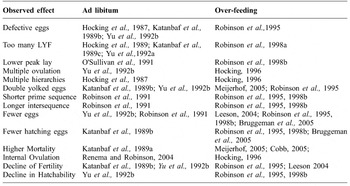
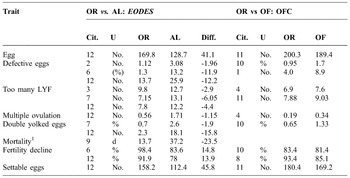
The problems engendered by over-feeding during the critical period leading to onset of lay in the modern commercial broiler breeder, mirror, albeit to a lesser degree, those presented by a full blown EODES. To some extent this is expected. Many studies since the 1980's (summarized in Table 1) have shown that levels of feeding intermediate between full restriction and full ad libitum generate partial manifestation of EODES (some illustrative examples are presented in Table 2). Thus, over feeding during the period before entry into lay would be expected to manifest as a quasi-EODES. What is unexpected is the very powerful effect generated by relatively minor over-feeding during this period on mortality and reproduction of the broiler breeder female during the critical period of onset of sexual maturity. The purpose of the present paper is to present a hypothesis concerning the genetic and management changes that have brought this about.
Comparison of effects of ad libitum feeding of broiler breeder females and of moderate over-feeding relative to optimal restriction (Over-feeding).

Illustrative examples comparing quantitative effects of optimal feed restriction (OR) vs. ad libitum (AL) feeding, to the effects of optimal restriction (OR) vs. moderate over-feeding (OF). Diff. are OR minus AL, or OR minus OF, as applicable. Cit., citation; U, units, see footnote for details.

1Meijerhof (Reference MEIJERHOF2005) reports greater mortality in broiler females under over-feeding, but does not give actual values. Our own commercial experience (Y.E.) is that over-feeding can result in excess mortality in the range of +0.2% to +0.4% per week, for the first months of production.
(1) Bruggeman et al., Reference BRUGGEMAN, ONAGBESAN, RAGOT, METAYER, CASS, FAVREAU, JEGO, TREVIDY, TONA, WILLIAMS, DECUYPERE and PICARD2005; (2) Hocking et al., Reference HOCKING, GILBERT, WALKER and WADDINGTON1987; (3) Hocking et al., Reference HOCKING, WADDINGTON, WALKER and GILBERT1989; (4) Hocking, Reference HOCKING1996; (5) Katanbaf et al., Reference KATANBAF, DUNNINGTON and SIEGEL1989a; (6) Katanbaf et al., Reference KATANBAF, DUNNINGTON and SIEGEL1989b; (7) Katanbaf et al., Reference KATANBAF, DUNNINGTON and SIEGEL1989c; (8) Leeson, Reference LEESON2004; (9) Robinson et al., Reference ROBINSON, ROBINSON and SCOTT1991; (10) Robinson et al., Reference ROBINSON, RENEMA, HARDIN and WILSON1995; (11) Robinson et al., Reference ROBINSON, RENEMA, BOUVIER L., FEDDES, WILSON, NEWCOMBE and McKAY1998a; (12) Yu et al., Reference YU, ROBINSON, CHARLES and WEINGARDT1992b.
The model
The explanatory hypothesis contains two elements (and possibly a third) that are proposed to have combined ‘synergistically’ to generate the OFC.
element 1: very severe feed restriction of the growing pullet until the start of the maturation process
It is remarkable that the commercial target body weight recommendations for broiler breeder pullets from hatch to the start of the maturation process at 14-16 weeks (Hocking et al. Reference HOCKING, WADDINGTON, WALKER and GILBERT1989; Eitan et al., Reference EITAN, SOLLER and ROZENBOIM1998) have remained almost the same as they were 20 years ago (Picard et al., Reference PICARD, BRUGGEMAN, JEGO, ONAGBESAN and HOCKING2004; Cobb, 2008, Reference COBB2005). Rearing pullets according to the current recommendations brings the actual daily feed restriction of the pullet to a much more severe level than in the past, i.e. from about 70% of ad libitum feeding 20 years ago, to about 33% of ad libitum feeding today (Picard et al., Reference PICARD, BRUGGEMAN, JEGO, ONAGBESAN and HOCKING2004), and target body weight at entry into lay to 40% of ad libitum fed pullets (Hocking Reference HOCKING1996; Renema and Robinson, Reference RENEMA and ROBINSON2004). Thus, it appears that increasingly severe feed restriction is required in order to maintain control of EODES (Hocking, Reference HOCKING1996; Lewis, Reference LEWIS2006) and ‘The severity and duration of feed restriction to broiler breeder chicken have to be continuously adapted according to changing genotype and selection goals’ (Bruggeman et al., Reference BRUGGEMAN, ONAGBESAN, RAGOT, METAYER, CASS, FAVREAU, JEGO, TREVIDY, TONA, WILLIAMS, DECUYPERE and PICARD2005). The direct implication is that partial feed restriction, if not sufficiently stringent, is interpreted by the ovary as quasi-ad libitum feeding and leads to a moderate manifestation of EODES, which would correspond to the OFC.
element 2: intense selection for increased breast proportion
In conjunction with increasingly severe feed restrictions, there has been a modification in breeding objectives which has placed much greater emphasis on increasing the proportion of lean breast meat in the carcass at point of sale (Melnychuk et al., Reference MELNYCHUK, KIRBY, KIRBY, EMMERSON and ANTHONY2004). This may also have dictated an increase in the widely accepted physiological parameter of minimum body weight threshold for entering sexual maturation (Brody et al., Reference BRODY, EITAN, SOLLER M. and NITZAN Z.1980; Soller et al., Reference SOLLER, EITAN and BRODY1984; De Beer and Coon, Reference DE BEER and COON2007). Recent results by Hocking (Reference HOCKING2004) showing independence of threshold weight at entry into lay from body fat composition also support the hypothesis that lean body mass, is critical for entry into lay.
An increase in threshold lean body mass for entry into lay is also implied by the increase in 24 week recommended target body weight of the female broiler breeder. For example, recommended 24-week body weight for out-of-season ‘Cobb 500’ female broiler breeders have increased from 2700 grams in 1987 to 3160 grams in 2005 (Cobb Management Guide, 2005). This period saw a major increase in the proportion of lean body mass of the commercial broiler chick at market weight. It is plausible that this change in body composition of the commercial broiler chick will be reflected in the proportion of lean mass of the female broiler at entry into lay.
the negative synergistic effect
As so often happens in broiler breeding and management, genetic changes create problems in bird functional aspects, which are compensated through management changes. The management changes in turn, interact with the birds genetic physiology, causing further functional problems (Eitan and Soller, Reference EITAN and SOLLER2002). In the present context, it is proposed that the severe feed restriction to 15 weeks that is implemented in order to prevent EODES, may have interacted with the emphasis on breast proportion, leading to the OFC. In detail, the hypothesis is as follows:
• During the first weeks post hatch, before initiation of severe feed restriction, the breast of the young chick accumulates muscle mass (Cobb 500 Management Guide, 2008)
• During the subsequent period of severe feed restriction, from 8 to 15 weeks (the latter part of early rearing), the accumulated breast muscle serves as an important source of protein for the growing pullet
• As a result, just before the start of the maturation process at 12 weeks the breast becomes ‘V’ shaped and breast muscle mass is small relative to its target final weight and proportion at onset of lay (Cobb 500 Management Guide, 2008; Meijerhof, Reference MEIJERHOF2005)
• Consequently, during the weeks from the start of the maturation process until first egg at 24-26 weeks, there is a need to rebuild the breast in order to achieve the minimal lean body mass (Element 2 above) needed for maturation (Soller et al.,1984; Renema et al., Reference RENEMA, ROBINSON, NEWCOMBE and McKAY1999; Melnychuk et al., Reference MELNYCHUK, KIRBY, KIRBY, EMMERSON and ANTHONY2004).
Thus, during this last period there is a very large protein requirement for building the body lean mass, caused by the need to compensate for the severe feed restriction until 14-16 weeks coupled with the intense selection for higher breast proportion over the past two decades.
Consequently, during the critical weeks of maturation from 21-24 weeks prior to entry into lay, the breast muscle must increase in mass to achieve minimum body lean mass for sexual maturity, while the ovary must reach its final mature state as well. But because of intense selection for a higher proportion of breast muscle on the one hand, and severe restriction until near the point of lay on the other, it can be postulated that lean body muscle mass is much further away from its final target state, than the ovary. Although very aggressive feeding levels would be justified from the point of view of bringing lean body mass up to the minimum threshold for onset of lay, these would be interpreted by the ovary as quasi-ad libitum feeding, leading to manifestation of the OFC. Therefore, feeding levels must balance the need to build lean body mass as rapidly as possible, so as to meet the minimum lean body weight requirement for entry into lay, against the need to maintain the animal in a state of physiological restriction to prevent onset of deleterious quasi-EODES by the ovary. Adjusting feed intake during this critical period is aimed at finding an empirical optimum level, which provides maximal rapid lean muscle growth needed for entry into lay, but which still maintains a state of sufficient restriction to avoid a shift to a state of quasi-EODES, with consequent development of the OFC. With the bird poised so delicately just below the point of quasi-EODES, any aggressive deviation from recommended feeding schedules will result in manifestation of the OFC.
a possible third element: a shift of EODES from dependence on body weight to dependence to feed intake
Interestingly, while early studies (Hocking Reference HOCKING1993, Reference HOCKING1996) show a stronger interaction between EODES development and body weight than to feed intake, later studies (Hocking, Reference HOCKING2004; Renema et al., Reference RENEMA, ROBINSON and ZUIDHOF2007; Robinson et al., Reference ROBINSON, ZUIDHOF and RENEMA2007) show a stronger relationship of EODES to feed intake than to body weight. Indeed, at the present time, management of the broiler breeder at entry into lay focuses more on control of rate of body weight gain, which is a matter of feed intake control, than on control of body weight per se. This may be relevant to our hypothesis, because minor increase in food intake over a short period would barely register at the body weight level, but would be noticeable at the food intake level. This may explain part of the greater sensitivity of the modern broiler breeder to even slight increase in feed intake.
It is important to emphasize that the proposed model does not conceive of the ovary and lean body mass as being in competition for the same nutrient stream. Rather, we conceive of the demands of rapidly increasing lean body mass as determining a nutrient stream that is more than adequate for the needs of the ovary, and which, from the standpoint of the ovary, can easily rise to levels that are interpreted as quasi-ad libitum. On this model, it is fortunate indeed that selection for increased breast proportion has been accompanied by selection for increased feed efficiency and decreased fat deposition. Otherwise, an even greater nutrient stream may have been required by the breast, with consequent increased likelihood of development of the OFC.
The OFC and the Broiler Breeder Paradox
The Broiler Breeder Paradox (Decuypere, 2006) refers to the inability to achieve high reproductive status and high juvenile growth rate in broilers, without severely restricted feeding. However, broiler breeders present a number of other seemingly paradoxical aspects. These include the simultaneous presentation of both multiple ovulation and low egg production, and deleterious welfare effects of both ad libitum feeding and restricted feeding. Gous (Reference GOUS2008) has recently added to this the paradox that fertility in broiler breeders is improved through the use of shorter, rather than longer day lengths. In this context, the OFC can be considered as yet another paradox. Namely, achievement of earlier sexual maturity of the female breeder through aggressive feeding, results in multiple problems in reproductive performance at entry into lay.
Acknowledgement
We thank Professor Paul Siegel for general encouragement and critical reading of the manuscript. We extend special thanks to an anonymous referee who patiently led us to render explicit many of our underlying assumptions, and who provided valuable references supporting our model.