Introduction
Arid and semiarid regions account for 45% of the global land area, support 38% of the global population and are among the regions with the most fragile ecological and water resource systems (Ye et al., Reference Ye, Xiao, Wang, Liao, Fu and Zhang2015). In the past 100 years, the mean temperature increase in global arid regions was 0.94°C, which exceeded the global mean temperature increase of 0.74°C (Gao and Zhang, Reference Gao and Zhang2016).
It is well known that mild warming can be advantageous for crop photosynthesis and growth. However, photosynthesis is negatively affected by high temperature, as crop transpiration and soil moisture evaporation are enhanced, and crop growth is inhibited. Climatic warming accelerates evaporation from vegetation and may further inhibit crop photosynthesis and dry matter accumulation (Picotte et al., Reference Picotte, Rosenthal, Rhode and Cruzan2007; Chen et al., Reference Chen, Liua, Zheng, Yin, Chu, Xu, Yan, Chen, Wang and Zhang2018). Substantial research has been carried out on the impact of climate change on plant water use efficiency (WUE) in China and the rest of the world (Lei et al., Reference Lei, Zhang, Chen and Zhang2016). Tenhunen et al. (Reference Tenhunen, Roupsard and Rambal2002) found that climate warming increases plant transpiration and soil water evaporation and directly affects plant growth and crop WUE in arid and semi-arid regions. Ogaya and Peuelas (Reference Ogaya and Peuelas2003) suggested that with decreases in soil moisture, the WUE of plant ecological systems decreases. Xiao et al. (Reference Xiao, Zhang, Xiong, Yang and Yang2007) and Zhang et al. (Reference Zhang, Zhu, Yu and Zhong2016) found that with warming, in the grain-filling and milk-maturing stages of spring wheat, the leaf net photosynthesis rate and stomatal conductance decreased, transpiration rate increased and photosynthesis and dry matter accumulation were inhibited, with further impacts on the WUE. The effects of climate change on agriculture and water resources are increasingly serious. In the next 50 years, crop growth and WUE will be directly impacted by global warming, and food and water resource security will face a new challenge (Zhang et al., Reference Zhang, Zhang, Bai, Li, Sun, Liu, Wang and Zhao2010).
The semi-arid region of China, which covers about one-third of China's total area, is located in a narrow strip from the northeast to the southwest of China and belongs to a climatic type with an annual average precipitation of 250–500 mm. The main crops grown in semi-arid regions of China are potato (Solanum tuberosum L.), broad bean (Vicia faba L.) and winter wheat (Triticum aestivum L.), and all are grown as one crop per year. The potato–broad bean–winter wheat rotation is a typical cropping system in semiarid regions of China, can significantly improve yield and soil nitrogen use efficiency and can be used as a major agricultural technique to cope with climate change (Yao et al., Reference Yao, Zhang, Lu, Han, Li and Zhang2009; Zheng et al., Reference Zheng, Jiang, Chen, Sun, Feng, Deng, Song and Zhang2014). In the current study, a crop rotation of potato–broad bean–winter wheat was used to study the impact of climate warming on yield and water use of the rotation system and to provide a scientific reference for improving the adaptability of crops to climate change.
Materials and methods
Details about the research site
The research was performed at Guyuan Agricultural Meteorology Experiment Station in a semi-arid area of China, 1896.7 m a.s.l, which is located within 35.14–36.38°N and 105.20–106.58°E. During 1959–2017, the annual mean temperature was in the range of 6.3–10.2°C, with an overall mean of 7.9°C. In the past 50 years, the temperature distinctly increased, with the amplitude of warming increasing, especially, after 1998. During 1959–2017, the range of annual rainfall was 282.1–765.7 mm, and the mean was 450.0 mm. Major crops include wheat, potato and maize, each giving one crop per year, and the area is a typical semi-arid, rain-fed agricultural area of the Loess Plateau. Potato–broad bean–winter wheat, pea–winter wheat–potato and winter wheat–broad bean–potato are the local major crop rotations.
Farm warming test
A warming test using infrared ray radiators was used to study the impact of warming on yield and water use of potato–broad bean–winter wheat in a semi-arid area of China (Kimball, Reference Kimball2005). In the UN Climate Change Conference held in Copenhagen in December 2009, it was determined that global warming in the next 50 years would be maintained, controlled within 2.0°C (Zheng, Reference Zheng2010), and consequently, in this research, we used five warming levels: 0, 0.5, 1.0, 1.5 and 2°C. The warming level refers to the increase in the corresponding temperature range on the basis of the actual temperature.
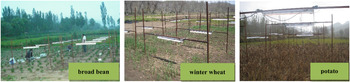
The crop rotation system of potato–broad bean–winter wheat was planted during 2012–2017. The experiment was initiated on 10 May 2012, and each plot was 8 m2 (2 × 4 m) with the spacing of 3.0 m between the plots. The experiment was arranged in randomized complete blocks with three replications. A simulated farm heating system using infrared ray radiators was installed at the beginning of the experiment (Fig. 1). The heating system includes support, infrared heaters (SRW-220, China), temperature sensors (WZP-035 PT100, China) and a data recorder and controller (2625A, FLUKE, USA). Each plot was equipped with three infrared radiating warming tubes (Longpu Model SK15/R7S, Longpu Electronics Company, China), and the support height was adjusted so that the warming tube was 1.2 m above the plant canopy surface. The levels of warming (0, 0.5, 1.0, 1.5 and 2.0°C) were controlled by measuring plant canopy surface temperature with infrared thermometers (Kimball et al., Reference Kimball, Conley, Wang, Lin, Luo, Organ and Avidsmit2008). All tubes (Longpu Model SK15/R7S, China), were oriented in a north–south direction in relation to the plots. The power and support height of the infrared warming tube was fixed according to the warming level required and the local weather. The powers of the infrared warming tubes used were 200, 400, 600 and 800 W. The tubes emitted a constant 130, 260, 400 and 530 W/m2, equivalent to a target warming of +0.5, +1.0, +1.5 and +2.0°C, respectively, at the plant canopy surface temperature (Fig. 2; Xiao et al., Reference Xiao, Zhang, Huang, Luo, Wang, Ma, Yao, Wang and Qiu2016).
(Colour online) A farm heating system using infrared ray radiators during the growing season of the potato–broad bean–winter wheat rotation system at Guyuan Agricultural Meteorology Experiment Station in a semi-arid area of China.

(Colour online) Design parameter of the infrared ray radiators at experimental plot at Guyuan Agricultural Meteorology Experiment Station in a semi-arid area of China. In the current study, each plot was 8 m2 (2 × 4 m), and radiation area of infrared ray was 4.5 m2 (1.5 × 3 m). Each plot was equipped with three infrared radiating warming tubes. The powers of the infrared warming tubes used were 200, 400, 600 and 800 W, equivalent to a target warming of + 0.5, + 1.0, + 1.5 and + 2.0°C, respectively, at the plant canopy surface temperature.

Control plots (warming levels 0°C) had dummy tubes of the same size and shape as the real tube but without a heating element. The potato–broad bean–winter wheat rotation system was warmed during the whole growing period both day and night (Tian et al., Reference Tian, Zheng, Zhang, Chen, Dong, Yang and Zhang2010). According to the experimental requirement, we set the temperature range on the data recorder. When the temperature data exceeds the required range, the controller sets off an alarm. If the weather consists of hot days, cool nights, wind and rainstorms, the actual temperature is lower or higher than the need to increase the temperature, and the control system alarm (VLAGA-1, Xiamen Enlai Company, China) will sound, indicating that it needs to be adjusted artificially. According to the test equipment level and current warming system, the precision of the temperature measurement system is between 0.1 and 0.2°C.
The potato, broad bean and winter wheat were planted by hand during 2012–17. Two separate 3-year rotations of potato–broad bean–winter wheat were completed, the first in 2012–14 and the second in 2015–17. The potato was planted on 15 May 2012 and 2015, broad bean on 20 April 2013 and 2016 and winter wheat on 5 October 2014 and 2017. Field management, such as cultivation, fertilization, weeds, diseases and insects, was consistent with the management of local farmers (Table 1). The research site is a typical semi-arid agricultural area, all the plant depends on natural precipitation during the study.
Field management of the crops, applied tillage, fertilization and plant protection traits at Guyuan Agricultural Meteorology Experiment Station in a semi-arid area of China

a The organic fertilizer, composed of crop straw, cow and sheep dung, was granular, and rich in a variety of nitrogen (N, 0.5%), phosphorus (P2O5, 0.6%), potassium (K2O, 0.4%), organic matter (15%), organic acids and other rich nutrients.
b NPK fertilizer (15-10-10) was a compound fertilizer using ammonium phosphate and potassium nitrate.
c The seed potato was cut into two pieces, ensuring each piece had two buds, and the weight of each piece was 25 g.
d Hundred kernel weight.
e Thousand kernel weight.
The potato was Longshu # 3, a common local variety with light white skin and high resistance to drought. The potato seed was cut into two pieces lengthwise from the top and making sure each piece has two buds, and weight of each piece is 25 g. In total, 0.5% potassium permanganate solution was used to disinfect the cutting tool to prevent infection of potato seeds. The sowing rate of the applied seeds was 2.2 t/ha, and a planting density of 8.1 × 10⁴ plants/ha was used. The potato sowing depth was 10 cm, and the rows were 35 cm apart. The organic fertilizer as basic fertilizer was 25 t/ha. NPK compound fertilizer was 500 kg/ha, potassium sulphate 230 kg/ha and urea 150 kg/ha for application of sowing fertilizer.
The broad bean was Qingchan #3, a common local variety with milky white skin, high ramifying capacity and low podding position. The hundred kernel weight of the applied seeds is 120 g, and the sowing rate is 220 kg/ha. A planting density of 2.1 × 10⁵ plants/ha was used. The sowing depth of broad bean was 6 cm, and the rows were 25 cm apart. As an application of sowing fertilizer, NPK compound fertilizer is 350 kg/ha, and potassium sulphate 200 kg/ha. In total, 50% thiophanate-methyl 500 times liquid was used to irrigate the root, and 2–3 times of medicament was used to prevent the fusarium wilt. When the lower leaf margin of the plant darkens, 50% carbendazim 1000-fold solution is used to control root rot.
The winter wheat was Zhuanglang #8, which is highly resistant to lodging, drought and cold; has a favourable yellowing property and matures early. The thousand kernel weight of the applied seeds is 45 g. and the sowing rate is 110 kg/ha. The sowing density was 4.6 × 10⁶ plants/ha, and seeds were sown at a depth of 6 cm in rows 15 cm apart. The organic fertilizer is 15 t/ha, NPK compound fertilizer is 450 kg/ha, and potassium sulphate 150 kg/ha as the application of sowing fertilizer.
The soil was a deep loessal soil suited for ploughing. The content of organic matter in the soil was 8.6 g/kg, total nitrogen was 0.43 g/kg, total phosphorus was 0.68 g/kg and total potassium was 19.6 g/kg during potato seeding on 15 May 2012. The soil nutrient content was measured during crop seeding of the potato–broad bean–winter wheat rotation system from 2012 to 2017 (Table 2). The farm was completely fenced to prevent the entry of animals.
Soil nutrient content, as measured on the sowing date, from 2012 to 2017a

a The soil nutrient content of the potato–broad bean–winter wheat rotation system was measured from 2012 to 2017, on the dates specified in column 1.
Calculation of WUE
The soil water contents in the seedling, stemming, fruiting, and maturing stages of potato during 2012–17 were measured to calculate the water consumption of the plots using (Li et al., Reference Li, Song, Liu, Li and Liu2001):

where ET 1−2 is the stage water consumption, i is the soil layer code, n is the number of total layers, γi is the dry unit weight of soil layer i, Hi is the thickness of the soil layer i, θi 1 and θi 2 are moisture contents of soil layer i at the beginning and end of the stage, respectively, as calculated by the percentage of the dry soil weight and P 0 is the effective rainfall.
The WUE of the potato–broad bean–winter wheat rotation system is calculated according to its total output and water use. The WUE was calculated as follows:

where WUE is in kg/ha/mm, Y is the crop grain/tuber yield (kg/ha) and ETα is the actual water consumption (mm) in the crop growing stage (i.e. the sum of water consumption in all stages).
Measuring and monitoring methods
Daily mean temperature and rainfall were recorded during the growing season of the potato–broad bean–winter wheat rotation system at Guyuan Agricultural Meteorology Experiment Station in a semi-arid area of China from 2012 to 2017 (Fig. 3).
(Colour online) Daily mean temperature and rainfall during growing season of the potato–broad bean–winter wheat rotation system from 2012 to 2017 at Guyuan Agricultural Meteorology Experiment Station in a semi-arid area of China.

During the warming period of the whole growing stage of the crop rotation system, each plot was equipped with an automatic temperature sensor (Campbell AR5, USA) to monitor the plant canopy surface temperature of warming treatments from 0 to 2.0°C (Kimball, Reference Kimball2015). The temperature data were recorded once per 20 min, and the results were automatically logged. The daily mean plant canopy surface temperatures were monitored during two complete cycles of the potato–broad bean–winter wheat rotation system from 2012 to 2017 (Fig. 4).
(Colour online) Daily mean crop canopy surface temperature during two complete cycles of the potato–broad bean–winter wheat rotation system from 2012 to 2017 at Guyuan Agricultural Meteorology Experiment Station in a semi-arid area of China.

Warming of the soil surface layer was also monitored continuously, in order to guarantee the accuracy of simulated atmospheric temperature increase, and the good effect of the simulated warming experiment. To monitor changes in ground temperature at 10, 20 and 30 cm in each plot, a Campbell CS229 temperature sensor (Campbell Scientific, Logan, UT, USA) was installed at the soil ground layer. The annual mean ground temperatures were monitored and recorded during two complete cycles of the potato–broad bean–winter wheat rotation system from 2012 to 2017 (Table 3).
Annual mean temperaturea of warming from 0 to 2.0°C during two complete cycles of the potato–broad bean–winter wheat rotation system from 2012 to 2017

a Annual mean temperature during two complete cycles of the potato–broad bean–winter wheat rotation system from 2012 to 2017 was calculated by daily mean temperature. This is annual mean temperature for year. Daily temperatures of potato–broad bean–winter wheat rotation system from 2012 to 2017 were recorded.
The potato was harvested manually from 25 to 29 September 2012 and 2015, the broad bean from 15 to 31 July 2013 and 2016 and winter wheat from 20 to 31 July 2014 and 2017. The numbers of days were recorded for different growing stages, including the sowing, seedling, flowering and mature stages, as well as the whole growing period of the potato–broad bean–winter wheat.
The photosynthesis and transpiration rates were measured using the portable photosynthesis system (LI-6400XT, USA) during the seedling, budding and blooming stages of potato; the seedling, ramifying, budding and blooming stages of broad bean and the trefoil, elongating, heading, blooming and booting stages of winter wheat. The second leaf of wheat, broad bean and potato from the top were labelled for the determination of leaf photosynthesis. To ensure the consistency of light intensity, atmospheric temperature and humidity, the photosynthesis and transpiration rates were determined at 9.00–11.00 h in the morning during the crop growing season in the two seasons, and the values were averaged between the two seasons. When the photosynthesis and transpiration rates were measured during the growing stages of potato, broad bean and winter wheat, the light intensity was maintained between 1600 and 1800, 1500–1700 and 1500–1800 μmol/m2/s, respectively. The photosynthetic rate of the crops leaf is measured by the PLC leaf chamber, and the size of the window is 25 × 18 mm. A light-emitting diode is used as a source of light, and the automatic light control range is 0–2500 μmol/m2/s. The atmospheric temperature is maintained between 22 and 27°C, 22 and 25°C and 23 and 28°C, respectively. The air humidity is maintained between 55 and 65%.
The yields of potato, broad bean and winter wheat in each plot (4.5 m2, 1.5 × 3 m) were determined. The potato planting density, single plant potato count, single potato weight and yield were recorded. The broad bean planting density, single plant pod count, single pod grain count, hundred-grain weight and yield were recorded. The winter wheat planting density, harvested ear count, single year grain count, thousand-grain weight and yield were recorded.
The quality of potato, broad bean and winter wheat is mainly determined by the contents of starch, fat and crude protein. The potato starch and crude protein, broad bean fat and crude protein, and winter wheat fat and crude protein were measured. The starch content (%) was measured by iodine colorimetry. The fat (%) was measured by the Soxhlet extraction method. The crude protein (%) was measured by Kjeldahl's method. Samples were collected fresh and measurements were completed within 1 week.
The soil moisture content was measured by the aluminium box drying method. The soil was sampled by a soil drill, each 20 cm was considered a layer, and the entire soil sampling depth was 0–100 cm. Each soil sample was put into an aluminium box initially and dried to a constant weight at 110°C before the soil moisture content was calculated.
The correlations of photosynthesis, transpiration, growing period, yield; and quality of potato, broad bean and winter wheat; in addition to soil water content, WUE and agricultural and meteorological data were estimated by statistical analysis using IBM SPSS Statistics 20.0. This program is used to solve research problems on the changes of the WUE, growing period and yield of the potato–broad bean–winter wheat rotation system by means of warming tests and predictive analytics. The broad bean data used in the current study were obtained from a previously published report (Xiao et al., Reference Xiao, Zhang, Huang, Luo, Wang, Ma, Yao, Wang and Qiu2016).
Results
Warming and crop photosynthesis
In the potato seedling, budding, and blooming stages, the photosynthesis and transpiration rates were improved significantly (P < 0.05) by warming (Fig. 5). However, during the stem and leaf ageing stages, the photosynthesis rate was decreased significantly (P < 0.05) when the temperature was increased by 0.5–2.0°C. Stem and leaf ageing is a key stage for potato yield formation, and potato growth and yield were affected significantly (P < 0.05) by the decrease in photosynthesis rate when the temperature was raised by 0.5–2.0°C.
Impact of warming on the photosynthesis and transpiration rate of potato at Guyuan Agricultural Meteorology Experiment Station in a semi-arid area of China. Note: Different letters in each line indicate a significant difference at P < 0.05.

In the seedling, ramifying, budding and blooming stages of broad bean, the photosynthesis and transpiration rates were improved significantly (P < 0.05) by warming (Fig. 6). However, during the podding stage, the photosynthesis rate was decreased significantly (P < 0.05) when the temperature was raised by 1.5–2.0°C. Podding is a key stage for broad bean yield formation, and growth and yield were affected by the decrease in the photosynthesis rate when the temperature was increased by 1.5–2.0°C.
Impact of warming on the photosynthesis and transpiration rate of broad bean at Guyuan Agricultural Meteorology Experiment Station in a semi-arid area of China. Note: Different letters in each line indicate a significant difference at P < 0.05.

In the trefoil and elongating stages of winter wheat, the photosynthesis and transpiration were improved significantly (P < 0.05) by warming. However, in the heading, blooming and booting stages, the photosynthesis rate was decreased significantly (P < 0.05) when the temperature was increased by 0.5–2.0°C (Fig. 7).
Impact of warming on the photosynthesis and transpiration rate of winter wheat at Guyuan Agricultural Meteorology Experiment Station in a semi-arid area of China. Note: Different letters in each line indicate a significant difference at P < 0.05.

Warming and the growing period
The potato, broad bean and winter wheat growing periods changed with rising temperature (Table 4); the potato growing period was prolonged, but those of broad bean and winter wheat were distinctly shortened. When warmed by 0.5–2.0°C, the growing period of potato was prolonged by 1–4 days per 1-year-period and that of broad bean and winter wheat was shortened by 4–16 days and 1–28 days per 1-year-period, respectively. The whole potato–broad bean–winter wheat rotation was shortened by 20–40 days per 3-year-period. However, when warmed by 0.5–2.0°C, the fallow period between potato and broad bean was shortened by 1–4 days, the period between broad bean and winter wheat was shortened by 5–16 days and the total fallow period of the potato–broad bean–winter wheat rotation was prolonged by 4–13days per 3-year-period. The changes in the growing and fallow periods of the potato–broad bean–winter wheat rotation will have a major impact on crop growth and yield.
Impact of warming on the growing period of the potato–broad bean–winter wheat rotation system from 2012 to 2017

a Different letters within each column indicate significant differences under 5%. Potato was planted on 15 May and harvested during 25–29 September in 2012 and 2015. Broad bean was planted on 20 April and harvested during 15–31 July in 2013 and 2016. Winter wheat was planted on 5 October and harvested during 20–31 July in 2014 and 2017.
The correlations between warming and the numbers of growing days and of fallow days for the potato–broad bean–winter wheat rotation showed that the whole growing period of the rotation was shortened and the whole fallow period was prolonged by warming (Fig. 8). The growing and fallow periods of the rotation were divided into two different stages when warmed by 1.0°C. The growing and fallow periods of the rotation were likely of reasonable lengths and crop growth would not be seriously affected by the warming of 0.5–1.0°C. However, the growing period sharply decreased, and the crop growth was seriously affected, when warmed by 1.0–2.0°C.
Relationship of warming with the growing and fallow periods of the potato–broad bean–winter wheat rotation system from 2012 to 2017 at Guyuan Agricultural Meteorology Experiment Station in a semi-arid area of China.

Warming and yield
Warming was generally beneficial to the potato yield but seriously reduced the broad bean and winter wheat yields, and the yield of the rotation system initially increased and then decreased (Table 5). The potato yield increased by 0.1–3.3% per 1-year-period when warmed to 0.5–2.0°C. The broad bean yield was distinctly increased by 13.0–16.1% when warmed to 0.5–1.0°C but decreased by 39.2–88.4% per 1-year-period when warmed by 1.5–2.0°C. Within the designed range, warming by 0.5–2.0°C was generally beneficial to winter wheat yield, with increases of 2.4–7.9% per 1-year-period. Warming by 0.5–1.0°C increased the winter wheat yield by 7.0–7.9%, but when warmed by 1.0–2.0°C, the increase was only 2.4–4.0% per 1-year-period.
Impact of warming on the yielda of the potato–broad bean–winter wheat rotation system from 2012 to 2017

a As is common in potato production, yield was determined using dry weight, obtained by multiplying actual fresh weight by 20%.
b Different letters within each column indicate significant differences under 5%. ‘ + ’ indicates a crop yield increase and ‘−’ a decrease.
The correlations of warming with the yield of the potato–broad bean–winter wheat rotation were divided into two circumstances within the warming range of 0.5–2.0°C (Fig. 9). The yield increase of the potato–broad bean–winter wheat rotation was 537.8–706.0 kg/ha per 3-year-period, an increase of 6.1–7.7%, when warmed by 0.5–1.0°C. However, when warmed by 1.0–2.0°C, the yield decreased by 1493.3–1552.6 kg/ha per 3-year-period, which was a decrease of 12.9–13.4%. Thus, the yield of the potato–broad bean–winter wheat rotation was seriously affected by the warming of 1.5–2.0°C.
Relationship between warming and the yield of the potato–broad bean–winter wheat rotation system from 2012 to 2017 at Guyuan Agricultural Meteorology Experiment Station in a semi-arid area of China.

Warming and WUE
When the temperature increased by 0.5–2.0°C, the WUE of the potato–broad bean–winter wheat rotation system improved by 1.3–7.9% (Table 6). In light of the correlation between warming and the WUE of the rotation system (Fig. 10), the impact of warming on the WUE varied in three cases within the designed warming range of 0.5–2.0°C. The WUE of the rotation system improved by 6.1–7.7% when the temperature increased by 0.5–1.0°C. When the temperature increased by 1.0–1.7°C, the WUE decreased from 8.1 to 7.7 kg/ha/mm. When the temperature increased by 1.7–2.0°C, the WUE was 7.4 kg/ha/mm, which was lower than the 7.7 kg/ha/mm for the non-warmed state. This finding indicates that the WUE appeared to decrease when the temperature increased from ~1.0°C above the ambient temperature to ~2.0°C above the ambient temperature.
Relationship between warming and water use efficiency of the potato–broad bean–winter wheat rotation system from 2012 to 2017 at Guyuan Agricultural Meteorology Experiment Station in a semi-arid area of China.

Impact of warming on water use efficiency of the potato–broad bean–winter wheat rotation system from 2012 to 2017

a Different letters in each column indicate a significant difference at P < 0.05. ‘+’ indicates an increase in crop yield and ‘–’ indicates a decrease.
Warming and quality
Potato starch (Y) was related to warming (X) according to the equation Y = 0.8114X 2 – 0.2549X + 71.956 (R 2 = 0.8495). Thus, potato starch content was increased by warming (Fig. 11). The broad bean fat content (Y) was increased by warming (X) according to the relationship Y = 0.1714X 2 – 0.0629X + 1.0257 (R 2 = 0.9724). The winter wheat fat (Y) was decreased by warming (X) according to Y = –0.0286X 2 – 0.0029X + 1.5057 (R 2 = 0.8095). The potato protein (Y) was decreased by warming (X) according to Y = 0.1288X 2 – 0.4071X + 1.8203 (R 2 = 0.9999). The broad bean protein content (Y) was increased by warming (X) according to Y = 0.4286X 2 – 0.3571X + 25.794 (R 2 = 0.2612). The winter wheat protein (Y) was increased by warming (X) as shown by Y = 0.1714X 2 + 0.6971X + 15.246 (R 2 = 0.9413).
Warming impact on the quality of potato, broad bean and winter wheat at Guyuan Agricultural Meteorology Experiment Station in a semi-arid area of China.

Discussion
High temperatures can reduce photosynthetic enzyme activity, destroy the chloroplast structure, and close stomata, all of which affect photosynthesis (Zhang et al., Reference Zhang, Zhang, Bai, Li, Sun, Liu, Wang and Zhao2010; Ponce et al., Reference Ponce, Guillermo, Moran, Susan, Zhang, Bresloff, Huxman, Eamus, Bosch, Buda, Gunter, Scalley, Kitchen, McClaran, McNab, Montoya, Morgan Jack, Peters, Sadler, Seyfried and Starks2013; Shen and Wang, Reference Shen and Wang2013; Xiao et al., Reference Xiao, Zheng, Qiu and Yao2013; Reference Xiao, Zhang, Huang, Luo, Wang, Ma, Yao, Wang and Qiu2016; Chen et al., Reference Chen, Zhou and Pang2015; Zhang et al., Reference Zhang, Zhao, Yin, Liu, Xue, Wang, Pu, Lal and Chen2015). In the current study, the crop photosynthesis rate of the potato–broad bean–winter wheat rotation system was significantly decreased when the temperature increased by 0.5–2.0°C in the podding stage of broad bean and the heading, blooming and booting stages of winter wheat. However, excessive warming will decelerate or inhibit crop photosynthesis and, thus, influence crop growth (Wang et al., Reference Wang, Yu, Dai, Zhou, Zhou, Qi, Qi and Ye2010; Yang et al., Reference Yang, Chen, Lin, Liu, Zhang, Zhao, Li, Ye, Li and Lv2015). In the grain-filling and milk-maturing stages of spring wheat, warming results in decrease in the leaf's net photosynthesis rate and stomatal conductance, increase in the transpiration rate and decrease in photosynthesis and dry matter accumulation (Zhao and Yu, Reference Zhao and Yu2008). Broad bean photosynthesis and transpiration changes in different warming conditions; when warmed by 0.5–1.5°C photosynthesis is distinctly faster than transpiration. When warmed by 1.5°C or more, broad bean photosynthesis at the seedling stage and ramifying stage is distinctly higher than transpiration, but transpiration is higher than photosynthesis in the budding stage, blooming stage and podding stage (Xiao et al., Reference Xiao, Zhang, Huang, Luo, Wang, Ma, Yao, Wang and Qiu2016).
Climate warming inhibits crop photosynthesis and dry matter accumulation, and further impacts the crop growing in semiarid regions of China (Deng et al., Reference Deng, Zhang, Pu, Liu, Guo, Wang, Zhao and Wang2008). In the current study, the growing period of potato was prolonged by 1–4 days per 1-year-period, and that of broad bean and winter wheat was shortened by 4–16 days and 1–28 days per 1-year-period, respectively, when the temperature increased by 0.5–2.0°C. The growing period of the potato–broad bean–winter wheat rotation system was shortened by 20–40 days per 3-year-period, and the fallow period was prolonged by 4–13days per 3-year-period. In the last 20 years, the whole growing period of spring wheat has shortened by 8–12 days, and the grain forming stage has shortened by ~4 days. Warm winters lengthen the winter wheat sowing stage by 4–8 days, the growing stage in early winter is lengthened, the greening stage in early spring is advanced by 4–7 days, the nutritive growing stage is advanced by 5 days, and the whole growing period is shortened by 6–9 days (Li et al., Reference Li, Ni and Wang2013). With warming since the 1980s, the growing period of potato in semiarid regions of China has shortened during the sowing–seedling–budding stages but has prolonged during the budding–blooming–mature stages. The interval from potato sowing to seedling stages has shortened by 1–2 days per 10 years, and time from the inflorescence to the mature stage has increased by 9–10 days per 10 years (Xiao et al., Reference Xiao, Zhang, Huang, Luo, Wang, Ma, Yao, Wang and Qiu2016).
Warming affects crop photosynthesis, transpiration and soil moisture evaporation, and further affects crop WUE. This study showed that the WUE of the potato–broad bean–winter wheat rotation decreased from a maximum of 8.1 to 7.4 kg/ha/mm, which was a decreased of 8.6%, when the temperature increased by 1.0–2.0°C. Below a certain threshold, warming increases the leaf stomatal conductance and net photosynthesis increases faster than transpiration; thus, the WUE is improved. Above a certain threshold, warming increases evaporation and further decreases the WUE (Lei et al., Reference Lei, Zhang, Chen and Zhang2016). Water content, temperature and other factors must be taken into consideration in research on plant WUE to explain plant respiration characteristics and to precisely understand plant WUE (Tenhunen et al., Reference Tenhunen, Roupsard and Rambal2002). Effective moisture in arid regions is a key factor controlling plant functions, and its decrease will increase the physiological threat and vulnerability of plants. WUE in the crop ecological system drops with the decrease in soil moisture, which means that under extremely arid conditions, the crop photosynthesis is decreased certain other factors in addition to the air pore factor. Xiao et al. (Reference Xiao, Zheng, Qiu and Yao2013) found that the WUE of spring wheat, potato and maize in the northwest semiarid region increased with air warming in the past 50 years. If the increase in temperature was 1.5°C, the WUE of potato was significantly increased. However, if the temperature increase was 1.5–2.0°C, the WUE of potato decreased. Yao et al. (Reference Yao, Wang, Deng, Han and Xing2010) studied and found that winter and spring air temperature in the semi-humid arid region of the Loess Plateau significantly increased, winter wheat over-winter death rate distinctly decreased, and the WUE increased. The WUE of broad bean in China's semiarid regions rises and then drops, with the warming of the air. When warmed by 0.5–1.5°C, the WUE of broad bean distinctly increases. However, when warmed by >1.5°C, the WUE of broad bean distinctly decreases (Xiao et al., Reference Xiao, Zhang, Huang, Luo, Wang, Ma, Yao, Wang and Qiu2016).
Climate warming definitely alters the yield and quality of the crop in the semi-arid regions of China. In the study, the potato yield increased by 0.1–3.3% per 1-year-period when warmed 0.5–2.0°C. The broad bean yield was distinctly increased by 13.0–16.1% when warmed 0.5–1.0°C but decreased by 39.2–88.4% per 1-year-period when warmed by 1.5–2.0°C. The winter wheat yield increased by 2.4–7.9% per 1-year-period when warmed 0.5–2.0°C. The yield of the potato–broad bean–winter wheat rotation increased by 537.8–706.0 kg/ha per 3-year-period, which was an increase of 6.1–7.7%, when the temperature increased by 0.5–1.0°C. However, the yield loss was 1493.3–1552.6 kg/ha per 3-year-period, which was a decrease of 12.9–13.4%, when temperature increased by 1.0–2.0°C. The current study, also, showed that the potato starch increased by 2.8–3.2%, but protein significantly decreased by 9.3–17.6%. The broad bean fat and protein increased by 0.7–4.9%, and the winter wheat fat decreased by 6.7%, but its protein significantly increased by 3.9–12.4%, when the temperature increased by 0.5–2.0°C. Warming affected spring wheat yield composition by distinct reductions in the number of grains per year and the thousand-grain weight, by 1–5 grains and by 1.3–8.8 g when warmed by 1.0–2.5°C, respectively (Xiao et al., Reference Xiao, Zhang, Huang, Luo, Wang, Ma, Yao, Wang and Qiu2016). The pea–spring wheat–potato crop rotation system is the main cropping mode in semi-arid regions of China, and Xiao et al. (Reference Xiao, Zhang, Xiong, Yang and Yang2007) studied the impact of advancing or postponing of crop sowing and harvesting stages on the growing stage length, nutrition of the next crop, and crop use efficiency of light, heat, rainfall and soil moisture.
Conclusions
Warming by 0.5–2.0°C significantly affected crop photosynthesis rates in a potato–broad bean–winter wheat rotation system as well as growing periods for the system as a whole, including the fallow period, and the individual crops. WUE, yields and macronutrient composition were also affected. The current results indicate that global warming could seriously affect the crop growth, yield and water use of the potato–broad bean–winter wheat rotation in semiarid regions of China.
Financial support
This work was supported by the Leading Talents of science and technology in Training Program of Ningxia Hui Autonomous Region (KJT2016006), the National Natural Science Foundation of China (41665009 and 41165009) and the National Special Fund for Public Welfare Industry (Meteorology) (GYHY201506001-8).
Conflict of interest
We have nothing to declare for conflicts of interest in the study.