I am being haunted by a dance I saw more than a year ago. Ever since it was performed as part of the Actions of Transfer: Women's Performance in the Americas conference at UCLA in November 2008, I have been reviewing it in my mind every few weeks. I am unsettled by its seeming simplicity and by the integrity and power that this simplicity conveys. Therefore I am writing not about a work I have just seen, but rather one I have been rewatching for several months. The dance, titled Woman and Water, was created and performed by Alutiiq artist Tanya Lukin Linklater. It premiered on 22 May at Visualeyez 2006, Canada's seventh annual festival of performance art, produced by Latitude 53 Contemporary Visual Culture; the festival's theme was “Domesticity,” and it was curated by founder Todd Janes in Edmonton, Alberta. When she was invited to UCLA, Lukin Linklater inquired about the availability of water near the conference where the piece might be performed, and, upon seeing the site, determined to stage the work in the plaza in front of Royce Hall, which is adjacent to a large fountain. This is what I remember watching:
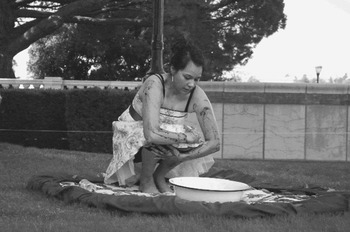
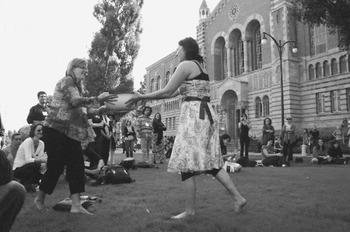
The audience gathers around a woman poised in the shade of a large sycamore tree. She watches them calmly as they settle onto the grass or perch on the edge of a large fountain, and then goes about her work—she cleans the grass of any twigs and leaves and then unfolds quilt after quilt, placing them on top of one another, scrunching their edges into a roundish perimeter that begins to resemble a bird's nest. Gathering leaves with delicate embrace, she lines the nest and then settles into a kneel at its edge, emptying box upon box of blackberries into a porcelain-colored bowl. Massaging the berries to a paste, she smears the purple liquid on her arms and neck, popping one berry in her mouth (see Fig. 1). Rounding her back to balance lower legs on upper arms, she pauses in the yoga posture known as the Crow. Then a hand floats upward; a leg unfurls with immense reach and tenderness. Each part of her body, relishing the multiple connections between earth and sky, ventures away from the nest and into its surrounds. Surging forward she confronts an audience member with her gently inquisitive gaze. Then another and another; each time her visage recalibrates to absorb and reflect the feelings she encounters. Now strutting back and forth in front of the viewers, she puffs her cheeks and buffoons, then drops that persona like a piece of clothing and moves toward the fountain. Swinging arms and torso, she propels herself from land into water, where she explores the knee-deep alternative gravity with sweeping legs and undulating feet. Coming to standing stillness, she beckons to a viewer, urging them into the water with her, then enfolding them in her arms in close embrace. She croons a lullaby-like chant, drawing all viewers into the intimate connection between her voice and her partner's ear. Gently disentangling from this embrace, she reaches out to yet another viewer. Four lullabies later, she leaves the water and returns to the bowl and quilts. She begins to distribute them, one by one, to her friends in the fountain, to audience members randomly, until the nest has vanished (see Fig. 2).
Tanya Lukin Linklater performing Woman and Water at UCLA's Actions of Transfer conference, November 2008: smearing herself with berry juice. Courtesy of UCLA Center for Performance Studies.

Tanya Lukin Linklater performing Woman and Water at UCLA's Actions of Transfer conference, November 2008: giving away the bowl. Courtesy of UCLA Center for Performance Studies.

And this is what I have been thinking about it: this performance hailed those who had been invited and also a number of passersby who were willing to pause and observe the action. The site also hailed Lukin Linklater, requiring that she adapt actions to its specific size and shape. Veering away from the controlled ambiance of the proscenium and challenging the proposition that there is a preferred point of view from which to observe the art event, Woman and Water asks both dancer and viewers to attend intensively to their specific surroundings. Changing with each performance of the piece, the surroundings change the piece itself. It will always be different depending upon where it takes place.
And yet the dance adheres to certain actions undertaken in a designated order. Lukin Linklater brought the blackberries and quilts with her, even if she used the local leaves and fountain. She has orchestrated a sequence of events that strongly invoke the elemental constituents of nature—water, earth, and air—in which water serves as the medium through which the self moves from acquiring home and identity to distributing this wealth to others. Actions unfold in solemn sequence, performed not ponderously but with great care. The events summon up the passage from youth to maturity: at first the dancer labors industriously, then she prepares herself to explore her environs with curiosity and sensitivity. Stepping into the water, she begins to share what she has learned with others, and then, returning to the nest she has labored to create, she redefines its use and value by giving its parts away. Will the quilts go off to perform other services? Will the bowl feed other hungry mouths? Will they engage in the making of other dances? When does Woman and Water end?
In its indeterminate ending and its improvised give and take among action, place, and participants, Woman and Water refuses to be assimilated into economies of ownership and commodification. This work does not call out to be discovered so it can move up the hierarchies of avant-garde work and be placed in wider circulation and on larger stages. The piece's ethics, with their commitment to the careful study of place and the taking of time to allow actions to reverberate, shun the entrepreneurial mechanics of concert dance production. In this dance nothing can be bought or owned. Although Lukin Linklater was commissioned to create and perform the dance, no admission fee is or can be charged. Not the invention of a single author, the dance's narrative braids strands from Alutiiq cosmology just as the movement vocabulary borrows from quotidian, modern, and ritual repertoires. Lukin Linklater is credited in the program with being the choreographer, yet the dance is performing her as much as she is performing the dance.
By blending designated actions with the unanticipated responses of both participants and a public space, Woman and Water resembles the minimalist and conceptual art projects of the 1960s that also called into question the commodification of the art object with its prioritization of object over process. Yet the dance's intent is not to provoke a critique of the status of dance as commodity or even to confront viewers with the possibility that any series of events might be apprehended as art. Rather, in its humble and straightforward address, Woman and Water offers a proposition about being in time, tuning one's actions to place, and the possibility of strangers coming together to partake in communal gathering. It asks: What if we all spend an hour together, witnessing a dancer's actions, enjoying the breeze and the funny coincidences between her movements and the ambient noise? What if we pause in the harried schedule of our day simply to do this, to notice the grass and trees along with the bodies of fellow viewers, and allow ourselves to appreciate that we are spending this time together?
Beyond this opportunity to dwell collectively, Woman and Water comments on the accretion and dispersal of things as part of life's unfolding. It also comments on the importance of domestic labor in sustaining life's cycle. The nest is caringly constructed so as to provide the necessary nurturance for a young being. The body that acquires fortitude from inhabiting it can then expand outward into the world, exploring its own possibilities for moving and, eventually, sharing its strength and vitality with others. Having served its function, the nest is dismantled and recycled, reinforcing the status of the dance as a process rather than a product and also referencing Native practices of potlatch. The narrative floats between the general and the specific, its actions gesturing toward the contours of life from birth to death, while tuning themselves to the unique physiques of each leaf that is gathered and each viewer encountered. By twining the levels of signification, the dance integrates human actions into the natural world as parts of its many cycles.
Lukin Linklater refers to her choreographic process as one of “mapping the cosmology onto the performance space and onto the actions of the performers.”Footnote 1 Perhaps the choreography of Lukin Linklater's dance functions as a kind of orienting device for determining and affirming a system of beliefs. If so, it seems that she is not transferring specific knowledge about events so much as principles for practices of value to her community. Extrapolating from the actions in the dance itself, these principles would include devoting attentiveness to the surrounding landscape, valuing all life, celebrating the uniqueness of each person, and upholding the mandate to redistribute wealth generously.
Lukin Linklater has shared her dances with her community, seeking their responses to the mapping that she has proposed, using the dance as a vehicle for remembering and renewing shared beliefs. She commemorates this shared production of knowledge in the way that she allows for the specificity of encountering each individual during the dance. Inviting everyone to participate as fully as they can, Woman and Water serves not as a typical archive, storing the wisdom of the community, but instead, as a re-membering—a practice in which the past is sown into the present and grown anew.