Implications
Exercise can lead to inaccurate estimates of nutrient and energy digestibility when markers are used. The results of this study showed, however, that the preferred TiO2 yield accurate faecal recovery values and can therefore be used to estimate digestibility of nutrients in ponies performing exercise.
Introduction
Exercise and physical training are known to affect gastrointestinal function and digestibility in horses (Orton et al., Reference Orton, Hume and Leng1985a and Reference Orton, Hume and Leng1985b; Katsuki et al., Reference Katsuki, Asai and Fujikawa1998; Pagan et al., Reference Pals, Chang, Ryan and Gisolfi1998; Bergero et al., Reference Bergero, Peiretti and Cola2002; Goachet et al., Reference Goachet, Harris, Phillippeau and Julliand2010 and Reference Goachet, Varloud, Philippeau and Julliand2014). Decreased DMD digestibility (DMD) and organic matter digestibility (OMD) with increasing workload was observed by Bergero et al. (Reference Bergero, Peiretti and Cola2002) and Pagan et al. (Reference Pals, Chang, Ryan and Gisolfi1998), while Orton et al. (Reference Orton, Hume and Leng1985a and Reference Orton, Hume and Leng1985b) reported increased digestibility of feed as a result of light exercise in horses. However, the alteration in nutrient digestibility due to exercise (Bergero et al., Reference Bergero, Peiretti and Cola2002; Orton et al., Reference Orton, Hume and Leng1985a and Reference Orton, Hume and Leng1985b) could not entirely be attributed to exercise. The level of DM intake might have a confounding effect on the digestibility of dietary components (Ragnarsson et al., Reference Schaafstra, van Doorn, Schonewille, van Riet, Visser, Blok and Hendriks2010). Katsuki et al. (Reference Katsuki, Asai and Fujikawa1998) reported contradictory results when feeding Timothy or alfalfa hay to horses being rested and exercised. No difference in DM intake (DMI) was recorded, but energy digestibility was significantly lower for the Timothy hay when horses were exercised while there was no difference when alfalfa hay was fed. Therefore, the primary objective of the current study addresses the question whether exercise has an impact on nutrient digestibility in ponies fed a fixed level of DMI. In addition, strenuous exercise has been associated with alterations in intestinal permeability (Øktedalen et al., Reference Oliveira, Costa, Bittar, Santos, Oliveira and Sá1992; Davis et al., Reference Davis, Willard, Williamson, Steiner and Williams2005) due to functional loss of the tight junctions (Pals et al., Reference Ragnarsson and Lindberg1997). This may lead to a potential leakage of markers used in digestibility studies (e.g. TiO2, Cr2O3) from the intestinal tract and subsequently results in inaccurate estimates of nutrient digestibility. Therefore, faecal recoveries of externally supplemented Ti and dietary ADL as well as urinary Ti excretions were determined in the current study.
Material and methods
Ethical considerations and animal welfare
The experimental protocol was approved by the Animal Experiments Committee of the Faculty of Veterinary Medicine, Utrecht University, Utrecht, the Netherlands (ethic committee approval no. 2012.III.01.003). Ponies had ad libitum access to fresh water provided in a large plastic bin throughout the study. In addition, environmental enrichment (jolly balls) was provided and the animals were groomed twice daily during the sample collection periods. One month before the study, all ponies were clinically examined, dewormed (Equest; Fort Dodge Animal Health Benelux B.V., Weesp, the Netherlands) and vaccinated (Equilis Prequenza TE; Intervet International B.V., Boxmeer, the Netherlands) by a licensed veterinarian.
Animals, experimental design and housing
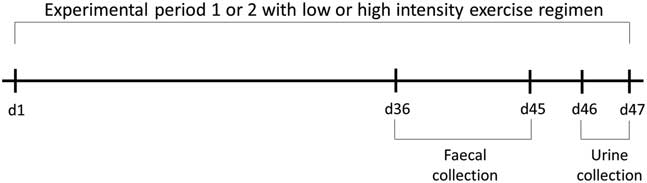
Six, 5-year-old, Welsh pony geldings with an initial BW of 253±3 kg (mean±SE) were used in a cross-over design study consisting of two experimental periods of 47 days (Figure 1) and a wash-out period of 14 days in between. Three geldings were randomly assigned to a low-intensity (LI) exercise regime, while the others were subjected to a high-intensity (HI) exercise regime. During an adaptation period of 26 days, the animals were accustomed to the grass hay and individual housing (4×4 m stalls). During the last 12 days of each experimental period, faeces and urine were collected of all ponies. Faeces were collected during 10 consecutive days for determination of apparent total tract digestibility of nutrients and faecal marker recovery. Urine was collected for 2 consecutive days to determine urinary excretion of Ti (Figure 1). The ponies were housed on sawdust during the first 33 days of each experimental period. Then, the boxes were thoroughly cleaned and rubber mats covered the floor during the last 14 days of the experimental periods. Throughout the study, ponies had free access to fresh water and the BW of each pony was measured and recorded weekly.
Schematic representation of the experimental design.

Experimental diets
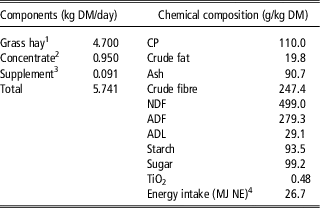
All ponies were fed a pelleted concentrate (Subli® B.V., Lochem, the Netherlands), mineral and vitamin supplement (Research Diet Services B.V., Wijk bij Duurstede, the Netherlands) and grass hay originating from the same batch. The ponies were fed iso-energetically (nett energy (NE) basis) and energy intake was calculated to be 26.7 MJ NE/day (Reference Cerdá, Pérez, Pérez-Santiago, Tornero-Aguilera, González-Soltero and LarossaCVB, 2004) for the experimental periods in order to meet the energy requirements for maintenance (250 kg BW; 23.0 MJ NE/day) and the HI exercise regime. Consequently, ponies subjected to the LI exercise regime were overfed. The absolute daily amounts of grass hay, pelleted concentrate, and the mineral and vitamin supplement as well as their chemical composition are provided in Table 1. The grass hay was offered in two equal meals at 0900 and 1800 h while the supplement was offered once daily at 1100 h by means of a feed bin with intake being monitored by the animal caretaker to ensure complete consumption of the supplement. Equal amounts of the pelleted concentrate were provided twice daily at 1100 and 1600 h. During the last 12 days of each experimental period, feed refusals, if any, were collected, weighed, and recorded each morning at 0600 h and subtracted from the amount of grass hay or concentrate offered to determine actual DMI. During each collection period, water intake was calculated from the daily amount of water offered and refused for each pony each morning at 0600 h.
Components and chemical composition of the experimental diet

DM=dry matter.
1 The chemical composition of the grass hay (950 g DM/kg, as-fed basis) was as follows (per kg, DM basis): Ash, 90 g; CP, 114 g; crude fat, 19 g; crude fibre, 277 g; NDF, 553 g; ADF, 305 g; ADL, 28 g; starch, 90g; sugar, 111 g.
2 The pelleted concentrate (899 g DM/kg, as-fed basis) was provided by Subli® B.V. (Lochem, the Netherlands) and contained: soybean hulls, wheat middlings, barley, palm kernel expeller, sugar cane molasses, alfalfa, vitamin and mineral premix.
3 The supplement (910 g DM/kg, as-fed basis) contributed the following (per kg, as-fed basis): NaCl, 100 g; CoCO3, 4 mg; Na2SeO3, 9 mg; KI, 20.6 mg; MnO, 2.7 g; CuSO4·5H2O, 1.6 g; ZnSO4·7H2O, 4.45 g; FeSO4·7H2O, 8 mg; retinol acetate, 20.64 mg; thiamin, 0.12 g; riboflavin, 0.1 g; cholecalciferol, 0.33 mg; dl-α-tocoferylacetate, 4 g; TiO2, 50 g; LiCl, 12 g; molasses, 60 g and alfalfa, 757 g.
4 Net energy of feedstuffs was calculated according to the formula NE (MJ/kg DM)=(km×(ME–31.3×CFAT)+0.80×31.3×CFAT)/1000, where NE is nett energy, ME is metabolizable energy (MJ/kg DM), and CFAT is crude fat (g/kg DM) (CVB, 2004).
Exercise
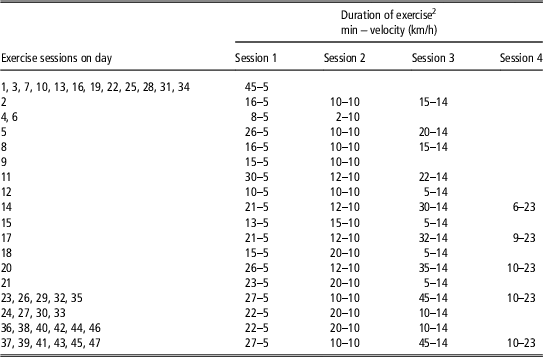
The level of intensity of the exercise regimes was based on categorization of exercise described in the current guidelines of the Dutch Feed Evaluation System (Reference Cerdá, Pérez, Pérez-Santiago, Tornero-Aguilera, González-Soltero and LarossaCVB, 2004). Ponies were acclimatized to exercise in a horse walker, on a high-speed equine treadmill (Derona Equine Performance Laboratory, Utrecht, the Netherlands) and behind a custom-made training device used on a racetrack. Using this training device, ponies following the HI exercise regime were trained simultaneously under standardized conditions. Ponies performing the LI exercise were trained once daily for 45 min in a horse walker at a speed of 5 km/h during the entire experimental period (walk). This exercise regime was also used during the adaptation and wash-out period. Ponies following the HI exercise regime were gradually trained for 47 days according to a protocol using the horse walker, the custom-made training device and high-speed equine treadmill (Table 2). All ponies were subjected to the exercise regimes at set times between 1100 and 1600 h. Heart rate monitors (Polar RS800CX) (Polar Electro, Kempele, Finland) were used during exercise.
Overview of exercise sessionsFootnote 1 , prior (day 1 to 35) and during faeces (day 36 to 46) and urine collection (day 46, 47), of the ponies submitted to the high intensity treatment

1 Horse walker and the custom-made training device used day 1 to 46 and high-speed equine treadmill on day 47.
2 For each day, the subsequent sessions are denoted as duration of exercise (min−velocity (km/h)).
Collection of samples
Representative samples of the grass hay, concentrate and supplement fed during each individual collection period were obtained before each experimental period. During the collection periods, voluntarily voided faeces and urine of each pony were collected quantitatively for 24 h for 10 and 2 consecutive days, respectively, using faecal collection harnesses (SteedAppleCatcher BVBA, Lanaken, Belgium) and urine quivers (Genap B.V., ’s-Heerenberg, the Netherlands) (Schaafstra et al., Reference Schaafstra, van Doorn, Schonewille, Wartena, Zoon, Blok and Hendriks2017). All 24-h collected faeces were weighed per pony and thoroughly mixed in concrete mixer (Altrad Lescha GmbH, Burgau, Germany). Then, 10% of the mixed 24-h faeces of each pony was collected and stored at −20°C in a sealed plastic bag until further processing. At the end of the faeces collection period, all 10 faecal samples per pony were defrosted and thoroughly mixed in a concrete mixer (Altrad Lescha GmbH, Burgau, Germany). Thereafter, two representative 1-kg samples were stored at −20°C in sealed plastic bags until further processing. At the end of the experiment, the faecal samples were dried at 60°C for 72 h. The grass hay, pelleted concentrate, supplement and dried faecal samples were ground to pass a 1-mm screen in a cross beater mill (T. Peppink & Zn, Amsterdam, the Netherlands) and stored in sealable containers at room temperature until chemical analysis.
The last two days of each experimental period, 24-h urine of each pony was collected divided over three time intervals, respectively 0600 to 1200 h, 1200 to 1800 h and 1800 to 0600 h. Each day at 1200, 1800 and 0600 h, the quantitatively collected urine was weighed and a 200-ml urine sample collected from the urine collected during each interval and mixed with 20 mg of thimerosal (Sigma Chemical Co, St Louis, Mo., USA). Subsequently, ~20 ml of urine of each interval per pony was frozen at −20°C until analysis.
Chemical analysis
Both feed and faeces samples were analysed for DM, NDF, ADF, ADL, ash and Ti. Grass hay, concentrate and supplement samples collected during each period were analysed for ADL and Ti content. Urine samples from each collection period were analysed for Ti. Feed and faecal samples were dried in a forced air oven at 103°C to constant weight according to ISO 6496 (ISO, 1983) and incinerated in a muffle furnace at 550°C according to ISO 5984 (ISO, 1978) for DM and ash determination, respectively. Fibre fractions (NDF, ADF and ADL; expressed without residual ash) were determined according to methods described by Van Soest et al. (Reference Van Soest, Robertson and Lewis1991) and Ti according to the method of Myers et al. (Reference Myers, Ludden, Nayigihugu and Hess2004) with modification. Briefly, Ti was determined using a spectrophotometer (Beckman Coulter Inc., Brea, USA) equipped with sipper module for 408 nm instead of 410 nm as reported by Myers et al. (Reference Myers, Ludden, Nayigihugu and Hess2004). The accuracy of each Ti assay run was monitored using an in-house reference sample, and was found to deviate 0.3% from the target value. The combined within and between-run precision of the determinations was ⩽2.5% (coefficient of variation).
Grass hay, pelleted concentrate and supplement as well as pooled faecal samples were analysed for CP (N×6.25) (ISO, 2005a, and 2005b), crude fat (ISO, 1999), crude fibre (ISO, 1981), starch (Nederlandse Norm (NEN), 1974b), sugar (NEN, 1974a) and combustion value (ISO, 1998).
Calculations
Organic matter (OM, g/kg DM) was calculated as:
 $${\rm OM}\,\left({{\rm g/kg}\,{\rm DM}} \right){\,\equals\,}1000-{\rm ash}\,\left( {{\rm g/kg}\,{\rm DM}} \right).$$
Apparent total tract DMD (%) and OMD (%) determined from TFC were calculated for each pony using mean daily feed intake (I, kg of DM or OM) and daily faecal output (FO, kg of DM or OM) as:
 $${\rm DMD}_{{{\rm TFC}}} \,{\rm or}\,{\rm OMD}_{{{\rm TFC}}} \,(\,\%\,){\,\equals\,}[({\rm I}-{\rm FO})\!{\rm /I}]{\times}100$$
Recovery of each marker in the faeces (Rf) was calculated using mean marker intake and faecal marker excretion over 10 consecutive days as:
 $$\eqalignno{{\rm Rf}\,(\%) {\,\equals\,}& ( {{\rm faecal}\,{\rm marker}\,{\rm excretion}\,({\rm g/day})\!\rm /}\cr &{\rm marker}\,{\rm intake}\,({\rm g/day}) ){\times}100$$
The apparent total tract DMD and OMD using the marker (ADL or Ti) method was calculated as:
 $${\rm DMD}_{{{\rm ADL}\,{\rm or}\,{\rm Ti}}} \,{\rm or}\,{\rm OMD}_{{{\rm ADL}\,{\rm or}\,{\rm Ti}}} (\,\%\,){\,\equals\,}\left[ {1-\left( {{\rm A/B}} \right){\times}\left( {{\rm XB/XA}} \right)} \right]{\times}100$$
in which A and B represent the marker concentration (g/kg DM) and XA and XB the OM or DM concentration in the feed and faeces, respectively.
Statistical analysis
All data were subjected to a one-way ANOVA with period and exercise as factors (SPSS Statistics 21.0) following the model:
 $$Y_{{ijk}} {\,\equals\,}\mu {\plus}P_{i} {\plus}T_{j} {\plus}e_{{ijk}} $$
in which Y ijk is the observed value for the treatment, μ the overall mean, P i the effect of the ith period (i=1 to 2), T j the effect of the jth treatment (j=1 to 2), and e ijk the error term. Digestibility values derived from the TFC method or the different markers were subjected to Paired Sample t-tests to compare and to underline differences between the exercise regimes. Differences were considered statistically significant when P<0.05, and trends were declared at 0.05⩽P<0.1.
Results
Body weight, dry matter, water intake and heartrates
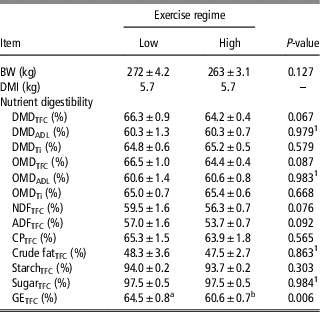
With the exception of one, all ponies completed their entire exercise regime. The pony in question could not follow the HI exercise regime during the second experimental period due to pododermatitis. After treatment and a rest period, including provision of nonsteroidal anti-inflammatory drug for 4 days (day 24 to 27), the pony continued the set exercise program with the other ponies without further complications. Feed refusals for the grass hay, concentrate and supplement were not observed throughout the study. A numerical increase in BW of 9 kg was observed for ponies subjected to the LI exercise regime, but a significant difference in BW between the treatments could not be detected (P=0.127) (Table 3). Exercise did not affect mean water intake (P=0.916). For all treatments combined, mean water intake was 25.9±3.1 l/day. The average heart rate at day 47 of all ponies at rest and the LI exercise regime was 40±3 and 66±4 beats/min, respectively. For the HI exercise, average heart rate of the ponies during day 46 and day 47 of the experimental periods was 84 beats/min (range: 43–142 beats/min) and 111 beats/min (range: 62–157 beats/min), respectively. During gallop (23 km/h), three ponies achieved a heart rate greater than 170 beats/min ranging from 1 to 4 min.
Mean (±SE) BW (kg), dry matter intake (DMI, kg) and total tract apparent digestibility of nutrients (%) determined by the total collection (TFC) and two dietary markers (Ti and ADL) in ponies receiving low- or high-intensity exercise

DMD=dry matter digestibility; TFC=total faeces collection; OMD=organic matter digestibility; GE=gross energy.
a,bMeans within a row with different superscripts differ (P<0.05).
1 Observed period effect (P<0.05).
Macro nutrient digestibility using total faeces collection
The total tract digestibility of CP, crude fat, starch and sugar were similar (P>0.05) during both exercise regimes (Table 3). The digestibility of DM, OM, NDF and ADF measured using the TFC method tended to be lower when ponies received the HI exercise regime (0.05⩽P<0.1). Apparent digestibility of energy was affected (P=0.006) by the exercise regime and was found to be 3.9% lower when the ponies received the HI exercise regime (Table 3).
Marker recovery
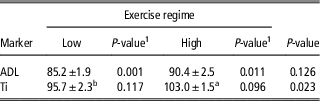
Mean Rf of ADL was similar (P=0.126) between treatments and overall Rf was found to be 84.8±1.7%. Mean Rf of Ti was 7.3% greater when the ponies received the HI exercise regime (P=0.023) (Table 4). Overall, mean Rf of ADL was different from 100% (P<0.001), while mean Rf of Ti was similar to 100% (P=0.703) (Table 4). Titanium was not detected in the collected urine of any pony.
Mean (±SE) faecal recoveries (% of intake) of the digestibility markers ADL and Ti over 10 consecutive days of ponies receiving low or high-intensity exercise

a,bMeans within a row with different superscripts differ (P<0.05).
1 Probabilities that the mean faecal recovery differs from 100 (P<).
Discussion
In the current study, the ponies were subjected to controlled conditions such as fixed level of feed intake and exercise. Exercise influences energy requirements and correspondingly voluntary feed intake (Orton, Reference Orton, Hume and Leng1985b) and passage of digesta through the gastrointestinal tract (van Weyenberg et al., Reference Van Weyenberg, Sales and Janssens2006). In the current study, the level of DMI intake was held constant to eliminate the confounding effects of feed intake on nutrient digestibility.
Exercise did not affect DMD and OMD in ponies, regardless whether the values were determined with dietary ADL or supplemented Ti as marker. However, DMDTFC, OMDTFC, NDFTFC and ADFTFC tended to be lower when ponies received the HI exercise regime. As such, the decreased digestibility of several energy containing dietary components may explain the overall reduction in GE digestibility. Decreased DMD and OMD together with increased workload were observed in ponies (Bergero et al., Reference Bergero, Peiretti and Cola2002) and the same tendency was found for DMD and GE digestibility in Thoroughbred horses (Katsuki et al., Reference Katsuki, Asai and Fujikawa1998; Pagan et al., Reference Pals, Chang, Ryan and Gisolfi1998). Perhaps, a decreased nutrient digestibility during exercise is caused by a diversion of blood flow from the gastrointestinal tract to the skeletal muscle and peripheral tissue during exercise (Manohar, Reference Manohar1986; Brouns et al., Reference Brouns, Saris and Rehrer1987; Duren et al., Reference Duren, Manohar, Sikkes, Jackson and Baker1992; Lorenzo-Figueras & Merritt, Reference Lorenzo-Figueras and Merritt2008). The mechanism by which the diverted blood flow influences enzymatic digestion and microbial fermentation, is not fully understood. Probably a compendium of factors and pathways are involved in the observed changes. It has been suggested that a reduction in transit time (Orton et al., Reference Orton, Hume and Leng1985; Pagan et al., Reference Pals, Chang, Ryan and Gisolfi1998) and muscle-microbiota axis (Cerdá et al., 2016) could explain the tendency towards a decreased DMD, OMD, NDF and ADF digestibility in the current study. These observations are in line with the study of Pagan et al. (Reference Pals, Chang, Ryan and Gisolfi1998) who observed a small decrease in DMD due to a reduction in ADF digestibility in Thoroughbred horses receiving trotting and galloping exercise daily.
In the current study, ADL was not fully recovered in faeces and was found to be 6.7% and 19.3% lower compared with our previous observations (Schaafstra et al., Reference Schaafstra, van Doorn, Schonewille, van Riet, Visser, Blok and Hendriks2015 and Reference Schaafstra, van Doorn, Schonewille, Wartena, Zoon, Blok and Hendriks2017) in ponies fed grass hay-only or a mixed ration composed of haylage and a pelleted concentrate, respectively. Formation of soluble methyl-carbohydrate complexes, partial destruction of faecal lignin by reagents, concentration of lignin in the diet, and physical and chemical differences between feed and faeces have been considered important factors for incomplete recovery of ADL in the faeces (Fahey and Jung, Reference Fahey and Jung1983). For this reason, only the indigestible fraction of lignin is preferred to be used as a dietary marker (Oliveira et al., Reference Oliveira, Costa, Bittar, Santos, Oliveira and Sá2012).
When Ti was used as an externally supplemented marker, the Rf observed in ponies subjected to both exercise regimes was nearly complete. Exercise increased the Rf of Ti from 95.7±2.3% to 103.0±1.5%. Although this increase was statistically significant, its practical relevance is questionable. In the current study, no urinary recovery of Ti was observed when ponies were subjected to both exercise regimes, thereby, suggesting no leakage of Ti or retention of Ti (Jani et al., Reference Jani, McCarthy and Florence1994). Overall Rf of Ti in the current study was 99.3±1.7% and is in line with our previous observations in ponies fed hay-only diets (Schaafstra et al., Reference Schaafstra, van Doorn, Schonewille, van Riet, Visser, Blok and Hendriks2015) and diets containing haylage and a pelleted concentrate (Schaafstra et al., Reference Schaafstra, van Doorn, Schonewille, Wartena, Zoon, Blok and Hendriks2017). Based on the results of the current and previous studies (Schaafstra et al., Reference Schaafstra, van Doorn, Schonewille, van Riet, Visser, Blok and Hendriks2015 and Reference Schaafstra, van Doorn, Schonewille, Wartena, Zoon, Blok and Hendriks2017), Ti can be used as a marker for the estimation of DMD and OMD in ponies subjected to an exercise intensity reflecting a maximum NE requirement of 1.36×maintenance.
In conclusion, physical exercise has an influence on the GE digestibility of the feed in ponies provided with equivalent levels of feed intake. In addition, externally supplemented Ti was shown to be fully recovered in the faeces of both low- and high-intensity exercised ponies, making it the preferred marker for digestibility trials in equines.
Acknowledgements
The authors acknowledge the staff of Department of Equine Sciences, Faculty of Veterinary Medicine, Utrecht University for their assistance in animal care and feeding; the laboratory staff of the Animal Nutrition Group, Wageningen University, for their help in chemical analysis; Subli® B.V., for kindly producing and providing the pelleted concentrate. Monica Verschuur is gratefully acknowledged for her help in execution of the experiment.
Declaration of interest
There are no conflicts of interest.
Ethics statement
The experimental protocol was approved by the Animal Experiments Committee of the Faculty of Veterinary Medicine, Utrecht University, Utrecht, the Netherlands (ethic committee approval no. 2012.III.01.003).
Software and data repository resources
Data and models are not deposited in an official repository.