INTRODUCTION
During the illness trajectory toward dying, the body is often in heightened focus. Decline of bodily functions (Lawton, Reference Lawton2000; Price, Reference Price2000) and distressing illness- or treatment-related symptoms (Rasmussen et al., Reference Rasmussen, Tishelman and Lindqvist2010) can be very troublesome and major reasons for admittance to hospice or specialist palliative care. Accordingly, the need for assistance with bodily care among patients in specialist palliative care is more or less based conditionally upon individual circumstances. As dying persons may have anything from basic to more symptom-oriented needs related to the body, bodily care within this context may involve a variety of care activities that all share the same goals of providing comfort (Lindqvist et al., Reference Lindqvist, Tishelman and Hagelin2012) and alleviating suffering (Öhlén et al., Reference Öhlén, Bengtsson and Skott2002).
For the ill person, receiving assistance with bodily care necessitates exposure of the body to strangers (professionals) in an often-unfamiliar environment (the care setting). Handing over responsibility for bodily care thus involves doing something that in a “normal” Western societal context would be unthinkable because of all the related taboos and norms around privacy and body disclosure (about these matters, see also Elias, Reference Elias2000). Thus, hospitals, or in this case specialist palliative care settings, are particular contexts where societal “rules” are heeded (e.g., regarding covering nakedness or touching intimate parts of a patient's body), but where situations often demand flexibility with these rules as patients more or less lose control over their bodies, depending on their condition (Lawler, Reference Lawler2006). Such loss of control adds to the vulnerability of the dying person and may challenge his or her sense of agency, integrity, and self-value (Conner et al., Reference Conner, Allport and Dixon2008; Lomborg et al., Reference Lomborg, Bjorn and Dahl2005). Chochinov and colleagues (Chochinov & Stienstra, Reference Chochinov and Stienstra2012; Stienstra & Chochinov, Reference Stienstra and Chochinov2006) argue that all bodies are subject to vulnerability, derived from the universal feeling of being at risk, which is part of being human; being near death is per se being vulnerable and fragile. Lawton (Reference Lawton1998; Reference Lawton2000) demonstrated this by revealing the extreme difficulties that persons enrolled in palliative care can face when the body becomes “unbounded.” In these situations, most of what used to be private bodily matters—such as undressing, showering, and passing urine or feces—and new unpleasant disease-related body excretions—i.e., from wounds (also described in Probst et al., Reference Probst, Arber and Faithfull2012), fistulas, or drainages—are exposed.
Embodied presence is always intersubjective, meaning that we all have this object body that we live through (Merleau-Ponty, Reference Merleau-Ponty2002). Thus, for dying persons, everyday activities, including social encounters and palliative care procedures such as bodily care, both shape and are shaped by the experience of being and living in the declined body. The experiential outcome of receiving (or not receiving) bodily care can thus be seen as one important aspect in relation to well-being and, as such, of relevance in the discourse regarding quality of specialist palliative care.
The need for experientially derived research evaluation of palliative care related to patients' needs was recognized as early as the 1980s (Mount & Scott, Reference Mount and Scott1983). However, despite the centrality of the body in dying and the dependency on care professionals to assist with bodily care, few previous studies have been identified that have their primary focus on the explication and in-depth understanding of meanings and experiential outcomes related to bodily care in the specialist palliative care or hospice context. Among the most prominent is probably Lawton's (Reference Lawton2000) fieldwork in hospice wards and day-care settings and her exploration of unbounded bodies. Other notable examples are the study by Rasmussen and colleagues (Reference Rasmussen2000) of patients' lived effects of hospice care in terms of a fragile experience of at-homeness/homelessness, and the work of Öhlén and coworkers. (Reference Öhlén, Bengtsson and Skott2002), which explicates the meaning of alleviated suffering as an “embodied experience of being in a lived retreat.” Eriksson and Andershed (Reference Eriksson and Andershed2008) reported some results linked to bodily care in their study of end-of-life care dependency, while Broom and Cavenagh (Reference Broom and Cavenagh2010) explored gender-related experiences of being cared for on a hospice ward. Finally, Lomborg and colleagues (Lomborg et al., 005; Lomborg & Kirkevold, Reference Lomborg and Kirkevold2008; Jensen et al., Reference Jensen, Vedelo and Lomborg2013) performed experience-based studies about bodily care and people with severe respiratory diseases. Although these studies were not performed in the context of specialist palliative care, they are interesting as they target a group of patients that are now increasingly recognized as a population that rightfully belong to specialist palliative care (Department of Health, 2008; National Board of Health and Welfare, 2013).
The objective of our study was to enhance the depth of existing knowledge about meanings and experiential outcomes of bodily care in the context of an inpatient specialist palliative setting.
METHODS
As we sought to explore individuals' lived experience related to bodily care, interpretive phenomenology was the chosen approach. A central feature of interpretive phenomenology is reliance on qualitative empirical methods to gather descriptions based on lived experience, from which underlying themes and structures of meaning may be drawn (van Manen, Reference van Manen1997). The life-world is at the outset intersubjective, an ambivalent synthesis of life and world, body and mind (Merleau-Ponty, Reference Merleau-Ponty2002). People always exist in sociocultural contexts where they affect each other and their life-worlds overlap (Schutz, Reference Schutz1967). Accordingly, research within a life-world approach applies modes of procedures for interrelating and sharing between participant and researcher; dialoguing and listening to stories as well as researcher participation in the context in which the phenomenon of interest takes place (Berndtsson et al., Reference Berndtsson, Claesson and Friberg2007).
Participants and Setting
Nine participants (5 women, 4 men) aged between 57 and 76 and with various (i.e., breast, abdominal, ovarian, prostate, pharyngeal) metastasized cancers were selected from one specialist palliative care ward according to the following inclusion criteria: enrolled in inpatient specialist palliative care, representation of a variety of ages, equal representation of sexes, having bodily-care needs, able to speak and understand Swedish, and having the strength to participate.
Participants were orally informed about the study by their physician and received further written information if they expressed interest in participating. The physician then referred these individuals to the researcher, who later provided further oral information. The researcher also gave participants information about the voluntary aspect of participation and the duty of confidentiality. Those who agreed to participate completed a written consent form, and a first meeting with the researcher was scheduled.
The specialist palliative care ward selected for this study was established approximately 20 years ago and has a reputation for quality care. It is located in a hospital building in an urban area of Sweden. At the time of our study, the staff consisted of approximately 20 registered nurses, 6 assistant nurses, 2 physicians, 1 occupational therapist, 1 physiotherapist, 1 social worker, and 1 chaplain. Of the registered nurses, five specialized in oncology nursing, one in palliative care nursing, and one in psychosocial counseling. Only three team members had less than three years experience in working with palliative care. Every patient in the ward had one nurse and one physician assigned primary responsibility for care. All participants had single rooms, either looking onto the street or a garden, and they had separate or shared bathrooms.
Data Collection
The first author collected data between October of 2012 and February of 2013 through repeated narrative interviews and supplementary participating observations. Participants were followed for as long as they had the strength and will to participate. Facilitating a trustful and mutual relationship is necessary to gaining access to the lived experiences of participants,. Thus, the approach presupposes that the researcher is sensitive to and has an openness and engagement in each participant's particular situation (van Manen, Reference van Manen1997). Participatory observation enables the researcher to share the context and situations in which the experiences take place, allowing the researcher to better understand and pose questions to the participants, which in turn facilitates relevant interpretations (Friberg & Öhlén, Reference Friberg and Öhlén2010).
The main opening questions for the narrative interviews were “Can you tell me about your bodily-care needs?” “Can you tell me what it's like for you when others care for your body?” and “Can you tell me about a bodily-care situation that you remember as special in some way?” Questions were also derived from bodily-care situations and observations that took place during the present or previous visits—e.g., “How did that make you feel?” “I noticed last time I visited you that you had (. . .). Can you tell me about that?” Probing questions—“Interesting, can you tell me a bit more about it?” “How do you mean, can you explain?”—were employed, as was the technique of reflective questioning (van Manen, Reference van Manen1997), building upon previous conversations—e.g., “Last time we spoke you said that (. . .), and I have been thinking a lot about what that means (. . .),” both of which were frequently used to promote in-depth understanding of participants' experiences.
The supplementary participating observations comprised contextual observations and observations of specific situations, for example, wound care or showering and participants' situational reactions (e.g., when a nurse enters the room to adjust the bed), or activities, which sometimes included dialogues with the researcher. The interviews were for the most part recorded via audiotape and transcribed verbatim. Exceptions were situations where participants did not want the recorder to be turned on or when unscheduled (spontaneous) interviews took place in awkward localities, that is, the smoking area where there were other patients. In these situations, observations and narrative interviews were memorized to the best possible extent, and field notes written down afterwards. After each encounter, field notes and observations were also documented. All writing was performed and filed on a computer.
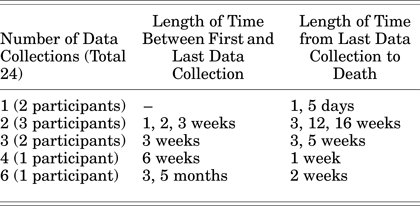
In total, 24 integrated observations and narrative interviews were performed (see Table 1 for details). The number of conversations per participant was determined by the individual participant's condition. Two participants were able to go home during the study period and declined to participate after being discharged from the palliative care ward. Demographic information about participants' age, diagnosis, body status, and illness trajectory was gathered from medical records and from the participants themselves.
Overview of data collection

DATA ANALYSIS
Data analysis was performed by both authors in cooperation and was informed by the approach described by van Manen (Reference van Manen1997). The texts (transcriptions, written interviews, documented observations) were first repeatedly read to get an overall sense of the data before being broken into clusters of related meaning content. These clusters were then analyzed and interpreted in the context of the overall understanding of the narrative interviews and supplementary observations by continuously moving back and forth between the clusters and the texts as a whole. The reflective questioning that was part of the data collection procedure can be viewed as a parallel process of interpretation in which the participants themselves were used to enrich, develop, or support the interpretations. In the final interpretative step, meanings and experiential outcomes of bodily care were disclosed and formulated (van Manen, Reference van Manen1997).
Rigor in interpretative phenomenological research relates to the researcher being open and attentive toward the concreteness and meanings of participants' verbal accounts (van Manen, Reference van Manen1997). Reflective and critical reasoning about disclosure and interpretation of results were continuous between the two researchers. Both authors had previous experience in providing bodily care to severely ill persons, albeit in various contexts, and both had extensive knowledge of the related theoretical and empirical literature. Accordingly, pre-understanding was continuously addressed and discussed during the whole research process, as part of striving to be as open as possible to the data (Van Manen, 1990).
Ethical Considerations
The regional ethical review board of Karolinska Institutet, Stockholm, approved the study prior to its commencement (diary no. 2012/881-31/1).
RESULTS
The results disclose meanings and experiential outcomes of bodily care that involve comforting and distressing experiences related to what can be described as conditional dimensions: the particular situation, one's own experiences of the body, and healthcare professionals' approaches. The meanings overlap in the sense that maintaining and losing body capability and breaching borders of bodily integrity seem to have shaped the nature of the experiences of being comforted and relieved in bodily-care situations, and being left in distress with unmet needs. Excerpts from conversations and observations are presented to supplement the meanings of the experiences described. The names used to represent participants are fictitious.
Maintaining and Losing Body Capability
At different points during their dying trajectory, participants hovered between experiencing relief at handing over responsibility for their bodily-care needs to staff and desiring to stay capable and independent in performing basic procedures, such as walking to the toilet or taking a shower: “You want to be able to. You can't just give up, just like that. You can't do that” (Christina). When they reached a breaking point where managing the body became too difficult, handing over responsibility to staff was a necessity. For some participants, this was described as frustrating, while others were rational and forbearing toward their dependency.
Caroline, aged 76, was a woman with ovarian cancer that had spread in the abdomen and caused major ascites, swallowing legs, and hampering strength. Caroline used to be bodily fit and had been capable of walking several kilometers every day, only a few weeks prior to her diagnosis. She had lived a very independent life and chosen to live apart from the man with whom she had an intimate relationship because she cherished her independence. To her own surprise, Caroline had adjusted to her decreased ability to manage by herself:
The first time, I tried to wash my hair myself, but I found it a struggle. It took so much effort—I felt I don't have the strength to manage this hair palaver. Anita [first name of nurse] washed me the other day, and I'm fine with that. You get used to it. Strangely enough, you do.
The breaking points could either be temporary (e.g., when the body was frail because of ongoing chemotherapy or a general infection), or they could be permanent as part of the gradual deterioration toward death. Martha was a 53-year-old woman with metastatic breast cancer.. She was weak and spent most of her days lying in bed. Because of a large anal wound, she had a diverting colostomy that she needed assistance with: “Do you manage it yourself?” (researcher asking). “No, not yet, because I can't sit down. It's difficult to lie down and do it. But I will later, because the theory is (. . .) I can do that. I always watch when they do it.” For Martha and the other participants, staying capable, or in her case regaining capability, was related to a strong desire to stay connected with people and fulfilling projects, that is, going home one more time, being fit enough to celebrate Christmas, meeting a good friend or grandchild, or just going for a short walk. It was also important for the preservation of self, of still feeling and being recognized as a living, capable human being.
Sometimes staff were described as “over-caring,” which led to a withdrawal of body capability from the individual. Karin, a 57-year-old woman with brain metastases from a breast cancer, was troubled by light dizziness and hampered coordination. She described staff efforts as effective procedures in which she was not really involved: “I can shower myself. Then they say, ‘we'll do it,’ and then I've been showered. Oh, right, that was quick.” For Karin, staff taking over her bodily care meant withdrawing her spatial capabilities, which she stressed were important for staying as “healthy” as possible for as long as possible for the short remainder of her life.
Breaching Borders of Bodily Integrity
Handing over the body for participants meant breaching borders of bodily integrity. These borders involved fear of losing independence and control, and of being bodily violated and shamed. When the participants managed to overcome these obstacles, they gradually felt more at ease and less exposed in the hands of staff. However, this was not always easy and often dependent on the situation, on personal experiences of the body, and on staff members' attitudes and approaches.
One significant part of this process was learning to trust staff to handle the body carefully. Martha clearly felt the pain from her anal wound. Watching her endure this pain was a heart-rending experience. She screamed, and her body was so tense that it almost lifted from the bed. Martha's pain was for the most part successfully relieved with morphine, and this was especially important in bodily-care situations. Martha described how she had adapted to what used to be bodily-threatening situations of receiving wound care that were repeated every day during her stay on the ward: “They [nurses] are very cautious and ask me the whole time, “Is that okay, is that okay?” (. . .) It was a lot worse at the start. Now it's kind of nothing really. So you get used to it.” The nurses' attentiveness toward her pain and her experiences of these situations enabled her to gradually learn to trust them to take care of her wound.
The borders of shame related to exposure of the body in care situations were described as adaptive processes: “It was a bit of a problem in the beginning, having guys washing this intimately. I thought it was a bit (. . .) in the beginning. But then (. . .) now I don't think about it anymore” (Caroline). It was also related to the dying process itself. Patrick, a 63-year-old man who was bedridden and oxygen dependent because of lung cancer, described how he felt about bodily-care situations that in his previous healthy life would have made him feel ashamed: “The weird thing is that I've never liked to defecate or pee in front of people like that otherwise. Now it doesn't bother me one bit. I don't care.” Patrick explained his change of attitude as a reevaluation of significant matters in his present everyday life. What used to be embedded with meanings of privacy, embarrassment, or dignity when he was healthy had become insignificant when death was “just around the corner” and not worth being concerned about.
While some participants experienced ease and feelings of trust, there were others who had felt violated and unsafe, mostly in more technically and medically related bodily-care situations. Joseph had a pharyngeal cancer that had spread to the lymphatic nodes and created a deep cavity, covering the whole left part of his face, throat, and ear. The wound was painful and bled easily, and it was so deep that the artery was only millimeters below the surface of the wound. Joseph had bad experiences from previous encounters with healthcare professionals in other care settings and believed that their heavy-handed and careless wound care had made his condition worse:
It's a new pair of hands every time and (. . .) some are very careless and don't understand what they're doing [the nurses, when they're going to put a fresh dressing on the wound]. A lot of them—most of them, they do what they've always done and do more harm than good.
Joseph felt that general routines and careless hands had violated him, and little attention had been given to his particular needs and experiences of wound care. For this reason, he had decided not to let the staff within the palliative care ward touch the wound, and he was relieved that they respected and enabled him to take personal responsibility. In so doing, they provided him with all the necessary equipment for cleaning and bandaging and respected his need for privacy when caring for his wound.
The bodily-care situations that exposed participants to what they perceived as staff incompetence made them feel unsafe and aware of their own need to be knowledgeable and use self-acquired experience-based knowledge of medical procedures to control the situation. Steve, a 67-year-old man with abdominal cancer, related a story about arriving at the palliative care ward on one particular occasion at a time when he had a chest drainage that was connected to a bag on his thigh:
I needed to go to the toilet, so I went there, sat on the seat, and discovered that the tube and connection to the bag are lying on the toilet floor. So I ring the bell when I come out and want some help with this. Then in comes a nurse, who's from another country—so far no problem. But then it's soon very obvious that she can't speak Swedish, so she didn't understand what I said. She said, “I'll sort it out,” or something like that, and then she just pushes it back together without cleaning it or anything with disinfectant. So I was a bit vocal and shouted, “Hold your horses,” but by then she was already on her way out. But before she had time to shut the door, I shouted something about her having to bring a nurse, but no one ever came. So after ten minutes I rang the bell again (. . .) maybe seven minutes, I don't remember, but (. . .) then I ring the bell again and someone else comes in. So I tell them again what happened. Well, then, of course, they took care of it properly. But that first nurse was clueless. She even managed to close the valve here, so it wasn't running in any direction.
Steve stressed professional competence and an ability to communicate as the two most important factors for feeling safe in situations where he needed others to care for his body.
Being Comforted and Relieved in Bodily Care Situations
Bodily care was for the most part described as providing general well-being: “I have never been spoiled, so it's [having his body cared for] kind of, it's like they [the nurses] are looking after me” (Ben). Some participants who described themselves as lonely persons, that is, living alone or having few relatives or friends, regarded it as dignifying to have someone comforting them by caring for their body.
The participants talked about specific bodily-care situations that involved relief from troublesome symptoms. These situations could involve basic care—that is, being assisted with shaving or adjustment of position in bed—but they could also be related to more technical and medically oriented care. Caroline felt unwell and restrained by her ascites, and she described the relief upon having it removed: “So it was so wonderful yesterday when they drained me. You could see how my stomach went down, and it was softer and everything, so that was really nice.” For her, being relieved from the burden of ascites meant regaining the capability to move about and being able to rest better in bed. Another example was Patrick, who described how he had not been able to pass urine for a long time. Wanting to be self-managing and independent, he had tried to manage without help for as long as possible, but when he finally accepted having a urinary catheter inserted, he was relieved, both from the burden of pain and from the conflicting distress of desiring to be self-managing but not being able to.
Touch massage was offered to patients in the ward. This was described as a relaxing moment of well-being, a time for drifting away from pain and bodily tensions. Having their body touched was also described as bringing about feelings of acknowledgment and of being connected as one human being to another.
Being Left in Distress with Unmet Needs
The participants' descriptions reveal several experiences of unrecognized or ignored need for bodily care. Most participants also described finding it hard to ask for help because they knew the staff was busy. One example was mouth cleaning: “I have complained but no one wants to do it [moistens his lips]. So I try to do it myself” (Patrick). Patrick was bedridden and very weak; he needed help with most of his bodily care (shaving, showering, drinking, and eating). The following excerpt is a field note from one of the last visits to Patrick, about two weeks before he died
Patrick is unshaven and has dirty hair. His nails are long and dirty. You can see that he hasn't had help with showering or hygiene routines for a long time. He holds his fork in his left hand (the right one is paretic after stroke) and eats very slowly. It's difficult for him to find the strength to lift his fork to his mouth, and he gets very short of breath.
It was obvious that no one had helped Patrick to shave for a while, and he was asked about the situation:
It would be lovely if they wanted to give me a shave. But you can't wait a week because that's too long. I've said that to them every three days. They were going to write everything else down in some book, but they must have forgotten.
Patrick felt ignored and distressed, and he recognized both his and the staff's expectations of him being able to manage on his own. In common with other participants, Patrick also felt that staff sometimes approached him as less ill and more capable than he actually was, as if they did not understand or recognize his bodily deterioration, or as if they wanted to optimize him by acknowledging him as capable.
Other examples of participants' feelings of being left with unrecognized needs related to their desire to maintain capability and be able to move about freely. Getting the patients out of bed to walk or perform other kinds of spatial movements were described by several participants to be a particular task for the physiotherapist, while the rest of the staff did not take such initiatives. The physiotherapist's visits were therefore much appreciated, as he or she attended to their needs of exercising and getting out of bed. Ben, aged 75, had a prostate cancer with brain metastases. He suffered from insufficient balance and was too weak to walk on his own:
Researcher: Can you get up at all and walk a bit by yourself?
Ben: Walking, you mean? No, that's no good.
Researcher: How come you've not tried?
Ben: I don't have anyone here to try with.
Ben's greatest sorrow was his legs, which could no longer support his body. Well aware of his bodily weakness and limitations, he nevertheless felt abandoned by staff for not recognizing his need and desire for assistance with getting out of bed, standing, and walking.
Not having bodily-care needs met made participants feel rejected and unseen in their frailty. One participant talked about not being woken up early enough in the morning to take his morphine tablets, which for him meant waking up in pain and abstinence with severe anxiety. Another example related to medicine distribution involved a participant who had extensive trouble sleeping and was desperate to sleep each night but did not receive his sleeping tablets until the night staff arrived, because this, they told him, was the routine on the ward.
Some participants described losing their temper and becoming upset when their bodily-care needs were not recognized. At the same time, when they vocalized their discontent to staff, sometimes emotionally, reacting with frustration, anger or tears, they felt ashamed because they knew that the staff were busy, and they did not want to appear ungrateful: “And you feel embarrassed afterward and think you've said something wrong” (Patrick).
Martha talked about the discrepancy between staff members who acknowledged patients' personal needs and wishes and those who did not. She exemplified this by describing how she wished to have the dry skin on her arms moisturized. When one particular nurse was on duty, she would always come to Martha's room and, while they were talking, gently take some lotion and start to moisturize her arms. Other staff members might place the lotion on her table but not close enough for her to reach, and they did not offer to assist her. As Martha was fragile both bodily and emotionally, these little gestures could make a great difference to her in a positive or negative way. In the first instance, the situation was comforting, while in the latter it could distress Martha and make her burst into tears because she felt abandoned.
DISCUSSION
The greatest challenge related to bodily care did not primarily seem to concern the elimination of body privacy. Rather, handing over responsibility for bodily care meant that patients had to deal with the experience of vulnerability subject to losing body capability and control and thereby experienced being fragile in situations when assistance with bodily care was needed. Unmet or unrecognized needs were described as intimidating and damaging for participants' dignity and self-value, as previously reported by Rasmussen (Reference Rasmussen2000) and Lomborg et al. (Reference Lomborg, Bjorn and Dahl2005), and in the wider perspective of care dependency by Eriksson and Andershed (Reference Eriksson and Andershed2008). Nevertheless, even though only one participant explicitly discussed previous self-evident privacy values (cf. Elias, Reference Elias2000; Pols, Reference Pols2013), all of our participants may have found such values to have lost their relevance in favor of more prominent existential matters related to body decline and awareness of impending death. An alternative interpretation is that the staff's approach to participants influenced the bodily-care situations in ways that promoted trust and ease (cf. Rasmussen, Reference Rasmussen2000). Lawler (Reference Lawler2006) stressed that loss of control over the body in illness is a powerful source of embarrassment from which the patient needs to be protected so that his or her dignity and personhood can be preserved. This may be done through a “somological” approach that entails caring for a patient's object body while approaching him or her as a subject with unique needs and experiences of the situation (Lawler, Reference Lawler2006).
For participants, breaching of integrity borders also involved fear of bodily violation. Integrity is about personal boundaries. According to Martinsen (Reference Martinsen2006), integrity means that something is untouchable and may be violated if touched. Being professional about integrity entails seeing and acting toward the patient in ways that will provide the most comfort and well-being, while simultaneously respecting and preserving their integrity. Malignant wound care has been recognized as bodily and psychosocially distressing because of the often-unbounded nature (appearance, smell, leaking) of such wounds (Wilkes et al., Reference Wilkes, Boxer and White2003). Staff enabling a patient to take personal responsibility for his wound, as described in our study, can thus be seen as a professional act of reducing the patient's burden of distress and at the same time protecting integrity.
Among the examples of bodily care, situations were described that relate to both basic nursing and specialized care. Basic nursing care is sophisticated by its very nature, and, to avoid abuse and malpractice, it takes many years of education and habitual experiences to understand how embodied knowledge such as pre-understanding based on previous experience of care, awareness of the patient's particular situation, and attentiveness and openness toward the patient's current experiences influence concrete caring actions so that they can lead to a comforting lasting outcome (Malmsten, Reference Malmsten1999). It seems that the bodily-care situations that involved feelings of trust and of being comforted elicited such skills among staff. For instance, the positive experience of the participant who described having her arms moisturized could be interpreted as a demonstration of “person-centered, context-specific professionalism.” In the literature, professionalism, or rather the characteristics of palliative nursing care, has been described by nurses as “always striving to do what is best for the individual patient, meaning meeting individual needs, including providing hygiene care, comfort and alleviation of suffering, and assisting the patient to maintain independence and control” (Barnard et al., Reference Barnard, Hollingum and Hartfiel2006).
Alongside descriptions of bodily needs and basic nursing care, our study also highlighted bodily-care situations that involved medically and technically advanced care activities. These activities could provide relief from troublesome symptoms but could also be distressing if not being adequately performed, or if recognition of participants' experiences of the situation was overridden by general routines.
The results of our study outline the quintessence of palliative care: dying persons have a mixture of basic and symptom-oriented bodily-care needs. Moreover, they are dying, and are thus extremely vulnerable. Accordingly, quality of bodily care in the specialist palliative context necessitates experience-based and theoretical expertise in palliative care principles, in symptom management during the trajectory of illness and dying, and in basic nursing care (cf. Benner et al., Reference Benner, Tanner and Cheslea2009).
Basic nursing care also requires extensive amounts of time, while being an instantaneous act, but in reality is rarely afforded the time needed. From the descriptions, we can tell that our participants could sense and react to the staff's time constraints and lack of assistance with basic bodily care by avoiding asking for assistance. Tishelman and coworkers (Reference Tishelman, Bernhardson and Blomberg2004) have stressed the complexity of caregiving for patients with advanced cancer and highlighted the tension between caregiving ideals (palliative care principles) and the limits of caregiving within the healthcare system (resources, guidelines, regulations). In our study, this seemed to be no exception. Accordingly, this highlights a need to reappraise the present organizational palliative care model of care for dying people.
STRENGTHS AND LIMITATIONS OF THE STUDY
There is always a challenge in achieving balance between obtaining rich data and respecting the integrity and well-being of dying persons, and performing research in this context can be emotionally and ethically challenging. Most of the bodily-care situations in the data were described by participants rather than observed by the researcher, simply because few of the situations took place when the researcher was in place, and these situations, in this context, were difficult to schedule. However, it is our impression that all the conversations and time spent with participants yielded not just sufficient research data but also enabled building relationships and providing support to participants through the conversations, which is in line with research previously performed within the palliative care context (cf. Carlander, Reference Carlander2011; Walker & Read, Reference Walker and Read2011).
CONCLUSION AND IMPLICATIONS
Our results highlight the interlink between the special nature and fragility of situations related to bodily care and how these are shaped by personal experiences of the body and of care professionals' skills and approaches, in ways that foster comfort in the context of inpatient specialist palliative care. These conditional dimensions correspond very well with what has previously been recognized as influential on the feeling of at-homeness (Rasmussen, Reference Rasmussen2000; Zingmark et al., Reference Zingmark, Norberg and Sandman1995), which can be seen as one integral aspect of well-being at the end of life.
These experientially derived results also show that patients in a specialist palliative care context may integrate both basic nursing care and medically oriented care activities in their everyday experiences (and needs) of bodily care, and that these two equally influence whether comfort and well-being are facilitated. From this follows that specialist palliative care settings need to acknowledge the value of skilled basic nursing care as part of and complementary to expertise in symptom relief during the trajectory of illness and dying. Finally, it is suggested that research and clinical evaluation of the quality of specialist palliative care increasingly involve experiential data, targeting patient needs and related outcomes of care.
ACKNOWLEDGMENTS
The authors sincerely thank the Erling Persson Foundation, the Sven and Dagmar Sahlén Foundation, the OE and Edla Johansson Scientific Foundation, and the Olle Engkvist Foundation for funding our study, and the study participants for generously sharing their time and their experiences of the last phase of life.