I am happy to report that Perspectives on Politics is thriving. We inherited a journal that was founded with a flourish in response to a range of concerns about the ways in which the U.S. political science profession had become highly specialized and balkanized, at the expense of broader understanding and public relevance. Our editorial predecessors had put the journal on a sound footing, a significant accomplishment for a new journal less than a decade old. At the same time, the journal we inherited faced some challenges related to the effective use of the Editorial Manager system; the efficiency of its operations, especially regarding communication with authors and reviewers; and its distinctive purposes and intellectual vision looking to the future. In the roughly 18 months since we assumed editorial control of the journal in June 2009, I believe that we have succeeded in addressing these challenges and projecting a new excitement about the journal and the role it can play in contributing to the invigoration of the discipline.
Our labors in 2009 centered on gaining our operational footing, editing and publishing the manuscripts inherited from Jim Johnson, and reaching out to attract new and exciting authors and manuscripts. Our first issue of 2010, which featured a special “Gender and Politics” theme—of which we are very proud—included most of the articles that remained in the queue. Since that issue, we have been publishing articles developed by our own editorial team. We have a highly talented, energetic, and well-organized staff, and we have instituted a fine set of procedures for dealing with authors, reviewers, and each other. As a consequence, we have been able to work efficiently and stay on production schedule with Cambridge and the printers. Indeed, we have exceeded our “normal” production quota, and in the past year, we have published a number of very large and high-quality issues. I have received a great deal of positive feedback from authors and readers about the journal, its quality, and its accessibility and responsiveness. More important, we are receiving a steady flow of manuscripts of an increasingly high quality, from “major” scholars eager to place their work in our journal and from more junior scholars who regard Perspectives and its mission as hospitable to their view of political science. By all accounts, the journal is doing exceptionally well. It is also a wonderful publication and a joy to work on.
The appendices to this report include some basic publication and production data. We will be happy to answer any questions about these data to the best of our ability.
In what follows, I would like briefly to outline a range of accomplishments worthy of note, which together help to explain our success thus far.
1. Perspectives is a collaborative effort, and the journal works well because it has a terrific staff. James Moskowitz is an exceptional managing editor. He combines business experience, strong communication and computer skills, a real aesthetic sensibility, and the scholarly perspective of an advanced and published political science Ph.D. student. James has contributed immeasurably to the success of the journal along every dimension, from the efficient operation of the EM system to the journal's terrific new design, and he is responsible for the extraordinary covers we have featured in the past year. James works full-time on the journal. In August of 2010, Margot Morgan became the full-time book review managing editor. Margot has worked with me (along with James) on the journal since I first became book review editor six years ago, and she had been serving as the point person regarding copyediting and production of the Review section. When she received her Ph.D. from Rutgers in 2010, she was promoted to a full-time position, enabling me to focus more attention on further improving the “front end” of the journal (and also to return part-time to the classroom, as per my agreement with IU).
James and Margot are a terrific team, and I could not do the job that I do without their active involvement. They are joined by five equally terrific editorial associates, whose contributions far exceed the 20 hours of work per week that their assistantships entail. Rebekah Tromble worked on the Review for two years and, after spending a year abroad doing dissertation fieldwork, returned to the staff as an editorial assistant working on the journal's front end. Rebekah and Katie Scofield, another excellent advanced graduate student, read every article submitted for publication and participate with James and me in weekly “conference reviews” in which we decide which pieces to send out for external review. They then divide up labor to find reviewers for the manuscripts and stay on top of all communication with reviewers. They also work closely with James to prepare for publication those articles eventually accepted for publication. Emily Hilty, Adrian Florea, and Hicham Bou Nassif work with Margot on the Review section, helping me find reviewers for each book, corresponding with reviewers, and working to move all reviews to publication. The staff works very well together. We meet weekly to discuss all aspects of the journal, prepare manuscripts for copyediting, and plan ahead. We also typically have lunch (supplied by me). It is a very upbeat work environment. All editorial assistants are encouraged to take initiative and make sure that their work on the journal complements their academic work and long-term scholarly plans.
Much of the work of academic journals is done by staff, almost all of whom are graduate assistants. I am very proud of my staff and proud of the work environment we have cultivated in our office. I believe this environment has contributed greatly to our success thus far with the journal. I also think that our discipline in general could do more to recognize the contributions of graduate assistants and foster work environments that help these assistants do their work in a way that also contributes to their professional development as young political scientists.
2. The journal has a terrific editorial board. We stay in fairly regular communication with the board as a whole and communicate very often with individual board members to consult on difficult decisions and seek reviews of manuscripts when this becomes necessary. Board members have been very responsive and helpful, and many of them have been proactive in encouraging authors to submit their work for review. I believe that a journal like Perspectives can only succeed if a diverse group of excellent and highly respected political scientists are willing to commit themselves and their credibility to the credibility of the journal. Sustaining this kind of connection has been an important accomplishment and remains an ongoing commitment.
3. We have excellent working relationships with APSA (especially Michael Brintnall and Polly Karpowicz), Cambridge University Press (especially Mark Zadrozny, Susan Soule, and Jonathan Geffner, who is the Cambridge point person on all production issues), Beljan (the compositors), and AIRES, which runs the Editorial Manager system. James has done an excellent job of staying in touch with all of these people, being responsive to their concerns and obtaining their help when it is necessary. I cannot say enough about the synergy between Cambridge and APSA and how essential this kind of relationship is to the success of the journal. We are also fortunate to have the help of three excellent copyeditors: Linda Lindenfelser, who worked with Jim Johnson when the journal was at Rochester; Maurice Meilleur, a published young political scientist currently working at the University of Illinois at Urbana–Champaign; and Melanie Loewhing, a talented writer and Ph.D. candidate at IU's department of communication and culture. While we do some copyediting in-house, we have budgeted to have almost all of it done externally by experienced professionals. This is important for a journal in which broad intelligibility, and thus excellent prose writing, is essential.
We are also very fortunate to have the exceptional support provided by Indiana University, its College of Arts and Sciences, and its political science department. IU provided course release for me and support for graduate assistance for the four years of my tenure as book review editor. It also housed our editorial office and furnished state-of-the-art computer support. It has committed itself to continuing this support for the duration of my tenure as editor-in-chief of the journal. (The only change is that IU has tripled our office space since we took over the entire journal.) This means that for eight and possibly 10 years, IU will have supported and housed the journal. This support and the scholarly and collaborative spirit in which it is provided have been indispensible to the success of the journal. In an age in which such support is increasingly hard to come by, this is worth noting. In these hard times, the fact that IU is a public university in what is not one of the country's wealthiest states makes this support especially notable. I would like personally to thank Russ Hanson, chair of the political science department; David Zaret and Bob Becker, deans in the College of Arts and Science; Karen Hanson, provost; and Michael McRobbie, president of Indiana University, for their support. I would also like to thank James Russell, director of the political science department's data lab, for exceptional tech support; and Jan Peterson, the department's administrator, for invaluable assistance with the finances and accounting associated with managing our office.
Table 12010 Submissions

Notes. The Book Review section ran reviews of 281 books treated in standard book reviews. Including coauthors—but excluding our numerous critical dialogues and symposia—the works of 376 authors were treated in some manner.
Table 2Submission Review Data
Notes. It is difficult to compare submissions data from 2010 against 2009, which was a transitional year. Table 2 compares the last full year of the previous editorship to the first full year of the current editorship and shows a 17% increase in the total volume of submissions compared to 2008. The most notable change in the manuscript assessment process is the increase in the percentage of article submissions that are declined without external review. (For further explanation, see the statement of editorial policies in the appendices.) In turn, a smaller percentage of manuscripts are sent out for external review.
4. We have maintained excellent and efficient communication with authors, reviewers, and people in the field more generally. We try—and almost always succeed—in completing our internal review of each submitted research article within 7 to 10 days of submission. We move promptly to identify external reviewers for all suitable manuscripts. I also write substantial and constructive letters to every author whose paper we decide not to send out for review, and I try to send these letters within 10 to 14 days of submission. I have received a great deal of appreciative feedback from many of the authors whose papers we choose not to send out for external review. We decline many papers, but we do not “reject” papers. We assess their quality and appropriateness as best we can; communicate our assessments in an honest, constructive, encouraging and prompt way; and do our best to help each paper that comes to us to move forward in some fashion in some appropriate venue. We also stay in close touch with authors at each stage of the publishing process, from external review through revision through preparation for publication. I write careful, clear, and substantive letters to each author of a promising paper offering guidance and, in particular, discussing ways that his or her paper can be framed to reach a broad readership of political scientists and maximize its broad impact. If there are delays, we write to authors explaining them, and I follow up personally with late reviewers to gently encourage them to send us their promised reviews. I write follow-up letters to authors from whom we really wish to see a revised paper, encouraging prompt revision and resubmission. I also write often to scholars in the field inquiring about interesting-sounding conference presentations and inviting article submissions. I am especially interested in cultivating connections to junior scholars whose work has merited official recognition or seems particularly interesting. We are always looking to reach out to new authors and readers, and to attract new and exciting work for review and publication. At the same time, all research articles are subject to our strict, double-blind external review process.
As a matter of general policy, we prize efficient, prompt, and kind communication. Every letter is an opportunity to explain the journal's distinctive mission and make a friend for the journal. We also keep excellent records of all communication. Every official letter is sent through Editorial Manager, and copied to the Perspectives e-mail account and my own e-mail account, and all letters are backed up.
Table 3Pipeline Summary by Final Decision, in Days
5. With the support of APSA and Cambridge, since March 2010 (vol. 8, no.1), the journal has had a new cover design that complements the designs of APSR and PS. Along with some changes to the table of contents and some clarifications of editorial policy, this means that the journal is much improved aesthetically. And while you cannot judge a journal by its cover, we believe that the aesthetics of the publication greatly enhance its appeal as a single, hard-copy publication with an overall mission and sense of itself. We hope that the integrated character of each issue helps us reach out to APSA members as well as potential readers beyond the profession.
6. Corresponding to these improvements are a number of other changes, most of which are at least somewhat “under the radar.” At the initiative of James Moskowitz, we have:
• standardized the Perspectives references section (we have also communicated with the APSR about creating some consistency in APSA journals);
• arranged the table of contents to better reflect the peer-review portion of the journal in distinction from the solicited portions;
• added a running index of the book reviews (to offset any disturbances to long-standing expectations caused by theme sections, etc.);
• implemented a system for sharing, uploading, and maintaining supplemental data. Significant thanks are owed to Cambridge for their support, and we hope this becomes a model for other journals;
• successfully pursued the indexing of Perspectives on Thomson/Reuters—which had surprisingly not yet been done—again with the help of Cambridge.
7. New editorial philosophy and policies. The March 2010 issue contained a special section featuring an “Editor Statement on Philosophy and Policy” (included in the appendices). This text and revised policies have also been posted online at the Perspectives website. We are doing everything possible to rationalize, clarify, and publicize journal policies. This is in tune with our decision to “brand” the journal as A Political Science Public Sphere (itself explained in the “Editor Statement”).
8. In particular, we have worked hard to make our peer-review process for all research article submissions more serious and systematic, and to make clear to all readers that every single research article published in Perspectives has been through a demanding, blind internal review process and then a double-blind external review process. Our review process—which includes careful editorial selection of reviewers and directions to all authors regarding revisions, as well as very careful line-editing of every sentence by the editor-in-chief, in addition to careful copyediting of accepted manuscripts—is as serious, if not more serious, than that of any other peer-reviewed political science journal. I am happy to report that we are receiving a healthy and constantly growing number of excellent article submissions, many of which, it turns out, are authored by top scholars in the field. By being very serious about our review process, we hope to increase the number of truly excellent articles submitted, and over time, to enhance the journal's reputation as a peer-reviewed journal, so that increasing numbers of junior colleagues think of Perspectives as a first option for their best work when this work is framed broadly, and so that departmental personnel and tenure and promotion committees will accord peer-reviewed research articles published in Perspectives—and indeed all Perspectives pieces—the measure of recognition they are due.
9. Journal focus. We are finding that it is possible to develop a reasonable publication schedule that provides a measure of focus to our issues. The September 2010 issue, for example, contained a number of articles and a terrific symposium on the theme of the Obama presidency that was timed to come out before the important November 2010 midterm elections. The December 2010 issue contained a number of articles and symposia on the theme of the relationship between political science and the military and security needs of the U.S. state. Our forthcoming March 2011 issue will highlight the theme of environmental politics. The June issue will highlight the theme of the study of democratization, and the September issue will highlight the theme of the politics of immigration. We are a general journal of political science and the articles we publish represent the best of what is submitted to us that makes it through our review process. Our primary consideration in deciding what articles to publish is scholarly quality, as this is judged through a review process in which the evaluations of scholarly peers are determinative. But by thinking strategically about timing and production schedule, proactively soliciting “Reflections” essays, and developing special Book Review theme sections, we can also call attention to some of the “big topics” that touch on all areas of political science—as it is our mission to do. I regard this kind of editorial “visioning” and planning as a central aspect of my job as editor-in-chief of this particular journal. At the same time, I am always listening to and indeed soliciting feedback from editorial board members and colleagues more generally about what we are doing, what themes to attend to, and how we can do what we do better.
10. Special review sections. Perspectives seeks to nurture a political science public sphere that allows scholars to move beyond their normal comfort zones and reach broadly, beyond conventional methodological and subfield divides and to the discipline as a whole. Toward this end, in the past six years, we have instituted a number of innovative formats to our Review section—book symposia, “critical dialogues,” creative categorizing of certain books (the rationale for these changes was explained in my March 2006 “Statement from the Book Review Editor,” which is also included here as an appendix, since our philosophy for the Book Review section has not changed, and indeed the perspectives laid out in that text anticipated what we are now trying to do with the journal as a whole). This year, we added an additional innovation: each issue will now contain, in addition to the “standard” four-subfield sections, a special “theme” section highlighting books that address an important substantive theme irrespective of field or approach. Among the themes already featured or in production are the following: gender politics, the geopolitics of Asia, democratization, human rights, global climate change, and the politics of immigration.
We regard this innovation as a crucial development. It is the outcome of conversations with scholars and leaders of APSA, as well as among ourselves, that have been going on ever since I became book review editor in 2005. These conversations have focused on the intellectual and practical limits of the four-field framework that Perspectives inherited from the APSR (it is worth noting that this framework only evolved over time at the APSR), and whether or not Perspectives should reform this framework. This topic was discussed at our editorial board's inaugural 2009 meeting in Toronto, and the board expressed enthusiastic support for some sort of change. At our 2010 board meeting in Washington, DC, the board supported my proposal that the best way for our editorial team to address this issue while still undertaking all the other changes noted above would be for the journal to add a fifth section to the review, which would highlight a different substantive theme in each issue, rather than to modify the long-standing four-field format, which serves many functions in the profession.
Table 4Submission Subfields, by Author Self-Classification
Note. Since authors may indicate any number of classifications they see fit, N is highly variable.
11. We are very proud of the contents of the journal over the past 18 months and would especially like to call attention to a number of particular contributions:
• The June 2010 issue included an excellent symposium on the research agenda of Elinor Ostrom. This was hurriedly organized to respond to and capitalize on her Nobel Prize, and it included essays by Bob Axelrod, Frank Baumgartner, Nancy Bermeo, Ben Fine, Robert Keohane, Margaret Levi, Jane Mansbridge, and Peregrine Schwartz-Shea.
• The September 2010 issue included a special section of “Reflections” on the Obama presidency, including essays by Larry Jacobs and Desmond King on presidential politics, Dan Carpenter on the politics of Federal Reserve reform, Jacob Hacker on health care reform, Suzanne Mettler on “the submerged state,” and Dorian Warren on the politics of labor and race.
• The December 2010 issue featured a “Reflections” symposium on the connections and disconnections between social science scholars and military and national security practitioners, and a “Review” symposium on the relationship between Cold War national security concerns and the creation of Soviet studies as a field. Both of these symposia included a diverse array of major scholars reflecting on an important question that has animated this journal from its inception: What are the ways that political science does and should relate to the broader political world? This issue of the journal also contained very timely essays by Amy Gutmann and Dennis Thompson on “The Mindsets of Political Compromise” and David Mayhew on “Legislative Obstruction.”
• Our forthcoming March 2011 issue, in press, will feature a lead article by Robert Keohane and David Victor on “The Regime Complex for Climate Change,” along with a special Review section dealing with environmental politics. And our forthcoming September 2011 issue, still in the planning stages, will contain a range of articles, essays, and special review features dealing with the U.S. politics of immigration, the European encounter between Islamic immigrants and multiculturalism, and the normative power and limits of “birthright citizenship.”
It bears reemphasis that it is only through serious planning and a long-term perspective that we can try to offer some thematic focus and highlight particularly important broad political issues—the environment, immigration, etc.—while also fulfilling our central function of promoting a broader kind of research article and publishing only the very best article submissions that make it through our internal review and then our rigorous system of double-blind external peer review. While all editors make decisions about production schedules and article placement, and while we treat our discretion in these matters as an opportunity to highlight broad themes and the ways that diverse scholars can speak to each other about these themes, it is also the case that each of these research articles stands on its own and speaks for itself.
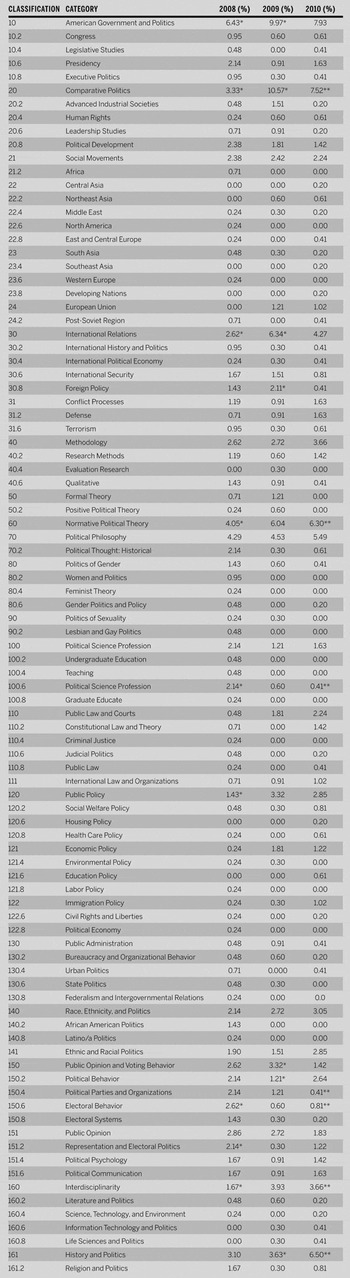
Table 5Annual Percentage of Total Classifications
Notes.
* Indicates percentage changes that fall within the top and bottom 5% of all percentage differences for 2008–09 and 2009–10
** Indicates percentages changes that fall within the top and bottom 5% of percentage differences for 2008–10.
12. We are working hard to project the journal as an important site of serious thinking about the future and purpose of our discipline. This was the reason for my essay on “What's the Value of Political Science?” published in the October 14, 2009, Chronicle Review; and my piece “Perestroika and the Journals,” which appeared in the October 2010 PS. More important, it is the reason we have initiated a new practice: each year, we will hold a special Perspectives theme panel at every APSA Annual Meeting. These panels will feature editorial board members and will focus on important themes relevant both to the discipline broadly and to the editorial challenges and directions of the journal. Our inaugural panel at the 2010 meetings in Washington, DC, was on the theme of “Perspectives on Subfields in Political Science.” It featured Dan Drezner, Paul Pierson, Stathis Kalyvas, Dara Strolovitch, and Lisa Wedeen, with me serving as moderator. The panel was very well attended (our informal count put the number of attendees at around 100). The purpose of these panels is to call attention to important, broad themes that transcend the normal conference designations; foster the idea and practice of the editorial board as a real intellectual community; and provide a forum for serious intellectual discussion of the journal in which all interested colleagues can participate. Our tentative plan is to focus our 2011 theme panel on “Peoples, Borders, and the Study of American Politics.” To sum up, the journal is thriving as a res:ult of the terrific work of many fine people and the support offered by APSA, Cambridge, Indiana University, and especially the colleagues who, as authors, reviewers, and readers, are our primary constituency.


Appendix A. A Statement from the Book Review Editor
Jeffrey C. Isaac
This statement was originally published in the March 2006 (vol. 4, no. 1) issue of Perspectives on Politics.
It was with great pleasure that I recently assumed the reigns as Book Review Editor of Perspectives. I am fortunate to have had excellent predecessors—Greg MacAvoy and Susan Bickford—who themselves had an excellent staff. This has made the transition relatively painless and successful. But, like all transitions, this one has involved glitches and has required patience and perseverance. We greatly appreciate the cooperation and flexibility that so many of our colleagues have shown.
I took on this task because I believe that Perspectives is a most important APSA initiative, one whose creation reflected many exciting and liberalizing trends in our profession, and one that promises to improve scholarly discourse within our profession and between it and the rest of the academy and the broader public. The Perspectives Book Review already has established a tradition of publishing first-class reviews. This tradition has built upon the much longer traditions associated with the Book Review section of the American Political Science Review.
The primary function of the Review, as I understand it, has always been fairly straightforward: to offer informative and critical book reviews of the most important newly published books. These reviews highlight, in a serious way, recent books and their authors. At the same time, commissioned reviews offer opportunities for critical engagement for scholars who, whatever their rank, have already experienced the level of scholarly recognition associated with publication. In this way the Review long has served an essential communicative function within the discipline. As Review Editor I intend to continue this practice.
A few words on this score would be helpful to all authors, of books and of reviews, as a way of clarifying our editorial policies.
The Book Review is and always has been highly selective. We receive between two and three thousand books every year, and can review approximately three hundred and fifty. This logistical reality imposes two constraints that necessarily involve serious editorial discretion and judgment.
The first regards the selection of books to be reviewed. In short, we can only review those books that appear to have some measure of scholarly breadth and to address important theoretical questions.We also try to review only books that clearly fall within the general parameters of “Political Science,” or, in exceptional cases, are at least clearly of strong interest to political scientists. As you can imagine, decisions about such things are complicated, and even the most judicious of such decisions will result in many fine books being passed over for review. There is simply no alternative for a general periodical such as Perspectives. And when we make such difficult choices, we do so with the hope and expectation that the books that don't make it to review will be reviewed in other scholarly publications.
The second constraint involves the editing of the reviews. In short, we can only afford to publish reviews that are clearly and strongly written, according to the criteria described in our invitation and commission letters. We take these formal letters very seriously, because they lay out the basic criteria according to which all reviews will be judged and edited by our staff. Space limitations are serious in a periodical in which space is a precious commodity. Deadlines are serious in a profession that values currency and that prizes the honoring of professional commitments. More importantly, the Review takes the literary quality of the reviews very seriously. The reviews are designed to promote fair and high-level collegial discussion of newly-published books. Such discussion requires that reviews be clearly and well written. Even more crucial, reviews should not simply describe books, but explain to readers how the books in question address serious theoretical debates within political science, and speak to broad questions of interest to political science. In the same way, it is important that criticism of books centers on the principal scholarly purposes and merits (or demerits) of the books.
These have always been the expectations associated with the Book Review. It is my intention as editor to take these expectations very seriously. I read each review carefully. I read for grammar and style as well as substance. I intend to be proactive as an editor in helping each review to be a first-rate piece of writing. I owe nothing less to our book authors or our reviewers or our profession in general. Indeed, such literary seriousness is fully consistent with one of the original and animating purposes of Perspectives.
In these ways the Review will remain pretty much the same as it long has been. At the same time, Perspectives is a new and innovative publication, and it is the intention of Jim Johnson and myself to see the Review section edited in a creative fashion, consistent with the broader purposes of Perspectives. So there will also be some changes, experimental to be sure, designed to further promote new forms of scholarly discussion.
We will encourage imaginative review essays and symposia. We will feature books of general Political Science relevance, and creatively seek out reviewers of such books. We will sometimes place “political theory” books on international justice in the “international relations” section, and assign them to “international relations” scholars. We will sometimes pair a book on “comparative politics” and a book on “international relations” or “American politics.” We will organize theme reviews, linking together books in “theory” and “comparative” and “IR” that deal with, say the European Union. Some of these more creative efforts require special care in selecting reviewers who are qualified, fair, and generally appropriate. Many of our professional colleagues already feel comfortable “thinking outside of the sub-disciplinary box.” Many more will feel comfortable, as writers and as readers, if they see that this is acceptable and that it can be done well. One of my goals as editor is to consider this acceptable and to see to it that it is done well. In the same way that we all ought to be able to read much of each others's work—and we do routinely assume responsibility, especially on tenure and promotion committees, for judging the quality of each others's work—we are capable of reading and even writing serious reviews of each others's books that are not always narrowly oriented by subfield. As editor I will actively promote such reviews, at the same time that I know that most reviews will be more “conventional,” and that it is important to satisfy the authors and readers who prefer such conventional reviews.
Most importantly, as editor, I will own my genuinely editorial activities and priorities, and will take responsibility for them. It is impossible for any journal of quality to simply run “automatically.” And while there are many fairly routine tasks associated with the Book Review section and its elaborate and formidable database, the basic tasks associated with the Review Editor are not routine— making difficult decisions about which books to review, who to assign to which books, how to “classify” books within sub-fields, how to pair books and, most especially, the ultimate question: how to decide whether and when a review is good enough to be publishable and ready to go to the press. This is not an easy decision, especially for one who takes editing seriously. But we will only publish reviews when we decide—when I decide—that they are high quality reviews.
As you may have noticed, in my prose I have slipped back and forth between the “I” and the “we.” This has been deliberate. For at the same time that I am the Review Editor, I can only function along with a highly qualified and efficient staff. I am very lucky to have a terrific team of assistants. All are graduate students, each is assigned primary responsibility for a field, and all work together to make the Book Review a highly professional organization. In the months to come you will be hearing from them, and it is my pleasure to introduce them now: Shanna Dietz (Indiana University, responsible for American Politics), Margot Morgan (Rutgers University, responsible for Political Theory and for special symposia and review essays), James Moskowitz (Indiana University, responsible for International Relations), and Rafia Zakaria (Indiana University, responsible for Comparative Politics). These excellent young scholars, along with the superb support staff and infrastructure of the Indiana University Department of Political Science, make it a pleasure to serve as Review Editor. I regard this job as a most important service to the discipline. It is a position of great scholarly responsibility.
I hope to discharge it wisely and well, and I look forward to hearing from you and to working with you.
Appendix B. Perspectives on Politics: A Political Science Public Sphere
Jeffrey C. Isaac
This article was originally published in the March 2010 (vol. 8, no. 1) issue of Perspectives on Politics.
Perspectives on Politics seeks to provide a space for broad and synthetic discussion within the political science profession and between the profession and the broader scholarly and reading publics. Such discussion necessarily draws on and contributes to the scholarship published in the more specialized journals that dominate our discipline. At the same time, Perspectives seeks to promote a complementary form of broad public discussion and synergistic understanding within the profession that is essential to advancing scholarship and promoting academic community.
Perspectives seeks to nurture a political science public sphere, publicizing important scholarly topics, ideas, and innovations, linking scholarly authors and readers, and promoting broad reflexive discussion among political scientists about the work that we do and why this work matters.
Like its sister publication, the American Political Science Review, Perspectives publishes high quality scholarship in political science. But while the APSR publishes scholarly research that is oriented to and judged according to the protocols of specialized scholarly discourses and subfields, Perspectives seeks to reach more broadly. Perspectives aims to publish scholarly work that asks “big” questions and that proposes bold and interesting conjectures in compelling ways even if they have not yet been definitively tested. We seek to encourage thinking outside the box, and to press authors, and readers, at least a bit beyond their normal academic comfort zones. We are interested in excellent and well-crafted articles that are written for a broad audience of political scientists and that speak to questions of broad public interest in ways that can be generally understood, appreciated, and engaged.
Perspectives is an important part of a broader process of rethinking that has taken place in American political science in recent years. A similar process has unfolded in other social science disciplines as well. Such rethinking is endemic to scholarly and academic inquiry, and the history of political science is punctuated by efforts to take stock, reconsider, and reorient the field (a theme nicely illustrated in Raymond Seidelman and Jim Farr's 1993 collection, Discipline and History). As Robert Putnam pointed out in his 2002 APSA Presidential Address, “The Public Role of Political Science,” the most recent period of rethinking has centered on the importance of greater breadth and public relevance in political science.We agree with Putnam that the promotion of such breadth and relevance is not an alternative to scholarly expertise but a complement to it.
The intellectual advantages of scholarly specialization have been well understood at least since Max Weber's “Science as a Vocation.” But the drawbacks of such specialization have also been well known, especially the tendency towards academic narrowness and insularity. Specialized discourses and methods produce greater scholarly expertise, but they do not necessarily generate comprehension of the big orienting questions central to political science as a social science. In order for political science to thrive and grow as a form of scholarly inquiry, political scientists need to keep in focus these orienting questions—the foundations of political order and disorder; the productivity and destructiveness of organized violence; the relationship between politics, economics, and society; the distribution of inclusion and exclusion, power and vulnerability, as this relates to race, class, gender, ethnicity, and other identities; the dynamics of democratic politics and the forms of democratic citizenship; the limits of the nation state— and to share their particular “takes” on these questions (or aspects of them). It is therefore essential to the scientific aspirations of political science that there be venues for such broad, integrated, and synthetic discussion.
Such venues are not simply important for intellectual reasons. Political science is both a mode (or modes) of inquiry and a set of professional and institutional practices related to employment, tenure, and promotion, and the business of the university as this is conducted on campuses across the U.S. and indeed across the world. Political scientists need a common language—a version of what the liberal political philosopher John Rawls called “public reason”—not simply in order to do science, but in order to get along as members of departments, tenure and recruitment committees, disciplinary associations, etc. We political scientists have minds, but also bodies! Collegiality, professional development, and most of all civil and constructive discussion and debate are central to the range of activities in which political scientists engage, and they enhance the quality of our lives and those of our students as much as they do the quality of our scholarly output.
Finally, broad and relevant discussion is important to the communities and constituencies beyond the academy to whom political scientists are necessarily connected. We draw on these communities and constituencies as sources of the themes we analyze. We also draw on them for the resources that support institutions of higher learning and advanced research, and for the civil freedoms that we exercise in the course of our intellectual work. And we contribute to these communities and constituencies, as teachers, as experts, as producers of social scientific research and scholarship, and as writers more generally. There is an ethical responsibility, especially in a democratic society, for the social sciences—and especially for political science—to take seriously our connections to this broader public world and the human challenges and opportunities these connections present. In promoting such seriousness, Perspectives seeks to foster mutually enlightening discussion between political science and the broader public worlds inhabited by journalists, politicians, military leaders, NGOs, citizen organizations, etc. (one good example of this is the recent Perspectives book review symposium on the U.S. Army Counterinsurgency Manual, which has generated extensive discussion in the military blogosphere).
Perspectives provides an institutional space for a kind of broad and synthetic discussion that enriches more specialized scholarly and theoretical discussion at conferences and in peer-reviewed journals and books and that also enhances the more general intellectual and public character and relevance of the profession.
There is nothing else like Perspectives in political science. Its creation was an important development in the discipline, one that paralleled similar efforts in other fields (e.g., the American Economic Association's Journal of Economic Perspectives and the American Sociological Association's Contemporary Sociology). In its short history, Perspectives has largely succeeded in developing a new kind of public sphere within the political science discipline. In promoting such a public sphere, Perspectives fills a gap between the broad professional and informational functions of PS and the more specialized scholarly functions of the APSR. Perspectives contributes to both professional collegiality and scholarly progress by virtue of being serious in a broadly intellectual way. While committed to disciplinary reflexivity, it has avoided what one colleague has called professional “navel gazing.” And while committed to the highest standards of scholarly quality, it has avoided excessive scholarly specialization. It has done this by remaining centered on the common substantive problems of politics that animate most political scientists, whatever the methodological and theoretical differences that might separate us.
We aim to continue this problem-centered orientation, with one crucial caveat—that what counts as a “problem” is itself a deeply political question, and one great promise of political science is its capacity to illuminate how what counts as a “problem” has come to so count, and how this can itself be rendered problematic, through scholarly analysis and critique and/or through political contestation.
In this sense, the ideal Perspectives article can be about virtually any topic, whether conventionally defined as “political” (e.g., elections, political parties, civil wars, judicial decision making) or not (e.g., music, cinema, psychology, physical geography). What defines the “ideal” Perspectives article is less the topic than the way of framing it. Consider the following examples:
• An article on legislative bargaining may draw on narrative or statistical or formal methods, or some combination. But it should be focused on the dynamics of legislative bargaining in actual legislatures, why these are politically important, how they relate to regime types or policy regimes or the problems associated with democratization. And while the piece might draw on and represent an important contribution to the relatively specialized discourse of “legislative studies,” it ought to speak to broad political questions in ways that reach beyond legislative studies (our discipline is heavily populated with articles that prefer reaching more narrowly and speaking to more specialized audiences, and excellent legislative studies pieces in that vein are probably better off submitted to venues such as Legislative Studies Quarterly, Comparative Political Studies, or the Journal of Theoretical Politics than to Perspectives).
• An article on Montesquieu's Spirit of the Laws may employ historical or formalist or genealogical methods of textual analysis. But it should be focused on how the text articulates important political understandings of relevance to such questions as the justification and structuring of liberal political authority, or the way scholars of comparative politics conceptualize regime types, or the social foundations of political power. And while the piece might draw on and represent an important contribution to the history ofpolitical thought, it ought to speak to broad political questions that reach beyond that domain of scholarship (and authors of fine work that is more narrowly historical or deconstructive or esoteric in approach are probably better off submitting those pieces to History of Political Thought or Political Theory than to Perspectives).
• An article on war can develop a realist or a liberal or a constructivist or a neo-Marxist approach. But it should be focused on how to understand the causes, dynamics, and consequences of actual wars, and how war is shaped by and in turn shapes other important political phenomena (whether democratic enfranchisement or ethnic violence or state-building or challenges of political leadership and political responsibility). And while the piece might draw from and contribute to the formal analysis of conflict or the discourse analysis of treaties, it ought to reach beyond those literatures, and speak to questions of broad interest to political science (and excellent scholarship more centered in specialized IR literatures is probably better off submitted to venues such as Journal of Conflict Resolution or International Organization or Millennium than to Perspectives).
• An article on film can employ content analysis or semiotics, and can be framed around theories of “media effects” or “identity politics.” But it should focus on how specific films or genres of film relate to questions of power or citizenship or political identity or the state, and how a better understanding of film allows us to better understand the sorts of phenomena of interest to students of social movements or elections or poverty. And while the piece might draw from or contribute to cultural studies or public opinion research, it should reach beyond these more specialized discourses and illuminate general political questions of interest to a broad range of political scientists (otherwise, such work is probably better submitted to Political Communication or the online journal Theory & Event than to Perspectives).
• An article on “behavioralism” or “constructivism” or “rational choice” can approach these themes in historical or philosophical or methodological terms. But hopefully it will offer broad and serious reflection and commentary on general intellectual or disciplinary trends that are of interest to a wide range of political scientists. And in offering insight into the methods, frameworks, and concepts that we often rather unreflexively employ in our work, it will hopefully also offer some constructive suggestions about how to produce better research capable of better understanding substantive problems of politics.
Perspectives is part of a broad network of scholarly communication and publication in political science. We do not seek to duplicate or to surpass the kinds of more specialized research that is published in the other important journals in our discipline. We simply, but crucially, wish to promote another, broader type of publication to join the chorus of voices and perhaps even to deepen its harmonic and rhythmic possibilities. It is our hope that every political scientist—regardless of methodological disposition or theoretical allegiance or subfield focus—will agree that this kind of publication is important and that framing one's work in this way does not detract from other more methodologically rigorous or esoteric or specialized formats, but complements these formats, and thereby adds something important to the discipline as a whole. In this sense, while we have an “ideal” conception of a distinctive Perspectives article, we do not have an “ideal” conception of a kind of political science or political scientist. Perspectives is ecumenical, and aims to encourage the broadest possible range of political scientists to participate, as the political scientists they are, in the broad discourse of our discipline. This may involve stepping a bit outside of one's normal comfort zone—but only a bit, for the “comfort zones” serve important intellectual and social purposes.
Further, Perspectives is most definitely a scholarly journal. There are many ways of writing about and engaging politics, and we intend to encourage vigorous discussion of these diverse ways. We also intend to encourage creative ways of thinking about the interfaces between scholarship and public life, and to lower many of the boundaries conventionally separating these domains. At the same time, we do not wish to eliminate these boundaries, nor the important intellectual distinctions that they often mark. There is a difference between writing a theoretical analysis of the challenges, dilemmas, and alternative strategies of a social movement, on the one hand, and writing opinion pieces or political essays advocating for or disparaging a social movement. Both are no doubt important forms of writing practiced by political scientists. But only the first kind belongs in Perspectives. There exists a wide range of journals of opinion, from New Left Review to Dissent to American Prospect to the Public Interest to Policy Review to First Things. Such venues help to constitute a robust public political sphere, and in this domain, scholars, functioning as intellectuals and citizens, are free to advocate, to criticize, to denounce, to enjoin, to mobilize, and to strategize. Articles and essays about how liberals can best defeat conservatives or how conservatives can best defeat liberals or how the women's movement can devise better strategies for fighting gender inequality or how conservative activists can devise better strategies for defeating the women's movement are addressed primarily to distinct, politically defined audiences. And they belong in those organs of opinion that publish for these defined audiences, or in broader journals of opinion. Perspectives is not such a journal of opinion. The point is not that Perspectives pieces should or can be “value free.” It is that Perspectives pieces seek to draw on scholarly literatures and to employ the critical methods of scholarly conjecture and refutation, in order to articulate better and deeper understandings of political life. Such understandings are clearly relevant to advocacy. But they are not the same thing as advocacy. And even when political scientists write in an explicitly or implicitly normative mode, they are doing more than simply advocating or emoting, and are presumably developing arguments that at least in large part draw on and contribute to bodies of scholarship.
Perspectives on Politics is a scholarly political science journal. What we seek, above all, is genuine, robust, broad, and intellectually serious communication about political science, within political science, and between political science and other scholarly and public discourses.
Effective communication is the key to success in any human endeavor, but especially to the enterprise of editing and publishing. The very purpose of publishing is to bring new ideas, discoveries, perspectives, and conversations into broad public view, so that they can be topics of ongoing, constructive dialogue. Publishing is communication. And the single most important key to the success of any serious journal—and Perspectives aims to be and be considered such a journal—is prompt, clear, and constructive communication with the colleagues who are our writers, our reviewers, and our primary readership, audience, and constituency. If we can sustain this kind of communication—and I am certain we can—then we will succeed in enhancing the already substantial credibility of the journal, raising its profile as a source of first-rate scholarship and innovative and exciting dialogue.