INTRODUCTION
Rodents act as intermediate hosts for a wide variety of cestode species (Deplazes et al. Reference Deplazes, Eckert, Mathis, Samson-Himmelstjerna and Zahner2016). Of these, the cestode family, Taeniidae, is of particular concern as it contains two genera, Taenia and Echinococcus, of zoonotic importance. These cestodes have an indirect lifecycle with the adult worm living in the definitive host and the larval worm (metacestode) in an intermediate host. While both taeniid genera contain zoonotic species, only one, Echinococcus multilocularis, is considered one of the most deadly parasitic diseases of humans (Torgerson et al. Reference Torgerson, Schweiger, Deplazes, Pohar, Reichen, Ammann, Tarr, Halkik and Müllhaupt2008).
In Europe, the E. multilocularis lifecycle typically consists of the red fox (Vulpes vulpes) as the definitive host and rodents from the Arvicolinae subfamily as intermediate hosts (Eckert and Deplazes, Reference Eckert and Deplazes2004). Humans are considered accidental intermediate hosts. Although considered a rare disease in humans, the known geographic range of the parasite is increasing with more countries reporting findings in wildlife hosts (e.g. Davidson et al. Reference Davidson, Romig, Jenkins, Tryland and Robertson2012). As a consequence, it has been suggested that risk for human exposure and infection is increasing in Europe (Gottstein et al. Reference Gottstein, Stojkovic, Vuitton, Millon, Marcinkute and Deplazes2015). To improve future surveillance and potential management/control efforts, there is an increased need to better understand the epidemiology of this parasite.
This is particularly true in countries, such as Sweden, where the parasite has only recently been found. In Sweden, the parasite was first identified in the definitive host, a red fox, shot December 2010 (Osterman Lind et al. Reference Osterman Lind, Juremalm, Christensson, Widgren, Hallgren, Ågren, Uhlhorn, Lindberg, Cedersmyg and Wahlström2011). Two subsequent nation-wide monitoring efforts found 3/2985 foxes (completed 2011) (Wahlström et al. Reference Wahlström, Lindberg, Lindh, Wallensten, Lindqvist, Plym-Forshell, Osterman Lind, Ågren, Widgren, Carlsson, Christensson, Cedersmyg, Lindström, Olsson, Hörnfeldt, Barragan, Davelid, Hjertqvist and Elvander2012) and 3/2779 fox feces (completed 2014) (National Veterinary Institute, 2016) positive for E. multilocularis. From this, prevalence in foxes was estimated to be extremely low (~0·1%) (Wahlström et al. Reference Wahlström, Enemark, Davidson and Oksanen2015). This low prevalence could be explained, in part, by the absence of two of the most important rodent intermediate hosts for central Europe, the common vole (Microtus arvalis) and the fossorial water vole (Arvicola scherman) (Wilson and Reeder, Reference Wilson and Reeder2005; Raoul et al. Reference Raoul, Hegglin and Giraudoux2015). Out of 1566 rodents examined for E. multilocularis in Sweden, only 8/439 (1·8%) semiaquatic water voles (Arvicola amphibius) and 1/187 (0·5%) field voles (Microtus agrestis) were found infected (Miller et al. Reference Miller, Olsson, Walburg, Sollenberg, Skarin, Ley, Wahlström and Höglund2016b ). From these results, it was suggested that field voles and water voles are of more importance for E. multilocularis transmission in Sweden than the other rodents captured (bank vole, Myodes glareolus, mice, Apodemus spp.) (Miller et al. Reference Miller, Olsson, Walburg, Sollenberg, Skarin, Ley, Wahlström and Höglund2016b ).
However, the low numbers of E. multilocularis positive rodents in Miller et al. (Reference Miller, Olsson, Walburg, Sollenberg, Skarin, Ley, Wahlström and Höglund2016b ) precluded in depth investigation regarding both the intrinsic and the extrinsic factors that can influence parasite transmission under Swedish conditions. According to Giraudoux et al. (Reference Giraudoux, Craig, Delattre, Bao, Bartholomot, Harraga, Quéré, Raoul, Wang, Shi and Vuitton2003) these factors include host ecology (e.g. host abundance, predator-prey dynamics, habitat preference), host susceptibility, and environmental factors affecting parasite egg survival. These factors are applicable not only to E. multilocularis, but also to any parasite with similar lifecycle traits. As such, there are several other taeniid cestodes with a fox–rodent lifecycle that can be studied. For instance, prevalence of Taenia polyacantha was reported as high as 13% in 359 mature, overwintered female My. glareolus examined in Finland (Haukisalmi and Henttonen, Reference Haukisalmi and Henttonen1993). Furthermore, Hydatigera taeniaeformis was the most common parasite (9·2%) detected in rodents captured (N = 719) in Denmark (Al-Sabi et al. Reference Al-Sabi, Jensen, Christensen and Kapel2013). Accordingly, patterns observed in transmission for these other taeniid cestodes may serve as a model (or proxy) for studying E. multilocularis transmission in Sweden.
For the purposes of this study, livers from rodents trapped from different habitats in four regions in Sweden were examined for presence of taeniid larval cestodes. In addition, background contamination from the occurrence of taeniid cestodes was determined from fox feces collected on or near rodent trapping sites. The overall aim of this paper is to relate transmission patterns for other taeniid parasites to the potential for E. multilocularis transmission in Sweden.
MATERIALS AND METHODS
Field and study design
For a detailed description of field design, rodent trapping and fox fecal collection methods see Miller et al. (Reference Miller, Olsson, Walburg, Sollenberg, Skarin, Ley, Wahlström and Höglund2016b ) and Miller et al. (Reference Miller, Olsson, Sollenberg, Skarin, Wahlström and Höglund2016a ). In short, rodents and fox feces were collected from four regions in Sweden, 2013–2015. Areas (~10 × 10 km) in the municipalities of Uddevalla and Katrineholm were chosen due to the known presence of E. multilocularis (Wahlström et al. Reference Wahlström, Lindberg, Lindh, Wallensten, Lindqvist, Plym-Forshell, Osterman Lind, Ågren, Widgren, Carlsson, Christensson, Cedersmyg, Lindström, Olsson, Hörnfeldt, Barragan, Davelid, Hjertqvist and Elvander2012). Areas (~20 × 20 km) in the municipalities of Gnesta/Nyköping and Vetlanda/Växjö were part of the Swedish national wildlife monitoring system (FoMA, http://www.slu.se/en/environment). The presence of E. multilocularis in FoMA areas was unknown at the beginning of the study.
Rodents were trapped in the spring and autumn, 2013–2015. Rodents were trapped using snap traps (Etutuote Ky, Vaasa, Finland) set in the small quadrat design (Myllymäki et al. Reference Myllymäki, Paasikallio, Pankakoski and Kanervo1971). These traps targeted the bank vole (My. glareolus), the field vole (Mi. agrestis), the wood mouse (Apodemus sylvaticus), and the yellow-necked mouse (Apodemus flavicollis). Field voles and water voles (Ar. amphibius) were trapped using topcat traps (Andermatt Biocontrol AG, Grossdietwil, Switzerland) set underground. As described in Miller et al. (Reference Miller, Olsson, Sollenberg, Skarin, Wahlström and Höglund2016a , Reference Miller, Olsson, Walburg, Sollenberg, Skarin, Ley, Wahlström and Höglund b ), the placement of snap trap quadrats was dependent mostly on knowledge of ideal rodent habitat and location of ecotone borders, while topcat traps could only be placed in areas with visible signs of field vole or water vole activity (i.e. tunnels, tumuli). The term ‘rodent trapping site’ refers to a collection of 2–4 quadrats set in one of three habitats (described below) or a collection of topcat traps set in a field. Rodent trapping was performed with ethical permits from the Swedish Environmental Protection Agency (NV-02939-11) and the Swedish Board of Agriculture (A-135-12).
Fox feces were collected in association with rodent trapping sites. Feces were collected opportunistically in the spring and autumn during rodent trapping (2013–2015). Additional sampling performed late winter/early spring (2014, 2015) allowed for a more focused collection of feces in fields where water voles and field voles were trapped. The term ‘fecal collection site’ refers to an area where at least one feces was collected within 500–600 m of a rodent trapping site (Miller et al. Reference Miller, Olsson, Sollenberg, Skarin, Wahlström and Höglund2016a ). Collection sites were generally limited to the predominate habitat (i.e. field or forest) surrounding the rodent trap site. As such, feces were classified either as collected in the forest, on the border between the forest and the field, or in the field.
Habitat classification
For the purposes of this paper, rodent trapping sites were broadly classified into three different habitat types: field, forest, and mixed. Field habitat typically consisted of unplowed grassy areas usually near a water source, such as an irrigation ditch or a stream. Forest habitat was typically coniferous trees (eg. Pinus spp., Picea spp.), but could contain broadleaf trees (e.g. Betula spp., Quercus spp., Salix spp., Corylus spp.) or a mixture thereof. Mixed habitat included trapping sites set on a mixture of both forest and field habitat, a clear-cut, or other habitat not clearly categorized as purely forest or field. Rodents were trapped from 31 trapping sites in Katrineholm (12 field, 16 forest, three mixed), 40 trapping sites Uddevalla (23 field, 14 forest, three mix), 18 trapping sites Gnesta/Nyköping (six field, eight forest, four mix), and 18 trapping sites Vetlanda/Växjö (two field, nine forest, seven mix).
Collection of liver parasites and fecal eggs
Collected rodents were frozen in the field and not thawed until dissected and examined for liver parasites. Dissection methods are detailed in (Miller et al. Reference Miller, Olsson, Walburg, Sollenberg, Skarin, Ley, Wahlström and Höglund2016b ). Because E. multilocularis has a predilection for the liver (Eckert, Reference Eckert, Palmer, Soulsby and Simpson1998) and because of logistical constraint, parasite examination was concentrated on this organ. However, other larval cestodes, such as T. polyacantha and Mesocestoides spp., have developmental stages both in the liver and free-floating in the abdomen (Rausch and Fay, Reference Rausch and Fay1988a ; Fujita et al. Reference Fujita, Oku, Okamoto, Sato, Ooi, Kamiya and Rausch1991). These free-floating parasites were also collected if observed when intestines were removed from the abdomen and during inspection of reproductive organs. Only mice from 2014 are examined due to the logistical constraint and the fact that these species are unlikely to host E. multilocularis (e.g. Stieger et al. Reference Stieger, Hegglin, Schwarzenbach, Mathis and Deplazes2002). Collected fox feces were sieved and eggs isolated according to the procedure outlined in Miller et al. (Reference Miller, Olsson, Sollenberg, Skarin, Wahlström and Höglund2016a ).
Rodent breeding classification
Rodents were classified into breeding and non-breeding based on reproductive characteristics. For females, this included an open vagina, evidence of lactation, placental scars and/or embryos. For males, this included size of testes and presence/absence of seminal vesicles. Rodents for which these characteristics could not be clearly categorized into breeding or non-breeding status were classified as ‘not determined’.
Parasite classification
Parasites are named according to the reclassification of species within the Taenia genus outlined in Nakao et al. (Reference Nakao, Lavikainen, Iwaki, Haukisalmi, Konyaev, Oku, Okamoto and Ito2013). As such, Taenia mustelae is identified as Versteria mustelae and Taenia taeniaeformis is identified as H. taeniaeformis. In addition, Lavikainen et al. (Reference Lavikainen, Iwaki, Haukisalmi, Konyaev, Casiraghi, Dokuchaev, Galimberti, Halajian, Henttonen, Ichikawa-Seki, Itagaki, Krivopalov, Meri, Morand, Näreaho, Olsson, Ribas, Terefe and Nakao2016) has recently reclassified the H. taeniaeformis s.l. complex into two species H. taeniaeformis s.l. and H. kamiyai and a potential third (as yet undetermined) species. However, these species have not been distinguished within the results presented herein, and the term H. taeniaeformis s.l. is retained.
Although the genus Mesocestoides is not part of the Taeniidae family, the primer pairs used in the multiplex PCR also target these species (Trachsel et al. Reference Trachsel, Deplazes and Mathis2007). Because Mesocestoides can be transmitted between foxes and rodents and may be present in the liver, these findings are also reported. However, the relationship to E. multilocularis may be less, due to the lifecycle which includes multiple intermediate hosts other than rodents (Deplazes et al. Reference Deplazes, Eckert, Mathis, Samson-Himmelstjerna and Zahner2016). Due to the close relation between the species Mesocestoides litteratus and Mesocestoides lineatus (and potentially other Mesocestoides spp.), positive findings are reported as Mesocestoides spp.
Molecular methods
Hydatigera taeniaeformis s.l. was identified morphologically at dissection by excision of the characteristic Strobilocercus fasciolaris (Deplazes et al. Reference Deplazes, Eckert, Mathis, Samson-Himmelstjerna and Zahner2016). In cases of uncertainty or in metacestodes not yet mature enough to contain strobilocerci, samples were submitted for molecular analysis. For these uncertain cases of H. taeniaeformis s.l. and all other liver parasites from rodents, molecular analysis was performed essentially as described in Miller et al. (Reference Miller, Olsson, Sollenberg, Skarin, Wahlström and Höglund2016a , Reference Miller, Olsson, Walburg, Sollenberg, Skarin, Ley, Wahlström and Höglund b ). Similarly, molecular analysis for parasite eggs from fox feces was performed essentially as described in Miller et al. (Reference Miller, Olsson, Sollenberg, Skarin, Wahlström and Höglund2016a ). For both rodents and foxes, parasite species were identified using a multiplex PCR with primers (Cest 1–5) specific for Echinococcus spp. and Taenia spp. (Trachsel et al. Reference Trachsel, Deplazes and Mathis2007). To confirm parasite species, purified PCR products were sent for sequencing (Macrogen, Amsterdam, The Netherlands). Sequence quality was initially analysed using CLC Main Workbench v5·6·1 (CLC Bio, Aarhus, Denmark) and then submitted for a nucleotide identity match using the Basic Local Alignment Search Tool (BLAST®) through the NCBI database (https://blast.ncbi.nlm.nih.gov/Blast.cgi). Sequences were imported to Mesquite v3·04 (Maddison and Maddison, Reference Maddison and Maddison2016) aligned in MAFFT v7·0 (Katoh and Standley, Reference Katoh and Standley2013) together with representative sequences for H. taeniaeformis s.l., V. mustelae, T. polyacantha, Me. litteratus/lineatus, and E. multilocularis available in GenBank®. From this initial analysis, representative sequences of each PCR+ Taenia parasite species and from the different hosts have been uploaded to ENA (European Nucleotide Archive) (http://www.ebi.ac.uk/ena/submit/sequence-submission) (Accession numbers: LT635720-LT635755).
For the purposes of this paper, only taeniid or Mesocestoides spp. sequences with high BLAST® matches (⩾95% quality cover, ⩾95% identity) and alignment were considered as confirmed sequences. In the case of T. polyacantha some sequences were accepted with match values as low as 94% as these sequences aligned well with each other and other representative T. polyacantha sequences. Parameters for E. multilocularis-confirmed samples are described in Miller et al. (Reference Miller, Olsson, Sollenberg, Skarin, Wahlström and Höglund2016a , Reference Miller, Olsson, Walburg, Sollenberg, Skarin, Ley, Wahlström and Höglund b ). Rodents were considered parasite positive if the liver or abdomen contained at least one PCR+ and sequence confirmed sample or at least one morphologically confirmed H. taeniaeformis s.l. Only fox feces with PCR+ and sequence confirmed samples were considered positive.
Statistical analysis
Statistical analyses were performed in R v3·3·1 (R Core Team, https://www.R-project.org). Proportions and binomial exact 95% confidence intervals were calculated using the BINOM package (Dorai-Raj, Reference Dorai-Raj2014).
Multivariable analysis was used to investigate factors affecting the likelihood for rodents to be parasitized. Generalized linear mixed-effect models were built using the LME4 package (Bates et al. Reference Bates, Mächler, Bolker and Walker2015). Preliminary investigation showed that the number of positive samples for only two (V. mustelae and H. taeniaeformis s.l.) of the five parasites identified were sufficient to model individually. However, the results from this modeling were similar to modeling positive samples without separating the parasite species (Supplementary Material 1). Therefore, it was decided to use this model for a more robust investigation.
To estimate the odds ratios for rodents to be parasitized or not (regardless of parasite species), mixed logistic regression models with logit link functions were fit with the proportion of parasitized rodents as the binomial response variable. Because parasite prevalence can vary both spatially and temporally, ‘region’, ‘habitat’, ‘season’, and ‘year’ were considered as fixed factors. Because parasite infection can be influenced by individual susceptibility and other intrinsic factors, ‘rodent species’, ‘rodent body mass’, ‘rodent body length’, ‘rodent breeding status’, and ‘rodent sex’ were also considered as fixed factors. ‘Trapping site’ was used as a random effect to account for excess variability not accounted for with other factors.
Multicollinearity was investigated using the variance inflation factor (vif function) in the car package (Fox and Weisberg, Reference Fox and Weisberg2011) and Cramer's V (Acock and Stavig, Reference Acock and Stavig1979). ‘Rodent breeding status’ and ‘season’ were found to be strongly associated. Rodent populations are usually at a low point in the spring and typically consist of a high proportion of breeding individuals as compared with autumn populations (Myllymäki, Reference Myllymäki1977). In addition, there was also a strong association between ‘rodent species’ and ‘habitat’. To account for these associations, only ‘rodent breeding status’ and ‘habitat’ were used in the final model. The factors ‘rodent mass’ and ‘rodent body length’ were strongly associated to each other and to ‘rodent species’, ‘season’, and ‘habitat’. However, the addition of the factors ‘mass’ and ‘rodent body length’ as well as ‘rodent sex’ and ‘year’ did not appear to have a significant effect in any of the models and were therefore excluded from the final model.
The final best fit model for proportion of rodents parasitized consisted of ‘region’, ‘habitat’ and ‘rodent breeding status’ as fixed effects with ‘trapping site’ as a random effect. ‘Region’ and ‘rodent breeding status’ were considered as categorical variables. ‘Habitat’ was constructed as numerical with the value ‘0’ for forest, ‘0·5’ for mix, and ‘1’ for field. This was to capture the linear trend between the habitat types.
Odd ratios and 95% confidence intervals were calculated for ‘habitat’ (Giesecke, Reference Giesecke2002). Odds ratios and standard error values were calculated for categorical variables using the least-squares means (lsmeans) function (Lenth, Reference Lenth2016). The P-values were adjusted for multiple comparisons using the Tukey method (Lenth, Reference Lenth2016).
RESULTS
Rodent field results
A total of 1702 rodents were collected from the four regions, 2013–2015. Of these, 1566 rodents were analysed and included Ar. amphibius, Ap. flavicollis, Ap. sylvaticus, Mi. agrestis, and My. glareolus. Total numbers of species caught by habitat are reported in Table 1. Because all or the majority of Ar. amphibius and Mi. agrestis were collected in the field, these species are hereafter considered ‘field’ rodents. Similarly, because nearly all My. glareolus and Apodemus spp. were caught in the forest, these species are hereafter considered ‘forest’ rodents. Total numbers of species caught by region as well as a summary of the individual rodents caught, including sex, breeding status, mass, and body length are given in Supplementary Material 2 and Supplementary Material 3, respectively.
Total number of rodent species (n) examined, percent parasitized (%) and 95% binomial exact confidence interval (95 CI) by trapping habitat

Rodent parasites
The total number of infected individuals are summarized by rodent species (Table 1, Table 2) and by study region (Supplementary Material 2). Nineteen rodents contained PCR+ Taenia samples which did not produce high-quality Taenia spp. sequences and/or sequences for which species identity could not be confirmed. However, 208 rodents contained samples from which fragments of nad1 or 12S rRNA (including substitutions but excluding the primer sites) could be successfully amplified and matched to previously identified haplotypes of Taenia (Hydatigera) taeniaeformis, Taenia (Versteria) mustelae, T. polyacantha, or Mesocestoides spp. available in GenBank®. In addition, nine rodents contained samples confirmed as E. multilocularis. These results have been previously reported in detail in Miller et al. (Reference Miller, Olsson, Walburg, Sollenberg, Skarin, Ley, Wahlström and Höglund2016b ) and are included here for comparison.
Parasite species found in rodent species (N = 1566) from all four study regions, 2013–2015

Includes mixed infections. Total number of collected rodents (N) are reported for each rodent species. Species are grouped by the habitat (field, forest) where the majority of individuals were collected (see also text). The number of positive rodents (n) and 95% confidence intervals (95% CI) are given for each parasite species (Hydatigera taeniaeformis s.l., Versteria mustelae, Echinococcus multilocularis, Taenia polyacantha, Mesocestoides spp.)
Seventeen of the 217 parasitized rodents had mixed infections [T. taeniaeformis/V. mustelae (six Ar. amphibius, five Mi. agrestis, one My. glareolus); Mesocestoides spp./V. mustelae (three My. glareolus); one T. polyacantha/V. mustelae (one My. glareolus); one E. multilocularis/V. mustelae (one Ar. amphibius)]. Nearly all of these rodents [15/17, 88% (10 females, five males)] were breeding. Thirteen of the 17 rodents with mixed infections (12 breeding, one not-determined) were caught in the spring.
Multivariable analysis
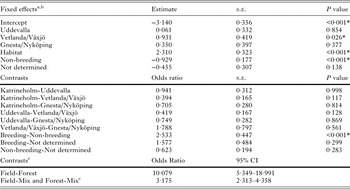
The results for the mixed logistic regression model are given in Table 3. Rodents caught in the field were 10 times (OR 10·08, 95% CI 5·35–18·99) more likely to be parasitized than rodents caught in forest habitat. Breeding rodents were nearly three times (OR 2·53, s.e. 0·447, P ⩽ 0·001) more likely to be parasitized than non-breeding. Rodents captured in one study region did not appear to be more or less likely to be parasitized than rodents in other regions (P > 0·05 for all regions).
Results of the mixed logistic regression model showing the effect of region, habitat, and breeding on proportion of parasitized rodents and odds ratios

a Number of observations: 1565, model deviance = 1082·7, model residual degrees of freedom = 1557.
b Estimates for categorical variables are compared to the intercepts (Katrineholm) and (Breeding).
Odds calculated separately for ‘habitat’ due to the numerical construction of this variable (see also text). For this reason, the odds ratio for field-mix and forest-mix are also the same.
(*) indicates significant value (P < 0·05).
Parasites in fox feces
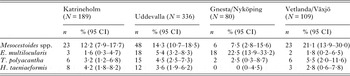
In total, 714 fox feces were analysed (Katrineholm-189, Uddevalla-336, Gnesta/Nyköping-80, Vetlanda/Växjö−109), 2013–2015. Due to either poor sequence quality or low match values, species identity could not be confirmed for 30 feces PCR+ for Taenia spp. However, species identity was confirmed in 142 feces and are reported by parasite species and region in Table 4. In addition, 41 feces were positive for E. multilocularis. These samples are previously reported in Miller et al. (Reference Miller, Olsson, Sollenberg, Skarin, Wahlström and Höglund2016a ) and are included here for comparison. Eleven samples had mixed infections [E. multilocularis/Mesocestoides spp. (one Katrineholm, six Uddevalla, two Gnesta/Nyköping); E. multilocularis/T. polyacantha (two Uddevalla)]. In addition to the results reported in Table 4, one feces from Vetlanda/Växjö was confirmed to have V. mustelae.
Parasite species found in fox feces (N = 714) from all four study regions, 2013–2015

Includes mixed infections. Total number of rodents (N) for each study region are given. Number of positive rodents (n) and 95% confidence intervals (95% CI) are given for each parasite species (Mesocestoides spp., Echinococcus multilocularis, Taenia polyacantha, Hydatigera taeniaeformis s.l.).
Fox–rodent spatial results
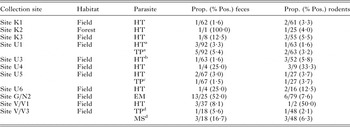
Feces were collected in 57 defined collection sites as defined in Miller et al. Reference Miller, Olsson, Sollenberg, Skarin, Wahlström and Höglund2016a . Most feces (96%) were collected in field habitat (Miller et al. Reference Miller, Olsson, Sollenberg, Skarin, Wahlström and Höglund2016a ). For eleven collection sites at least one parasite finding in fox feces matched at least one parasite finding in a rodent (Table 5). For four of these cases, feces positive for a parasite species (H. taeniaeformis s.l., T. polyacantha and Mesocestoides spp.) were found in the field collection site, while rodents positive for these species were found in a forest trap site adjacent to the field (and for which only one or no feces were collected).
Fecal collection sites (as described in Miller et al. Reference Miller, Olsson, Sollenberg, Skarin, Wahlström and Höglund2016a ) where both rodents and feces were positive for the same parasite, 2013–2015

Sites are reported as from the study regions (Katrineholm-K, Uddevalla-U, Gnesta/Nyköping-G/N, V/V-Vetlanda/Växjö). Parasites are reported as Hydatigera taeniaeformis s.l. (HT), Taenia polyacantha (TP), and Echinococcus multilocularis (EM). Fecal and rodent results are reported as a proportion of positive samples (Prop.) and a percentage of positive samples (% Pos.).
a The rodents positive for HT and TP were collected in the forest in a rodent trapping site (n = 20) adjacent to Site U1. All feces for Site U1 were collected in the field. No rodents (n = 43) in the rodent trapping site in the field were positive.
b Although most of Site U3 was field, a small part of the site contained sparse forest/forest edge. One rodent positive for HT was caught in this forested area.
c The rodent positive for TP was collected in the forest in a rodent trapping site (n = 14) adjacent to U5. For U5, 66 feces (including the TP positive feces) were collected in the field. One parasite negative feces was collected in the forest rodent trapping site.
d All feces for this site were collected in a small field surrounded by forest. All collected rodents were trapped in the surrounding forest. Early in the project, this forest was clear-cut, but trapping was continued for the entirety of the project.
DISCUSSION
The most common parasites to be identified in the rodents in this study were V. mustelae and H. taeniaeformis s.l., and the rarest parasites were E. multilocularis, T. polyacantha, and Mesocestoides spp. (a non-taeniid). All of these parasite species were commonly observed in the collected fox feces, except for the single finding of V. mustelae. As the definitive hosts for V. mustelae are, in fact, mustelids (Deplazes et al. Reference Deplazes, Eckert, Mathis, Samson-Himmelstjerna and Zahner2016), this single finding was considered a fecal passant. In addition to the host difference for V. mustelae, the more common definitive hosts for H. taeniaeformis s.l. are felids (Deplazes et al. Reference Deplazes, Eckert, Mathis, Samson-Himmelstjerna and Zahner2016). Despite these disparities, all of these taeniid cestodes are related to E. multilocularis transmission in similar studies (Le Pesteur et al. Reference Le Pesteur, Giraudoux, Delattre, Damange and Quéré1992; Reperant et al. Reference Reperant, Hegglin, Tanner, Fischer and Deplazes2009; Burlet et al. Reference Burlet, Deplazes and Hegglin2011; Al-Sabi et al. Reference Al-Sabi, Jensen, Christensen and Kapel2013). Although Mesocestoides spp. has a lifecycle that includes multiple intermediate hosts other than the rodent, it is still of interest as it has at least a partial fox–rodent relationship (Deplazes et al. Reference Deplazes, Eckert, Mathis, Samson-Himmelstjerna and Zahner2016). Thus, the transmission patterns for parasite species reported in this study can be used as a model to discuss E. multilocularis transmission in Sweden.
The most striking observation from these results is the almost complete separation of several of these parasites by rodent species, and, thus by habitat. E. multilocularis and H. taeniaeformis s.l. were almost exclusively found in Ar. amphibius and Mi. agrestis in field habitats (Table 2). In contrast, T. polyacantha and Mesocestoides spp. were all found in Apodemus spp. or My. glareolus captured in forest/mix habitat (Table 2). Similar findings were observed in Denmark (Al-Sabi et al. Reference Al-Sabi, Jensen, Christensen and Kapel2013) and France (Le Pesteur et al. Reference Le Pesteur, Giraudoux, Delattre, Damange and Quéré1992). Although V. mustelae was also observed in My. glareolus in forest/mix habitats, the higher prevalence was in Mi. agrestis and Ar. amphibius in this study. These results are somewhat contradictory to Al-Sabi et al. (Reference Al-Sabi, Jensen, Christensen and Kapel2013) and Le Pesteur et al. (Reference Le Pesteur, Giraudoux, Delattre, Damange and Quéré1992) both of which observed V. mustelae most commonly in My. glareolus from forested/closed habitats. Our results, thus, suggest a particular significance of the rodent species Mi. agrestis and Ar. amphibius and their associated habitat for taeniid parasite transmission in Sweden.
This observed pattern is a result of a complex interaction of factors affecting parasite transmission, which can be broadly categorized into either host ecology or host susceptibility. The multivariable model was an attempt to understand the complexity of these processes for taeniid cestode transmission as a whole. However, one limitation of the interpretation of the final model was the absence of the factor ‘rodent species’, which had been removed due to a close association with ‘habitat’ and to ‘parasite species’ observed in our preliminary statistical analyses. As discussed in more detail below, rodent species have differing susceptibilities to different parasites. By removing this factor, the model assumes that rodent susceptibility is equal for all species. It is unclear how this may have affected overall results. The results of Table 1 show that there is not a significant difference between numbers of parasitized rodents (by rodent species) between habitats; however, there appears to be an increasing gradient of parasitization from forest to field. In addition, preliminary investigations modelling V. mustelae and H. taeniaeformis separately indicated a preference for field habitat [Field-Forest OR 5·95 (95% CI 3·02–11·73); Field-Forest OR 33·04 (95% CI 8·36–130·60), respectively] (Supplementary Material 1, see also Table 2). Finally, the decision to include the factor ‘habitat’ rather than ‘rodent species’ was based on the assumption that, in nature, rodent ecology limits parasite infection in spite of rodent susceptibility (see further discussions below). Although results should be interpreted carefully, the final model provides support for the importance of field habitat and the rodent species present within.
The high odds of becoming parasitized in the field compared with forest implies a high contamination level from feces of infected definitive hosts in these areas. Definitive hosts (foxes, mustelids, and cats) are attracted to fields to feed on both Ar. amphibius and Mi. agrestis (Erlinge, Reference Erlinge1975; Liberg, Reference Liberg1984; Raoul et al. Reference Raoul, Deplazes, Rieffel, Lambert and Giraudoux2010). Compared with My. glareolus and Apodemus spp., these species represent concentrated easy-to-catch food resources (Henttonen, Reference Henttonen1987; Erlinge et al. Reference Erlinge, Hoogenboom, Agrell, Nelson and Sandell1990; Jędrzejewska and Jędrzejewski, Reference Jędrzejewska and Jędrzejewski1990; Jeppsson, Reference Jeppsson, Tamarin, Ostfeld, Pugh and Bujalska1990). Focused predation by definitive hosts in fields will naturally contribute to larger numbers of feces in these same habitats. This was demonstrated by the studies of Robardet et al. (Reference Robardet, Giraudoux, Caillot, Augot, Boue and Barrat2011) and Guislain et al. (Reference Guislain, Raoul, Poulle and Giraudoux2007), which found higher densities of fox feces in habitats with higher relative indices of Microtus spp. and Arvicola spp. presence. Although somewhat biased by the decision to focus efforts in field habitats, Miller et al. (Reference Miller, Olsson, Sollenberg, Skarin, Wahlström and Höglund2016a ) also found a high proportion (96%) of feces in fields. Still, this decision was due in part to the observed collection success in fields compared with the forest (Miller et al. Reference Miller, Olsson, Sollenberg, Skarin, Wahlström and Höglund2016a ).
If feces in these areas of high fecal concentration are parasite infected, the risk for rodent exposure may be increased. For example, Table 5 lists several trapping sites where feces positive for H. taeniaeformis s.l. also contained rodents positive for H. taeniaeformis s.l. As discussed in Miller et al. (Reference Miller, Olsson, Sollenberg, Skarin, Wahlström and Höglund2016a ), but also reported here (Table 5), the field with the highest number of rodents positive for E. multilocularis was also the field with the highest number of feces positive for E. multilocularis. In the case of zoonotic parasites, such as E. multilocularis, these areas may also represent areas of higher risk of exposure to human accidental intermediate hosts. Indeed, such foci of E. multilocularis infection as described here in rodents/fox feces have been related to foci of E. multilocularis infected humans in other countries, such as France (Giraudoux et al. Reference Giraudoux, Delattre, Takahashi, Raoul, Quéré, Craig, Vuitton, Craig and Pawlowski2002; Said-Ali et al. Reference Said-Ali, Grenouillet, Knapp, Bresson-Hadni, Vuitton, Raoul, Richou, Millon and Giraudoux2013).
In addition to high levels of background contamination, the underground nature of Ar. amphibius, the tunnels of which are often shared by Mi. agrestis, may also put these rodents at higher risk for parasite egg exposure (Hansson, Reference Hansson, Craig and Pawlowski2002). For instance, Burlet et al. (Reference Burlet, Deplazes and Hegglin2011) suggested that cats may be attracted to the loose soil of water vole tumuli to bury their feces. In addition, fox feces have been observed on top of water vole tumuli in (Stieger et al. Reference Stieger, Hegglin, Schwarzenbach, Mathis and Deplazes2002) and in this study. Furthermore, stoats (Mustela erminea) have been observed hunting within the tunnels of water voles in southern Sweden (Erlinge, Reference Erlinge1981) and are also likely defecating within the tunnels. Although taeniid eggs are highly resistant to environmental exposure, these eggs would have increased survival in the cool, moist soil environment (Veit et al. Reference Veit, Bilger, Schad, Schäfer, Frank and Lucius1995). This could explain the high levels of V. mustelae, H. taeniaeformis s.l., and E. multilocularis seen in the fields in this study.
However, even in the presence of potentially high egg contamination, there is a complex interaction between rodent susceptibility and host ecology affecting likelihood of taeniid parasite transmission. For instance, no My. glareolus and Apodemus spp. were infected with E. multilocularis even in trapping sites near foci of E. multilocularis infected feces. Likewise, no Apodemus spp. were infected with V. mustelae despite presence of this parasite in all habitats and in all other rodent species. Experimental studies by Woolsey et al. (Reference Woolsey, Bune, Jensen, Deplazes and Kapel2015a , Reference Woolsey, Jensen, Deplazes and Kapel b ; Reference Woolsey, Jensen, Deplazes and Kapel2016) support these observations and demonstrate superior E. multilocularis metacestode development in M. arvalis and Mi. agrestis compared with My. glareolus or laboratory mice. Similarly, Iwaki et al. (Reference Iwaki, Abe, Shibahara, Oku and Kamiya1996) demonstrated higher susceptibility of V. mustelae in red backed voles (M. rutilus) than in laboratory mice. Overall, these results imply limited significance for Apodemus spp. for V. mustelae and E. multilocularis transmission and limited significance of My. glareolus for E. multilocularis transmission (see also Miller et al. Reference Miller, Olsson, Walburg, Sollenberg, Skarin, Ley, Wahlström and Höglund2016b ). On the other hand, although My. glareolus can be infected by H. taeniaeformis s.l. (Tenora et al. Reference Tenora, Wiger and Baruš1979; Al Sabi et al. Reference Al-Sabi, Jensen, Christensen and Kapel2013), the strong preference of My. glareolus for forested habitat may have protected it from exposure in this study. This idea is supported by Al-Sabi et al. (Reference Al-Sabi, Jensen, Christensen and Kapel2013), which found that My. glareolus caught in field habitat (e.g. gardens/parks) had a higher prevalence of H. taeniaeformis s.l. (24%) than those caught in forested habitats (<1%).
In addition to rodent species susceptibility, individual susceptibility also affects parasite transmission. In the multivariate analysis, breeding and season (spring) were highly associated, and breeding animals were nearly three times more likely to be parasitized than non-breeding. This is unsurprising as, in the spring, rodent populations (over-wintered cohort) consist of low densities of older animals which are either becoming reproductively mature or actively breeding (Myllymäki, Reference Myllymäki1977). Sex hormones, particularly in males, have been shown to influence host immunity resulting in an increased potential for parasitization (reviewed in Klein, Reference Klein2004). Moreover, older rodents have had more time for parasite exposure and maturation of parasite infections than juveniles (Burlet et al. Reference Burlet, Deplazes and Hegglin2011). In addition to this study, others have observed that rodents from the over-wintered cohort experience high levels of parasitization (e.g. Haukisalmi et al. Reference Haukisalmi, Henttonen and Tenora1988; Haukisalmi and Henttonen, Reference Haukisalmi and Henttonen1993).
Interactions within the internal parasite community may also influence host–parasite infection dynamics. For example, Pétavy et al. (Reference Pétavy, Tenora and Deblock2003) found that E. multilocularis metacestodes in rodents co-infected with H. taeniaeformis s.l. (n = 3) were sterile (i.e. contained no protoscolices). This suggests that co-infection with H. taeniaeformis decreases development of E. multilocularis metacestodes. However, in contrast, Burlet et al. (Reference Burlet, Deplazes and Hegglin2011) suggested that infection with E. multilocularis increased host susceptibility towards H. taeniaeformis s.l., which was supported by observations of multiple strobilocerci of H. taeniaeformis s.l. in voles with mature E. multilocularis metacestodes. Within the present study, only one rodent with E. multilocularis was co-infected with another liver parasite, and this was V. mustelae. Although the E. multilocularis lesion contained protoscolices, only one V. mustelae metacestode was noted. The most common co-infection in this study was between H. taeniaeformis s.l. and V. mustelae. Because T. polyacantha and Mesocestoides spp. only exist transiently (or in some cases not at all) in the liver (Rausch and Fay, Reference Rausch and Fay1988a ; Fujita et al. Reference Fujita, Oku, Okamoto, Sato, Ooi, Kamiya and Rausch1991), there may be less competition between these parasites and true liver parasites. However, at least for T. polyacantha, severe pathological effects have been noted with mature infections (Wiger, Reference Wiger1977; Fujita et al. Reference Fujita, Oku, Okamoto, Sato, Ooi, Kamiya and Rausch1991), which could decrease overall immunity and increase susceptibility to co-infection. Indeed, Rausch and Fay (Reference Rausch and Fay1988b ) found 12/1164 wild-caught voles co-infected with T. polyacantha arctica and E. multilocularis. To better understand these relationships, further experimental studies are needed.
Concluding remarks
Our results show that there are ecologic and intrinsic host factors acting to separate taeniid cestodes between different rodent species in the Swedish environment. Both Mi. agrestis and Ar. amphibius appear to be both susceptible and highly exposed to taeniid cestodes, including E. multilocularis, as compared with My. glareolus and Apodemus spp. Therefore, future monitoring efforts for E. multilocularis in Sweden should focus in habitats (e.g. fields) where Mi. agrestis and Ar. amphibius are abundant.
SUPPLEMENTARY MATERIAL
The supplementary material for this article can be found at https://doi.org/10.1017/S0031182017000257
ACKNOWLEDGEMENTS
The authors thank Mikael Andersson Franko for statistical advice. They also thank the local landowners that put their land at our disposal and the students that helped complete fieldwork.
FINANCIAL SUPPORT
This work was funded through an EU Formas grant (EMIDA-ERA NET) for a project entitled ‘Echinococcus Multilocularis in ROdents (EMIRO)’ (221-2011-2212). The samples from Vetlanda/Växjö and Gnesta/Nyköping were mainly collected within the Environmental and Monitoring and Assessment at the Swedish University of Agricultural Sciences (FoMA, http://www.slu.se/en/environment).
ETHICAL STATEMENT
Fieldwork was performed with ethical permits from the Swedish Environmental Protection Agency (NV-02939-11) and the Swedish Board of Agriculture (A-135-12).