


At around the time that the European Health Policy Group (EHPG) was formed, the World Health Organization (WHO) published its famous (some might say infamous) report that ranked countries around the world by their health care system performance, with performance measured by some composite score that combined various factors, such as equity, efficiency and responsiveness (WHO, 2000). France came out at number one. Ranking exercises of this general kind have continued throughout the decade, with perhaps the latest at the time of writing being that produced by the Commonwealth Fund (Davis et al., Reference Davis, Schoen and Stremikis2010). This time, in a comparison of seven wealthy countries, the Netherlands assumes top spot, indicating that over the past decade, health systems performance has seemingly correlated quite closely with national football team performance at recent World Cup tournaments.
Arguably, ranking exercises of this kind can have their uses, indicating that the title of this note is a clear demonstration of an author in desperate search of a provocative title. For instance, they may serve as a spur to action for apparently poor performing countries, although one may equally contend that they could demotivate those who come out right at the top (a ‘we are great, so why bother?’ effect) and/or those at the very bottom (a ‘we have no hope, so why bother?’ effect). However, a necessary (but not sufficient) condition to ensure that the rankings, in and of themselves, have substantive meaning is that all of the various countries involved attach identical weight to all of the various health care policy objectives. It is apparent (to me, at least) that this is unlikely to be the case, the implications of which I will highlight by means of a simple hypothetical example.
Assume that there are just four health care policy objectives: equity, responsiveness, cost-containment and efficiency. Assume further that there are four countries (if you like, in global order of importance, although this is not necessary to the example): England, the United States, the Netherlands and France. Assume (hypothetically) that the objective scores (in marks out of ten) for each country's health care system on each of the objectives are as follows:
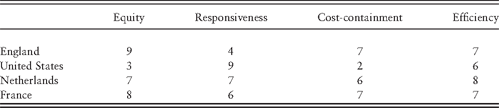
Next assume that the weights that England attaches, via its democratically (?) elected government, to each of the policy objectives are 0.4 for equity, 0.1 for responsiveness, 0.3 for cost-containment and 0.2 for efficiency. The weights, which sum to one, thus reflect the relative importance that the country lends to each policy objective. Applying these weights to the data in the above table gives the following ranking:
No. 1: England (with a composite score of 0.4×9 + 0.1×4 + 0.3×7 + 0.2×7 = 7.5)
No. 2: France (7.3)
No. 3: Netherlands (6.9)
No. 4: United States (3.9)
However, assume that the United States attaches a different set of weights, with, compared to England, the population seemingly giving less import to equity and more to responsiveness. With weights applied by our hypothetical US Government of, respectively, 0.1, 0.6, 0.1 and 0.2, the ranking is
No. 1: United States (7.1)
No. 1: Netherlands (7.1)
No. 3: France (6.5)
No. 4: England (5.4)
The Dutch, despite their consensual natures, object, and apply weights of 0.3, 0.3, 0.2 and 0.2. Now:
No. 1: Netherlands (7)
No. 1: France (7)
No. 3: England (6.7)
No. 4: United States (5.2)
And finally, the French, as might be expected, object some more, preferring weights of 0.2, 0.3, 0.3 and 0.2, to give
No. 1: France (6.9)
No. 1: Netherlands (6.9)
No. 3: England (6.5)
No. 4: United States (5.1)
The basic point of the above example is to show that it is possible – even easy – to derive very different rankings of health care system performance when the weights that are attached to the different policy objectives are altered, and indeed the relative importance attached to the different objectives is likely to vary across different populations, either by purpose or by circumstance. Therefore, attaching the same weights across all countries may well produce a misleading, even distasteful, impression. It would be akin to my mother making a magnificent marzipan cake, judged by all of her neighbours to be the best marzipan cake in her street, even perhaps the best in the City of Leicester. This wouldn't be great for my family though, because all of them hate marzipan.
Of course, all of this isn't to say that different countries do not have anything to learn from each other regarding their health care systems. Some countries seem to perform very well on specific aspects of health care, and those from other countries should attempt to learn how they do this, and deduce whether policies can be transferred to and within the institutional structure of their own system without undermining other important health policy goals. But it is to say that over the next 10 years of the EHPG, its members should treat ‘whole system’ cross-country ranking exercises with a healthy degree of scepticism – even when their own country comes out on top.


