


Introduction
There have been widespread concerns about the adverse mental health impacts of COVID-19, and the pervasive distancing and isolation measures used to restrict its transmission (e.g. Fiorillo and Gorwood, Reference Fiorillo and Gorwood2020; Holmes et al., Reference Holmes, O’Connor, Perry, Tracey, Wessely, Arseneault and Bullmore2020; Mazza et al., Reference Mazza, Ricci, Biondi, Colasanti, Ferracuti, Napoli and Roma2020). Around the globe people have experienced profound changes to their daily routines, healthcare, employment, financial security, and connection to others (Biddle et al., Reference Biddle, Edwards, Gray and Sollis2020; International Monetary Fund, 2020; Moreno et al., Reference Moreno, Wykes, Galderisi, Nordentoft, Crossley, Jones and Arango2020; Newby et al., Reference Newby, O’Moore, Tang, Christensen and Faasse2020; Usher et al., Reference Usher, Bhullar, Durkin, Gyamfi and Jackson2020). Increased rates of psychological distress, anxiety, depression and insomnia have been observed in the general population (e.g. Luo et al., Reference Luo, Guo, Yu, Jiang and Wang2020; Pierce et al., Reference Pierce, Hope, Ford, Hatch, Hotopf, John and Abel2020; van Agteren et al., Reference van Agteren, Bartholomaeus, Fassnacht, Iasiello, Ali, Lo and Kyrios2020; Wu et al., Reference Wu, Jia, Shi, Niu, Yin, Xie and Wang2020; Xiong et al., Reference Xiong, Lipsitz, Nasri, Lui, Gill, Phan and McIntyre2020), and specific concerns have been raised about individuals who are vulnerable to excessive distress and disability associated with fears of contamination and illness transmission, such as those with obsessive compulsive disorder (OCD; Asmundson et al., Reference Asmundson, Paluszek, Landry, Rachor, McKay and Taylor2020; Banerjee, Reference Banerjee2020; Kumar and Somani, Reference Kumar and Somani2020; McKay et al., Reference McKay, Minaya and Storch2020; Rivera and Carballea, Reference Rivera and Carballea2020; Silva et al., Reference Silva, Shavitt and Costa2020).
Prior to COVID-19, 1.2% of adults met criteria for OCD annually (Ruscio et al., Reference Ruscio, Stein, Chiu and Kessler2010). The disorder is characterised by recurrent and intrusive thoughts, impulses or images (obsessions) and/or repetitive behaviours or rituals performed to alleviate distress (compulsions) (American Psychiatric Association, 2013). Although clinical presentations are heterogeneous, obsessions relating to contamination and cleanliness are among the more commonly experienced symptoms (Williams et al., Reference Williams, Chapman, Simms, Tellawi, Abramowitz, McKay and Storch2017). The rapid spread of COVID-19 has been comprehensively publicized, and an array of containment strategies mandated (e.g. quarantine, social distancing, wearing of face masks). Improved personal hygiene has been heavily encouraged including frequent handwashing, using hand-sanitisers, and avoiding touching common surfaces (e.g. Centers for Disease Control and Prevention, 2020). While these public health strategies are essential at this time, there is a clear intersection between these recommendations and OCD-related cognitive and behavioural vulnerabilities. For instance, people with OCD hold maladaptive cognitions or beliefs associated with over-estimating threat, inflating personal responsibility, needing certainty and perfection, and over-estimating the importance and control of thoughts (Obsessive Compulsive Cognitions Working Group, 1997; Obsessive Compulsive Cognitions Working Group, 2001; Obsessive Compulsive Cognitions Working Group, 2003). In response to these beliefs and the distress they are thought to cause, people with OCD engage in unhelpful and excessive avoidance and repetitive behaviours like cleaning and checking (Salkovskis, Reference Salkovskis1999; Wells, Reference Wells1997). It is possible that the highly publicized spread of COVID-19 coupled with the heavy promotion of hygiene practices has exacerbated OCD symptoms for some individuals (e.g. further increased perceptions of threat or responsibility, and motivated greater engagement with repetitive behaviours like handwashing; Jassi et al., Reference Jassi, Shahriyarmolki, Taylor, Peile, Challacombe, Clark and Veale2020). Preliminary reports suggest that COVID-19 has increased incident cases of OCD and, for a proportion of people, a deterioration of pre-existing OCD symptoms (Abba-Aji et al., Reference Abba-Aji, Li, Hrabok, Shalaby, Gusnowski, Vuong and Agyapong2020; Benatti et al., Reference Benatti, Albert, Maina, Fiorillo, Celebre, Girone and Dell’Osso2020; Chakraborty and Karmakar, Reference Chakraborty and Karmakar2020; French and Lyne, Reference French and Lyne2020). Interestingly, Prestia et al. (Reference Prestia, Pozza, Olcese, Escelsior, Dettore and Amore2020) found that a history of OCD contamination symptoms prior to COVID-19 significantly predicted elevated OCD symptoms during quarantine among previously treated OCD out-patients. Although further study is needed to quantify the impact of COVID-19 on the prevalence and symptom profiles of OCD, it is vital that appropriate mental health support and treatments are available for individuals experiencing distress during this time.
Mental health services have been adapting their models of service provision in response to the pandemic with many embracing remotely delivered services (Feijt et al., Reference Feijt, de Kort, Bongers, Bierbooms, Westerink and Ijsselsteijn2020; Fisk et al., Reference Fisk, Livingstone and Pit2020; Reay et al., Reference Reay, Looi and Keightley2020; Wang et al., Reference Wang, Wei and Zhou2020). Digital mental health interventions, such as internet-delivered cognitive behaviour therapies (iCBT), have been shown to be effective and safe in many clinical populations, and may have utility in supplementing existing mental health services (Andrews et al., Reference Andrews, Basu, Cuijpers, Craske, McEvoy, English and Newby2018; Carlbring et al., Reference Carlbring, Andersson, Cuijpers, Riper and Hedman-Lagerlöf2018; Gratzer et al., Reference Gratzer, Torous, Lam, Patten, Kutcher, Chan and Yatham2020; Holmes et al., Reference Holmes, O’Connor, Perry, Tracey, Wessely, Arseneault and Bullmore2020; Moreno et al., Reference Moreno, Wykes, Galderisi, Nordentoft, Crossley, Jones and Arango2020; Torous et al., Reference Torous, Jän Myrick, Rauseo-Ricupero and Firth2020; Wind et al., Reference Wind, Rijkeboer, Andersson and Riper2020). Evidence indicates that CBT for OCD can be successful disseminated via the internet to both clinicians and mental health consumers (see Jacoby et al., Reference Jacoby, Berman, Reese, Shin, Sprich, Szymanski and Wilhelm2019; Klein et al., Reference Klein, Meyer, Austin and Kyrios2011), but it is important to note how iCBT differs from CBT delivered via videoconferencing or telephone (telehealth) (e.g. Nicholas et al., Reference Nicholas, Knapp, Vergara, Graham, Gray, Lattie and Mohr2021). Videoconferencing-based CBT is a high-intensity format of therapy where the clinician delivers the treatment in live, interactive sessions with the client (i.e. the therapeutic contact is all synchronous). Like in-person or face-to-face consultations, clinicians providing video-conferencing CBT sessions may or may not follow a standardised treatment protocol. In contrast, iCBT involves highly standardised courses of CBT delivered via the internet in the form of structured workbooks, lesson slides, and web-based resources. These interventions are considered low-intensity therapies as the CBT course materials are often supplemented by brief input from clinicians (contact is typically a mix of synchronous and asynchronous, e.g. telephone calls and emails). iCBT can also be undertaken in self-guided or unguided formats where the individual undertakes the course independently and does not involve a clinician in their programme.
Studies have demonstrated that iCBT guided by a clinician (‘clinician-guided’ or ‘clinician-assisted’ iCBT) produces large effect size reductions in OCD symptom severity compared with progressive relaxation training, supportive therapy, and treatment as usual under randomised controlled conditions, with good rates of adherence (∼67–75%) and gains maintained for up to two years (Andersson et al., Reference Andersson, Enander, Andrén, Hedman, Ljótsson, Hursti and Rück2012; Andersson et al., Reference Andersson, Steneby, Karlsson, Ljótsson, Hedman, Enander and Rück2014; Andersson et al., Reference Andersson, Ljótsson, Hedman, Enander, Kaldo, Andersson and Rück2015; Kyrios et al., Reference Kyrios, Ahern, Fassnacht, Nedeljkovic, Moulding and Meyer2018; Mahoney et al., Reference Mahoney, Mackenzie, Williams, Smith and Andrews2014; Wootton et al., Reference Wootton, Dear, Johnston, Terides and Titov2013; Wootton et al., Reference Wootton, Dear, Johnston, Terides and Titov2015). When iCBT for OCD is delivered in routine care settings or when participants undertake a self-guided course, studies have reported medium to large pre- to post-treatment effect size reductions in OCD symptom severity, with course completion in 30–40% of users (Klein et al., Reference Klein, Meyer, Austin and Kyrios2011; Luu et al., Reference Luu, Millard, Newby, Haskelberg, Hobbs and Mahoney2020; Wootton et al., Reference Wootton, Karin, Titov and Dear2019). There are a number of advantages of online mental health interventions like iCBT, including their comparative accessibility, anonymity, convenience, fidelity, affordability, scalability, and portability (e.g. Marshall et al., Reference Marshall, Dunstan and Bartik2019; Marshall et al., Reference Marshall, Dunstan and Bartik2020). These advantages may be particularly pronounced when a community’s mental health needs are high and the provision of traditional, face-to-face services is compromised, as in the current pandemic context. Although the effectiveness of self- and clinician-guided iCBT for OCD is yet to be examined during COVID-19, it may represent one low-intensity, highly scalable option to support the mental health of individuals experiencing OCD symptoms during the COVID period.
The appropriateness of undertaking the exposure and response prevention (ERP) components of cognitive behaviour therapy during the pandemic has been questioned; however, many maintain that ERP should be provided as it remains the gold standard psychological treatment for OCD (Fineberg et al., Reference Fineberg, Van Ameringen, Drummond, Hollander, Stein, Geller and Dell’Osso2020; Krompinger et al., Reference Krompinger, Kuckertz, Schreck, Nota, Van Kirk and Falkenstein2020; McKay et al., Reference McKay, Minaya and Storch2020; Shafran et al., Reference Shafran, Coughtrey and Whittal2020; Storch et al., Reference Storch, Schneider, Guzick, McKay and Goodman2020). Clinical guidelines for conducting ERP during COVID encourage clinicians to continue following evidence-based protocols while carefully considering the local COVID-related risks, their patients’ individual health status, their professional ethical obligations, and current government mandates and restrictions (e.g. washing hands for the recommended 20 seconds when returning home from a public place rather than handwashing for 20 minutes or until one ‘feels right’; Jassi et al., Reference Jassi, Shahriyarmolki, Taylor, Peile, Challacombe, Clark and Veale2020; Sheu et al., Reference Sheu, McKay and Storch2020). For some individuals with OCD, it is conceivable that engaging with ERP may be more difficult and less successful during COVID. For example, some individuals may feel vindicated in their (over)estimation of threat and intolerance of uncertainty and may be highly reluctant to reduce avoidant and compulsive behaviours (Jassi et al., Reference Jassi, Shahriyarmolki, Taylor, Peile, Challacombe, Clark and Veale2020). However, there is a scarcity of research on how COVID-19 has impacted the outcomes of ERP.
In one study examining the outcomes of residential ERP during COVID-19 for eight participants, Kuckertz et al. (Reference Kuckertz, Van Kirk, Alperovitz, Nota, Falkenstein, Schreck and Krompinger2020) found that the majority experienced symptom improvement (on par with a 2019 pre-COVID cohort). Levels of generalised worry did not improve across treatment (as they had in the 2019 sample), and the authors suggested that this could result from COVID-related stressors. The impact of COVID-19 varied across the eight participants, but the most common impacts were not OCD-specific, but related to general stressors associated with family, societal and economic changes. While the effects of online CBT/ERP for OCD have not been studied during COVID, it is possible that, consistent with the results of Kuckertz et al. (Reference Kuckertz, Van Kirk, Alperovitz, Nota, Falkenstein, Schreck and Krompinger2020), iCBT will continue to be as effective as pre-COVID interventions. However, greater pre-treatment OCD symptom severity and OCD-related avoidance has previously been associated with poorer outcomes in iCBT for OCD (Wheaton et al., Reference Wheaton, Patel, Andersson, Rück and Simpson2021), and it is conceivable that iCBT outcomes may be attenuated under pandemic conditions if levels of OCD symptom severity and avoidance are greater during COVID-19. With disruption to traditional face-to-face services during the pandemic, it is also possible that demand for online OCD interventions will increase. Studies from Titov et al. (Reference Titov, Staples, Kayrouz, Cross, Karin, Ryan and Nielssen2020b) and Staples et al. (Reference Staples, Nielssen, Kayrouz, Cross, Karin, Ryan and Titov2020) found increased digital mental health service utilisation in the early period of COVID-19 in Australia [specifically, compared with 2019, there was an 89% increase in website visits, 90% increase in telephone calls, and a 16.7% increase in assessments in the early months of COVID-19 in Australia (March to June 2020)]. However, this increased use was not specific to OCD and studies are now required to identify if demand for iCBT for OCD has increased during the pandemic.
As such, this study examined the uptake and outcomes of the self-guided and clinician-guided THIS WAY UP iCBT for OCD course in routine care during the first 8 months of COVID-19 in Australia (March to October 2020). The uptake of the course in the previous year provided a basis of comparison. Although the pre-COVID effectiveness of this iCBT programme has been evaluated (see Luu et al., Reference Luu, Millard, Newby, Haskelberg, Hobbs and Mahoney2020; Mahoney et al., Reference Mahoney, Mackenzie, Williams, Smith and Andrews2014), these studies did not detail participants’ OCD symptom profiles (i.e. dimensions related to contamination, symmetry and completeness; responsibility for harm and injury; unacceptable thoughts; Abramowitz et al., Reference Abramowitz, Deacon, Olatunji, Wheaton, Berman, Losardo and Hale2010). Given the potential nexus between contamination-related symptoms and COVID-19, this study examined this issue. We hypothesised that during COVID-19 there would be an increased uptake of the OCD iCBT course with participants reporting significantly higher contamination-based concerns compared with the pre-COVID group. Consistent with previous studies and the fidelity of the programme, we also hypothesised that iCBT would produce medium effect size reductions in OCD symptom severity with course completion rates comparable to pre-COVID-19 levels (30–40%). Additionally, we expected that the OCD iCBT course would be associated with significant reductions in depression symptom severity, psychological distress, and functional impairment from pre- to post-treatment.
Method
Sample
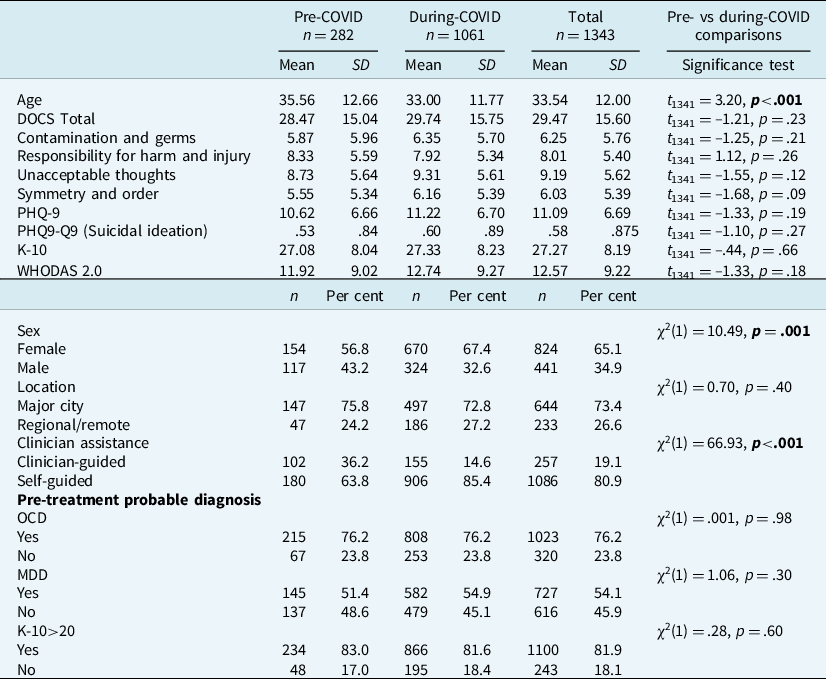
A total of 2013 participants registered for the THIS WAY UP iCBT for OCD during the study period (11 March 2019 to 31 October 2020). To register, participants needed to be Australian residents over 18 years of age. Study participants included a pre-COVID group (n = 457) who registered for the course between 11 March 2019 and 11 March 2020, and a during-COVID group (n = 1556) who registered between 12 March 2020 and 31 July 2020 (i.e. the date the World Health Organisation confirmed the COVID-19 pandemic and 31 October being the date of data extraction). Of these 2013 registrants, 1343 (282 in the pre-COVID group and 1061 in the during-COVID group) commenced their iCBT course, reported their demographics, and completed clinical assessments. Note that all analyses/results herein are based on this group of course users. Participants’ rural status, that is whether they resided in major cities versus in regional or remote communities, was inferred from their postcode and the Australian Statistical Geography Standards (Australian Bureau of Statistics, 2016). In general, OCD course users were female, in their early to mid-thirties, and lived in major cities in Australia (see Table 1).
Demographic and clinical characteristics of OCD iCBT course users in the pre- and during-COVID groups

DOCS, Dimensional Obsessive Compulsive Scale; PHQ-9, Patient Health Questionnaire-9; K-10, Kessler Psychological Distress Scale; WHODAS 2.0, World Health Organization Disability Assessment Schedule; MDD, major depressive disorder; OCD, obsessive compulsive disorder.
This study was conducted as part of the routine Quality Assurance activities of THIS WAY UP and all self-report measures examined were required for the safe conduct of the OCD course. Prior to registration, all participants provided electronic informed consent that their pooled de-identified data could be collected, collated, analysed and published for quality assurance and research purposes.
Intervention
The OCD course was developed by THIS WAY UP, a non-profit digital mental health service provided by St Vincent’s Hospital (Sydney, Australia) and the University of New South Wales, and funded by the Australian Department of Health. The course includes six lessons that are completed sequentially over 6–12 weeks and typically costs $AUD59. However, during the pandemic, all THIS WAY UP programmes were made available free of charge with support from St Vincent’s Hospital’s Inclusive Health Foundation between the 25 March and 30 June 2020. THIS WAY UP was promoted in a series of short national media engagements in April 2020, which included one newspaper article, one television news story, and one radio interview.
While completing the course, participants follow the journey of a fictional character with OCD who learns CBT skills to manage and reduce her symptoms. Lesson content has been detailed elsewhere (see Mahoney et al., Reference Mahoney, Mackenzie, Williams, Smith and Andrews2014), but in brief, includes psychoeducation; arousal reduction skills; cognitive restructuring; imaginal and graded exposure and response prevention; troubleshooting difficulties; and relapse prevention. A summary with homework exercises is provided at the end of every lesson with the purpose of reinforcing treatment content. Additional downloadable resources about general wellbeing skills are also included in the iCBT programme. This programme has been shown to improve OCD symptom severity, psychological distress and functional impairment under both randomised controlled conditions and when accessed in routine care (Luu et al., Reference Luu, Millard, Newby, Haskelberg, Hobbs and Mahoney2020; Mahoney et al., Reference Mahoney, Mackenzie, Williams, Smith and Andrews2014).
Participants in this study could complete the OCD iCBT course independently (i.e. self-guided) or be supervised by the clinician of their choice in the community (i.e. clinician-guided). Most participants commenced the self-guided course (80.9%; see Table 1). Professionals who prescribed the iCBT course retained clinical responsibility for their participant for the duration of the programme. Participants and their prescribing clinicians were advised that participants were unlikely to benefit from the iCBT programme if they (1) were being treated with benzodiazepines or atypical anti-psychotics; (2) had an alcohol or substance use disorder; (3) had schizophrenia or bipolar affective disorder; or (4) were actively suicidal. These recommendations are given because the efficacy of the THIS WAY UP OCD course has not been evaluated in these populations (see Mahoney et al., Reference Mahoney, Mackenzie, Williams, Smith and Andrews2014); however, adhering to these recommendations was at the discretion of the individual participant and their clinician, and were not exclusion criteria.
Measures
The Dimensional Obsessive-Compulsive Scale (DOCS)
The DOCS assessed OCD symptom severity in the past month across four symptom dimensions: (i) concerns about contamination and germs; (ii) concerns about symmetry and completeness; (iii) concerns about being responsible for harm and injury; and (iv) unacceptable thoughts (Abramowitz et al., Reference Abramowitz, Deacon, Olatunji, Wheaton, Berman, Losardo and Hale2010). Evidence of test–re-test reliability (r = 0.66 over 12 weeks), convergent and divergent validity, and sensitivity to change has been provided (Abramowitz et al., Reference Abramowitz, Deacon, Olatunji, Wheaton, Berman, Losardo and Hale2010; Wheaton et al., Reference Wheaton, Abramowitz, Berman, Riemann and Hale2010). DOCS total scores ≥18 distinguish those with OCD from non-clinical groups (sensitivity and specificity = 0.78; Abramowitz et al., Reference Abramowitz, Deacon, Olatunji, Wheaton, Berman, Losardo and Hale2010), and was used as the clinical threshold for this study as the indicator of probable OCD diagnosis as well as an indicator of symptom remission at post-treatment. Participants completed the DOCS before the first and fourth lessons, and after completion of the sixth lesson. Pre-treatment internal reliability in this study was α = .92.
The Patient Health Questionaire-9 (PHQ-9)
The PHQ-9 is a 9-item self-reported screening tool for probable major depressive disorder (MDD) in the preceding 2 weeks (Kroenke et al., Reference Kroenke, Spitzer and Williams2001). PHQ-9 item 9 (Thoughts that you would be better off dead, or of hurting yourself in some way) was used to assess levels of suicidal ideation in the sample. Scores ≥1 on this item indicate that the respondent has experienced these thoughts in the past 2 weeks. Evidence of temporal stability (r = 0.84 over 48 h), convergent, divergent, criterion validity and treatment sensitivity has been provided (Beard et al., Reference Beard, Hsu, Rifkin, Busch and Björgvinsson2016; Kroenke et al., Reference Kroenke, Spitzer and Williams2001). Total scores ≥10 indicate probable MDD (Kroenke et al., Reference Kroenke, Spitzer and Williams2001). Participants completed the PHQ-9 before the first and fourth lessons, and after completion of the sixth lesson. Pre-treatment PHQ-9 internal consistency was α = .89.
The Kessler Psychological Distress Scale (K-10)
The K-10 is a 10-item measure of global psychological distress experienced by individuals in the preceding 2 weeks (Kessler et al., Reference Kessler, Andrews, Colpe, Hiripi, Mroczek, Normand and Zaslavsky2002). Evidence of test–re-test reliabilty (r = .80 over 1–2 weeks), convergent and discriminant validity, and treatment sensitivity has been provided (Furukawa et al., Reference Furukawa, Kessler, Slade and Andrews2003; Merson et al., Reference Merson, Newby, Shires, Millard and Mahoney2021; Slade et al., Reference Slade, Grove and Burgess2011; Sunderland et al., Reference Sunderland, Wong, Hilvert-Bruce and Andrews2012). Total scores ≥20 indicate probable mental disorder(s) (Andrews and Slade, Reference Andrews and Slade2001). Participants completed the K-10 prior to each lesson. In this study, baseline internal consistency was α = .91.
The World Health Organization Disability Assessment Schedule (WHODAS 2.0)
The WHODAS 2.0 is a 12-item measure of general health-related disability experienced over the past 30 days (Üstün et al., Reference Üstün, Kostanjsek, Chatterji and Rehm2010). Evidence of temporal stability reliability (r = 0.98 within 7 days) and construct validity (including treatment sensitivity) has been provided (Andrews et al., Reference Andrews, Kemp, Sunderland, Von Korff and Üstün2009; Üstün et al., Reference Üstün, Kostanjsek, Chatterji and Rehm2010). Participants completed the WHODAS 2.0 prior to the first lesson and on completion of the final lesson. Baseline internal consistency was α = .90.
Statistical analyses
All analyses were performed in SPSS v26. Descriptive statistics were first conducted to investigate patterns of course registration, commencement and adherence. Next, independent samples t-tests and χ2 tests were used to examine COVID-related differences in baseline demographics, course adherence, pre-treatment symptom severity, and probable casedness (Bonferroni adjustment was applied across the multiple group comparisons, α = .05/22 = .002).
Linear mixed models were then used to estimate treatment effects in pre- and during-COVID groups, using the MIXED procedure with a random intercept for subject. First, models were estimated using a restricted maximum likelihood estimator and a variance components covariance structure for the random effects. Second, the relative fit of the residual covariance structure of the random effects was evaluated using the Bayesian information criterion (Raftery, Reference Raftery1995), where a Toeplitz covariance structure provided the closest model fit for the residuals for the K-10, compound symmetry for the WHODAS 2.0, and autoregressive for the DOCS and PHQ-9. The fixed effects of clinician assistance (self-guided versus clinician-guided) and its interaction with time were then added to each model. The fixed effect corresponding to the clinician assistance by time interaction enabled us to examine whether there was a difference in improvements on the outcome measures in the self-help versus clinician-guided course users. Hedges’ g effect sizes were calculated between Lesson 1 and Lesson 6 assessments based on the pooled standard deviation and corrected for the correlation between repeated measurements. Effect sizes were classified as small (g = 0.2–0.5), medium (g = 0.5–0.8) or large (g>0.8).
Among treatment completers, a reliable change index was calculated where a change of ≥20.74 on the DOCS in the pre-COVID group and ≥21.35 in the during-COVID group between pre-and post-treatment assessments was considered reliable change with 95% confidence (Jacobson and Truax, Reference Jacobson and Truax1991). Consistent with previous studies (e.g. Hobbs et al., Reference Hobbs, Mahoney and Andrews2017; Luu et al., Reference Luu, Millard, Newby, Haskelberg, Hobbs and Mahoney2020), we also computed the proportion of participants who had at least a 50% pre-to-post treatment reduction in DOCS total scores. The proportion of participants who scored above the clinical cut-off score of 18 on the DOCS was calculated at pre- and post-treatment to examine if symptom severity normalised with participants scoring <18 at post-treatment classified as in remission.
Results
COVID-related differences in the uptake of iCBT for OCD
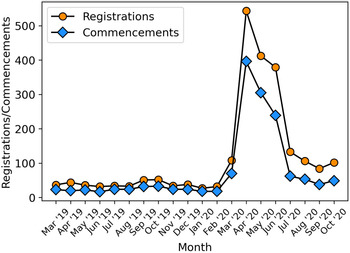
Figure 1 shows the number of monthly OCD iCBT course registrations and course commencements from March 2019 to October 2020. There was a sharp increase in the number of course registrations and commencements in April 2020 followed by a gradual decrease in subsequent months (although counts of monthly course registrations and commencements invariably remained higher than those of 2019). Notably, there was a reduction in course registrations and commencements in June 2020, which appears to have coincided with the gradual resumption of face-to-face mental health service provision in Australia (see Jayawardana and Gannon, Reference Jayawardana and Gannon2021). On average, there were 37.50 course registrations and 23.25 course commencements each month in the pre-COVID period of March 2019 to February 2020. In the during-COVID period (March to October 2020), there was an average of 233.38 course registrations and 151.50 commencements each month. This is an approximate 522% increase in registrations and a 652% increase in course commencements between the pre- to during-COVID periods. The uptake of the OCD iCBT course peaked in the early months of the COVID period in Australia (April to June 2020) where we observed a 1191.1% increase in course registrations and a 1593.2% increase in course commencements compared with April to June 2019.
Monthly course registrations and commencements of the OCD iCBT course before and during the COVID-19 pandemic in Australia.

COVID-related differences in user demographics and clinical characteristics
Table 1 provides the demographic and clinical characteristics of the participants who commenced their OCD iCBT course in each time period. Compared with the pre-COVID group, the COVID group were more likely to be female and slightly younger. More during-COVID-pandemic users enrolled in a self-guided course (during-COVID self-guided users n = 906, 85.4% of enrolments) versus pre-COVID self-guided users (n = 180, 63.8%), while more pre-COVID-pandemic users enrolled in a clinician-guided course [during-COVID clinician-guided users n = 155 (14.6%) versus pre-COVID clinician-guided users n = 102 (36.2%)]. Both groups were characterised by high rates of probable disorder with >75% of course users reporting OCD symptom severity consistent with a diagnosis of OCD, >50% reporting symptoms consistent with probable MDD, and >80% reporting clinically significant psychological distress. Rates of probable disorder and symptom severity were not significantly different across the pre- and during-COVID groups. No significant group differences were observed for self-reported levels of suicidal ideation or for the four dimensions of OCD symptom scores indexed by the DOCS.
COVID-related differences in adherence to iCBT for OCD
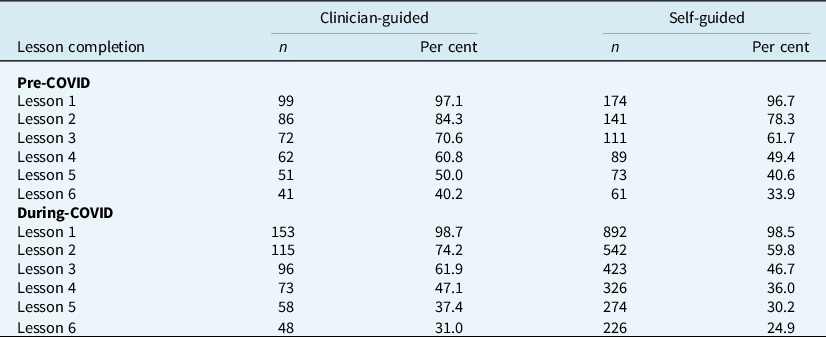
On average, pre-COVID course users completed more iCBT lessons [mean (SD) = 3.77 (2.04)] than during-COVID users [mean (SD) = 3.04 (2.08), t 1341 = 5.22, p<.001]. A higher proportion of pre-COVID course users (36.2%) completed all six lessons of the OCD iCBT course compared with during-COVID users (25.8%, χ2(1) = 11.83, p = .001). Table 2 provides a lesson-by-lesson summary of adherence for the clinician-guided versus self-guided users in each group. In both during- and pre-COVID groups, clinician-guided users did not complete significantly more lessons than self-guided users [during-COVID clinician-guided mean (SD) = 3.50 (2.03) versus self-guided mean (SD) = 2.96 (2.08), t 1059 = –3.01, p = .003; pre-COVID clinician-guided mean (SD) = 4.03 (2.00) versus self-guided mean (SD) = 3.62 (2.05), t 280 = –1.64, p = .10]. In both time periods, clinician guidance did not significantly affect the likelihood of completing the full six lessons of the course [pre-COVID: χ2(1) = 1.12, p = .29; during-COVID: χ2(1) = 2.51, p = .11].
Lesson-by-lesson completion rates for clinician-guided and self-guided users commencing the OCD iCBT course before and during the pandemic

COVID-related differences in treatment effects
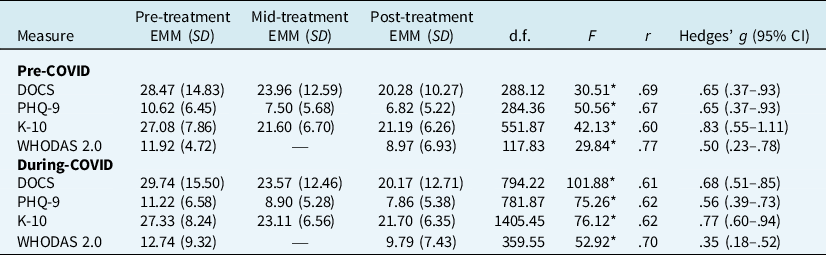
Table 3 shows the estimated marginal means, linear mixed model results and effect sizes for each outcome measure from pre- to post-treatment. On average, both pre- and during-COVID users experienced significant improvements in symptom severity, psychological distress and functional impairment (p<.001). iCBT in both groups was associated with medium effect size reductions in OCD and MDD symptom severity, and medium to large effect size reductions in psychological distress. Small effect size reductions in health-related disability were also observed across iCBT for both groups. The time×clinician assistance (clinician-guided versus self-guided) interaction was not significant for any model in the pre-COVID group, DOCS (F 2, 283.46 = .20; p = .82); PHQ-9 (F 2, 279.24 = .77, p = .47); K-10 (F 5, 546.69 = .99, p = .42); WHODAS (F 1, 115.47 = 2.35, p = .13) or the during-COVID group, DOCS (F 2, 780.67 = .21, p = .81); PHQ-9 (F 2, 766.47 = .24, p = .78); K-10 (F 5, 1384.17 = .51, p = .77); WHODAS (F 1, 353.20 = .03, p = .86), indicating that clinician-guided and self-guided participants did not differ in their degree of improvement across iCBT on any outcome measure.
Reductions in symptom severity, distress and disability from pre- to post-iCBT for pre- and during-COVID groups

DOCS, Dimensional Obsessive-Compulsive Scale; PHQ-9, Patient Health Questionnaire-9; K-10, Kessler Psychological Distress Scale; WHODAS 2.0, World Health Organization Disability Assessment Schedule 2.0; r, Pearson correlation between Lesson 1 and Lesson 6 scores for calculation of within-group effect sizes; EMM, estimated marginal mean. Mid-treatment measures completed prior to Lesson 4. *p<.001.
COVID-related differences in rates of remission and reliable change (completer sample)
Among iCBT course completers who had a probable OCD diagnosis at pre-treatment, we did not observe significant differences between the pre- and during-COVID groups in terms of post-treatment remission rates [pre-COVID = 37.3% (28/75), during-COVID = 35.2% (74/210), χ2(1) = .11, p = .75], the proportion of participants experiencing a 50% reduction in DOCS score from pre- to post-treatment [pre-COVID = 30.7% (23/75), during-COVID = 35.2% (74/210), χ2(1) = .51, p = .47] or the proportion of users experiencing reliable improvements in OCD symptom severity post-treatment [pre-COVID = 17.3% (13/75), during-COVID = 22.4% (47/210), χ2(1) = .85, p = .36]. One user in the during-COVID group experienced reliable deterioration in OCD symptom severity.
Discussion
This study examined the uptake and effectiveness of the THIS WAY UP iCBT course for OCD in routine care during the first 8 months of COVID-19 in Australia (March to October 2020). To our knowledge, this is the first study to do so. As predicted, we observed large increases in the number of monthly OCD course registrations and commencements during the COVID period (>500%) with peak uptake (>1100%) occurring in April to June 2020. Although it is difficult to determine the exact cause of these increases, it is possible that a combination of factors may have contributed. These factors include the level of distress and uncertainty induced by COVID-19 among those experiencing symptoms of OCD and disruptions to the provision of traditional face-to-face health services, coupled with the national media promotion of THIS WAY UP and the waiving of course fees in April 2020. The pattern of course uptake seen in this study is similar to the uptake of telehealth services in Australia during this period of time where uptake was high in April and May, and subsequently reduced in June 2020 as face-to-face mental health services gradually resumed and pandemic restrictions eased (Jayawardana and Gannon, Reference Jayawardana and Gannon2021; Looi et al., Reference Looi, Allison, Bastiampillai and Pring2020). Additionally, our results are congruous with the increased consumption of other remotely delivered mental health supports observed the early COVID period in Australia, such as telephone calls to mental health helplines, telephone mental health assessments, and mental health website visits (e.g. Mahoney et al., Reference Mahoney, Elders, Li, David, Haskelberg, Guiney and Millard2021; Medhora, Reference Medhora2020; Staples et al., Reference Staples, Nielssen, Kayrouz, Cross, Karin, Ryan and Titov2020). The considerable uptake of online mental health services seen in this study is also highly consistent with numerous expert concerns about the impacts of the pandemic on the wellbeing of people with OCD (e.g. Banerjee, Reference Banerjee2020; Kumar and Somani, Reference Kumar and Somani2020; McKay et al., Reference McKay, Minaya and Storch2020; Silva et al., Reference Silva, Shavitt and Costa2020).
Independent of whether they commenced the iCBT for OCD course before or during the pandemic, participants in this study were characterised by high rates of probable OCD (>75%) and MDD (>50%). Contrary to predictions, there were no COVID-related differences in OCD symptom severity specifically, or contamination concerns. Rates of probable OCD and MDD were also comparable, as were levels of psychological distress and suicidal ideation. Our findings are consistent with previous reports, which have found that only a minor proportion of individuals with OCD have experienced a COVID-related deterioration of their symptoms (e.g. 6% in Chakraborty and Karmakar, Reference Chakraborty and Karmakar2020; and 36% in Benatti et al., Reference Benatti, Albert, Maina, Fiorillo, Celebre, Girone and Dell’Osso2020), and that the impacts of the pandemic have been variable for those with OCD as they have been for the general population (Kuckertz et al., Reference Kuckertz, Van Kirk, Alperovitz, Nota, Falkenstein, Schreck and Krompinger2020; Prestia et al., Reference Prestia, Pozza, Olcese, Escelsior, Dettore and Amore2020; Toh et al., Reference Toh, Neill, Phillipou, Tan, Van Rheenen, Meyer and Rossell2021). There has probably been a diverse range of experiences for people with OCD during the pandemic; some may have experienced a dramatic exacerbation in their symptoms while others may have noticed no change or even a reduction in their symptom severity. For example, persistent health promotion in the mass media could inflate some individuals’ sense of personal responsibility which could intensify distress, hygiene practises, and control of others. Alternatively, COVID-related lockdowns and working from home arrangements may have facilitated avoidance, reduced perceptions of threat, and provided a greater sense of certainty and control (Jassi et al., Reference Jassi, Shahriyarmolki, Taylor, Peile, Challacombe, Clark and Veale2020). These possibilities are speculative, and further research is needed to clarify the impact of the COVID pandemic on the cognitive and behavioural experiences of people with OCD.
It is also not clear why THIS WAY UP users commencing the OCD iCBT course during the pandemic were more likely to be female and younger than those commencing their course prior to COVID-19 in Australia. However, the ponderance of females in their thirties is typical of users engaging with digital mental health services in Australia (e.g. Titov et al., Reference Titov, Dear, Nielssen, Wootton, Kayrouz, Karin and Staples2020a), and, as others have argued, this highlights the need for targeted strategies to engage under-represented user groups (Battersby et al., Reference Battersby, Baigent and Redpath2020). A greater majority of during-COVID users (85%) undertook the self-guided course compared with the pre-COVID users (64%), and it is possible that more during-COVID users engaged with the self-help format due to restrictions in accessing traditional face-to-face and clinician-guided services caused by the pandemic. Taken together, our findings suggest that the demographic and clinical characteristics of COVID-19 OCD iCBT users are comparable to those of pre-COVID users. Thus, while the mean severity of symptoms (including contamination-based symptoms) reported by iCBT users was comparable before and during the pandemic, the volume of course users reporting clinically significant symptoms increased dramatically in the COVID period. These findings underscore the demand for digital mental health services during the pandemic, especially self-directed services, and concur with multiple studies that have reported the increased prevalence of clinically significant mental health symptoms in the Australian population during COVID (e.g. Fisher et al., Reference Fisher, Tran, Hammarberg, Sastry, Nguyen, Rowe and Kirkman2020; Rossell et al., Reference Rossell, Neill, Phillipou, Tan, Toh, Van Rheenen and Meyer2021, van Agteren et al., Reference van Agteren, Bartholomaeus, Fassnacht, Iasiello, Ali, Lo and Kyrios2020).
As hypothesised, the effectiveness of the OCD course was similar across the pre- and during COVID groups. In both groups iCBT was associated with medium effect size reductions in OCD symptom severity, and we did not observe meaningful differences in rates of remission or reliable clinical change across the groups. Current outcomes are consistent with previous evaluations of OCD iCBT (Klein et al., Reference Klein, Meyer, Austin and Kyrios2011; Luu et al., Reference Luu, Millard, Newby, Haskelberg, Hobbs and Mahoney2020; Wootton et al., Reference Wootton, Karin, Titov and Dear2019), and accord with Kuckertz et al. (Reference Kuckertz, Van Kirk, Alperovitz, Nota, Falkenstein, Schreck and Krompinger2020) who found that their intensive residential ERP programme appeared to be similarly effective before and during the COVID pandemic. It is also important to note that we found similar treatment outcomes in the self-guided and clinician-guided groups in both the pre- and during-COVID-pandemic periods. This finding is consistent with Luu et al. (Reference Luu, Millard, Newby, Haskelberg, Hobbs and Mahoney2020) and suggests that a portion of individuals undertaking iCBT for OCD can benefit from treatment without guidance from a clinician. This finding is also consistent with a recent meta-analysis demonstrating non-significant differences between guided and unguided iCBT for mutliple anxiety disorders (Pauley et al., Reference Pauley, Cuijpers, Papola, Miguel and Karyotaki2021). Our results highlight the demand for and utility of self-directed iCBT, especially during the pandemic when people may be unable or unwilling to attend in-person appointments or consult clinicians. However, it should be noted that outcomes for OCD iCBT delievered in routine care settings are not as robust as those observed for face-to-face CBT/ERP [e.g. where responder rates can be 62–86% (Foa et al., Reference Foa, Liebowitz, Kozak, Davies, Campeas, Franklin and Tu2005) and meta-analyses have reported pooled Hedges’ g = 1.39 (Olatunji et al., Reference Olatunji, Davis, Powers and Smits2013)], although this issue has been discussed elsewhere and is not related to the pandemic (see Luu et al., Reference Luu, Millard, Newby, Haskelberg, Hobbs and Mahoney2020). Overall, our findings suggest that the effectiveness of iCBT for OCD during the early COVID-19 period in Australia was similar to its effectiveness prior to the pandemic.
In line with Luu et al. (Reference Luu, Millard, Newby, Haskelberg, Hobbs and Mahoney2020) and Wootton et al. (Reference Wootton, Karin, Titov and Dear2019), we expected that 30–40% of users would complete the OCD iCBT course. However, course completion in the during-COVID users was marginally lower than this. Although clinician-guided users in the pre- and during-COVID groups were no more likely to complete lessons than the self-guided users in this study, clinician-guided iCBT for OCD has previously been associated with significantly higher adherence rates than self-guided courses (e.g. Luu et al., Reference Luu, Millard, Newby, Haskelberg, Hobbs and Mahoney2020). During the COVID period in this study, it is possible that both clinician-guided and self-guided course users became confused by a perceived contradiction between the recommended ERP exercises in the course (e.g. reducing compulsive behaviours like cleaning and handwashing) and public health recommendations associated with COVID-19 containment measures. This potential confusion could influence programme adherence, especially for self-guided users who formed a large portion of the during-COVID group and who did not elect to work with a clinician who could provide guidance during the iCBT. It is also possible that the waiving of course fees influenced adherence (as seen in Hilvert-Bruce et al., Reference Hilvert-Bruce, Rossouw, Wong, Sunderland and Andrews2012) or that COVID-related stressors (e.g. social, occupational, and financial adversities) may have impeded lesson completion for some users in this study. Further reports by other research groups on individuals undertaking iCBT for OCD during the COVID-19 pandemic are needed to replicate and extend these findings in order to clarify the impact of COVID-19 on OCD treatment engagement.
Limitations
As this study evaluated the outcomes of iCBT for OCD in routine care, there was no control group. Current outcomes may be due to other factors such as concurrent treatment, spontaneous remission, or changes in users’ personal circumstances during COVID-19. We also cannot determine the exact cause of the increased uptake in course registrations as possible contributing factors such as the media promotion of THIS WAY UP and the waiving of course fees are confounded with other factors such as the disruption to face-to-face service provision. Furthermore, longer-term outcomes of the OCD iCBT course were not evaluated because follow-up data were not collected.
The current sample was comparatively homogeneous (mainly young females residing in major Australian cities), and it is unclear if results would vary with a more heterogeneous sample. Additionally, approximately 30% of people who registered for the iCBT course did not progress to complete study measures or start their course, and as such, the outcomes of this group is unknown. Future research should seek to examine the characteristics of this group and explore practical avenues for enhancing their engagement with treatment. No data were collected about the history of users’ presenting problems or prior treatment. Consequently, we do not know how novel iCBT was for current users and what proportion of the current COVID-19 sample consisted of new onset OCD cases versus individuals with pre-existing OCD.
Lesson completion provided an estimate of users’ engagement with the iCBT course, but the quantity and quality of participants’ use of the CBT/ERP skills is unknown, and the mechanisms by which change was achieved were not assessed (for instance, changes in OCD cognitions; Adams et al., Reference Adams, Riemann, Wetterneck and Cisler2012; Wilhelm et al., Reference Wilhelm, Berman, Keshaviah, Schwartz and Steketee2015). Furthermore, the use of the DOCS may have under-estimated treatment effects and baseline OCD symptom severity in the during-COVID cohort because the measure assesses symptoms over the past month. It should also be noted that the THIS WAY UP OCD iCBT course was not modified for the COVID-19 context. It is unclear what effect this may have had, but the inclusion of additional COVID-specific resources and guidelines may have been helpful for users.
Finally, the impact of the pandemic in Australia may be markedly different from other regions around the world; our findings may not generalise to other populations. For example, as of mid-June 2021, the total number of COVID cases (per million people) has been estimated at 101,163 in the USA, 67,716 in the UK, and 1,188 in Australia (Dong et al., Reference Dong, Du and Gardner2020; Ritchie et al., Reference Ritchie, Ortiz-Ospina, Beltekian, Mathieu, Hasell, Macdonald and Roser2021). The consequent number of COVID-related deaths (per million people) in the USA (∼1814) and the UK (∼1888) are also considerably higher than those in Australia (∼ 36) (Dong et al., Reference Dong, Du and Gardner2020; Ritchie et al., Reference Ritchie, Ortiz-Ospina, Beltekian, Mathieu, Hasell, Macdonald and Roser2021). It should also be noted that the health care system in Australia is different from that of other countries. Many health services are publicly funded, and nation-wide, government-funded mental health telehealth consultations were rapidly instigated and subsequently consumed in the early COVID period in Australia (Jayawardana and Gannon, Reference Jayawardana and Gannon2021). Furthermore, iCBT for OCD has been available in Australia for over a decade, which is not the case for other regions around the world (e.g. Patel et al., Reference Patel, Wheaton, Andersson, Rück, Schmidt, La Lima and Simpson2018). Clearly, future studies are needed to understand the comparative impacts and management of the pandemic across the globe.
Conclusions
An unprecedented number of individuals accessed the THIS WAY UP iCBT for OCD course in the early months of the COVID-19 pandemic in Australia. Like pre-COVID evaluations, the OCD iCBT course was associated with medium effect size reductions in OCD symptom severity. Results highlight the scalability of digital mental health programmes and support their continued funding, promotion, and integration into the broader mental healthcare infrastructure.
Data availability
Data are available on request due to privacy/ethical restrictions.
Acknowledgements
None.
Author contributions
Ian Li: Conceptualization (equal), Data curation (lead), Formal analysis (lead), Funding acquisition (supporting), Investigation (equal), Methodology (equal), Project administration (supporting), Resources (supporting), Software (supporting), Supervision (supporting), Validation (supporting), Visualization (lead), Writing-original draft (equal), Writing-review & editing (equal); Michael Millard: Conceptualization (equal), Data curation (supporting), Formal analysis (supporting), Funding acquisition (equal), Investigation (supporting), Methodology (equal), Project administration (supporting), Resources (lead), Software (supporting), Supervision (equal), Validation (supporting), Visualization (supporting), Writing-original draft (supporting), Writing-review & editing (supporting); Hila Haskelberg: Conceptualization (equal), Data curation (equal), Formal analysis (supporting), Funding acquisition (equal), Investigation (supporting), Methodology (equal), Project administration (supporting), Resources (supporting), Software (lead), Supervision (equal), Validation (supporting), Visualization (supporting), Writing-original draft (supporting), Writing-review & editing (supporting); Megan Hobbs: Conceptualization (supporting), Data curation (supporting), Formal analysis (supporting), Funding acquisition (supporting), Investigation (supporting), Methodology (equal), Project administration (supporting), Resources (supporting), Software (supporting), Supervision (equal), Validation (supporting), Visualization (supporting), Writing-original draft (equal), Writing-review & editing (supporting); John Luu: Conceptualization (equal), Data curation (supporting), Formal analysis (supporting), Funding acquisition (supporting), Investigation (supporting), Methodology (equal), Project administration (supporting), Resources (supporting), Software (supporting), Supervision (supporting), Validation (supporting), Visualization (supporting), Writing-original draft (supporting), Writing-review & editing (supporting); Alison Mahoney: Conceptualization (lead), Data curation (supporting), Formal analysis (equal), Funding acquisition (supporting), Investigation (lead), Methodology (lead), Project administration (lead), Resources (supporting), Software (supporting), Supervision (lead), Validation (lead), Visualization (equal), Writing-original draft (lead), Writing-review & editing (lead).
Financial support
This research received no specific grant from any funding agency, commercial or not-for-profit sectors.
Conflicts of interest
None.
Ethics statement
This study was approved by the Human Research Ethics Committee (HREC) of St Vincent’s Hospital (Sydney, Australia) (2019/ETH00088).



Comments
No Comments have been published for this article.