1. Introduction
The presence of a giant bird in the Late Cretaceous of southern France was first reported by Buffetaut et al. (Reference Buffetaut, Le Loeuff, Mechin and Mechin-Salessy1995) on the basis of a synsacrum fragment from Fox-Amphoux (Var). Gargantuavis philoinos was erected by Buffetaut & Le Loeuff (Reference Buffetaut and Le Loeuff1998) on the basis of a synsacrum and parts of the pelvis, from Campagne-sur-Aude (Aude), as the holotype, with an incomplete femur from Villespassans (Hérault) being referred to it because of anatomical congruence of the femoral head. Since then, no additional material referable to Gargantuavis had been identified, despite active excavations at various sites in southern France, showing that this bird is a rare component of the local Late Cretaceous vertebrate assemblages (Buffetaut & Le Loeuff, Reference Buffetaut and Le Loeuff2010). The discovery of a well-preserved cervical vertebra of a very large bird in the Upper Cretaceous of Cruzy (Hérault) is therefore worth reporting, especially in the context of a recent controversy about the avian or pterosaurian nature of Gargantuavis (Mayr, Reference Mayr2009; Buffetaut & Le Loeuff, Reference Buffetaut and Le Loeuff2010; Buffetaut, Reference Buffetaut and Csiki2011a). The new specimen is referred to Gargantuavis philoinos and provides additional evidence about its osteology.
Institutional abbreviations: MC – Musée de l'Association Culturelle, Archéologique et Paléontologique de l'Ouest Biterrois, Cruzy (Hérault, France); MDE – Musée des Dinosaures, Espéraza (Aude, France).
2. Geographical and geological setting
The vertebra was discovered in the course of excavations at the Montplo-Nord locality, of late Campanian–early Maastrichtian age as indicated by its vertebrate assemblage, near the village of Cruzy (Hérault). There, continental red marls interbedded with sandstone lenses corresponding to a floodplain environment yield abundant vertebrate remains. The faunal assemblage has not yet been described in detail but is generally similar to that from the nearby Massecaps locality (Buffetaut et al. Reference Buffetaut, Le Loeuff, Tong, Duffaud, Cavin, Garcia and Ward1999). It includes freshwater bivalves, fish (lepisosteids), turtles (the bothremydid Foxemys), crocodilians, pterosaurs (azhdarchids) and dinosaurs (titanosaurid sauropods, dromaeosaurid and abelisaurid theropods, nodosaurid ankylosaurs, rhabdodontid ornithopods). Previously reported Gargantuavis specimens (Buffetaut et al. Reference Buffetaut, Le Loeuff, Mechin and Mechin-Salessy1995; Buffetaut & Le Loeuff, Reference Buffetaut and Le Loeuff1998) are from localities of similar age and general geological setting in southern France (Provence and Languedoc).
3. Description
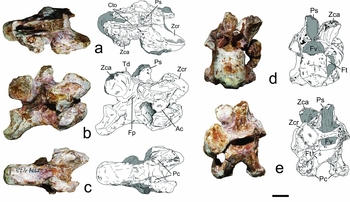
Osteological nomenclature follows Baumel & Witmer (Reference Baumel, Witmer, Baumel, Breazile, Evans and Berge1993). The bird vertebra from Montplo-Nord (MC-MN 478, Fig. 1) is generally well preserved, having suffered only slight distortion. Although the apophyses on the left side are broken, those on the right side are in good condition, despite some abrasion of the edges. As shown by vast calcite-filled inner spaces revealed by the breaks on the left side, the bone was heavily pneumatized. A pneumatic foramen is visible on both sides, low on the neural arch, between the bases of the pre- and postzygapophyses (Fig. 1b). Such a foramen is commonly present in cervical vertebrae of modern birds (O'Connor, Reference O'Connor2004). There is no indication of pneumatic foramina on the centrum. The centrum is low and elongate, with a ventral face that is flat caudally and deeply concave cranially between the Processi carotici, which are well developed, forming well-defined subtriangular facets that project medially (Fig. 1c). The caudal articular surface of the centrum, located posterior to the caudal margin of the postzygapophyses, is markedly saddle-shaped, being concave craniocaudally and convex transversally, and narrower than high (Fig. 1b, d). Unlike the condition in most birds, the ventral part of this articular surface is remarkably narrow, without any significant transversal expansion (Fig. 1c). The cranial articular surface is strongly concave transversally and convex craniocaudally (Fig. 1e). The vertebra from Montplo-Nord thus shows the distinctive heterocoelous condition that is found in modern birds and some Cretaceous forms (Marsh, Reference Marsh1879), most of which belong to Ornithuromorpha, although the phylogenetic distribution of this character seems unclear (O'Connor, Chiappe & Bell, Reference O'Connor, Chiappe, Bell, Dyke and Kaiser2011). The better preserved right side of the vertebra shows an Ansa costotransversaria enclosing the Foramen transversarium for the passage of blood vessels. The Processus costalis is broken caudally. The Zygapophysis cranialis is large, with a fairly deep elongate depression on its lateral surface (Fig. 1a). The zygapophysial facet is oval, flat, and slopes at about 45°. The Zygapophysis caudalis is incompletely preserved, part of its dorsal margin being damaged. The zygapophysial facet is large and somewhat concave. There is a well-developed Torus dorsalis (although much less developed than the epipophyses of non-avian theropods). The Processus spinosus is tall (although its distal end is broken) and short craniocaudally (Fig. 1b). Its caudal margin is sloping, whereas its cranial margin is vertical. Both its cranial and caudal faces are concave, probably for the insertion of tendons. Posterior to the Processus spinosus, a long and narrow median groove is limited laterally by the Cristae transversae obliquae, which merge caudally with the zygapophyses (Fig. 1a). Anterior to the Processus spinosus, a broad shelf extends onto the medial side of the zygapophyses and overhangs the Foramen vertebrale, which is cranially low, with an oval outline, and caudally higher and narrower.
Large bird vertebra, referred to Gargantuavis philoinos, from the Late Cretaceous of Cruzy (Hérault, France), MC-MN478. Photographs (left) with explanatory drawings (right), in dorsal (a), right lateral (b), ventral (c), caudal (d) and cranial (e) views. Ac – Ansa costotransversaria; Cto – Cristae transversae obliquae; Fp – Foramen pneumaticum; Ft – Foramen transversarium; Fv – Foramen vertebrale; Pc – Processi carotici; Ps – Processus spinosus; Td – Torus dorsalis; Zca – Zygapophysis caudalis; Zcr – Zygapophysis cranialis. Scale bar = 10 mm.

4. Identification and comparisons
MC-MN 478 clearly belongs to a bird, as shown by its heterocoelous condition, which is an avian character (Marsh, Reference Marsh1879). Incipiently heterocoelous cervical vertebrae have been reported in troodontid and dromaeosaurid dinosaurs (Xu & Norell, Reference Xu and Norell2004), but MC-MN 478 shows an advanced heterocoely that seems to have no equivalent in any known non-avian dinosaur. Similarities with troodontid vertebrae (Makovicky & Norell, Reference Makovicky, Norell, Weishampel, Dodson and Osmólska2004) include the presence of Processi carotici and a distinct Torus dorsalis on the postzygapophyses, but the markedly saddle-shaped, posteriorly projecting caudal articular surface of the centrum of MC-MN 478 has no equivalent in troodontids. The lack of pneumatic openings on the centrum also seems to separate MC-MN 478 from deinonychosaurs. Its elongate centrum, the presence of a Foramen transversarium and of well-developed Processi carotici, and the complete absence of a hypapophysis show that MC-MN 478 belongs to the middle part of the neck. The articular surfaces of MC-MN 478 show that in this region dorsal bending was possible, whereas ventral bending must have been nearly impossible because the long saddle-shaped caudal articular surface was blocked by the strongly developed and medially projecting Processi carotici. This indicates that the vertebra belongs to Boas's section II of the neck, in which only dorsal flexion is possible (Boas, Reference Boas1929). However, because the various sections of the neck as defined by Boas (Reference Boas1929) do not contain the same number of vertebrae in all groups of birds, the exact position of MC-MN 478 in the vertebral column cannot be precisely determined. Lateral bending must have been extremely limited because the cranial articular surface is deeply concave transversally and must have severely restricted lateral movements of the elongate caudal articular area of the vertebra immediately anterior to it.
Comparison with Gargantuavis philoinos is not easy because there are no cervical vertebrae in the original material. In size, however, MC-MN 478 is compatible with the type synsacrum of Gargantuavis philoinos (MDE-C3–525), as suggested by comparisons with vertebral columns of modern large terrestrial birds. In ratites there is a gradual decrease in the diameter of the vertebral centra from the synsacrum to the cervical vertebrae (Mivart, Reference Mivart1874, Reference Mivart1877): the width of the articular face of an ‘intermediate’ cervical vertebra is roughly one third that of the cranial articular face of the synsacrum. Assuming a comparable decrease in Gargantuavis, the 40 mm wide cranial articular face of the type synsacrum is in good agreement with the 13 mm wide articular faces of the centrum of MC-MN 478. The vertebra from Montplo-Nord is roughly the size of a corresponding vertebra of a cassowary (Casuarius), in good agreement with size estimates based on the original giant bird material from southern France, which suggested a cassowary-sized (Buffetaut et al. Reference Buffetaut, Le Loeuff, Mechin and Mechin-Salessy1995) or ostrich-sized (Buffetaut & Le Loeuff, Reference Buffetaut and Le Loeuff1998) bird. Because MC-MN 478 is compatible in size with previously described specimens of Gargantuavis philoinos and has been found in sediments of the same age in the same geographical area, it seems reasonable to refer it to this taxon, rather than postulating the existence of two distinct giant birds in the local Late Cretaceous vertebrate assemblages.
Comparisons with other Cretaceous birds are limited because details of vertebral structure are available for few of them (many of the more complete Cretaceous birds are known from specimens that are crushed flat on slabs of rock). Buffetaut & Le Loeuff (Reference Buffetaut and Le Loeuff1998) suggested possible affinities between Gargantuavis and Patagopteryx deferrariisi, a hen-sized flightless bird from the Late Cretaceous of Patagonia (Bonaparte & Alvarenga, Reference Bonaparte and Alvarenga1992; Chiappe, Reference Chiappe, Chiappe and Witmer2002), because of similarities in pelvic construction. However, MC-MN 478 shows little resemblance to the cervical vertebrae of Patagopteryx, which have a low neural spine and a caudal articular area that does not project beyond the level of the postzygapophyses (Chiappe, Reference Chiappe, Chiappe and Witmer2002). Similarly, MC-MN 478 differs from enantiornithine cervical vertebrae from the Late Cretaceous of Argentina (Walker & Dyke, Reference Walker and Dyke2009) in the strong posterior elongation of its caudal articular region. MC-MN 478 appears to be more markedly heterocoelous than the cervical vertebrae of Patagopteryx and enantiornithines.
The cervical vertebra from Montplo-Nord is clearly distinct from those of the Late Cretaceous Ichthyornis, which are not fully heterocoelous (Marsh, Reference Marsh1879, Reference Marsh1880; Clarke, Reference Clarke2004). In the large marine Late Cretaceous bird Hesperornis, similarly positioned cervical vertebrae are fully heterocoelous (Marsh, Reference Marsh1880), but differ from MC-MN 478 in their transversally narrow, anteroposteriorly elongate neural spine and in their caudal articular surface, which is more expanded transversally and does not project much beyond the level of the postzygapophyses.
Comparisons with large extinct birds from the Cenozoic do not reveal notable similarities. MC-MN 478 differs from the much more robust and less elongate cervical vertebrae of the Early Tertiary gastornithids (Gervais, Reference Gervais1873; Lemoine, Reference Lemoine1878; Matthew & Granger, Reference Matthew and Granger1917). This confirms that Gargantuavis and gastornithids are not closely related (Buffetaut, Reference Buffetaut2002). The Dromornithidae from the Cenozoic of Australia (Murray & Vickers-Rich, Reference Murray and Vickers-Rich2004) have short cervical vertebrae with low neural spines, unlike MC-MN 478. In the mainly South American Phorusrhacidae, there is no posterior elongation of the caudal articular area and the neural spine is low (Sinclair & Farr, Reference Sinclair and Farr1932).
MC-MN 478 is somewhat reminiscent of modern ratites (Mivart, Reference Mivart1874, Reference Mivart1877) in the elongation of the centrum. Its proportions are more reminiscent of the cervical vertebrae of the emu (Dromaius) and the cassowary (Casuarius) than of those of the ostrich (Struthio) and the rhea (Rhea), which are more elongated (Mivart, Reference Mivart1877). However, its posteriorly projecting and narrow caudal articular region and its tall and anteroposteriorly compressed Processus spinosus are significant differences.
To sum up, MC-MN 478 is not especially reminiscent of any Cretaceous bird in which the cervical vertebrae are well known, nor does it closely resemble the vertebrae of more recent large birds. This may suggest endemic evolution on the relatively isolated Late Cretaceous Ibero-Armorican island.
5. Conclusions
It was recently suggested that the remains attributed to Gargantuavis in fact belong to a giant pterosaur (Mayr, Reference Mayr2009). This is untenable because of highly significant differences between the specimens referred to Gargantuavis and the corresponding elements in pterosaurs (Buffetaut & Le Loeuff, Reference Buffetaut and Le Loeuff2010; Buffetaut, Reference Buffetaut2011a; Mourer-Chauviré et al. Reference Mourer-Chauviré, Tabuce, Mahboubi, Adaci and Bensalah2011). The typically avian vertebra from Montplo-Nord, which confirms the presence of a very large bird in the Late Cretaceous of France, can in all likelihood be referred to Gargantuavis philoinos and provides new evidence about its anatomy. Its size and morphology indicate a bird with probably a long, rather slender neck, unlike the Early Tertiary gastornithids, which had a robust and relatively short neck (and a very large head). The shape of the articulations suggests that, at least at the level of this vertebra, bending of the neck was very limited, except in a dorsal direction.
The vertebra from Montplo-Nord shows an advanced heterocoelous condition that distinguishes it from various groups of basal birds in which heterocoely apparently was not fully developed (O'Connor, Chiappe & Bell, Reference O'Connor, Chiappe, Bell, Dyke and Kaiser2011). Buffetaut & Le Loeuff (Reference Buffetaut and Le Loeuff1998) concluded that Gargantuavis philoinos could be placed within Ornithothoraces and was more advanced than Enantiornithes because of femoral morphology, but was probably not an ornithurine because of the large size of the acetabulum (possibly more apparent than real because in the type of Gargantuavis philoinos the ilium is incompletely preserved). The cervical vertebra from Cruzy supports placement of Gargantuavis within Ornithuromorpha but does not suggest close proximity to Patagopteryx. In terms of heterocoely, it is more advanced than Ichthyornis, which may suggest that it is close to or within Ornithurae (defined as ‘a dichotomy between Neornithes and Hesperornithiformes’, and as the sister-group of Ichthyornis, by O'Connor, Chiappe & Bell, Reference O'Connor, Chiappe, Bell, Dyke and Kaiser2011). This also raises the question of the acquisition of heterocoely in Cretaceous birds, which is not fully understood and may have involved some parallel evolution. However, a more precise assessment of the phylogenetic position of Gargantuavis philoinos requires a re-examination of all specimens referred to this taxon, which is beyond the scope of this paper. With the vertebra from Montplo-Nord confirming its avian status, Gargantuavis philoinos remains the only giant ground bird hitherto reported from the Late Cretaceous, since Samrukia nessovi, a purported huge bird from the Santonian of Kazakhstan (Naish et al. Reference Naish, Dyke, Cau, Escuillié and Godefroit2012), is in fact a pterosaur (Buffetaut, 2011b).
The ecological place of Gargantuavis philoinos in the ecosystems of the Late Cretaceous Ibero-Armorican island (Pereda-Suberbiola, Reference Pereda-Suberbiola2009) remains uncertain. Contrary to a suggestion by Buffetaut & Le Loeuff (Reference Buffetaut and Le Loeuff1998), it does not seem to have occupied an ecological niche similar to that of ornithomimosaurs in other parts of the world, because it appears to have been a graviportal rather than cursorial form (Buffetaut & Le Loeuff, Reference Buffetaut and Le Loeuff2010). The new vertebra from Cruzy, in addition to the previously described material, may suggest a bird somewhat similar in proportions to some of the medium-sized graviportal moas of New Zealand, such as Pachyornis (Bunce et al. Reference Bunce, Worthy, Phillips, Holdaway, Willersley, Haile, Shapiro, Scofield, Drummond, Kampk and Cooper2009), although lack of evidence about the skull limits the reliability of the comparison. Be that as it may, the new specimen confirms that a very large ground bird co-existed with dinosaurs on the Ibero-Armorican island. In the present state of our knowledge, no such giant Late Cretaceous birds have yet been reported from other parts of the world, including areas with excellent Late Cretaceous vertebrate records, and this suggests that the occurrence of Gargantuavis in France probably reflects endemicity (Pereda-Suberbiola, Reference Pereda-Suberbiola2009).
Acknowledgements
This work was supported by the INTERRVIE Programme of the Centre National de la Recherche Scientifique and by the Association Culturelle, Archéologique et Paléontologique de l'Ouest Biterrois, whose members are thanked for their help in the field. We are grateful to Jean-Claude Guilhaumon (Cruzy) for permission to dig on his land. Thanks to Christine Lefèvre for access to material in the comparative anatomy collection of the Muséum National d'Histoire Naturelle, Paris, and to Jean Le Loeuff (Musée des Dinosaures, Espéraza) for access to the type material of Gargantuavis philoinos. Federico Agnolin and Gareth Dyke provided useful reviews.