Introduction
Cosmopolitanism, which implies the recognition of commonality among humans, is popularly associated with contemporary urban communities. However, historical evidence suggests other, more diverse sites of cosmopolitanism. In this paper I will examine a historical trading community in Central/South Asia as a case-study for how cosmopolitanism may arise—and has arisen in the past—in communities often thought peripheral to major urban centres. I will argue that in the early twentieth century, residents of the North Indian region of Ladakh formed a cosmopolitan community through their interactions with trading commodities. The notion of cosmopolitanism employed in this paper is informed by neo-pragmatic or epistemological philosophy, which understands cosmopolitanism as a conceptual framework utilized by individuals known as ‘cosmopolitans’. The conceptual boundaries that cosmopolitans traverse are cultural boundaries, overcome by cultural exchange. Thus this paper has broader implications for the ways in which we conceptualize the agency of individuals and/or communities in cosmopolitan processes, and recognize cosmopolitanism in particular sites across time and/or space.
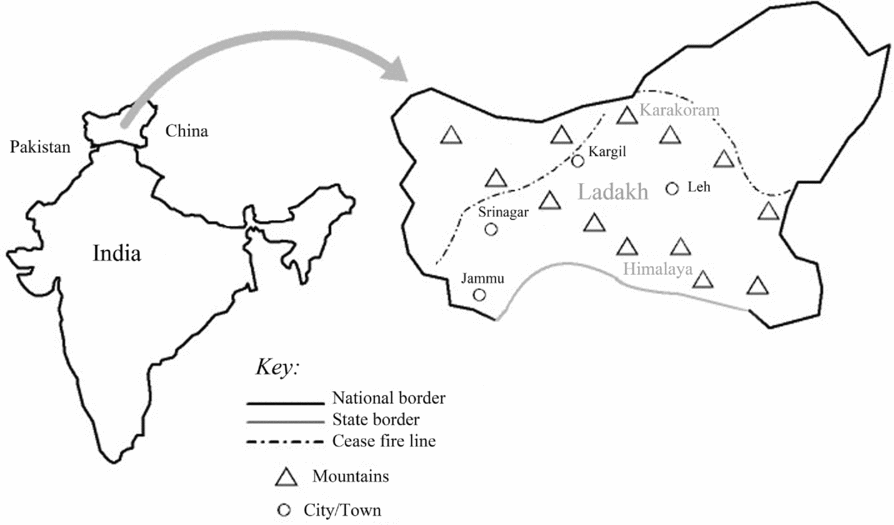
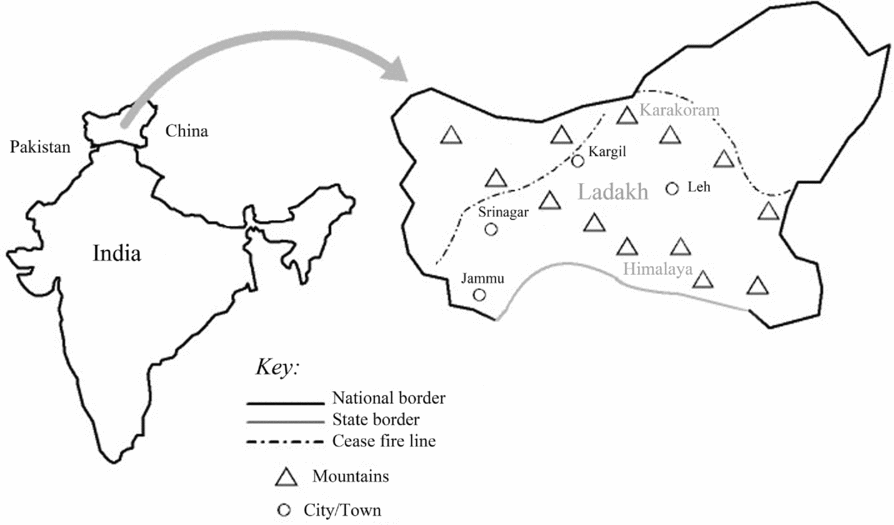
Map of the Ladakh region in Jammu and Kashmir state, India. Source: J. Fewkes.Footnote 1
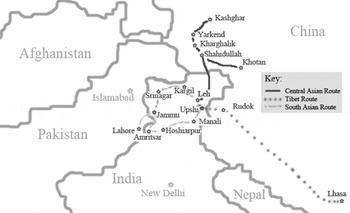
Map of the main early twentieth century trading routes through Ladakh. Source: J. Fewkes.Footnote 2

Historical trade in Ladakh
Hemmed in by mountains on every side, the geographic region of Ladakh is a quintessential frontier zone, often defined in relation to its surroundings. From this perspective, Ladakh is on the border between Central and South Asia, near the valley of Kashmir, on the western edge of the Tibetan plateau, and situated between the Himalayan mountain range to the south and the Karakoram mountain range to the north. In synchronic geo-political terms it is a combination of two political districts—Leh and Kargil—in the state of Jammu and Kashmir; these are also the names of the two main towns in Ladakh, each an urban centre of their respective district.
There is a long history of trade in Ladakh, associated with what is today commonly called the ‘Silk Road’ or ‘Silk Route’,Footnote 3 a network of routes that were travelled by traders from China to Eastern Europe. One of the most vital components of Ladakh's participation in the Silk Route was its geographic location. Leh town in Ladakh, located near key mountain passes, was a trading network ‘hub’, a place that offered traders access to a number of routes, including three main networks to Central Asia, South Asia, and Tibet.Footnote 4 These routes were only open for a brief window of time in the summer, when the snow had melted in the mountains and they were passable for travellers.
As Janet Rizvi has pointed out, the ‘most vibrant of the trading stations’ in the trading networks of Central Asia were towns like Leh, situated between inhabited and uninhabited sections of routes or the ‘first sizeable settlement reached by caravans’ after inhospitable terrain.Footnote 5 In towns like these traders could rest and refuel before continuing onwards; in this region such locations included the towns of Yarkend, Khotan, Kashgar, and Leh. Thus, according to one European traveller, in the summer and early autumn in Leh:
. . . there is such a motley collection of types and various costumes, and such a babble of different languages, as it would not be easy to find elsewhere. Savage Tartars in sheepskins, and other outlandish men, jostle with the elegant Hindoo merchant from the cities of Central India, and the turbulent Mussulman Pathan scowls at the imperturbable idolaters from the Celestial Empire. Leh in September is, indeed, one of the busiest and most crowded of cities, and the storekeepers and farmers who have to supply this multitude must make a very good profit for this time. Leh is therefore a very cosmopolitan [italics added] city, even in the dead season; for there are resident merchants and others of various races and creeds. Small as is the permanent population, at least four languages are in common use here—Hindostani, Tibetan, Turki, and Kashmiri—while several others are spoken.Footnote 6
While various other data support the idea that the early twentieth century Ladakh bazaar was a cultural contact zone exhibiting a variety of forms of cultural expression, E. F. Knight makes a rather isolated claim here about the cosmopolitan nature of the Ladakhi market scene. Is this a fair claim to make—was early twentieth century Ladakh indeed a cosmopolitan site?
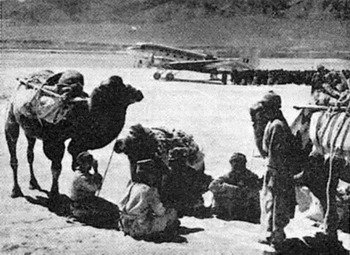
Leh town today is sometimes disparaged as a sleepy, provincial town in India. In the 1940s, when India's northern boundaries became disputed political borders, regional trading networks were severed and Ladakhi trade with Central Asia ceased. Furthermore, popular accounts of early twentieth century life in Ladakh, commonly conceptualized as occupied by a primarily agricultural community, seem to characterize Ladakhis as provincials. For example, when Ladakh became part of India in 1948, regional conflict between Pakistan and India necessitated the influx of Indian troops to the region. In order to bring military troops and supplies to the area, an airfield was constructed in Leh. Ladakhi lore has it that when the first aeroplane landed in Leh, Ladakhi villagers brought hay to the airfield to feed it.
A photograph of the first Royal Indian Air Force Dakota aeroplane to land in Leh, 24 May 1948. Source: Unattributed photograph from the unofficial Indian Air Force section of www.bharat-rakshak.com

This story seems to suggest a lack of broader knowledge, and would not commonly be conceptualized as a cosmopolitan interaction.
Thus, the question of whether or not historical Ladakhis were cosmopolitan is particularly important for multiple reasons. First, what would we expect cosmopolitanism in action to look like—is feeding hay to aeroplanes not quintessentially un-cosmopolitan? Second, Leh is not a bustling Indian metropolis like Mumbai or New Delhi, and therefore may seem like an unlikely site in which to identify cosmopolitanism. Does cosmopolitanism only occur in urban areas, the elite global cities? Finally, if Ladakhi participation in trade networks made regional inhabitants cosmopolitan, did the severing of local trade networks bring an end to this cosmopolitanism? That is, is cosmopolitanism so dependent on particular economic, political, and/or social contexts that it can be ‘lost’ if those contexts change?
Research sources
This ethno-historical research project began in 1997 while I was staying in a house in the centre of Leh town, in a small neighbourhood called Chu-tay Rang-tak (watermill). With an interest in both historical trade and social life in present-day Ladakh, I was fascinated by Leh residents' memories of the past. One day when Mohammed Deen Khan, the owner of the house, was telling me about the role his grandfather had played in trade between South and Central Asia, he suddenly said, ‘You know, I have his business papers. Would you like to see them?’
My research project was born from this sentence. These business papers have been stored in the Khan house for several decades and include thousands of pages of detailed documentation of trade between Central and South Asia through Ladakh. These documents were the personal and business papers of two caravan route officials in Leh: Bahauddin Khan and his son, Shams-ud-din Khan. The papers had languished in various parts of the house; they had been boxed, reboxed, and sometimes threatened with consignment to the rubbish fire, but had survived because Bahauddin's grandson felt that these materials provided significant evidence of Ladakh's trading history.
Assembled, there are approximately 1,000 pages of documents, including personal memos, personal and business letters, registered letter envelopes, money order receipts, export permits, telegrams, account books, and telegram receipts, mainly dating between 1900 and 1948. While the majority of the correspondence is between Leh and Kargil and other towns in North India—particularly Hoshiarpur, Amritsar, and Srinagar—these documents include correspondence with a number of other areas in present-day China, England, India, and Pakistan. The contents of the documents also represent trading networks that extended much further, referring to goods and traders linked to areas in present-day Afghanistan, Germany, Japan, Kazakhstan, Turkey, the United States, and Uzbekistan. Using the documents to trace the movements of goods we can observe patterns of international trade in carpets, cloth, synthetic dyes, manufactured pharmaceuticals, drugs, weaponry, household items, jewellery, and clothing.
In spite of the detail contained in the documents, without ethnographic work, the information they give is partially incomplete; they only tell half the story about trade in early twentieth century Ladakh. Thus, in addition to general participant-observation work in Ladakh, during my ethnographic research I conducted formal interviews with the descendants of North Indian traders, undertook genealogical research, and surveyed households with written questionnaires. A final source of data for this project was discovered in December 2000 in the town of Kargil. This consisted of hundreds of trade artefacts from the Aziz Bhat serai, a trading facility in Kargil formerly owned by a local official named Munshi Aziz Bhat. The serai, having fallen into disarray after the death of its owner in the early twentieth century, was officially closed in 1950/51. In the ensuing years of disuse, large portions of the roof had collapsed under heavy snow. In 1994 construction began on the front portion of the old serai ruins to dismantle the structure and make room for new shops. At this time construction workers discovered a number of old crates, which contained an amazing array of trade goods and provided a great deal of further insight into Ladakh's early twentieth century trade.Footnote 7
An epistemological/neo-pragmatic approach to cosmopolitanism
To be cosmopolitan is generally to participate in a pluralistic and diverse public sphere. However, the term carries with it a sense of separateness: cosmopolitans are a group of people who experience cultural diversity in a particularly identifiable manner. The cosmopolitan experience is generally viewed as one that brings together multiple cultural backgrounds, contrasting with pluralism, which emphasizes cultural differences within diverse settings.Footnote 8 Ascribed to this type of cosmopolitan is a cultural universalism that leaves no room for regionalism or local ethnic identities.Footnote 9 Thus cosmopolitanism as cultural universalism is contrasted with cultural particularism, and cosmopolitans are most often identified as such in spaces (geographic or social) or at times when others are not participating. For example, a distinct community is identified as cosmopolitan in contrast to others within the same time period, social networks, city, region, or even global community. This idea of the cosmopolitan may then seem problematic—how can cosmopolitans simultaneously be universalists and yet be identifiable as a separate cultural or social group?
In spite of the fact that cosmopolitanism is an abstract and constructed category—dependent on how we interpret and understand information about the world—I believe that this conceptual problem is worth examining more closely. Philosophical pragmatism tells us that a concept is meaningful or significant only insofar as its application is useful.Footnote 10 Despite the constructed nature of this concept, defining cosmopolitanism is still a valuable endeavour, practically speaking. Furthermore, to say that cosmopolitans are constructed is not to say that they are not ‘real’. Even the concept of a physical entity such as a table crucially depends on cultural knowledge that allows us to interpret collections of pieces of wood (or metal or plastic, etc.) as tokens of the type ‘table’ because they are arranged in particular ways and used for particular purposes. Similarly, defining cosmopolitanism requires us to define the cultural knowledge that allows us to create this particular category of social experience. Recognizing individuals as cosmopolitan is useful for providing models of how populations can understand cultural differences within a global context and may allow us to understand practically how areas of culture are linked together within individual lives—the lives of cosmopolitans. This model of cosmopolitanism enables an examination, in particular cultural settings and time periods, of individuals as embodiments of the values associated with globalization today. Identifying cosmopolitans thus reveals the possibility of negotiating diverse cultural perspectives and interests without devaluing cultural difference, with the realization that these negotiations are neither the reflexive prerogative, nor the chance product, of modern globalization.
James Bohman, when writing about cosmopolitans, emphasizes that members of cosmopolitan societies must realize that there are multiple conflicting interests and cross-cutting social issues in the social worlds that they occupy.Footnote 11 Cosmopolitans are not simply world citizens then, but world citizens who have managed somehow to recognize separate cultural spheres in their own lives. The cosmopolitan is one who actively creates a cultural world, straddles what seems like a cultural divide to others around them, and is thus constantly engaged in renegotiating their role within these larger cultural spheres. This requires the recognition of shared interests with people in other areas, without requiring that the interests be expressed in the same way. Thus we can conceive of cosmopolitanism as a conceptual framework that is utilized by individuals termed cosmopolitans.
Conceptual borders are necessary for making sense of the world—we require a conceptual scheme with which to order our experience, as noted most famously by Immanuel Kant in Critique of Pure Reason. As Norwood Hanson noted, observation is theory laden; we would not understand much if we constantly allowed all things to be anything.Footnote 12 Yet the concept of the table mentioned earlier is not the table itself; conceptions point to things outside of themselves, and thus are inherently representational. Furthermore, since we cannot step outside our conceptualization of the world, there is no way to ensure that our concepts of the world are ‘correct’ or represent the world adequately. In fact, conceptualizing the world is inherently distorting, as concepts must selectively emphasize particular features of that which they represent in order to organize information.
If we want our conceptions of the world to be true in some sense, the best we can do is to take a somewhat pragmatic approach and construct them in such a way that they emphasize those features that we take to be important, neglecting only aspects that seem irrelevant, and do so in such a way that allows for a degree of fluidity. This is the way that most of us frequently operate already: in social contexts we often allow some fluidity to our conceptions, interpreting terms less rigidly than we might do if we were asked to provide definitions of them. Keeping our conceptions fluid and allowing leeway is precisely what enables us to come to new understandings. In the socio-cultural realm, such a readiness to interact with new understandings translates to the attitude of the cosmopolitan. Cosmopolitans are those who have taken the opportunity to recognize the limitations of their conceptions, and found cause to take into consideration a set of expectations other than their own. The conceptual boundaries that cosmopolitans traverse are cultural boundaries, overcome by cultural exchange. Cosmopolitans practise a fluidity of conceptual boundaries in the cultural sphere without relinquishing such boundaries altogether. Using such a definition of cosmopolitanism, I would argue that the late nineteenth and early twentieth century Ladakhi traders were indeed cosmopolitans.
Cosmopolitans in a material world: a commodity-centred perspective
Historical Ladakhis may not seem to be cosmopolitan consumers because of the relatively small size of the market for goods during that time and the small percentage of Ladakhis who are thought to have participated in consumer markets in the region. Indeed most of the trade goods that flowed through Ladakh in the early twentieth century were sold outside of Ladakh, which was considered a transit stop for most of its trading history. The government of the maharajah of Jammu and Kashmir charged high customs duties for many of the goods coming from Central Asia, which were reimbursed only if those goods were transported in sealed containers to British India. This arrangement was stipulated in the Commercial Treaty of 1870 between Jammu and Kashmir and the British Indian government, which mandated that the government of British India would refund the government of Jammu and Kashmir for all duties charged, in exchange for the right to trade freely with Central Asia through Jammu and Kashmir. In spite of these general market patterns, however, a small amount of consumer goods were sold within Ladakh. This is shown in the types of goods on display in local houses in Ladakh today, in the storehouses of Munshi Aziz Bhat in Kargil, and in bills of sale in the Khan Archives from Leh. The generally agriculturally engaged Ladakhi population had only a few means by which to participate in market exchanges in the early twentieth century. Ladakhi villagers in rural areas supplied travellers with food and animal fodder that they traded for fixed exchange items such as pashmina, gold or currency. Descendants of other traders from Srinagar, who were based in Kargil in the early twentieth century, explained that in their grandfather's time, pashmina was traded by locals for goods at their general store. This economic system was based on the resources that local Ladakhis could provide that were considered valuable commodities in the international market. Supplying travelling traders commonly brought forms of cash into rural Ladakhi pockets which enabled the purchase of limited imported household items, such as cloth, soap, and other common consumer products.
However, by recognizing their roles as cultural brokers in the Central/South Asian trade system, rather than their roles as consumers, I argue that Ladakhi trading communities were cosmopolitan. The traders who brought goods through Ladakh were not cultural automatons; each trading decision was made in response to a variety of perspectives on the significance of the individual commodities. Regional trade participants could therefore have negotiated a sense of belonging to larger social networks within their own cultural frameworks, creating their own symbolic system of commercial goods. This section focuses on the role of three specific trade commodities: cotton piece goods, synthetic dyes, and charas (a cannabis product). The evidence presented below will outline the processes by which differing views of socio-cultural significance were attributed to these goods' contexts of production, distribution, and consumption in the global arena. These commodities have been selected to help clarify how the Ladakhi middlemen could have negotiated, through choices made in trading contexts, between varying cultural conceptualizations of commodities.
Cotton piece goods
Cotton cloth, often referred to as cotton piece goods, was a common commodity in South and Central Asian trade. One surprising trend in the cloth trade between British South Asia and Chinese Central Asia is the large amount of Japanese cotton piece goods that were transported through Ladakh, in spite of what seems like the prohibitive taxation of these goods. In the early twentieth century, outside of British colonial markets, relatively low priced Japanese cotton piece goods were less expensive than all varieties of British cotton cloth. Nevertheless, the latter ‘continued to constitute the bulk of India's imported cotton piece goods’ due to protective tariffs on British cotton imports in India that set a 10 per cent lower tariff rate on cotton goods coming from Britain to India.Footnote 13 What is surprising, then, is that Japanese cotton piece goods steadily grew in popularity in British colonial India, in spite of government restrictions on the goods and the high taxes on this commodity. This can only be understood by examining the context in which it occurred, as the relevant features for conceptualizing cotton piece goods varied among producers, distributors, and consumers in different cultural contexts.
The mills that produced cotton piece goods in both Britain and Japan were symbols of national industries and national power. In Britain cotton cloth production was conceived of in terms of its significance in the English Industrial Revolution, as textile production and surrounding industries ‘gave Great Britain its industrial supremacy before 1885’.Footnote 14 Britain had the largest textile industry in the world at the end of the nineteenth century, and, since 1843, consumers in India had been the largest market for these goods.Footnote 15 In Japan, national aspirations for power in Asia framed concepts of cotton cloth production in nationalist discourse. Japanese cloth distribution grew throughout Asia in the mid-nineteenth century; by 1940 textiles and textile machinery comprised more than 50 per cent of total Japanese exports.Footnote 16 Piece goods (both cotton and silk) had helped to establish Japan in the global market. Thus, from the perspective of producers, cotton piece goods were conceived of as a central symbol of national identity in both Japan and Britain in the early twentieth century.
Interviews and trade correspondence indicate that distributors of cotton piece goods, on the other hand, generally focused on the features of the cloth that translated to profit: the durability of the product, which could easily be shipped long distances, and its high resale value. Distributors valued British cotton piece goods more than other imports because of the 10 per cent reduction in tariffs, which made importing this cloth increasingly lucrative for Indian cloth dealers in Mumbai and Srinagar. Distributors of cloth originally viewed the Japanese cotton industry as insignificant; in the 1860s and 1870s Japan had only a few cotton mills whose total output was approximately the same as a ‘single fair-sized Lancashire mill’.Footnote 17 Japanese cotton piece goods were preferred by distributors in other parts of Asia only after 1896, when the Chinese government ‘placed a ban on Indian goods in consequence of the outbreak of an epidemic in Bombay’.Footnote 18 Shifts to the distribution of Japanese cloth in India would not take place until later, and were prompted by South Asian consumers' ideas about the salient features of cloth.
From the consumers' perspective, textile imports played an important role in defining the Indian independence struggle of the early twentieth century. Encouraging the use of khadi, a fabric comprised of handspun Indian-produced thread, was the symbolic keystone of Gandhi's fight for independence from the 1920s to the 1940s. These shifting concepts of the political significance of cloth led to a boycott of British textile goods called the ‘Khadi Movement’. Thus Ladakhi traders who chose to distribute or transport Japanese cotton cloth over British cloth, in spite of higher prices, participated in South Asian movements against colonialism.
Synthetic dyes
Synthetic aniline dyes were produced in laboratories in England, Germany, and later the United States. They were brought to Ladakhi consumers by traders associated with family dye houses in Amritsar who acted as agents for specific foreign manufacturers. Trade documents show evidence of synthetic dyes circulating in Leh and Kargil markets at least as early as the 1920s and 1930s. These dyes were a significant source of income to many North Indian traders, and also a source of widespread social change. The ways in which the significance of these dyes was conceptualized, however, varied widely between the different cultural communities involved in their production, distribution, and consumption.
The European laboratories that produced synthetic dyes were run by scientists who were not especially interested in colour, but rather in the chemical production of quinine, and later the structure of the benzene ring.Footnote 19 Synthetic dyes were at first simply a marketable by-product of research that, as it helped to fund the development of national chemical industries in England, Germany, and the United States, became a representation of scientific advancement that formed the basis for discourses of national pride in these countries.
In contrast, the distributors of synthetic dyes in North India conceptualized dyes in relation to their trading role: the product was easy to transport, durable, and had a high resale value in areas such as Chinese Central Asia where synthetic dyes were purportedly worth their weight in gold dust. Distributors also stressed the ease of producing synthetic dyes, in contrast to natural dyes, which were time consuming to produce, difficult to use, costly, and not always effective. Additionally, as astute businessmen, Ladakhi traders quickly recognized the importance of synthetic dyes in the production of their own regional products such as woollen and pashmina goods. Having access to fashionable colours was key to producing a higher quality textile product that was competitive in world markets.
Consumers saw the social value of affordable colour as another key feature of this dye. The social role of colour (and in particular mauve dyes) was such a salient feature of consumer interest that it shaped social relations in both Ladakhi and British communities. In Ladakh, elites had previously used natural dyes as a symbol of their status; pure white cloth was seen as ‘low-class’.Footnote 20 In Britain, the 1870s were called the ‘mauve decade’ as the synthetic dye colour became a fad; what had previously been a luxury colour that only the wealthy elites could afford now became available to the masses.Footnote 21 Thus in both Ladakh and Britain the colour mauve became a sign of social change. This was so significant that Queen Victoria's attribution of ‘loose morals’ to the mauve decade is thought to be associated with the social upheaval resulting from the advent of synthetic dyes—that is, the loss of clearly defined social hierarchies. As the social sorting function of colour changed, other features of clothing became socially salient.
The presence of synthetic dyes in Ladakhi trading networks thus indicates how Ladakhi traders were agents in broader historical narratives. These traders made decisions about the purchase of aniline dyes in the context of building relationships with representatives of global dye firms in British India, such as Punjabi trading houses. The purchase and purveyance of synthetic dyes linked these traders to multiple cultural phenomena, including the scientific revolution in Europe, shifting colonial economies in India, and fashion trends in Europe and the United States.
Charas
Another good that represented a significant portion of the trade coming through Ladakh was the drug charas, a highly potent product of Cannabis indica. Unlike cotton piece goods and synthetic dyes from British India, this product came from Chinese Turkestan to British India. The long-distance trade in charas occurred as a result of the specific conditions in Chinese Turkestan, which yielded a reportedly higher quality crop. This claim has been a matter of some recent controversy;Footnote 22 however, in the early twentieth century the quality of Chinese Turkestan-produced charas was yet to be disputed. Early twentieth century charas trade was legal, and there were many established merchants, commission agents, and bankers in South Asia who earned their livelihood through charas and similar goods. Documents from Ladakh's trading community thus contain a number of papers written on company stationery headings that mention charas as a chief commodity of trade. The trade in charas between Chinese Central Asia and British South Asia through Ladakh was regulated by multiple governments, including those of China, Jammu and Kashmir, and British India. In order to transport charas from Ladakh to Srinagar for eventual transport to British India, traders needed to get permission for specific loads, which had to state the numbers of bundles, invoice numbers, amount of duty deposited, and destination port. These permits were issued by the British joint commissioner in Ladakh, working in conjunction with the Kashmir Customs and Excise Office, customs officers stationed in serais, a special charas officer stationed in Ladakh, and the British customs officer in Srinagar. Charas had high excise duties attached to it, as much as thousands of rupees for each shipment, and those who traded in charas also had to pay for licences from the government. Ladakh's storage facilities (charas godowns) were sites of high profit for traders and were at the centre of the political economy. At the same time, they were only a small part of the state duty revenue of Jammu and Kashmir.Footnote 23
Charas trade was a tool for political manoeuvring between British and Chinese officials and represented a particularly powerful political tool for the Chinese government in Central Asia. British officials in North India considered the Chinese government's plan to outlaw regional cultivation of charas in 1898 as an attempt to destabilize the basis of British trade as it was the key export between British India and Central Asia. Furthermore, charas played a significant role in the European discourse about health and the body in the nineteenth and early twentieth centuries, discourse that changed dramatically over time and mirrored changing colonial ideas about colonial subjects in South Asia.
From approximately 1840 to 1900 cannabis was considered to be a new resource for European doctors and over 100 scholarly papers were published during this time in European and American medical literature recommending cannabis for treating patients.Footnote 24 By the end of the nineteenth century, however, doctors had become reluctant to rely on cannabis for treating patients. The invention of the hypodermic syringe in the 1850s increased the use of opiates in the medical profession, and the subsequent development of more chemically stable synthetic drugs like aspirin and barbiturates all but made cannabis preparations obsolete in European and American medical circles.Footnote 25 Resulting changes in studies of Indian cannabis use in British literature can be read as expressions of the changes in attitudes towards both cannabis and the colonial subjects of British India, and in the perceptions of interactions between social habits and physical embodiments. The ‘effects of churrus or natural resin’, studied in India by a Dr O'Shaughnessy in the mid-nineteenth century, were described in positive terms and included an increased appetite and cheerfulness, with excess causing delirium and the curious ability to move a man's limbs into any position and have them stay there, like a ‘waxen figure’.Footnote 26 This study thus supports the general colonial conceptualization of Indian habits that created a pliant and cheerful native, perhaps given to delusional excesses. Dr O'Shaughnessy also mentioned in the course of this study that he considered a large dose of charas for users in India to be one-and-a-half grains, but for those using it in England to be ten or twelve grains,Footnote 27 making the measurement of excess a culturally variable one. However, by the time the Indian Hemp Drugs Commission undertook a British Indian government-sponsored study of the physical effects of cannabis in the late nineteenth century, different perceptions of the interaction between colonial subjects and their social habits were expressed. Examiners appointed by the British viceroy in India eventually concluded that ‘moderate’ use by Indian subjects was harmless and users harmed themselves only when exceeding that moderation, although they failed to define ‘moderation’.Footnote 28 Problems with cannabis use were not thought of as a characteristic of the substance then, but rather attributed to Indian users who lacked the ability to control their desires, habits or actions. This viewpoint of Indian charas users supported colonial arguments of the ‘white man's burden’ prevalent at this time, or British paternalism in the colonial setting that justified colonial rule as necessary for the good of subjects who were unable to rule themselves. By the early twentieth century, colonial studies of cannabis use claimed that it was a criminally dangerous drug. These studies painted a much darker picture of a perceived lack of social moderation in European terms, speaking of charas users as those responsible for ‘heinous’ crimes who required institutionalization or even incarceration.Footnote 29 These representations of the social habits of Indian colonial subjects in British medical literature reflected widespread fears of violence and resistance from the colonial population.
Ladakhi traders needed to do more than interact with several different communities in order to maintain a foothold in the charas trade. The licensing system meant that those trading in charas had to have political connections to maintain their standing within the system. Obtaining a licence meant maintaining control over a part of the market, as well as a guarantee of continuing business interactions with all involved governments. Therefore charas traders, due to the political control of the trade, had to regularly negotiate between the interests of the Chinese government in Central Asia, the local government of Jammu and Kashmir, and the colonial government of British India. The charas trade was of such high value in British India that its regulation was one of the primary tasks of the British joint commissioner stationed in Leh during the trading season. Business relationships between Ladakhi elites and British colonial officials, and the consequent social relationships, most often began as a result of their involvement in the charas trade. The most successful were those who could maintain the most varied social networks with British, Indian, Kashmiri, Chinese, and Central Asian communities.
Traversing cultural boundaries for profit
While none of these examples offer direct proof that Ladakhi traders negotiated their own cultural understanding of the commodities from the contested meanings in the global arena, I would argue that it is reasonable to consider this as a possibility. In all of these examples Ladakhi traders had to be aware of the shifting meanings of the traded goods in order to make reasonable choices for their businesses. Through such processes they would have been prompted to recognize how cultural contexts played a role in organizing relevant features of an experience. As seen in the above examples, historical trade networks in South and Central Asia provided the opportunity for exposure to diverse cultural spheres, linking the lives of Ladakhi traders to those of others throughout Asia as well as in Europe and the United States and to significant global debates of the period. It is also reasonable to assume that these traders were exposed to the differing viewpoints associated with the commodities they traded, as the historical documents provide evidence that they had access to newspapers, magazines, and books from around the world.
Significantly, as seen in the charas example, participants who cultivated a cosmopolitan outlook were rewarded in this business environment. While there was profit to be made from participating in regional trade networks, substantial economic gain was more likely if traders participated in trans-regional trade networks where their understanding of multiple local perspectives, and associated material contexts, translated into economic success. Hence the more cosmopolitan traders of the region were likely to be the most successful.
There is also a variety of evidence to suggest that cosmopolitans in trading situations were indeed engaged in the process of negotiating between multiple cultural perspectives and contexts for profit. Languages, currencies, and calendrics constituted multiple systems that individuals involved in trade had to understand, and negotiate between, in order to participate.
In the case of languages, historical evidence shows that even some Ladakhis living in small villages participated in the international trade system as transporters and were engaged in the process of cosmopolitanism.Footnote 30 Transporters were part-time participants contracted by traders to transport goods for a particular segment of the trade journey. This was a simple way to earn cash for a household economy based largely on subsistence agriculture, and it enabled villagers in remote areas to purchase commodities that they otherwise could not have. Since traders from Yarkend, who spoke the Uyghur language, were some of the wealthiest traders with whom these villagers came into contact, many village transporters would study Uyghur to maximize their ability to profit. Crossing linguistic boundaries between Ladakhi and Uyghur allowed villagers to sell provisions to foreign travellers who came through their area.
In the process of traversing between local and national economies, traders also negotiated deals in a variety of currencies. The British Indian rupee, anna, and paisa, Chinese promissory notes, and Mexican silver dollars were some of the most common currencies used by these traders.Footnote 31 Translating the values of various currencies into others may seem to be a straightforward process. The value of any particular currency, however, depends crucially on the system that informs its meaning. British Indian currencies were commonly used in Jammu and Kashmir in the nineteenth century. These currencies, issued by the colonial government of India, linked the economy of Jammu and Kashmir with that of the British colonial empire. While the British Indian rupee had previously been based on a silver standard, falling silver prices made this standard undesirable. The value of the British Indian rupee was then linked to the British pound sterling in the late nineteenth century. This politically backed currency was considered so stable in the Asian economy that in the nineteenth century it was used not only in British India, but also in many other British colonies and independent parts of Asia.Footnote 32 Chinese bank drafts, or promissory notes, in contrast, were documents drawn on, and only on, specific banks in Chinese Turkestan. Their value was therefore dependent on the political stability of the local region. Thus, although many traders seemed to accept these notes from trading partners, few accounts, even those kept with partners in Chinese Turkestan, were kept in promissory note terms. The suspected weakness of this currency was corroborated when these bills became valueless in the late 1940s and came to be used as play money by the juvenile descendants of traders. The value of Mexican silver dollars was less dependent on national and local economic institutions. During the nineteenth century most silver circulating in world markets came from Mexico and other Spanish colonies; coins minted there had a higher silver content than the coins of other countries.Footnote 33 The silver was of such importance in this exchange that one author argues that the Mexican dollar was not a technically a coin, but rather a piece of silver.Footnote 34 These three different currencies, then, drew upon differing systems of value, backed by colonial economies, by local economies, and by precious metals. Traders who were paid in these currencies in the late nineteenth and early twentieth centuries could not necessarily change their earnings into another currency by simple conversion. Instead, they often would consider the value of the currency in relation to a common commodity, and would send each other telegrams to help fix these values in the marketplace, writing, for example, the current value of rice in rupees. Negotiating between these currencies allowed traders to participate in economically diverse marketplaces.
Finally, Ladakhi traders navigated culturally delineated temporal boundaries as well. The traders' memos, accounts, and telegrams were marked with dates from as many as three different calendars commonly used in South Asia: Gregorian, Hijri, and Vikrami. As a result, many early twentieth (Gregorian calendar) century papers were marked with years in the late twentieth (Vikrami calendar) and mid-fourteenth (Hijri calendar) centuries, which could cause considerable confusion if the reader was not aware of the different calendars that were in use. The Gregorian calendar was solar-based and was often used by the British colonial government in India. The Hijri lunar-based calendar was used by Islamic communities throughout South and Central Asia, particularly in the princely state of Jammu and Kashmir and in Chinese Turkestan. The Vikrami lunar-based calendar was used by North Indian Hindu and Sikh communities, particularly in the Punjab region.Footnote 35 As all of these populations were involved in Ladakhi trade networks, most traders in the region were familiar with all three calendric systems. The use of these various calendars indicates a complex negotiation between cultural systems, as converting a date from one system to another is not merely a matter of translating the terms involved. The months do not correspond to one another from year to year, and the methods of rendering do not lend themselves to ready conversion: even the length of a year is different depending upon which calendar is used. Like learning languages and keeping separate accounts for different currencies, negotiating between calendars was a necessary task for Ladakhi traders in order to conduct and succeed in their businesses. They needed to be able to understand transport agreements that contained arrival estimates for goods and the contract details about penalties for late shipments. They had to issue storage agreements bound by particular lengths of time and send telegrams, where extra words were costly, with dates that served as shorthand for shipment and order information. The Ladakhi traders were also subject to the laws of a number of governments and so had to be adept in each system in order to recognize the effective dates of trade regulations. Traders who were not able to skilfully traverse calendric boundaries would not only miss valuable opportunities, but might also violate business or governmental dictates.
In all of these cases cosmopolitans were those who learned to accommodate various sets of boundaries, and were able to jump fluidly from one set to another when necessary. Success in broader trade networks depended upon the Ladakhi traders' ability to understand multiple perspectives and culturally relevant contexts, becoming cosmopolitan in order to be successful. However, success sometimes depended not only on adapting to new contexts and adopting new perspectives, but also on being able to recognize new information or cultural viewpoints and test how they interacted with existing ones. Thus we can conceptualize even the earlier anecdote about feeding hay to aeroplanes as a story about Ladakhi cosmopolitanism.
While giving hay to aeroplanes may seem to suggest that historical Ladakhis were not cosmopolitan, experimenting with fuel sources for modes of transport provides a basis for a cosmopolitan outlook, for example an informed and fluid understanding of multiple contexts. There are reasonable assumptions at work in this scenario: that transport methods are usually animals, that animals require fuel in the form of food, and that hay is a common food for animals. While for the Ladakhis in this anecdote there was no basis for thinking that transport vehicles could be fuelled by anything other than animal feed, by experimenting with feeding different types of fuel to the aeroplane they were able to come to the realization that aeroplanes do not require hay as fuel. Repeating this as an experiment will eventually lead to the conclusion that aeroplanes require other types of fuel, a realization that can lead to further inquiry about what gives rise to these differences and the eventual delineation of mechanical from animal transport vehicles. Experience filtered through novel technology is interpreted initially according to criteria established in the context of familiar interactions; only after exposure to unfamiliar scenarios can one understand the new experience according to new assumptions.
Implications for conceptualizing sites of Asian interactions
The philosophical considerations discussed earlier suggest that cosmopolitans are neither cultural universalists, relying on common cultural grounds, nor are they merely open to other cultural perspectives. Cosmopolitans are involved in the process of negotiating cultural differences, being actively engaged in cross-cultural interactions. This way of understanding cosmopolitans helps not only to clarify what is involved in becoming cosmopolitan, it also helps us to recognize various shortcomings in other ways of understanding cosmopolitans. Thus, while this argument is based on material from a very specific ethnographic locale, the general implications of this paper include a call for scholars to reconceptualize the agency of individuals and communities in cosmopolitan processes, and to recognize the cosmopolitan nature of less commonly considered areas.
Common examples of cosmopolitanism, such as Knight's at the beginning of this paper, rest on assumptions about what a cosmopolitan setting looks like. However, the use of multiple languages or the presence of visitors from various cultures does not suffice for producing cosmopolitanism. Individuals and communities must be actively engaged with these diverse cultural forms to participate in the processes that lead to cosmopolitanism. The mere presence of multiple languages in a setting, for example, is only an indicator of the potential for these processes. We engage in the fallacy of reificationFootnote 36 when we conceive of cosmopolitanism as a particular, identifiable outlook on the world. This fallacy is avoided, however, if we recognize that people are cosmopolitan by virtue of the ways in which they treat concepts, rather than by virtue of their exposure to concepts and the social and/or material forms associated with them. Determining whether someone is cosmopolitan thus requires understanding an individual's context, his/her encounter with a divergent perspective, and how his/her later behaviour is informed (or not) by that encounter. That one can find American shaving blades, German dyes, and Japanese cloth in a marketplace suggests the presence of cosmopolitanism—but it is a starting point for research rather than an end point. The presence of material culture suggests that cosmopolitan attitudes may have existed, but merely being in the presence of such material culture is not enough to make one cosmopolitan.
Separating out people's interactions with social/material forms of cultural diversity and the choices they make in relation to those forms also show us how to better recognize socially and geographically marginalized communities as engaged in the cosmopolitan process. The ability to own a particular item, an ability based on factors such as economic status, is then obviously distinct from being cosmopolitan. Those who cannot afford or do not have the option to purchase existing technology—computers or mobile phones, for example—can still be understood as cosmopolitans in process. Thinking of spaces such as urban centres and internet chat rooms as being cosmopolitan in themselves, rather than as part of the process of cosmopolitanism, is simply another instance of reification.
Therefore, while particular economic, political or social contexts may be part of the settings in which individuals/communities are engaged in cosmopolitan processes, they do not define the cosmopolitan. The cosmopolitan is defined by engagement, which can continue after particular contexts have changed. Although Ladakhi trading networks were severed in the mid-twentieth century, cosmopolitanism was not definitively ‘lost’ in the region.