Introduction
DURING the past half millennium, colonization and conquest brought organized religion to myriad communities around the globe. Across the developing world, this period witnessed a significant expansion of Christianity, which engineered momentous societal transformations.Footnote 1 Scholars have investigated the long-lasting political effects of these interventions, primarily through their effect on education,Footnote 2 but the discussion largely overlooks that these effects came in various forms. They were molded by the religious doctrine, practices, and organization of the churches, sects, and missions leading them.Footnote 3 For example, the Baptist missions generally emphasized congregational autonomy and decentralized churches, whereas the Welsh Presbyterian missions preferred a highly centralized network of churches.Footnote 1 In this article, I argue that the operation of religious missions left their distinct imprints on the targeted societies. By structuring a network of social ties, these interventions affected the sociostructural context in ways that shaped ethnicity and subsequent ethnopolitical mobilization.
In recent years, scholars including Ashutosh Varshney and Deborah Yashar have examined the role of religion-based associational ties in determining political action.Footnote 5 My work follows the lead of these scholars but, like Pippa Norris and Ronald Inglehart, contends that the role of religion goes deeper and is more foundational.Footnote 6 Norris and Inglehart argue that religious traditions have distinctive worldviews and value systems that affect the culture and politics of nations in an enduring fashion. I extend this argument and look past ideational factors to posit that through doctrine and practices, religious traditions give their distinctive shape to the social structure of a group.Footnote 7 Using evidence from Northeast India, I demonstrate that peculiarities in the social networks associated with religious denominations and sects can be used to understand the process of mobilization in the context of ethnic rebellions in postcolonial agrarian communities.
My work also focuses on the internal sociostructural constitution of ethnic groups, rather than their external environment,Footnote 8 in understanding political outcomes. Scholars have consistently argued that shared ethnicity is a powerful facilitator of political violence.Footnote 9 But not all ethnic groups are readily politicized and mobilized, and even fewer turn to violent rebellion.10 For ethnic groups who do experience organized rebellions, mobilization varies both across and within them.Footnote 11 I advance a structural argument that relies on network-based approaches to social structure and focuses on the social networks of ethnic groups to account for the variation.Footnote 12
The dominant set of explanations for greater cooperation among coethnics centers on the assumption that ethnically homogeneous populations allow for better information flow.Footnote 13 Recent pathbreaking work by Jennifer Larson and Janet Lewis underscores the need for further research into ethnic networks to better understand the process of information flow and collective action.Footnote 14 I argue that some ethnic networks and parts thereof are more conducive to information flow and collective action than others.Footnote 15 Ethnic groups are invariably characterized by subethnic communities, such as families, neighborhoods, villages, clans, and tribes, all of which have denser and often stronger ties with their members than with other coethnics. The ability of an ethnic group to coordinate collective action is determined by the network of social ties within subethnic communities and links between such communities across an ethnic group. This ability is reflected in the structural connectivity of an ethnic group, the principal variable of interest in this article, which encapsulates the extent to which subethnic units are socially connected. The differences in structural connectivity across ethnic groups are manifested in distinct network patterns that hold the key to unlocking the process of mobilization. Importantly, in the absence of structural connectivity, the internal homogeneity of an ethnic group is not sufficient to ensure mobilization.
Not all social ties are conducive to high-risk activities.Footnote 16 The nature of ties across subethnic communities should be such that they facilitate the transition of these communities into purveyors of rebellion. This transition requires the existence of “bridges” with multiple ties spanning subethnic communities.Footnote 17 These are wide but not diverse bridging ties, unlike those discussed by Varshney and Yashar.Footnote 18They reflect the congruity of preferences across the bridged communities.Footnote 19 Wide bridges facilitate the dissemination, reinforcement, and reassurance necessary for participation in high-risk rebellions. I further argue that in agrarian societies, religion plays an instrumental role in determining whether an ethnic group includes wide bridges across subethnic communities.
I use evidence from Northeast India to demonstrate the importance of structural connectivity and the role of religion in shaping this connectivity. The region, which is inhabited by numerous geographically concentrated indigenous groups, has experienced several ethnic insurgencies since India’s independence in 1947. This article involves village-level quantitative analysis using unique microlevel insurgent recruitment data from the Mizo insurgency (1966–1986).Footnote 20 These data provide information about the individuals who entered and exited the Mizo National Front (mnf), which spearheaded the insurgency. To the best of my knowledge, this is the first study of rebel mobilization that relies on the entire body of insurgents in a rebel group. Constrained by the absence of reliable data on participants, recent works like those by Macartan Humphreys and Jeremy Weinstein, and Güneş Tezcür,Footnote 21 while insightful, rely on subsets of participants, which could bias their findings.Footnote 22 I use microlevel data obtained through a combination of archival research, semistructured interviews, and satellite-imagery-based thematic maps to examine the effect of structural connectivity associated with the spread of Christianity against a range of possible explanations.
In the Mizo-inhabited areas, the Welsh Presbyterian Mission set up an expansive network of highly centralized and well-integrated churches and civil society organizations. The result was a structurally integrated society with wide bridges that transcended subethnic identities, which facilitated the insurgent mobilization.Footnote 23 I demonstrate this effect of structurally integrated society on the insurgent mobilization with a range of measures of the structural connectivity of the Mizo society at various points during the first half of the twentieth century, all directly related to the spread of Christianity. I also employ semistructured interviews of seventy-seven individuals from all districts in the territory to further show that the causal mechanism is neither religiosity nor interpersonal ties, but is instead the overall structural environment. I supplement this analysis with ethnographic evidence from the neighboring Meitei and Naga ethnic insurgencies.
The article is organized as follows. I first outline the theoretical argument, including the role of organized religion in shaping structural connectivity. The next section presents empirical analyses, beginning with a discussion of the scope boundary followed by an account, including historical background, of the Mizo insurgency. I then present evidence based on regression analysis, semistructured interviews, ethnographic work in Nagaland and Manipur, and secondary accounts of other insurgencies. Last, I conclude.
Sociostructural Context, Religion, and Insurgent Mobilization
The resource mobilization approach has put sociostructural context at the forefront of the study of social movements and contentious politics.Footnote 24 Influenced by this approach, a number of recent works on ethnicity and political violence emphasize the importance of structural variables like strong community, associational ties, transcommunity networks, social endowment, quotidian networks, social embeddedness, and politicized networks.Footnote 25 I build on these studies with a specific focus on ethnic rebellions. I examine the internal sociostructural characteristics of the targeted ethnic population that either facilitate or constrain mass mobilization and participation in high-risk activities. The core of my theoretical argument rests on the idea that mobilization in an ethnic group is a reflection of its social structure. I rely on the explication of social structure by Siegfried Nadel that was further developed by Harrison White and his colleagues as “the pattern or network (or ‘system’) of relationships.”Footnote 26 The network of relationships composing an ethnic group manifests in distinct patterns that can help us to map and to understand rebel mobilization and recruitment. Some of these patterns are more favorable than others for mobilizing rebels.
Scholars largely agree that shared ethnicity facilitates collective action. They have specified a range of mechanisms linking the two variables, but a common theme underlying many of the arguments is that ethnically homogeneous networks facilitate better information flow and are more conducive for collective action. Recent work has begun to unravel the puzzle of coethnicity by testing the mechanisms and assumptions underlying these arguments.Footnote 27 Larson and Lewis use experimental data from two Ugandan villages to demonstrate that ethnically homogeneous networks are more conducive to information flow than ethnically heterogeneous networks.Footnote 28 My argument seeks to account for variations within and across ethnic groups; the focus is not only on networks within smaller, subethnic communities, such as villages, but also on their larger context.Footnote 29 The ability of a subethnic community to cooperate and to coordinate collective action depends on its position within the larger network of an ethnic group.
Notably, several influential works highlight the importance of face-to-face communities in political violence.Footnote 30 But because such communities are by definition small and distributed across the target population, the argument is better suited for explaining the emergence of smaller terrorist cells than of larger or mass-based rebellions. Moreover, faceto-face kinship, friendship, and even neighborhood networks are common across societies, but rebel mobilization varies. To account for large rebellions, the activation of and coordination among face-to-face networks scattered across a population needs to be explained. This requires the analysis to be scaled up and the focus to be turned to the larger structural context of these communities.
I conceptualize ethnic groups as networks of small subethnic communities like families, neighborhoods, villages, clans, and tribes. These networks involve denser and often stronger ties among members than among other coethnics. Drawing on the social network literature, I argue that the key to understanding rebel mobilization and recruitment is to comprehend the overall structure of social relations constituting the targeted population.Footnote 31 This focus includes not only the network of social ties within subethnic communities, but also ties between such communities across an ethnic group. I use the concept of structural connectivity to capture this dimension. Structural connectivity measures the extent to which individual households, the basic face-to-face social units constituting an ethnic group, are socially connected to each other
within the group network.Footnote 32 Essentially, it reflects the extent to which subethnic communities are socially connected internally and with each other.Footnote 33 Ethnic groups with high structural connectivity are more conducive to collective action because social connectivity across the group is not dependent on a small number of actors.Footnote 34
High-risk activities, such as armed rebellion, require wide bridges across subethnic communities.Footnote 35 Such bridges signify the existence of multiple ties across the communities and reflect a homogeneity of preferences among them.Footnote 36 They facilitate not only dissemination, but also the social reinforcement and the social reassurance necessary for participation in high-risk rebellion.Footnote 35 Reinforcement ensures that contradictory pressures on actors are minimized, nudging them in one direction. Reassurance enhances their sense of security by ensuring support and reducing their chances of being compromised.
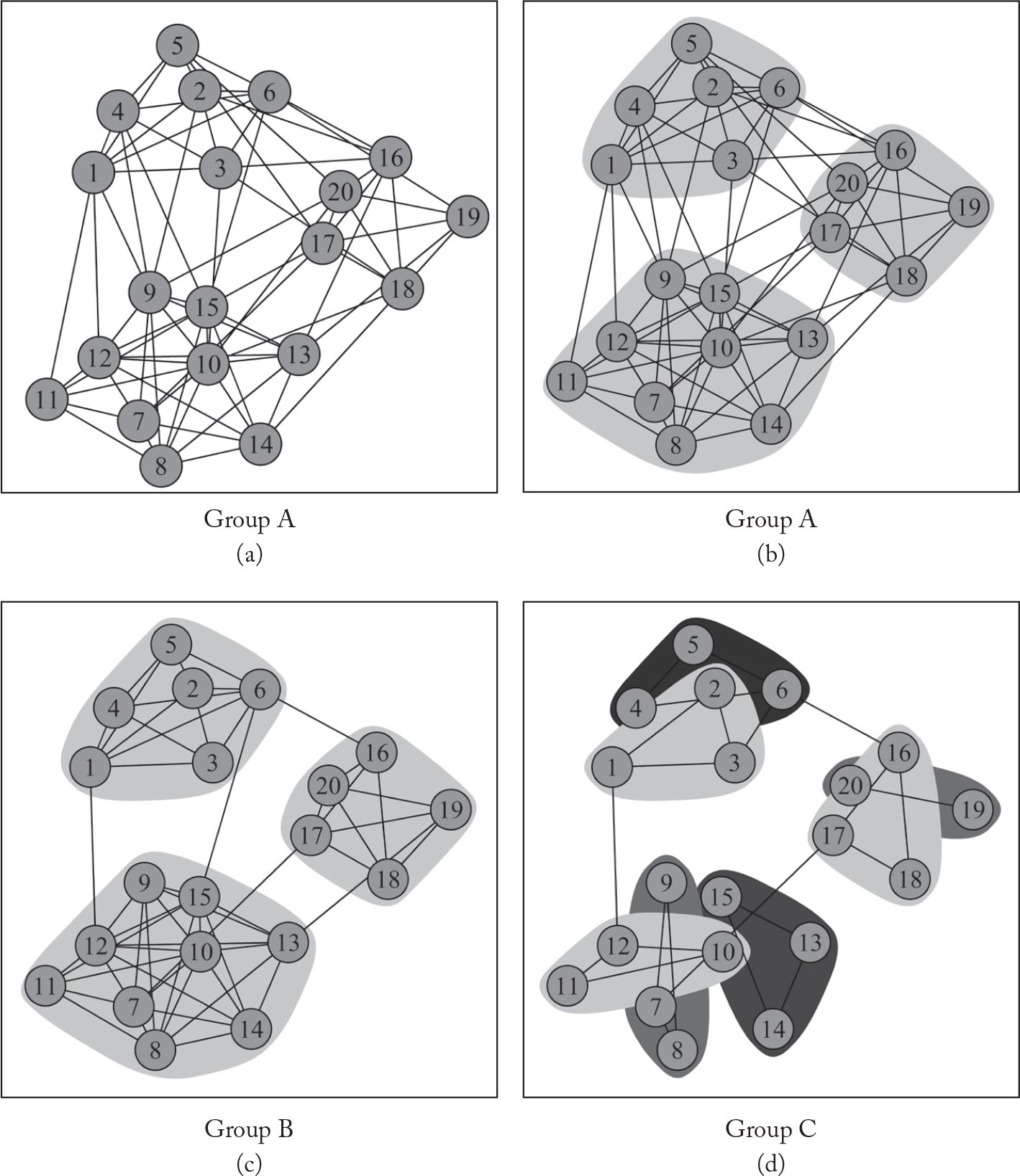
Figure 1 presents schematic social networks of three ethnic groups, A, B, and C, each comprising twenty households. The spatial locations of these households are kept constant across the subfigures to facilitate easy comparison. Panels (a) and (b) are structurally identical and represent the same ethnic group A, except that (b) identifies three distinct subethnic groups, or modules, within the network, characterized by “densely connected groups of vertices [households], with only sparser connections between groups.”Footnote 38 These subethnic groups could be tribes, villages, or clans. The three subethnic groups composing group B are identical to those of group A; they have the same internal connectivity measured in terms of the density of ties between constituent households. But while the bridges across the constituent parts are wider in group A and the group is structurally well connected, they are significantly narrower in group B and heavily dependent on a few ties to maintain connectivity across the modules, as shown in panel (c). For example, in group B, the module comprising households 1 through 6 is connected to the module comprising households 16 through 20 only by the tie between households 6 and 16. Seven such ties (2–16, 3–16, 6–16, 5–17, 3–18, 6–19, 5–20) are present in group A. By comparison, group C is significantly fragmented, with smaller modules and fewer ties bridging them, as shown in panel (d).
Social Networks of Ethnic Groups

When compared to groups B and C, the high structural connectivity of group A implies a higher degree of reinforcement and reassurance, which should facilitate insurgent mobilization.Footnote 39 High structural connectivity enables rapid diffusion of preferences across group A. The wide bridges across the subgroups in group A help to amplify the message and lend it the credibility necessary for high-risk mobilization.
They also make the group better able to enforce compliance and to ensure support and protection for coethnic rebels. Notably, the few actors ensuring connections across the subgroups in group B could act as gatekeepers to prevent the spread of mobilization. Such an action would be challenging for group A because it requires coordination among a larger number of actors. The options before rebel entrepreneurs seeking to mobilize group B are to either rely on narrow bridges across subgroups or to bypass these bridges and to mobilize the population directly. Either way, the mobilization of group B is more challenging and more costly than for group A. Group C presents the most challenging structure for the insurgents to mobilize because wide bridges are almost absent beyond small cliques represented by the seven insular modules highlighted in shades of gray. A lack of bridges usually implies heterogeneity of preferences across subgroups, which should render insurgent mobilization difficult and costly. Being surrounded by diverse actors increases uncertainty and ambivalence,Footnote 40 which is not conducive for rebellion.
The argument advanced in this section gives rise to two important predictions. First, we should expect ethnic groups with high structural connectivity to be more conducive to insurgent mobilization (hypothesis 1). Second, we should also expect the subethnic communities within an ethnic group that are better integrated with the larger ethnic group to be more responsive to insurgent mobilization, all else being equal (hypothesis 2). The people in such communities experience the reinforcement and reassurances necessary for participation in high-risk activities.
In agrarian economies that have not yet experienced sufficient industrialization and market penetration to affect social structure, I trace the existence of wide bridges in the network of social relations constituting an ethnic group, and its structural connectivity, to religion.Footnote 41 Religious sects and denominations, influenced by their worldviews and doctrine, are accompanied by distinct institutions and practices that impart particular characteristics to the social structures of ethnic groups.Footnote 42 Institutions and practices associated with traditional religions, such as animism and nature worship, are largely confined to a narrow segment of the population, for example, clan, village, or group of villages, which is not conducive to mass mobilization.Footnote 43 Unlike traditional religions, the effect of mass or world religions, both Western and non-Western, on structural connectivity varies significantly. They generally help to differentiate ethnic groups from each other, but their effect on internal differences across subethnic communities varies.
Some religious interventions result in new institutions and organizations that span an ethnic group.Footnote 44 These institutions provide for greater coordination of messages, liturgy, activities, and practices across the population. In the process, they facilitate wide bridges accompanied by regular and frequent interactions between different segments of the population, as in the case of group A. The bridged communities are characterized by a number of commonly shared attributes, including language, traditions, cultural practices and values, and worldview, which manifest in the homogeneity of preferences. Other interventions function in a more decentralized manner, allowing greater independence for individuals and groups within the population. In cases in which the new faith places a higher emphasis on personal experience and salvation, the emergence of expansive institutions and organizations may not be observed, as in the case of group C. Where autonomy is extended to local communities and groups, new institutions and organizations may not extend beyond the local segments of the population, as in group B.
Empirical Analysis
Scope Boundary: Ethnic Insurgencies in Zomia, Northeast India
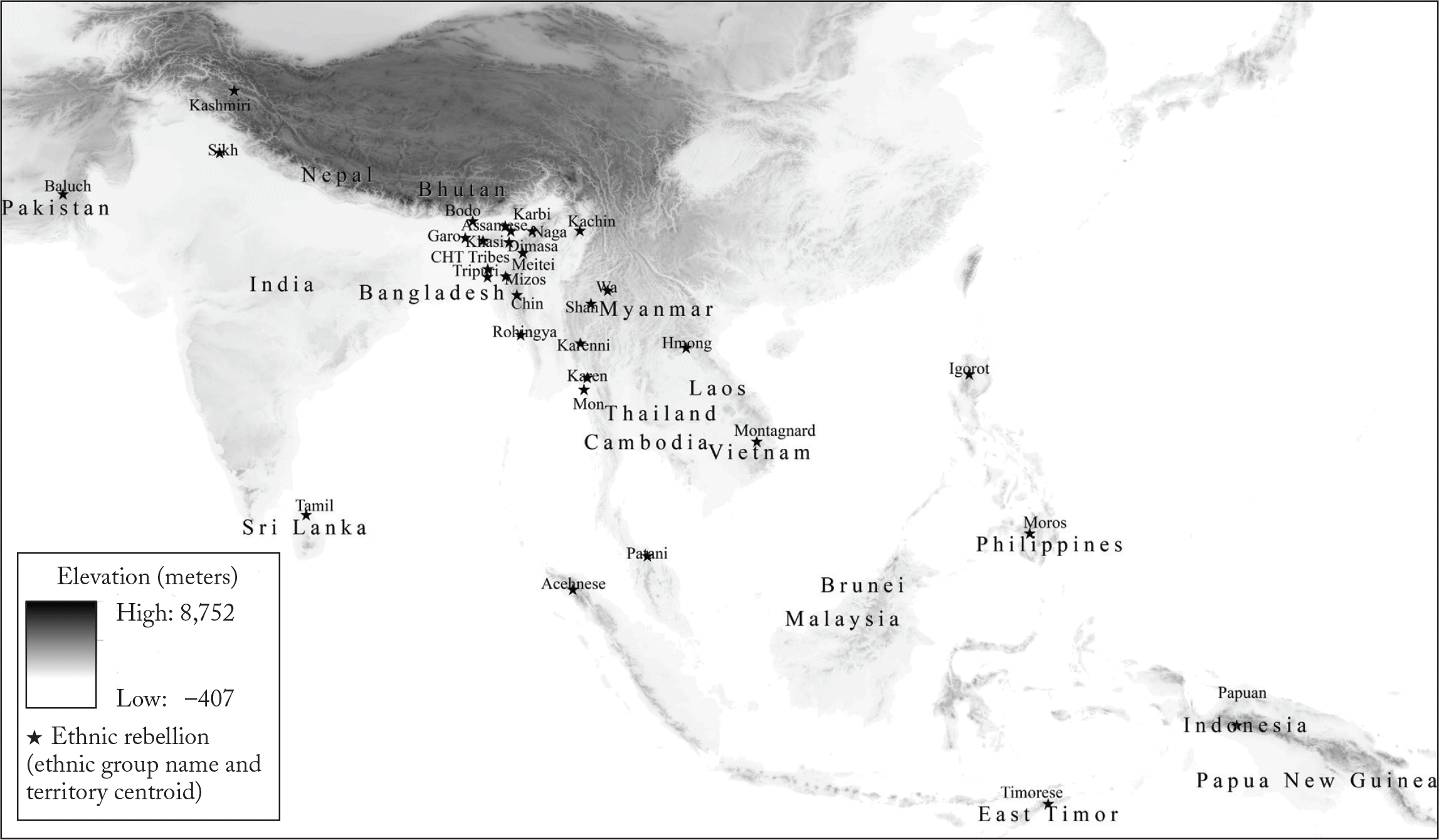
The context for my research is ethnic rebellions in Northeast India. Of the twelve ethnic rebellions that India experienced postindependence, ten have been in this region.Footnote 45 The region, inhabited by India’s adivasi (indigenous groups), forms part of a vast stretch of land known as Zomia, which extends across Southeast Asia and has endured numerous protracted ethnic insurgencies since 1945 (Figure 2).Footnote 46 These sons-of-the-soil insurgencies, which involve geographically concentrated ethnic minorities challenging more powerful states, remain underrepresented in the existing scholarship, especially in ethnographic research, even though they constitute a sizable proportion of civil wars and tend to last longer.Footnote 47 The ethnic groups of Zomia are similarly situated with respect to the state of which they are a part, but they stand out agroecologically, culturally, linguistically, socioeconomically, and ethnohistorically within their country. Similarities across these cases become more pronounced for those located within a region of a country, such as Northeast India.
Ethnic Minority Rebellions in South and Southeast Asia since 1945

James Scott has persuasively argued that the inhabitants of Zomia constitute “runaways” who have escaped the state.Footnote 48 But the past two hundred years have been marked by their progressive, often forced, assimilation into their larger neighboring states. Historically, Northeast India had little interaction with the rest of the country.Footnote 49 The expansion of British colonial possessions into neighboring India and Burma during the nineteenth century led to conquest, even though the territory was largely seen as financially unrewarding.Footnote 50 There was pressure from the home government to minimize expenses on the frontier.Footnote 51 The inhabitants of the region did not present an existential threat to British rule, but because they were causing a significant loss of British and native lives, they were more than mere nuisance.Footnote 52 The British sought to minimize the cost of administration by implementing indirect rule and relying on “the missionary of the cross” to “pacify” indigenous groups.Footnote 53
If we exclude military coups, these civil wars, also referred to as peripheral civil wars, constitute nearly half of civil war cases since 1946; Sarbahi Reference Sarbahi2014. These conflicts are still underrepresented in the existing civil war data sets either due to their low intensity or to underreporting about these cases. Frequently, they drop out of the data set prematurely while the armed conflict is still ongoing. For instance, the Mizo case is coded as an armed conflict only for three years, 1966–1968, in the UCDP/ PRIO (Uppsala Conflict Data Program/Peace Research Institute Oslo) Armed Conflict Dataset even though the conflict lasted for more than two decades. See Gleditsch et al. Reference Gleditsch, Wallensteen, Eriksson, Sollenberg and Strand2002.
Although recent studies on political violence in South Asia examine the long-term effects of colonial political institutions, the role of religious interventions has received little attention.Footnote 54 Importantly, while colonial political institutions were similar across ethnic groups and involved indirect rule, the nature of religious intervention varied because the region was exposed to different religious traditions.Footnote 55 The British curbed competition among missions by giving them exclusive jurisdiction over specific areas.Footnote 56 The foreign missions also avoided competition to ensure “mutual benefits and economics of scale.”Footnote 57 The absence of competition among missions in the region, unlike what Guillermo Trejo observed in post–Vatican II Mexico, enabled them to leave distinctive marks on ethnic societies.Footnote 58
Sons-of-the-soil insurgencies have some particular characteristics. The low intensity of these conflicts may make social structure more influential because social networks are usually frayed by high intensity. But we should expect the behavior of coethnics to be affected by the group’s preconflict social structure, that is, current behavior should reflect past interactions. In other words, it will be easier to mobilize members of group A than those of groups B and C, ceteris paribus. The role of religion in determining social structure may change as societies transition out of subsistence agriculture and their interactions with out-groups increase. A decline in the salience of religion, at least in shaping social ties if not beliefs, or increased religious competition may engender changes in social structure.Footnote 59 Moreover, as an ethnic group becomes geographically dispersed, the social structure may become more complex and analytically less tractable. Yet such changes do not undermine the role of structural connectivity and wide bridges in determining high-risk activities. Notably, my argument is probabilistic and acknowledges that individuals within the same insurgency could be recruited through multiple mechanisms.Footnote 60
Organized Religion, Sociostructural Changes, and the Mizo Insurgency
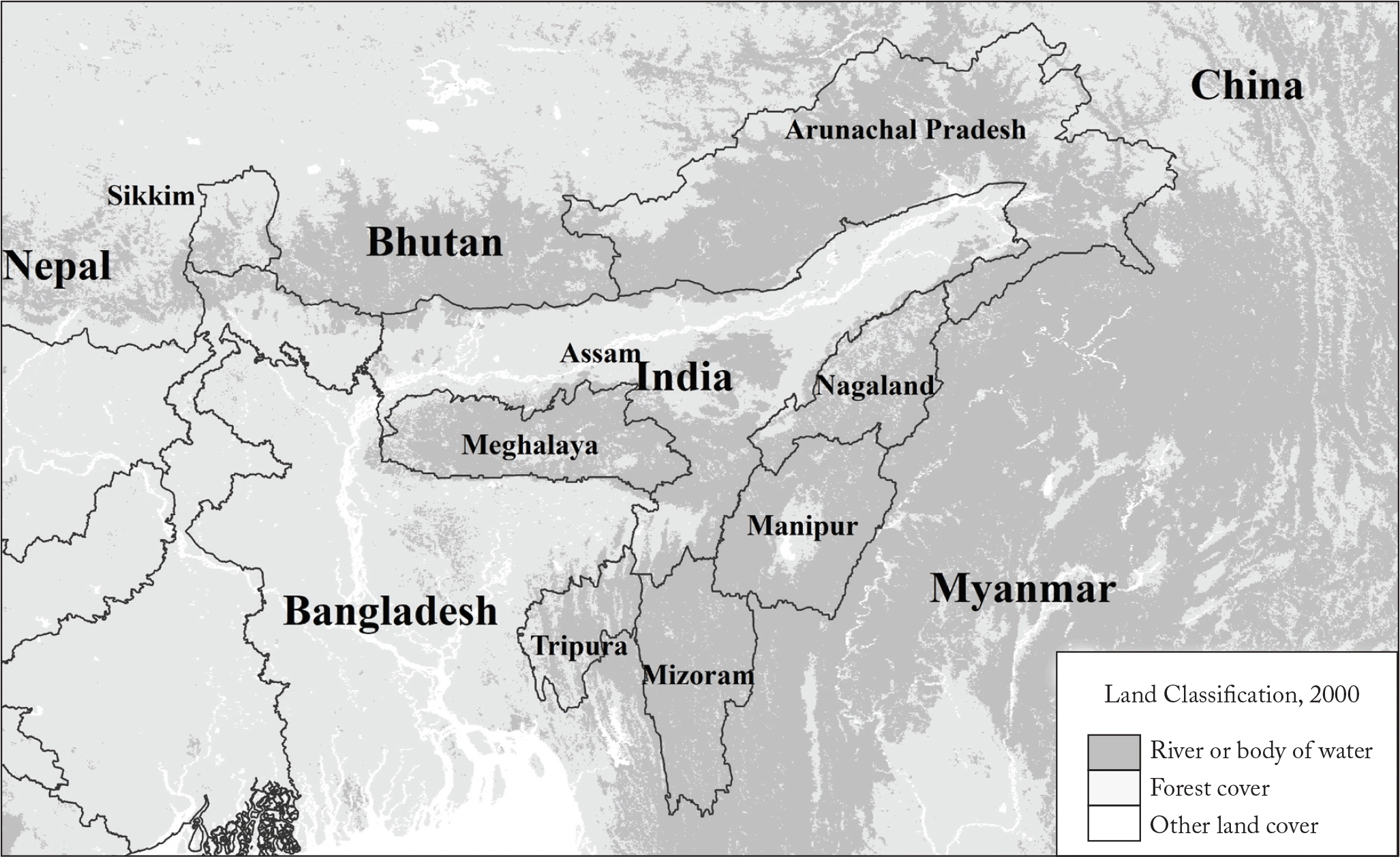
Mizos inhabit the Indian state of Mizoram, which borders Bangladesh and Myanmar (Figure 3).Footnote 61 The state has a population of around 1.1 million and an area roughly the size of New Jersey. Perched in an inhospitable and unenviable terrain, the Mizos had been largely independent of external control until the late nineteenth century.Footnote 62 The British established direct control over the territory to ensure protection for their more lucrative assets, especially tea plantations, along and occasionally in Mizo-inhabited areas.Footnote 63 The colonial policy, driven by the desire to maintain security with minimal investment, involved relying on Christian missionaries to “civilize” and “pacify” the native population.Footnote 64
Northeast India: States, Neighboring Countries, and Land Cover
Source: Global Land Survey (Tucker, Grant, and Dykstra Reference Tucker, Grant and Dykstra2004).

Christian missionaries began working in the territory in 1893, and by the second quarter of the twentieth century, almost half of the Mizo population had accepted Christianity.The arrival of Christianity marked the culmination of bitter intragroup rivalries that were frequently occasioned by headhunting.Footnote 65 The Mizo clans were scattered across the territory in communities “as numerous in dialect and designation as the villages in which they live, owning no central authority.”Footnote 66 The territory fell under the influence of the Welsh Presbyterian Mission.Footnote 67 The Welsh missionaries brought with them their distinctive religious institutions, which gradually restructured Mizo society by eroding village(khua) and clan- (chi) based divisions. The new faith strengthened ties within these subethnic communities and forged wide bridges, rooted in a common faith and worldview, between them.Footnote 68
The spread of Christianity helped to connect subethnic communities as missionaries began to traverse the territory frequently. The role of native leaders—preachers, teachers, deacons, and kraws sipais (soldiers of the cross)—educated and trained by the mission was particularly in-fluential and they served as bridges across communities dispersed over a mountainous and densely forested territory with nonexistent roads.Footnote 69 This process was accompanied and furthered by the spread of a common language. Early missionaries gave only one of the many local dialects—Lushei (or Duhlian)—writing, translated key portions of the Bible in it, and began providing education, including reading and writing, to the natives.Footnote 70
As the Christian population increased, the bridges across subethnic communities were institutionalized by a well-integrated and centralized body of churches, including village-level churches, and church districts and presbyteries, with the Mizoram Presbyterian Church Synod at the center. These churches were staffed by a permanent cadre of pastors and other personnel. The institutional practice of transferring pastors and church officials every few years and close coordination on church-related activities helped to sustain interactions across communities. In 1935, the mission helped to establish the Young Mizo Associ-ation (yma), a social organization, to leverage the power of youth in the service of the church and to “uphold Christian practices and virtues.”Footnote 71 The yma was organized in the image of the Presbyterian church, with a well-integrated network of branches, sub-headquarters, and headquarters. The organization provided another layer of connection between Mizo villages and clans.
The precolonial Mizo villages were probably already internally well connected, given their small size, which facilitated physical proximity among constituent households and a relatively homogeneous population.Footnote 72 But the spread of Christianity changed the existing social structure by undermining the hierarchy, strengthening social ties, and bolstering shared beliefs and way of life.Footnote 73 The mission attacked traditional institutions, such as as the zawlbuk (bachelors’ quarters) and bawi (obligatory labor), which were sources of power for native chiefs.Footnote 74 The centrality of the Mizo chiefs in the network of social relations was undercut and gradually replaced by churches that placed an emphasis on the community of believers without a social hierarchy. Mizo society is largely devoid of the social stratification rooted in wealth, birth, education, and occupation that is so visible in other parts of India. During my fieldwork, I witnessed a high level of trust in the way people, regardless of their socioeconomic stature, responded to and welcomed coethnic strangers “loitering” through their villages and knocking on their doors.
The new faith also served to strengthen ties within villages. The growth and endurance of Christianity was deemed as contingent upon a transformation of Mizo society and weaning Mizos from their old animist ways.Footnote 75 Consistent with this vision, the Mizo church began to govern every aspect of people’s day-to-day lives, from personal hygiene and dietary habits to birth, marriage, and death ceremonies. The mission viewed a strong community as critical to preventing backsliding and to ensuring that people adhere to new norms of behavior. Consequently, the social practice of meeting multiple times a week was institutionalized through church-related activities. Even today, much of daily life revolves around church-related activities, and there is strong societal pressure on individuals to follow the established norms.Footnote 76 The day starts with the church bell at six o’clock for the daily prayer meeting. In addition, there’s the Sunday service and people meet four times a week for evening services. To inculcate a unified belief system and worldview, preaching and sermons are coordinated across the churches.
The Mizo Insurgency
By the middle of the twentieth century, the Mizo population resembled group A. The Mizos were structurally integrated and therefore more conducive for insurgent mobilization. As Mizos began to debate their political future, their high structural connectivity, rooted in a common faith, manifested in a strong sense of community and shared ethnic identity.Footnote 77 Unlike in the precolonial era, the out-group was not constituted by the neighboring villages or clans, but by non-Mizos.Footnote 78 A significant section of the postcolonial political elite was not reconciled to the integration of their territory with India for fear of being dominated by vais (outsiders). The famine, or mautam, of 1959 and the poor re-sponse to it by the state triggered the formation of the proindependence mnf. It began mobilizing public opinion, resources, and recruits, and on February 28, 1966, launched a rebellion that lasted for two decades, ending with a peace settlement in 1986.
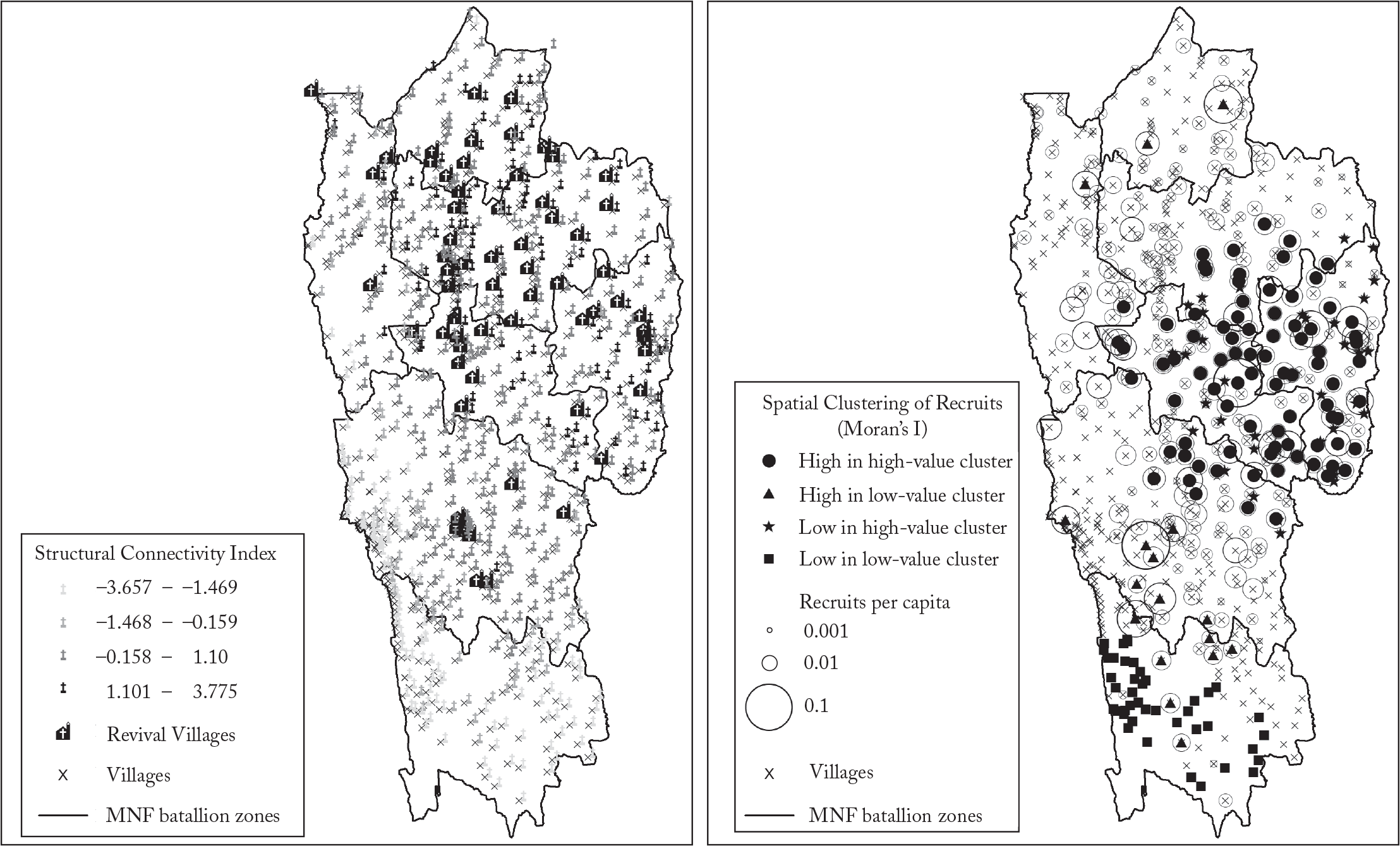
The mnf succeeded in mobilizing a wide segment of the Mizo population, which even its opponents acknowledge. For instance, a nonagenarian Mizo elder, who was highly critical of mnf founder Laldenga, and advised him against any misadventure, contended that the support for the mnf in villages was very high and that most of the youth were mnf volunteers.Footnote 79 mnf recruitment data suggest that mnf mobilization varied significantly across the territory (Figure 4).Footnote 80 Although the immediate trigger for the insurgent mobilization was a famine, Figure 4 suggests that recruitment was higher in areas not affected by the famine. Interestingly, the areas of higher recruitment appear to correlate with the areas of Christian revival that led to the rapid expansion of Christianity during the first quarter of the twentieth century, suggest-ing support for my argument.Footnote 81 I investigate this relationship in the next subsection, relying on village-level data.
Spatial Distribution Of Structural Connectivity, MNF Recruits, and Melocanna Baccifera

Research Design and Data
The core of my empirical approach involves regression analysis employing rare village-level data on rebel recruitment. I examine how villagelevel variation in structural connectivity affects insurgent mobilization (hypothesis 2). My expectation is that villages that are structurally well connected by religion-based wide bridges within the Mizo society will be more conducive to insurgent mobilization. This analysis is conducted across 689 census villages based on the 1961 Census of India, the last census before the launch of the insurgency in 1966.Footnote 82 I also leverage information collected during the course of my fieldwork in the region between 2009 and 2016 in support of my argument, including the causal mechanism. This research includes semistructured interviews with seventy-seven ex-insurgents from across fifteen community development (cd) blocks, or subdistricts, covering all eight districts of Mizoram between June 2014 and July 2016. In addition, I present ethnographic evidence from the neighboring Naga and Meitei insurgencies in support of hypothesis 1 that insurgent mobilization is constrained by the structural connectivity of an ethnic group.
Dependent Variable: MNF Rebel Recruitment
My dependent variable, a measure of insurgent mobilization, is the number of mnf recruits per unit village population. The mnf established an organization that was designed for the long-term objective of transitioning into a ruling party. It was meticulous about maintaining its internal records on a wide range of matters including parliamentary deliberations, finances, military and intelligence operations, personnel, and administrative decisions. The recruitment records were systematically compiled over the course of the mnf’s existence.Footnote 83
The absence of reliable data on participants explains a general lack of attention to mobilization and recruitment in recent quantitative studies of political violence.Footnote 84 Even for ethnographers who spend a sizable amount of time in dangerous and inhospitable environments, getting a reliable sense of rebel recruitment is challenging. Incumbents and insurgents are invariably unwilling to share such information.Footnote 85 This gap makes the mnf data remarkable. They enable me to avoid a serious pitfall faced by studies that rely on subsets of participants, such as demobilized, arrested, and deceased insurgents.Footnote 86 Although these works provide valuable insight into recruitment and mobilization processes, the findings could be biased because of the absence of information on rebels lost to attrition.Footnote 87
The mnf collected badge number, name, father’s name, native place, date of recruitment, education, rank, battalion, and date and manner of exit, but the organization redacted identifying information—name and father’s name—from the records. The mnf recruited 2,356 rebel soldiers, including 1,940 ordinary recruits and 416 so-called commis-sioned officers, until the end of 1969.Footnote 88 This period coincided with the most intense phase of warfare.Footnote 89 Information about the native place, date of recruitment, and the rank is the most complete. The recruitment date of a large number of the recruits is listed as January 1, 1967, when the Mizo National Army (MNA) was officially inaugurated.Footnote 90
Of the 2,356 recruits, I was able to identify the native place of 2,091 of them. Although this information is not available for 161 recruits, the native place of thirty-seven other rebels could not be positively identified.Footnote 91 Sixty-seven recruits were from the ethnic Mizo-inhabited areas adjacent to the Mizo Hills: Myanmar and the neighboring Indian states. The mnf records provide the educational background of only 685 recruits. The mean number of school years completed by this cohort is 6.55 (median is 6). The average age of a recruit at the time of joining, based on 590 observations for which it is available, is approximately 20.5 years. The youngest recruit was 15.5 years old and the oldest was 47.5, with the median age being 19.4. Of the 2,356 recruits, eventually 552 surrendered, 375 died, 159 were arrested, 136 deserted, and 44 were injured.
The MNA comprised seven regionally based battalions: Chawngbawla (CH), Khuangchera (K), Lamlira (L), Saizahawla (S), Taitesena (T), Vanapa (V), and Zampuimanga (Z). These were grouped into two brigades—the Dagger Brigade (K, T, and Z) and the Lion Brigade (CH, L, S, and V)—operating in the south and north of the territory, respectively. The geographical boundaries of the battalion areas and the spatial distribution of the dependent variable—recruits per unit village population—are displayed in Figure 4. Luc Anselin Local Moran’s I statistics indicate the existence of clusters of high values (circles) of recruits per unit population in the mid-north and east.Footnote 92 Similarly, clus-ters of low values of the dependent variables are located in the south (squares).
Explanatory Variable: Measures of Structural Connectivity
I use village-level membership in the yma normalized by village population as the primary measure of structural connectivity among the Mizos. The yma has played a predominant role in the social life of Mizos since its foundation and works in close association with the church.Footnote 93 It was established to provide community to Christians and to help uphold Christian values and practices to prevent reversion to traditional religion.Footnote 94 The yma preceded the earliest political organization in the territory by more than a decade and did not emerge in response to interethnic (Mizo–non-Mizo) interactions. The earliest village-level yma membership data compiled by the organization is for 1965. These data are the best available measure of the width of bridges across Mizo villages. The larger the proportion of a village population in the yma, the wider the bridge of social ties connecting the village to the larger Mizo community. I test the sensitivity of the results to a binary version of this variable, which marks the presence of a yma branch in a village.
I employ three other measures of structural connectivity for robustness tests. The first measure is a binary variable identifying whether a village has a church and a yma branch, which in essence captures the width of ties across villages. The highly integrated organization of Mizo churches implies that village communities with churches are structurally better connected than others. The church location data is from the annual reports of the Mizo churches for 1957.Footnote 95 I also test the effect of the presence of church separately. The second measure is the distance to the nearest revival village. These villages were centers of intensified religious activity during the first quarter of the twentieth century and spurred the expansion of Christianity.Footnote 96 They were hot spots of socio-religious mobilization in the region and emerged as influential nodes— with especially dense connections to the neighboring villages—in the network of social relationships within the territory. I expect recruitment to decline with distance from revival villages. The list of revival villages is from Reverend Lalsawma’s work on revival in Mizoram.Footnote 97 The last measure is an index of structural connectivity, which is constructed using principal component analysis of three variables: yma membership, church presence, and distance to the nearest revival village.
Key Alternative Explanations and Controls
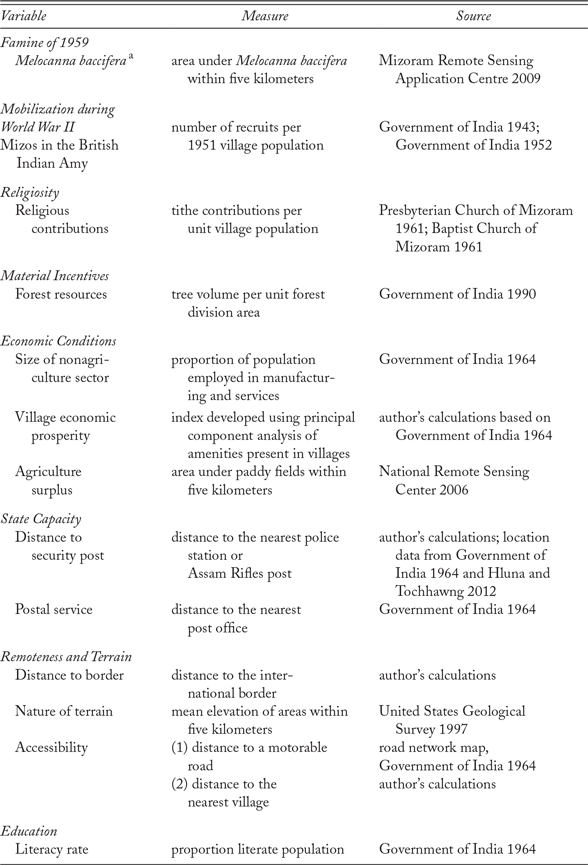
I test my argument against a range of explanations and present them in Table 1.Footnote 98 These include two factors frequently associated with the Mizo insurgency: the 1959 famine and World War II. The famine was triggered by the mass flowering of the bamboo Melocanna baccifera, which caused the rat population to explode and then to feed on crops and graneries. The subsequent famine led to the formation of the mnf.Footnote 99 I therefore use the distribution of Melocanna baccifera as a measure of the impact of famine in Mizoram.Footnote 100
Description of Control Variables

a The famine was triggered by the flowering of this species of bamboo. See section A-2 in the supplementary material; Sarbahi 2020b.
Some scholars attribute ethnic insurgencies in the region to the militarization associated with World War II.Footnote 101 The prospect of a Japanese invasion of India via Burma led to a larger involvement of locals in the British war effort.Footnote 102 There were close to three thousand Mizos enlisted in the British Indian Army during the war and some of the key leaders of the mnf, including two founding members, Laldenga and Manliana, were veterans of the Second World War. I use village-level archival data on World War II recruits in the British Indian Army to test the effect of the war.
Regression Analysis
My identification approach involves the use of the method suggested by Joseph Altonji, Todd Elder, and Christopher Taber to alleviate concerns about the influence of unobservable factors.Footnote 103 I also use subdistrict fixed effects for the twenty-nine cd blocks to control for unobserved heterogeneity. The cd blocks, called circles during the British era, are clusters of villages. They are the administrative units immediately above villages and constitute microunits for socioeconomic planning.Footnote 104 The list of controls is extensive, but not exhaustive. The region did not have a written language until the late nineteenth century. My substantial fieldwork and archival research in the region did not always yield the desired village-level measures. It is not possible to control for historical factors like internecine warfare among neighboring villages and chieftains. The inclusion of block fixed effects should alleviate some of the concerns. I also examine the sensitivity of my findings to a range of measures of structural connectivity.
Because the dependent variable is bounded between 0 and 1, use of the ordinary least square (ols) regression is not advisable. First, we expect the conditional expectation of the dependent variable to have a nonlinear distribution. Second, we expect heteroskedasticity because the variance for the observations close to the extremities is likely to be different from the rest of the population and approach zero. Moreover, the predicted values from OLS estimates may not fall within the bounds. I use the fractional regression model proposed by Leslie Papke and Jeffrey Wooldridge.Footnote 105 The model is a generalized linear model (glm) with a logit link function, and the distribution of Y is binomial.Footnote 106 I use a spatial lag of the dependent variable to account for the spatial autocorrelation. This is the mean value of the dependent variable for the villages within a six-kilometer radius from a given village.Footnote 107 The GLM model takes the following form:
 $$E({Y_i}|{X_1}) = {\mu _i},{Y_i} ~ Binomial,$$
where µi is the expectation of the dependent variable, Yi, given the vec-tor of explanatory variables, Xi, for village i. Equation (1) is estimated using a logit model:
 $${\mu _i} = 1/(1\, + \,\exp ( - {\eta _i})),$$
where ηi is the linear function of regressors:
 $${\eta _i} = {\alpha _i} + \rho {\Sigma _{j \ne i}}{w_{ij}}{Y_i} + \beta {X_i},$$
where ρ is the spatial autoregressive coefficient, which measures the general strength of spatial dependence, w ij is an element of the spatial weight matrix reflecting the degree of connection between two villages i and j, coded one for villages falling within six kilometers and zero for others; Y j is the measure of rebel recruitment for the neighboring village j; and ai are unobserved block fixed effects.
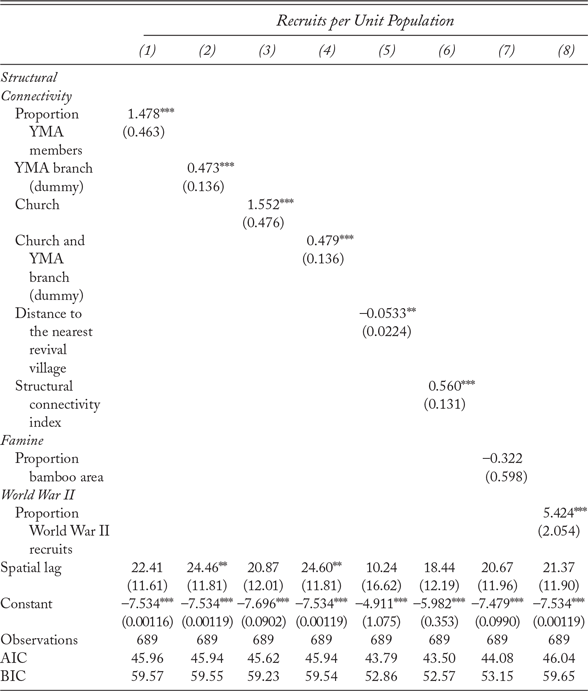
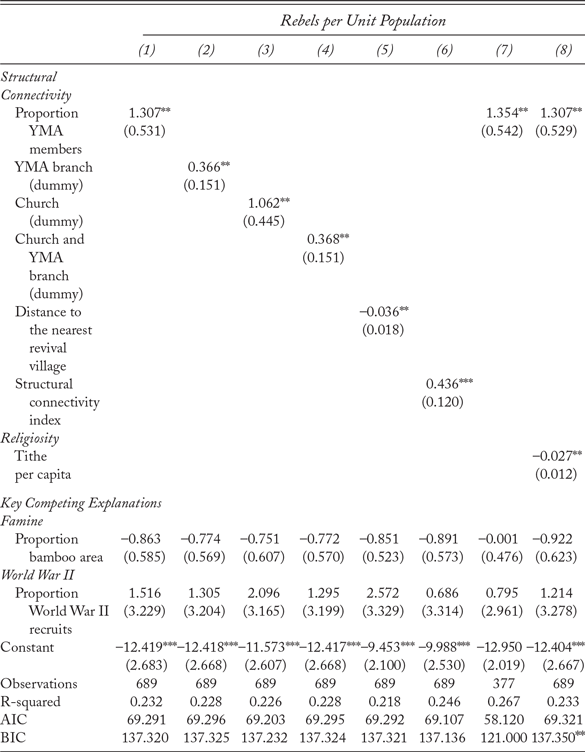
The bivariate estimates of key variables presented in Table 2 are con-sistent with hypothesis 2.Footnote 108 All of the measures of structural connectivity have the expected signs and are statistically significant. These findings hold in the multivariate regressions presented in Table 3.Footnote 109 The main findings are presented in Table 3, model 1. The results provide strong support for hypothesis 2 and are robust to a range of additional controls and specifications.Footnote 110 The Mizo villages that are structurally well connected by means of wide religion-based bridging ties contribute more recruits to the insurgent army than those that are not. The coefficient of membership in the yma is positive and statistically significant. The two explanations frequently associated with the Mizo insurgency—the famine of 1959 and World War II—did not affect recruitment. The results also demonstrate that education, material incentives, accessibility, and state capacity had no effect on recruitment.
Regression Estimates of Rebel Recruitment: Bivariate Estimatesa

** p < 0.05, *** p < 0.01; robust standard errors in parentheses, clustered at administrative block level (subdistrict or level 4)
a All estimates include administrative block fixed effects and a spatial lag of the dependent variable. Distance in kilometers.
Regression Estimates of Rebel RecruitmentFootnote a

** p < 0.05, *** p < 0.01; robust standard errors in parentheses, clustered at administrative block level (subdistrict or level 4)
a All estimates include administrative block fixed effects and a spatial lag of the dependent variable. Distance in kilometers.
b Sample is restricted to the villages located in the erstwhile North Lushai Hills subdivision of the territory.
Substantively, the effect of structural connectivity on recruitment is large. An increase in yma membership from its 25th percentile to the 95th percentile increases rebel recruitment by more than 46 percent— from fifty-four recruits per ten thousand population to seventy-nine recruits per ten thousand. Notably, the findings are robust to alternative measures of structural connectivity: the presence of both a church and a yma branch, the distance to a revival village, and structural connectivity index (Table 3, models 2–6). Recruitment is positively associated with villages with both a yma branch and a church, and with the structural connectivity index. Recruitment declines with distance from revival villages. The results are unchanged with the presence of a church as a measure of structural connectivity (model 3). The effect of structural connectivity improves if the sample is restricted to the erstwhile North Lushai Hills subdivision, where the Welsh Presbyterian Mission was first established and which was its core area of influence (model7).Footnote 111 These findings strongly suggest that the sociostructural changes brought about by the spread of Christianity under the Welsh Presbyterian Mission had a direct effect on mnf mobilization.
Some scholars, including Robert Woodberry and Tomila Lankina and Lullit Getachew, suggest that Christian missions can affect mobilization by engendering mass education and communication.Footnote 112 My find-ings do not support the human capital mechanism that links missions with mobilization. The estimate of literacy is positive but statistically insignificant. The contribution of the mission to literacy in Mizoram is undeniable, but the literacy rate significantly lagged behind the percentage of Christians in the population—44 percent of the population
was literate and 87 percent was Christian in 1961.Footnote 113 Eighty-three percent of the literate Mizos had no formal education, and a paltry 0.41 percent went beyond tenth grade.Footnote 114 The mnf records provide the educational background of only about one-third of the recruits. It would be reasonable to assume that the rest of the recruits were not literate because education determined an individual’s rank and responsibilities in the MNA.Footnote 115 It is no surprise, therefore, that much of the mnf mobilization was through face-to-face contact or public meetings, as I discovered in my interviews. Christianity did facilitate greater communication across Mizo villages, but only partly as a result of education and common language. A major contribution came from the missioninduced structural changes, which preceded, and in turn promoted, education and common language.
A legitimate concern is that the mechanism linking rebel recruitment with the measures of structural connectivity is religiosity—that religious fervor, as opposed to structural connectivity, drove individuals to join the mnf. It is true that the mnf agenda was couched in religious terms. I use a crude proxy for religiosity: religious contributions or tithe per capita collected by a village church (Table 3, model 8). This measure suggests that village religiosity suppresses participation in the mnf, which is consistent with the role of the Mizo churches as facilitators of peace during the conflict. Notably, because I have included three measures of economic conditions that are not statistically significant, this measure does not capture only economic conditions. The robustness of findings to alternative measures of structural connectivity should also allay concerns that the findings simply reflect the role of associational ties. The underlying dimension shared by these measures and encapsulated by the structural connectivity index is that they constitute a network of reinforcement and reassurance across the Mizo villages.
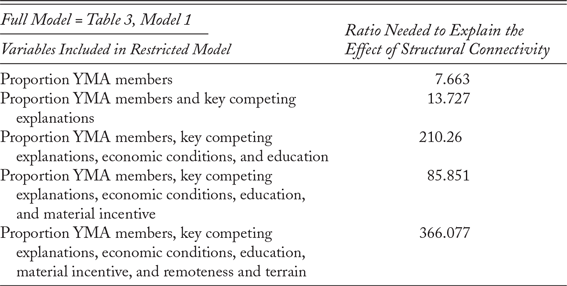
It is still possible that the results are driven by unobserved factors and that their inclusion may eliminate the effect of structural connectivity. I rely on the approach advanced by Altonji, Elder, and Taber to examine whether this is probably the case.Footnote 116 The routine entails estimating how large the influence of unobserved variables is relative to observed variables for the positive effect of structural connectivity on insurgent recruitment to hold. Table 4 presents the ratio of the effect of omitted variables relative to observed variables that would result in eliminating the effect of structural connectivity. The ratio values are very high and range between 7.7 and 366, which strongly indicates that the effect of structural connectivity cannot be explained by unobserved factors and that additional controls are highly unlikely to affect the coefficient.
Selection on Unobserved Variables Relative to Observed Variablesa

One concern is that the yma membership figures are from the year before the onset of rebellion and could be endogenous to the conflict. There are several reasons that undercut this possibility. First, the yma is a nonpartisan organization and has steadfastly avoided involvement in politics. The organization’s centrality in Mizoram derives from its strong nonpartisan credentials. It had no reason to shun that approach, especially since the mnf was divided over the issue of rebellion and the Mizo church was staunchly opposed to violence.Footnote 117
Second, the decision to expand the number of branches was centralized, slow, and made annually. I do not expect the number of branches to expand suddenly in response to political mobilization. The results do not change if I use a dummy for the presence of a yma branch in a village instead of yma membership per person.
Third, the decision to launch the insurgency was sudden and caught many by surprise. The adverse effects of conflict in terms of the destruction of lives, livelihood, freedom, and property were not apparent before the insurgency; hence, it is unlikely that people increased their participation in the yma in response to increased suffering.
Last, the estimates using alternative measures of structural connectivity, which capture the structure of the Mizo society at various points during the first half of the twentieth century, yield similar findings. It is unlikely that these measures are endogenous to the conflict process. The data on the location of churches is from the mid-1950s. Importantly, the Presbyterian church was always neutral, was steadfast in its opposition to violence, launched a powerful peace initiative soon after the outbreak of violence, and played a central role in the settlement. Additionally, the revival villages emerged decades before the formation of any political organization, including the mnf.
Evidence from Semistructured Interviews
Turning to individual-level data to further validate my argument, I conducted semistructured interviews in the native language, Lushei, with seventy-seven ex-insurgents from across fifteen cd blocks to understand the recruitment process.Footnote 118 The surviving ex-insurgents, given their small number, constitute a hard-to-reach population, so random sampling was not feasible. My sampling strategy aimed to (1) diversify the sample in the hope of making it more representative, and (2) interview a sizable number of ex-insurgents. I selected cd blocks to maximize the variation on both recruitment and structural connectivity and to include both highand low-value clusters. Within the selected blocks, I interviewed people in the block headquarters and then randomly selected a village from among the remaining villages. People were interviewed in the selected village and in villages along the way.Footnote 119 Once we were in a locality or village, we asked households from different parts of the village to prepare a list of former mnf members to interview. We purposefully avoided snowball sampling. Those we were able to interview included forty-three rural and thirty-four urban residents—including seven women.Footnote 120 None of the individuals that we connected with, either at their home or farm, declined to be interviewed.Footnote 121 We conducted interviews primarily during mornings and evenings when people were at home. The information presented is from interviews with people who joined the organization before 1969.
Recruits from central and eastern Mizoram, an area with high structural connectivity and recruitment, reported experiencing positive reinforcement and reassurance when they contemplated joining the mnf. An exinsurgent affirmed,“We knew them [mnf members] very well…. They came from neighboring villages. We had very close connections with them—Tlangsam, Zote, Ruantlang [villages], and the surrounding areas.”Footnote 122 People were open about discussing their interest in joining
the mnf with others, including their family and friends, who were generally supportive. The mnf moved freely through these areas and held public meetings. In the words of an ex-insurgent, “During those days, almost all of the youth were influenced by the movement. The mnf people used to come to my village. They were cheered and celebrated as heroes…. Once I made a decision [to join], I told my parents. My father was fully supportive, saying that unlike Indians I will be fighting my enemy on my own soil. My mother was reluctant and fearful, but she still offered a prayer for me.”Footnote 123 Exinsurgents recounted similar stories: their parents asked them to “follow the Word of God”124 or to “behave well as a soldier.”Footnote 125
Ex-insurgents frequently attributed their participation to shared collective enthusiasm for the movement—a political wave (thiltleh) or “movement’s spirit” pushing them toward rebellion. “Every youth wanted to support the mnf, but not everyone wanted to fight…. A few young men joined the mnf underground…. The rest remained overground and supported the group [mnf]. It was embarrassing for young men to not support the mnf…. I did not support the mnf wholeheartedly, but still joined [the group].”Footnote 126 A female ex-insurgent noted that “the movement was so strong that everyone—every boy and girl— wanted to join as a volunteer. I did not even think twice about it.”Footnote 127 The ex-insurgents from high structural–connectivity areas showed little fear of being compromised or targeted. “We were moving around freely. We were dressed simply yet people were able to identify us. We were treated as national workers not terrorists. This was a source of our strength and explains our survival. Ninety percent of the people were with us, even when the army entered their villages.”Footnote 128
The experiences of insurgents from low structural–connectivity clusters were different. They did not feel secure or supported and were subjected to contradictory pulls. One participant explained, “We didn’t discuss with anyone…. [We] didn’t want to reveal that we were volunteers to anybody including our family, friends and villagers.”Footnote 129 MZ024 declined to answer whether his villagers supported him, but quickly added, “Families were against it…. We escaped to join against their wishes.”Footnote 130 Another participant complained that he was harassed by his villagers. “I didn’t get any support from my villagers. When I was underground I never stayed in my native village…. If any crime occurred in my village, I was quickly blamed for it.”Footnote 131 MZ062 bemoaned, “People did not understand the [mnf] movement…. It was not easy [to join the mnf].” He underscored the lack of communication and understanding across villages in low-structural-connectivity areas. “People [from neighboring villages] were afraid to visit Cheural and Lungtian because some of us were from these villages.”Footnote 132 This distrust was reflected in a more thorough vetting process for people interested in joining the mnf.Footnote 133 In response to my question about whether people were on their side, MZ043 quipped, “The Mizo army killed [a couple of ] informers and after that we did not have any problems.”Footnote 134 He stated that he feared of being victimized if he quit the mnf.
These interviews undermine the possibility that the yma acted as a forum for organizing rebellion. The yma members among the ex-insurgents were unanimous in their opinion that they never discussed the mnf agenda officially in the yma. But “informally,” politics was “always discussed among like-minded people.”Footnote 135 This response is not different from the answers of interviewees who mentioned discussing the movement in other settings—schools, jhums (agriculture fields), and churches. As a participant explained, “Of course we discussed politics and independence. Everybody discussed it openly whenever we met and could find time whether in church or in the yma. Male or female…. We even discussed in jhum. We would openly talk about independence.”Footnote 136 The yma and the Mizo churches provided trustworthy channels for the flow of information across communities. An ex-insurgent recounted how as a yma official on a trip to Aizawl, the state capital, he learned about the mnf agenda. On his return, he “tried to convince others and joined the underground [insurgency].”Footnote 137
The interviews further dispel the possibility that religiosity explains participation. Although ex-insurgents highlighted how their faith helped them to pull through a difficult phase, religion did not figure prominently in our discussions of their motivation to join the mnf. When asked about the motivation for joining the organization, an overwhelming majority of ex-insurgents (sixty-nine out of seventyseven) did not make any reference to religion. Most of them (forty-nine out of seventy-seven) focused on either Mizo nationalism or self-determination without any reference to religion. A subset of these interviewees was even given the option of choosing between six different explanations, including religion. Only two out of thirteen individuals chose religion.
Evidence from the Naga and Meitei Insurgencies
The absence of comparable recruitment data makes it impossible to conduct a similar analysis in other cases. I present evidence based on my ethnographic work among the Nagas in Nagaland and Meiteis in Manipur, in Northeast India (Figure 3) in support of hypothesis 1. The Nagas constitute a structurally segmented group, similar to group B in Figure 1, while the Meiteis represent a structurally fragmented group, like group C in Figure 1. They also illustrate the role of religion— Baptist Christianity among the Nagas and casteless Hinduism among the Meiteis—in shaping the structural connectivity of an ethnic group.
The Meitei insurgency also underscores that internal homogeneity without structural connectivity does not guarantee mobilization. The similarities across the three cases provide a controlled environment in which many of the contending explanations, including population size, economic circumstances, education, state capacity, access to coethnics across the border, agroclimatic conditions, presence of natural resources, and terrain, could be ruled out.
The Nagas were evangelized by the American Baptist Missionary Union. The Baptist emphasis on congregational autonomy and decentralized churches caused the Naga churches and polity to organize along subethnic identities. Gordon Pruett summarizes the relationship thus: “The Baptist polity meshes happily with Naga tribal polity…. Both polities are ‘congregational’ and solidly committed to the concept of local autonomy.”Footnote 138 The Baptists followed the tradition of connexionalism, or setting up associations of churches for “fellowship, encouragement and cooperative ministries,”Footnote 139 but these associations were also organized around subethnic divisions. The American Baptists also chose to evangelize in the dominant dialects of the targeted subethnic groups, so the linguistic homogenization that occurred among the Mizos did not take place among the Nagas. The resulting network of social relations in the Naga-inhabited areas was modular and characterized by segments embracing subethnic communities and sparse connections across subethnic groups (group B in Figure 1).
The segmented structure of the Nagas significantly constrained the mobilization undertaken by the Naga National Council (nnc). The NNC was forced to build the organization atop the prevalent tribal divisions and to rely on influential leaders within Naga tribes. The constituent units of the insurgent army were rooted in subethnic divisions and were invariably commanded by coethnic officers, and they controlled their own arms and ammunition. Moreover, the insurgent mobilization did not embrace all subethnic groups with the same vigor. The initial thrust of the mobilization for rebellion was in and around the territory inhabited by the Angamis, a Naga tribe. Mobilization subsequently spread to other subethnic groups, but the rebel network that emerged had denser links in some subethnic groups than in others. The groups that were the first to come under the influence of Christianity—Angami, Ao, Lotha, and Sema—exercised greater influence on the rebel organization.Footnote 140 Two large subethnic groups, the Konyaks and the Tangkhuls, mobilized later. These groups are critical players in the current phase of the insurgency. The Tangkhuls dominate the National Socialist Council of Nagalim, or nscn i-m, and the Konyaks lead the nscn k. The staggered mobilization and a subethnically constituted rebel organization provided the basis for the future fragmentation of the Naga movement.
The spread of Hinduism among the Meiteis in the eighteenth century was less intrusive. The new religion adapted to many of the preHinduism sociocultural practices among the Meiteis. As a result, the Meiteis developed their own peculiar caste system, which lacked the rigidity and hierarchy of the mainland version.Footnote 141 Nearly the entire population was assigned to the warrior (Kshatriya) caste, an upper caste that constitutes a small minority in the mainland. The new religion placed less emphasis on the significance of community and more on personal experience and salvation. Meitei society is organized on a “self-sufficient economic paradigm” in which the social structure, economic production, provision of basic amenities, such as water, and even the structure of houses, are geared to promote a self-sufficient and independent life.Footnote 142 Consequently, the Meiteis lack the societal groups and institutions that enhanced the structural connectivity among the Mizos and Nagas. Highly localized and smaller subethnic groups, which are based on clan or neighborhood ties, assume a greater significance among them.
The Meiteis have high social homogeneity yet low structural connectivity. Their social structure, which resembles group C in Figure 1, makes high-risk mass mobilization challenging. The Meitei insurgents failed to leverage widespread popular disenchantment with the merger of the territory with the Indian Union in 1948. The insurgents had to rely on close-knit kinship and friendship networks, typically rooted in the same neighborhood,Footnote 143 for recruits, which severely limited the scope of mobilization, since the social reinforcement and reassurance necessary for high-risk activities did not extend beyond these small, insular networks. As a former member of the United National Liberation Front, the oldest Meitei insurgent group, acknowledged, “We did try to mobilize. There was some groundwork [done]. We had a popular anti-merger agitation [opposition to the merger of Manipur with India]. In 1964, antimerger meant anti-India…. But we did not succeed.”Footnote 144
Evidence beyond Northeast India
There is suggestive evidence in support of my argument from other cases in Zomia, but they require closer examination. Mandy Sadan, for instance, contends that the network of Kachin Baptist churches provided the structure that undergirds Kachin ethnonationalism and the protracted insurgency in northwest Myanmar. She argues that the Jinghpaw-language churches emerged as “the main network by which broadly distributed, dislocated and displaced [Kachin] communities were able to retain a sense of communication with each other.”Footnote 145 Her work also suggests that the emergence of divisions within the movement centered around communities, such as those around Patao and the Triangle region, which were not touched by the colonial Baptist mission. The Karen insurgency followed a pattern very similar to that of the Nagas. The Karen ethnonationalist movement emerged from the Baptist conventions with the Sgaw Karen Baptists—the first and the largest segment of the Karen population to be evangelized—and assumed the lead role.Footnote 146 But the segmented nature of the ethnic group constrained mobilization and caused the movement to fragment.Footnote 147
Conclusion
Ethnic groups are widely considered to have a high potential for political mobilization, but ethnic rebels display significant differences in their ability to mobilize coethnics. In this article, I demonstrate that the structural connectivity of an ethnic group is a significant determinant of insurgent mobilization. I trace the structural connectivity of an ethnic group to the doctrine and practices associated with religion. Among myriad ethnic communities that experienced the advent of organized religion during the colonial period, the forms such religious interventions took are critically important to understanding postcolonial political mobilization. The emergence of a centralized network of churches and civil society organizations under the Welsh Presbyterian Mission among the Mizos helped to transform a geographically dispersed and isolated population into a socially integrated group with wide bridges across subethnic communities.
I leverage the variation in the expansion of Christianity across villages in Mizoram along with data on rebel recruitment to demonstrate that structural connectivity matters. Structural connectivity outperforms alternative explanations, including the famine of 1959 and the mobilization associated with World War II. These findings are robust to a wide range of specifications and controls and are not driven by omitted variables. Structural connectivity explains the variation in insurgent mobilization among socially homogeneous ethnic groups. Both the Mizos and Meiteis are remarkably homogeneous, but mobilization succeeded among the Mizos and failed among the Meiteis. The structure of the Meitei society forced insurgents to rely on kinship, friendship, and neighborhood ties, which hampered mobilization. The absence of wide bridging ties beyond subethnic tribes among the Nagas resulted in an insurgency marred by tribal divisions. Structural connectivity may also account for the fragmentation of insurgent movement among the Kachins and Karens.
Structural connectivity, at least prima facie, appears to be a strong predictor of the pattern of insurgent mobilization beyond Zomia. For instance, the failure of Ahmad Shah Massoud’s forces to extend their core support beyond the Panjshiri Tajiks in Afghanistan in the 1990s makes sense from this perspective.Footnote 148 A disproportionate representation of certain castes from among similarly situated castes in the 1971 Janatha Vimukthi Peramuna uprising in Sri Lanka can be reasonably interpreted as a result of the difference in their structural constitution.Footnote 149
But a conclusive claim would require additional research using finegrained data. Beyond mobilization, the overall trajectory of the ethnic insurgencies in Northeast India suggests a link between structural connectivity and conflict outcome. The structurally integrated Mizos concluded a durable peace settlement; the Meitei insurgents, operating among a structurally fragmented ethnic group, have shown little interest in peace; and the structurally segmented Nagas have secured two prolonged ceasefires but without a peace agreement.
My work highlights the synergy between colonial states and religious missions in shaping ethnic communities. In highlighting the role of religion, it shifts focus from the ideational dimension—beliefs, values, and worldviews—to the sociostructural dimension—social interactions, institutions, and associations. The role of religion in shaping social structure may vary across societies. As an agrarian, ethnic society transitions toward a higher level of market penetration and socioeconomic development, including increased interactions with out-groups, the structure of an ethnic society, as well as the role of religion in shaping it, may change. The Basque society, for instance, experienced similar changes as a result of industrialization and the resulting influx of immigrants toward the end of the nineteenth century.Footnote 150 These changes, which affected the structural connectivity of the Basque society and helped to forge denser ties and assimilation with the non-Basque population, were not conducive for insurgent mobilization in the midtwentieth century. This article illuminates pathways to several interesting and rewarding lines of inquiry—on religion, ethnicity, political mobilization, and conflict outcome—for further investigation in future research.
Supplementary Material
Supplementary material for this article can be found at https://doi.org/10.1017/S0043887120000222.
Data
Replication files for this article are embargoed until April 1, 2022. They can be found at https://doi.org/10.7910/DVN/13P4YD.
Acknowledgements
I am indebted to H. Ramhuapliana for his outstanding research assistance and unrelenting support over the course of my research in Mizoram. This work has benefited from helpful comments from Benjamin Bagozzi; Teri Caraway; Kathleen Collins; Christina Ewig; Lisa Hilbink; Patrick Johnston; Ore Koren; Ron Krebs; James Lo; Manus Midlarsky; and Jeremy Weinstein, as well as from participants in seminars and panels at the annual meetings of the American Political Science Association (2017); Indian Institute of Technology, Mumbai (2017); Manipur University, Imphal (2018); the Annual Conference on South Asia, University of Wisconsin–Madison (2018); B. R. Ambedkar University, New Delhi (2019); and the School of Advanced International Studies–Carnegie India Security Workshop (2020). I thank the anonymous reviewers and editors of World Politics for their thoughtful and constructive feedback and suggestions.
Funding
I am grateful for the financial support from the Grant-in-Aid (GIA) program at the University of Minnesota.
Author
Anoop Sarbahi is an assistant professor of political science at the University of Minnesota, Twin Cities. His research, which straddles the line between comparative politics and international relations, encompasses a diverse range of issues related to political violence and various phases of conflict trajectory. His current book project is “Anchoring Rebellion: Ethnicity, Religion, and Conflict Trajectory.” He can be reached at sarbahi@umn.edu.