How infants learn language and perceive speech is a fundamental question in human language research. At a primary level, infants must learn to identify the units of sound that comprise their language. In particular, they are required to learn which speech sounds signal changes in meaning (e.g., they must be able to distinguish b from t in order to differentiate ball from tall). The language-specific set of sound categories are referred to as the phonetic representation. Phonetic representations underlie learning of lexical items and the acquisition of word meanings necessary to establish a vocabulary. Despite the fundamental role phonetic representations play in language acquisition, there has been very little research on their development in a bilingual context.
The present work is concerned with the development of phonetic representations in infants being raised in a bilingual environment from birth.1
Throughout this paper, we will use the term “bilingual infants” to refer to infants who are being raised in a bilingual environment and “monolingual infants” to refer to infants who are being raised in a monolingual environment.
DEVELOPMENT OF SPEECH PERCEPTION IN MONOLINGUALS
Even very young infants display some initial organization of the acoustic–phonetic space. One- and 4-month-old infants discriminate along a voice onset time (VOT) continuum in a categorical manner, discriminating a change that crosses the English boundary, from 20 to 40 ms, but not changes of equal magnitude from −20 to 0 ms or from 60 to 80 ms (Eimas, Siqueland, Jusczyk, & Vigorito, 1971). This initial state appears to be language general; young infants discriminate categorical changes in VOT that do not denote meaning in the native language in such diverse language environments as English (Aslin, Pisoni, Hennessey, & Perey, 1981), Spanish (Lasky, Syrdal-Lasky, & Klein, 1975; Rivera-Gaxiola, Silva-Pereyra, & Kuhl, 2005) and Kikuyu (Streeter, 1976).
From this language-general starting point, monolingual perception has been shown to develop in accordance with the properties of the ambient language (Werker & Tees, 1992). Effects of experience are observed in vowel perception by 6 months of age (Kuhl, Williams, Lacerda, Stevens, & Lindblom, 1992; Polka & Werker, 1994) and in consonants by 10–12 months of age (Anderson, Morgan, & White, 2003; Best, McRoberts, LaFleur, & Silver-Isenstadt, 1995; Kuhl et al., 2006; Rivera-Gaxiola et al., 2005; Werker & Lalonde, 1988; Werker & Tees, 1984). One well-documented aspect of the functional reorganization underway (Werker, 1995) is the maintenance of native contrasts and the decline of nonnative contrasts. Recent evidence has also emerged for experiential facilitation of native contrast discrimination (Kuhl et al., 2006; Polka, Colantonio, & Sundara, 2001; Rivera-Gaxiola et al., 2005; Sundara, Polka, & Genesee, 2006). Polka et al. (2001) first presented evidence for facilitation with work on English and French infants' and adults' discrimination of the English /d/–/Δ/ contrast, where, for the English participants, the native contrast discriminated in infancy appeared to strengthen at some point between 10 and 12 months and adulthood. Subsequently, Kuhl et al. (2006) tested infants learning either English or Japanese and found that both groups displayed similar discrimination of the English /ra/–/la/ contrast at 6–8 months. However, although the Japanese infants' discrimination had declined predictably by 10–12 months, the English-learning infants' discrimination increased correspondingly between the same ages (see Sebastián-Gallés, 2006, for a discussion). This observed facilitation is consistent with the concept of enhancement first described by Aslin and Pisoni (1980), where boundaries that are initially present are reinforced by experience and become more prominent. (See also Narayan, 2006; Narayan & Werker, 2007, for evidence that some native contrasts may not be initially discriminated.)
Aslin and Pisoni (1980) also describe a process of realignment, where linguistic experience may shift a boundary from its initial language-general location to one consistent with the ambient language. This process appears to be particularly relevant in the case of VOT contrasts where category boundaries are placed differently along the continuum in different languages (Lisker & Abramson, 1970). Indeed, 4- to 6.5-month-old Spanish-learning infants discriminated bilabial stops from −60 to −20 and 20 to 60, but not an equivalent magnitude in change from −20 to 20, which crossed the boundary discriminated by Spanish adults (Lasky et al., 1975). This infant pattern of discrimination is not consistent with the native Spanish phonetic boundaries, suggesting that initial perceptual boundaries may shift to align with native boundaries at some point between 4 and 6.5 months and adulthood. Thus, it appears that native phonetic perception refines from its initial language-general state in a number of different ways (maintenance, decline, facilitation, realignment) to result in language-specific perception. These findings, of course, primarily describe processes documented in monolinguals. In a bilingual environment the task of the infant could be more complex, and it is an open question whether the development of bilingual infants' phonetic representations progresses differently from monolingual development.
DEVELOPMENT OF SPEECH PERCEPTION IN BILINGUALS
The literature on the phonetic development of infants being raised in bilingual environments is generally sparse. However, a unique trajectory has been documented in the vocalic development of bilingual infants compared to monolinguals. Bosch and Sebastián-Gallés (2003) tested infants learning both Spanish and Catalan, and monolingual Catalan infants on their discrimination of a Catalan-specific vowel contrast, /e/–/ε/. At 4 months of age, infants in both monolingual and bilingual environments were able to discriminate the contrast. Similarly, both groups discriminated the contrast at 12 months of age. However, at 8 months the groups diverged: the monolingual-learning infants were able pull apart the two vowel categories, whereas the infants being raised in bilingual environments did not. It appears that at 4 months both groups were discriminating in a language-general fashion, and that language-specific responding is observed by 8 months in monolinguals. However, for the bilinguals, language-specific responding was delayed until 12 months of age. Bosch and Sebastián-Gallés argued that this temporary failure to discriminate is because of a more crowded distribution in the phonetic space of the bilingual infants (Catalan /e/, Catalan /ε/, and Spanish /e/), which may initially cloud the distinction, and data on English monolingual 8-month-olds' discrimination of vowels in a tight space corroborates this account (Sabourin, Bosch, Sebastián-Gallés, & Werker, 2006).
Delays in facilitation of a native-language speech sound contrast have also been demonstrated in 4-year-old bilingual children as compared to monolinguals (Sundara et al., 2006). Similarly, Fennell, Byers-Heinlein, and Werker (2007) demonstrated that although monolingual infants succeed in a minimal pair associative word learning task with the /b/–/d/ contrast by 17 months of age, bilingual infants do not succeed until 20 months of age. Again, this pattern of responses likely results from the greater complexity of the phonetic space in bilingual representation, resulting in a longer process of reorganization.
These findings lead to the question of whether the more crowded distribution in the bilingual phonetic space has an effect on the language-specific phonetic category representations that are formed by bilingual infants. Is the process the same, or possibly simply longer, for infants from bilingual environments than infants being raised in monolingual environments, with the end result being two phonetic representations, one from each language? Alternatively, does the bilingual simply create one representation of whichever language is dominant, and thus act as a monolingual in one of his/her two languages or does the process create a different, unique “bilingual” representation in accordance with the input from the environment? The research on infants is currently too sparse to answer these questions, and so we turn first to a overview of the findings from adults.
The work on adults is largely based on individuals who learned their second language (L2) after infancy (Best, 1995; Flege, 2003), and suggests that phonetic representation is substantively different in bilinguals. Extensive work on the nature of adult bilingual phonetic representation in sequential bilinguals has yielded three competing hypotheses. The first is that bilinguals have a single phonetic representation that is the same for both languages and unlike that of a monolingual (Flege, 1987, 1995; Flege, Munro, & MacKay, 1995). In their work on Spanish–English bilinguals, Flege and colleagues have shown that on both production and perception tasks bilinguals set category boundaries for stop consonants at locations that are neither Spanish, nor English, but somewhere in between.
The second hypothesis is that bilinguals have two separate independent phonetic systems, each like that of a monolingual (Grosjean, 1997). Grosjean argued that if the experimental environment is controlled such that the bilingual is in one language mode or the other (but not a mix of the two), they will respond to perception and production tasks as a monolingual in either language. Support for this view comes from data on the perceptual abilities of simultaneous Canadian French–English bilingual adults indicating the presence of two separate categories of coronal stops, one for each language (Sundara & Polka, in press). Production data from the same population are also supportive, with the adults demonstrating the ability to produce VOT values within the range of the monolinguals in the respective language contexts (MacLeod & Stoel-Gammon, 2005). Sundara, Polka, and Baum (2006) replicate the finding that bilinguals produce different VOT values for each of their languages, but show further that bilinguals employ only a subset of the other cues to voicing used by monolinguals.
The third hypothesis is that bilinguals have a dominant representation corresponding to only one of their languages (Bosch, Costa, & Sebastián-Gallés, 2000). In support, Sebastián-Gallés, Bosch, and colleagues report that bilinguals have monolingual capacity in only one language (e.g., Pallier, Bosch, & Sebastián-Gallés, 1997; Sebastián-Gallés & Soto-Faraco, 1999). This argument is similar to the one made by Cutler, Mehler, Norris, and Segui (1989), in regard to bilingual word segmentation strategies, where the dominant language often corresponded to the language of the mother.
A CRUCIAL DETAIL: THE TIMING OF LANGUAGE ACQUISITION
Because the adult bilingual phonetic representation literature is largely of bilinguals who were not exposed to their L2 in infancy, it is an open question how simultaneous bilinguals structure their phonetic representations. Some of the studies that have examined the impact of early experience imply that there is a lasting difference: Tees and Werker (1984) tested adults who had been exposed to Hindi and English simultaneously before the age of 2, but exclusively English thereafter, and found that they were able to discriminate a difficult Hindi-specific place of articulation contrast after brief reexposure. In contrast, English monolinguals who had not been exposed to the Hindi contrast in infancy continued to fail to discriminate the distinction even after a year of Hindi instruction. Experience overhearing a language in childhood has also been found to positively affect both production (Au, Knightly, Jun, & Oh, 2002) and perception (Oh, Jun, Knightly, & Au, 2003) of that language in adulthood, with maintenance of perception dependent on occasional reexposure to the overheard language. The one contradiction to this pattern of results comes from a study of adults who were adopted from Korea in childhood and placed in French homes, isolated entirely from any other Korean speakers. As adults, these individuals showed no evidence of discrimination of Korean-specific phonetic contrasts (Ventureyra, Pallier, & Yoo, 2004).
CURRENT STUDIES
The current studies sought to shed light on the development of phonetic representations in young infants being simultaneously exposed to two languages from birth by comparing the development of phonetic representations in bilingual and monolingual infants. The primary question was whether bilingual infants would provide evidence of two phonetic representations, one corresponding to each of their languages. The monolingual infants were, of course, expected to show only one. To investigate this we looked at infants' ability to discriminate two points along a voicing continuum (see below) across three age groups: 6–8, 10–12, and 14–20 months. These age groups were chosen as likely pivotal moments in the organization of the representation of native phonetic categories given the findings outlined above.
Different languages place phonetic category boundaries in different locations along a voicing continuum (see next paragraph). Thus, selection of this phonetic distinction also allowed us to explore further the development of monolingual phonetic representations. In particular, it allowed us to distinguish more fully whether listening experience serves to maintain, facilitate, or realign initial boundaries.
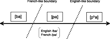
The speech sounds chosen were from a narrow range of the VOT continuum. VOT refers to the gap between the release of a consonant and the onset of voicing. A positive VOT value denotes a release prior to the onset of voicing (voicing lag), whereas a negative VOT value denotes voicing before the release (voicing lead). VOT has been demonstrated to be a reliable cue to phonetic boundaries in many languages (Lisker & Abramson, 1964). However, cross-linguistic differences exist in exactly where the boundary is placed along the VOT continuum (Lisker & Abramson, 1970). For example, the English and French languages place their boundaries between the voiced [b] and voiceless [p] categories differently; a voicing lag exists in both languages, but the lag is longer in English than in French, that is, the French boundary is distinguished with a shorter VOT than the English (Caramazza, Yeni-Komshian, Zurif, & Carbone, 1973). This difference results in an ambiguous area along the VOT continuum in between the respective boundaries that is labeled /p/ by French speakers and /b/ by English speakers (Figure 1).

Mock locations of the French and English category boundaries.
Three tokens were created, [ba] (perceived by both groups as /ba/), [pa] (an ambiguous medial token, perceived as /p/ by adult French speakers and /b/ by adult English speakers) and [pha] (perceived by both groups as /pa/). Infants were habituated to the ambiguous [pa] token and tested on their ability to discriminate a change to each of the [ba] and [pha] tokens. If the infants' perceptual boundary corresponds to that shown by French adults, the infants should discriminate a change to [ba]. If their boundary corresponds to that shown by English adults, infant discrimination should be observed to [pha]. The question was whether the bilingual infants would evidence phonetic representations for each of their languages (and thus discriminate both stimuli), or whether one language would be dominant (and thus they would distinguish the boundary present only in that language). Monolingual infants were expected to discriminate only the boundary present in their language.2
The values of VOT corresponding to language-specific category boundaries are relative, depending on how the stimuli are created, as the perception of phonetic boundaries is affected by other aspects of the signal (e.g., fundamental frequency, Abramson & Lisker, 1985; Haggard, Ambler & Callow, 1970; first formant frequency, Liberman, Delattre & Cooper, 1958; and speaking rate, Miller & Volaitis, 1989). Artificial manipulation of speech stimuli is often necessary for experimental control, but in doing so, the stimuli also become less natural, and often could not be produced by the human vocal tract (Lisker, 1978). Thus, perception of experimental stimuli can be thought of as following a best fit principle rather than an exact replication of natural speech perception.
Six- to 8-month-old infants were first tested to confirm that early discrimination was independent of language exposure consistent with the literature reviewed above. For this first study it was predicted that the monolinguals and bilinguals would behave in the same language-general manner. On the basis of the existing literature and given the artificial manipulations to the stimuli, we were unable to predict in advance whether the young infants would discriminate best at one boundary location over the other, or, as a strong “maintenance” model might suggest, if they would show discrimination of both boundaries.
EXPERIMENT 1: 6- TO 8-MONTH-OLD INFANTS
Method
Participants
Ten infants being raised in monolingual English environments (range = 6 months, 0 days to 7 months, 24 days, average = 6 months, 23 days) and 9 infants being raised in bilingual English–French environments (range=5 months, 13 days to 9 months, 0 days, average = 7 months, 12 days) were tested. Infants in all experiments were full term with no reported health problems. To ensure that infants in the bilingual group were receiving sufficiently bilingual exposure, parents filled out a questionnaire developed by Laura Bosch and Núria Sebastián-Gallés at the University of Barcelona (Bosch & Sebastián-Gallés, 1997b). This questionnaire probes the languages spoken by the caretakers of the infant (e.g., parents and/or grandparents), as well as the language spoken by and amount of exposure to any other caretakers and friends who spend time with the infant. Differences in language exposure between weekends and weekdays and while on vacation are also taken into account.
Materials
HABITUATION AND TEST STIMULI
The auditory stimuli consisted of three consonant–vowel (CV) syllables: [ba], [pa], and [pha]. A female English monolingual produced natural tokens of /ba/ and /pa/, from which one token of each was used to create the three syllables with the software SoundEdit Pro 16 Version 2 on a Power Mac G3 computer. The release burst and first pitch period from the natural /ba/ token was removed and replaced with the release burst and an appropriate amount of VOT from the natural /pa/. Based on the Quebecois measurements of Caramazza et al. (1973), it was determined that VOT values of 8, 28, and 48 ms were appropriate for the phones [ba], [pa], and [pha], respectively. The tokens were equated for duration (450 ms each). To create each of the three types of habituation trials, a single token was repeated 10 times with an interstimulus interval (ISI) of 980 ms, creating a sound file 13.5 s long. The final tokens were confirmed as appropriate exemplars of the intended categories by informal identification by several adult bilinguals and monolinguals.
PRE- AND POSTTEST STIMULI
The auditory stimuli consisted of a string of words spoken in both Canadian English and Quebecois French by a female bilingual speaker. An equal number of words in each language were included so that pretest exposure could help ensure that the bilingual participants were in a “bilingual mode” (Grosjean, 1998). The trials were 13.5 s long.
VISUAL STIMULI
The visual stimulus presented for the duration of all trials was a static image of an unbounded black and white checkerboard. Between trials, a video of a flashing red light was presented as an attention getter.
Apparatus
Infants were tested individually, either at the University of Ottawa or at the University of British Columbia in Vancouver
UNIVERSITY OF OTTAWA
The visual stimuli were presented on a 40-in. Hitachi monitor positioned approximately 95 cm from the infant. A Bose 101 speaker was placed above the monitor to deliver auditory stimuli. A Sony Digital 8 handycam was used to record and relay online behavior to the experimenter. Black draping was hung from the ceiling to the floor with openings only for the monitor and camera lens. Parents wore Peltor headphones playing female vocal music with instrumental accompaniment via a Sony CFD-V17 stereo. The experiment was controlled by a Macintosh PowerBook G4 laptop in the room, separated from the infant by a divider 1.5 m high.
UNIVERSITY OF BRITISH COLUMBIA
The visual stimuli were presented on a 27-in. Mitsubishi monitor positioned approximately 95 cm from the infant. A Bose 101 speaker was placed above the monitor to present the auditory stimuli. A Panasonic AG 180 video camera was used to record infants for later reliability coding and to relay the infants' image to the control room. Parents wore Koss TD/65 headphones with female vocal music playing from Panasonic XBS portable stereo. The experiment was controlled from a separate control room by a Macintosh PowerPC G4 computer.
Procedure
Infants sat on their parent's lap facing the television screen. The experiment was controlled using the computer software Habit (Cohen, Atkinson, & Chaput, 2000). The experimenter initiated each trial when the infant visually fixated on the attention getter.
A habituation procedure was used to test infants' discrimination of the stimuli (Best, McRoberts, & Sithole, 1988; Horowitz, 1975; Werker et al., 1998). The first trial was the pretest with French and English words. Next, infants were habituated to the medial [pa] stimulus, receiving between 6 and 21 trials. The habituation phase terminated once infants' looking time across three trials fell below 50% of that to the first three trials. Following habituation, infants were then exposed to two test trials: [ba] and [pha]. The order of the test trials was counterbalanced between participants. It was expected that if infants could discriminate the change in the stimulus, this would lead to a recovery in looking time to the visual stimulus. Finally, a posttest trial assessed interest level to ensure that the infant was still engaged in the task. Looking time was coded online, and 25% of the trials were recoded for reliability. Reliability coding involved a second trained coder who scored the looking times of the selected participants offline. Both online and offline looking times were rounded to the nearest 0.1 s. For data to be considered reliable, the Pearson product-moment correlation of online and offline scores had to be equal to or greater than .95. This level of agreement was reached for subjects in all three experiments.
Results
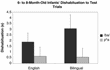
To test whether infants dishabituated to each of the test trials, the mean of the last two habituation trials was subtracted from each of the /ba/ and /pha/ test scores. This resulted in two dishabituation scores, where 0 would denote no recovery in looking to the test trials (Figure 2).

The 6- to 8-month-old infants' dishabituation scores. The error bars represent standard errors.
The dishabituation scores were submitted to a 2 (Language Group: French–English bilingual or English monolingual) × 2 (Test Trial: /ba/ or /pha/) between–within analysis of variance (ANOVA). A significant effect of test trial emerged, F (1, 17) = 8.14, p = .011, but there was no effect of language group, F (1, 17) = .262, ns, nor any interaction between the two, F (1, 17) = .888, p = .36.
Follow-up one-sample t tests examined whether the dishabituation was significantly greater than 0. The monolinguals displayed significant recovery to /ba/, t (9) = 2.37, p = .042, but not to /pha/, t (9) = .81, p = .44. The same pattern of results was observed in the bilinguals, with significant recovery to /ba/, t (8) = 3.92, p = .004, but not to /pha/, t (8) = .462, ns.
Discussion
The results of this first experiment demonstrate that there were no observed differences in discrimination between the monolingual and bilingual infants. These results are consistent with the language-general performance that was predicted at 6–8 months of age. The pattern of responding indicates that only one boundary within the targeted VOT range is sufficiently salient to be discriminable by young infants, quite probably a result of the very narrow range of VOT under study (8–48 ms).
The next step is to test older infants to ascertain whether they would behave in a language-specific manner and to examine any differences between the monolingual and bilinguals. Our first question was how the older infants being raised in bilingual environments would perform. On the basis of the theoretical distinctions made in the adult L2 acquisition literature, it is possible that they would discriminate test trials corresponding to both the French and the English boundaries and thus demonstrate an emergent bilingual-like pattern of discrimination. Such a pattern, which would involve both maintenance and facilitation, would suggest that exposure to two languages allows infants to restructure their phonetic representations to highlight the voicing boundaries used in both languages to which they are exposed. An alternative possibility is that older infants will behave similarly to the 6- to 8-month-olds and discriminate only one boundary along the continuum. This pattern of responding would be consistent with a monolingual representation, and suggest that the bilingual infants structure their phonetic representation such that one language is dominant.
It is interesting that the initial boundary that was discriminated by both groups of infants at 6–8 months corresponds to the /ba/ test trial, consistent with French (not English) adult discrimination. Thus, for these particular stimuli, the boundary discriminated by the young English monolingual infants is not the same boundary that is discriminated by adults. This suggests that for English speakers, a process of realignment occurs at some point between 6 and 8 months and adulthood. Testing older monolingual English infants could thus allow us to narrow down the age at which realignment along the VOT continuum occurs for infants establishing monolingual representations.
In monolingual perceptual development, an effect of experience on discrimination of consonants is observed by 10–12 months (Anderson et al., 2003; Best et al., 1995; Werker & Tees, 1984). However, given the reported delay in the reorganization of vowel perception in bilingual acoustic–phonetic space (Bosch & Sebastián-Gallés, 2003), we chose to first test slightly older infants of 14–20 months. This age range is one likely to reveal experiential influences, even if the effect of experience is seen at a later age in bilingual infants. If no differences are found at this age, it can be assumed that bilingual infants are not able to divide the VOT continuum according to two perceptual boundaries within this tight range. If differences are found between bilingual infants of 14–20 months and the 6- to 8-month-olds, then a third experiment was planned with infants aged 10–12 months to narrow down the age at which the change in responding first emerged.
EXPERIMENT 2: 14- TO 20-MONTH-OLD INFANTS
Method
Participants
Eight monolingual English infants (range = 13 months, 2 days to 19 months, 0 days; average = 15 months, 0 days) and 12 bilingual English–French infants (range = 13 months, 9 days to 20 months, 0 days; average = 14 months, 7 days) participated in this experiment.3
Preliminary results of these three studies were published in the Proceedings of the Boston University Conference on Language Development (Burns, Werker, & McVie, 2003). The sample size for Experiments 2 and 3 were increased for the current paper to ensure that the results reflected meaningful rather than random variability.
Stimuli and procedure
The stimuli and procedure were the same as Experiment 1.
Results
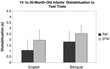
Dishabituation scores were submitted to a 2 (Language Group: French–English bilingual, English monolingual) × 2 (Test Trial: /ba/ or /pha/) between–within ANOVA. There was no main effect of test trial, F (1, 18) = 1.11, p = .30, but a main effect of language group, F (1, 18) = 15.9, p < .001, was observed. The interaction between the two was not significant, F (1, 18) = .012, ns (Figure 3).

The 14- to 20-month-old infants' dishabituation scores. The error bars represent standard errors.
One-sample t tests compared dishabituation scores to 0. The English monolinguals exhibited marginal recovery to /pha/, t (7) = 2.27, p = .057, but not to /ba/, t (7) = 1.24, p = .25. The bilinguals discriminated /pha/, t (11) = 3.63, p = .004, and showed marginal discrimination of /ba/, t (11) = 2.11, p = .058.
Discussion
The results of Experiment 2 with infants of 14–20 months reveal language-specific differences between the groups, in contrast to those of Experiment 1 where the monolinguals and the bilinguals responded alike. In Experiment 2, the bilingual infants showed significant recovery in looking time to both test trials, indicating sensitivity to phonetic boundaries consistent with both English and French native representations. This bilingual pattern of responding provides evidence of the establishment of both the French and the English boundaries in the tight phonetic space under study.
In contrast, the English monolingual infants in this age range discriminated only one test trial, the one corresponding to the English boundary. The discrimination of these infants reflected effects of language experience, compared to the 6- to 8-month-olds who had initially discriminated in a manner consistent with the French boundary. At this older age the VOT boundary appears to have aligned with that of English. Thus, unlike the language-general perception of the 6- to 8-month-olds, by 14–20 months both the monolinguals and the bilingual infants succeeded in displaying discrimination consistent with the ambient language input.
A final experiment was conducted to test both bilingual and monolingual infants at 10–12 months, the age at which phonetic reorganization of consonants is observed in monolingual infants (Anderson et al., 2003; Kuhl et al., 2006; Rivera-Gaxiola et al., 2005; Werker & Tees, 1984). Given this well-established body of work showing maintenance and facilitation by this age, it was predicted that realignment would also be evident by this age in English monolingual infants. Hence, it was predicted that English infants would show a discrimination of only the boundary consistent with English. For bilingual infants the observed shift to language-specific responding at 14–20 months in Experiment 2 could occur at an earlier age. However, given the delays reported in phonetic reorganization of vowels (Bosch & Sebastián-Gallés, 2003) and of consonants in a word learning task (Fennell et al., 2007), it is unclear if bilingual infants could be expected to succeed at the same age as their monolingual counterparts. Experiment 3 thus asks: can the effects of reorganization be observed at a similar age for both monolingual and bilingual infants?
EXPERIMENT 3: 10- TO 12-MONTH-OLD INFANTS
Method
Participants
Fourteen monolingual English infants (range = 9 months, 19 days to 11 months, 27 days, average = 10 months, 28 days) and 18 bilingual English–French infants (range = 10 months, 8 days to 12 months, 5 days, average=11 months, 2 days) participated in this experiment.
Stimuli and procedure
The stimuli and procedure were the same as Experiments 1 and 2.
Results
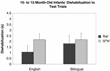
The dishabituation scores were submitted to a 2 (Language Group: French–English bilingual or English monolingual)×2 (Test Trial: /ba/ or /pha/) between–within ANOVA. There was no effect of test trial, F (1, 29) = 2.82, p = .104, or of language group, F (1, 29) = .345, ns, nor any interaction between the two, F (1, 29) = .419, ns (Figure 4).

The 10- to 12-month-old infants' dishabituation scores. The error bars represent standard errors.
Planned follow-up one-sample t tests compared dishabituation scores to 0. The English monolinguals looked significantly longer to the /pha/ test trial, t (12) = 3.93, p = .002, but not to the /ba/ test trial, t (12) = 1.48, p = .17. The bilinguals exhibited significant recovery to /pha/, t (17) = 3.76, p = .002, and marginal recovery to /ba/, t (17) = 2.10, p = .051.
Discussion
Both the monolingual and the bilingual 10- to 12-month-old infants displayed discrimination consistent with the pattern of responding of the older infants in Experiment 2. As expected, the observed shift of boundary discrimination by the English infants appears by 10–12 months of age, consistent with previous work on other processes of functional reorganization of the native phonetic space such as maintenance and facilitation (Werker & Tees, 1992). In addition, however, the bilingual infants dishabituated to both test trials, indicating the existence of phonetic boundaries consistent with both English and French representation at this early age. The parallel patterns found at 10–12 months and 14–20 months between the monolinguals and bilinguals suggests that the time course for the development of phonetic representation in bilingual infants is not delayed, and may, in fact, be similar to that of monolingual infants.
GENERAL DISCUSSION
This set of experiments tested the development of phonetic representations in infants who are growing up in French–English bilingual or English-only environments. The original question was whether the bilingual infants would develop two phonetic representations, one for each of their languages, or a combination of their two representations, or whether language dominance would be observed at the phonetic level, with a monolingual-like pattern indicative of only one phonetic representation in one or the other language. A second question that emerged in the course of the studies pertained to the development of phonetic representations of monolingual infants and the timing of the shift from language general to language-specific responding. Initial language-general representations were not consistent with English boundaries, allowing us to track the development of monolingual phonetic representations.
The first experiment tested infants of 6–8 months of age. A language-general pattern of responding was found and no differences were observed between the two groups. This experiment also confirmed that no effect of language exposure was found at this age, setting the stage for further experiments with older infants to investigate the role of experience. At this age, the discriminated boundary (by both groups of infants) was consistent with French, indicating that the perception of the English monolingual infants was not initially aligned with adult English representations.
The second experiment tested older infants of 14–20 months. Consonantal reorganization is typically observed in monolingual infants by 10–12 months of age (Anderson et al., 2003; Best et al., 1995; Kuhl et al., 2006; Werker & Lalonde, 1988; Werker & Tees, 1984), but because a delay has been suggested in vowel organization in bilinguals (Bosch & Sebastián-Gallés, 2003), slightly older infants were tested to account for this. The results of this experiment demonstrated that the older bilingual infants successfully discriminated both test trials, suggesting that infants being raised in bilingual environments establish native phonetic representations in both of their languages. The monolingual infants also displayed language-specific perception by 14–20 months, discriminating only the boundary corresponding to the English language. Thus, it appears that by 14–20 months, language-specific discrimination has emerged in both groups of infants in accordance with the language environment in which the infants were being raised.
The final experiment tested infants of 10–12 months to narrow down the time line of the perceptual reorganization. It was anticipated that the monolingual discrimination would have realigned by 10–12 months to match adult English phonetic categories, consistent with previous findings on maintenance and facilitation, but it was unknown whether the bilinguals would be delayed relative to their monolingual counterparts. In fact, the same pattern of results was found in both groups at 10–12 months as at 14–20 months. This provides evidence that the trajectory of bilingual development of consonantal phonetic representation is similar to that of monolinguals, and confirms that the realignment process in the monolingual infants occurs within a similar time frame as other aspects of reorganization such as maintenance and facilitation.
Underlying processes of reorganization
Bilingual infants
At 10–12 months the bilingual infants discriminated an additional boundary that was not initially discriminated at 6–8 months. The timing of this development is consistent with that observed in the perception of a difficult Filipino nasal contrast, /na/–/Na/ (Narayan, 2006; Narayan & Werker, 2007). In this study neither the English- nor the Filipino-learning infants of 6–8 months appeared to discriminate the contrast, but by 10–12 months the Filipino infants discriminated the native contrast, whereas the English infants did not. The Filipino infants and the current bilinguals both appear to discriminate a contrast at 10–12 months that was not evident at 6–8 months. There are a few theoretical explanations that could explain our results (and those of Narayan & Werker). It is possible that the boundary discriminated by 10–12 months is not present at younger ages, and as a result of exposure, a new boundary is induced where none existed before. Alternatively, it is known that different tasks result in different patterns of results when studying infants (Werker & Curtin, 2005); for example, McMurray and Aslin (2005) have shown that 8-month-old infants can perceive the VOT continuum in a gradient fashion. Following this, latent sensitivity to either boundary could be present at the younger age but not prominent enough to result in discrimination in this task and further language experience would be required to pull out the distinction. Another possibility specific to the VOT contrast in the current study would posit the existence of another boundary at 6–8 months outside the targeted VOT space (below 8 ms or above 48 ms), which was exapted and realigned with the boundary that was supported by experience. Distinguishing these possibilities is an important area for further research.
Regardless of the underlying processes by which the second boundary comes to be discriminated, the bilingual infants were found to respond in a phonetically bilingual manner by 10–12 months of age, discriminating both the English and the French boundaries along the VOT continuum. The time course of this attunement is consistent with the time course observed in monolinguals. However, this result is puzzling given the delays bilinguals demonstrated in using native phonetic categories to drive word learning (Fennell et al., 2007) and in their establishment of native vowel categories (Bosch & Sebastián-Gallés, 2003). Because word learning is an inherently different task that taps into different perceptual and cognitive processes than simple speech perception, one could easily argue that the Fennell et al. (2007) results are not inconsistent with those presented here. Indeed, as argued by Fennell and colleagues, and as supported by the present work, the very presence of slightly different phonetic boundaries for each of their two languages may require that the bilingual child wait for further distinguishing information before committing to a decision that two similar sounding words are indeed supposed to refer to two different objects. In the word–object associative task used by Fennell et al., distinguishing information was not present that would help the child determine which language, and hence which boundary, was important. In a situation where this ambiguity is not as great, the bilingual is able to use native phonetic categories to guide word learning (Mattock, Polka, & Rvachew, 2006).
The explanation for the Bosch and Sebastián-Gallés (2003) findings of a later age for bilingual establishment of native vowel categories may lie in the relative frequencies with which the sounds occur in the language. The phonetic categories represented in the work presented here are both highly frequent, whereas in the linguistic environment studied by Bosch and Sebastián-Gallés (2003) the Catalan /ε/ is much less frequent than the Spanish and Catalan /e/. One account of phonological reorganization holds that infants keep track of the distributional frequencies of sounds in the language environment, using them to guide perception (Maye, Werker, & Gerken, 2002). Unimodal frequency distributions would be characteristic of one category, whereas bimodal (or trimodal) frequency distributions would highlight category distinctions. If one of the phones were less frequent than the others, there could be a point in distributional learning wherein the less frequent phone was amalgamated into the more frequent category. This is particularly likely in the tight vocalic space the Spanish–Catalan infants must pull apart, as the Catalan /ε/, although different from the Catalan /e/, has some acoustic–phonetic features that overlap with the Spanish /e/. In a case such as this, more exposure would be required for the multiple modes to emerge. According to this line of reasoning, it is not monolingualism versus bilingualism per se that determines the age at which phonetic contrasts reorganize; instead, it is the frequency and acoustic–phonetic features of the contrasts in question.
Sabourin and colleagues (2006) recently tested the distributional explanation of the Bosch and Sebastián-Gallés results by examining discrimination in English monolingual infants of three English monopthong vowels that not only reside in a crowded vowel space, but also vary in distributional frequency. All three vowels, /ε/, /I/, and /e/ are matched in phoneme frequency in English, but /e/ surfaces as both a monopthong [e] and a dipthong [eI] in Western Canadian English, complicating its distributional frequency. At 8 months of age, Western Canadian English-learning infants had difficulty discriminating /e/ versus /I/. These results support the hypothesis that it is likely the relative frequency of the vowels in input speech, rather than the bilingual status of the infants that is responsible for the later reorganization in Bosch and Sebastián-Gallés (2003). To recall, it has been shown in other studies with monolingual infants that, although there is relative consistency in the age at which changes occur, the precise age of reorganization varies slightly as a function of the frequency of occurrence of the phones in question in the ambient language (Anderson et al., 2003).
Monolingual infants
The monolingual infants, in contrast to the bilingual infants, only discriminated one boundary in each of the three experiments. The boundary discriminated at the youngest age corresponded to the French boundary, whereas that discriminated at the older ages corresponded to the English boundary. Although developmental shifts in boundary perception between early infancy and adulthood have long been hypothesized (Aslin & Pisoni, 1980; Lasky et al., 1975), the current experiments considerably narrow down the age at which this realignment process occurs by revealing a shift in discrimination in accordance with the ambient language between 6 and 8 and 10 and 12 months of age. This timing is consistent with other aspects of functional reorganization such as maintenance versus decline (Anderson et al., 2003; Best et al., 1995; Werker & Tees, 1984) and facilitation (Kuhl et al., 2006; Narayan & Werker, 2007) where discrimination at the younger age appears consistent with a language-general pattern of responding and becomes language specific by 10–12 months, with only slight variations in the age at which the change is observed.
Of interest are the processes by which discrimination shifted in the monolinguals. Perhaps the most parsimonious explanation for these results is that the initial boundary shifted between 6 and 8 and 10 and 12 months of age in accordance with the language input, consistent with the process of realignment (Aslin & Pisoni, 1980). An explanation for how realignment occurs is still required, however, and some possibilities have been outlined with respect to the bilingual data above.
CONCLUSION AND FUTURE DIRECTIONS
Several unanswered questions remain from these preliminary studies. It is still an open question as to whether the infants learning two languages behave as two monolinguals, or whether the representation they use for online processing is somehow uniquely bilingual (Elman, Diehl, & Buchwald, 1977). We do not know what a uniquely bilingual phonetic representation might look like, although studies of sequential bilingualism in adults (Flege, 2003) suggest certain possibilities. We do not know if infants can be deliberately put into “bilingual mode,” where the infant is primed for both/either language, or a “language dominant mode,” as has been suggested for adults (Grosjean, 1998). It is also unknown whether the bilingual learning infants identify the specific representations with the specific languages as adults can (Ju & Luce, 2004). All of these unanswered questions are areas for future study.
The work reported here documents the realignment of monolingual phonetic representations and demonstrates that infants being raised in bilingual environments establish the phonetic representations for each of their two languages in much the same manner and on the same time course as infants establishing monolingual representations. From an initial language-general state both monolingual and bilingual infants succeeded in discriminating language-specific boundaries by 10–12 months, a discrimination that is maintained through 14–20 months. These results suggest that when infants are exposed to two languages from birth, they are equipped to process each language in a native manner, at least at a phonetic level, and that the development of phonetic representation is neither delayed nor compromised by additional languages.
The authors thank Alain Desrochers at the University of Ottawa for the generous use of his facilities for testing many of the bilingual infants. We also thank Fiona Scott for her assistance testing participants, the members of the Infant Study Centre at UBC, and the parents and infants who participated in these studies. This research was funded by Social Sciences and Humanities Research Council of Canada (SSHRC) Grant 410-2004-0744, Human Frontiers Science Program Grant RGP0068/002-C301, a Canada Research Chair (to J.F.W.), a UBC psychology postdoctoral fellowship (to T.C.B.), and SSHRC and Michael Smith Foundation for Health Research Graduate Fellowships (to K.A.Y.).