Introduction
Approximately 14 to 20 million Americans (Tiep, Reference Tiep1997) have chronic obstructive pulmonary disease (COPD), which has the highest annual cost of medical care of any chronic illness within the Veterans Affairs (VA) system (Yu et al. Reference Yu, Ravelo, Wagner, Phibbs, Bhandari, Chen and Barnett2003) and increased prevalence of affective disorders (Kunik et al. Reference Kunik, Braun, Stanley, Wristers, Molinari, Stoebner and Orengo2001). Moderate-to-severe depressive and anxiety symptoms have been reported in COPD patients [(7–42%) Van Ede et al. Reference Van Ede, Yzermans and Brouwer1999 and (16–40%) Karajgi et al. Reference Karajgi, Rifkin, Doddi and Kolli1990 respectively]. Psychological factors contribute significantly to disability in COPD (Graydon & Ross, Reference Graydon and Ross1995; Yohannes et al. Reference Yohannes, Roomi, Waters and Connolly1998; Kim et al. Reference Kim, Kunik, Molinari, Hillman, Lalani, Orengo, Petersen, Nahas and Goodnight-White2000; Yu et al. Reference Yu, Ravelo, Wagner, Phibbs, Bhandari, Chen and Barnett2003), and patients with significant anxiety and/or depressive symptoms report lower quality of life (QoL) than would be expected based on severity of physical symptoms (Karajgi et al. Reference Karajgi, Rifkin, Doddi and Kolli1990; Yohannes et al. Reference Yohannes, Roomi, Waters and Connolly1998; Kim et al. Reference Kim, Kunik, Molinari, Hillman, Lalani, Orengo, Petersen, Nahas and Goodnight-White2000; Cully et al. Reference Cully, Graham, Stanley, Ferguson, Sharafkhaneh, Souchek and Kunik2006).
The impact of anxiety and depression on use of health services by COPD patients has not been examined, although improved management of psychiatric co-morbidity has been suggested to decrease COPD-related health-care costs (Wilson et al. Reference Wilson, Devine and So2000). Studies of health-service use by older patients with chronic medical illness document increased use and cost by patients with depression, even when controlled for severity of medical illness (Druss et al. Reference Druss, Rohrbaugh and Rosenheck1999). The effect of anxiety on health-service use has also not been well studied, but results of one large, community-based random probability sample of older patients, controlled for age, chronic disease and functional limitations, associated anxiety symptoms with increased doctor visits (Kim et al. Reference Kim, Kunik, Molinari, Hillman, Lalani, Orengo, Petersen, Nahas and Goodnight-White2000).
Unfortunately, less than 25% of COPD patients with moderate-to-severe anxiety or depressive symptoms receive interventions to address them (de Beurs et al. Reference de Beurs, Beekman, van Balkom, Deeg, van Dyck and van Tilburg1999; Kim et al. Reference Kim, Kunik, Molinari, Hillman, Lalani, Orengo, Petersen, Nahas and Goodnight-White2000). Although the treatment guidelines published by the Global Initiative for Chronic Obstructive Lung Disease (2004) mention addressing ‘altered mood states’, they do not outline specific treatment or referral guidelines (de Beurs et al. Reference de Beurs, Beekman, van Balkom, Deeg, van Dyck and van Tilburg1999).
Usual care for COPD patients includes smoking cessation, prevention and treatment of acute exacerbations, airway and secretion management, nutritional interventions and pulmonary rehabilitation programs, usually with physical therapy and exercise. Education in self-management is also included, as it results in fewer hospitalizations/days of hospitalization (Lorig et al. Reference Lorig, Sobel, Stewart, Brown, Bandura, Ritter, Gonzalez, Laurent and Holman1999), reduced morbidity (Worth & Dhein, Reference Worth and Dhein2004), improved outcomes and reduced costs during 12-month follow-up (Gallefoss, Reference Gallefoss2004).
A few small studies have examined cognitive behavioral therapy (CBT) for anxiety and depression in COPD patients. Two case series (Lisansky & Clough, Reference Lisansky and Clough1996; Eiser et al. Reference Eiser, West, Evans, Jeffers and Quirk1997) reported that CBT did not change anxiety symptoms but improved exercise tolerance (Eiser et al. Reference Eiser, West, Evans, Jeffers and Quirk1997) and QoL (Lisansky & Clough, Reference Lisansky and Clough1996). One randomized controlled trial (RCT) (de Godoy & de Godoy, Reference de Godoy and de Godoy2003) showed significantly decreased depression and anxiety with psychotherapy that included CBT. CBT has demonstrated efficacy in older adults with generalized anxiety (Stanley et al. Reference Stanley, Beck and Glassco1996; Stanley et al. Reference Stanley, Roberts, Bourland and Novy2001; Wetherell et al. Reference Wetherell, Gatz and Craske2003) and younger adults with depression (Lejuez et al. Reference Lejuez, Hopko, Lepage, Hopko and McNeil2001), and small studies have evaluated variations of our CBT protocol in older medical patients with anxiety (Stanley et al. Reference Stanley, Hopko, Diefenbach, Bourland, Rodrigues and Wagener2003a) and in COPD patients (Kunik et al. Reference Kunik, Braun, Stanley, Wristers, Molinari, Stoebner and Orengo2001).
Although COPD alone greatly influences QoL and health-service use, we propose that moderate-to-severe anxiety and depressive symptoms also significantly reduce QoL and increase use of health services. No studies have prospectively examined the effect of psychosocial interventions on QoL in COPD patients with significant psychosocial distress. The objectives of this RCT were to compare the effects of CBT group treatment and COPD education on (1) disease-specific and generic QoL (primary outcome); and (2) depressive and anxiety symptoms, 6-minute walk distance (6MWD), and use of health services (secondary outcomes). Based on a sizeable literature supporting the efficacy and effectiveness of CBT for treating psychological and medical problems (Barlow et al. Reference Barlow, Wright, Sheasby, Turner and Hainsworth2002), the primary hypothesis was that CBT group treatment would be more beneficial than COPD education.
Method
Recruitment of participants
Individuals with chronic breathing disorder receiving medical care at the Michael E. DeBakey VA Medical Center (MEDVAMC) in Houston, TX, the year before the study were identified through administrative databases, targeted for recruitment and screened, as described previously (Kunik et al. Reference Kunik, Roundy, Veazey, Souchek, Richardson, Wray and Stanley2005). Additional participants were recruited by other methods, including flyers and advertisements. Participants gave informed consent, as approved by the Institutional Review Boards of the MEDVAMC and Baylor College of Medicine.
Inclusion/exclusion criteria
Inclusion criteria were (1) diagnosis of COPD [forced expiratory value in 1 second (FEV)1/forced vital capacity (FVC)<70% and FEV1<70% predicted] (American Thoracic Society, 1991) confirmed with spirometry; (2) moderate anxiety and/or moderate depression; and (3) treatment by a primary care provider or pulmonologist, to maximize comparability of usual care across groups. Participants had to meet all three criteria to be included.
Anxiety symptoms were evaluated using the Beck Anxiety Inventory (BAI; Beck & Steer, Reference Beck and Steer1993). Inclusion was based on a score of ⩾16, classified as moderate anxiety (Beck & Steer, Reference Beck and Steer1993), which balances specificity (0.67) and sensitivity (0.62) for identifying anxiety in older adult psychiatric patients (Kabacoff et al. Reference Kabacoff, Segal, Hersen and VanHasselt1997). It also represents a severity of anxiety approximately 2 standard deviations (s.d.s) above the mean for an older normal community sample aged 45 to 65 (mean=4.4, s.d.=6.3) (Gillis et al. Reference Gillis, Haaga and Ford1995) and 1 s.d. above the mean for an older medical sample aged 60 to 84 (mean=7.2, s.d.=6.78; Steer et al. Reference Steer, Willman, Kay and Beck1994).
Depressive symptoms were evaluated using the Beck Depression Inventory-II (BDI-II; Beck et al. Reference Beck, Steer and Brown1996). Inclusion was based on a score of >14, classified as mild depressive symptoms (Beck et al. Reference Beck, Steer and Brown1996), which corresponds with an empirically derived cut-off differentiating between community and clinically symptomatic samples of adults (cut-off=14.3; Seggar et al. Reference Seggar, Lambert and Hansen2002) and 1 s.d. above a BDI-II mean for male primary care patients (mean=5.8, s.d.=6.9; Arnau et al. Reference Arnau, Meagher, Norris and Bramson2001). Both instruments have substantial psychometric support for use among older adults and/or medical patients (Steer et al. Reference Steer, Willman, Kay and Beck1994; Wetherell & Arean, Reference Wetherell and Arean1997; Arnau et al. Reference Arnau, Meagher, Norris and Bramson2001) and both are sensitive to change following CBT (Stanley et al. Reference Stanley, Beck, Novy, Averill, Swann, Diefenbach and Hopko2003b; Wetherell et al. Reference Wetherell, Lenze and Stanley2005).
Physicians received a summary of participants’ depressive and anxiety symptoms and encouragement to continue usual treatment. This was not expected to affect outcomes for anxiety and depression (Simon et al. Reference Simon, Fleck, Lucas and Bushnell2004; Roundy et al. Reference Roundy, Cully, Stanley, Veazey, Souchek, Wray and Kunik2005).
Exclusion criteria were any of the following: (1) a cognitive disorder, evidenced by a score of 23 or less on the Mini-Mental State Examination (MMSE; Folstein et al. Reference Folstein, Folstein and McHugh1975); (2) a psychotic disorder; or (3) current non-nicotine substance abuse or dependence. Patients with psychotic and non-nicotine substance use disorders were excluded using the Structured Clinical Interview for DSM-IV (SCID; Spitzer et al. Reference Spitzer, Williams, Gibbon and First1992). SCID assessments were administered by three BA-level psychology research assistants fully trained in SCID administration and supervised by M.A.S., who met with them twice monthly to discuss and clarify diagnoses. The SCID was also used to identify patients meeting full DSM-IV criteria for an anxiety or mood disorder.
Instruments for assessing primary outcome
COPD-specific QoL was measured using the Chronic Respiratory Questionnaire (CRQ; Guyatt et al. Reference Guyatt, Berman, Townsend, Pugsley and Chambers1987). Generic QoL was measured using the Medical Outcomes Survey Short Form-36 (SF-36; Ware & Sherbourne, Reference Ware and Sherbourne1992).
Instruments for assessing secondary outcomes
Anxiety and depression were measured using the BAI and BDI-II. The 6MWD was used to evaluate functional ability. Participants were asked to cover as much distance as possible, with standardized encouragement. The 6MWD has high reliability and validity as a measure of functional status and is commonly used in COPD studies (Carter et al. Reference Carter, Holiday, Nwasuruba, Stocks, Grothues and Tiep2003). Service use was determined by number of hospitalizations and out-patient, mental health and emergency room visits during the 3 months before entering the study (Griffiths et al. Reference Griffiths, Burr, Campbell, Lewis-Jenkins, Mullins, Shiels, Turner-Lawlor, Payne, Newcombe, Ionescu, Thomas and Tunbridge2000), based on self-report data, because of their ease of acquisition and lack of bias due to age, gender, education, income or health status (Ritter et al. Reference Ritter, Stewart, Kaymaz, Sobel, Block and Lorig2001).
CBT group-treatment intervention
Treatment consisted of eight 1-h sessions of CBT, based on previous studies (Kunik et al. Reference Kunik, Braun, Stanley, Wristers, Molinari, Stoebner and Orengo2001; Stanley et al. Reference Stanley, Hopko, Diefenbach, Bourland, Rodrigues and Wagener2003a) integrating interventions for both anxiety and depression (Stanley et al. Reference Stanley, Veazey, Hopko, Diefenbach and Kunik2005). The protocol included (1) education and awareness training focused on anxiety, depression and associated physiological, cognitive and behavioral symptoms (session 1); (2) relaxation training (session 2); (3) increasing pleasurable activity and decreasing anxiety-related avoidance (sessions 2–3); (4) cognitive therapy (alternative thoughts, encouraging self-statements, and thought-stopping) (sessions 4 and 5); (5) problem-solving techniques (session 6); (6) sleep-management skills (session 7); and (7) skills review and planning for maintenance of gains (session 8). Each session began with group discussion and review of symptoms, practice exercises and motivational interviewing techniques, as needed. Next, instruction and practice in a new skill were provided. Finally, additional home-practice exercises were assigned. Group sessions were skills based, but attempts were made to encourage group interactions while emphasizing individual skill-building needs. (See Stanley et al. Reference Stanley, Veazey, Hopko, Diefenbach and Kunik2005 for a discussion of CBT procedures and case examples.)
Treatment was administered to groups of up to 10 patients, led by psychology interns and postdoctoral fellows with significant experience in CBT for anxiety and depression. A more senior CBT expert reviewed 34 (22%) of 152 randomly selected sessions to assess therapist competency and adherence. Mean competency score was 6.59±0.20 on an eight-point scale (2=weak, 4=good, 6=very good, 8=excellent). Mean adherence score was 6.74±0.18 on an eight-point scale (2=weak, 4=moderate, 6=good, 8=optimal). Therapists were comparable in experience and competence to those providing care in previous studies of CBT for late-life anxiety upon which this intervention was based (Stanley et al. Reference Stanley, Beck, Novy, Averill, Swann, Diefenbach and Hopko2003b).
COPD education intervention
The control intervention included eight sessions of COPD education (45-minute lectures/15-minute discussions, designed to control for contact time and group social support), developed by a co-investigator. Topics included breathing strategies and airway management, pathophysiology of lung disease, medications, use of oxygen, avoidance of environmental irritants, nutrition, exercise, smoking cessation and end-of-life planning (Carter et al. Reference Carter, Nicotra and Tucker1999). The same psychology interns and postdoctoral fellows who conducted the CBT group treatment also administered these sessions. Using the same therapists to provide treatment in both conditions is comparable to procedures used in prior studies of CBT for late-life anxiety (Stanley et al. Reference Stanley, Beck and Glassco1996, Reference Stanley, Hopko, Diefenbach, Bourland, Rodrigues and Wagener2003a) and depression (Gallagher-Thompson & Steffen, Reference Gallagher-Thompson and Steffen1994) and reduces concerns about therapy effects that may be confounded by the provider. To ensure adequate delivery of COPD education, each session was taped, and 28 (18%) out of 152 sessions were reviewed to ensure competency of therapists and adherence to the protocol. Mean competency score was 6.61±0.19 and mean adherence score was 6.75±0.16 on the same eight-point scales described above.
Assessments
All assessments (weeks 4 and 8 and months 4, 8 and 12) included the CRQ, SF-36, BDI-II, BAI and 6MWD. Follow-up assessments at 4, 8 and 12 months also measured health-service use during the prior 3 months. Study personnel performing assessments were blinded to treatment condition.
Randomization procedures
We used the Statistical Analysis Systems PLAN procedure (SAS Institute, Inc., Cary, NC, USA) to create the randomization list, with blocks of size 2 to provide approximately equal numbers per class. The statistician provided randomization numbers and treatment codes to the study coordinator when sufficient patients for two classes had completed the baseline assessment and consented to participate. The instructor assigned the treatment to the code initially by flipping a coin.
Sample size and power
Sample size was based on change in the four CRQ dimensions. We used an effect size of 0.50 for each measure based on effect sizes of 1.00 for dyspnoea, 0.80 for fatigue, 0.50 for emotion, and 0.60 for mastery in the Cambach COPD/asthma study (Cambach et al. Reference Cambach, Chadwick-Straver, Wagenaar, van Keimpema and Kemper1997), in which effect sizes for Guyatt's minimal clinically important differences (Jaeschke et al. Reference Jaeschke, Singer and Guyatt1989) were 0.60 for dyspnoea, 0.40 for fatigue and 0.50 for emotion. A sample size of 100 patients per group was adequate to detect an effect size of 0.50 with 80% power at a 0.01 significance level. Twenty patients were added to each group to allow for a 20% drop-out rate.
A sample of 100 was also adequate to detect effect sizes that Oslin et al. (Reference Oslin, Streim, Katz, Edell, Edell and TenHave2000) obtained for SF-36 scores when they evaluated functional status of in-patients with depression treated with CBT [mental health (0.85), role-emotional (1.55), role-physical (1.21), pain (0.64) and social function (1.15)] at the 0.01 significance level with 80% power.
Statistical analysis
At baseline, χ2 tests were used to compare categorical demographic variables, and t tests were used to compare continuous and ordinal variables.
Analysis of variance with random coefficients for the intercept and slope was used to compare changes between groups in the CRQ, SF-36, BDI-II, BAI and 6MWD from baseline to 8 weeks (treatment) and from 8 weeks to 52 weeks (follow-up). The model contained terms for intercept, treatment, time, and interaction between time and treatment. Baseline and 4- and 8-week values were used to estimate the intercept and slope of change during treatment, and 8-week and 4-, 8- and 12-month values were used to estimate the intercept and rate of change during follow-up. The treatment effect measured the difference between groups at baseline, the time effect measured change over time in the two groups combined, and the time-by-treatment interaction measured difference in rate of change between groups. Using a random coefficient model allowed us to fit a line for each individual based on available data, and the mean of individual estimates was the intercept and slope (rate of change) for the group. Missing values for one or more visits for an individual did not prevent his/her inclusion in the analysis.
Regarding use of health services, Poisson regression with a random intercept was used to estimate event rates and compare visit rates (study to prestudy) and rate ratios between groups. The event rate is the average number of events (visits, hospitalizations) per month, and the rate ratio is the quotient of the event rate during the 12-month study period relative to the event rate during the 3-month prestudy period. The cross-product ratio is the quotient of the rate ratio in the CBT group relative to that in the COPD education group and therefore compares the change in usage between groups. If the rate ratio is 1, then we did not find a change in usage from the prestudy to the study period; and if the cross-product ratio is 1, then we did not find a greater change in one group than the other.
Analysis was by intent to treat. Tests of significance were made at the 0.01 level.
Results
Study population
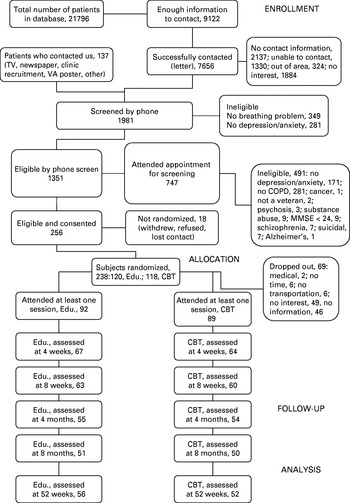
Participants were recruited from 11 July 2002 to 30 April 2004 (see Fig. 1). We were able to contact 1981 individuals, who were screened by telephone. Of these, 1351 were eligible for pretreatment assessment, 747 presented for further testing, and 256 were eligible and consented to participate. A total of 238 were randomized, 118 to the CBT group and 120 to the COPD education group (Fig. 1). A total of 181 attended at least one session, which was highly correlated with attendance at six or more sessions. There were no significant differences between individuals attending at least one group and those who did not except for CRQ subscales of dyspnoea (p=0.16) and mastery (p=0.000). Final logistic regression excluding subjects with missing data showed only one variable to be significantly different, the CRQ subscale of mastery (Cully et al. Reference Cully, Graham, Stanley and Kunik2007).
Flowchart showing the numbers/attrition of participants from enrollment through allocation, treatment and follow-up to analysis.

Demographics
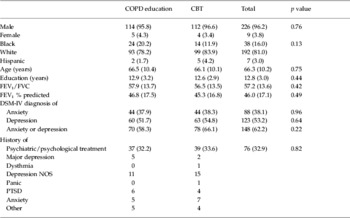
There were no significant differences between groups with respect to: gender; race; age; education; FEV1/FVC; FEV1 predicted; DSM-IV diagnosis of anxiety, depression, or anxiety and/or depression; or history of psychiatric treatment (Table 1). The population was primarily male and white. On average, 38.1% had a DSM-IV diagnosis of anxiety, 53.2% had a DSM-IV diagnosis of depression, and 62.2% had a DSM-IV diagnosis of depression or anxiety. A history of psychiatric treatment was recorded for 32.9%.
Demographic characteristics

Values are n (%) or mean (standard deviation).
COPD, Chronic obstructive pulmonary disease; CBT, cognitive behavioral therapy; FEV1, forced expiratory value in 1 s; FVC, forced vital capacity<70%; FEV1 % predicted, forced expiratory value <70% predicted; NOS, not otherwise specified; PTSD, post-traumatic stress disorder.
Baseline values of outcome measures and changes during treatment
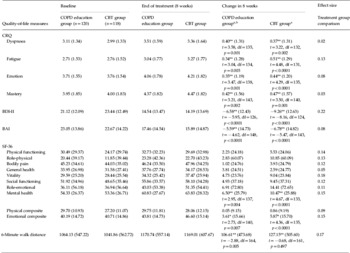
Baseline and 8-week values and change from baseline to 8 weeks are shown in Table 2. There were no significant baseline differences between groups.
Change in quality of life during treatment period (week 1 to week 8): means at beginning and end of the 8-week period
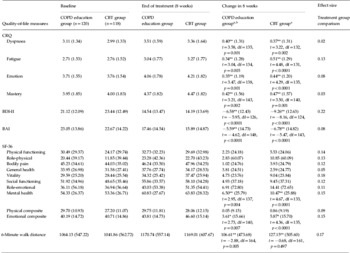
Values are mean (standard deviation).
COPD, Chronic obstructive pulmonary disease; CBT, cognitive behavioral therapy; BDI-II, Beck Depression Inventory II; BAI, Beck Anxiety Inventory; CRQ, Chronic Respiratory Questionnaire; SF-36, Medical Outcomes Survey Short Form-36; df, degrees of freedom.
a Reflects a significant change over time in the combined treatment groups (time effect was significant) and the absence of a difference between groups (time by treatment effect was not significant) from the analysis of variance model.
b The change from baseline to end of treatment at 8 weeks was not significantly different between groups for any of the variables.
* p<0.01, ** p<0.005.
Significant improvement was noted in CRQ subcategory scores (p<0.005); mean CRQ subcategory scores improved on average by 0.38 points in the COPD education group and 0.44 points in the CBT group during the 8-week treatment period; and in the SF-36 mental health score (p<0.005) and emotional composite score (p<0.01); but changes did not differ significantly between groups.
Similarly, significant improvement was also noted in BDI-II and BAI scores and 6MWD (p<0.005) over the treatment period, but changes did not differ significantly between groups. Observed effect sizes of the comparison of change between groups were small (Table 2). A secondary analysis using a t test to compare mean change in the outcome from baseline to 8 weeks between groups and baseline values between groups also showed no significant differences between groups.
Participants with a SCID diagnosis of anxiety disorder had lower baseline values for CRQ fatigue and emotion, and SF-36 vitality, social function, mental health and emotional composite, and higher baseline values for BDI-II than participants without a SCID anxiety diagnosis. Patients with a SCID diagnosis of depressive disorder had lower baseline values of the CRQ emotion subcategory score and the SF-36 mental health composite score than participants without a SCID diagnosis of depressive disorder. However, participants with either SCID diagnosis did not have significantly different time and treatment effects from patients without a SCID diagnosis.
Follow-up values of outcome measures
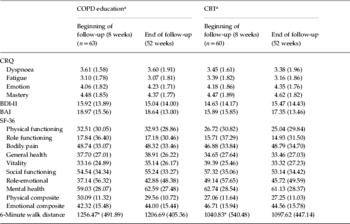
The only significant difference between groups at the beginning of follow-up was in the 6MWD (1256.47±53.70 for COPD education and 1040.83±58.62 for CBT, p<0.01) (Table 3).
Change in quality of life during follow-up (weeks 8–52): means at beginning and end of the 44-week period

Values are mean (standard deviation).
COPD, Chronic obstructive pulmonary disease; CBT, cognitive behavioral therapy; CRQ, Chronic Respiratory Questionnaire; BDI-II, Beck Depression Inventory-II; BAI, Beck Anxiety Inventory; SF-36, Medical Outcomes Survey Short-Form 36.
a The change from beginning to end of follow-up was not significantly different between groups for any of the variables.
* p<0.01; group means are not equal at beginning of follow-up period.
Improvement was maintained with no significant change in values for 44 weeks and no significant differences in change between groups.
Rate ratios of service use during the 12 months relative to the 3 months preceding baseline, and also cross-product ratios, were not significantly different from 1, indicating that ratios of post-treatment to pretreatment number of visits in the groups were equal. There were approximately 0.97 out-patient visits, 0.053 hospital admissions, 0.17 mental health visits and 0.10 emergency visits per month, per participant, in this population.
Discussion
Both CBT group treatment for anxiety and depressive symptoms and COPD education significantly improved QoL, anxiety, depression and 6MWD, with no significant differences between groups, and improvement was maintained during the following 44 weeks. The CBT group-treatment intervention was not more efficacious than COPD education in reducing anxiety and depression, as we had hypothesized. Use of health services was not significantly affected by either intervention.
Our studies (Kunik et al. Reference Kunik, Roundy, Veazey, Souchek, Richardson, Wray and Stanley2005; Roundy et al. Reference Roundy, Cully, Stanley, Veazey, Souchek, Wray and Kunik2005) have found prevalence rates of 26.4% for moderate depressive symptoms (BDI 20–28) and 23.9% for severe depressive symptoms (BDI>28), and also prevalence rates of 17–26% for moderate anxiety (BAI>18) and 26–32% for mild anxiety (BAI>15) (Kunik et al. Reference Kunik, Braun, Stanley, Wristers, Molinari, Stoebner and Orengo2001; Kim et al. Reference Kim, Kunik, Molinari, Hillman, Lalani, Orengo, Petersen, Nahas and Goodnight-White2000). Given that 24–74% of persons with chronic breathing disorders have clinically significant anxiety or depression (Kunik et al. Reference Kunik, Roundy, Veazey, Souchek, Richardson, Wray and Stanley2005), health-care systems might consider providing interventions to prevent potential deterioration in QoL for these patients.
Although we expected treatment to improve all measures of emotional well-being, COPD is a chronic degenerative disease and we did not expect improvement in physical status. Improvement was modestly clinically significant as defined by mood (Seggar et al. Reference Seggar, Lambert and Hansen2002), anxiety (Steer et al. Reference Steer, Willman, Kay and Beck1994) and QoL outcomes (Jaeschke et al. Reference Jaeschke, Singer and Guyatt1989; Wyrwich et al. Reference Wyrwich, Bullinger, Aaronson, Hays, Patrick and Symonds2005), suggesting that incorporating COPD education and/or CBT group treatment for anxiety and depression into the treatment of persons with at least moderate symptoms can be beneficial in improving QoL. Because one intervention provided instruction about COPD and the other provided instruction about anxiety/depression, both may have increased self-efficacy of patients, which could partly explain the decreased anxiety and depression in both groups. The literature has repeatedly demonstrated a significant effect of CBT relative to no treatment for late-life anxiety disorders (Stanley et al. Reference Stanley, Hopko, Diefenbach, Bourland, Rodrigues and Wagener2003a), but response rates with older adults are lower than with younger adults, and effects of CBT relative to other interventions such as supportive therapy are small (Wetherell et al. Reference Wetherell, Lenze and Stanley2005). It is possible that treatment conducted by more senior experts might provide greater divergence of outcomes, as well as treatment being more individualized to patient needs than was possible in group treatments. In addition, including patients with more severe symptoms might also have shown a greater difference in results across groups; however, when we examined those with diagnoses, this was not so.
Current results differ from the findings of our small, earlier trial (Kunik et al. Reference Kunik, Braun, Stanley, Wristers, Molinari, Stoebner and Orengo2001) evaluating one session of CBT for anxiety and depression in elderly patients with COPD, in that CBT decreased depression and anxiety more than education in the earlier study. However, the groups studied were different: the earlier study recruited COPD patients who, on average as a group, showed some depression and anxiety, whereas this study targeted patients with at least moderate symptoms of these disorders, screened for them and had participants complete diagnostic instruments.
Although effective for treating depression in patients with a wide range of physical diseases (Borson et al. Reference Borson, McDonald, Gayle, Deffebach, Lakshminarayan and VanTuinen1992; Gill & Hatcher, Reference Gill and Hatcher2007), antidepressants do not reliably affect disease self-management behaviors in chronically ill patients (Gill & Hatcher, Reference Gill and Hatcher1999). No studies have compared the efficacy of antidepressants, CBT and COPD education. In addition, pharmaceutical studies have targeted only patients with a diagnosis of depression, whereas this study targeted patients with clinically significant anxiety or depressive symptoms. No controlled pharmaceutical studies have evaluated efficacy in anxious persons with physical illness. As has been noted, commonly used instruments and screening tools necessary for diagnosis of DSM-IV disorders are somewhat impractical for use in the primary care environment (Pincus, Reference Pincus2003). This study provides useful and feasible tools for the primary care provider for screening and targeting patients for intervention (Kunik et al. Reference Kunik, Azzam, Souchek, Cully, Wray and Krishnan2006).
Other strengths of this study are its focus on older adults, suggesting that findings are relevant and meaningful for the population being studied, and the year-long follow-up, demonstrating sustainable improvements.
Regarding limitations, low recruitment was a problem. Of 256 eligible participants, 238 people were randomized, but only 181 attended their first session. However, retention in research studies at this facility can often be challenging. In general, patients treated at VA facilities tend to have more physical and mental problems than the average US citizen (VA Office of Quality and Performance, 2000). Even within the VA system, Veterans Integrated Services Network (VISN) 16, to which MEDVAMC belongs, ranks low in terms of patients' physical and mental well-being, as documented in the 1999 Large Health Survey of Veterans (VA Office of Quality and Performance, 2000), so just getting to and from sessions might have been problematical. In addition, 56.8% of VISN 16 veterans who receive treatment at VA facilities have an educational level of ⩽12 years (VA Office of Quality and Performance, 2000), which may result in their being less motivated to participate in psychological interventions.
Other limitations relate to the way interventions were delivered. Set sessions at the same, fixed time each week might have contributed to drop-outs, and the group format, requiring exposure of all subjects to all skills and information, might have prevented individuals from benefiting from extra exposure to individually appropriate techniques or ideas. More idiographic treatment, provided in an individual format, might improve outcomes. The study population also consisted mostly of white male veterans, limiting its generalizability. In addition, 40% of patients did not meet criteria for DSM-IV diagnoses, and patients with symptoms that reach disorder criteria might respond differently to treatment. Finally, we did not document (1) psychotropic medication changes throughout the study, or (2) changes in COPD medication during the study. It is possible that the first weakness could have obscured differences in results between the two treatments. Although we expected fairly consistent medical treatment between groups, documenting differences in this area might have helped to substantiate the value of one approach over the other.
Our study compared two active interventions. In the COPD education intervention, patients not only received lectures and materials about COPD but also were around other patients with similar situations and problems. The opportunity for interaction and support provided by the sessions may have increased their benefit. A recent meta-analysis of 14 RCTs found self-help groups to be effective in treating emotional disorders (den Boer et al. Reference den Boer, Wiersma and Van den Bosch2004).
Given the high percentage of patients with COPD and at least moderate levels of anxiety and depression, interventions at the level of diagnosis, acute treatment, and long-term management are greatly needed. This study highlights the benefits of incorporating mental health screening, education and care into COPD clinical practices and suggests that CBT or COPD education can result in sustainable improvement of QoL for patients with moderate-to-severe depression or anxiety.
Acknowledgments
This study was supported by Grant No. IIR 00-097 from the Department of Veterans Affairs, Veterans Health Administration, Health Services Research and Development (HSR&D) Service, Washington, DC, and in part by the Houston Center for Quality of Care and Utilization Studies, HSR&D Service, Office of Research and Development; and the South Central Mental Illness Research, Education and Clinical Center, Department of Veterans Affairs.
We thank Avila Steele, Annette Walder and Sonora Hudson for their assistance in data monitoring/coordination, statistical analysis, and manuscript editing/preparation, respectively.
Declaration of Interest
None.