INTRODUCTION
Interactions between different parasite species sharing the same host population can play important roles in determining patterns of parasite abundance and diversity within host individuals (Sousa, Reference Sousa1994; Poulin, Reference Poulin2001, Reference Poulin2007). However, interspecific interactions among parasites vary both in their qualitative nature and in their quantitative impact. The larval stages of trematodes within snail first intermediate hosts provide interesting models to study interspecific antagonistic interactions among parasites. For instance, some trematode species are capable of directly predating on other species co-occurring in the same individual host, eventually eliminating them from the host (e.g. Lim and Heyneman, Reference Lim and Heyneman1972; Sousa, Reference Sousa1993). This is often invoked to explain deficits in multi-species infections observed in natural snail populations, i.e. different trematode species often co-occur in the same individual snails less frequently than expected from their respective prevalences (Kuris and Lafferty, Reference Kuris and Lafferty1994; Lafferty et al. Reference Lafferty, Sammond and Kuris1994). Since infection rates are low in most snail populations, with overall prevalence of infection by all trematode species combined typically below 15–20% (Poulin and Mouritsen, Reference Poulin and Mouritsen2003), it may be that different species rarely encounter each other anyway and that such strong interactions play little role at the component community level (see Esch et al. Reference Esch, Curtis and Barger2001; Curtis, Reference Curtis2002).
In systems where prevalences are higher, strong antagonistic interactions among trematode species can become important, as can weaker interactions involving straightforward competition for space and other resources. Snails become infected either when they ingest a trematode egg or when they are penetrated by free-swimming miracidia hatched from those eggs, depending on the trematode species. In areas of high trematode prevalence, it is likely that snails are exposed to repeated infections over relatively short periods of time. Trematodes multiply asexually within their snail first intermediate host, though a snail provides only limited space for parasite use. If it is to survive, the snail cannot lose tissues other than its gonads to make room for parasites, nor can it increase its food intake indefinitely. These constraints set the stage for intense competition for resources among trematodes sharing the same host. Different species of trematodes could avoid direct competition by each targeting a different subset of the host population and thus avoiding co-occurrence in the same individual host. If and when they do co-occur, competition for resources could manifest itself in at least two ways. First, we might expect that, all else being equal, the number of rediae or sporocysts of one species would be lower in the presence of another species within the same snail compared to when it is found alone. In support of this prediction, Hendrickson and Curtis (Reference Curtis2002) have observed this numerical response between 2 trematode species co-occurring in the same snail, though the effect was shown by only 1 of the 2 species, the other being unaffected by the presence of its potential competitor. Similarly, Lagrue et al. (Reference Lagrue, McEwan, Poulin and Keeney2007) have found that the number of sporocysts issued from one miracidium decreased as the number of miracidia that infected one snail increased; this was a case of intraspecific competition for resources within the snail, but the pattern translates easily to interspecific competition, given that all trematode species have more or less the same resource requirements (e.g. food and space). The second way in which competitive effects could be manifested would involve a failure by miracidia of one species to infect a snail harbouring infection by a second species. Thus, we might expect that the number of clones (each issued from a single miracidium) of one species would be lower in the presence of another species within the same snail. This potential effect could limit the genetic diversity of infections within hosts. To our knowledge, no previous study has investigated this possibility.
Here, we examined interactions between the two most common trematode species using the intertidal snail Zeacumantus subcarinatus (Batillariidae) as first intermediate host in Otago Harbour, South Island, New Zealand. The most common trematode infecting Z. subcarinatus is Maritrema novaezealandensis (Microphallidae), which develops into sporocysts inside the snail (Martorelli et al. Reference Martorelli, Fredensborg, Mouritsen and Poulin2004). The second most prevalent trematode in this snail is Philophthalmus sp. (Philophthalmidae), which develops into rediae in the snail (Martorelli et al. Reference Martorelli, Fredensborg, Leung and Poulin2008). We have developed microsatellite loci for M. novaezealandensis (Keeney et al. Reference Keeney, Waters and Poulin2006), which make it possible to identify the number of clones, i.e. the number of different miracidial infections, inside any given snail and detect multiple genetic clones within individual snails (Keeney et al. Reference Keeney, Waters and Poulin2007). Both of these trematodes occupy the place where the gonads would be in an uninfected snail, castrating the snail in the process. The high total prevalence of these and other less common trematodes and their impact on snail reproduction combine to depress snail population density in some areas of Otago Harbour (Fredensborg et al. Reference Fredensborg, Mouritsen and Poulin2005).
The specific objectives of this study were (i) to compare the sizes of snails harbouring both Philophthalmus sp. and M. novaezealandensis with those harbouring each individual species separately; (ii) to determine whether the proliferation of Philophthalmus sp., measured by the number of rediae, is influenced by the co-occurrence of M. novaezealandensis in the same snail; and (iii) to determine whether the genetic diversity of M. novaezealandensis infections, quantified by the number of clones per snail, is affected by the presence of Philophthalmus sp. in the snail. These results will add new insights to our growing understanding of interspecific interactions among trematodes in snail hosts.
MATERIALS AND METHODS
Approximately 500 Z. subcarinatus snails were collected haphazardly during low tide from Lower Portobello Bay in Otago Harbor, South Island, New Zealand in November 2005. The maximum shell length of each snail was measured with Vernier calipers to the nearest 0·1 mm (mean values are followed by standard deviations), snails were dissected, and any parasites within the snails were identified. To examine relationships between snail size, larval parasite number, and parasite clonal diversity, the first 20 snails possessing only Philophthalmus sp. and 25 snails possessing both M. novaezealandensis and Philophthalmus sp. were selected and the number of mature Philophthalmus sp. rediae within each snail was counted using a stereomicroscope. The number of M. novaezealandensis sporocysts per snail could not be counted accurately since sporocysts often form clumps that cannot be disentangled without destroying them. For the snails possessing both M. novaezealandensis and Philophthalmus sp., 20 individual M. novaezealandensis sporocysts were haphazardly selected and retained from each snail for genetic analyses. The sporocysts were rinsed in fresh water that had been 0·22 μm filtered, and then placed into 1·5 ml tubes.
For DNA extraction, individual sporocysts were placed in 400 μl of 5% chelex containing 0·1 mg/ml proteinase K, then incubated at 60°C for 2 h and boiled at 100°C for 8 min. The genotypes at 5 microsatellite loci (Mno-1, Mno-28, Mno-30, Mno-45 and Mno-47) were determined for the 20 individual M. novaezealandensis sporocysts collected from each of 25 snails, as described by Keeney et al. (Reference Keeney, Waters and Poulin2006, Reference Keeney, Waters and Poulin2007). Previously, we determined that 20 sporocysts per snail are sufficient to estimate the number of genotypes occurring within a snail (Keeney et al. Reference Keeney, Waters and Poulin2007). Identical multilocus genotypes were identified with the program GENALEX 6 (Peakall and Smouse, Reference Peakall and Smouse2006). The following analyses used unique genotypes within snails only, since identical trematode clones within snails are the products of asexual reproduction. Expected and observed heterozygosities, Weir and Cockerham's (Reference Weir and Cockerham1984)f estimator of F IS, deviations from Hardy-Weinberg (H-W) expectations, and tests of genotypic disequilibrium between all pairs of loci were calculated with GENEPOP version 3.4 (Raymond and Rousset, Reference Raymond and Rousset1995). Significance of deviations from H-W expectations was determined using the Markov chain exact probability test of Guo and Thompson (Reference Guo and Thompson1992) and significance of genotypic disequilibrium values was determined using Fisher's exact test as implemented in GENEPOP version 3.4 (10 000 dememorizations, 1000 batches, and 10 000 iterations per batch were used for all tests). Alpha significance values were corrected for multiple pair-wise comparisons for tests of H-W deviations and genotypic disequilibrium using the sequential Bonferroni approach (Rice, Reference Rice1989) (initial significance determined at P⩽0·05/5=0·010 and P⩽0·05/4=0·013 for H-W and disequilibrium tests, respectively).
The following statistical analyses were performed with SPSS 13.0 for Windows; nonparametric tests were used for data that did not conform to the assumptions of normality and equality of variances. A Kruskal-Wallis (K-W) test was used to examine if differences occurred in the length of snails infected with only M. novaezealandensis, snails infected with both M. novaezealandensis and Philophthalmus sp., and snails infected with only Philophthalmus sp. Post-hoc pair wise comparisons were made between each pair of infection classes with Mann-Whitney U (M-W) tests and alpha significance values were corrected for multiple pairwise comparisons using the sequential Bonferroni approach (initial significance determined at P⩽0·05/2=0·025). The relationship between snail length and number of Philophthalmus sp. rediae was examined separately for snails possessing Philophthalmus sp. only and those harbouring Philophthalmus sp. with M. novaezealandensis using Pearson product-moment correlations. Analysis of covariance (ANCOVA) with snail length treated as a covariate was used to compare the number of Philophthalmus sp. rediae between snails with only Philophthalmus sp. and snails infected with both M. novaezealandensis and Philophthalmus sp. The strength of the relationship between the number of M. novaezealandensis genotypes detected and number of Philophthalmus sp. rediae was examined using Spearman's rank-order correlation. The mean number of M. novaezealandensis genotypes from the snails possessing both M. novaezealandensis and Philophthalmus sp. detected in this study was compared to the mean number identified previously in 21 snails possessing only M. novaezealandensis from the same sample collection (Keeney et al. Reference Keeney, Bryan-Walker, King and Poulin2008) with a M-W test.
RESULTS
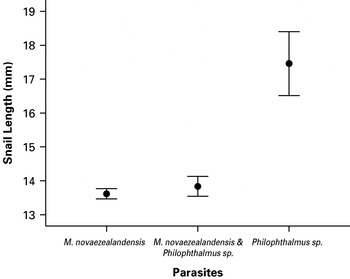
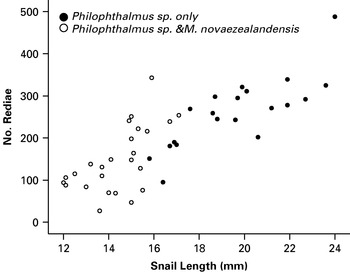
A total of 493 snails were dissected from the initial sample collection and ranged in length from 10·1 to 24·0 mm (mean=14·3±1·8). In total, 245 snails (49·7%) were infected with only M. novaezealandensis (length=10·7 to 19·3, mean=13·6±1·2), 39 snails (7·9%) were infected with only Philophthalmus sp. (length=13·6 to 24·0, mean=17·5±2·9), and 58 snails (11·8%) were infected with both Philophthalmus sp. and M. novaezealandensis (length=12·0 to 17·1, mean=13·8±1·2). Additional trematodes found within snails included species belonging to the families Heterophyidae, Microphallidae, and Echinostomatidae, and 54 snails (11·0%) were not infected with any trematode species (length=10·1 to 17·0, mean=14·2±1·1). A significant difference in length was detected among snails infected with only M. novaezealandensis, snails infected with both M. novaezealandensis and Philophthalmus sp., and those infected with only Philophthalmus sp. (K-W test, H=73·010, D.F.=2, P<0·001) (Fig. 1). Post-hoc pairwise comparisons indicated that there was no significant difference in the length of snails infected with only M. novaezealandensis versus snails infected with both M. novaezealandensis and Philophthalmus sp. (M-W test, Z=−1·175, P=0·240), but that both of these classes were significantly smaller than snails infected with Philophthalmus sp. only (M-W tests, Z=−8·452, P<0·001 for snails infected with only M. novaezealandensis versus snails infected with Philophthalmus sp. only and Z=−6·796, P<0·001 for snails infected with both M. novaezealandensis and Philophthalmus sp. versus snails infected with Philophthalmus sp. only). The subset of 25 snails possessing both M. novaezealandensis and Philophthalmus sp. used for redial counts ranged in length from 12·0 to 17·1 mm (mean=14·4±1·4) and the 20 possessing only Philophthalmus sp. ranged in length from 15·8 to 24·0 mm (mean=19·6±2·4). The number of Philophthalmus sp. rediae was positively and linearly related to snail length for both snails possessing only Philophthalmus sp. (R 2=0·645, P<0·001) and snails possessing Philophthalmus sp. and M. novaezealandensis (R 2=0·386, P=0·001) (Fig. 2). There was no significant difference in the number of Philophthalmus sp. rediae between snails with Philophthalmus sp. only versus snails with M. novaezealandensis and Philophthalmus sp. (ANCOVA, F 1,42=1·902, P=0·175, 4·3% of the variance in number of rediae explained by presence/absence of M. novaezealandensis) once samples were corrected for differences in snail length (as previously mentioned mean snail length was significantly different between these groups, and explained 50·2% of the variance in number of rediae).
Length of snails infected with only Maritrema novaezealandensis (n=245), M. novaezealandensis and Philophthalmus sp. (n=58), and only Philophthalmus sp. (n=39). Circles represent mean values with 95% confidence intervals.

Relationship between snail length and number of Philophthalmus sp. rediae for snails infected with only Philophthalmus sp. (n=20) and snails infected with both Philophthalmus sp. and Maritrema novaezealandensis (n=25).

A total of 500 M. novaezealandensis sporocysts were genotyped from the snails possessing both M. novaezealandensis and Philophthalmus sp. (20 sporocysts from each of 25 snails) and 34 different genotypes were identified. The number of alleles for each locus ranged from 3 to 22 and observed heterozygosities ranged from 0·500 to 0·735 (Table 1). No loci deviated significantly from Hardy–Weinberg expectations and significant genotypic disequilibrium was detected between loci Mno-1 and Mno-45 (P=0·003; all other comparisons P⩾0·361). Individual snails possessed 1–3 M. novaezealandensis genotypes (mean=1·36±0·64) and 7 snails contained more than 1 genotype. There was no significant relationship between the number of M. novaezealandensis genotypes detected and number of Philophthalmus sp. rediae present within snails (r S=−0·202, P=0·332). No difference was detected in the mean number of M. novaezealandensis genotypes between snails possessing M. novaezealandensis and Philophthalmus sp. and snails possessing only M. novaezealandensis (M-W test, Z=−0·972, P=0·331).
Microsatellite data for each locus and over all loci for Maritrema novaezealandensis in snails
(A=number of alleles, H o=observed heterozygosity, H e=expected heterozygosity, f=Weir and Cockerham's (1984) estimator of F IS.)

DISCUSSION
It seems almost inevitable that when 2 or more parasite species co-exist frequently under conditions of limited resources, not only will competition take place, but it is also expected to have measurable impacts on parasite infrapopulations (i.e., all conspecific parasites occurring in the same host individuals). The requirement of high prevalence for interspecific competition to play a meaningful role is entrenched in the parasitology literature (Holmes and Price, Reference Holmes, Price, Anderson and Kikkawa1986; Poulin, Reference Poulin2001, Reference Poulin2007). In our system, with sampling restricted to medium- and large-sized snails (Philophthalmus sp. is rarely found within small snails), we found that almost two-thirds of dissected snails harboured Maritrema novaezealandensis infections, while almost 20% harboured Philophthalmus sp. infections. These relatively high prevalences resulted in frequent co-occurrences in the same individual snails. For instance, of the 97 snails infected by Philophthalmus sp., more than half (60%, or 58 snails) shared their snail host with M. novaezealandensis. This situation could have population-level consequences if the two species exert intense competitive effects on each other. Our results, however, reveal that these competitive effects may not be strong.
We found that, among snails infected by Philophthalmus sp., the number of Philophthalmus sp. rediae per snail was the same, on average, whether or not the snail also harboured M. novaezealandensis. This finding mirrors that of Hendrickson and Curtis (Reference Curtis2002), who reported that the number of rediae of Himasthla quissetensis was unaffected by the co-occurrence of another trematode, Zoogonus rubellus, in the same snail. Both these results suggest that the multiplication of trematode species that develop through rediae is insensitive to the presence of other trematode species that use sporocysts instead. It has long been recognized that trematode species using rediae are often competitively superior to those using sporocysts within snails. In fact, rediae can directly feed on sporocysts (Lim and Heyneman, Reference Lim and Heyneman1972; Sousa, Reference Sousa1993), and in hierarchies of pairwise antagonistic interactions among co-existing trematode species, species with rediae are typically dominant (Kuris, Reference Kuris, Esch, Bush and Aho1990; Kuris and Lafferty, Reference Kuris and Lafferty1994). In our system, rediae of Philophthalmus sp. have been seen piercing and potentially feeding on sporocysts of M. novaezealandensis (D. Keeney, unpublished observation). Thus, the proliferation of Philophthalmus sp. inside a snail appears more or less independent of the presence or absence of M. novaezealandensis, and seems instead mainly constrained by the size of the snail as the number of rediae increased with snail length.
Although the above result was not entirely surprising, the lack of an effect of the presence or number of Philophthalmus sp. rediae on the likelihood of multiple M. novaezealandensis infections in the same snail was somewhat unexpected. Trematode species with sporocysts can incur a cost of sharing a snail with species that have rediae. For example, the number of sporocysts of Zoogonus rubellus is significantly reduced by the presence of Himasthla quissetensis, which develops through rediae (Hendrickson and Curtis, Reference Curtis2002). We could not count the number of M. novaezealandensis sporocysts in our snails, as explained in the Materials and Methods section. However, given the general negative impact of species with rediae, such as Philophthalmus sp., on species with sporocysts, we would have expected that it would be less likely that additional M. novaezealandensis infections, originating from further eggs ingested by the snails, would become established and multiply in snails harbouring Philophthalmus sp. rediae. We found a maximum of 3 different genotypes, i.e. 3 clones each issued from a different egg, inside a single snail, though our earlier studies of the genetic diversity of M. novaezealandensis from the same site suggests there can be up to 5 clones in certain snails (Keeney et al. Reference Keeney, Waters and Poulin2007). The similar number of M. novaezealandensis clones per snail found in snails with and without Philophthalmus sp. could mean that it is possible for new clones to become established independently of the presence of a more ‘dominant’ infection by rediae of another species. However, this opportunity may diminish with the duration of the redial species' infection as new M. novaezealandensis infections are not occurring in the large snails harbouring only Philophthalmus sp. Alternatively, the multiple infections by different clones of M. novaezealandensis may have occurred prior to the arrival of Philophthalmus sp. in the snail, and from that point on further infections by M. novaezealandensis may be unlikely. Since M. novaezealandensis clones do not appear to accumulate within snails throughout the snails' lives (Keeney et al. Reference Keeney, Waters and Poulin2007), the presence of established clones may prevent the successful establishment of additional clones, regardless of the presence or absence of Philophthalmus sp. A decline in M. novaezealandensis genetic diversity could then result from interactions with a subsequent Philophthalmus sp. infection, but would be difficult to detect given the number of sporocysts remaining in the snails we examined.
At the level of the snail population, there is little evidence of severe antagonism between the two trematode species. Of the 493 snails dissected, the number (58 snails) that harboured both M. novaezealandensis and Philophthalmus sp. is almost exactly the same as the number (60 snails) that would be expected by chance alone based on the respective prevalences of the two species. There was, however, an apparent segregation between the two trematodes based on snail size: snails harbouring only Philophthalmus sp. were clearly larger than either those harbouring only M. novaezealandensis or both M. novaezealandensis and Philophthalmus sp. The differences in shell length we observed between snails infected by different species (or by both species) have several potential explanations. Since both trematodes are relatively common in snails that are approximately 12–15 mm long, but only Philophthalmus sp. is typically found in the largest snails, direct antagonism in snails where they co-occur may, in part, account for the disappearance of M. novaezealandensis in larger and older snails.
Given the high prevalence of M. novaezealandensis without Philophthalmus sp., processes in addition to direct antagonism must also operate to explain the lack of large snails possessing M. novaezealandensis. Firstly, perhaps snails harbouring M. novaezealandensis succumb to their infection, whereas those with Philophthalmus sp. can live for much longer and thus achieve greater shell lengths. Other studies have indeed reported trematode-induced mortality in intertidal snails, often specific to certain trematode species only (e.g. Sousa and Gleason, Reference Sousa and Gleason1989; Huxham et al. Reference Huxham, Raffaelli and Pike1993). Secondly, snails harbouring M. novaezealandensis may be capable of either outliving or eliminating their infection, whereas those with Philophthalmus sp. may not do so, such that among large snails, those with Philophthalmus sp. infections far outnumber those infected by M. novaezealandensis. Although the mean sizes of snails harbouring M. novaezealandensis and those with both species co-occurring were similar in the present study, only M. novaezealandensis was found in snails shorter than 12 mm (n=17) and M. novaezealandensis is relatively common in snails smaller than those in the present sample while Philophthalmus sp. is not (D. Keeney, unpublished observation). Earlier infections could facilitate snails outliving M. novaezealandensis infections versus Philophthalmus sp. The observed size segregation could also indicate that M. novaezealandensis infections facilitate subsequent Philophthalmus sp. infections, perhaps by providing a usable food source or compromising the snail's immune system as proposed for Austrobilharzia terrigalensis (Walker, Reference Walker1979), that then outlast M. novaezealandensis within the snail. However, this would require that the consistency between observed and expected numbers of mixed-species infections is a coincidence, and is highly speculative given the present dataset. Thirdly, the patterns we observed could be explained by differential effects of the two trematodes on the growth of their snail hosts. If M. novaezealandensis has no effect on snail growth, whereas Philophthalmus sp. causes snail gigantism, as seen in other systems (see Gorbushin and Levakin, Reference Gorbushin and Levakin1999; Sorensen and Minchella, Reference Sorensen and Minchella2001), then the shell size differences we found would be a logical result. However, an earlier study (Hay et al. Reference Hay, Fredensborg and Poulin2005) in our system suggests that effects of Philophthalmus sp. on snail growth, if any, are more likely to be manifested by a slight increase in shell diameter than by any increase in shell length. Therefore the exact reasons for the differences in shell length we observed between snails infected by different species remain to be determined. Nevertheless, these differences, combined with the results of our within-snail analyses of numbers of Philophthalmus sp. rediae and numbers of M. novaezealandensis genotypes, suggest that although interspecific antagonism may occur in mixed-species infections, it is unlikely to be a major force shaping the abundance and dynamics of these two common parasites in the component community.
Funding for this research was provided by the Royal Society of New Zealand's Marsden Fund.