Implications
In the Mediterranean Basin, organic production could be a viable alternative for increasing sustainability of small ruminant pasture-based farms. Indicators are required to provide concise and valuable information regarding possibilities for converting small ruminant farms to organics. The conversion could involve a redesigned system, therefore not only the obligatory compliance issues should be considered but also those related to agroecological management. This article proposes a concise method for improving the adaptation of dairy goat farms to the organic model.
Introduction
Pasture-based small ruminant systems play an important socioeconomic and environmental role in the Mediterranean Basin; however, they are decreasing in number (De Rancourt et al., Reference De Rancourt, Fois, Lavín, Tchakérian and Vallerand2006). In general, agriculture worldwide has become greatly intensified and modernized over the past few decades (LaSalle et al., Reference LaSalle, Happerly and Diop2008). This has led to an increase in the use of fertilizers, synthetic pesticides, antibiotics, hormones and fossil fuels, and consequently led to an increase in environmental problems (Pimentel et al., Reference Pimentel, Hepperli, Hanson, Douds and Seidel2005). Agroecology, which defines, classifies and analyses agrarian systems from agronomic, ecological and socioeconomic viewpoints (Labrador and Sarandon, Reference Labrador and Sarandon2001), is proposed to solve these environmental problems. Organic agriculture is by definition the practical application of agroecology.
Organic agriculture is based on four principles (International Federation of Organic Agriculture Movements (IFOAM), 2009): Health (organic agriculture should sustain and enhance the health of soils, plants, animals and humans as one and indivisible); Ecology (organic agriculture should be based on living ecological systems and cycles, work with them, emulate them and help sustain them); Fairness (organic agriculture should build on relationships that ensure fairness with regard to the common environment and life opportunities); and Care (organic agriculture should be managed in a precautionary and responsible manner to protect the health and well-being of current and future generations and the environment).
Organic livestock is fundamentally based on grazing, integrating the soil–plant–animal cycle, conserving the environment and biodiversity and favouring animal welfare. Furthermore, food produced on organic farms is free from chemical substances and genetically modified organisms, and has favourable organoleptic properties (Pimentel et al., Reference Pimentel, Hepperli, Hanson, Douds and Seidel2005). Organic production may also contribute to mitigating environmental problems, and is thus accepted by consumers and society in general (Pingali and Raney, Reference Pingali and Raney2005; Vaarst et al., Reference Vaarst, Padel, Hovi, Younie and Sundrum2005). In addition, Ronchi and Nardone (Reference Ronchi and Nardone2003) state that organic farming practices may help promote sustainable land use and improve environment conservation, animal welfare and product quality, which is of particular interest for the less favoured Mediterranean areas.
Small ruminant farms in the Mediterranean Basin mainly use indigenous breeds (Castel et al., Reference Castel, Ruiz, Mena and Sánchez Rodríguez2010), which are greatly valued by organic producers for their successful adaptation to a high-forage diet, good production level and longevity. Furthermore, in this region, many farms graze their animals on natural pastures (Hadjigeorgiou et al., Reference Hadjigeorgiou, Osoro, Fragoso de Almeida and Molle2005), which are also much appreciated by organic producers for the following reasons: (i) lower manpower requirements (García-Martínez et al., Reference García-Martínez, Olaizola and Bernués2009); (ii) contribution to better milk quality (Cuchillo et al., Reference Cuchillo, Delgadillo, Navarro and Pérez-Gil2009); (iii) better image of the system as perceived by the consumer (Dubeuf et al., Reference Dubeuf, Ruiz Morales and Castel Genís2010); (iv) better balance between ecosystems, biodiversity and landscape conservation (Bernués et al., Reference Bernués, Ruiz, Olaizola, Villalba and Casasús2011).
In order to increase organic husbandry, it would be useful to follow a concise method to evaluate the degree of approximation of conventional farms to the organic model of production and identify aspects to be improved on each farm. This method should be broad and multidimensional (Munda, Reference Munda2004; Bellon and Lamine, Reference Bellon and Lamine2009), and should address the management of animals, soils and vegetation, as well as environmental, economic and social aspects. They should be expressed through indicators so as to compare different farms in a region or country and analyse the evolution of a group of farms over time.
Previous studies report those indicators that have been used to analyse farm sustainability (Coffey et al., Reference Coffey, Reynolds and Hale2004; Nahed et al., Reference Nahed, Castel, Mena and Caravaca2006; Galán et al. Reference Galán, Peschard and Boizard2007; Peacock and Sherman, Reference Peacock and Sherman2010); animal welfare (Napolitano et al., Reference Napolitano, De Rosa, Ferrante, Grasso and Braghieri2009; Phythian et al., Reference Phythian, Michalopoulou, Jones, Winter, Clarkson, Stubbings, Grove-White, Cripps and Duncan2011), environmental effects, animal welfare and milk quality of organic farms (Müller-Lindenlauf et al., Reference Müller-Lindenlauf, Deittert and Köpke2010), and differences, in general, between organic and conventional farms (Nauta et al., Reference Nauta, Baars and Bovenhuis2006; Rozzi et al., Reference Rozzi, Miglior and Hands2007). Other studies evaluate the technical and economic performance of organic farming (Benoit and Laignel, Reference Benoit and Laignel2009; Benoit et al., Reference Benoit, Tournadre, Dulphy, Laignel, Prache and Cabaret2009). Nevertheless, literature on the conversion to organic farming is sparse (Bellon and Lamine, Reference Bellon and Lamine2009), and few specific methods have been proposed for evaluating the possibilities for this conversion (Olivares et al., Reference Olivares, Gómez and Meraz2005). In this sense, principles-based indicators should be considered to avoid the introduction of farming practices that undermine the principles of organic farming (Darnhofer et al., Reference Darnhofer, Lindenthal, Bartel-Kratocvhvil and Zollitsch2010).
This article proposes a farm-scale multicriteria method for assessing the conversion of dairy goat systems to the organic model that considers not only the EC regulations for organic livestock farming but also the agroecological principles. In addition, application possibilities are analysed in a case study in the Northern Sierra of Seville (NSS), southern Spain.
Methodology
Design of method
Indicator design and selection of relevant issues for evaluating the degree of approximation of livestock farms to the organic model were based on published articles, and were first evaluated by two panels of experts, followed by field surveys. A person with solid experience in agroecology, organic production and/or small ruminant grazing production, was considered an expert.
In 2007, eight academic experts in agroecology and organic production were invited to participate in the first panel of experts to evaluate on-farm indicators and issues, which had previously been identified in a bibliographical review. The main criterion followed for the selection of issues was that they should be directly related with the European standards on organic production concerning: (i) use of permitted and banned substances and restricted drugs that help to prevent, control, cure and eradicate diseases and avoid penalization (Gray and Hovi, Reference Gray and Hovi2001; Mata, Reference Mata2001); (ii) use of agroecological technologies, which should not contaminate, be dependent on capital or degrade the physical environment, but should permit the efficient use of local resources, the maintenance of biological diversity and the productive capacity of the soil in the long term (Guzmán and Alonso, Reference Guzmán and Alonso2001); (iii) implementation of management and promotion mechanisms for organic livestock farming.
Issues were identified as binomial variables (yes = 1, no = 0). All were considered as dummy variables (1, 0) to homogenize the units of measurement, and thus facilitate the calculation of each indicator. Dummy variables could be created because the organic standards are based on well-defined criteria or thresholds for the use of inputs or permitted and non-permitted practices, therefore, most variables can be answered in this way. In the case of continuous variables, such as variable 2.3 of Table 2 concerning Stocking rate, the original data were standardized to dummy variables assuming value 1 when the result was within the permitted or recommended threshold (in this case a stocking rate below or equal to 13.3 goat or sheep/ha) and value 0, in the opposite case. Therefore, all variables acquired an eigenvalue with a binomial or Bernoulli distribution (Zar, Reference Zar1984), which greatly simplified the method and made it easier to obtain information.
Subsequently, each indicator takes its value from the arithmetic mean of the values of its own variable (Grimm and Wozniak, Reference Grimm and Wozniak1990), multiplied by 100:

where j = 1, 2, 3, …, 9 indicators; i = 1, 2, 3, …, mj variables; mj representing the number of variables i for the indicator j; k = 1, 2, 3, …, 24 farms; vi(j, k) = variable i for indicator j and farm k (values ranged from 0 to 1).
In this way all the indicators are standardized to a common relative scale (%).
Variables were not weighted for the calculation of the indicators because they reached an eigenvalue with only two possible and mutually exclusive results (0 or 1). The optimum for each indicator was 100%, which was obtained if all of its variables elicited a positive answer.
The next stage was to confirm the interest of selected variables and the lack of important issues, taking into account the particularities of the organic small ruminant production in the Mediterranean Basin. For that purpose, a second panel of experts was constituted, integrated by 12 experts in organic and/or pastoral small ruminant production. In this case, technicians, organic certifiers and farmers were also included.
An Organic Livestock Proximity Index (OLPI) was drawn up with the collaboration of the second panel of experts. This Index was based on the multicriteria approach for weighting and aggregating multidimensional information (Munda et al., Reference Munda, Nijkamp and Rietveld1994; Falconi and Burbano, Reference Falconi and Burbano2004; Munda, Reference Munda2004).
The OLPI of each farm was the sum of its weighted indicator values:

where j = 1, 2, 3, …, 9 indicators; k = 1, 2, 3, …, 24 farms; WCj = weighting coefficient assigned to each indicator (Table 1); Ij(k) = the value of indicator j for farm k.
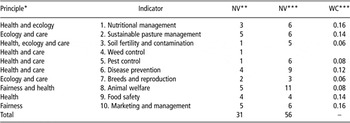
Indicators: principles linking, NV and WC used for calculating the ‘Organic Livestock Proximity Index’

NV = number of variables; WC = weighting coefficient.
*Principles of organic agriculture (IFOAM, 2009).
**Variables included for the first panel of experts.
***Variables and WC adopted after validation of second panel of experts. Indicators 4 and 5 were merged into the indicator named ‘Weed and pest control’. Therefore, the proposed method has only nine indicators.
The weighting coefficient or specific weight assigned to each indicator (between 0 and 1) was defined as a function of: (i) its importance according to the principles of organic livestock farming and agroecology and (ii) the difficulty in fulfilling the requirements of the European standards on organic production (Table 1). In this sense, Nutritional management and Marketing and management were the two indicators assigned the greatest weights, both because of their agroecological importance and the difficulty for the dairy goat farms in the Mediterranean Basin to reach them. In contrast, Soil fertility and contamination, Weed and pest control, Breeds and reproduction and Animal welfare obtained a lower score as, in general, the initial situation of the systems for which the method is proposed is closest to the organic model of production.
The global OLPI for all case-study farms was the average of their values:

where k = 1, 2, 3, …, 24 farms; OLPI(k) is the OLPI of each farm.
Application of the method in a case study
In the third phase, the method was tested in the field in a case study.
Characteristics of the study area
Forty-five percent of Spain's organic livestock farms are located in Andalusia. Thirteen percent of Andalusia's organic livestock farms (principally meat-purpose sheep and cattle) are located in the Andalusian province of Seville, where there are only 10 goat farms, all of which raise the animals for meat. Furthermore, few feed mills, slaughterhouses and cheese-making businesses exist in the province of Seville (3, 2 and 2, respectively; Ministry of the Environment and Rural and Marine Affairs (MARM), 2009).
The NSS is a traditional goat-farming region in Andalusia, southern Spain. Mountain dairy goat systems of this region are similar to those of other regions of the Mediterranean Basin. The NSS is located between 38° 05′ and 37° 31′ North latitude, and 6° 30′ and 5° 23′ West longitude. Altitude ranges from 236 to 968 m, and the area is characterized by sharp cliffs and gentle slopes. The predominant ecosystem is open woodland or dehesa (an agrosilvopastoral system common to western and southwestern Spain), with a Mediterranean climate, average annual rainfall of 730 mm and an average annual temperature of 16°C (Statistical Institute of Andalusia-Andalusian Government (SIA-AG), 2008). The average dairy goat herd size is 278 and the predominant breed is Florida, which yields an average of 346 kg of milk annually (Castel et al., Reference Castel, Mena, Ruiz, Camúñez-Ruiz and Sánchez-Rodríguez2011).
Data collection
Data were taken from a sample of 24 conventional goat farms (20% of all the NSS goat farms in the region), selected with the assistance of a local cooperative called Corsevilla.
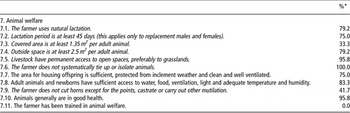
Throughout the spring and summer of 2008, a questionnaire regarding all the variables included in the method (Tables 2 to 6) was submitted to farmers. It is noteworthy that in the cases where the farmer gave negative answers to variables 1.3 and 1.4 of Table 2, that is, they did not grow crops, variables 2.1, 4.4, 4.5 and 5.6 of Tables 2 to 4 were not taken into account for the calculation of the corresponding indicators (Sustainable pasture management and Weed and pest control).
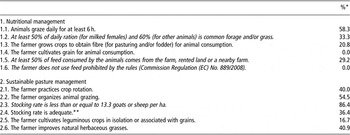
Variables included in indicators 1 to 2 (items of obligatory compliance according to EC 889/2008 are in italics)

*The value reached for each variable corresponds to the percentage of farms with an affirmative response for that variable.
**Stocking rate is adequate if it is within the limits considered optimal for the type of ecosystem and animal studied (0.8 to 3.2 goats/ha; Ruiz et al., Reference Ruiz, Castel, Mena, Camúñez and González-Redondo2008) and signs of overgrazing are not observed.
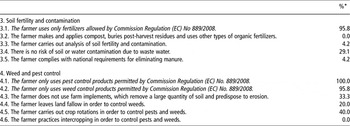
Variables included in indicators 3 to 4 (items of obligatory compliance according to EC 889/2008 are in italics)

*The value reached for each variable corresponds to the percentage of farms with an affirmative response for that variable.
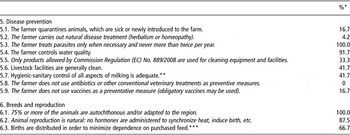
Variables included in indicators 5 to 6 (items of obligatory compliance according to EC 889/2008 are in italics)

*The value reached for each variable corresponds to the percentage of farms with an affirmative response for that variable.
**This includes revision of milking equipment at least once every 6 months.
***The seasons with the greatest nutritional needs should coincide with those of greater grass production.
Variables included in indicator 7 (items of obligatory compliance according to EC 889/2008 are in italics)

*The value reached for each variable corresponds to the percentage of farms with an affirmative response for that variable.
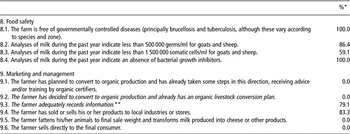
Variables included in indicators 8 to 9 (items of obligatory compliance according to EC 889/2008 are in italics)

*The value achieved for each variable corresponds to the percentage of farms with an affirmative response for that variable.
**The farmer has up-to-date records of veterinary treatments, feed management and purchases and sales.
In order to avoid subjectivity in the answers, guidelines were drawn up indicating which requirements had to be fulfilled for each variable for the answer to be affirmative. Although most of the information required to respond to the variables was elicited through the interview with the farmer, which took place on the farm, in other cases it was necessary to resort to information provided by breeding associations, cooperatives, the milk industry and livestock health associations (farmers’ organizations to control animal health) of the region.
Statistical analysis
Goat farms were grouped based on a K mean cluster analysis (Manly, Reference Manly2004) using the weighted OLPI as a classification variable. Later, the indicators of the conglomerates were analysed using a single factor or one-way ANOVA.
The SPSS statistical program (SPSS, 2006) was used.
Results
The first panel of experts suggested 31 variables relative to Principles of Organic Agriculture (IFOAM, 2009), grouped into 10 indicators (Table 1).
The second panel of experts proposed 25 more variables (Table 1) and grouped indicators Weed control and Pest control in a new variable named Weed and pest control. The 56 variables are detailed in Tables 2 to 6. Twenty-three of them (which are in italics) have been directly extracted from Council Regulation (EC) No. 834/2007 on organic production and labelling of organic products and repealing Regulation (ECC) No. 2092/91 (henceforth referred to as EC 834/2007) and from the Commission Regulation (EC) No. 889/2008 of 5 September 2008 laying down detailed rules for the implementation of the Council Regulation (EC) No. 834/2007 on organic production and labelling of organic products with regard to organic production, labelling and control (henceforth referred to as EC 889/2008). The remaining 33 variables have been selected according to their importance for successful agroecological management, and according to Bellon and Lamine (Reference Bellon and Lamine2009) and Darnhofer et al. (Reference Darnhofer, Lindenthal, Bartel-Kratocvhvil and Zollitsch2010) who point out the superiority of a redesigned system to an input substitution system in the organic conversion process.
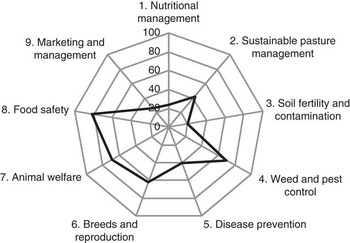
Figure 1 shows the mean value for each indicator for the 24 NSS farms: 1. Nutritional management (23.6%); 2. Sustainable pasture management (42.6%); 3. Soil fertility and contamination (20.0%); 4. Weed and pest control (70.4%); 5. Disease prevention (40.7%); 6. Breeds and reproduction (62.5%); 7. Animal welfare (68.9%); 8. Food safety (82.3%); 9. Marketing and management (26.4%). The weighted mean OLPI value was 46.5%.
Mean indicator values (percentage of approximation of conventional farms to the organic model) for farms in the Northern Sierra of Seville.

As Figure 1 shows, the indicator values for the NSS farthest from the organic standards are: Nutritional management, Soil fertility and contamination and Marketing and management. These are followed by Sustainable pasture management and Disease prevention.
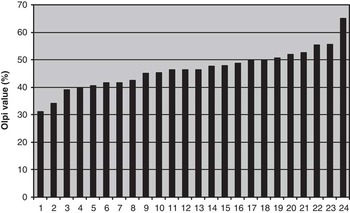
Figure 2 shows the degree of heterogeneity of the sample with regard to the OLPI. In global terms, the degree of approximation to the organic model of the farms analysed does not reach 50%, ranging from a minimum value of 31% to a maximum of 65% (Figure 2), showing a wide heterogeneity among farms.
Northern Sierra of Seville farms classified by increasing order of approximation to Organic Livestock Proximity Index (OLPI). Farms 1 to 8 belong to conglomerate 1; farms 9 to 21 belong to conglomerate 2 and farms 22 to 24 belong to conglomerate 3.

Tables 2 to 6 show results for each variable. They represent percentages of farms, which responded affirmatively to the question asked for each variable.
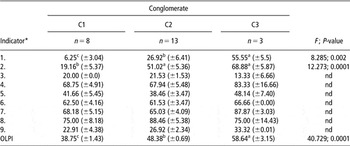
Table 7 shows mean percentages for OLPI and for the nine indicators included in OLPI, grouped into three conglomerates. ANOVA detected significant differences in OLPI (P < 0.001), as well as in indicators for Nutritional management (P < 0.01) and Sustainable pasture management (P < 0.001). The goat farms with the lowest and highest percentages of approximation to the organic model belong to conglomerates C1 and C3, respectively.
Mean value and standard error for nine indicators in the OLPI for goat farms in the Northern Sierra of Seville (southeast Andalusia, Spain), grouped by conglomerates

OLPI = Organic Livestock Proximity Index.
a, b, cMean values with different letters in the same row are significantly different; nd = non-significant difference.
*1. Nutritional management; 2. Sustainable pasture management; 3. Soil fertility and contamination; 4. Weed and pest control; 5. Disease prevention; 6. Breeds and reproduction; 7. Animal welfare; 8. Food safety; 9. Marketing and management. The indicator's value ranges from 1 to 100. The greater the value, the closer the approximation to the organic model.
Discussion
Regarding the method proposed
In order to determine the degree of approximation of a farm or group of farms to the organic production model, it is necessary to identify the most important issues and summarize the information obtained into a set of indicators to establish the limitations, potential and opportunities of the system. A multicriteria index permits a global qualification of the characteristics and functioning of the management system and avoids loss of information.
As reported by Munda (Reference Munda2004) a priori, it is not possible to establish which is the best multicriteria method for a given empirical problem, as this will depend on the objectives and the context.
The capacity of each methodology to build a multicriteria index depends on how measurements and perceptions can be converted to a single scale to compare elements or indicators and to establish orders of priority. The simplest ways to draw up a multicriteria index with a specific scale of measurement (such as the one used in this study) are: (i) select the variables and indicators; (ii) standardize the variables to avoid scale and unit of measurement effects (such as Z-values or %); and (iii) weight and aggregate them using multicriteria techniques (Munda et al., Reference Munda, Nijkamp and Rietveld1994).
Indicators
Indicators proposed in this article have been designed to be included in a scheme for on-farm assessment of conversion to organics. Nevertheless, values obtained per indicator may serve as a basis for studies in which comparisons are made between regions or to analyse the evolution of a group of farms over time.
According to Bellon and Lamine (Reference Bellon and Lamine2009), analysing conversion and more generally transition in agriculture as multidimensional issues, involves both production and social practices, and entails interdisciplinary approaches. Environment, product quality (Bellon and Lamine, Reference Bellon and Lamine2009) and animal welfare (Napolitano et al., Reference Napolitano, De Rosa, Ferrante, Grasso and Braghieri2009) should be considered. The proposed method includes indicators relative to all issues, although farming performance and technology are the most numerous.
For environmental impact assessment, several types of indicators can be distinguished. Bockstaller et al. (Reference Bockstaller, Guichard, Makowski, Aveline, Girardin and Plantureux2009) point out three groups: the first consists of simple indicators based on one variable or a simple combination of variables obtained by survey or from databases and are not directly measured; the second group includes indicators based on calculation and integrate more than one type of factor, for example, farm practices and soil conditions; and the third group includes indicators based on one and several measurements, for example, biodiversity index. In contrast, Napolitano et al. (Reference Napolitano, De Rosa, Ferrante, Grasso and Braghieri2009) consider that the indicators to be included in a scheme for on-farm assessment of animal welfare should be valid (meaningful with respect to animal welfare), reliable (reflecting the tendency to give the same results on repeated measurements) and feasible (concerning time and financial requirements).
When selecting the indicators proposed in this article, priority was given to the three criteria highlighted by Napolitano et al. (Reference Napolitano, De Rosa, Ferrante, Grasso and Braghieri2009): validity, reliability and feasibility. Consequently, the indicators proposed belong to the first and second type described by Bockstaller et al. (Reference Bockstaller, Guichard, Makowski, Aveline, Girardin and Plantureux2009). In this sense, the indicators Soil fertility and contamination, Weed and pest control, Disease prevention, Breeds and reproduction and Marketing and management belong to the first group, and therefore information is obtained by survey. In contrast, the indicators Nutritional management, Sustainable pasture management, Animal welfare and Food safety, included issues that should be measured directly, although in some cases the farmer already had the data.
Issues
Of the 56 variables, 33 variables proposed are not explicitly included in EC 889/2008, but are valid from an agroecological point of view. Issues considered are important to avoid the conventionalization of organic farming (defined by Darnhofer et al. (Reference Darnhofer, Lindenthal, Bartel-Kratocvhvil and Zollitsch2010), as the introduction of farming practices that undermine the principles of organic farming) and to promote true organic farming, which may involve a redesign of the farm system instead of simple input substitution (Bellon and Lamine, Reference Bellon and Lamine2009).
The combined approach using a scientific literature review, expert opinion and field studies, yielded a list of relevant and feasible issues for assessing the conversion of small ruminant systems to the organic model. A first approach to this method was presented during the 9th International Conference on Goats held in Queretaro, Mexico (Mena et al., Reference Mena, Nahed, Ruíz, Castel and Ligero2009a).
The list of variables proposed by the first panel of experts was simpler and shorter than the list finally included in this article. The second panel of experts (technical experts from the farmers associations, cooperatives and certifiers that had greater knowledge of the goat production systems of the Mediterranean Basin) added new variables in order to provide more precise information specific to the Mediterranean Basin goat systems. They also suggested merging the indicators Weed control and Pest control into a single indicator called Weed and pest control, so as to avoid repetitions in the questions and answers on agricultural practices.
If there are different livestock species on a farm, certain considerations will be necessary. If the farmer manages both sheep and goats together, they can be considered as a single species, but if they are managed very differently, then the method should be applied separately. If animals other than sheep or goats are farmed, then the method should be adjusted slightly and each species should be dealt with separately. Nevertheless, although the species are treated separately, Soil fertility and contamination and Weed and pest control can be obtained together.
After conducting the field survey, it was observed that the local extension agents, who periodically visit the farms found it easy to obtain information on most of the issues included. Furthermore, this information would give a precise idea of the issues to be improved for conversion to organic farming.
OLPI
For integrated analysis of all the information obtained, the authors of this study grouped the 56 variables into nine indicators and then calculated a multicriteria index called OLPI, which is a weighted mean of the indicators. Expert opinion has been considered to design the OLPI, especially on the selection of the variables, the definition of the indicators and on their relevant importance, as the main goal of the method was to detect the main deficiencies of a farm or group of farms when converting to organics.
Weights of indicators for calculating the OLPI were based on the importance conferred to them by the experts and were transformed to a percentage scale, as in Rozzi et al. (Reference Rozzi, Miglior and Hands2007) to build the organic total merit index for organic dairy farmers. If the method is used to compare farms of different regions, OLPI should not be considered, as the weighting coefficients must be adjusted in accordance with specific local criteria (Gallopín, Reference Gallopín1997).
In the context of multicriteria decision making (where a decision-making problem consists of choosing the best alternative according to certain criteria, or amount of knowledge) most applications require criteria to be weighted according to importance, thus implying an extension of usual non-weighted operators (Grabisch, Reference Grabisch1995). An interesting class is the Ordered Weighted Averaging (OWA) operators, introduced by Yager (Reference Yager1991), which is a weighted sum with ordered arguments. In OWA the weight must be ranked in the order in which the factors are aggregated, based on fuzzy measures (Boongoen and Shen, Reference Boongoen and Shen2009).
Fuzzy measures have been used as a new aggregation tool in the field of subjective multicriteria evaluation (Grabisch, Reference Grabisch1995). The theory of fuzzy logic provides a mathematical means to capture the uncertainties associated with human cognitive processes, such as thinking and reasoning. Furthermore, the theory of multicriteria decision making based on fuzzy measures (i.e. Choquet integral) has proved to be a better approximation to reality, as it admits that systems have different nuances and that decisions are made according to a wide range of possibilities and criteria that are all equally valid, although sometimes they are contradictory or conflicting. The merit of the Choquet integral is to bring a powerful tool to model interaction and dependency between variables (Grabisch, Reference Grabisch1995). Despite their immense value, fuzzy integrals are difficult to apply to real situations (Grabisch, Reference Grabisch1995).
The main advantage of the OLPI method over fuzzy logic in multicriteria analysis is that it is easy to calculate. In later studies, once the method proposed has been applied to more farms, we will have a more precise idea of the relationship between different criteria and conditioning factors, and therefore fuzzy logic methodologies, such as the Choquet integral, can be used for decision making.
The case study
For 31 of the 56 variables (Tables 2 to 6), the level of compliance is less than 50%. This indicates that despite the fact that the farms raise animals of autocthonous breeds and most graze their animals, many aspects must be improved for farm management to be considered agroecologically adequate. These results agree with the findings of Ronchi and Nardone (Reference Ronchi and Nardone2003), who reported that on the basis of the current production systems in the Mediterranean areas, only a limited number of farms have the optimal requirements for a transition from conventional to organic farms, and for sustainable economic viability.
In order to illustrate the potential of this method, variables farthest from the agroecological optimum, and consequently from the organic standard, were analysed. In addition, suggestions are made for improving the farms to bring them closer to the organic model.
Dairy goat systems in the studied area have deficiencies in the organic requirements of nutritional management, as self-sufficiency is low and they have a short provision of common fodder. This agrees with the observations of Mena et al. (Reference Mena, Nahed, Ruíz, Castel and Ligero2009a) and Nardone et al. (Reference Nardone, Zervas and Ronchi2004), who point out that lack of feed autonomy is one of the main difficulties to overcome in the transition from conventional goat farms to organic.
As Ruiz et al. (Reference Ruiz, Mena, Castel, Guinamard, Bossis, Caramelle-Holtz, Contu, Sitzia and Fois2009) report, goat farmers who base animal feeding on local grasses in mountainous areas do not manage grazing appropriately. Dairy goats graze throughout the whole year, even though in summer and winter natural grasses are scarce in the Mediterranean ecosystem. Furthermore, farmers believe that goats obtain enough fibre when grazing, and therefore do not provide sufficient roughage in the stable. This leads to a fibre-poor diet when grass is in short supply (Ruiz et al., Reference Ruiz, Mena, Castel, Guinamard, Bossis, Caramelle-Holtz, Contu, Sitzia and Fois2009). Therefore, it is necessary to increase provision of common fodder, especially during the summer and early autumn, in order to comply with the EC 889/2008 minimum fibre requirements (variable 1.2 of Table 2). According to the principles of organic livestock farming, organic fodders should mainly be produced on the farm itself, or by another local farmer.
It is also necessary to grow grain for animal feed (variable 1.4. of Table 2), and use only feed permitted by the EC regulation for organic livestock farming (variable 1.6. of Table 2; EC 889/2008). Leguminous crops in monocultures or associated with grasses, and improvements (fertilization, replanting, etc.) of natural grasses (variables 2.5 and 2.6 of Table 2) will help to increase feed self-sufficiency. However, as Mena et al. (Reference Mena, Nahed, Ruíz, Castel and Ligero2009a) have reported, in the Mediterranean Basin, steep slopes and poor soil quality reduce the possibility of growing animal feed on the farm. According to Ruiz et al. (Reference Ruiz, Mena, Castel, Guinamard, Bossis, Caramelle-Holtz, Contu, Sitzia and Fois2009), the mean quantity of planted grasses is 0.09 ha per goat per farm.
Another important aspect related to the use of grasses is the livestock carrying capacity. Although most of the farms have less than 13.3 goat or sheep/ha (variable 2.3 of Table 2), which is equivalent to 2 Livestock Units/ha – the maximum stocking rate allowed by the EC 889/2008 – only one-third have an adequate stocking rate (variable 2.4 of Table 2), considering the characteristics of the Mediterranean ecosystem where 0.8 to 3.2 goats/ha are recommended (Ruiz et al., Reference Ruiz, Castel, Mena, Camúñez and González-Redondo2008). Therefore, livestock carrying capacity and reproduction planning should be adjusted. In this sense, the seasons with the greatest milk production (when the animals have greater nutritional needs) should coincide with those of greater grass production, namely in spring. This would improve feed self-sufficiency on the organic farm.
Successful agroecological farm management requires adequate soil management and soil quality. Although there are few references to this in EC 889/2008, the method includes two related indicators: Soil fertility and contamination and Weed and pest control. According to the results of this study, only 4.2% of farmers should stop using chemical fertilizers if they wish to change to organics. Practices, which improve these two indicators according to the specifications of EC 889/2008 are: improvement in manure management (e.g. composting), periodic analyses of soil fertility, fallow periods, crop rotation and intercropping (which all help to control pests without resorting to pesticides).
As for the indicator Disease prevention, farmers should improve three variables: natural disease treatment (variable 5.2 of Table 4), which no farmer does; correct use of antibiotics (variable 5.8 of Table 4), some farmers use antibiotics without veterinary guidance; and correct use of vaccines (variable 5.9 of Table 4). In humid regions, parasitic disease control is difficult in organic livestock (Lu et al., Reference Lu, Gangyi and Kawas2010); however, parasitic disease control and prevention is not a problem in the studied area, as the climate of Andalusia (low rainfall and high temperatures) does not favour parasite development.
The indicator Animal welfare has an acceptable level of compliance. Only one variable, covered space for the animals (variable 7.3 of Table 5), was not provided by the farms, in fact only 33% have the minimum covered space required by EC 889/2008, which is 1.5 m2 for adult goats. However, this is not a problem in Andalusia where the climate is gentle, and therefore a minimum covered space is not obligatory.
Finally, Marketing and management is one of the three indicators with the lowest level of compliance. The low values for the variables included in this indicator (Table 6) are because of the lack of specific markets for organic products, which are often sold in Spain as conventional products (García et al., Reference García, Perea, Acero, Valerio and Ramos2008). As Mena et al. (Reference Mena, Ligero, Ruíz, Nahed, Castel, Acosta and Guzman2009b) report, promoting direct marketing channels is also necessary for a successful conversion to organics.
Table 7 shows three groups (clusters) of farms, classified according to the OLPI value. Significant differences are only found among clusters for OLPI and for two indicators: Nutritional management and Sustainable pasture management. For all indicators except Soil fertility and contamination, greater values are obtained for group C3. This is because, in general, farmers do not fertilize the soil in any of the groups. This is consistent with Nardone et al. (Reference Nardone, Zervas and Ronchi2004), who point out that many farms located in arid, sub-humid/humid tropical and temperate environments are based mainly on extensive use of non-fertilized natural pastures.
Conclusion
The method proposed provides concise and valuable information for converting conventional mountain goat dairy farms to organics, which includes agroecological management and not only aspects of obligatory compliance to the European organic standards. In contrast, the method summarizes many issues related to soil, vegetation and animal management, as well as marketing, in nine indicators and an index called OLPI. Although the OLPI is interesting in itself, it is particularly valuable because it is explained by the behaviour of the indicators and issues, thus avoiding a loss of information.
The case study shows how easy this method is to use and the interest of the information obtained on-farm both at local and regional levels. In fact, it provides an initial idea of the possibilities of converting to organic livestock farming and identifies the actions to be taken in the conversion process. In this sense, the case study has pointed out some key practices to be adopted in order to adapt conventional mountain goat farming systems to the organic model: (i) diminish outsourcing of concentrates, (ii) improve the quality of natural grasses and optimize their use by animals, (iii) adapt herd sizes to the environmental carrying capacity and (vi) promote direct marketing channels for value added goat products and enhance farmer participation.
The application of the method to a large number of farms provides greater awareness of the relationships that exist between the different issues involved in the conversion. This means that multicriteria methods based on fuzzy logic can be used for decision making and should be developed in subsequent studies.
This method was originally applied to goats, but when modified and adjusted it can be extrapolated to small ruminants in general.
Acknowledgements
Research was funded by the Regional Government of Andalusia, Spain (Project no. 92162/75). The authors also appreciate the collaboration of the experts, technicians and farmers consulted, particularly Benito Salvatierrra Izaba, Roberto Aguilar Jiménez, Julio Calderón Pérez and Monte Carmona.