1. Introduction
The concept of amicus curiae was first introduced and incorporated into Israeli law in 1999 in the case of Kuzli v State of Israel (‘the Kuzli case’).Footnote 1 This was a minor procedural ‘revolution’ as, for the first time in the history of the Israeli legal system, a body which was not a formal party to the legal proceedings was allowed to submit an amicus brief. In an article published in 2006 we provided a general overview of the roots and the potential use of this procedural device in the Israeli legal system. Since the Kuzli case, when the criteria for the use of an amicus were established, over fifteen years have elapsed. As described in the 2006 article, from a historical and a comparative legal perspective this legal development represents an innovation in that it was adopted by the Supreme Court from Anglo-American law.Footnote 2 The aim of this study was to (i) conduct an empirical follow-up and analyse the different patterns of use of the amicus in Israel; (ii) explore the characteristics of those who use it; (iii) examine the courts' decisions that have allowed or rejected the submission of an amicus; and finally (iv) explore the influence of this concept on the final results of the cases.
2. Israeli Amici
The following section will briefly describe the emergence of the amicus tool in Israel. The first application for an organisation to participate as an amicus was in the Kuzli case.Footnote 3 In the wake of this incident, the Public Advocate sought to submit an amicus brief. The Public Advocate's Office claimed that given its expertise, the role it was granted in the Public Advocacy Act, and the issue raised regarding the legal representation in the case, it should be allowed to submit an amicus brief. The accused, who demanded a retrial on the ground of lack of appropriate legal representation, consented to the request, but the Attorney General opposed it. The reasons for the objection were twofold. First, in terms of authority, the amicus brief was not recognised under Israeli law and, as a ‘foreign’ legal concept, it should be rejected. Second, in terms of an overall ruling, the state claimed that agreeing to the request would violate the principle of a fair trial, which is a fundamental principle of Israeli law.Footnote 4
Aharon Barak, then President of the Israeli Supreme Court, allowed the admission of the amicus brief. The decision to accept the request was based on a number of factors, which, in subsequent years, have become the main criteria for permitting the participation of amici in legal proceedings. President Barak opened the discussion by stating that every motion to join as an amicus should be decided on its merits, according to the whole gamut of special circumstances of the case. Nonetheless, he then added a detailed, but open and incomplete, list of considerations that should be taken into account in deciding the issue. These include the following:
• the potential contribution of the proposed amicus to the legal proceedings;Footnote 5
• the nature and the identity of the party requesting to join;Footnote 6
• the expertise, experience and representation of the amicus;Footnote 7
• the type of case and the procedures involved;Footnote 8
• the identity of the parties involved;Footnote 9
• the stage at which the request to join was submitted;Footnote 10
• the essence of the issue in dispute;Footnote 11 and
• the position of the parties to the proceedings.Footnote 12
Barak applied these criteria to the Kuzli case and concluded that the Public Defender should be allowed to submit its brief as amicus curiae.
The Kuzli case marked the adoption of the friend of the court in Israel. As a result of this new precedent, Israeli courts acquired the authority to allow individuals, organisations and institutions which were not formal parties to a legal procedure to present their position to the court. Since this historical ruling, various organisations and bodies have used this novel legal device and submitted applications to acquire the status of an amicus. However, although more than a decade has elapsed, the use of this procedural instrument has not yet been formally anchored in or regulated by any statutory rules or regulations. Moreover, no empirical research has yet been conducted with regard to its actual usage. The goals of the study that will be discussed in this article were to examine and describe the patterns of usage of the amicus curiae in the Israeli legal system, the attributes of those who use it, the courts' rulings regarding these applications, and the extent to which this legal instrument influences judicial decisions.
3. The Research
3.1. Description of the Research
The general objective of this empirical research is to answer the following questions:
1. To what extent has the amicus curiae concept become assimilated into Israeli law?
2. What are the personal and organisational attributes of the bodies that make use of the concept?
3. What are the procedural characteristics of the cases in which the concept is involved?
4. What is the approval rate of amicus curiae applications?
5. Is there a correlation between the attributes of the amicus, the procedural characteristics, and the court's decision to allow the submission of the amicus?
6. What arguments and legal reasoning do the courts use in support of their decision to accede to or reject an application to submit an amicus brief?
7. Did the amicus's brief influence the court's decision?
The method used in this research was quantitative, composed of statistical analysis of factual variables gathered from Israeli rulings relevant to the questions to be discussed.
3.2. The Sample
The research sample was a compilation of all judicial decisions and rulings relating to the institution of the amicus published at each level of the Israeli judicial system. The cases were gathered chronologically, from the date of the ruling in the Kuzli case up to 1 March 2010, in an attempt to capture a decade of court rulings in this field. A total of 125 decisions were found.
The sample was compiled in two stages. The first was based on a search of computerised legal databases. These databases included Takdin,Footnote 13 Pador, Nevo,Footnote 14 Law Data,Footnote 15 the website of the Israeli court system,Footnote 16 sites of non-governmental organisations (NGOs) which we had identified as specialising in applications to appear as amicus, Footnote 17 and the standard search machine, Google. We used the following code words for searching these databases: ‘friend of the court’, ‘amicus’, and ‘amicus curiae’. Mentions of the Kuzli case were also located by using the number of the case or the name ‘Kuzli’, but without reference to expressions such as ‘friend of the court’ and similar.
The second stage included direct and personal contact with specific individuals, bodies and organisations who or which are active in the area of social change and might be involved in relevant legal proceedings. These personal contacts were asked to determine whether they had direct or indirect information about additional cases in which an application to appear as an amicus had been made, but which had not been published or included in public databases. This was done in order to make the dataset as complete as possible while being aware of the fact that many legal cases in Israel are not reported.
3.3. Research Tools
The collection of data from the cases in the sample was based on a quantitative data analysis performed by a research tool specially designed for this study: a coding sheet designed to code and analyse legal rulings. The coding sheet included seven parts:
1. Technical background data regarding the particular case – the case number, date of the application, names of the judges, identity of the court, the nature of the legal process, the identities of the party which the amicus wished to join and of the opposing party.
2. Background details of the person/body requesting participation as an amicus – identity, area of expertise, level of expertise in the area in which participation was requested, past involvement in other cases, experience as an amicus and whether represented by a lawyer.
3. Procedural background aspects related to the application – the stage at which the application was made, its length, whether it included simply an application to participate or included the applicant's standpoint, whether it included a request to plead orally, and whether in addition to the basic standpoint it included a request that the court should take concrete steps.
4. Significant data connected with the application and the court's decision in relation to it – the position of the formal parties in the case in respect of the application, the court's decision on the application, the reasons for its acceptance or rejection, the extent to which reference was made to the criteria laid down in the Kuzli case and to the fact that this was a relatively new process under Israeli law.
5. Data relating to the discussion of the application – whether discussion of the application was separated from discussion of the main case, and whether this discussion took place in the presence of the parties.
The final two sections were different and separate, and referred to two alternative situations.
6. If the court approved the application to participate as an amicus, whether data connected with the degree of influence of the amicus's viewpoint on the final decision was collected (that is, to what extent the result reflected the viewpoint of the amicus in practice, and to what extent the court related directly and significantly to the viewpoint of the amicus).
7. If the court rejected the application of the amicus and did not allow it to submit a brief, data collected to compare (as far as possible) the final decision of the court with the standpoint of the amicus who was not permitted to participate (that is, the extent to which the final result was consonant with the unheard views of the amicus, and the extent to which the court related significantly to these views.
In order to validate the project, five rulings were analysed separately and independently by three researchers. Each ruling was read and analysed individually using the coding sheet. Interrater reliability was then computed using intra-class correlation (ICC); and interrater agreement was calculated according to the procedure described by MacLennan,Footnote 18 based on the study by Ebel.Footnote 19 The result of the interrater agreement was higher than 0.85. Once the researchers had reached agreement over the various questions and definitions of the research tool, a research protocol was written and the content differentials were encoded for completion of the questionnaire.
3.4. Limitations of the Research
As in the case of any empirical research, this study suffered from inherent methodological limitations. Its primary limitation is that it was based simply on the formal (and publicly available) court rulings. It did not assess or analyse the amici's applications to participate, or other documents that were submitted to the court (such as responses to the application prepared by other parties to the case). Reliance on formal decisions of the court alone is liable to present a partial picture of the overall legal reality. Moreover, this study was based primarily on court decisions that have been reported only in public databases. This type of research is in danger of missing applications for participation as an amicus, which, for various reasons, were not officially published.Footnote 20 Hence, the sample is not wholly representative. However, as noted above, in attempting to deal with this limitation, contact was made with major advocacy NGOs that are active in the submission of legal petitions to be a potential amicus – the reasoning being that such NGOs may have submitted a request which was not published.
4. The Findings
4.1. The Extent of the Use of the Amicus Device
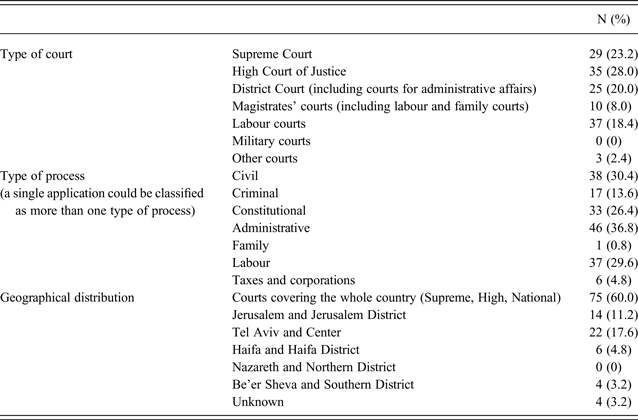
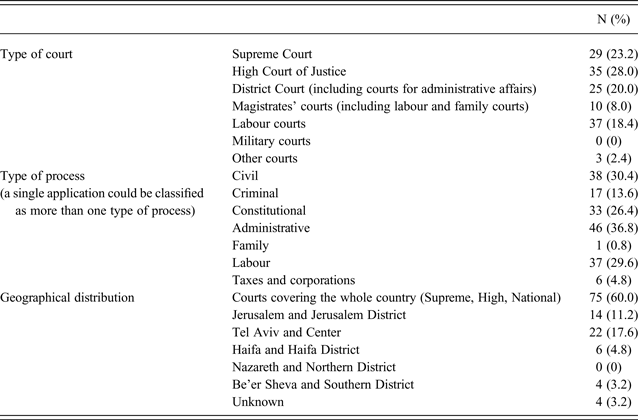
The opening question of the research involved ascertaining the extent of the usage of the amicus concept in Israeli law. The hypothesis was that, considering that this is a relatively new legal instrument, it would be used only to a limited extent. This hypothesis was confirmed. The search described above yielded a total of 125 applications submitted to all types of court. This number was out of 97 cases or rulings since, in some cases, more than one application was made in the same case, when compared with tens of thousands of cases handled each year by the courts.Footnote 21 As the results of the applications constituted the main subject of the analyses, all of the following data is based on the sample of these applications, rather than on the sample of the cases. Table 1 presents the basic background data of the applications in the sample. The findings should be read carefully because of the potential for selection bias. It may, for example, be that more Supreme Court cases are published compared with other types of case in Israel. Nevertheless, there was no possible way to examine or to compare the number of published Supreme Court cases as opposed to those of other courts (as this data is not available to the public). Moreover, since petitions regarding the public interest are usually submitted to the higher-level courts and not to the lower courts, this is a possible explanation of the high rate of applications to join cases as amicus made to Israel's higher-level courts.
Background data of applications in the sample (N = 125)*
Note:
* The number of applications (N) lower than 125 is as a result of missing data in the original case as reported; on the other hand, in some tables the columns may add up to more than 125 because of parallel criteria applying to the same case.
Overall, 83 different judges have decided applications to join cases as amici, some of whom dealt with more than seven applications. Our statistical analysis found no correlation between the identity of the judge and the result of the application to participate as an amicus. Similarly, 61 different lawyers represented the amici. No correlation was found between the identity of the lawyer and the judicial decision regarding the application.
The overall picture drawn by the data in Table 1 reflects the following general trend. In the decade following the Kuzli case, most of the applications (89.6 per cent) to join cases as amicus were made to Israel's higher-level courts: the Supreme Court (functioning as the Supreme Court of Justice or as a court of appeal); the District Court (functioning as a court for administrative affairs); and labour courts (primarily the National Labour Court). The number of applications to lower courts (such as magistrates' courts, local labour courts and family courts) were relatively few. Most of the cases were concerned with constitutional or administrative issues (handled by the Supreme Court or administrative courts) or fundamental issues related to employment legislation (dealt by the labour courts). Again, as noted above, this explains the high rate of cases submitted to the higher-level courts.
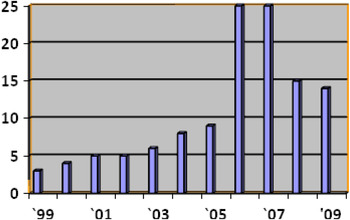
In addition to the analysis of background data, the applications were also classified by date. Figure 1 presents the distribution of the number of applications according to the years in which they were made.
Distribution of applications from 1999 to 2009

As is apparent from Figure 1, during the years immediately following the Kuzli case there were almost no applications for amicus status with only a few being made. On the other hand, from the mid-2000s a significant rise in the use of this device is discernible. Thus, despite the low average number of applications per year, the extent of the use of this device reached a peak of 25 applications in each of the years 2005 and 2006. Although there has been a decline in the number of applications since then (and a decade is too short a period of time to reflect long-term trends), it should be noted that from the mid-2000s a relative increase in the use of the amicus device has occurred. It should be added that the decrease in the number of applications since 2007 may be the result of the limitations of the research, reflecting the fact that court rulings during these years have not yet been published and, therefore, do not yet appear in the public databases.
4.2. Background Data of the Amicus and Other Parties in the Case
The second research question requires an examination of the personal and organisational background characteristics of the bodies that make use of the amicus concept and the other parties involved in the cases. The research hypothesis was that, in view of the importance of its use in strategic litigation, most of those using this tool would be NGOs which promote values of equality and social justice, such as the Association for Civil Rights and similar organisations.
Characteristics of the amicus
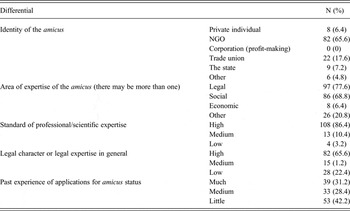
The characteristics of the amicus are presented in Table 2.
Characteristics of the amicus

On the basis of the data presented in Table 2, we can depict an archetype of the Israeli amicus in the first ten years of its existence. In the great majority of the cases, the institutions that submitted requests to become an amicus were organisations in the third sector: NGOs with a relatively high level of socio-legal expertise, which make frequent use of the amicus concept.Footnote 22 Trade unions representing professional interests are a particularly interesting sub-category in this context; they also make relatively frequent use of the amicus device.Footnote 23 However, the relatively little use made by the state and its institutions, and by private institutions, is in conspicuous contrast to this. Moreover, privately owned corporations and profit-making institutions are completely absent from the list of those who have requested to participate as amici.
There are several reasons for this observation. One possible reason is the lack of awareness in the different sectors of the potential benefits of the amicus (particularly in the private sector). Another possible reason is associated with the motives of the organisations in the different sectors. The organisations of the third sector deal with the promotion of social and economic change among broad interest groups; from their point of view, therefore, the amicus is a useful and effective tool for achieving this end,Footnote 24 whereas private organisations concentrate on their own specific interests. As for the state, it can always intervene as a formal party in a case should it wish to express an opinion; therefore the amicus device does not give it any advantage.
Characteristics of other parties in the case
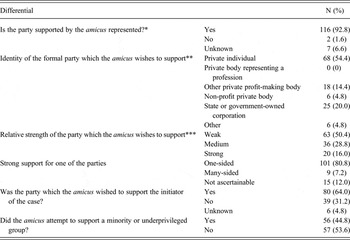
The study also explored data concerning the other participants involved in the proceedings and their position in relation to the other formal parties and the amicus. A summary of the findings is given in Table 3.
Background data of the other parties to the case and the relationship between them and the amicus

Notes:
* The fact that in almost every case the party that the amicus wished to support was already represented by a lawyer raises an interesting question regarding the relative ‘weakness’ of that party.
** When applying for amicus status, the potential amicus does not ask to ‘join’ any party. Nonetheless, in many cases, the context shows that, in fact, the amicus wishes to support the standpoint of one of the formal parties to the proceedings.
*** The definition of ‘relative strength’ is as follows: a private individual or NGO is considered to be weak in comparison with the state or a private corporation; a private corporation is considered to be moderately strong in comparison with the state; and the state is always considered to be strong. When two parties of equal strength were in conflict, each was estimated to be moderately strong in comparison with the other. It should be pointed out that this categorisation was made for the sake of a uniform statistical analysis; it does not accord with the real situation, in which affluent private individuals, for example, may enjoy a status of strength in relation to private associations. Nonetheless, this distinction gives us some idea of the direction and degree of the ‘difference’ in strength between the parties in a typical case in which the participation of an amicus is requested.
An analysis of the characteristics of the formal parties to the cases that potential amici applied to join depicts a typical pattern: in most instances, the amicus asked to support the party that initiated the case (as plaintiff or appellant) and supported that party solely. The party was a private individual represented by a lawyer. In the majority of the cases, this party conducted the case against the state or a private for-profit corporation. These findings accord well with those described earlier with regard to the identity of the amici. It is easy to explain the intervention of a non-profit, socio-legal organisation, on behalf of a party who is seen to be relatively ‘weak’. In other words, the amicus may contribute to equality of power between the parties.
4.3. Procedural Aspects of Applications to Participate as Amicus
The third research question concerned the procedural characteristics of the process whereby Israeli courts consider whether to grant an application to participate in a case as an amicus. The research hypothesis was that the procedures would vary, given that this is a tool regulated by the court and has not yet been incorporated in legislation. The findings were divided into two parts: the procedural aspects involved in the submission of the application, and aspects of the court's management of the application.
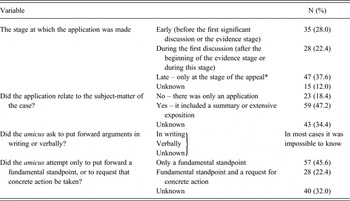
The main procedural aspects of the application are presented in Table 4.
Background procedural aspects of an application to participate as an amicus

Note:
* This may be another variable that could be affected by the selection bias based only on a sample of published cases. However, this variable can be also explained by the fact that the use of this legal instrument is not yet regulated by legislation and is less known to many lawyers.
According to Table 4, most of the applications to serve as amicus were made during the advanced stages of the case. This may occur either during the hearing of the case itself (after the start of the evidence stage) or during the appeal, rather than during the earlier stages. This finding shows that in many instances the cases that amici join are originally initiated by private bodies with no intervention from socio-legal organisations, and that these organisations submit their request only after the private plaintiffs have ‘gone the distance’ – either on completion of the preliminary stages or on submission of an appeal to a higher court.
This finding may be connected with the development of the rationale of the amicus tool as used in Israel. While historically it was intended solely to provide the court with factual information about the case, it turned into an institution the aim of which is to provide a professional and critical, and sometimes a biased, perspective. Another explanation may be that the parties to the initial case approach socio-legal organisations only after losing the case at first instance, or after their case has received public attention.Footnote 25
Another interesting finding in this section concerns the tactics adopted by amici. Many of the applications include their position as amicus in the request itself. Even though the findings do not explain the reasons for this tactic, it may be surmised that it is based on the assumption that the presentation of the applicant's position will increase the chances of it being accepted by the court. Even if the application itself is rejected, in the long run, this tactic may influence the court's decision, while taking into account the position of the amicus.
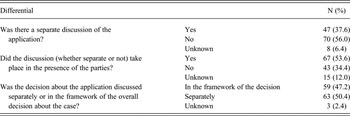
Table 5 presents an analysis of the data concerning the procedural aspects of the court's management of the application.
Procedural aspects of the discussion of the application

As can be seen from the data in Table 5, there is great variance in all aspects of the procedural management of applications to join a case as amicus. It is therefore extremely difficult to discern a general pattern of management of the applications submitted to different courts. In most cases, there was no separate hearing of the application, and the hearings took place in the presence of the parties. Moreover, in almost half of the cases the court did not deliver a separate decision on the application, but discussed it as part of the final decision in the case. This finding may be explained by the desire for efficiency, mainly on grounds of time constraints. Finally, in almost 10 per cent of the cases, it was impossible to determine how the process was carried out. All that could be ascertained was whether the application was accepted or rejected – and this, too, only appeared in the final ruling.
4.4. Characteristics and Results of the Application
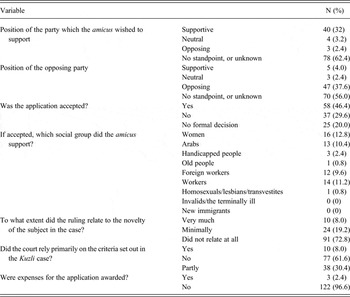
The fourth research question relates to the proportion of amicus applications accepted by the courts. The research hypothesis was that as this was a novel and relatively unknown procedure, the proportion of acceptances would be low. In the first stage, we examined the position of the opposing side towards the application process, whether it was accepted or rejected, and the extent to which the application supported an ‘underprivileged group’. Table 6 summarises the findings of this research.
Data concerning essential characteristics of the application and its results

The most important finding reflected in Table 6 is that in about half of the cases the application to join as amicus was accepted; if we consider only those cases with a formal decision, the accepted cases constitute the majority. The award of costs by the court should also be considered: in more than 96 per cent of the cases, the applicant was not awarded costs. This lends itself to the idea that the court did not consider the application for amicus as an infringement of the judicial process, but rather as a legitimate attempt, even if rejected.
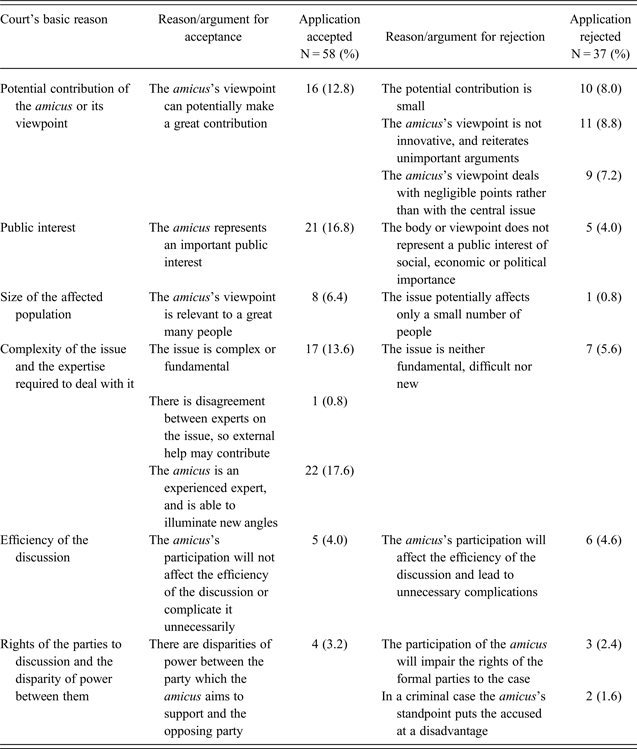
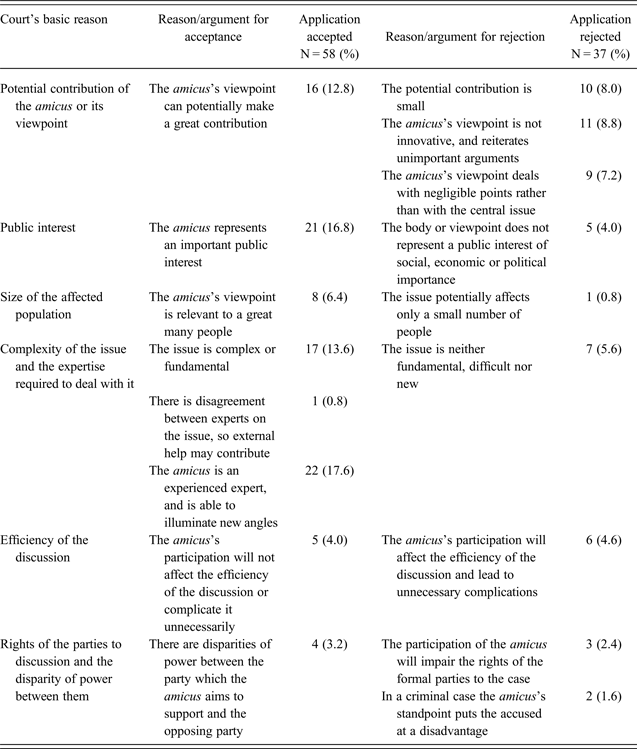
The next question to be considered (the sixth research question) relates to the legal reasoning used by the courts in reaching their decision to accept or reject the application. It should be emphasised that the analysis of the findings at this stage is based only on those cases in which an explicit decision to accept or reject the application was made (accept = 58; reject = 37). A summary of these findings is presented in Table 7.Footnote 26
Analysis of the reasons and arguments for accepting or rejecting applications to serve as an amicus
Influence of the amicus on the decision of the court

As shown in Table 7, most of the instances in which the request to participate as amicus was rejected were justified by the argument that the amicus would add nothing to the parties' arguments, or that its contribution would be negligible and would not relate to the principal issue. The reason for accepting most of the applications was that the amicus was a body which represented an important public interest that was fundamental to the issue under consideration, or that the issue was complex, or that the contribution of the amicus was of potential importance. Arguments relating to the difference in power between the parties or differences of opinion between experts had little weight as a basis for accepting the application, and the consideration that the efficiency of the discussion or the rights of the parties would be affected had little weight in the decision to reject the application.
Thus, it may be stated that while decisions to reject applications to participate as amicus focused on the content of the amicus's standpoint (claiming that it was not innovative or that its contribution was negligible), in the decisions to accept the focus was a combination of the character of the amicus itself (a body representing an important public interest) and reference to the legal issue at stake (a fundamental or complex issue).
4.5. The Influence of the Amicus on the Decisions of the Court
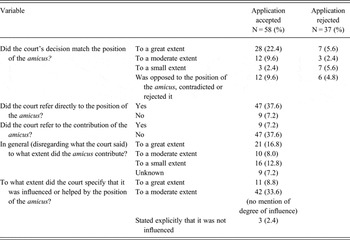
The seventh research question is to what extent did the viewpoint of the amicus influence the court's final decision. Our analysis of the data regarding this influence can be divided into two parts: when the amicus's application was accepted and it participated in the case, and when it was rejected and it did not participate.
Overall, the courts have refrained from referring to the degree to which the views of the amicus contributed to their final decision and verdict. Only in 11 instances have the judges stated that their decision was based on the amicus's position. Yet, even without explicit reference to the amicus brief and its position, the findings show that in the majority of the cases in which the amicus was allowed to participate, the court's ruling matched the amicus's position to a moderate-to-great degree.
It should be pointed out that the validity of this finding is limited in that it is impossible to show the necessary causal connection between the judicial decision and the opinion submitted by the amicus and the finding itself. In other words, the judicial decision may have been the same even had the amicus not participated in the case. In terms of causation, it may be that the decision to allow the amicus to participate simply reflected the prior position of the court, which sympathised with the amicus's views or considered them to be more acceptable under the circumstances.
Despite these limitations, the findings are most encouraging from the point of view of the amicus. There is a greater probability that those amici whose application was accepted will be referred to in the final ruling, and that the ruling will reflect their views, at least to a degree. Moreover, it must be recalled that for many amici, the very fact that they are referred to in the ruling or that their arguments are used, even if only partially and indirectly, constitutes an achievement, and implies recognition of their legitimacy and that of the interests that they represent. Indeed, even in most of the cases in which the amicus's application to participate was rejected, the court specifically referred to its position.
4.6. Correlations between the Independent Variables and the Dependent Variable
The fifth research question relates to the correlation of the characteristics of the amicus and the procedural aspects of the decision to accept the application to join the case. To assess this, χ2 analysis was used. The results indicate that the only variable that was found to be statistically correlated with the probability that the application would be accepted was the amicus's support of a minority or underprivileged group (p < 0.05). When an amicus sought to submit an opinion in support of such a group (involving mainly women, Arabs or workers), the probability that its application to join the case would be wholly or partly accepted was 2.25 times higher than that of another amicus who did not support such a group.
The significance of this finding is that none of the characteristics of the amicus and/or procedural aspects can predict the probability that an application to participate as an amicus will be accepted or rejected.
These findings also reveal an apparent difference between the factor that actually influenced the court's decision regarding the application to participate and the reasons that the court itself gave for its decision to approve or reject the request. An analysis of the verbal reasoning of those courts which approved the application shows that the decision was based on a combination of the following arguments:
• The potential amicus was a body that represented an important broad public interest.
• The issue under discussion was ‘fundamental’ or ‘complex’.
• The views of the amicus could potentially make an important contribution to the case.
Against this, the statistical analysis shows that the identity or characteristics of the group which the amicus intended to support had the greatest statistically significant influence on the probability of success for the amicus whose point of view the court was about to hear. It may be that in this context it was more convenient for the court to base its conclusions on considerations that seemed ‘objective’ (such as the complexity of the issue) rather than on a combination of reasons that might require further philosophical and legal justification (such as ‘inequality of power’ between the parties).
5. Discussion and Summary
In the previous section, we presented a complex empirical overall picture of the use of the amicus device in Israel in the first decade of its existence. Some parts of this picture are clear, but others remain obscure because of the limitations of the research, the pattern of the courts' procedure in this respect, and the lack of regulation of the amicus instrument. In this section, we will discuss two central issues that, in our view, arise from that description.
5.1. The Israeli Amicus at the End of the First Decade of the Institution's Existence: Evidence of its Integration and its Potential for Developing in the Future
In our earlier article,Footnote 27 it was still unclear in which direction the amicus concept would develop: who would make use of it, for what purposes, and how would the courts react to it? On the basis of the findings described above, it may be argued that a decade after the Supreme Court's decision in the Kuzli case, which introduced a completely new procedural institution into Israeli law, this institution has been successfully integrated into and implemented by the judicial system. It did not fade away as a result of failure to use it; rather, it has been accepted and adopted by the courts. Moreover, looking to the future, our findings suggest that there is considerable potential for the continued development of this device in furthering social agendas in the legal arena. From the viewpoint of the NGOs and professional organisations which strive to further the rights of minority or underprivileged groups such as women, Arab minorities and foreign workers, the institution of the amicus introduces a new powerful strategy and a tool for the promotion of their political and social agendas.
The tendency of the increasing usage shows that more and more organisations and bodies are adopting the use of the amicus as part of their legal strategy. It seems that many Israeli human rights organisations, as well as other social and economic organisations, have come to realise the great potential benefit hidden in the usage of this tool. This applies particularly to organisations that represent important social interests or underprivileged groups, which the courts find easier to recognise as being able to make an important contribution to the essential issues.
Moreover, the findings indicate that there is a real probability that a potential amicus's opinion will be heard by the court. Similarly, there is a high probability that the party that wishes to join will support the application and that, eventually, if the court decides formally to approve the application, its position will be reflected in the court's ruling. Further, the statistical analyses show that most of the background differentials (such as the identity of the court, identity of the party that the amicus wishes to join, and the timing of the application to participate) do not reduce the probability that the application will be granted.
There is no guarantee that this state of affairs will continue in the future. It does, however, support our main contention that, looking to the future, the amicus is still potentially capable of contributing to the moulding of Israeli law and society. Accordingly, when bodies, organisations and individuals consider the prospect of being appointed as an amicus, it seems that this field of activity is not only far from being fully exploited, but also that the courts are open-minded towards such initiatives.
5.2. The Adoption of an American ‘Supportive’ Amicus
In our first article on the topic, we described the historical development of the amicus institution at common law in general and in the American legal system in particular.Footnote 28 As was noted, under American law, a transition of the amicus institution has taken place from a ‘neutral’ legal instrument – the purpose of which was to supplement the information at the disposal of the court or to present unknown viewpoints without supporting one of the parties or identifying with its agenda – to a quasi-political instrument, the purpose of which is to support one of the parties and overtly promote its interest.Footnote 29
The findings of our study show that in Israel the ‘adoption’ of the common law amicus instrument has also ‘adopted’ its ‘new’ identity and rationale: that of a quasi-political instrument. As described in the previous section, it is possible to divide most amici into two main categories. The first consists of those who represent professional interests, such as lawyers' or certified public accountants' associations and various other trade unions. They join the case out of professional motives to promote an agenda connected with the administration and practice of the profession. In most cases, these amici primarily promote the interests of strong segments of society. In contrast, those in the second category mostly join cases in which NGOs for the promotion of rights are involved; they adopt a position that supports one party, usually an underprivileged group. The interesting point is that, at an early stage, both categories of amicus, representing different sections of the population, had adopted the function of a political ‘supportive’ approach rather than of neutrality or mere ‘assistance’ to the court.
This finding is not surprising in view of two facts. The first is that many Israeli civil rights lawyers have an American legal background.Footnote 30 The pattern of use of the amicus as a tool for social change is well known to these lawyers because they have been exposed to its use by American civil rights organisations. Therefore, the adoption of this pattern of action by Israeli lawyers representing Israeli civil rights organisations is expected, and proves the influence of American legal education on the Israeli legal system.Footnote 31
The other relevant fact is that historically the amicus instrument in Israel was established following the institution of a strong community of cause lawyering, which created the circumstances in which the legal situation favoured the supportive role of the amicus.Footnote 32 This was primarily because of the increasing number of social and legal rights organisations which have initiated discussions of political issues, and the increasing legislating of most spheres of life. This has been expressed in litigation and the bringing of complex and fundamental issues before the courts in Israel.Footnote 33 It should be remembered that from the time of the establishment of the State of Israel, the courts have formed an arena for resolving disputes on public controversies. Among these subjects were the rights of Arab minorities, the increase in violence in general and violence against women in particular, the increasing importance of issues connected with the quality of the environment, and the increase in criminal acts of holders of public office and Knesset members.Footnote 34 All these have increased the aspiration to bring these issues before the courts, which entails the adoption of a strong supportive, or even political, standpoint rather than a neutral position.