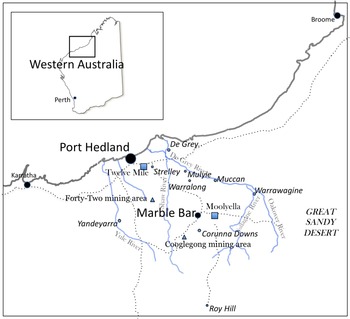
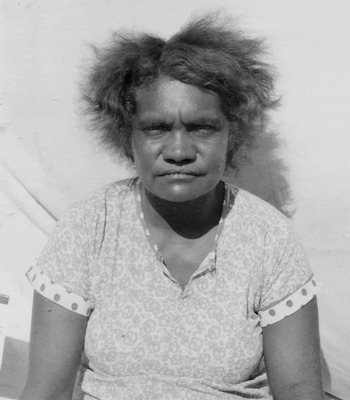
One Saturday morning in 1946, Caroline Jula gathered her blankets, billycans, and few possessions and walked away from Warrawagine, a million-acre sheep and cattle property on the Nullagine River in the Pilbara district of Western Australia's remote Northwest (see figure 1). A young Aboriginal woman in her twenties, Jula (see figure 2) left with other Aboriginal workers and residents of the station,Footnote 1 men, women, and children who had worked as sheep or cattle musterers while some maintained windmills or built fences. Others, like Jula, a domestic worker since childhood, had labored in and around the station homestead, the home of the non-Aboriginal station manager. “We strike,” Jula recalled of the day that they left. “Start rolling up swag, that morning, Saturday, we off, and walk.”Footnote 2 Camping along the way, the Warrawagine workers and their families walked one hundred miles to the Moolyella tinfield to join about 150 Aboriginal strikers who had also left their employment on surrounding stations or in townships. When police and officers of the state's Native Affairs Department began pressing the strikers to return to work, Jula recalled how they resisted:
No, we not go back in a station, no, because we work there in a station, no money, maybe we get a soap, and tobacco, and little bit sugar, and tea leaf.
…We say no, we not go back any more, strike strike, we strike in Moolyella, we got to stop, we got to work living, self.Footnote 3
Printed with Permission. Map of the Pilbara region showing key places mentioned in the text. Map by Anne Scrimgeour.

Printed with Permission. Caroline Jula, 1953. Courtesy of South Australian Museum.

The strike that Jula joined, known as “the Pilbara Walk-Off,” was actually a series of strikes that continued, officially, for about three years between 1946 and 1949, drawing in several hundred Aboriginal workers from across the Pilbara region. Recognized as the first organized Aboriginal strike action and variously described as “the Blackfellas’ Eureka” and “the Great Stockman's Strike,” this historical episode has been justly celebrated for its significance for both the labor movement and Aboriginal rights’ activism in Australian history. However, historians, like the authorities of the time, have focused almost exclusively upon the role and experiences of the male stockworkers, the Aboriginal men whose low-paid labor was essential to the region's pastoral industry.Footnote 4 By focusing attention upon the Aboriginal women domestic workers who participated in the Pilbara strike action, we not only deepen understanding of collective resistance in domestic service, but also see for the first time the key role of Aboriginal women domestic workers in this pivotal event in Australia's Indigenous and labor history.
Existing histories of Aboriginal domestic service note the highly exploitative, slavelike conditions of that employment, with discussions of workers’ resistance centering upon those kind of covert, individualist tactics termed by James Scott as “weapons of the weak,” such as working slowly and ineptly, running away, and stealing.Footnote 5 The absence of collective organization or action by Aboriginal domestic workers is, of course, an absence matched in other histories of domestic labor, and, even today, despite the remarkable organizing efforts by domestic workers, strikes remain rare.Footnote 6 Domestic workers’ role in broader historical crises of class, race, or colonial contestation has also often appeared quite ambivalent.Footnote 7 This lack of collective resistance of domestic labor generally has been met with various interrelated explanations, such as the “over-supply” of willing substitutes, gender construed as alleged female inclination to be submissive and cautious, isolation, and affective affiliations with employers.Footnote 8 In the Pilbara Walk-off, however, we see a clear-cut, if unique, case of collective political strike action against employers by domestic workers, in concert with other workers.
Aboriginal domestic workers in the Pilbara suffered many of the disabilities characteristic of domestic service over time and throughout the world, and they shared with other domestic servants features that made collective action difficult. Yet certain aspects of the situation in the Pilbara made strike action possible. Here, Aboriginal domestic workers resided in their own camp communities, close to but detached from the white homestead. Few ever slept in the house; women charged with care of babies and small infants sometimes did but even that arrangement was typically temporary.Footnote 9 Thus, in contrast to counterparts elsewhere, domestic workers in the Pilbara were not physically isolated from their families and community. Indeed, domestic employment on stations could actually serve to prevent the breaking up of Aboriginal families, with station managers sometimes acting to circumvent the attempted removal by government authorities of mixed-descent girls, particularly those being trained as domestic servants.Footnote 10 (The Western Australian Native Affairs department had a policy of removing and institutionalizing children of mixed European or Asian parentage—Jula herself had lost her only surviving son, who was taken from her after she brought him down to Perth for medical treatment.Footnote 11 ) Furthermore, the pingkayi or holiday period that the domestic workers shared with other Aboriginal workers provided their ongoing connection to the wider social and cultural world of Aboriginal life. Taken in the wet season when station work was impossible, pingkayi enabled a continued, if restricted, access to country: the retention of knowledge and skills to enable people to live off the land and to find alternative means of sustaining themselves away from the stations. Pingkayi also enabled Aboriginal people throughout the region to maintain the broader social and family networks and the religious and cultural structures that would serve as an organizational basis for the strike. Pilbara domestic workers thus did not suffer the physical and social isolation from coworkers that frequently makes collective action difficult. At the same time, the conditions of most Aboriginal labor on Pilbara stations had features characteristic of domestic labor. Domestics, therefore, were members of a community of workers with common grievances, rather than workers isolated from their own communities and coworkers. This ongoing connection with their broader Aboriginal community was critical in enabling the domestic workers to take part in the strikes.
The participation of domestic workers in the Pilbara strikes would make their labor visible in a way that challenged entrenched assumptions about marginality and insignificance in the social and political economy of the Northwest. The domestic workers’ strike highlighted the dependence of the pastoralists upon this labor, customarily taken for granted. Such visibility, and the challenges that the domestic strikes posed in themselves, destabilized the precarious framework of race and class hierarchy upon which the pastoralists’ dominance rested. The irony is that the invisibility of the Aboriginal women's household labor before the strikes has been perpetuated since in the histories of the Walk-Off that ignore the roles they played, both as workers and strikers. This continued invisibility is a direct product of the way in which their labor was obscured or denied recognition in the historical record. Yet oral histories of the women strikers, the small but recurrent references to the impact of their action in the official accounts, and occasional private letters of their female employers, pieced together, enable us to see that Aboriginal women domestic workers played their part in this history.
Aboriginal Domestic Labor on the Pilbara Stations
Western Australia's harsh, semi-arid Pilbara region is the traditional country of people speaking the Ngarla, Nyamal, and Kariyarra (Ngarluma) languages. Europeans with flocks of sheep first arrived in the area in the 1860s, and in the midst of violent conflict characteristic of settler occupation of indigenous land, Aboriginal labor became a key feature of a pastoral economy based on colonial domination and accommodation. As disease and violence depleted the local Aboriginal population, other groups of people speaking Nyangumarta, Mangarla, Warnman, and Western Desert languages travelled in to the river country from Great Sandy Desert to the north and east. They too were incorporated into the station communities and economy and also began working for the “whitefellas,” or walypila, as they called Europeans.
The people lived in “native camps,” close to station homesteads, often in the dry bed of a nearby creek or river. They worked in exchange for basic food and permission to remain on pastoral leases. The men were mostly engaged in stockwork and shearing as well as outside tasks around the homestead such as gardening—old men and young boys sometimes worked in homes too, and women sometimes did stockwork alongside men. Nevertheless, it was the women who typically undertook domestic work within the station homestead—food preparation and cooking, laundry and ironing, bedmaking, sweeping, dusting, and general cleaning, as well as child care.
Aboriginal station workers’ employment has been characterized as “colonized labor,” based on a minimal, if any, wage payment, the low caste status of their tasks, the insecure and itinerant nature of their employment, and the slaverylike working conditions. Some historians, most notably Ann McGrath, have queried whether Aboriginal pastoral workers were ever “truly colonized,”Footnote 12 but nevertheless the degree of control and power over Aboriginal workers that station owners and managers in the Northwest of Western Australia exercised was excessive by any estimation. Since 1905 Aborigines were employed under a permit system and special legislation that, while ostensibly protecting them from exploitative employers, made it an offense for these employees to “neglect or refuse to enter upon or commence his [sic] service,” to “refuse or neglect to work,” or to “desert or quit his [sic] work” without the employer's consent.Footnote 13 Police cooperated with station owners and managers to ensure workers remained on stations, returning them at the end of their holiday period and locking up those who attempted to leave.Footnote 14 In the 1940s, Aboriginal workers could still be arrested, transported in chains, and imprisoned on minor charges, while designated “troublemakers” could be removed, indefinitely, to an Aboriginal institution in another part of the state, under a warrant issued by the Minister of Native Affairs.Footnote 15 The lack of freedom to move between stations as well as police intimidation and harassment would be among the strikers’ principal grievances.Footnote 16
Aboriginal pastoral workers were historically excluded from the existing provisions covering employment. In 1907 the Commonwealth Court of Conciliation and Arbitration (a federal body that settled labor disputes) made a ruling (an “Award”) on wages and conditions covering the shearing industry, as well as famously setting a basic minimum male wage,Footnote 17 but Aboriginal workers came under neither. In 1932 Aborigines were explicitly excluded from the provisions of the federal award for station workers because it was seen to conflict with the various state-based systems regulating their employment; and this exclusion was maintained in 1938 and again in 1944 despite efforts to have it removed. Pastoralist employees argued, successfully, that existing legislation covering Aboriginal employment provided adequate protections for Aboriginal workers.Footnote 18 Not until the mid-1960s would Aboriginal workers be included in the provisions governing pastoral awards and not until 1966–1968, following the famous Wave Hill Walk-off (a strike by Gurindji pastoral workers in the Northern Territory), would the Commonwealth Conciliation and Arbitration Commission (as it was then known) rule that Aboriginal pastoral workers were entitled to the same wages as white employees in the industry.Footnote 19
All domestic workers on pastoral properties, both Aboriginal and non-Aboriginal, were in fact excluded from Award provisions for pastoral workers. In 1917, when the powerful Australian Workers Union (AWU) secured some limited coverage for Aboriginal union members in some Australian states (but not Western Australia), Aboriginal female domestic workers along with other non-Aboriginal “house based” workers were specifically excluded from the provisions of the Award. From 1910 an original prohibition on dealing with disputes of domestic workers had been removed from the legislation governing the purview of the Arbitration Court, but nevertheless the presiding judge (Justice Higgins) in 1918 had ruled that the clause excluding domestic servants from the pastoral workers’ award should be retained because domestic service was properly the province of the state-based Wages Boards and Courts.Footnote 20 The exclusion of domestic workers in general from Western Australian arbitration legislation dated back to 1912 and had been retained in 1925 after a lengthy debate.Footnote 21 In 1941 the issue emerged again in Western Australia with a bill to bring domestic workers under the jurisdiction of the state's Arbitration Act. At that time, wages for non-Aboriginal live-in housemaids in the state's capital city of Perth ranged between 12/6 and £1 a week, up to 30/-, plus board, but according to one domestic worker, “Most girls work for 15/- and are thankful”Footnote 22 (a pittance at a time when the average Australian male wage was £5/15/8 a week and even the average female wage £3/4/4.)Footnote 23 Although the bill only provided for domestic workers to have the right to organize and approach the state's Court of Arbitration to ask for an award, the Commissioner of Native Affairs, Francis Bray, urged the Minister for the North-West for an explicit exclusion of Aborigines stating that “representatively, they are poor in ability as domestics, and naturally it would not be right that their employment should come under an Arbitration Award.” Bray proposed that, to avoid disturbing the employment of these workers, such an Award's provisions should be limited to employment within twenty-five miles of Perth (in the south, where the vast majority of domestic workers were not Aboriginal). The Minister for the North-West assured him that a metropolitan award was indeed the most that could be “hoped for” should the bill succeed,Footnote 24 but in the end, the bill was defeated on the grounds it would harm the interests of “young unskilled girls” seeking domestic employment and that “[t]he best way to get a domestic servant was to marry one.”Footnote 25 We have no record of what Aboriginal women working on the stations made of the issue.
There was by the 1940s a long popular tradition of denigrating Aboriginal domestic labor as laughably incompetent, requiring training and constant supervision. Even experienced domestic workers, like Jula's mother who taught her to do housework,Footnote 26 were portrayed as being forever under tutelage. Jenny Hardie, who married into a pastoralist family in the 1960s, wrote in her 1981 history of the Pilbara how “each day, for a few hours, the [Aboriginal] women drifted up to the homestead to be taught by ‘the missus’ the finer arts of domesticity.”Footnote 27 In this prevailing representation of domestic labor on stations, Aboriginal workers were cast as children to motherly white women, a construction intrinsic to racialized domestic service relationships that sociologist Judith Rollins refers to as “maternalism.”Footnote 28 Such perceptions masked the coercive nature of labor relations, coexisting with amiable and even genuinely affectionate relationships that sometimes developed between the white and black members of station communities.Footnote 29 These attitudes enabled some employers to attempt to evade their responsibilities to domestic workers on the grounds that they were given work only as an act of kindness. In 1939 the manager of Mulyie Station denied that Waterlily was his employee, when called upon to pay her traveling expenses for medical treatment. She was just “a good old thing,” who cleaned boots and turned down beds in the afternoon, he told the Commissioner of Native Affairs. “She looks on this as home,” he went on, “and likes to do a little now and then but is a free agent and comes and goes as she pleases. What better can she have—food, clothing and a home … the ideal help that the country can give the native.”Footnote 30
In hindsight, West Australian historian (and former Minister for the Territories) Paul Hasluck posited, rather condescendingly, the greater value of Aboriginal domestic labor in the development of the North than that of the male station workers:
They attended to most of the housework, waited at table, carted bucket after bucket of water to fill the household tanks, fetched and carried, watered the garden, did the laundry, washed up and generally attended to all the little things that whites found tedious or unbearable in a trying climate.Footnote 31
Yet pastoralist employers at the time rarely acknowledged the work of Aboriginal women domestic workers on stations as being anything but peripheral to the “real” work of the station.
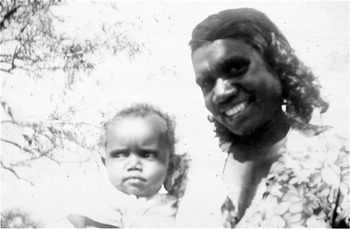
It certainly was real labor. Hardie's description of women aimlessly “drifting up to the homestead for a few hours” conflicts sharply with the recollections of the women who worked as domestic servants in station homesteads. Girls born on the station began learning domestic work as children, a process that white mistresses called “breaking in.”Footnote 32 Others, who moved there as adults, like Kulyu (Molly Williams) (see figure 3) at Mulyie Station, whose parents worked as domestics for the local policeman in the Marble Bar township, began by sweeping and raking in around the homestead, before working inside the house.Footnote 33 In the early 1990s when Anne Scrimgeour interviewed Kulyu, Jula, and a number of other former domestic workers from the Pilbara strike, she found common memories of long working days, regulated by the ringing of bells and monotonous routines. Typically the working day began before sunrise, when the women got the kitchen ready and cooked and served breakfast for all the workers, Aboriginal and white. Chores were structured around mealtimes, with the women cleaning and laundering after washing up the dishes, before returning to their camp to wait for the bell to call them back to serve the next meal: “‘E ring a bell, for everybody, we coming in.”
And three o'clock we coming back, do the work again. Give'm cup of tea, you know, whitefellas, I give'm cup of tea, and water'm garden, afternoon. And suppertime, night time, get a supper, have'm supper, and after tea we go do the work, they just feed'm whitefellas, you know.Footnote 34
Nyirrarlpi (Maggie Ginger), who worked on Muccan Station, recalled:
At that time we all used to work. We washed the dishes and cleaned the room and the verandah with a broom. I used to water all the plants. Then I went home and would wait until lunchtime. And then when they rang the bell for everyone, I'd go back. Then I'd have lunch and do some more work. I'd wash the dishes and put them away. I used to serve out the food at the table and then take the plates back to the kitchen. I used to serve out all the food and take some for myself. I'd wait a while and then have my own dinner, and then wash the dishes. I'd clean all the rooms and bring all the clothes in from off the line. I used to wash them, dry them, and then iron them, and stack them away in the cupboards. I'd put all his things away for him. When I'd put all the things away I'd be finished, and I would go home. I would be finished work. When I had finished doing everything I could go home. I would stay at home and then go back to the house in the evening. Then I'd start doing some more work.Footnote 35
Printed with Permission. Kulyu (Molly Williams), 1960. Courtesy of Eugenie Knox.

If those who employed them did not see their work as important and valuable labor, the women workers themselves could not fail to recognize the dependence of the station upon them. When other Aboriginal station workers decided to take collective strike action to secure better wages and conditions for themselves, the Aboriginal domestic workers would not miss the opportunity to join and make a stand themselves.
Aboriginal Domestic Workers in the Pilbara Strikes
The initial action involved Aboriginal workers throughout the Port Hedland and Marble Bar region of the Pilbara ceasing work on the same day. Although employers had been forewarned of the strike, they did not believe their workers were capable of undertaking coordinated action of this nature, particularly given the distances involved. “We had always said that they could never be conscripted or got together in a crowd,” station manager's wife, Edith Miller, recounted.Footnote 36 Most walypila, therefore, were taken by surprise when Aboriginal men and women throughout the region refused to work on or close to May 1, 1946—International Workers’ Day.
Many pastoralists genuinely believed that their arrangement with Aboriginal workers was one that suited Aboriginal people well, providing them with “station homes where they were fed and nursed and had an easy-going life that appealed to them.”Footnote 37 Domestic workers, like other Aboriginal station workers, were not at all content with this arrangement. None of the women interviewed by Scrimgeour received wages, and in their recollections many also cited the paucity and poor quality of food provided as a reason for the strike. Caroline Jula recalled, “We only get little bit of bread, and meat, stink, you know, and old tea. Everyone bin get'm, for dinner. In the hand, no plate, nothing. … We eat in the woodheap.”Footnote 38 Other rations, such as soap, tobacco, and needles and cotton, were provided on Sundays, but Jula complained that the women received only one dress, which had to last them all year, and that they had to make the rest of their clothing out of old flour bags.
The involvement of domestic workers in the strike was evident from the outset. Edith Miller gave an account of women asking for wages for themselves at De Grey Station. “The women weren't paid then,” she said,
and they held us up over that, and I sympathized with them. They came to me first and said, “I want you to tell boss,” this was Lily, “I want you to tell boss we want wages,” and I said “No good me telling boss, you blokes got to tell him, you got to tell him why you wantum wages,” “Oh we want ’um, oh want to buy ’um,” “What you want to buy ’um because you get dresses given you.” “[We] want to buy ’um self.”Footnote 39
Miller took the women's request to her husband, and as a result “the girls who were waiting at tables and doing housework did get a small amount of money, only a few shillings, but still it was pay, that's all they were after.”Footnote 40 In an interview, Nyirralpi (Maggie Ginger) made it explicit that the striking domestic workers, like the stockworkers, wanted monetary wages: “That's why we strike for right now. We got a right now, long as we've got our own tucker, we got'm. We got'm money. We bin stop no money first one, that's why we bin strike.”Footnote 41
Police in the Marble Bar region responded quickly to the sit-down strike, traveling around stations and convincing workers to return to their tasks.Footnote 42 In Port Hedland district, too, at the request of the managers there, police and an officer of the state's Native Affairs Department patrolled stations to ensure that workers returned to jobs.Footnote 43 At the same time, various station owners (including Les Miller at De Grey) agreed to increase wages for the duration of the shearing to prevent disruption.Footnote 44 These temporary increases seem to have not included domestic workers (and it's unclear from Edith Miller's account whether the wages given to the women workers after they protested were connected in any way).
Within days the authorities believed that the strike had been successfully suppressed,Footnote 45 but their complacency was short-lived. Aboriginal strike leaders Dooley Binbin and Clancy McKenna had been arrested and sentenced to three months imprisonment, under the legislation that made it illegal to “entice” Aboriginal workers from their employment. Although the imprisonment of Aboriginal people in the north rarely received attention in Perth, the involvement of Don McLeod, a non-Aboriginal man with connections to the Communist Party, meant that the strike and its suppression quickly gained public attention and the support of the labor movement and women's groups in Perth who protested to the Secretary-General of the United Nations Organization in New York. Under considerable pressure, the government released McKenna and Dooley. McLeod, also arrested and charged, received only a fine, rather than prison.Footnote 46
As the pastoralists tried to reduce wages at the end of the shearing season, workers, including domestics, began to “walk-off” the stations. Although the original intention of strike organizers was for workers to remain on their stations and workplaces, some workers—many of them domestic workers—had been forced away from their place of employment during the strike actions. Management at two Port Hedland District stations had responded to the strike not by having the police compel the men to work, but by calling upon them to expel Aboriginal people wholesale from the property.Footnote 47 The police ordered the exiles to camp at the Twelve Mile camp, twenty kilometers from Port Hedland, and the Native Affairs Department initially provided rations to prevent them traveling around stations, causing further unrest.Footnote 48 Exiles included a woman described by the police as “a very good domestic,” who was placed, along with her husband, to work at the Port Hedland Native Hospital for their rations: she refused, insisting upon a wage, which the police officer involved recommended should be set at 5/-.Footnote 49 A second group consisted entirely of domestic workers, both male and female, from the town of Marble Bar, who had been working at the hospital there and “around the town.”Footnote 50 Six men, described by the local police officer as “ordinary house and yard boys,” and four women described as “housegirls” had joined the strike and stopped work on May 1. After the constable spoke to them in what he called “the right way,” they agreed to return to work, but their employers refused to reinstate them. As Aboriginal people were only permitted to live in town if they were employed,Footnote 51 the police ordered those who lost their jobs to leave town. They walked the twenty kilometers to Moolyella where they could make a living mining tin.Footnote 52 These two small groups of displaced workers formed the nuclei around which two strike camps developed during the following months, as increasing numbers of people left the stations.
The annual Port Hedland horse races at the end of July—a holiday for both Aboriginal and walypila workers—provided an opportunity for many Aboriginal people to join the strike camps at the Twelve Mile and Moolyella. Daisy, an Aboriginal woman employed as a cook at Strelley Station, her husband Wampi Ball, and the seven other Aboriginal people who lived on Strelley Station were among the 150 who did not return to station employment when the races ended. Daisy was unusually well paid at 15/- a week,Footnote 53 equivalent to about $48.40 today, a not uncommon if low wage for non-Aboriginal maidservants, but approximately half of the wage a non-Aboriginal cook could expect to earn at the time. Her relatively higher wage perhaps indicated the value her white woman employer, the station manager's wife, Benja Sherlock, placed on her services. Daisy withdrawing her labor would have a profound impact on her white mistress.
Letters from Benja at the time give a vivid glimpse of the strike's impact on women, both Aboriginal and white, and how the withdrawal of the women's domestic labor brought the reality of the strike home to the wives of the men who ran the stations. The day after Daisy and her husband left, Benja wrote to her sister:
Just another short note as I am so tired I can hardly sit up and my back and feet ache!! I've been on my feet since 6 am, and its now 8:30 pm. Well the natives are on strike again, and this time for two pounds a week!!!Footnote 54
In another letter, a week after Daisy's departure, Benja added a heartfelt postscript: “Wampi and Daisy are back!!!! Oh my goodness—please God let them stay, is my fervent prayer during every waking moment.” But as Daisy came back with a cold and had remained in camp, Benja was not to be relieved just yet. The next morning after breakfast Daisy appeared, “and it seemed to good to be true. She looked a bit sour on it, but said she felt better and has been going ever since. She is excellent in the kitchen, so clean, and it was a treat to see her get things ship shape and doing the little extras that I'd had to leave.”Footnote 55
But Benja was anxious. Her husband had not yet told Wampi he planned to reduce his wages again at the end of the shearing, and there was no certainty for Benja that Daisy and Wampi would not be “up and off” when they heard. “I feel sick at the very thought of it,” she wrote.Footnote 56 Just over another week later: “Daisy has been wonderful and I can't bear to think of her leaving!” The following day Wampi was paid at the preshearing rates, and he and Daisy informed the Sherlocks of their intention to leave.
Benja's description of hearing the news from Daisy makes it clear that the withdrawal of women's domestic labor had a powerful emotional and symbolic impact upon the white station women, that seemed at once both much smaller and much larger than the men's struggle.
I was sewing in the dining room when I heard Daisy call, “Are you there Missy?” In she came, with her hat on, to say goodbye. She said, “I'm very sorry to leave you,” and she was near to tears, the dear old thing. … By then I was close to blubbing myself, but managed to say that perhaps they may come back when all the trouble was finished, and she agreed. I thanked her for all she had done for me, and we said goodbye.
I felt the bottom had fallen out of everything. When I went over to the kitchen to see to dinner, there were their meat and veggies [vegetables] still in the oven and I felt too sad and depressed for words.
She realized too, seeing how Daisy had made the place “spotless,” that Daisy must have already been preparing to go while they waited to find out about the wages.Footnote 57 Despite the evidence of the Aboriginal workers’ determination, undoubtedly many of the station managers’ wives believed that the Aboriginal strikers, and particularly the women workers, were unwilling or misguided victims of agitators. Yet still more and more Aboriginal people, like Caroline Jula and her family, left their stations and workplaces as opportunity presented itself. By October 1946 there were 180 strikers based at the Twelve Mile, and another 150 at Moolyella.Footnote 58 According to the police officer stationed at Marble Bar, “practically every station” in the district was affected by the loss of their workers to the strike.Footnote 59
By the second year of the strike, the absence of Aboriginal domestic labor was keenly felt. Station managers were able to replace the striking stockworkers with young and inexperienced white men brought up from the south (called “jackaroos”), but it was another matter altogether to replace the domestic workers.Footnote 60 Domestic service labor had been in steady decline in Western Australia (as it had been in Australia generally) since the late 1880s, with a rapid decline between 1933 and 1947, a large factor being the low status of the work.Footnote 61 Housemaid work on the remote Northwest pastoral stations was even less attractive to white working-class women than urban employment. As one such woman in a letter to a Perth newspaper editor in 1941 advised others from the capital, never “try a housemaid's job on a station … you are considered by the ‘Boss’ and the ‘Missus’ and family less than the dust beneath their natives’ feet.”Footnote 62 The station owners and managers were wholly reliant on what local female labor they could secure.
The heightened anxiety around white dependence on Aboriginal domestic labor was given symbolic expression in October 1947 when a policeman accused Lily, a mixed-descent Aboriginal domestic worker, of acting as a vital connection between the strikers and McLeod, whom the pastoralists and the police continued to blame for fomenting the unrest. As he then was being prevented from having any direct contact with Aboriginal people, it was believed that it was at the boarding house at Port Hedland where he took his meals, run by a white woman named Sophie Ellis, that he was able to communicate with them. Lily, employed by Mrs. Ellis, was “the wife of one of the strikers & in my opinion the Main go between with McLeod (Communist) & the 12 miles Striker camp,” according to the police officer. Mrs. Ellis's permit to employ Lily was cancelled.Footnote 63 Whether the policeman was just punishing McLeod's hostess by dispensing with her servant (who was evidently not on strike), or whether he genuinely believed that Lily was McLeod's interlocutor, the episode suggests another way in which Aboriginal domestic workers had become more visible at this time, with their loyalty now judged dubious.
But perhaps most significantly, the withdrawal of Aboriginal domestic labor made the day-to-day work of maintaining the pastoralists’ homesteads of the Northwest glaringly visible. While the work of cooking and feeding the stockworkers was undoubtedly the more demanding of the domestic work required on the station, it was the status-defining work of serving the station manager or owner family that was the more important in terms of maintaining the hierarchical framework that shored up the power of the leading pastoralist families and the broader social structure of the Northwest. This “gentry tradition,” as depicted by historian Tom Stannage, centered around the claim that Western Australia had been colonized by elite pioneering families who could have mixed in Britain with the “first order of society.”Footnote 64 In the rather wistful recollections of Edith Miller, we can see the awkwardness that the domestic workers’ strike created:
I'll always remember after the strike started some of the station owners from further up [the De Grey River] coming through and staying for lunch, and one of them looked at me at the end of the table and he said, “Are we gentry, or do we stack [the dirty dishes]?” I said, “we stack today,” nobody to take the plates away. No it was a sad time.Footnote 65
With displays of gracious living being essential demonstrations of success in the pastoral industry, it was confronting to have the white women of the manager's, or even the owner's, family obliged to do the chores. It pointed not only to an inversion of the “proper” class and racial order, but also, importantly, to the dependence of white colonization on women's undervalued domestic work. As Anne McClintock has observed, in the broader context of colonialism, domestic service functions as a “labor of invisibility” that together with the white mistress's visible “labor of leisure” operates to “disavow and conceal … the economic value of women's work.”Footnote 66 The Aboriginal domestic workers, by striking, made both the economic and the symbolic value of their labor very visible.
Over the three-year course of the strike, wages and living and working conditions for Aboriginal people on stations improved as pastoralists attempted to attract Aboriginal workers back to the stations. Meanwhile the Commonwealth Arbitration Court heard AWU claims for a new Pastoral Industry Award, which would have removed the exclusion of both Aboriginal stationhands and domestic workers (Aboriginal and non-Aboriginal), commencing in March 1948. As usual, employers argued against the inclusion of Aborigines on the grounds that they were unreliable and required supervision. Both claims failed. But, for the first time in the Court's history, the work undertaken by Aboriginal women domestics specifically had been discussed (the employers, predictably, disparaging its value and denying their dependence on that labor).Footnote 67
At the same time a survey undertaken by the West Australian Native Affairs Department during the strike recommended that a fixed minimum wage should be brought in for all Aboriginal workers in the pastoral industry in the Northwest, albeit with provisions made “for the non-efficient workers and also for the domestic female servant who may not be worth the full minimum wage.”Footnote 68 Although even this did not happen, the authorities’ position undoubtedly helped press the pastoralists to improve conditions, even for domestic workers, and while women's wages remained below that of men (the rule in Australia generally), more domestic workers were paid and rates of pay increased as the strike progressed. In early 1948, for example, four women employed as domestic workers received wages (£1 per week) at Mulyie Station, on the De Grey River, where years before the manager had refused to recognize Waterlily as a worker.Footnote 69 During the course of the strike Kulyu (Molly Williams) took work as a domestic servant on Warralong Station, alongside her husband's position as a kangaroo shooter. For the first time they were provided with improved housing. Kulyu explained: “That time they put us in the table now, they give us table, [a] room to live, bathroom, all there. [When] they bin hear'm strike was starting, they put us in a table, they give us home.”Footnote 70
Aboriginal Domestic Workers after the Strike
When the strike officially ended in July 1949, not all the strikers returned to station employment. Some people turned their attention to establishing themselves as a financially independent group, as part of a mining venture undertaken with McLeod. Their success led increasing numbers of Aboriginal people to again leave stations and other employment to join mining camps scattered throughout the district, and by May 1952, 663 Aboriginal men, women, and children were involved in the mining venture.Footnote 71
With Pilbara stations again facing severe labor shortages, the state government commissioned a Committee of Enquiry to investigate the situation of Aboriginal labor in the area. Pastoralists believed their workers had been intimidated into leaving the stations and joining the cooperative, citing as evidence the fact that some women cried when they left.Footnote 72 The committee found no evidence that force was a factor in the movement of people away from the stations, but they heard statements from pastoralists that indicated the degree to which stations were affected by the loss of domestic labor to the mining cooperative. Jim Lewis, joint manager of four stations, including Warrawagine, was leaving the Pilbara because of the lack of domestic workers. “It is too hard on his wife,” Lewis's joint manager testified. Lewis's wife, for whom Jula had worked before the strike (Jula by this point was working for the mining cooperative), had found conditions so difficult without domestic help that her weight had fallen to six stone (38 kilograms). “Stations generally are having this experience in relation to domestic labour, particularly cooks,” Lewis's co-manager said. “I cannot see much hope unless on some form of indentured labour on the domestic and gardening side.” He thought the shortage of labor for mustering, only needed for a short period each year, could be overcome by having stations stagger the mustering but said, “we need domestic help all the time.” He told the committee, “I cannot stress too much the domestic difficulties.”Footnote 73
Other pastoralists also stressed the hardship caused by the loss of domestic labor. A white woman who had interests in two Pilbara stations said that it was “very hard for women on stations if there is no labour to assist.”Footnote 74 Another pastoralist told the committee of inquiry that “one of our greatest disabilities at present and for the future is losing our native labour on the domestic side.”
Young jackeroos have to be well catered for. This principally lies with the Managers’ wives, who act as mothers to these young fellows. Although we use all facilities, they cannot be relieved of much work, such as washing and ironing, plus in most cases, cooking. We are finding it very hard to replace the native women.Footnote 75
But many Aboriginal women found the alternative available very appealing. McLeod told the committee that, although life in the mining camps was not easy, “the women [were] more keen to work in our camps than on stations.”Footnote 76 The cooperative was organized along egalitarian lines, with women having equal say in the decision-making process, both at general meetings and through a women's committee. As one man later recalled, “at strike-time we decide ‘women got the power.’”Footnote 77
A notable leader in the shift to the mining cooperative enterprise in this period was Daisy Bindi (see figure 4). A Nyangumarta woman of “great energy and personality,” and a former stockworker, by 1951 she was a domestic worker on Roy Hill Station.Footnote 78 This station, an officer of the Native Affairs Department reported in April that year, although one of the biggest in the Pilbara, was “also one of the slowest to make a move for the betterment of the natives.”Footnote 79 It appears that the women workers were still not receiving any wages at all, even at this late date.Footnote 80 In September 1951 the Roy Hill people, including Daisy,Footnote 81 attended a large meeting in Marble Bar at which they were invited to join the mining venture. Daisy decided against it, saying (according to a police report) that “I am for the Squatter [the pastoralist employers] as they are treating us properly and Station is my home and I am going back.”Footnote 82 Nonetheless, Daisy planned to negotiate for wages and better conditions. Returning to Roy Hill from the Marble Bar meeting in advance of the other workers, she told the station owner, Alec Spring, that they would return if he went with her to see McLeod at Marble Bar and got a “white paper” (presumably she meant that he was to sign a labor agreement). Spring ignored this request, however, and the workers returned to Roy Hill anyway, at Daisy's suggestion.Footnote 83
Printed with Permission. Daisy Bindi, 1963. Courtesy of South Australian Museum.

Sometime after this Daisy approached the manager to negotiate for increased wages for the men and wages for the women while Spring was away.Footnote 84 “I bath and tidy myself and I know what I am going to say,” recalled Daisy. She had with her all of the women workers, most of the men, and some of the white male workers.Footnote 85 The manager refused and warned them not to make trouble. In response, the women who worked in the kitchen stopped work. To resolve the impasse, the manager called all the married men together and offered to pay their wives 10/- per week if they returned to work. Most accepted this offer, and Daisy chastised them for making such a concession. She spoke to the manager again but remained dissatisfied.Footnote 86 According to notes made during a government survey taken at the time, management agreed to but did not honor her request for better wages, and refused the request for better food.Footnote 87 Eventually Daisy had enough. During pingkayi, the holiday time around Christmas, Daisy arranged for the mining cooperative to send a truck out to Roy Hill to pick up the people there and take them away to start up a new mining cooperative of their own.Footnote 88 Ninety-six people left on the truck with her.Footnote 89 Despite pressure from Spring and police officers to return to station work, the Roy Hill people began mining tin at the Cooglegong mineral field under Daisy's leadership. Eventually they joined the larger cooperative, not least because of the group's wish to have their children educated at the school being established at the cooperative's newly acquired station, Yandeyarra.Footnote 90 In 1959 Daisy came to Perth. Interviewed at the time, Bindi explained triumphantly, “On the stations we had nothing. Now, we got everything. … That strike, and Co-operative, mek new life for us.”Footnote 91
Conclusion
The women domestic workers of the Pilbara found an unprecedented opportunity in the Walk-Off to articulate their dissatisfaction with their own working conditions and to take effective, collective action to protest and effect change. In joining the strikes, it is clear that they went beyond expressing solidarity and support for the male stockworkers. Their involvement in the strikes can be read as an assertion of the value of their own labor and their rights as Aboriginal workers. In withdrawing their labor in the white homesteads, they made its importance visible.
In recuperating and analyzing this history, we transform understandings of the history of the Pilbara strike and the broader sweep of Indigenous labor history. Recognizing the role of the domestic workers in this action does more than simply add the labor of the home to Aboriginal pastoral labor history—it shows how such domestic labor was inextricable from, and indeed fundamentally supported in an ongoing, continuous and everyday way, the other forms of labor that were utilized in the pastoral sector. Looking at the domestic workers’ participation in the strike action also provides a different approach and insight into the history of resistance by domestic workers, highlighting how the connection of domestic workers to their wider community made such action possible. From Caroline Jula to Daisy Bindi, and encompassing all the other women workers whose names are forgotten, our aim has to been to draw out and underline the forgotten role of Aboriginal domestic workers in the Pilbara pastoral workers’ strike. In this enterprise, they succeeded where many other domestic workers have not, not just in organizing and carrying out collective industrial action, but perhaps even more crucially, in making visible the significance of Aboriginal women's domestic work.