The recently published book on the purpose, imagery, style, technical construction and condition of the Westminster Retable includes contributions by a number of specialists on various aspects of the artificial cameos formerly placed at regular intervals across the top and bottom and on the vertical divisions of the frame.Footnote 1 The coloured glass ovals and the putty-like material used in their manufacture, the method of their insertion into the wood of the frame and also the evidence for the way they were subsequently prised off in the post-medieval period are fully described and illustrated. Unhappily, only two out of the original thirty-six cameos are now available for art-historical analysis: one lost in 1972, but previously recorded by photography, and the other still extant.
John Cherry, author of the principal essay on the art of the cameos in that book, rightly places them as a decorative phenomenon in the wide context of the availability of, taste for and re-use of antique gems on precious objects made by medieval craftsmen.Footnote 2 These objects range from the most conspicuous and sacred reliquary shrines, such as that of the Three Kings in Cologne, down to small personal signet rings.Footnote 3 Cherry suggests that, although the cameos on the Retable are only imitations, their display of profile heads shows that they were deliberately employed with conscious antique connotation, in order to carry the medieval viewer back mentally to the historical period when Christ lived on earth. This striking interpretation of the use of the cameos has, of course, interesting implications for the overall iconographical and devotional programme of the Retable.
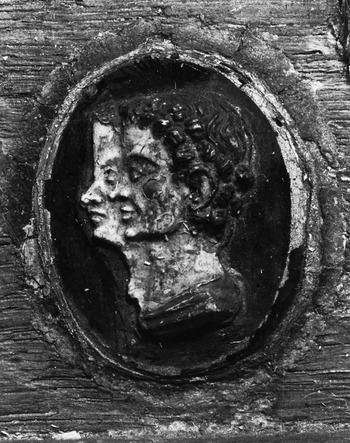
Apart from their evident antique antecedents, there is arguably another side to the Westminster Retable's cameos, namely their place in the ongoing history of style and subject matter in English and also in French figurative art and design, given the continental contacts apparent in the artistic programme of the Abbey. Thanks to Otto Fein's Warburg Institute photograph of the recently lost cameo, its lively elegant design can still be appreciated (fig 1). It is briefly described by Cherry as showing ‘two heads overlapping and facing left, with curly hair. It is the type of cameo known as “jugate” (literally “yoked together”)’. I offer here a rather more detailed description. The two profiles, though they have marked similarities, are carefully differentiated. The brow of the outer head (at the left) is very straight and high, topped by a small crest of hair evidently parted in the middle, combed back and flat on the top. The top of the inner (principal) head is similarly flat, nearly horizontal. His brow, though it too goes straight up, has a lower hairline. His hair sprouts up and is arranged in a series of heavy noduled curls, interrupted by his large flat ear and appearing again round the nape of the neck. A second row of curls, beyond the first, clothes the head like a garland, while the crown of the head has smoothly undulating strands of hair, meeting and ending in the noduled curls. The eye of both heads is similar, though the principal head has the line of a high, arched eyebrow, hidden in the outer head at the left. The nose of this outer head projects from the level of his deeply indented lower eyelid, whereas the nose of the principal head projects more naturally from above eye level. Both noses jut out and are bulbous at the tip, with fleshy nostril lobes. Differences between the heads are noticeable below the nose level. The wide mouth of the outer profile is pursed, and slopes down. The pointed chin is set further back than the lips and slopes down to meet the throat. In the uppermost head, the distance between the nose and the upper lip is longer. The mouth is shorter and curves upwards, not downwards, the strongly marked fold of the cheek giving the effect of smiling alertness. The chin and jaw are square, confirming the attentive look of the whole head. The longer lines of the features of the outer profile give it a more contemplative, dreamy appearance. The sloping chin is in keeping with that of the profiles of several female portraits in antique cameos and intaglios, but the flat visible hair suggests that the outer profile is that of a man.Footnote 4 The long neck and well-modelled throat of the uppermost head is terminated by a scarf-like swathe of drapery, well in keeping with the conventions of classical exemplars.Footnote 5
Westminster Retable: jugate cameo. Photograph: Warburg Institute

In English book painting, the heyday of the profile head is the first half of the twelfth century. In the St Albans Psalter and in the books immediately related to it, the pictorial narratives place all the participating figures in strict silhouette with their heads seen side-on in serried ranks. It is typical, for example, that, in the St Albans Psalter scene of the Massacre of the Innocents, the heads of Herod, the executioners, the mothers and even the slaughtered babies are seen in profile.Footnote 6 A mixture of head positions becomes customary by around the mid-twelfth century, but the conspicuous use of the profile is still a decorative feature in the Winchester Psalter, notably in the Judgement scenes, where rows of profile heads – strongly delineated whole heads, not overlapping – alternate with rows of three-quarters posed whole heads.Footnote 7 Also in the Winchester Psalter, there are rare examples of truly overlapping heads, for instance in the top left- and right-hand corners of the Crucifixion scene on folio 22.Footnote 8 By the end of the twelfth century, in the monumental naturalistic style seen in the last stages of the Winchester Bible, the great Canterbury Psalter in Paris and the Leiden Psalter (as well as in the North French equivalent of that style, the Ingeborg Psalter), the norm in crowd scenes is positive clusters of heads set in the three-quarters pose. The profile is sparsely used, usually in isolation.Footnote 9
However, another convention, which was to have great vogue, is hinted at in the Winchester Bible itself, in the initial D of Psalm 101. In the heads of the group of the first-born sons being slain, two profiles flank a centrally placed three-quarters posed head.Footnote 10 By around the mid-thirteenth century, where throngs of heads are set together in illuminated manuscripts, the overriding English convention is carefully to alternate the profile and three-quarters pose. The deliberateness with which this convention is observed is strikingly displayed in W de Brailes's scene of the Fall of the Rebel Angels on folio 24 of Baltimore, ms W 106.Footnote 11 Only one band of heads, that adjacent to the bottom left of Christ's pointed oval frame, are shown in overlapping profile; all the others regularly contrast profile and three-quarters posed heads. In the Douce Apocalypse (by common consent close to the Westminster Retable in style and probable date), the same convention is carefully adhered to, for example, in the rows of heads of the witnesses at the Marriage of the Lamb on folio 52v and in the row of adjacent heads, male and female, at the very top centre of the scene of the Marking of the Brows on folio 38v.Footnote 12
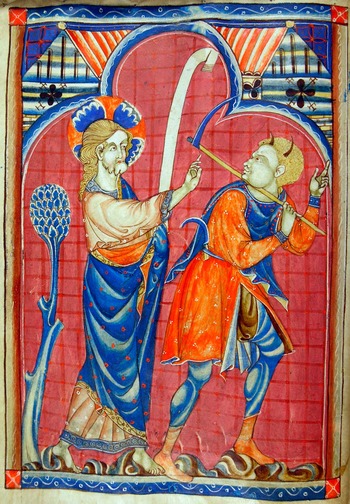
The first profile head in this row, immediately beyond the full figure of the cloaked and wimpled woman, brings us reasonably near to the facial type of the principal head on the Retable's jugate cameo, with long flat brow, pursed, smirking lips and square chin. Comparison with this particular miniature in the Douce Apocalypse confirms that both the jugate heads are male, since, as noted above, the outer head has hair exposed; women are regularly identifiable by their head-gear in the groups of overlapping heads in the Douce Apocalypse, whereas many men are bare-headed. In the Douce Apocalypse, however, the norm for men's hair is that the forehead and the nape of the neck are framed by a broad band of S-shaped curls and the crown of the head, with wavy furrows, immediately succeeds the first row of curls, not the two rows of the Retable's cameo. The festoon of hair on the cameo is reminiscent of the mass of curls below the mitre of the Archbishop in the Westminster Psalter, as is the conspicuous shell-shaped ear, though of course in the cameo placed flat, not projecting.Footnote 13 The alert, clean-cut features of the jugate cameo's principal head, though specific characteristics of physiognomy are different, is recognizably akin to the head of Cain on folios 5v, 6 and 6v of Cambridge, St John's College, ms K 26, particularly the last of these (fig 2), where the dramatically expressive profile head has a high, rounded mop of hair, though cropped, not curly.Footnote 14
Cambridge, St John's College, ms K 26, fol 6v: the Condemnation of Cain. Photograph: by permission of the Master and Fellows of St John's College, Cambridge

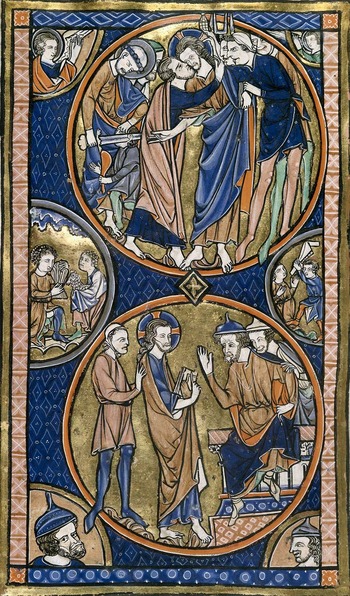
The facial types in the cameo are quite distinct from those in the figure scenes on the Retable, and are all the more interesting as independent evidence (through the manuscript connections observed here) that the highest level of contemporary artistic skill was at work on the margins of the Retable. One striking aspect of this skill is the specific alignment of the two overlapping male heads. The search among many manuscript pages has indicated that this was not at all the norm in English book painting, although a striking exception is found in the Oscott Psalter, of around the same date as the Retable.Footnote 15 In the scene of the Betrayal, folio 16v (fig 3), the two guards who lay hands on Christ thrust their faces forward, both in profile to the left, one beyond the other, as in the jugate cameo. This dramatic use of the motif, as well as its occurrence in the Retable, might indeed suggest sensitive response to the conventions of antique jugate cameos, as Cherry has argued. But the Retable cameo heads are not antique in flavour. They are alive with crisp naturalism, a quality of style seen in the best English book painting of the second half of the thirteenth century and in the finest products of French art of that period, notably in sculpture. It is the contemporaneity of the cameos with the art of the Retable that it is worthwhile addressing.
BL, Add ms 50000, fol 16v: the Betrayal and Arrest of Christ. Photograph: © British Library Board

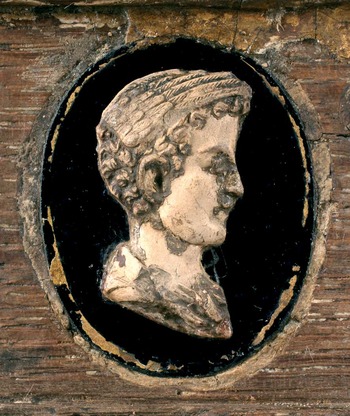
The one surviving cameo (fig 4) plays a crucial role in any interpretation of the place of the cameos in the programme of the Retable as a whole, as well as fully opening up the international flavour of this particular aspect of its design. It is briefly described by Cherry as follows: ‘The head is in profile with curly hair. Above the ear is a wing with the tips of the longer feathers facing forward, allowing a few curls of hair to appear beneath.’Footnote 16 To add some more detail to this description, the brow of the head on this cameo is straight and high, similar in height to that of the principal jugate head. Compared with both the jugate heads, the nose here is depressed. The mouth is short and pinched, the chin firm and the cheek more rounded than in the principal jugate head. The large ear is similar to his. Small, tight, S-shaped curls overhang the forehead and frame the brow, clustered above the ear and about the back of the head. The crown of the head is covered closely by a folded bird's wing, the covert feathers in three rows and the long extended feathers reaching up above the brow.
Westminster Retable: cameo of head with feathered headdress. Photograph: © the Dean and Chapter of Westminster Abbey

According to Cherry, the presence of the headdress with wings ‘indicates that the figure is Mercury’. He gives a comparatively lengthy account of the various roles and functions of this god in classical mythology, notably as guide of souls to the underworld, which might help to explain the adoption of his image on the frame of the Retable.Footnote 17 Cherry does not cite any specific representation of Mercury as the source of the English artist's design. In Matthew Paris's Chronica Majora, the marginal drawing of Brutus, the legendary founder of Britain, offering sacrificial wine to the goddess Diana, represents the image of the goddess with wings on her ankles. Susanne Lewis recognized these as ‘the wings of Mercury’, but again does not indicate the model.Footnote 18 In myth and legend, through the patronage of Hermes/Mercury, the hero Perseus is lent winged sandals and a winged cap to aid his assault on the Gorgon, Medusa. The figure of Perseus was well known to English artists as part of the cycle of illustrations in Cicero's version of Aratus’ poem on the constellations, numerous copies of which were produced in the tenth, eleventh and twelfth centuries. Following a Carolingian copy of a late antique exemplar, Perseus is shown with small wings attached to his forehead.Footnote 19 In the latest English version, the mid-twelfth-century Bodleian, Digby 83, folio 48v, the wings on Perseus’ head have grown quite large and spread out to right and left.Footnote 20 Even in the Anglo-Saxon period, the motif of the winged headdress had begun to proliferate. In an astronomical manuscript from Fleury, wings also sprout from the foreheads of the constellations Sagittarius and Aquarius.Footnote 21 These wings spread backwards, blowing out behind the head; that is, going in exactly the opposite direction from those in the Retable cameo. In these Anglo-Saxon drawings, the wings carry some ultimate recollection of the wings that decorate both sides of the cap worn by Hermes/Mercury in antique art. But the role of Mercury as such in the diffusion of the motif of the winged headdress, by the time when the Westminster Retable was under way, is doubtful.
By the mid-thirteenth century, as Ruth Mellinkoff pointed out in her definitive paper on medieval examples of the motif, it had become widespread in the context of biblical and hagiographical narrative painting and sculpture.Footnote 22 The headdress with wings was used to pick out and glamorize (Mellinkoff says ‘stigmatize’) individual heathen adversaries of Christ and the saints, a category we might term paiens, to use the vocabulary of the Trinity College Apocalypse.Footnote 23 On folio 1 of the Trinity Apocalypse, one of the spies who witness St John baptizing Drusiana wears the winged headdress, the wing folded back on the brow, with the long feathers sticking up over the top and back of the head. Once introduced, the motif is not, however, a necessary adjunct to such a scene. Other Apocalypse illustrations, for example, in the Paris Apocalypse, do not show the spies distinguished in this way, merely as massively armed, wild, dishevelled folk.Footnote 24 On folio 14v of the Trinity Apocalypse, the winged headdress is introduced a second time, at the top right of the miniature, on the head of the last member of the crowd of unbelievers witnessing the beast slaying the saints in Revelation 13, 7–9. The wings fold over on top of the head, the bend of the wing being again on the forehead and the wing feathers rising backwards and up.Footnote 25 Again, it is interesting that the illustration on folio 37v of the Douce Apocalypse, of the crowds representing secular society succumbing to the power of the beast and witnessing the slaying of the saints, does not employ this exotic attribute. Mellinkoff regards the wearer of the winged headdress in the Trinity Apocalypse scene of the slaying of the saints as per se ‘evil’. Since he is very much in the background, he might perhaps be taken for merely a consenting spectator.
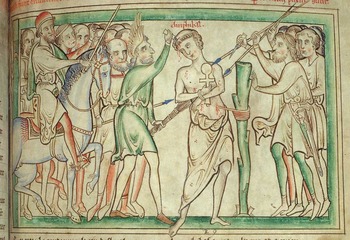
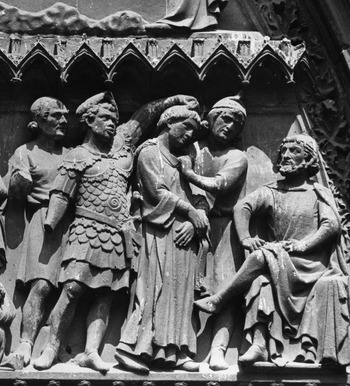
It is true, however, that, more diagnostically, the winged headdress identifies active persecutors of Christ and his saints. In the Lambeth Apocalypse, where St John is brought for trial before the Emperor Domitian, one of the two henchmen who manhandle the saint wears a winged headdress, the wings bending upwards from the brow. His partner wears an elegant foliate wreath.Footnote 26 On folio 45 of the Life of St Alban in Trinity College Dublin (fig 5), the principal torturer in the gory scene of the martyrdom of St Amphibalus wears on his head a single, loosely feathered wing, tucked in at the back of his head and spreading vertically up above his brow.Footnote 27 A major French monument, of c 1260, adds to this evidence. In the sculptured scenes illustrating St Stephen's life and martyrdom on the south portal of Notre Dame, Paris (fig 6), the soldier who grips the saint by the hair in the trial scene wears a winged headdress clamped smoothly on his curly hair.Footnote 28 This form of the headdress is reminiscent of a wreath, such as is seen on the laureate bust on the gold coinage of the Emperor Frederick ii.Footnote 29 The bend of the wing is at the back of his head, and the spikes of the long feathers meet tip to tip at the top of his head, over the coiled locks of hair on his forehead. In addition to his feathered headdress, the soldier at Notre Dame is given a definitely Roman character by his lavish scaled cuirass, although his features are of the forceful kind often shown in dark-faced persecutors of the saints in French book painting, for example, in the mid-thirteenth-century illustrated Vie et Histoire de Saint Denys.Footnote 30 In that book, the Roman prefect Sisinnius and the executioners under his command have no peculiarities of costume. However, in a fourteenth-century version of the beheading of St Denys and his companions, Sisinnius wears elaborate plate armour, and the principal executioner, robed and bearded, wears a large winged headdress, seen as a single pad, without a bend, similar therefore to the headdress of the soldier at Notre Dame.Footnote 31 Exactly the same format of headdress is also pointed out by Mellinkoff in the Psalter of St Louis, where it is worn clamped on their heads by three Philistine soldiers wearing scale armour, in the scene of the blinding of Samson.Footnote 32
Dublin, Trinity College, ms E 1 40, fol 45: the Martyrdom of St Amphibalus. Photograph: by permission of the Board of Trinity College Dublin

Paris, Notre Dame, detail of south transept tympanum: the Trial of St Stephen. Photograph: James Austin, Conway Library, The Courtauld Institute of Art, London

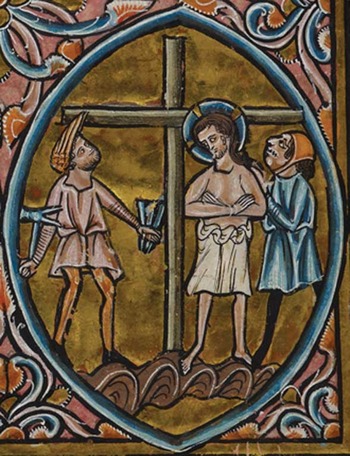
The winged headdress of the Westminster Retable cameo head has the specific wreath-like design depicted in the French manuscripts and the French sculpture cited above. It is quite different in design from English examples, such as that worn by the executioner of St Amphibalus, where the full length of the wing is shown, bent in the middle and with a ragged silhouette rising clear of the head. However the Westminster cameo need not necessarily be following a specifically French convention, or be of French design. This form of the headdress is also known in England, in a phase of scriptural and devotional imagery rather earlier than the Trinity and Lambeth Apocalypses, namely in two of the Passion scenes in William de Brailes's Book of Hours of about 1240.Footnote 33 The gang crowding in to arrest Christ on folio 1, to the right of the central group of Christ and Judas, mostly consists of mailed soldiers. However, their ringleader, looking backwards and seen in profile, wears a smooth plume of feathers on his head. The feathers run forward from the back of his head, not from the brow backwards, and closely fit the head, as in the Retable cameo. Then again, on folio 43v of the de Brailes Hours in the miniature of Christ awaiting crucifixion (fig 7), the executioner carrying in the nails and hammer wears the same headdress, bunched over the ear and spiking up to the brow. De Brailes's executioners wear very basic tunics and leggings, exactly like their counterparts in the mid-thirteenth-century Vie et Histoire de Saint Denys. None of the other English depictions – for example, the henchman of the Emperor Domitian in the Lambeth Apocalypse – show that extra move towards fanciful Romanizing and militarizing habiliments seen in the soldier in the St Stephen scene at Notre Dame and in the Philistines in the St Louis Psalter.
BL, Add ms 49999, fol 43v: Christ Awaiting Crucifixion. Photograph: © British Library Board

When debating the question of what, if any, meaning (other than sumptuous decoration) can be given to the presence of the profile cameo heads on the frame of the Westminster Retable, the viewpoint of the artistic conventions of the period is worth considering. Frames and margins in thirteenth-century manuscripts often feature heads, sometimes even in profile, as, for example, in the Rutland Psalter, adjacent to the text of verse 4 of Psalm 67.Footnote 34 The margin in TNA, PRO E36/284, folio 10v shows carefully differentiated heads in roundels, in various poses, adjacent to the text relating to them.Footnote 35 Observant heads, among them prophets wearing Jews’ hats, placed in circles or half-circles at the corners and sides of the miniature, are a conspicuous feature of the Beatus initial in the Little Canterbury Psalter, now in Paris.Footnote 36 Heads in semi-roundels are also an important part of the picture cycle in the Oscott Psalter. Profile heads in the top corners of folio 11, adjacent to the scene of Christ carrying the Cross, though framed separately, are engaged in the nearby narrative. At the top, the head is that of a man who raises his hand to shout abuse at Christ.Footnote 37 In a much later book, the Macclesfield Psalter, the profile head of a curly-haired youth set in a roundel in the margin of folio 58 has a slightly opened mouth as if he were reading the words splendidly written in gold in the adjacent Psalm initial, Dixi custodiam.Footnote 38 Just such a specific relationship between a marginal head and the principal matter on the page appears also in French illumination. The profile head of a youth, looking right, opposite the initial and text of Psalm 118 in a French late twelfth-century Cluniac psalter, perfectly illustrates verse 9: ‘By what doth a young man correct his way? By observing thy words.’Footnote 39
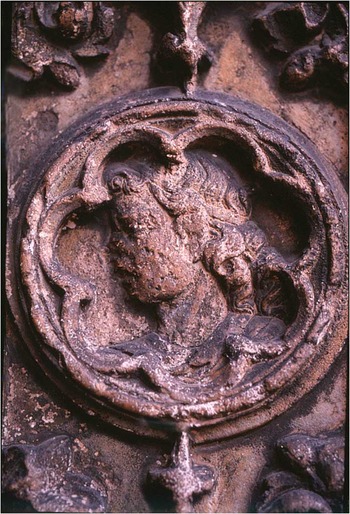
It is a notable feature of all the attendant heads in the manuscripts cited above that they inhabit circular or part-circular frames, not oval ones. Only in the form of the vesica, the pointed oval, does any variant on the circular form occur. De Brailes, for example, very freely varies circles and vesica-shaped medallions to frame his narrative scenes (fig 7), but never the oval. At Auxerre, on the west front of the cathedral, a profile head, looking left (fig 8), is placed in the border of the panel of interlocked historiated medallions, themselves a very close parallel for the layout of the miracle scenes on the Westminster Retable.Footnote 40 This head, like those on the Retable, is an admirable essay in the modernizing of the genre of the classical cameo. The youthful head has firm features, a rounded cheek and well-modelled throat. The undulating curls, bound by a fillet, hang down heavily at the back of the neck. This imitation cameo is not, however, contained in an oval, but in a round frame, heavily cusped. The oval is the prerequisite of the jeweller, and is seen consistently in cabochon gems on fine metalwork throughout the early Middle Ages and, of course, in re-used cameos. Intriguingly, the shape of the antique intaglio cornelian used as his seal by one of Henry iii's clerks is subordinated to its pointed oval frame.Footnote 41 However, Matthew Paris's drawing of the St Albans cameo, Kaadmau, shows the full grandeur of its oval shape, set in a narrow, segmented frame.Footnote 42 About the same time, the oval format of the framed cameo representing the idolator's object of worship on the right jamb of the central portal of Notre Dame, Paris, is an emphatic part of its visual presentation.Footnote 43 Like this sculptured image, and like Kaadmau, the cameos on the Retable are presented in their pure oval form, and as such do indeed declare their relation to fine metalwork, and ultimately their classical affiliations.
Auxerre Cathedral, west front, central portal: detail of cameo-like head. Photograph: Paul Binski

Formal and passive as they must necessarily be in their role as cameos, to judge by the active role of marginalia indicated above, the profile heads on the frame of the Retable might have had some iconographic connection with the subject matter of the figurative scenes that they flank. Cherry has made the case for the head that he identifies as Mercury as having resonance, as psychopomp, in the context of the spiritual journey which the High Altar of Westminster Abbey symbolized. Too many examples of figures wearing wings on their heads exist in thirteenth-century art to suggest that a specific allusion to a classical god is the first interpretation that would spring to mind. In her very wide haul of examples in English, French and German art (not, however, including the Westminster Retable), Melinkoff offers a number of interpretations, appropriate to the very various contexts in which the imagery occurs, ranging from wings as attributes of the personified wind to puzzling and haphazard use of the winged headdress in images of peasants hunting and boating. However, the principal use of the winged headgear is undoubtedly in the context of pagan hostility to Christ and to the early Christian saints John, Stephen, Alban and Denys. Some at least of these wearers of the feathered headdress must be deemed agents of Roman authority.
The narrative programme of the Westminster Retable is unusual in its emphasis, not on the Passion of Christ, but on his Miracles. The three extant Miracles are the Raising of Jairus's Daughter (Matthew 9, Luke 8), the Healing of the Man Born Blind (John 9) and the Feeding of the Five Thousand (Matthew 14, John 6).Footnote 44 The cameo head wearing the winged headdress is now solitary and conspicuous on the frame of the Retable, immediately below the medallion of the lost Miracle scene. The cameo might just possibly give us a clue as to which miracle was formerly illustrated there. If there was an iconographical connection to the lost scene, the context was obviously not that of Christ's Passion. The dignified, aloof, constrained poise of the profile head is very different from the malicious and grimacing features of the riff-raff who commonly wear the feathered headgear, in scenes of harassment.Footnote 45 A decorous Roman official represented in this position on the frame of the Retable might perhaps be identified as the Roman centurion at Capernaum, whose confidence in Christ's healing powers astonished Christ himself and drew from him an impressive prophesy of the welcoming of the Gentiles into the Faith. The Miracle of the Healing of the Centurion's Servant, sick of the palsy, is reported in Matthew 8 and Luke 7.
If it is speculative to propose a connection between the winged cameo head and the lost miracle scene above, and it is bound to be so, since we cannot now know what was the content of the other thirty-four lost cameos, it is much more speculative to ascribe specific meaning to the jugate heads. If the winged head had stuck more definitely to its Anglo-Saxon roots, so as to pass for Perseus or for one of the other constellations accustomed to flaunt a winged headdress, then an astronomical or calendarial purpose might have been intended and the neighbouring jugate cameo could have represented Gemini, characters familiar from the May pages of English Psalter calendars, although the jugate heads are by no means identical, as we have seen.Footnote 46 The two heads faced towards the monumental figure of St Peter at the left of the Retable. In his essay on the Retable's iconographic programme, Paul Binski connects the gesture of St Peter towards the adjacent miracle scenes with the reference in St Peter's sermon, reported in Acts of the Apostles 2, to Christ's ‘miracles and wonders and signs’.Footnote 47 At the conclusion of this sermon, St Peter's audience urgently seeks and receives baptism. The same emphasis on St Peter's advocating and administering the rite of baptism occurs in the Acts of SS Processus and Martinian, the erstwhile guards of St Peter in the Mamertine Prison, jointly baptized by him with water miraculously drawn from the Tarpeian Rock and subsequently martyred together by order of Nero. Gregory the Great wrote a homily on these saints, referring to the miracles of healing attendant on their relics in Rome. Bede placed them in his Martyrology.Footnote 48 Their feast day, 22 July, is marked in calendars of St Albans, Ely, Winchester, Evesham, Gloucester, Winchester and, most relevantly, of Westminster.Footnote 49 As Roman prison guards, they might, of course, be expected to wear winged hats, but design principles might well have prevented the depiction of this motif on jugate heads and in such proximity to the other cameo head so equipped. The interpretation of the fresh-faced youths on the jugate cameo as representing SS Processus and Martinian, St Peter's own converts placed at his feet, has at least the merit of being in keeping with the ideas and values of the period when the Westminster Retable was made, and is offered here as a small move aimed to counteract the stark sense of loss which we must now feel when we survey its pitifully vandalized frame.
Acknowledgements
I am very grateful to Paul Binski, FSA, who read an initial draft of this paper and who usefully suggested my widening its scope. I am indebted also to Anna Gannon, FSA, for looking up material for me in Cambridge and to Paul Binski, Kathryn McKee, Ann Massing, Bernard Meehan, David Park, FSA, and Paul Taylor for practical assistance in procuring the illustrations.
ABBREVIATIONS AND BIBLIOGRAPHY
- Abbreviations
- Baltimore
Walters Art Museum, Baltimore (Maryland)
- BL
British Library, London
- BN
Bibliothèque National, Paris
- Bodleian
Bodleian Library, Oxford
- TNA
The National Archives, Kew