Introduction
Although generalist predators capture a wide variety of prey, they utilize only a subset of the available prey due to passive and active prey selection (Araújo et al. Reference Araújo, Bolnick and Layman2011, Futuyma & Moreno Reference Futuyma and Moreno1988, Toft Reference Toft1999). Passive prey selection depends on the constraints that are outside a forager’s control (e.g. hunting strategy, morphological constraints, sensory spectra). Active prey selection is based on active decisions of the forager to accept or to avoid a prey (Stephens et al. Reference Stephens, Brown and Ydenberg2007, Toft Reference Toft1999). What is often overlooked is that the selectivity for a certain prey type by a generalist predator (i.e. its proportional representation in a predator’s diet relative to its proportional representation in the environment) can be highly dynamic depending on the prey community composition (Baudrot et al. Reference Baudrot, Perasso, Fritsch, Giraudoux and Raoul2016, Owen-Smith & Mills Reference Owen-Smith and Mills2008, Schmidt et al. Reference Schmidt, Harwood and Rypstra2012a). The selectivity for a certain prey type i by generalist predators can be constant, i.e. it does not change with changing prey community composition. The selectivity for prey i can change with total density of overall prey availability, change with absolute density of the prey type i in the environment, and/or relative density of the prey type i (Baudrot et al. Reference Baudrot, Perasso, Fritsch, Giraudoux and Raoul2016).
The change in selectivity for prey can arise, for example, when predators use different optimization criteria at low and high prey densities. They can behave opportunistically when they are highly energy-limited but they can become more selective at high prey densities (Baudrot et al. Reference Baudrot, Perasso, Fritsch, Giraudoux and Raoul2016, Riechert Reference Riechert1991, Stephens et al. Reference Stephens, Brown and Ydenberg2007). The change in selectivity for prey can also arise as generalist predators try to achieve the optimal composition of nutrients that enhances their fitness by consuming various prey types in a certain ratio (Mayntz et al. Reference Mayntz, Raubenheimer, Salomon, Toft and Simpson2005, Schmidt et al. Reference Schmidt, Harwood and Rypstra2012a, b, Toft et al. Reference Toft, Cuende, Olesen, Mathiesen, Larsen and Jensen2019). For example, Schmidt et al. (Reference Schmidt, Harwood and Rypstra2012a) observed that dipterans are over- and under-represented in the diet of the wolf spider Pardosa milvina (Hentz 1844) when they are scarce and highly abundant in the environment, respectively. This is because the overconsumption of dipterans leads to the nutritional imbalance and lower fitness of Pardosa (Schmidt et al. Reference Schmidt, Sebastian, Wilder and Rypstra2012b).
Predators use various hunting strategies which is one of the primary filters determining prey selection (Cresswell & Quinn Reference Cresswell and Quinn2010, Huey & Pianka Reference Huey and Pianka1981, Michalko & Pekár Reference Michalko and Pekár2016). Some predators build traps to capture predominantly mobile prey (Michalko & Pekár Reference Michalko and Pekár2016, Miler et al. Reference Miler, Yahya and Czarnoleski2018). Spiders (Blackledge et al. Reference Blackledge, Kuntner and Agnarsson2011), mycetophilid larvae (Peck & Russell Reference Peck and Russell1976) and caddisfly larvae (Hydropsychidae (Wallace Reference Wallace1975)) weave webs and nets, while antlions and wormlions dig pitfalls or use natural barriers as a fence (Jingu & Hayashi Reference Jingu and Hayashi2018, Miler et al. Reference Miler, Yahya and Czarnoleski2018). Trap-building predators often catch mobile prey without eating it, but such overkilling still has a top-down impact on the prey population (Mader et al. Reference Mader, Birkhofer, Fiedler, Thorn, Wolters and Diehl2016, Michalko & Pekár Reference Michalko and Pekár2017, Nentwig Reference Nentwig1980). Therefore, if we are to understand and predict the function of trap-building predators in food-web dynamics we need to investigate the dynamics of prey selection at the stage of prey entrapping as well.
Trap-building predators, like other sit-and-wait predators, have been considered to be mostly opportunistic and their traps to intercept mobile prey proportionally to its availability in the environment (Higgins Reference Higgins1987, Huey & Pianka Reference Huey and Pianka1981). Prey selection by a trap-builder then takes place primarily at the stage of prey manipulation and consumption (Nentwig Reference Nentwig1980). Nevertheless, more recent research has shown that trap-building predators can respond to prey availability and prey type by flexibly adapting properties of their traps (reviewed in Scharf et al. Reference Scharf, Lubin and Ovadia2011). For example, Nephila pilipes (Fabricius) (Araneidae) build stiffer webs by producing thicker silk threads and incorporating more radii when fed with crickets, i.e. prey with high kinetic energy, than when fed with flies, i.e. prey with low kinetic energy (Tso et al. Reference Tso, Wu and Hwang2005). This suggests that prey selection at the stage of entrapping may be finer than just selecting for mobile prey and that the prey selection might be dynamic in relation to the changes in prey community composition. Research on the dynamics of prey selection of trap-building predators in relation to the changes in prey community composition is very scarce.
Web-building spiders represent an excellent model system to investigate the dynamics of prey selection of trap-building predators. Web-building spiders can be highly flexible and adjust the mechanical and architectural features of their webs in response to prey availability and prey type (Blackledge et al. Reference Blackledge, Kuntner and Agnarsson2011, Blamires et al. Reference Blamires, Chao and Tso2010, Reference Blamires, Chao, Liao and Tso2011). They are dominant predators in various tropical terrestrial ecosystems including natural tropical forests, savannas and agroecosystems (Bambaradeniya & Edirisinghe Reference Bambaradeniya and Edirisinghe2009, Lamarre et al. Reference Lamarre, Hérault, Fine, Vedel, Lupoli, Mesones and Baraloto2016, Petcharad et al. Reference Petcharad, Miyashita, Gale, Sotthibandhu and Bumrungsri2016, Potapov et al. Reference Potapov, Klarner, Sandmann, Widyastuti and Scheu2019, Stefani et al. Reference Stefani, Pires, Torezan-Silingardi and Del-Claro2015, Wongprom & Košulič Reference Wongprom and Košulič2016) and influence ecosystem processes through trophic cascades (Liu et al. Reference Liu, Chen, He, Hu and Yang2014, Reference Liu, Behm, Chen, Fu, He, Hu, Schaefer, Gan and Yang2016, Michalko et al. Reference Michalko, Pekár, Dul’a and Entling2019, Nahas et al. Reference Nahas, Gonzaga and Del-Claro2012, Sigsgaard Reference Sigsgaard2007, Stefani et al. Reference Stefani, Pires, Torezan-Silingardi and Del-Claro2015). Their effect on the focal prey and the functioning of tropical ecosystems varies greatly. The investigation of the dynamics of prey selection may contribute to the explanation of this variation.
In this study we investigated the dynamics of prey selection by the orb-weaving spider Gasteracantha hasselti C.L. Koch (Araneidae) depending on the composition of the available prey in various forest habitats located in the north-eastern part of Thailand. Gasteracantha hasselti is a medium-sized spider that builds its classical orb-webs in vegetation in forest habitats across South Asia (World Spider Catalog 2018). We expected G. hasselti to be a generalist predator that intercepts mostly flying insects, especially Diptera, similarly to most spiders with classical orb-webs (Michalko & Pekár Reference Michalko and Pekár2016). We also expected the selectivity for a particular prey of G. hasselti to be highly variable, depending on the relative density as well as total prey density, since orb-web spiders can adjust their webs depending on the overall prey availability as well as prey type in order to select profitable prey (Blamires et al. Reference Blamires, Chao, Liao and Tso2011).
Methods
Data collection
The study took place in lowland tropical forests located in the Sakaerat Environmental Research Station (SERS) and Sakaerat Silvicultural Research Station of north-eastern Thailand (14.51 N, 101.93 E, Nakhon Ratchasima Province) during the dry period in Thailand (20 October–1 November 2017). A detailed description of climatic and environmental conditions in the study area can be found in Trisurat (Reference Trisurat2010). We collected the spiders in four forest types: evergreen forest, 20–30-year-old secondary forest, 20–30-year-old monoculture reforestation dominated by Eucalyptus camaldulensis Dehnh (Myrtaceae), and 20–30-year-old mixture reforestation dominated by Acacia mangium Wild. (Fabaceae) and E. camaldulensis.
We took six samples in each forest type, i.e. N = 24 in total, but in the following analyses we used only 14 samples because we used only those samples where we collected at least five Gasteracantha individuals (see later). In each sample we collected the potential and actual prey. As the orb-web is an adaptation to catch flying insects (Michalko & Pekár Reference Michalko and Pekár2016, Nyffeler Reference Nyffeler1999, Olive Reference Olive1980) we aimed to sample and analyse only flying insects. We used sticky traps to sample the availability of flying insects, which is a commonly used method (e.g. Diehl et al. Reference Diehl, Mader, Wolters and Birkhofer2013, Herberstein & Elgar Reference Herberstein and Elgar1994, Juillet Reference Juillet1963, Wallis & Shaw Reference Wallis and Shaw2008). We collected the potential prey by using two sticky traps (20 × 15 cm), one white and one yellow coloured, hanged next to each other at a height of ~1.6 m above the ground. Each sticky trap was operational for 5 days. The density of potential prey was then obtained by summing both the traps. We sampled the actual prey of Gasteracantha by a 20 min visual search. The visual search was performed by the same four people each time (VS, PW, OK, RM). We sampled the actual prey between 10:00 and 17:00 h. We collected all the active spider webs (i.e. spider was using the web) with the prey remnants and web-owners in near proximity to the sticky traps. Spiders and prey were stored in 75% alcohol. When a researcher manipulated a spider and/or web we stopped to measure the time and started again when the manipulation was finished. Therefore, the time during which a researcher manipulated a web and a spider was not included in the 20 min of visual search. The Gasteracantha spiders were identified according to Deeleman-Reinhold (Reference Deeleman-Reinhold2001). The voucher specimens are stored at the Forestry Faculty, Kasetsart University, Bangkok, Thailand.
We identified the actual and potential prey to the order level because the masticated prey was often impossible to identify to lower taxa. This level of identification is often used to study the trophic niches of spiders (reviewed in Michalko & Pekár Reference Michalko and Pekár2016). However, we then investigated the prey preferences only for four prey groups, namely Hemiptera, Coleoptera, Diptera and Hymenoptera. This was because the sticky traps are only suitable for catching flying insects and because these four prey types are all attracted to the trap colours used (Heinz et al. Reference Heinz, Parrella and Julie1992, Juillet Reference Juillet1963, Wallis & Shaw Reference Wallis and Shaw2008). Although the different colours may show different community composition at the species level, when the taxonomic resolution is at the family and order level, the compositional differences are blurred (Vrdoljak & Samways Reference Vrdoljak and Samways2012).
Statistical analyses
We investigated prey selection by means of Chesson’s index of prey selectivity (α, Chesson Reference Chesson1983). For prey type 1, α 1= (r 1/n 1)/Σ(r i/n i), where r i is the proportion of prey type i in the diet and n i is the relative availability of prey type i in the environment. The index can have values in the range of 0 to 1. The higher the value the higher the selection of the given prey type.
Statistical analyses were performed within the R environment (R Core Team 2018). We investigated the dynamics of prey selection by Generalized Estimating Equations (GEE), which is an extension of Generalized Linear Models for autocorrelated data (Pekár & Brabec Reference Pekár and Brabec2018). The samples represented the statistical clusters and we expected even correlation among the prey types within the clusters. We used Gamma error structure since the dependent variable was continuous but heteroscedastic and non-normally distributed (Pekár & Brabec Reference Pekár and Brabec2016). As the Gamma family is only for positive values, we added 0.016 to the response variable, which was the lowest observed non-zero value (Pekár & Brabec Reference Pekár and Brabec2016). We used log- (mean selection, changes in selectivity along absolute densities of potential prey) or inverse-link function depending on which provided better fit for the data (Zuur et al. Reference Zuur, Hilbe and Ieno2015). When we investigated the changes in prey selection along the absolute densities we range-standardized the absolute densities within each prey type between 0 and 1 to improve the fit of the model as there were differences among the prey types by order. As the measurements were obtained from different numbers of individuals, we weighted the model by the number of individuals per sample. The linear predictor was of ANCOVA type, i.e.: prey type + proportion in potential prey + prey type: proportion in potential prey, or prey type + absolute densities of potential prey + prey type: absolute densities of potential prey. The terms were removed according to the rules of marginality and their significance (Pekár & Brabec Reference Pekár and Brabec2016).
As the prey types can interact in determination of predator diet (e.g. Heong et al. Reference Heong, Bleih and Rubia1991), we also investigated the relationship between the absolute densities of the prey types using Spearman correlation coefficient. As there were differences by order we range-standardized the absolute densities within each prey type between 0 and 1.
Results
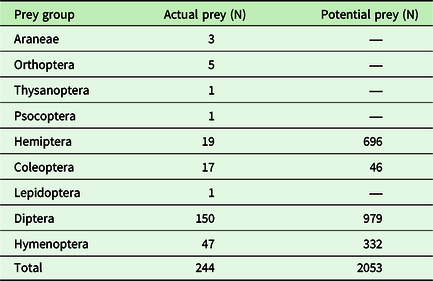
We collected 244 and 2053 individuals of actual and potential prey, respectively, in the 14 plots (Table 1). Gasteracantha intercepted a wide variety of prey belonging to nine arthropod orders (Table 1). The diet of Gasteracantha was dominated by Diptera followed by Hymenoptera.
Actual prey and potential prey of the spider Gasteracantha hasselti. We show the densities of such potential prey that could be effectively caught by the sticky traps and that were used in the analyses. The dash means that the prey type was not used in the analyses.

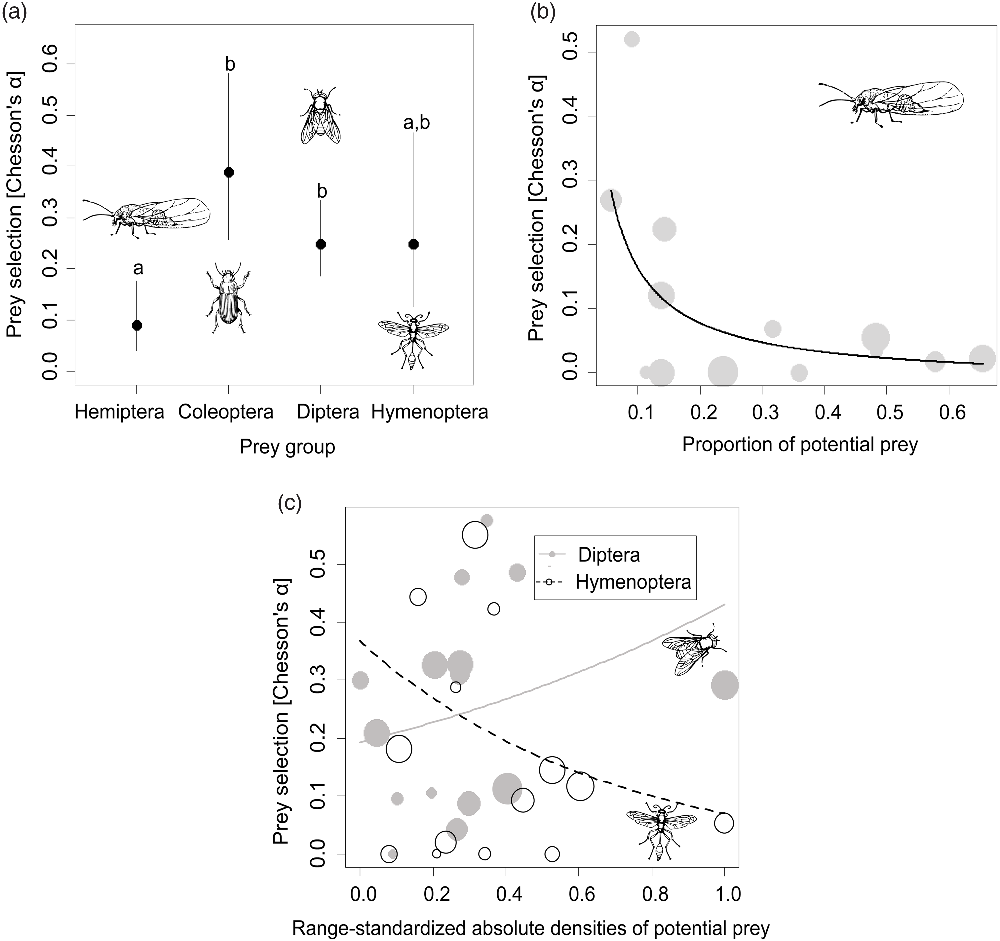
The mean prey selectivity of Gasteracantha differed among the prey types (GEE-g, χ23 = 13.0, P = 0.003, Fig. 1a). Gasteracantha selected mostly Coleoptera but it was not significantly different from Diptera and Hymenoptera (contrasts, P >0.130). Gasteracantha selected Hemiptera significantly less than Diptera and Coleoptera (contrasts, P <0.007). The mean prey preferences did not differ between Hymenoptera and Hemiptera.
The prey preferences of Gasteracantha hasselti. (a) The mean prey preferences for four prey groups across 14 forest plots. The points are means and the lines are CI95%. (b) The changes of prey preferences for Hemiptera along their relative abundances in potential prey. The estimated model is displayed. The equation for the relationship is:  $y ={{1}\over {{0.369 + 52.262{\rm{x}}}}} - 0.16.$
(c) The changes in prey preferences for two prey groups along their absolute densities that were range-standardized. The estimated model is displayed. The equation for Hymenoptera is:
 $y = {e^{ - 0.958 - 1.495x}} - 0.16$
and the equation for Diptera is:
 $y = {e^{ - 1.566 + 0.763x}} - 0.16.$
The size of the points in the panels b, c corresponds with the number of webs of Gastercantha with prey collected at the given plot and their relative weights in the statistical analyses.

There was no significant effect of total prey density on the selection of particular prey types by Gasteracantha (GEE-g, χ23 = 2.4, P = 0.485). The selection of a particular prey type changed with its relative densities in a prey type specific way (GEE-g, χ23 = 14.1, P = 0.003, Fig. 1b). The selectivity for Hemiptera significantly decreased with their increasing relative proportions in available prey (contrasts, P <0.001) while there was no significant change in selection for the other three prey types (contrasts, P >0.130).
The prey selection for a particular prey also changed with its absolute density in a prey type specific way (GEE-g, χ23 = 28.52, P < 0.001, Fig. 1c). The selection for Hymenoptera significantly decreased with their absolute densities (contrasts, P = 0.002) while the selection for Diptera increased with their absolute densities (contrasts, P = 0.048).
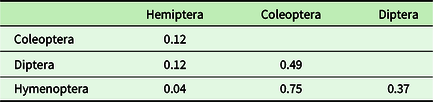
The absolute densities of Hymenoptera, Diptera and Coleoptera showed medium to strong correlation (Table 2). In contrast, the absolute densities of Hemiptera showed only weak or negligible correlation with other potential prey types (Table 2).
Spearman correlation coefficients among densities of potential prey types of Gasteracantha hasselti in the Sakaerat Environmental Research Station in north-eastern Thailand.
Discussion
We investigated the dynamics of prey selection by the trap-building spider Gasteracantha hasselti depending on the prey community composition. Generally, Gasteracantha is a generalist predator that captured a wide variety of prey but mostly Diptera, Hymenoptera, Hemiptera and Coleoptera. All these prey types were not only entangled in the web but also evidently processed and consumed by Gasteracantha (authors, pers. obs.). As such Gasteracantha fits well in the classical pattern of orb-web spiders’ diets (Michalko & Pekár Reference Michalko and Pekár2016). The dynamics of prey selection of the Gasteracantha’s webs were determined by the absolute densities of Diptera and Hymenoptera and by relative densities of Hemiptera in the environment. The overall prey density did not influence prey selectivity. We will further discuss some possible explanations for the observed pattern.
Mean prey selection
The webs of Gasteracantha, on average, selected mostly Coleoptera and Diptera. Although the mean selectivity for Hymenoptera was similar to Diptera, the selectivity for Hymenoptera were highly variable. Hemiptera were selected the least. The high selection for Diptera by Gasteracantha corresponds with other diurnal orb-web spiders (Herberstein & Elgar Reference Herberstein and Elgar1994, Ludy Reference Ludy2007, Nyffeler Reference Nyffeler1999). The lower (but not significant) selectivity for Diptera than Coleoptera might have arisen because we pooled Brachycera and Nematocera. From the remnants that could be further distinguished, the webs caught, and spiders consumed, more brachycerans than nematocerans but the sticky traps actually caught more nematocerans indicating their higher availability in the environment (authors, pers. obs.). Thus, nematocerans might lower the selectivity for dipterans in comparison to coleopterans.
On average Gasteracantha webs highly selected Coleoptera, which is in accordance with the results for the species Gasteracantha cancriformis (L.), that accept and eat Coleoptera readily (Muma Reference Muma1971). However, another population of G. cancriformis ate only around half the number of the intercepted scolytid beetles (Henaut et al. Reference Henaut, Pablo, Ibarra-Nuñez and Williams2001). Moreover, the acceptance rate by another congeneric species Gasteracantha mammosa C.L. Koch for Coleoptera was minimal in comparison with dipterans and hymenopterans (Yoshida Reference Yoshida1989). The discrepancy can be caused by several reasons. First, it might be the difference in distribution of the potential prey types. Predator populations exposed to different composition of prey types can have distinct prey preferences and actively select different prey (Britt et al. Reference Britt, Hicks and Bennett2006, Heong et al. Reference Heong, Bleih and Rubia1991, Líznarová et al. Reference Líznarová, Sentenská, García, Pekár and Viera2013, Munroe et al. Reference Munroe, Simpfendorfer and Heupel2014, Pekár & Cárdenas Reference Pekár and Cárdenas2015, Pilot et al. Reference Pilot, Jędrzejewski, Sidorovich, Meier-Augenstein and Hoelzel2012). The exposure to different prey can even modify the catching and processing abilities of the predator for particular prey types (Britt et al. Reference Britt, Hicks and Bennett2006, Líznarová et al. Reference Líznarová, Sentenská, García, Pekár and Viera2013, Sandoval Reference Sandoval1994, Tso et al. Reference Tso, Wu and Hwang2005). The within-taxa variation in prey body size might also be behind the discrepancy, as some orb-weaving spiders are most efficient capturing a certain taxa-specific body size (Chacon & Eberhard Reference Chacon and Eberhard1980, Nentwig Reference Nentwig1982). The differences among Gasteracantha species might be further caused by the evolved species-specific prey preferences and web-properties (Pekár et al. Reference Pekár, Petráková, Šedo, Korenko and Zdráhal2018, Yamanoi & Miyashita Reference Yamanoi and Miyashita2005). Thus, the variance among the studies may be due to phenotypic plasticity induced by different availability of prey types, different distribution of prey body size within taxa and evolved species-specific features.
Gasteracantha might highly select Coleoptera and Diptera because they are nutrient and energy rich, they are rarely dangerous for spiders and rarely possess chemical compounds that would make them noxious or toxic for spiders (Lease & Wolf Reference Lease and Wolf2011, McHugh & Liebherr Reference McHugh, Liebherr, Resh and Cardé2009, Merritt et al. Reference Merritt, Courtney, Keiper, Resh and Cardé2009). Although Coleoptera are strongly sclerotized, which is their main defence against predators, araneids are able to overcome this defence because they possess strong chelicerae (Foelix Reference Foelix2011, Henaut et al. Reference Henaut, Pablo, Ibarra-Nuñez and Williams2001, McHugh & Liebherr Reference McHugh, Liebherr, Resh and Cardé2009). Gasteracantha might select Hymenoptera slightly less than Diptera and Coleoptera because they are often dangerous and can seriously harm spiders, and araneids manipulate them carefully or sometimes spiders even free them from their webs alive (Nentwig Reference Nentwig1985). In contrast, Hemiptera, the least selected prey, often contain compounds that make them toxic and noxious for spiders (e.g. Toft Reference Toft2005).
Prey size is a very important determinant of prey selection in generalist predators (Klečka & Boukal Reference Klečka and Boukal2013, Michalko & Pekár Reference Michalko and Pekár2015, Nentwig & Wissel Reference Nentwig and Wissel1986, Warren & Lawton Reference Warren and Lawton1987). Orb-webs are sometimes hypothesized to be designed to select mainly large prey (Blackledge Reference Blackledge2011). Indeed, hemipterans were the smallest prey as they were represented mostly by Sternorrhyncha. Therefore, the low selectivity of Gasteracantha for Hemiptera might also be caused by their small size. However, the sizes of the other three prey types more or less overlapped (from the remnants that could be distinguished). Therefore, it is unlikely that prey size would be the sole factor determining the prey selection by Gasteracantha. Prey size interacts with other prey characteristics such as dangerousness and kinetic energy, etc., in prey selection by spiders and other generalist predators (e.g. Klečka & Boukal Reference Klečka and Boukal2013, Michalko & Pekár Reference Michalko and Pekár2015, Tso et al. Reference Tso, Wu and Hwang2005, Reference Tso, Chiang and Blackledge2007, Yamanoi & Miyashita Reference Yamanoi and Miyashita2005). Therefore taxon, a surrogate for these prey-traits, influences additively or interactively the effect of prey size on prey selection (Klečka & Boukal Reference Klečka and Boukal2013, Michalko & Pekár Reference Michalko and Pekár2015). Unfortunately, many prey were masticated, which prevented us from obtaining a sufficient number of prey-size measurements for reasonable statistical analyses.
The dynamics of prey selection
The selectiveness of Gasteracantha for Coleoptera was constant but was variable for Hemiptera, Diptera and Hymenoptera. The selectivity for Hemiptera quickly decreased as their relative densities increased. The slightly higher selectivity of Gasteracantha for Hemiptera at their low relative densities in comparison to their high relative densities may be because Hemiptera contain an essential nutrient or they might help spiders optimize their nutritional intake (Toft Reference Toft1995, Reference Toft2005, Toft et al. Reference Toft, Cuende, Olesen, Mathiesen, Larsen and Jensen2019). Thus, even though Hemiptera are often of low nutritional quality and toxic for generalist predators (Toft Reference Toft2005), the incorporation of a small number of hemipterans in the spiders’ diets can improve spider fitness (Toft Reference Toft1995). On the other hand, the observed pattern could also arise due to Gasteracantha’s imperfect knowledge about the potential prey offer and due to Gasteracantha’s need to sample the prey offer (Stephens et al. Reference Stephens, Brown and Ydenberg2007). Under low relative densities of hemipterans, Gasteracantha might kill hemipterans as a result of prey sampling and because it is difficult for spiders to learn about toxic prey if they have only few encounters with such prey (Toft Reference Toft1999). Catching some hemipterans will then likely create a positive selectivity if this prey is rare. Under high relative hemipteran densities, when Gasteracantha may expect their presence, it might avoid this prey (Toft & Wise Reference Toft and Wise1999, Stephens et al. Reference Stephens, Brown and Ydenberg2007).
The selectivity of Gasteracantha for Diptera might increase with their absolute densities because Diptera may represent highly profitable prey (innocuous, nutritionally high quality prey (Lease & Wolf Reference Lease and Wolf2011, McHugh & Liebherr Reference McHugh, Liebherr, Resh and Cardé2009, Merritt et al. Reference Merritt, Courtney, Keiper, Resh and Cardé2009)). According to the optimal foraging theory, the selectivity for a profitable prey type should rise with its densities (Stephens et al. Reference Stephens, Brown and Ydenberg2007). The decreasing selectivity for Hymenoptera with their increasing absolute densities might be because they perhaps represent less profitable prey than Coleoptera and Diptera (dangerous, lower nutritional quality (Lease & Wolf Reference Lease and Wolf2011, McHugh & Liebherr Reference McHugh, Liebherr, Resh and Cardé2009, Merritt et al. Reference Merritt, Courtney, Keiper, Resh and Cardé2009)). The densities of Hymenoptera correlated moderately and strongly positively with densities of Diptera and Coleoptera, respectively. Therefore, at low densities of profitable prey Gasteracantha might behave more opportunistically and capture less profitable Hymenoptera as well, while behaving more selectively when the densities of the profitable prey increase. On the other hand, as Hymenoptera were moderately correlated with Diptera and strongly with Coleoptera, Gasteracantha might alter its web-properties to maximize the interception of highly selected Coleoptera and Diptera, which might decrease the web-efficiency to intercept and retain Hymenoptera (Sandoval Reference Sandoval1994, Tso et al. Reference Tso, Wu and Hwang2005). Also, Hymenoptera might be able to better spot and avoid the webs when it contained more Diptera and Coleoptera (Rao et al. Reference Rao, Cheng and Herberstein2008, Uetz Reference Uetz, Evans and Schmidt1990).
To conclude, we found that the trap-building predator Gasteracantha hasselti captured a wide variety of prey and it can thus be considered as a euryphagous generalist (Pekár & Toft Reference Pekár and Toft2015). Gasteracantha therefore fitted well within the classical trophic niche pattern of orb-web spiders (Michalko & Pekár Reference Michalko and Pekár2016). The prey selection by the trap of this predator had its fixed and dynamic components, and the dynamic component was determined by the relative as well as absolute densities of the particular prey types. Therefore, the selectivity of the trap of Gasteracantha for one prey type also depends on the abundances of other prey types in the environment. The trap selectivity for prey and relative rank of a particular prey type was driven by the presence and densities of the highly selected prey rather than the overall prey density.
Acknowledgements
We would like to thank Chaowalit Songsangchote for his help in the field and Nicole H. Cernohorsky for English editing. We also want to thank the reviewers for their comments that improved the manuscript.
Financial support
Specific University Research Fund of the Faculty of Forestry and Wood Technology, Mendel University in Brno (LDF_PSV_2017004).