Introduction
The home has a variety of physical, social, political, economic and philosophical meanings (Chaudhury and Rowles Reference Chaudhury, Rowles, Rowles and Chaudhury2005), and holds a central place in the lives of older people (De Jonge et al. Reference De Jonge, Jones, Phillips and Chung2011; Rowles and Bernard Reference Rowles, Bernard, Rowles and Bernard2013b). The experience of home is a transactional relationship, intimately related to place, identity, life history and attachment, temporality and changes across the lifecourse (Oswald and Wahl Reference Oswald, Wahl, Rowles and Bernard2013; Rowles and Bernard Reference Rowles, Bernard, Rowles and Bernard2013b), ‘leading to behavioural, emotional, and cognitive bonding within a meaningful and social setting’ (Oswald and Wahl Reference Oswald, Wahl, Rowles and Chaudhury2005, p. 28).
As people age and spend increasing amounts of time within the home, the home environment increases in importance and needs to be able to support a range of valued activities, roles and occupations (De Jonge et al. Reference De Jonge, Jones, Phillips and Chung2011). Increasingly, as populations age, it is expected that people will remain in their own homes for as long as possible, and indeed, many older people do not wish to move from their homes and familiar neighbourhoods (Davey Reference Davey2006; De Jonge et al. Reference De Jonge, Jones, Phillips and Chung2011; Tanner, Tilse and De Jonge Reference Tanner, Tilse and De Jonge2008). Well-designed housing can moderate the effects of ageing-related disability arising from deteriorating vision, limited mobility and chronic diseases, thus enabling and maintaining independence within the home (Danziger and Chaudhury Reference Danziger and Chaudhury2009). Jette (Reference Jette2006) similarly suggests that, for example, a person with arthritis may experience varying levels of disability depending upon the extent to which their environment supports or impedes their activity and participation. Studies have found that where environmental factors match an individual's capabilities, and where the environment is accessible, usable, safe and supportive (Iwarsson, Ståhl and Löfqvist Reference Iwarsson, Ståhl, Löfqvist, Rowles and Bernard2013; Peace Reference Peace, Rowles and Bernard2013), occupational limitations and frailty can be delayed and independence maintained (Danziger and Chaudhury Reference Danziger and Chaudhury2009; Niva and Skar Reference Niva and Skar2006). Conversely, unsafe and inadequately designed housing and neighbourhoods can negatively impact upon older people's mobility, physical and social participation, and emotional mental wellbeing, and ultimately lead to a high risk of falls and/or injury and premature entry into residential care (Danziger and Chaudhury Reference Danziger and Chaudhury2009; Davey Reference Davey2006; De Jonge et al. Reference De Jonge, Jones, Phillips and Chung2011; Mackenzie, Byles and D'Este Reference Mackenzie, Byles and D'Este2009; Tanner, Tilse and De Jonge Reference Tanner, Tilse and De Jonge2008).
The degree to which person to environmental fit (Lawton Reference Lawton1985, Reference Lawton1989b; Lawton and Nahemow Reference Lawton, Nahemow, Eisdorfer and Lawton1973; Oswald and Wahl Reference Oswald, Wahl, Rowles and Bernard2013) is achieved is an important factor in successfully ageing in place (Oswald et al. Reference Oswald, Wahl, Schilling, Nygren, Fange, Sixsmith, Sixsmith, Szeman, Tomsone and Iwarsson2007; Peace, Holland and Kellaher Reference Peace, Holland and Kellaher2011) and improving disability-related outcomes (Wahl et al. Reference Wahl, Fänge, Oswald, Gitlin and Iwarsson2009). It is important, therefore, to gain a more thorough understanding of features that make a home more supportive as older people age and experience increasing disability, how the external environment impacts upon functional status and what environmental aspects are of most importance for older individuals.
Person, occupation and environmental fit
The concept of person–occupation–environmental fit draws on previous work by Lawton and Nahemow (Reference Lawton, Nahemow, Eisdorfer and Lawton1973) and Lawton (Reference Lawton1985, Reference Lawton, Bengston and Schaie1989a), and suggests that the decision to remain in or leave the home can be a subjective one, based on the extent that the person perceives they no longer ‘fit’ the home environment, and the extent to which the home environment is experienced as challenging or sustaining (Law et al. Reference Law, Cooper, Strong, Stewart, Rigby and Letts1996; Oswald et al. Reference Oswald, Wahl, Naumann, Mollenkopf, Hieber, Wahl, Brenner, Mollenkopf, Rothenbacher and Rott2006; Peace, Holland and Kellaher Reference Peace, Holland and Kellaher2011). Poor design of aged housing and many private homes has led to increased criticism of housing planners, because the needs of ageing people have not been adequately anticipated, and indicates a lack of understanding about what features are most important for increasing and enabling independence (Davey Reference Davey2006; McLaughlin and Mills Reference McLaughlin and Mills2008). For example, many older people lament the lack of space for the keeping of pets (Tanner, Tilse and De Jonge Reference Tanner, Tilse and De Jonge2008), or for storage purposes, and a lack of available space in purpose-built aged housing for hobby and craft activities, or socialising with family and friends (Danziger and Chaudhury Reference Danziger and Chaudhury2009), yet this is an important feature of the home for older people (Després and Lord Reference Després, Lord, Rowles and Chaudhury2005). Moreover, the importance of maintaining independence in cooking, bathing and toileting for older people is well recognised (Danziger and Chaudhury Reference Danziger and Chaudhury2009), yet bathrooms and kitchens in many homes are particularly problematic with regards to functionality and accessibility (Danziger and Chaudhury Reference Danziger and Chaudhury2009; Niva and Skar Reference Niva and Skar2006; Percival Reference Percival2002) and rooms may be too small to accommodate the transition to a wheelchair or motorised mobility device (McLaughlin and Mills Reference McLaughlin and Mills2008). Studies have shown that where structural modifications or adaptations have been made, 96 per cent of older people agree their home environment is more accessible, even those areas not directly affected by the modifications (Niva and Skar Reference Niva and Skar2006). However, structural changes to the home can also compromise individual meanings, emotional attachment and connections to the home, and in some cases, where modifications are badly planned or designed, are experienced as stigmatising or detrimental to the older person's sense of identity and accomplishment (De Jonge et al. Reference De Jonge, Jones, Phillips and Chung2011; Tanner, Tilse and De Jonge Reference Tanner, Tilse and De Jonge2008).
Research has shown that perceived sense of choice and control over the home environment is necessary for positive social, mental and emotional wellbeing (Bailey et al. Reference Bailey, Foran, Scanaill and Dromey2011; Danziger and Chaudhury Reference Danziger and Chaudhury2009), life satisfaction and autonomy (Oswald and Wahl Reference Oswald, Wahl, Rowles and Bernard2013). For many older people, the ability to remain in their own home is important for maintaining and promoting a strong sense of emotional attachment, social connectedness, identity, meaningful activity, and reciprocity within their community or neighbourhood (Bailey et al. Reference Bailey, Foran, Scanaill and Dromey2011; De Jonge et al. Reference De Jonge, Jones, Phillips and Chung2011; Percival Reference Percival2002; Tanner, Tilse and De Jonge Reference Tanner, Tilse and De Jonge2008).
The need for this research
Previous studies of older people's experiences of their home and neighbourhoods have been limited by a number of factors. For example, Wahl and colleagues’ review found that many studies were limited by poor research quality and inconsistencies between measures (Wahl et al. Reference Wahl, Fänge, Oswald, Gitlin and Iwarsson2009). Danziger and Chaudhury (Reference Danziger and Chaudhury2009) point to the method of recruitment (snowball sampling), size of the sample population (26 participants) and high participant homogeneity as limiting the depth of interviews available for analysis. De Jonge et al. (Reference De Jonge, Jones, Phillips and Chung2011) suggest that the generalisation of findings from their study of 30 older people aged 56–90 years is limited by sample size, age and self-selection of participants, and place of residence, such that the findings may not reflect the experiences or views of all people over 65 years. Local contexts such as weather conditions (particularly in winter) may also reduce generalisability of studies (Hjorthol Reference Hjorthol2013). Further studies are therefore necessary to increase knowledge and understanding of the needs and experiences of older people, and of how older people can best be supported to remain independent and optimally age in place.
Increased understanding is particularly needed of the role of both objective characteristics and perceived attributes of home environments, and the dynamics between the person, home and neighbourhood environment (Wahl et al. Reference Wahl, Fänge, Oswald, Gitlin and Iwarsson2009). Socio-economic status, poverty, urban density and cultural influences may determine whether an older person experiences the home and neighbourhood as challenging, unsafe or supportive (De Donder et al. Reference De Donder, Buffel, Dury, De Witte and Verté2013; Lawton Reference Lawton1985). Also, questions exist about the ways in which the environment and home are experienced by older community-dwelling persons (Annear et al. Reference Annear, Keeling, Wilkinson, Cushman, Gidlow and Hopkins2014; Lawton Reference Lawton1985; Lawton, Moss and Moles Reference Lawton, Moss and Moles1984), particularly amongst culturally and age-diverse populations such as in Australia. Lawton (Reference Lawton1985) suggests older people need to be understood in terms of personal (age-related and physical) and wider neighbourhood/community change over time (temporality), as many cities are undergoing urban renewal (Lawton Reference Lawton1985). Oswald and Wahl (Reference Oswald, Wahl, Rowles and Chaudhury2005) contend that previous research has ‘reduced questions regarding the meaning of home to whether or not the home environment is accessible or usable’ and that ‘the relationship between loss of competence and the meaning of home in a broader sense [has] received comparatively little attention’. This paper builds on previous research by focusing on the subjective, lived-experience and meanings of home and the wider neighbourhood in a broader, ecological sense.
The study reported here aimed to gauge to what extent older people's homes can be considered supportive, and to identify those features that are considered most important for supporting and enabling successful ageing in place. This paper seeks, therefore, to explore a relatively large sample of older people's subjective experiences, their expectations, and the suitability of their home and neighbourhoods.
The Housing and Independent Living Study
This paper draws upon the qualitative elements of the Housing and Independent Living (HAIL) study undertaken in Australia, a mixed-method project. The Housing and Independent Living Study was undertaken within the context of the New South Wales Government Towards 2030: Planning for Our Changing Population initiative (NSW Department of Premier and Cabinet 2008), which places emphasis on appropriate housing, community and proximity to services as central to the ability of older people to maintain quality of life and continue living in their communities as they age. HAIL focused on environmental and built housing factors for maintaining independence in older age, by studying the homes and neighbourhoods of a sample of community-dwelling older people. In this study, ‘home’ encompasses the built/physical aspects of the house, unit/apartment or other dwelling place in which people sleep and perform activities of personal and daily living, including features within the property boundaries such as the gardens, and also the meanings attached to the home by individuals. ‘Place’ refers to both immediate surroundings (e.g. street, retirement village), neighbourhood, wider community (suburb), and the relationships that people have with their neighbourhood such as level of familiarity, identity and security, and sense of belonging. The HAIL study employed a combination of self-report survey data and objective measurements to gauge functionality, accessibility and safety of the home and neighbourhood. In-home interviews were used to further explore people's subjective ratings and expectations of their current home and future housing needs. This paper focuses upon the qualitative data from these interviews.
Supportive home and environment
For this study, we conceptualised ‘supportive’ environments to be those that have been well designed to enable people to maintain independence in activities of daily living despite increasing levels of disability and functional impairment, for example, homes that are adaptable, accessible, functional, and free from structural or environmental hazards; and communities and neighbourhoods that are walkable, accessible and safe (World Health Organization 2007). Supportive environments are also those that facilitate social inclusion and feelings of safety and belonging within the community, and a sense of connection to others (De Jonge et al. Reference De Jonge, Jones, Phillips and Chung2011; Peace Reference Peace, Rowles and Bernard2013; Rowles and Bernard Reference Rowles, Bernard, Rowles and Bernard2013b). Indeed, a person's subjective experience of their home and environment is intrinsically tied to emotionality, feelings of attachment, belonging and identity, and can have both negative and positive outcomes in terms of being able to remain functionally independent and to age in place successfully. Moreover, a move to more accessible or functional housing can be detrimental to social roles and identity; so much so that valued roles may be overlooked by designers focused on ease of access to the bathroom, for example (Tanner, Tilse and De Jonge Reference Tanner, Tilse and De Jonge2008). Accordingly, supportive housing designs need to take into account how future changes and adaptations to the home, such as assistive technologies, shape both physical and affective aspects of the home (Bailey et al. Reference Bailey, Foran, Scanaill and Dromey2011; Milligan, Bingley and Gatrell Reference Milligan, Bingley, Gatrell, Davidson, Smith and Bondi2005).
Context for this study
The suburbs in this study were Woollahra, Hunters Hill and Mosman (Inner Sydney area), Ku-ring-gai, Sutherland and Bankstown (Outer Sydney), and Wyong (Sydney Surrounds). These suburbs are economically and geographically diverse, comprising older established homes and neighbourhoods, and more recent, post-war construction. House prices vary according to area. Historically, the inner-city suburbs of Sydney experienced significant post-war European migration in the 1950s and 1960s, and were predominantly working class until the 1970s when a shift occurred towards inner-city revitalisation and increased multiculturalism (Turner Reference Turner2008). Post-war housing shortages meant that many homes in Sydney and surrounds were self-built by the owners (Dingle Reference Dingle1999; Frost and Dingle Reference Frost, Dingle and Troy1995), with a corresponding rise in mortgaged home ownership (Paris Reference Paris1985). Similar to the United States of America, post-war urban development was characterised by increased suburban sprawl in areas peripheral to Sydney city (Daly Reference Daly1998), low-density detached housing set back on sizeable blocks of land, economic, age and cultural homogeneity, and high car dependency (Frost and Dingle Reference Frost, Dingle and Troy1995). The high level of car ownership and commuting for employment has also fostered the growth of regional shopping centres more suited to car use (Frost and Dingle Reference Frost, Dingle and Troy1995). More detailed information on these areas is available at http://profile.id.com.au/sydney.
Participants
Participants in this study comprised 202 persons from HAIL who consented to an in-home interview. HAIL participants were randomly selected from participants aged 75–79 years in the ‘New South Wales 45 and Up’ study (www.45andUp.org.au) (45 and Up Study Collaborators 2008). This age group are considered most likely to still be in good general health and at that stage of life where they may be considering a future move to a more supportive home and environment. Participants were all living within the greater Sydney region, in local government areas identified as having the greatest proportion of older people aged 70 years and over.
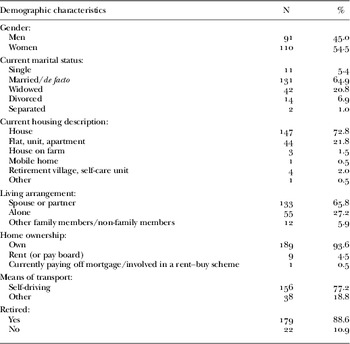
A total of 200 men and 200 women were invited to participate in the HAIL study, of which 260 responded with postal surveys, and 202 persons were interviewed (Byles et al. Reference Byles, Mackenzie, Redman, Parkinson, Leigh and Curryer2014). Demographic characteristics of the participants are shown in Table 1.
Demographic characteristics for participants (n = 202)*

Note: * Missing data not shown.
Overall, more men were married than women, and more women were living alone. Almost a third of women were widowed. Most participants were completely retired, with a small proportion describing themselves as partially retired. Most participants drove as the main means of transport, and most owned their home. The majority of participants lived in houses. One participant described their housing as ‘other’ (a caravan). A small number had migrated to Australia, with one participant arriving under a government immigrant settlement scheme, such as those between 1945 and 1965 whereby the Australian government paid most of the travel costs in exchange for migrants working and settling in Australia for a period of at least two years, at a location and occupation determined by the government. Migrants were later assisted to settle in the local community (National Archives of Australia 2013; NSW Migration Heritage Centre 2010).
Participants reported a range of common health conditions such as heart disease, diabetes, osteoarthritis, high blood pressure or cancer. Most people indicated little functional or physical limitation, and most reported generally good mental health and wellbeing. Only a small proportion of people suffered from depression or anxiety.
Methodology
Participants were interviewed in their own homes, with interviews averaging about half an hour in length, and being conducted prior to assessing the participant and inspecting the home (as part of the HAIL study). Interviews were conducted by researchers from The University of Newcastle with two researchers in attendance for each interview. Semi-structured interviews were used in order to establish rapport and encourage the occupants to feel at ease, and to elicit full and rich accounts of the occupant's perceptions about their home and neighbourhood, and their expectations of future housing needs. Scope was allowed for people to diverge from the interview schedule in order to encourage more unstructured narratives to emerge, and the interviewers engaged in reflective questioning to encourage further clarification and exploration of themes that emerged during the interview where more detailed responses were appropriate. Occupants were asked a range of questions relating to their housing history, their current choice of home, perceptions about the ease and practicality or functionality of the home, future expectations of the home and of the occupant's needs, perceptions about the local community and availability of services, what changes (if any) the occupants had made to the home, or what changes (if any) the occupants thought they may need to make to the home in the future. Example questions include: Can you tell me how you came to be living in this home? What do you like about living here? Have you made any changes yourself to the home? How well does the design of your home help you to do what you need to be able to do, or want to do? Is there anything you dislike or that you would change about the neighbourhood? If you needed to make changes to your home, how easy would it be for you to make those changes? How do you see your future living here, say in the next ten years? With the occupant's consent, interviews were recorded, de-identified and later transcribed verbatim. Transcripts were entered into a computerised qualitative analysis program (NVivo version 7; QSR International 2006). Two senior researchers performed the coding and analysis, using a narrative approach to identify broad themes. This method of analysis focused on how participants understood their current home situations and transmitted these understandings through their stories about their life within their home context. Consideration was also given to any specific social, historical and cultural contributors to their narratives, and how these accounts represented their perceptions of themselves in relation to their home. As these narratives varied from one individual to another, a thematic analysis was used to examine what was said as opposed to how it was said and to look for key patterns to understand the occupant's attachment to their home, and how they planned to adapt or modify either themselves or their home in relation to their changing needs (Riessman Reference Riessman2008). Transcripts were also individually read by the two senior researchers and attention given to recognising those occupants whose narratives diverged from common themes, or who expressed differing views or experiences so that all narratives were given consideration. Trustworthiness of data collection and analysis were maximised by detailed training given to all the research staff involved in collecting the interview data and analysis. Consensus was reached between the researchers in coding and identifying themes from the data whereby, firstly, the initial coding was completed by one researcher, and a second researcher reread a sample of interviews to confirm the main themes and identify any additional information; and secondly, discussion between researchers about the main themes and subsequent interpretation.
Findings
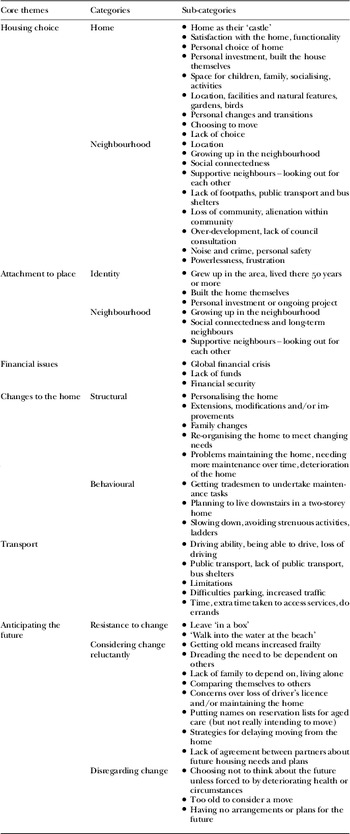
Six key themes emerged from the interviews, namely housing choice, attachment to place, financial issues, changes to the home over time, transport and anticipating the future (see Table 2). These themes are discussed in more detail below.
Core themes relating to home and neighbourhood

Housing choice
Many occupants had lived in their current home for 50 years or more, and many had lived in the area since their youth. Their choice of home was decided upon early on in their marriage, and at least a quarter of those interviewed had planned and built their homes themselves, as a long-term investment:
It's built by myself and my father and a little help from my grandfather. I was an electrician, I am an electrician, and I did all the electrical work and I did a lot of the carpentry work as well. (Married male 1)
Others had the home built for them, to their own design: ‘the builder built the house for us to our sketch’ (married male 2); or had built additions on to the home such as garages and extra rooms, or remodelled the kitchen, thus customising the home to their needs: ‘this room has been added on since we first came here, we built what we could afford to start with and then we found we needed more and we put the room on the back at a later stage’ (married male 3).
For these people, the home was an integral part of their adult life and identity. One couple had moved into their home on the day of their marriage, 54 years previously. Another person suggested that government settlement and housing policies when they first migrated to Australia had determined their choice of home location. Others had moved into the home only recently, for a variety of reasons including marriage, the death of a spouse, retirement, no longer being able to drive and needing access to public transport, being unable to manage and maintain a large yard, being closer to their family, or because the children had grown up and the previous home had ‘outlived its usefulness’ (married male 4).
However, some occupants reported that their home was not one of choice. For instance, one couple described how lack of financial resources had impacted on their current living arrangements: ‘I could say I don't like the caravan but that's all we ended up with you know and haven't got any money to go any further’ (married female 1).
Living in a caravan had been the unintended result of unanticipated events: they had bought a caravan intending to travel north but the husband had suffered a heart attack, ‘so we've been here ever since’ (married female 1). This couple's narrative diverged from the majority of those people interviewed, in that they felt they had little choice about the type of home they lived in or where they lived due to a lack of financial resources, and had therefore seemingly become resigned about their fate.
In this study, most occupants identified the social functions of their home as an important factor in their choice of home and particularly valued the opportunity to host family occasions in the home because of the size and design of their homes. Several people valued their spare rooms as necessary for allowing children and grandchildren to visit: ‘it's a home for my family … we've got 12 grandchildren, they know that they're always welcome to come and stay’ (married male 1), or being able to provide accommodation for sons and daughters following marital breakdowns.
Many occupants were concerned about increasing levels of development, high-rise and dense housing developments that attracted an influx of people to their local area, and expressed frustration at their disempowerment in the face of change: ‘Traffic is disastrous, they've [the council] altered the street … I didn't agree with that and a lot of the neighbours didn't but the council were adamant … they [the council] take away our freedom of choice’ (married male 1). Indeed, the powerlessness invoked by lack of council consultation for changes to the local community was a very emotive issue, with some occupants describing their experience of these changes as ‘hell’ and ‘bedlam’ (divorced male 1). Others hinted at increased alienation within their community, blaming increased development for the need to lock doors as protection against burglaries, and the need to ‘bunker down’ (divorced male 1) against escalating crowds, noise and unsociable behaviour at the weekends.
Increased community development had led to people experiencing challenges in getting around their community, and having to negotiate crowded public spaces, deal with traffic congestion and lack of parking, and increasing aircraft noise. Many voiced concerns about increased vehicular traffic, which combined with their own limitations affected their ability to continue driving; less driving meant increased use of buses, which is a slower form of transport, and so people lamented that it took longer to complete smaller amounts of shopping more frequently and other activities. Moreover, despite having a concessional Seniors Card which facilitated increased affordability of public transport, inadequate transport shelters impacted upon accessibility to services and mobility for older people living in the area. ‘Ten years ago [the bus shelter] was knocked down to put up a building where the gap used to be and we've been campaigning to get the council to put it back but … it hasn't happened’ (divorced male 1). The lack of bus shelters that provided cover against the rain was one factor identified by several people as preventing them from going out in rainy weather.
Interview comments further underscored the importance of location and transport for providing access to local shops, facilities, and valued activities such as membership of clubs and churches, artistic pursuits, fishing, bowls, card games, social walks, dancing, swimming, playing tennis, sailing, golf, volunteering and bushwalking. Some people described the loss of local shops, library, take-away and small supermarket stores to larger shopping centres, which are designed for access by car, and the difficulties encountered in accessing these larger centres if they are no longer driving and more walking is required, or if they are unable to carry their shopping. Specifically, the lack of footpaths was mentioned that would otherwise allow them to mobilise safely around the community, ‘she [92-year-old neighbour] bought herself one of those scooters and she can't use it because the footpaths are useless’ (married male 5). One person described their local paths as ‘ramshackle’ (married male 6). These narratives highlight the powerlessness and frustrations experienced by many residents, and are particularly aimed at the local councils who seem either unable or unwilling to invest in needed infrastructures such as footpaths that may enable older people living in the community to maintain mobility and independence. Occupants also described problems walking around the community at night due to poor lighting, whilst other people felt that the design of their neighbourhood did not always allow them to walk for pleasure or for exercise.
Attachment to place
Many occupants described their levels of attachment to the area or specific home where they lived (sometimes returning to that same place after a period of time living elsewhere). For some, their attachment to the home related to having built the home themselves, for example one couple who had lived in their home for the past 66 years:
Just after the war, things were very hard to build and I think when it's your first home and you've really had to work for it and extend like we've done … you don't want to move because you've put so much of your life and you've brought your children up [in the home]. (Married female 2)
Like the aforementioned couple, several occupants were tradespeople during their working lives and had a substantial personal investment in their home because of their personal efforts in building the home, and had further cemented their investment in the home by continuing to work on and improve the house during their residency. These strongly held attachments to the home made it difficult to be objective about any decisions to leave the home as their physical health deteriorated and/or the functionality of the home decreased. Most occupants were satisfied with their homes because they considered them to be a good match for their needs, and whilst aware that they were ‘slowing down’ (married male 7, married male 8, married female 3), were satisfied to remain in their homes for as long as they could be sustained within the home and do the activities they enjoyed, such as gardening, which appeared to be highly valued, as did being close to nature and enjoying the bird life in their gardens. To some, their home was their ‘castle’ (married male 9).
Whilst some occupants acknowledged that minor improvements to the home might be required, this did not overly concern them; others expressed satisfaction with what they considered to be their low-maintenance homes. Having a level home with no steps and not needing any alterations in the future was highly valued, as was being conveniently located to local shops and services. Many occupants simply ‘loved’ the area they lived in, with some people considering it ‘paradise’ (married male 1, married male 10, married female 4). People mentioned the value of access to beaches and bays, even if it meant walking up and down hills to get there.
Many occupants also described the importance they placed on their home's close location to community activities, family members, friends and neighbours, and even feeling safe by being located in a cul de sac. Many narratives placed emphasis on the value of strong community connections: ‘there's a good community spirit here’ (married female 5); and support mechanisms within their neighbourhood: ‘We've got [name] over the fence, the neighbour, he looks after the place if we should go away and likewise we look after his place’ (married female 6). Others described noting if neighbours had not been seen for a day or so, and having sets of each other's keys for emergency use. One married couple described how the strong bonds with their neighbours had been forged over the course of half a century: ‘we've got wonderful neighbours, the lady next door moved in when we did. They built at the same time and the people on the corner at the same time. We've all been here the 52 years’ (married male 3).
Most people were reluctant to consider moving because of their sense of connection due to having grown up in the area, or connections with long-term neighbours and their preference to be settled rather than relocating, and having to re-establish connections. Some people who had already moved to downsize and have less maintenance still missed the old home. People valued the proximity to friends and long-time neighbours and lamented the loss of those who had moved away. This sense of connection persisted even after neighbours moved away, indeed some people still called houses by their ex-neighbours’ names after they had left. However, several people identified that the numbers of people known to them in their local community was diminishing, being replaced by the arrival of increased numbers of younger people: ‘there's nobody here now who was here when we came, nobody at all’ (widowed female 1). Moreover, some people felt quite isolated within their local community, and suggested that people now tended to keep to themselves, and that they only knew their immediate neighbours. Some people felt that the age of their neighbours was important, suggesting that they were able to establish better relationships with older neighbours, although others valued a range of age groups in the neighbourhood, especially any contact with children.
Financial issues
Many occupants reported having lost funds in the recent global economic downturn, and therefore could not foresee being able to afford any major changes that may be needed to their homes, such as kitchen and bathroom modifications. For instance, ‘We have to watch it now, lost a bit of money recently in a mortgage trust and another one's not going so well – it's no good worrying about it’ (married male 11). Many homeowners had already committed what funds they did have to providing financial assistance to their children, which limited what they could spend on home improvements. For instance, ‘We're happy with our lifestyle and we don't need anything more. But if we decided to do those sorts of things [home improvements] it would break the bank a bit. Particularly when we want to help our own children to get into their own homes and do other things’ (married male 6).
People recognised they might have limitations in funding to increase their comfort but they were mostly concerned about their financial security. One participant described this as ‘we could have spent it [money] on nice things but we're getting a part pension … and that sort of limits my ability to spend money on comfortable things, but I don't really miss it. What I really want is security’ (married male 9).
One couple spoke about the prohibitive cost of moving to a retirement village, which they felt they would be unable to afford, and so their options for the future were limited by lack of available finances. One person felt that: ‘Oh financially I think we could still make some changes but I couldn't rebuild, that might be beyond me’ (married male 3).
Changes to the home over time
While many occupants acknowledged the need to adapt as they age, few had thought through what this would mean in terms of home modifications, and most did not have firm plans. Although many occupants felt their housing needs would change in the next ten years, very few had plans to move at some time in the future. The majority of people had already made some changes to their home in the last five years, such as bathroom and kitchen modifications, or had thought about ramps and minor modifications. In some cases, modifications had already been undertaken to accommodate older relatives living in the home, such as putting rails on stairs, installing ramps, or extensions to the home. Other changes were related to the organisation of existing rooms within the house to meet changing needs, including planning to live downstairs in a two-storey home if their abilities deteriorated, or reorganising bedrooms within the home to be closer to the toilet. Some occupants described the need for them to add special equipment (such as adjustable beds) to meet changes in health, whilst others suggested they could replace steps with ramps if needed.
Many occupants had already made substantial changes to the home over the time of their residence, such as improving lighting, adapting or changing furniture and cupboards, updating floor coverings, and installing ducted air conditioning and ducted vacuuming facilities. Some occupants described more extensive structural changes to the home including extensions or adding an extra storey to allow part of the house to be rented out, an entertainment room or outdoor undercover entertaining area, pool or car port. Many of these alterations were made to accommodate changes in the family, or older relatives living with them, or providing a new bathroom and toilet when mains sewerage became available. Some changes over time were related to activities that people valued, such as having a ‘decent workshop’ (married male 11), or electrical work to accommodate a computer installation.
In acknowledging the challenges of deteriorations to the home (especially paintwork), and the need for increased maintenance over time, occupants described difficulties with a number of home maintenance tasks such as cleaning gutters, ‘well I think if I had to get up and clean the gutters now I'd be in a bit of strife … and I would have a go but she [his wife] won't let me’ (married male 1). Other activities that occupants anticipated may compromise the future safety of their homes or limit their ability to remain at home were heavy housework, cleaning windows, working on ladders or on the roof, and maintaining the garden.
Behavioural change
Many people described changes in their own behaviours and expectations, rather than changes to their environment, with one occupant saying: ‘well I fit in with the house rather than the house fits me’ (married female 7). Behavioural changes included giving up activities such as bowls (because of vision problems), restricting long trips in the car, and taking more time to do things such as caring for the garden and lawns. Other occupants planned to delegate tasks to others, such as getting a tradesman to work on the home rather than doing the tasks themselves, especially tasks that involved the use of ladders.
Most of the occupants attributed changes in their activities to various health challenges such as loss of memory, problems with knees, slower walking, difficulties with balance, difficulty with bending and reduced energy. Many occupants described a general slowing down and avoidance of strenuous activities and limitations with selected activities, such as no longer being allowed to go out in their boat alone, difficulty playing bowls and challenges with increasingly complex technology (e.g. telephones and televisions).
Transport
The ability to drive is a particular concern for older people. One couple talked about having to ‘use the car all the time; you can't get out here much unless you've got your own transport … if you haven't got a car you're lost’ (married female 1). Many occupants recognised that they may eventually lose their ability to drive, whilst others had already ceased driving. The ability to drive has an impact on access to shops and services, and the time taken to complete errands and tasks. Those people relying on public transport complained that the bus services were too infrequent or the routes too inconvenient, thus contributing to increased isolation and lack of mobility, with one person saying:
[The retirement village] have a shopping bus once a week but that's only for a few hours. The local bus is not very often at all. And then if you catch the bus you go on a cook's tour. You go all around in and out and everywhere and that and then you can't get to the [railway] station unless you've got a car, so that all makes you a bit isolated. (Married female 1)
Likewise, the design and location of shopping centres was seen to impact on whether people could keep driving, with traffic and difficulties parking described as an issue for many. Whilst public transport options were appreciated, many people identified the need for new or improved shelters at bus stops.
Anticipating the future
People seemed to fall into one of three groups in relation to their future – resistant to change, considering change reluctantly or disregarding change while they are well. Only one in five persons had made plans to move at some time in the future (Byles et al. Reference Byles, Mackenzie, Redman, Williamson and Parkinson2011). The majority (70%) had already made changes or modifications to the home in the previous five years, mainly to bathrooms, kitchens, garden and outdoor areas (Byles et al. Reference Byles, Mackenzie, Redman, Williamson and Parkinson2011).
Resistance to change
Some very extreme statements were made such as they would only leave their homes ‘in a box’ (married male 1, married male 2, married male 12, married male 13, married male 14, married female 8, widowed female 2), or that if they needed to move into a nursing home they would ‘walk into the water down the beach’ (married male 11). Another stated adamantly: ‘We'll stay here till the last day I'm sure of it’ (married female 9).
Considering change reluctantly
Most people had given some thought to changes needed in the future, but did not have firm plans. Many people associated getting older with frailty. Many dreaded the potential to need to be cared for by others, and would only consider home care support or supported living if they were totally incapacitated and needed a nursing home: ‘eventually we might have to get some assistance, I'm not fooling myself but at the moment I'm healthy enough to do most of the things I have to do’ (married male 1). Some people were concerned about having no family to depend on for the future, should the transition to further care become necessary, and occupants who lived alone acknowledged that they viewed the future differently in terms of being willing to consider moving into a hostel. Many people had observed the fate of other older people they knew who had moved into hostels, or had experienced a stroke, and tended to make comparisons when reflecting on their future needs. Other occupants were aware of the difficulties associated with the inevitable loss of a driving licence, and maintaining their property long term, and anticipated that these issues would enforce a change of housing. Some people had their name on a hostel or aged accommodation reservation list as a kind of insurance for the future, but were not really intending to move: ‘I have my name down in three places … [so I can] keep my options open’ (widowed female 1). These occupants were more likely to wait until their need for such accommodation became more urgent before considering this seriously. Some married couples described a lack of agreement between them and their partners about their future housing needs and plans, so that there was the potential for increased conflict as circumstances changed.
Disregarding change
Some people chose not to think about future changes to their home while they were healthy, deferring making a decision until they were forced to by immediate changes to their circumstances or health status, ‘if I was in a wheelchair I'd have trouble with the stairs’ (single female 1). Some occupants voiced the opinion that whilst they were mobile they would stay at home; others believed that there came a point where they were too old to consider a move. One lady imagined her future:
I just have a feeling that people will say that funny old lady that lives up there on the corner with those animals and that overgrown garden and they'll be all talking about me. Because I've made no arrangements to go anywhere or do anything… (Single female 1)
Discussion
The narratives in this study resonate with previous research by Lawton and Nahemow (Reference Lawton, Nahemow, Eisdorfer and Lawton1973), Lawton (Reference Lawton1985, Reference Lawton, Bengston and Schaie1989a), Després and Lord (Reference Després, Lord, Rowles and Chaudhury2005) and Oswald and Wahl (Reference Oswald, Wahl, Rowles and Chaudhury2005), particularly in regards to behavioural adaptation and change, and the importance of treasured possessions in creating the home. Older people are both proactive and reactive problem solvers, such that emotional, cognitive and behavioural changes will occur in response to challenges in the environment and changes in physical function (Lawton Reference Lawton, Bengston and Schaie1989a, Reference Lawton, Scheidt and Windley1998; Rowles and Bernard Reference Rowles, Bernard, Rowles and Bernard2013b).
The home is both concrete and physical accomplishment. It is intimately related to attachment, physical, social and autobiographical insideness, security and familiarity (Oswald and Wahl Reference Oswald, Wahl, Rowles and Chaudhury2005); and testament to personal tenacity and adaptation in the face of increasing decline (Després and Lord Reference Després, Lord, Rowles and Chaudhury2005; Oswald and Wahl Reference Oswald, Wahl, Rowles and Chaudhury2005). Indeed, a major goal of the home in later life is to maintain identity and personality (Oswald and Wahl Reference Oswald, Wahl, Rowles and Bernard2013). Sherman and Dacher (Reference Sherman, Dacher, Rowles and Chaudhury2005, p.78) contend, the home is ‘evidence of a life to which [older persons] remain connected’, a ‘marker(s) of morale, while simultaneously enhancing it’. Conversely, the home may also provoke anxiety and despair. Home also symbolises wider relationships with neighbourhood and community. Importantly, the home and neighbourhood environment may either complement or enhance existing skills and personal competencies (Lawton Reference Lawton, Scheidt and Windley1998).
Change and resistance
The narratives in this study emphasise the importance of home to older people, and of older people's resistance towards moving from their home. Many do not want to move, or do not plan to move, as needs change. Our findings support previous studies by Percival (Reference Percival2002), Shenk, Kuwahara and Zablotsky (Reference Shenk, Kuwahara and Zablotsky2004), Bridge and Kendig (Reference Bridge, Kendig, Minichiello and Coulson2005), Davey (Reference Davey2006) and De Jonge et al. (Reference De Jonge, Jones, Phillips and Chung2011) in this regard. Interestingly, people seemed more likely to make changes to their own behaviour than to their environment, by modifying, centralising and restricting their activities to keep pace with their changing abilities (Bailey et al. Reference Bailey, Foran, Scanaill and Dromey2011; Després and Lord Reference Després, Lord, Rowles and Chaudhury2005; Lawton Reference Lawton1985; Oswald et al. Reference Oswald, Wahl, Naumann, Mollenkopf, Hieber, Wahl, Brenner, Mollenkopf, Rothenbacher and Rott2006, Reference Oswald, Wahl, Schilling, Nygren, Fange, Sixsmith, Sixsmith, Szeman, Tomsone and Iwarsson2007; Tanner, Tilse and De Jonge Reference Tanner, Tilse and De Jonge2008). In such cases, the occupants become adept at negotiating taken-for-granted hazards, such as stairs or a poorly designed bathroom (Bailey et al. Reference Bailey, Foran, Scanaill and Dromey2011), through a process of ‘maintenance’ whereby a series of repetitive, well-practised and largely unconscious behaviours occur in relation to the physical environment (Lawton Reference Lawton1989b). However, this does not always guarantee against falls and injuries within the home. Assistive technologies, devices or modifications to the home to mitigate falls and enhance independence can be embarrassing or stigmatising (De Jonge et al. Reference De Jonge, Jones, Phillips and Chung2011), and jeopardise identity, emotionality, sense of control and attachment to the home (Bailey et al. Reference Bailey, Foran, Scanaill and Dromey2011; De Jonge et al. Reference De Jonge, Jones, Phillips and Chung2011).
Thus, the solution to reduced mobility and safety within the home is not always a simple one, such as installing rails or an outside ramp to accommodate wheelchair access, and requires careful consideration of environmental, psychological, social and emotional aspects by housing planners, policy makers, occupational therapists and social workers, and others involved in the promotion of safety and independence amongst older people living in the community. This also extends to the use of mobility aids and devices outside the home, such as ‘rollators’ or ‘walkers’, which may not always be optimally designed for outdoor use, or which may also be experienced as stigmatising (Iwarsson, Ståhl and Löfqvist Reference Iwarsson, Ståhl, Löfqvist, Rowles and Bernard2013).
For those whose changing needs and circumstances make a move to alternative accommodation (such as more supportive housing or a nursing facility) inevitable, it is important to recognise the range of processes involved (e.g. transference of not only oneself, but treasured possessions and daily routines), and how these may impact on the ageing individual's wellbeing and sense of home and place (Rowles and Bernard Reference Rowles, Bernard, Rowles and Bernard2013b). Some people are particularly adept at ‘place-making’, having developed the capacity over the lifecourse to easily transition from place to place. However, those older people who have lived in a single dwelling all their life, or who have only moved once or twice over the lifecourse, or who have fewer resources (financial, psychological, family and social networks) may have difficulty with re-adapting (Rowles and Bernard Reference Rowles, Bernard, Rowles and Bernard2013b). Social workers can play a key role here in smoothing the process of transference, by providing supports such as arranging preliminary visits to the new setting (either real or simulated), assisting with downsizing and sorting of possessions and identification of key mementoes, reminiscence and ‘photo-linking’, facilitating contact with social networks through return visits with social and community groups, and the use of social media such as the internet and Facebook (Rowles and Bernard Reference Rowles, Bernard, Rowles and Bernard2013b).
Perceived disempowerment and ageism
These narratives highlight the importance of the home and of the local community in supporting a sense of wellbeing and independence as older people age, and the importance of planning safe and accessible neighbourhoods and communities that are adequately serviced by public infrastructure such as public transport, bus shelters and footpaths (Iwarsson, Ståhl and Löfqvist Reference Iwarsson, Ståhl, Löfqvist, Rowles and Bernard2013; Rowles and Bernard Reference Rowles, Bernard, Rowles and Bernard2013b). Moreover, these narratives emphasise the importance of meaningful consultation with older people about changes to their homes, living situations and services within the community (Bernard and Rowles Reference Bernard, Rowles, Rowles and Bernard2013; Peace Reference Peace, Rowles and Bernard2013). Many of the participants expressed a lack of self-efficacy and control over their immediate environments and without incorporating a person-centred approach (Bernard and Rowles Reference Bernard, Rowles, Rowles and Bernard2013) to changes, these are unlikely to be well received or taken up by older people (Kendig, Clemson and Mackenzie Reference Kendig, Clemson, Mackenzie, Smith, Elsinga, Eng, O'Mahony and Wachter2012). The role of socio-economic factors in determining current circumstances is also important, as the current residence may not have been one of choice to begin with, but the result of historical circumstances. Older people may not always have the resources to move to another home or location, and it appears many of the people interviewed have experienced dissatisfaction, increased vulnerability and alienation within their community as a result of increased development, or suggested changes to their home. The suburb may have experienced changes in cultural and age homogeneity (Després and Lord Reference Després, Lord, Rowles and Chaudhury2005), such as in older suburbs undergoing revitalisation and increased development. Also, as people age, home and/or neighbourhood characteristics which were once desired may now be undesirable. The experience of temporal change was a common theme in this study.
Outside of the home, it is vital that the transport needs of older people in the community are adequately serviced. Unmet public transport needs and inaccessibility of public transport impacts on older people's ability to remain living independently in the community, quality of life (Hjorthol Reference Hjorthol2013) and social participation in the community (Després and Lord Reference Després, Lord, Rowles and Chaudhury2005).
Person and environmental fit
Lawton (Reference Lawton1985, Reference Lawton, Bengston and Schaie1989a, Reference Lawton, Scheidt and Windley1998), Peace, Holland and Kellaher (Reference Peace, Holland and Kellaher2011) and Safran-Norton (Reference Safran-Norton2010) contend that where the home environment is seen as too challenging or incongruent, or attachment to the home is compromised by environmental or functional decline and increased disability, the older person will most likely be forced to either adapt, or to relocate to other accommodation. However, a supportive and responsive environment can enable older people living in the community to maintain a workable level of person–environmental fit (Bailey et al. Reference Bailey, Foran, Scanaill and Dromey2011; Lawton Reference Lawton1985; Lawton and Nahemow Reference Lawton, Nahemow, Eisdorfer and Lawton1973; Peace, Holland and Kellaher Reference Peace, Holland and Kellaher2011) and thus be empowered to more optimally age in place. This applies to both the home and neighbourhood environment. Similar to Després and Lord's findings (Després and Lord Reference Després, Lord, Rowles and Chaudhury2005), participants in this study reported that knowing neighbours, friends and family could be counted on in times of need provided reassurance, confidence and security, thus emphasising the importance of support networks.
An important consideration for both housing and policy initiatives, and one borne out by the narratives in this study, is that the degree of control a person may have over their home environment can be severely limited by lack of financial assets or available income (Kendig, Clemson and Mackenzie Reference Kendig, Clemson, Mackenzie, Smith, Elsinga, Eng, O'Mahony and Wachter2012). Poverty plays a key role in decisional autonomy such as determining housing location and type, and where older people may choose to spend the rest of their lives (Byrnes, Lichtenberg and Lysack Reference Byrnes, Lichtenberg and Lysack2006), as does the influence of social and historical contexts such as migration. In this study, most participants owned their homes in well-established areas. Many of these areas had undergone gentrification and increasing home values, rendering the occupants ‘asset rich’ but income poor.
As quoted by Percival (Reference Percival2002), many older home owners have their realisable wealth tied up in their home and therefore inaccessible unless the home is sold. The narratives in this study support this concept. Moreover, older women living alone are particularly vulnerable to financial constraints due to interrupted work histories or non-paid work in the home across the lifecourse, lower wages generally, and inability to accrue adequate superannuation or savings of their own, due to gender roles and marital or family responsibilities (Richardson Reference Richardson1999; Slevin and Wingrove Reference Slevin and Wingrove2007).
Similar to Després and Lord (Reference Després, Lord, Rowles and Chaudhury2005), we found that home ownership provided a sense of security, and in some cases, was also perceived as being the more affordable option to retirement villages. For some, home represented a move to a retirement village or self-care unit and a substantial proportion had moved to flats or apartments. When older people moved home, this choice was also influenced by their perceptions of the ‘meaning of home’. Moving house could represent new preferences or desires in old age, and a positive and empowering experience (Oswald and Wahl Reference Oswald, Wahl, Rowles and Chaudhury2005). Conversely, the process of moving can be highly stressful, so that an individual may experience difficulty in re-adapting and re-making the meaning of ‘home’; in such cases adaptation becomes increasingly reactive rather than proactive (Rowles and Bernard Reference Rowles, Bernard, Rowles and Bernard2013b).
Supportive housing and environments
The people in this study who most strongly identified with and felt connected to their neighbours and communities seemed to have more positive perceptions of their homes and communities and hence may be better able to remain living in the home. Indeed, well-developed social capital, and a strong sense of community connection and cohesion, is crucial for ageing in place, particularly for elderly women living alone (Peace, Holland and Kellaher Reference Peace, Holland and Kellaher2011). Studies have shown that supportive, age-friendly communities and neighbourhoods (Iwarsson, Ståhl and Löfqvist Reference Iwarsson, Ståhl, Löfqvist, Rowles and Bernard2013) can ameliorate the effects of limited mobility and increased age-related disability through the utilisation of positive support networks such as neighbours to provide access to much-needed services and facilities, and to reduce feelings of isolation, loneliness and despair (Bridge and Kendig Reference Bridge, Kendig, Minichiello and Coulson2005; Danziger and Chaudhury Reference Danziger and Chaudhury2009; De Jonge et al. Reference De Jonge, Jones, Phillips and Chung2011; Wiles et al. Reference Wiles, Allen, Palmer, Hayman, Keeling and Kerse2009). Indeed, many older people choose to remain in their homes despite increasing challenges, so they can remain in close proximity to family, friends and supportive neighbours (De Jonge et al. Reference De Jonge, Jones, Phillips and Chung2011). Moreover, a sense of belonging to neighbourhood and place, and intergenerational contact (Thang and Kaplan Reference Thang, Kaplan, Rowles and Bernard2013) are crucial for maintaining a positive sense of identity and wellbeing, and facilitate the successful transition to old age (Wiles et al. Reference Wiles, Allen, Palmer, Hayman, Keeling and Kerse2009).
The narratives in this study make it clear that supportive homes and environments are those which are experienced as empowering, promote feelings of belonging, attachment, identity, environmental mastery and wellbeing. Supportive homes and environments are also those which provide scope for maintaining daily habits and routines, and provide opportunities for socialising with family, friends and the wider community (Peace Reference Peace, Rowles and Bernard2013; Rowles and Bernard Reference Rowles, Bernard, Rowles and Bernard2013b; Thang and Kaplan Reference Thang, Kaplan, Rowles and Bernard2013). Sherman and Dacher (Reference Sherman, Dacher, Rowles and Chaudhury2005) suggest that provision of space for treasured possessions can facilitate sense of control for older people, and enrich the experience of home. Housing policies and home and urban design should be developed with the needs of the ageing population in mind so that the home and neighbourhood environment are safe and accessible, promote positive associations and intergenerational integration, and in the case of the home, are adaptable to facilitate independence and accommodate age-related changes in function and mobility. It is also important to recognise that what constitutes person–environmental ‘fit’ may change over time in response to changing individual needs and resources; and changing (or in some cases, deteriorating) environment. It is crucial, therefore, for individuals and those working with older people periodically to re-assess and even recalibrate ‘fit’ with the environment over the lifecourse.
Limitations
The people in this study were all residing within the greater Sydney region of New South Wales, Australia, and as such, this study focuses only on those older people living in urban areas. Older people living in rural or remote areas represent a need for further research in this area. Additionally, many of the people in this study owned their own homes and had generally lived in the area for many years (in some cases, decades), and these findings need to be interpreted in that light. For example, older people who are renting or with less stable housing histories may have very different views and needs. It is also important to recognise that different meanings of the home (Rowles and Bernard Reference Rowles, Bernard, Rowles and Bernard2013b) (such as whether or not a home is perceived as supportive) are subjective and may be dependent on the person's functional capacities (Oswald and Wahl Reference Oswald, Wahl, Rowles and Chaudhury2005). Therefore, what is considered supportive by some may not be congruent with the views of all older people, particularly given that older populations are diverse and have varying degrees of disability and functional competence. Notwithstanding these limitations, this paper does add to understandings of how older people view their homes and their expectations regarding their home and ageing in place, and their views about their neighbourhood.
Conclusion
This study has highlighted the way that older people manipulate their own behaviours to accommodate increasing disability rather than modifying the home or moving from their home to another location. Such behavioural modifications and self-imposed restrictions are cause for concern because older people may isolate themselves within their own home and communities, and subsequently be at increased risk of alienation and depression. Moreover, this study has highlighted the importance of housing design and the necessity of housing planners to be more forward-thinking in planning adaptable housing to accommodate and support the resident person across the lifecourse and as they age. There is also a need for housing designers, architects and health professionals to collaborate more fully with older people to identify those features that older persons most want and need, particularly with regards to accessibility and reducing hazards in the home. Finally, this study indicates that older people living in the community should be informed, listened to and empowered to engage in meaningful consultation with local councils about proposed changes and development, and additional supports and infrastructure should be provided to help ameliorate negative impacts arising from increased community development and housing.
Acknowledgements
This paper draws on findings from the Housing and Independent Living (HAIL) Project undertaken by researchers at The University of Newcastle, The University of Sydney and the Sax Institute, and funded by Ageing Disability and Home Care, in the New South Wales (NSW) Family and Community Services. The 45 and Up Study is managed by the Sax Institute in collaboration with major partner Cancer Council New South Wales; and partners: the National Heart Foundation of Australia (NSW Division); the NSW Ministry of Health; beyond blue: the national depression initiative; Ageing, Disability and Home Care, NSW Family and Community Services; Australian Red Cross Blood Service; and Uniting Care Ageing. We sincerely thank the men and women of the 45 and Up Study who consented to participate in the HAIL project and who allowed assessors to visit them in their home, and for their graciousness and willingness to provide information relevant to the HAIL project. Further information is available from http:// www.45andUp.org.au. All researchers in the Faculty of Health and Medicine at The University of Newcastle are members of the Hunter Medical Research Institute (HMRI). We wish to thank Louise Thomas, Research Centre for Gender Health and Ageing, University of Newcastle for her assistance with the manuscript. This research was approved by The University of Newcastle Human Research Ethics Committee, H-2009-0209. The HAIL study was funded by the Ageing Disability and Home Care, NSW Family and Community Services. No conflicts of interest have been identified.