Introduction
Recurrent pregnancy loss (RPL), defined as a minimum of two consecutive miscarriages within the first or early second trimester of the pregnancy, has an estimated incidence of 1–3%. Its aetiology is complex and cannot be established in up to 50% of patients (Alijotas-Reig and Garrido-Gimenez, Reference Alijotas-Reig and Garrido-Gimenez2013). It has been reported that high levels of double-stranded sperm DNA fragmentation (dsSDF) are associated with an increased risk of miscarriage (Ribas-Maynou et al., Reference Ribas-Maynou, García-Peiró, Fernández-Encinas, Amengual, Prada, Cortés, Navarro and Benet2012b), and a possible cause of RPL.
Endogenous sperm DNA damage can occur in spermatogenesis during the formation of meiotic crossovers, or during spermiogenesis while histones are replaced by protamines, resulting in dsSDF (Jan et al., Reference Jan, Hamer, Repping, de Rooij, van Pelt and Vormer2012). Sperm DNA can also be damaged by reactive oxygen species (ROS), which may oxidize covalent links in DNA, leading to nucleotide base loss, which in turn results in single-stranded SDF (ssSDF) (Ribas-Maynou et al., Reference Ribas-Maynou, García-Peiró, Fernández-Encinas, Amengual, Prada, Cortés, Navarro and Benet2012b). ROS can also damage the sperm membrane, affecting both its motility and its ability to bind to the oocyte membrane (Tremellen, Reference Tremellen2008).
During an in vitro fertilization (IVF) cycle centrifugation and swim up are frequently used to collect the highly motile sperm fraction and remove impurities (Boomsma et al., Reference Boomsma, Heineman, Cohlen and Farquhar2007). Centrifugal separation has been suggested to induce SDF (Agarwal et al., Reference Agarwal, Ikemoto and Loughlin1994). Therefore, a sperm preparation technique that allows the selection of sperm with low levels of dsSDF, while avoiding the induction of SDF should help to improve the clinical outcomes in patients with male factor-related RPL.
Several microfluidic-based sperm selection devices have been developed in recent years (Smith and Takayama, Reference Smith and Takayama2017; Suarez and Wu, Reference Suarez and Wu2017; Samuel et al., Reference Samuel, Feng, Jafek, Despain, Jenkins and Gale2018). These methods use raw ejaculated semen, and do not require centrifugation; therefore, the enrichment process should be less damaging to the sperm. Microfluidic sperm sorting seems to result in preparations with a diminished percentage of spermatozoa with DNA fragmentation (Shirota et al., Reference Shirota, Yotsumoto, Itoh, Obama, Hidaka, Nakajima and Miyamoto2016; Quinn et al., Reference Quinn, Jalalian, Ribeiro, Ona, Demirci, Cedars and Rosen2018; Parrella et al., Reference Parrella, Keating, Cheung, Xie, Stewart, Rosenwaks and Palermo2019; Yildiz and Yuksel, Reference Yildiz and Yuksel2019); nevertheless, results in the published literature from large cohorts are still lacking.
Our goal was to test whether sorting sperm using a commercial microfluidic device (Fertile Chip®; DxNow, Inc. and KOEK Biotechnology, now named ZyMot® ICSI) reduced the proportion of dsSDF in the resulting spermatozoa compared with swim up through a blinded split pilot study. We hypothesized a reduction in dsSDF compared with ejaculated and post swim up sperm cells of at least 20%. Furthermore, we provide the clinical results of a consecutive cohort of 163 ICSI cycles of patients diagnosed with ≥60% dsSDF, to assess the utility of the device in routine clinical work.
Materials and methods
Study population and ethical approval
This pilot study included sperm samples from nine patients (see Statistical analysis for sample size calculation), performed between December 2017 and July 2018, while the clinical data corresponded to 163 consecutive ICSI cycles performed until February 2020. In all cases, patients had at least 60% dsSDF detected by neutral COMET. The study was approved by the Ethics Committee for Clinical Research of the institution, and informed consent was obtained before the inclusion of the participants in the study.
Double-stranded sperm DNA fragmentation measurement
The neutral COMET assay was performed as described previously (Ribas-Maynou et al., Reference Ribas-Maynou, Gawecka, Benet and Ward2014b). Briefly, each sample was washed twice in phosphate-buffered saline, and 25 μl of sample was mixed with 50 μl of 1% low melting point agarose (Sigma Aldrich, USA). In total, 5 μl were allowed to gel with a coverslip on a slide, incubated in two lysis solutions (Comet lysis solutions, Halotech, Madrid, Spain) for 30 min each, and washed in TBE buffer (0.445 M Tris–HCl, 0.445 M boric acid, 10 mM EDTA) for 10 min. Afterwards, the slide was placed on the electrophoresis canister in TBE buffer, and an electric field of 1 V/cm was applied for 12.5 min. After this, the sample was washed in neutralization buffer (0.4M Tris–HCl, pH 7.5) for 5 min, dehydrated in a series of ethanol concentrations (70%, 90% and 100%) for 2 min each and air dried. COMET slides were stained with 4′,6-diamidino-2-phenylindole (DAPI) (Thermo Fisher Scientific) and images were captured under an epifluorescence microscope (Nikon Eclipse ed200 with Intenslight; Nikon; Japan) for analysis.
Microfluidic-based selection
Fertile Chip® (DxNow, Inc. and KOEK Biotechnology) is a device comprised of five small channels of 4 mm wide, 15 mm length and a thickness of 50 µm, which makes the model restricted to mainly a two-dimension movement (Tasoglu et al., Reference Tasoglu, Safaee, Zhang, Kingsley, Catalano, Gurkan, Nureddin, Kayaalp, Anchan, Maas, Tüzel and Demirci2013). Each channel has a small aperture (diameter of 0.65 mm) on one end and a larger one (diameter of 2 mm) on the opposite end. An aliquot of 6.5 μl of medium (Sperm Wash, Irvine Scientific, USA) was applied in each of the 10 apertures of the device. Then, 2 μl of fresh semen were placed in the small apertures; and a small drop of culture oil (Oil for Embryo Culture; Light Mineral Oil; Irvine Scientific, USA) was placed over each of the 10 apertures of the chip. The loaded Fertile Chip® was placed horizontally in a closed heater at 37ºC for 30 min. To reach the large apertures at the end of the channel, spermatozoa must swim through the channels. The distance to be travelled enriches for the population of spermatozoa with good motility.
After incubation, 5 μl of medium from each of the large apertures was removed and placed either into a tube (for the pilot study) or directly into the ICSI dish (for ICSI cycles).
Blinded split pilot study
One semen sample from each participant was collected for this study. A portion of each sperm sample was frozen (aliquot 1), and the remaining portion was split into two further aliquots: one was processed using a Fertile Chip® and frozen (aliquot 2), and the other was processed using swim up and frozen (aliquot 3). The three frozen aliquots were analyzed blindly using neutral COMET assay to detect dsSDF by analyzing on average 187 spermatozoa in each one. We then compared the dsSDF of the aliquots processed using Fertile Chip® with the dsSDF of the aliquots of ejaculate and of those processed by swim up.
The ejaculated semen samples were analyzed following WHO recommendations (World Health Organization, 2010) and using an Integrated Semen Analysis System (ISAS®, PROISER, Spain). Volume (ml), concentration of spermatozoa (million/ml) and sperm progressive motility (% of a+b forms) were recorded. A 150-μl aliquot of fresh ejaculate was snap frozen in a small tube by plunging it into liquid nitrogen (aliquot 1).
The Fertile Chip® was loaded with fresh sperm as explained previously and, after incubation, 5 μl of medium from each of the large apertures was removed and placed into a tube (25 µl total volume). This aliquot was snap frozen by plunging it into liquid nitrogen (aliquot 2).
For swim up, 2.5 ml of medium (SpermWash, Nidacon, Sweden) were added to the rest of the semen sample. The mixture was centrifuged 10 min at 300 g. Supernatant was removed and 0.3 ml of fresh medium (SpermRinse; Vitrolife; Sweden) was added. After incubation for 10 min at 30ºC with the tube positioned at an 45º angle, a 150 μl aliquot was removed from the top of the medium column, placed in a fresh tube, and snap frozen as described (aliquot 3).
The percentage of dsSDF sperm was determined for each of the three frozen aliquots of each participant using neutral COMET.
Clinical ICSI cycles cohort
A Fertile Chip® was applied as a method of sperm selection in 163 ICSI cycles of patients diagnosed previously with ≥60% dsSDF and assessed by neutral COMET.
Controlled ovarian stimulation was induced with exogenous gonadotrophins using two possible strategies: a flexible GnRH-antagonist protocol, starting gonadotropins on the second day of cycle and introducing the antagonist when a follicle reached a diameter of 14 mm, or a long GnRH-agonist protocol, starting the agonist in the mid luteal phase of the preceding menstrual cycle and adding gonadotropins on the second day after menstrual bleeding.
Ovulation was triggered when follicles reached a diameter of > 17 mm, using either 0.3 mg Triptorelin (Decapeptyl ® , Ipsen Pharma Biotech, France) or 250 µg hCG (Ovitrelle®, Merck Serono, Italy) depending on the stimulation protocol (Lattes et al., Reference Lattes, Checa, Vassena, Brassesco and Vernaeve2017). Cumulus–oocyte complexes (COCs) were retrieved 36 h post triggering using ultrasound-guided transvaginal follicular aspiration.
The ejaculated semen samples were analyzed following WHO recommendations (World Health Organization, 2010) and using an Integrated Semen Analysis System (ISAS®, PROISER, Spain). Volume (ml), concentration of spermatozoa (million/ml) and sperm progressive motility (% of a+b forms) were recorded. A Fertile Chip® was then applied and, after incubation, 5 μl of medium from each of the large apertures was placed directly into a polyvinylpyrrolidone (PVP) droplet in an ICSI dish. Denudation and ICSI were performed as described elsewhere (Pujol et al., Reference Pujol, García, Obradors, Rodríguez and Vassena2018).
After ICSI, the oocytes were placed in a time-lapse incubator (Embryoscope Plus; Vitrolife) and fertilization was assessed 16–18 h later.
Embryos at days 2 and 3 were scored following the system of morphological assessment of embryos from the Spanish Association of Reproductive Biology (ASEBIR) (Cuevas Saiz et al., Reference Cuevas Saiz, Carme Pons Gatell, Vargas, Delgado Mendive, Rives Enedáguila, Moragas Solanes, Canal, López, Bonet and Hurtado de Mendoza Acosta2018), which considers number of blastomeres, percentage of embryo fragmentation and symmetry of the blastomeres. Blastocysts were scored according to Gardner and Schoolcraft (Reference Gardner, Schoolcraft, Jansen and Mortimer1999). KID Score (EmbryoscopePlus; Vitrolife) was used to assess embryo kinetics. Those embryos with a higher scores were selected for embryo transfer (ET), and the supernumerary embryos were vitrified the same day of the transfer. ET was carried out using hyaluronan-rich transfer medium (UTM®, Origio, Denmark).
When frozen embryos were transferred, thawing was carried out the day before the frozen ET (FET) for embryos frozen at day 3 and the same day as the FET for the blastocysts.
As a luteal phase support, 400 mg of progesterone (Utrogestan®, SEID, Spain) were administered every 12 h vaginally. Progesterone supplementation was ended either the day of a negative pregnancy test, or 4 weeks later if positive. Clinical outcomes were evaluated: biochemical pregnancy (positive pregnancy test performed 14 days after ET); clinical pregnancy (fetal heartbeat observed at seventh week of gestation), ongoing pregnancy (adequately processing pregnancy at 12 weeks of gestation) and live birth.
Statistical analysis
In the pilot study we compared the dsSDF percentage of the semen samples of nine patients processed using Fertile Chip® (aliquot 2) with the ejaculated sperm (aliquot 1) and with the same samples processed using swim up (aliquot 3).
The study sample size was calculated to detect a difference of 20% in the dsSDF percentage between the study groups (standard deviation 11.7%), with an alpha risk of 0.05 and a beta risk of 0.05 (95% of power). With these specifications, nine samples were enough to test our hypothesis. Differences in dsSDF percentage between the study groups were evaluated using the non-parametric Wilcoxon test for related samples. Analyses were performed using SPSS v.22.0 and a P-value < 0.05 was set as statistically significant.
For the clinical ICSI cycles cohort, results are presented as mean and standard deviation (SD).
Results
Blinded split pilot study
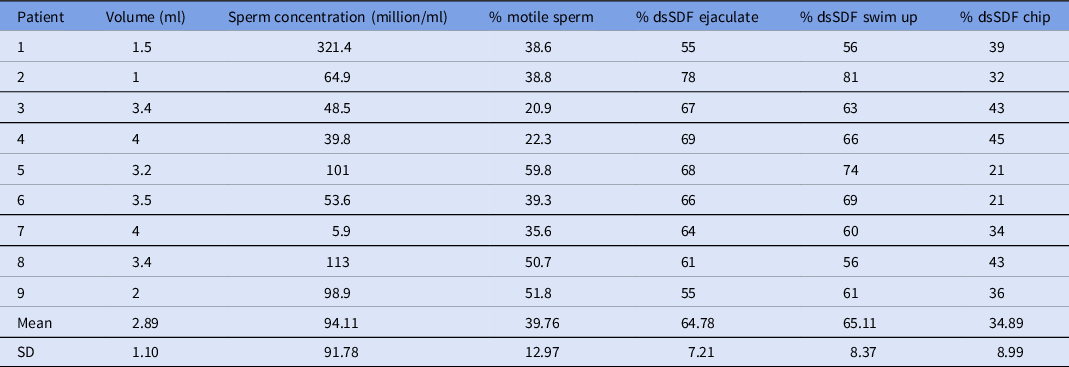
The nine patients included in the study had a mean age of 38.9 years (range 34–53) and their mean body mass index was 26.8 kg/m2 (range 20.9–32.84). Their basic semen basic characteristics are presented in Table 1. All patients had already undergone assisted reproductive technology (ART) prior to inclusion in the study: one patient had gone through three artificial insemination cycles and the other eight patients had undergone between one and four IVF cycles. Two had not achieved a pregnancy, six had previous miscarriages and two already had a child (one of them had miscarriages after the first child).
Sperm basic characteristics and detail of the percentages of dsSDF for each aliquot of each patient included in the pilot study

Details of the percentage of dsSDF by patient for each of the aliquots are also presented in Table 1. The mean percentage of dsSDF found in the ejaculate by neutral COMET was 64.78% (median 66%; SD 7.21). The dsSDF percentage changed slightly after swim up: mean 65.11%; median 63%; SD 8.37; P > 0.05. Conversely, the neutral COMET assay applied to the samples after microfluidic sorting using a Fertile Chip® showed a significantly lower dsSDF: mean 34.89%; median 36%; SD 8.99; P = 0.008. This difference was statistically significant both compared with the ejaculate (P = 0.008) and with the sample obtained after swim up (P = 0.008). Therefore, application of the Fertile Chip® technique resulted in a significant reduction (46.14%) of dsSDF compared with the raw sample. The reduction in dsSDF was also significantly reduced in the Fertile Chip® samples compared with swim up (46.41%).
Clinical ICSI cycles cohort
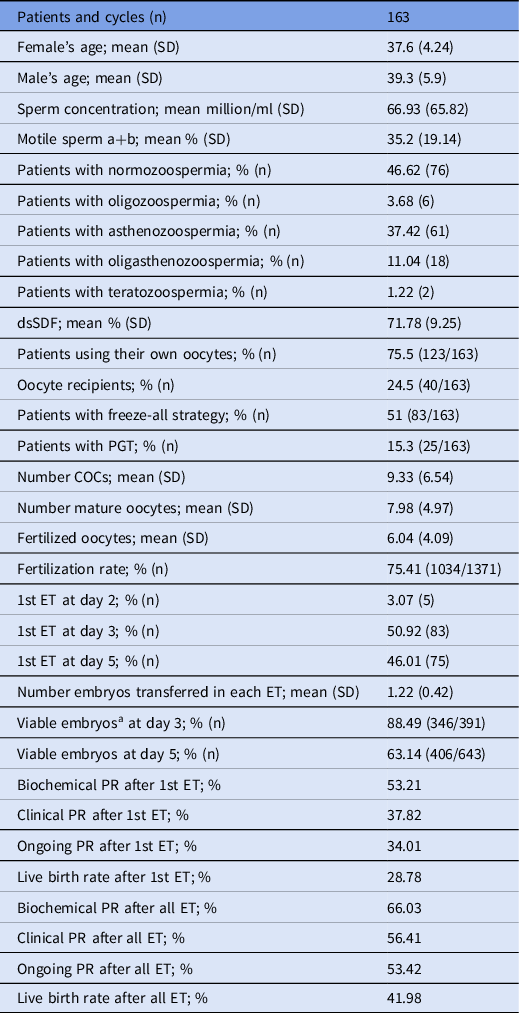
The age of the patients in the clinical cohort was 37.6 (SD 4.24) for the women and 39.3 (SD 5.9) for their male partners (see Table 2). Only one ICSI cycle for each patient was included in the analysis. The mean sperm concentration was 66.93 million/ml (SD 65.82) and the mean percentage of motile sperm (a+b forms) was 35.2% (SD 19.14). On average, the percentage of dsSDF found in the ejaculate by neutral COMET was 71.78% (SD 9.25). Sperm samples were diagnosed mostly as normozoospermia (46.62%), 3.68% were oligozoospermia, 37.42% asthenozoospermia, 11.04% oligoasthenospermia and 1.22% teratozoospermia.
Results of the clinical cohort ICSI cycles

COCs, cumulus–oocyte complex; dsSDF, double-stranded sperm DNA fragmentation; ET, embryo transfer; PGT, preimplantation genetic testing; PR, pregnancy rate.
a The term ‘viable embryos’ indicates the ones that were transferred or vitrified.
The percentage of viable embryos (the ones that were transferred or vitrified) was 88.49% (346/391) at day 3 and 63.14% (406/643) at day 5.
Pregnancy rates after the first ET were 53.21% (biochemical), 37.82% (clinical) and 34.01% (ongoing), and the live birth rate was 28.78%. The miscarriage rate was 9.04%. A high percentage of patients only had one ET (65.38%), 27.56% had two ET, while just a few had three ET (6.41%). The pregnancy rates achieved after all the ET performed were 66.03% (biochemical), 56.41% (clinical), 53.42% (ongoing), while the live birth rate was 41.98% and the miscarriage rate was 14.43%.
Discussion
The COMET is a DNA fragmentation assay that allows detection of both ssSDF and dsSDF (Ribas-Maynou et al., Reference Ribas-Maynou, García-Peiró, Fernández-Encinas, Amengual, Prada, Cortés, Navarro and Benet2012b). Measuring the two types of SDF is relevant, as their clinical correlates seem to be different. It has been described that high levels of ssSDF impair natural pregnancy (Simon and Lewis, Reference Simon and Lewis2011; Ribas-Maynou et al., Reference Ribas-Maynou, García-Peiró, Fernández-Encinas, Amengual, Prada, Cortés, Navarro and Benet2012b), while high levels of dsSDF has been found to affect embryo kinetics and are associated to low implantation (Casanovas et al., Reference Casanovas, Ribas-Maynou, Lara-Cerrillo, Jimenez-Macedo, Hortal, Benet, Carrera and García-Peiró2019) and increased risk of miscarriage (Ribas-Maynou et al., Reference Ribas-Maynou, García-Peiró, Fernández-Encinas, Amengual, Prada, Cortés, Navarro and Benet2012b).
ssSDF measured by alkaline COMET is a strong predictor of achieving natural pregnancy, not inferior to SDF measured by oxidative sperm DNA fragmentation tests [sperm chromatin dispersion (SCD), terminal deoxynucleotidyl transferase dUTP nick end labelling (TUNEL) and sperm chromatin structure assay (SCSA)] (Ribas-Maynou et al., Reference Ribas-Maynou, García-Peiró, Fernández-Encinas, Amengual, Prada, Cortés, Navarro and Benet2012b). Conversely, several authors showed that oxidative DNA fragmentation tests cannot predict outcomes in ICSI cycles (Esbert et al., Reference Esbert, Pacheco, Vidal, Florensa, Riqueros, Ballesteros, Garrido and Calderón2011; Bach and Schlegel, Reference Bach and Schlegel2016). ssSDF seems to be caused mainly by ROS activity (Ribas-Maynou et al., Reference Ribas-Maynou, García-Peiró, Fernández-Encinas, Amengual, Prada, Cortés, Navarro and Benet2012b), is associated with impaired sperm motility (Simon and Lewis, Reference Simon and Lewis2011; Ribas-Maynou et al., Reference Ribas-Maynou, García-Peiró, Abad, Amengual, Navarro and Benet2012a) and because of the nature of the break, involving one DNA strand and being too extensive to be repaired by the oocyte, the embryo often arrests its development.
Notably, dsSDF is mainly caused by nuclease activity and involves both DNA strands, allowing for template-directed repair mechanisms; in these cases, the oocyte repair mechanisms attempt to repair the breaks. However, if not repaired, dsSDF could cause DNA damage in the embryonic genome, resulting in pregnancy loss (Ribas-Maynou et al., Reference Ribas-Maynou, García-Peiró, Fernández-Encinas, Amengual, Prada, Cortés, Navarro and Benet2012b). Neutral COMET can detect dsSDF caused by an absence of activity of ATM kinase; this kinase is in charge of the phosphorylation of a histone that activates DNA repairing mechanisms. When ATM activity is suboptimal, phosphorylation is affected and dsSDF are produced by the absence of DNA repair (Lange et al., Reference Lange, Pan, Cole, Thelen, Jasin and Keeney2011).
To date, no treatment has been found to reduce dsSDF and, consequently, diminish the incidence of male factor-related RPL.
During IVF, the sperm is prepared in the laboratory before fertilization (for an extended methodological review see Vaughan and Sakkas, Reference Vaughan and Sakkas2019). It has been stated that an improvement in sperm DNA quality post sperm preparation is not always apparent; in specific cases, both density gradients and swim up separation have been found to increase SDF in viable spermatozoa, with the increase in DNA damage being less evident post swim up (Muratori et al., Reference Muratori, Tarozzi, Carpentiero, Danti, Perrone, Cambi, Casini, Azzari, Boni, Maggi, Borini and Baldi2019). Furthermore, samples are more susceptible to an increase in SDF over time if the incubation is performed at 37ºC (Tvrdá et al., Reference Tvrdá, López-Fernández, Sánchez-Martín and Gosálvez2018) and it is also interesting to mention that sperm freezing has been found to affect ssSDF because, at thawing, an increase in oxidative stress is produced. In contrast, it has no effect on dsSDF (Ribas-Maynou et al., Reference Ribas-Maynou, Fernández-Encinas, García-Peiró, Prada, Abad, Amengual, Navarro and Benet2014a).
As previously mentioned, oxidative stress causes ssSDF and also impairs motility by damaging sperm membranes but does not have an effect on dsSDF (Casanovas et al., Reference Casanovas, Ribas-Maynou, Lara-Cerrillo, Jimenez-Macedo, Hortal, Benet, Carrera and García-Peiró2019). Therefore, it can be assumed that any method selecting motile spermatozoa would decrease the proportion of ssSDF but not influence dsSDF (Lara-Cerrillo et al., Reference Lara-Cerrillo, Ribas-Maynou, Rosado-Iglesias, Lacruz-Ruiz, Benet and García-Peiró2021).
In the present study, we show for the first time a significant reduction in dsSDF fragmentation (46%) after using Fertile Chip® compared with paired unprocessed samples or samples processed by swim up. There have been a few other reports in the literature reporting a reduction in SDF after the application of different microfluidic devices: Shirota and colleagues (Reference Shirota, Yotsumoto, Itoh, Obama, Hidaka, Nakajima and Miyamoto2016) used a cycloolefin polymer-based microfluidic device (Qualis MFSS; Menicon Co.), which also allowed the preparation of sperm samples in 30–45 min without centrifugation, although in this case the sample needed to be filtered and diluted as a preparation. This device had four chambers; three of them loaded with medium and the fourth with sperm. After using the device, sperm fragmentation (measured using SCSA) was reduced to 1% compared with 10% when processing the samples using centrifugation and swim up. Yildiz and Yuksel (Reference Yildiz and Yuksel2019) compared the DNA fragmentation (measured using toluidine blue stain) of samples prepared using Fertile Plus Chip® (Koek Biotechnology, Izmir, Turkey) and density gradients. They found a significant decrease in SDF when using the chip (22.3% vs 29.5%). Parrella et al. (Reference Parrella, Keating, Cheung, Xie, Stewart, Rosenwaks and Palermo2019) also found that the samples processed using a microfluidic device (ZyMot Multi®, DxNow, Gaithersburg, MD; former Fertile Plus Chip®) had less SDF (measured by TUNEL) compared with the ones prepared using density gradients (1.8% vs 12.5%). Only one report by Quinn et al. (Reference Quinn, Jalalian, Ribeiro, Ona, Demirci, Cedars and Rosen2018) used a Fertile Chip®, the same device used in our study. They compared DNA fragmentation (measured using SCD assay) of a fresh sample, as well as samples processed using density gradients and swim up, to the sample obtained using the chip. The median DNA fragmentation for a Fertile Chip® samples was 0% while the one obtained for samples processed using density gradients and swim up was 6%. Unprocessed samples had a median of 15% DNA fragmentation, and are likely to be below the threshold to cause a significant clinical phenotype in the couple. Consequently, the study did not provide robust indications on whether the device would be clinically useful.
In our study, SDF was measured using neutral COMET and the mean percentage of dsSDF in the raw sample was 64.8%, very similar to the one obtained post swim up (65.1%) and significantly higher than the one obtained after the use of a Fertile Chip® (34.9%). The four mentioned studies and ours found a reduction in DNA fragmentation after sorting using microfluidic devices, but it is important to note that a direct comparison of effectiveness cannot be made as the DNA tests used were different across studies. The techniques used to detect DNA fragmentation in the other studies were SCSA, toluidine stain, TUNEL and SCD, respectively. None of these techniques correlated with dsSDF as detected by neutral COMET (Ribas-Maynou et al., Reference Ribas-Maynou, García-Peiró, Fernández-Encinas, Abad, Amengual, Prada, Navarro and Benet2013). In our work, neutral COMET was used to detect SDF, and this is the only technique that allows the specific detection of dsSDF (Ribas-Maynou et al., Reference Ribas-Maynou, García-Peiró, Fernández-Encinas, Amengual, Prada, Cortés, Navarro and Benet2012b).
ICSI, in which motile spermatozoa are positively selected, could be capable of bypassing ssSDF (Casanovas et al., Reference Casanovas, Ribas-Maynou, Lara-Cerrillo, Jimenez-Macedo, Hortal, Benet, Carrera and García-Peiró2019). However, dsSDF should not be bypassed by sperm selection (Lara-Cerrillo et al., Reference Lara-Cerrillo, Ribas-Maynou, Rosado-Iglesias, Lacruz-Ruiz, Benet and García-Peiró2021); in this sense our study confirmed that the Fertile Chip® diminishes dsSDF specifically, providing a further means of sperm selection to date unavailable to the embryologist.
With the application of the technique in 163 ICSI cycles of patients diagnosed with high dsSDF in our laboratory, we can confirm its applicability in routine IVF laboratory work. Moreover, the results obtained are in line with those reported by the Spanish Fertility Society (SEF) (SEF, 2018) for women of similar ages: a clinical pregnancy rate of 35.5% and a live birth rate of 26% transferring a mean of 1.7 fresh embryos. ESHRE reported in their 2016 registry (Wyns et al., Reference Wyns, Bergh, Calhaz-Jorge, De Geyter, Kupka, Motrenko, Rugescu, Smeenk, Tandler-Schneider, Vidakovic and Goossens2020) a live birth rate of 25.4% after the transfer of fresh embryos: 51.9% of them were double embryo transfers.
All couples included in our clinical ICSI cycles cohort had a poor prognosis due to their increased risk of male factor-related RPL (Ribas-Maynou et al., Reference Ribas-Maynou, García-Peiró, Fernández-Encinas, Amengual, Prada, Cortés, Navarro and Benet2012b) and expected low implantation rate (Casanovas et al., Reference Casanovas, Ribas-Maynou, Lara-Cerrillo, Jimenez-Macedo, Hortal, Benet, Carrera and García-Peiró2019); the use of a Fertile Chip® may have positively influenced the results, even though a prospective randomized study would be needed to confirm causality in our results.
In conclusion, the use of a Fertile Chip® for the preparation of semen samples significantly reduced the percentage of sperm with dsSDF. Its applicability in ICSI cycles of patients with high dsSDF was validated and its use resulted in good laboratory and clinical outcomes. Further clinical studies are needed to determine whether the use of this microfluidic sperm-sorting device is associated with an improvement in clinical pregnancy and live birth rates in patients with high percentages of dsSDF.
Acknowledgements
The authors wish to thank the CIRH laboratory team for their help in receiving patients and analyzing and processing the samples and Désireé García and Sarai Brazal for her contribution to the data analysis.
Author contribution
AP: Study design and implementation and manuscript preparation. AGP: Sample and data analysis, manuscript revision and expert knowledge. JRM: Sample and data collection. RL: Sample and data analysis, manuscript revision and expert knowledge. DM: Manuscript revision and expert knowledge. RV: Study design, implementation and supervision, expert knowledge and manuscript preparation.
Funding
This research received no external funding.
Conflict of interest
AGP is a founder of CIMAB, a company that commercializes the Fertile Chip® and that performed the COMET assay to diagnose SDF. JRM was an employee of CIMAB. The remaining authors declare no conflict of interest.
Ethical approval
The study was approved by the Ethics Committee for Clinical Research of the institution, and informed consent was obtained before the inclusion of the participants in the study.