INTRODUCTION
Bivalve molluscs of the family Pectinidae contain several diverse species in the oceans; it contains about 300 extant species within approximately 60 genera (Waller, Reference Waller and Shumway2006); it is found worldwide in nearly all depths from shallow, subtidal waters to the abyss (Rehder et al., Reference Rehder, Alfred and Knopf1981). Pectinid bivalves are well adapted to many different habitats and modes of life (Jimenez et al., Reference Jimenez, Aguirre and Rivas2009). In the present study, we report the occurrence of the Tranquebar scallop, Volachlamys tranquebaria (Gmelin, 1791) which was previously reported only from the Gulf of Mannar and Digha coast of the Bay of Bengal (Venkatraman et al., Reference Venkatraman, Srinivasan, Satyanarayana and Prabhakar2002; Ramakrishna et al., Reference Ramakrishna and Talukdar2003) off the mainland of India. This species is known to occur in silt-clayey bottoms and hitherto recorded from estuarine environments.
MATERIALS AND METHODS
In April 2011, collections of bivalve molluscs were carried out as a part of a pilot study on benthic faunal assessment in the Vellar estuary (latitude 11°29′N and longitude 79°46′E), south-east coast of India. Specimens were handpicked and brought to the laboratory where they were rinsed in freshwater and cleaned with brush to remove the fouling organisms. The specimens were sorted and identified as Volachlamys tranquebaria based on sufficient taxonomic tools (Sathyamoorthy, Reference Satyamoorthy1956; Shanmugam et al., Reference Shanmugam, Rajagopal and Nazeer1997).
RESULTS
Individuals collected were identified as:
SYSTEMATICS
MATERIAL EXAMINED
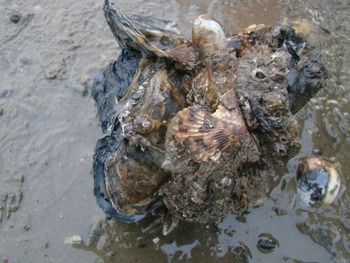
Vellar estuary, south-east coast of India (latitude 11°29′N and longitude 79°46′E) April 2011, 7 individuals 31–44 mm in length, 2 m depth, silt-clayey bottom, found associated with edible oysters, Crassostrea madrasensis (Figure 1).
Volachlamys tranquebaria associated with oyster bed.

DESCRIPTION
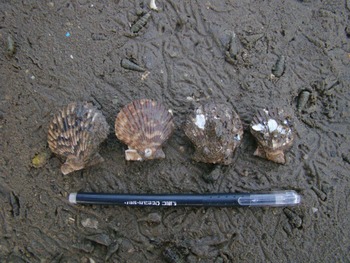
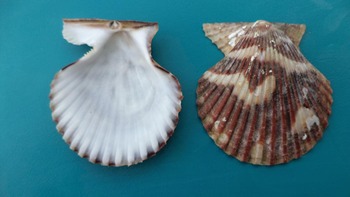
The shell is highly variable in colour pattern, but usually white, well defined broad shell, carrying reddish brown or chestnut transverse bands, typically in the form of broadly expanded V-shaped marking pointing towards the umbo, but frequently these bands lose their distinctness and become more irregular in shape tending to cohere with each other. The radial ribs on the surface are strongly developed. The upper surfaces of these ribs are smooth, but their sides are finely serrated (Figures 2 & 3). The ribs are round and sharp at ventral side with small inter space between them. Sculpture of 19 to 23 rounded ribs with similarly sized grooves is present on both surfaces of this bivalve species.
Volachlamys tranquebaria.

View of Volachlamys tranquebaria.

DISCUSSION
The occurrence of a marine species, Tranquebar scallop, Volachlamys tranquebaria along with edible oyster bed of Crassostrea madrasensis in an estuarine environment is new to the fauna of the Vellar estuary. The fauna of the broad zone of brackish water in an estuary is composed primarily of marine origin species (Percival & Whitehead, Reference Percival and Whitehead1929); it is also reported in India by Jayabal & Kalyani (Reference Jayabal and Kalyani1989) and Nagabhushanam & Krishnan (Reference Nagabhushanam and Krishnan1993). There are several studies on mollusan diversity of the Vellar estuary (Chandran, Reference Chandran1987; Arularasan & Kasinathan, Reference Arularasan and Kasinathan2007; Kesavan et al., Reference Kesavan, Palpandi and Shanmugam2009). However, Perna viridis, Modiolus metcalfei and Balanus spp. are found common in all estuaries. The occurrence of V. tranquebaria in association with edible oyster (Crassostrea madrasensis) reef community is new to this estuarine ecosystem, especially the Vellar estuary; whereas, V. tranquebaria were recorded previously in marine water of the Gulf of Mannar and Bay of Bengal. Probably, this association is more opportunistic to colonize a new habitat and explains the adaptability of this new species. The availability of a suitable substratum is one of the critical factors for the colonization of sessile species (Schejter & Bremec, Reference Schejter and Bremec2007). Moreover intertidal oyster reefs provide habitat for several invertebrate and fish species (Zimmerman et al., Reference Zimmerman, Minello, Baumer and Castiglione1989; Plunket et al., Reference Plunket, Megan and Peyre2005).
Salinity value of 31 psu recorded at the collection site of V. tranquebaria indicates a probable shift in salinity regime of the Vellar estuary due to recent widening of its mouth. We predict this as a positive reason for the occurrence of V. tranquebaria in the Vellar estuary. However, a shift in the species composition of benthic fauna of the Vellar estuary remains unclear and this needs further research for future management.
ACKNOWLEDGEMENT
The authors are grateful to the Director and Dean, Center of Advanced Study in Marine Biology, Faculty of Marine Sciences, Annamalai University, Parangipettai, Tamil Nadu, India for facilities provided.