Introduction
The limited efficacy of currently available medications for dementia (Qaseem et al., Reference Qaseem2008) and the absence of pharmacological therapies for mild cognitive impairment (MCI) (Raschetti et al., Reference Raschetti, Albanese, Vanacore and Maggini2007) have heightened interest in non-pharmacological treatments which help older individuals cope with the functional and emotional consequences of intellectual decline. Within the variety of interventions that have been developed (Livingston et al., Reference Livingston, Johnson, Katona, Paton and Lyketsos2005; Forbes et al., Reference Forbes, Forbes, Morgan, Markle-Reid, Wood and Culum2008; Blankevoort et al., Reference Blankevoort, van Heuvelen, Boersma, Luning, Jong and Scherder2010; Olazarán et al., Reference Olazarán2010) cognition-focused approaches aim at restoring memory and other cognitive abilities or at compensating impairments in order to preserve functioning in the everyday context. In cognitively intact older adults such treatments can provide modest benefits in terms of trained skills which may last for several years (Wolinsky et al., Reference Wolinsky2010) but are inconsistently associated with an enhanced capability of performing day-to-day activities (Acevedo and Loewenstein, Reference Acevedo and Loewenstein2007). In older adults with MCI or dementia, cognition-focused interventions can also be associated with statistically significant improvement in trained skills. According to several systematic reviews and meta-analyses, however, these gains usually do not generalize to untrained tasks and have only a questionable impact on real life (Grandmaison and Simard, Reference Grandmaison and Simard2003; Sitzer et al., Reference Sitzer, Twamley and Jeste2006; Institut für Qualität und Wirtschaftlichkeit im Gesundheitswesen, 2009; Buschert et al., Reference Buschert, Bokde and Hampel2010; Jean et al., Reference Jean, Bergeron, Thivierge and Simard2010a; Olazarán et al., Reference Olazarán2010). In the present review we seek to determine whether the effects of cognition-focused interventions are clinically significant. Specifically, we address the questions whether these treatments fulfill criteria for clinical importance as applied to drug trials, whether one type of cognition-focused intervention is more efficacious than another, whether there is evidence for long-term effects, and whether cognition-focused treatments have a potential for augmenting pharmacological treatments,
Methods
Candidate studies were identified in two steps. First, information was collected from recent existing reviews and meta-analyses (Grandmaison and Simard, Reference Grandmaison and Simard2003; Sitzer et al., Reference Sitzer, Twamley and Jeste2006; Institut für Qualität und Wirtschaftlichkeit im Gesundheitswesen, 2009; Buschert et al., Reference Buschert, Bokde and Hampel2010; Jean et al., Reference Jean, Bergeron, Thivierge and Simard2010a; Olazarán et al., Reference Olazarán2010). Second, a search of electronic databases (Medline, Science Citation Index Expanded) was conducted using the following search terms: randomized, controlled, dementia, Alzheimer, mild cognitive impairment, cognitive, memory, stimulation, training, rehabilitation, reality orientation. The deadline for study inclusion was December 2010. Study selection and appraisal of trials were performed independently by two authors (AFK and NTL); disagreement was resolved by consensus. Information was extracted using a standardized checklist.
To be included in the present review studies had to meet the following requirements: randomized controlled design; publication in a peer-reviewed journal; diagnosis of dementia or MCI (excluding vascular or frontotemporal dementia); intervention focusing on cognition (excluding validation, social contact, multisensory stimulation, occupational therapy and physical exercise); intervention dedicated primarily to patients (excluding programs targeting caregivers or mental health professionals); information provided on at least one of the following outcomes: cognition, activities of daily living (ADL), behavioral disturbance, global rating, rate of progression, quality of life, individual goal attainment, participant satisfaction, nursing home admission or carer burden; use of validated instruments for the assessment of outcomes; appropriate statistical analysis including within-group or between-group comparisons.
The diagnostic category of MCI was used in accordance with the consensus definition which includes amnestic and non-amnestic subtypes (Winblad et al., Reference Winblad2004). For classifying interventions we adopted the typology of a recently updated Cochrane review (Clare et al., Reference Clare, Woods, Moniz-Cook, Orrell and Spector2008). It distinguishes cognitive stimulation (CS), cognitive training (CT) and cognitive rehabilitation (CR). CS is characterized as activities aimed at general enhancement of cognitive and social functions. CT features guided practice on specific tasks, e.g. memory, attention, problem solving or ADL with the aim of maintaining or improving these specific abilities and possibly achieving generalization to untrained tasks. CR is defined as an individualized approach which focuses on the development of strategies with the aim of improving functioning in the everyday context (Wilson, Reference Wilson2002). Since many CR interventions include CT elements we combined these intervention types into one category. Control conditions were categorized into active modalities (including conversation, social support, education, occupational therapy, physiotherapy or relaxation techniques), passive modalities (including usual care, no treatment or wait list) and antidementia medication only. Control conditions were considered as matched with the intervention if treatment duration and therapist contact were similar.
To determine the clinical significance of treatment effects we applied criteria that have been proposed for clinical drug trials (Chin, Reference Chin2008; Qaseem et al., Reference Qaseem2008; Molnar et al., Reference Molnar, Man Son Hing and Fergusson2009). We assigned first-order evidence of clinical significance to treatment regimens which provided one of the following benefits as compared with the control condition at post-intervention assessment: delay of symptom progression as defined by improvement of cognitive ability of ≥2 units on the Mini-Mental State Examination (MMSE) or ≥4 units on the Alzheimer's Disease Assessment Scale, cognitive part (ADAS-Cog): statistically significant improvement on ADL or on attainment of personally relevant goals. Second-order evidence of clinical significance was attributed to interventions which were associated with statistically significant gains relative to the control condition at post-treatment assessment on behavioral and psychological symptoms of dementia (BPSD), mood, quality of life or carer burden. As an additional criterion of clinical significance we calculated standardized mean treatment differences (SMD) for studies that provided sufficient data on commonly used cognitive outcome measures such as the MMSE (increase in score indicating improvement) or the ADAS-Cog (decrease of score indicating improvement) at endpoint. In studies using multiple control conditions, the comparison between the intervention and the active control condition was considered to be relevant. SMDs were calculated as Hedges’ g and presented together with 95% confidence intervals (CI). Missing standard deviations at endpoint were replaced by the standard deviations at baseline. The SMDs of the individual studies were pooled using a random effects model (DerSimonian and Laird, Reference DerSimonian and Laird1986). Between-study heterogeneity was assessed using the I2 statistics; I2 values higher than 50% were interpreted as considerable heterogeneity. Funnel plots and Egger's tests were used to explore the possibility of publication bias. Since this test is based on symmetry it was only applied if at least ten trials were available. All meta-analytic calculations were conducted using Comprehensive Meta Analysis Version 2 (Borenstein et al., Reference Borenstein, Hedges, Higgins and Rothstein2006).
Results
Description of eligible studies
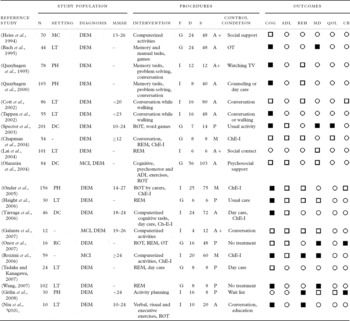
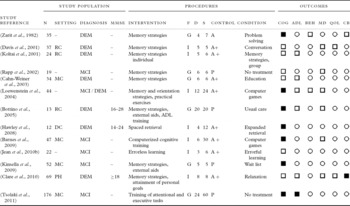
A total of 108 studies were screened for eligibility: 61 were retrieved from previous reviews and meta-analyses, and 47 were identified by searching electronic databases. From this total, 75 studies were excluded for the following reasons: no randomization (N = 55), no diagnosis of dementia or mild cognitive impairment (N = 10), no cognition-focused intervention (N = 6), no relevant outcomes (N = 3), duplicate publication (N = 1). Of the remaining 33 studies, 20 refer to CS (Heiss et al., Reference Heiss, Kessler, Mielke, Szelies and Herholz1994; Bach et al., Reference Bach, Bach, Böhmer, Frühwald and Grilc1995; Quayhagen et al., Reference Quayhagen, Quayhagen, Corbeil, Roth and Rodgers1995; Reference Quayhagen2000; Cott et al., Reference Cott, Dawson, Sidani and Wells2002; Tappen et al., Reference Tappen, Willians, Barry and DiSesa2002; Spector et al., Reference Spector2003; Chapman et al., Reference Chapman, Weiner, Rackley, Hynan and Zientz2004; Lai et al., Reference Lai, Chi and Kayser-Jones2004; Olazarán et al., Reference Olazarán2004; Onder et al., Reference Onder2005; Haight et al., Reference Haight, Gibson and Michel2006; Rozzini et al., Reference Rozzini, Costardi, Vicini-Chilovi, Franzoni, Trabucchi and Padovani2006; Tárraga et al., Reference Tárraga2006; Galante et al., Reference Galante, Venturini and Fiaccadori2007; Onor et al., Reference Onor, Trevisiol, Negro, Signorini, Saina and Aguglia2007; Tadaka and Kanagawa, Reference Tadaka and Kanagawa2007; Wang, Reference Wang2007; Gitlin et al., Reference Gitlin, Winter, Burke, Chernett, Dennis and Hauck2008; Niu et al., Reference Niu, Tan, Guan, Zhang and Wang2010) and 13 involve CT or CR (Zarit et al., Reference Zarit, Zarit and Reever1982; Davis et al., Reference Davis, Massman and Doody2001; Koltai et al., Reference Koltai, Welsh-Bohmer and Schmechel2001; Rapp et al., Reference Rapp, Brenes and Marsh2002; Cahn-Weiner et al., Reference Cahn-Weiner, Malloy, Rebok and Ott2003; Loewenstein et al., Reference Loewenstein, Acevedo, Czaja and Duara2004; Bottino et al., Reference Bottino2005; Clare and Jones, Reference Clare and Jones2008; Hawley et al., Reference Hawley, Charry, Boudreaux and Jackson2008; Barnes et al., Reference Barnes2009; Kinsella et al., Reference Kinsella2009; Jean et al., Reference Jean2010b; Tsolaki et al., Reference Tsolaki2011). Key features of the trials are summarized in Tables 1 and 2. Interventions of the CS type were typically evaluated in long-term or day-care settings and rarely in memory clinics or research centers, involved subjects with dementia, had an average sample size of 70 participants (range 12–201), a mean duration of 15 weeks (range 4–56) and a medial number of 36 sessions (range 6–103). Interventions in individual and group format were almost equally frequent. In contrast, treatments of CT or CR modality were usually tested in memory clinics or research centers, often involved individuals with mild cognitive impairment, had a smaller sample size (mean 45 participants, range 13–76), a shorter duration (mean 8 weeks, range 3–24) and included fewer sessions (mean 15, range 5–60). The frequency of group and individual treatment formats was balanced. Interventions of the CS type emphasized various combinations of computer-based cognitive activities, reality orientation training, reminiscence, or memory and conversational exercises, whereas CT- and CR-type treatments focused on the acquisition of memory strategies and on the use of external memory aids. Most studies employed an active control condition which was matched to the intervention in terms of duration and contact frequency in 12 trials. The most frequently investigated outcomes were cognition (31 studies), mood (16 studies), ADL (15 studies) as well as behavioral and psychological symptoms (BPSD, 12 studies). Global rating, quality of life, attainment of individual goals and carer burden or distress were rarely assessed. Symptom progression, time to important clinical endpoints, participant satisfaction or rate of nursing home admissions were not investigated at all. In seven studies, long-term effects of the intervention were examined.
Summary of studies evaluating cognitive stimulation

Study population: DC = day care center; DEM = dementia; LT = long-term care facility; MC = memory clinic; MCI = mild cognitive impairment; PH = private home; RC = research center
Procedures: A = active non-pharmacological control condition; A+ = active non-pharmacological control condition matched to intervention; ChE-I = cholinesterase inhibitor treatment; D = duration [weeks]; F = format; I = individual; G = group; M = medication; OT = occupational therapy; P = passive control condition; REM = reminiscence; ROT = reality orientation training; S = sessions
Outcomes: ADL = activities of daily living; BEH = behavioral disturbance; CB = carer burden; COG = cognition; MD = mood; QoL = quality of life
Symbols: □ tested; not significant; ■ tested; significant; ○ not tested
Summary of studies evaluating cognitive training and rehabilitation

Study population: DC = day care center; DEM = dementia; LT = long-term care facility; MC = memory clinic; MCI mild cognitive impairment; PH private home; RC = research center
Procedures: A = active non-pharmacological control condition; A+ = active non-pharmacological control condition matched to intervention; ChE-I = cholinesterase inhibitor treatment; D = duration [weeks]; F = format; I = individual; G = group; M = medication; OT = occupational therapy; P = passive control condition; REM = reminiscence; ROT = reality orientation training; S = sessions
Outcomes: ADL = activities of daily living; BEH = behavioral disturbance; CB = carer burden; COG = cognition; MD = mood; QoL = quality of life
Symbols: □ tested; not significant; ■ tested; significant; ○ not tested
Efficacy of interventions
Cognitive stimulation
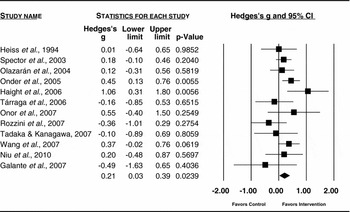
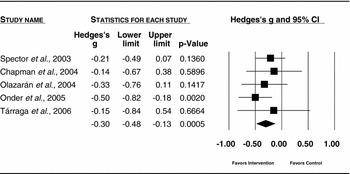
Significant improvements in cognitive ability relative to the control condition on any measure were observed in 11 out of 18 studies evaluating cognitive outomes (Bach et al., Reference Bach, Bach, Böhmer, Frühwald and Grilc1995; Quayhagen et al., Reference Quayhagen, Quayhagen, Corbeil, Roth and Rodgers1995; Reference Quayhagen2000; Tappen et al., Reference Tappen, Roach, Brooks-Applegate and Stowell2000; Spector et al., Reference Spector2003; Onder et al., Reference Onder2005; Haight et al., Reference Haight, Gibson and Michel2006; Rozzini et al., Reference Rozzini, Costardi, Vicini-Chilovi, Franzoni, Trabucchi and Padovani2006; Tárraga et al., Reference Tárraga2006; Wang, Reference Wang2007; Niu et al., Reference Niu, Tan, Guan, Zhang and Wang2010). In the 12 trials which used the MMSE as a cognitive outcome, the overall SMD was 0.21 (95% CI 0.03–0.39: p = 0.024; Figure 1). There was some heterogenity among studies (I2 42%, heterogeneity test p value = 0.06) but no evidence of a relevant publication bias (Egger's test p = 0.92). In five studies the ADAS-Cog was used as a cognitive endpoint. The overall SMD was –0.30 (95% CI –0.48–0.13; p < 0.001; Figure 2) indicating a consistent positive effect on this measure. The impact of CS on ADL was evaluated in nine trials but no statistically significant treatment differences were found. Effects of CS on BPSD, mood, patient quality of life and carer burden were identified in a minority of studies that considered the respective outcome. Since many interventions represented combinations of several strategies it was not possible to determine whether one variety of cognitive stimulation was more efficacious than another.
Effect sizes (SMD) in trials on cognitive stimulation using the MMSE as a cognitive outcome

Effect sizes (SMD) in trials on cognitive stimulation using the ADAS-Cog as a cognitive outcome

Cognitive training and rehabilitation
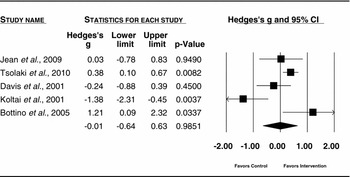
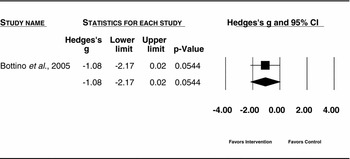
Cognitive ability was used as an outcome in all 13 trials, and significant improvements relative to the control condition on any measure were observed in seven studies (Zarit et al., Reference Zarit, Zarit and Reever1982; Loewenstein et al., Reference Loewenstein, Acevedo, Czaja and Duara2004; Bottino et al., Reference Bottino2005; Hawley et al., Reference Hawley, Charry, Boudreaux and Jackson2008; Barnes et al., Reference Barnes2009; Kinsella et al., Reference Kinsella2009; Tsolaki et al., Reference Tsolaki2011). In five trials using the MMSE as a cognitive outcome measure, the overall SMD was -0.01 (95% CI -0.64–0.63; p = 0.99; Figure 3), indicating no difference between treatment groups. Data from individual studies were highly heterogeneous (I2 = 78%). Exclusion of two outlier studies (Koltai et al., Reference Koltai, Welsh-Bohmer and Schmechel2001; Bottino et al., Reference Bottino2005) did not change the overall result. Only one study employed the ADAS-Cog as a cognitive outcome. The SMD was –1.08 (95% CI –2.17–0.02, p = 0.054) indicating a marginally significant treatment-related difference (Figure 4). Significant effects of the intervention on ADL, on the achievement of personally relevant goals or caregiver burden were only found in single trials. No impact on BPSD, mood or patient quality of life was demonstrable in any study. There was no clear association between diagnostic category (MCI or dementia) and study outcome.
Effect sizes (SMD) in trials on cognitive training or rehabilitation using the MMSE as a cognitive outcome

Effect size (SMD) in one trial on cognitive training or rehabilitation using the ADAS-Cog as a cognitive outcome

Clinical significance of treatment effects
Cognitive stimulation
First-order evidence of clinical significance was found in one trial (Haight et al., Reference Haight, Gibson and Michel2006) which evaluated a six-week life review intervention in group format on 30 patients with mild to moderate dementia in assisted living facilities. In that study the treatment difference on the MMSE was unusually large (7.34 units) and there was an additional significant advantage favoring treatment on the Columbia Scale for Depression in Dementia. Second-order evidence of clinical significance was identified in seven out of 20 studies (Bach et al., Reference Bach, Bach, Böhmer, Frühwald and Grilc1995; Spector et al., Reference Spector2003; Rozzini et al., Reference Rozzini, Costardi, Vicini-Chilovi, Franzoni, Trabucchi and Padovani2006; Onor et al., Reference Onor, Trevisiol, Negro, Signorini, Saina and Aguglia2007; Gitlin et al., Reference Gitlin, Winter, Burke, Chernett, Dennis and Hauck2008; Wang et al., Reference Wang, Yen and OuYang2008; Niu et al., Reference Niu, Tan, Guan, Zhang and Wang2010). The most frequently reported benefits of potential clinical importance were related to mood and BPSD.
Cognitive training and rehabilitation
First-order evidence of clinical significance was identified in two studies. One trial evaluated a multicomponent group program in 176 memory clinic attenders with mild cognitive impairment in comparison to a wait-list control condition over 24 weeks (Tsolaki et al., Reference Tsolaki2011). The intervention was associated with a significant treatment difference on a scale assessing basic ADL. The second study was an eight-week trial of individual goal attainment combined with memory strategies and stress management in 69 patients with mild dementia in AD. The intervention was compared with active (relaxation) and passive (no treatment) control conditions. Despite brief duration the treatment was associated with statistically significant improvements of individual goal performance and satisfaction relative to both control modalities (Clare et al., Reference Clare2010). There were also significant treatment differences regarding mood and carer quality of life.
Duration of effects
Long-term effects – defined as significant treatment differences being present six or more months after completion of the intervention – were observed in three out of seven trials. Persistence of effects beyond the immediate treatment period were demonstrated in cognitive ability and BPSD (Rozzini et al., Reference Rozzini, Costardi, Vicini-Chilovi, Franzoni, Trabucchi and Padovani2006), in memory performance (Clare and Jones, Reference Clare and Jones2008) and in global rating (Chapman et al., Reference Chapman, Weiner, Rackley, Hynan and Zientz2004)
Augmentation of pharmacological treatment
Four trials compared combination therapies with pharmacological monotherapy as a control condition. In subjects with MCI the combination of an individual 20-week computerized CS intervention in individual format and cholinesterase inhibitor (ChE-I) medication was superior to ChE-I treatment alone on two out of six neuropsychological tests, on depressive symptoms and on BPSD (Rozzini et al., Reference Rozzini, Costardi, Vicini-Chilovi, Franzoni, Trabucchi and Padovani2006). In patients with dementia, a CS intervention in group format focusing on communication supplemented with ChE-I treatment had no significant advantage over medication alone, but this trial included only eight weekly treatment sessions (Chapman et al., Reference Chapman, Weiner, Rackley, Hynan and Zientz2004). An individual 24-week computerized CS program in combination with ChE-I provided a significant additional benefit on the MMSE (1.34 units) over medication alone (Tárraga et al., Reference Tárraga2006). A five-month CR treatment in group format combined with ChE-I was associated with a significant improvement on the MMSE (2.26 units) and on a working memory test relative to ChE-I monotherapy (Bottino et al., Reference Bottino2005).
Discussion
Interventions of the CS type, which aim at general enhancement of cognitive function, appear to have a potential for providing a wide range of cognitive benefits as is evident from overall improvements on measures that are used to quantify the severity of intellectual impairment such as the MMSE or ADAS-Cog. The size of these effects in terms of standardized mean treatment difference is small. By comparison, however, the effects of cholinesterase inhibitors, which represent the current standard of antidementia drug treatment, are not larger at doses lower than the maximum dose (Rockwood, Reference Rockwood2004). This is particularly remarkable since the average duration of CS interventions was only 15 weeks, suggesting that the observed treatment difference was probably not due to deterioration in the control group but was driven by improvement in actively treated patients. Interventions of the CT/CR type, on the other hand, which attempt to train specific cognitive abilities or to impart compensatory strategies, are inconsistently associated with improvements on tests tapping trained skills. These treatment modalities do not appear to have an overall effect on measures of general cognitive ability. This suggests that gains on specific abilities usually do not generalize to other functions and that the acquisition of neurorehabilitation techniques per se may not improve cognition overall. The observation that the cognitive effects of the different types of intervention are not identical supports the view that they should be regarded as distinct though overlapping treatment modalities.
The major issue we addressed in the present work is whether the effects of cognition-focused interventions are clinically meaningful. Robust evidence of clinical significance was defined as delay of symptom progression and statistically significant treatment differences on ADL performance or attainment of individual goals. Effects of this magnitude were demonstrated in one out of 20 trials evaluating interventions of the CS type (Haight et al., Reference Haight, Gibson and Michel2006) and in two of ten trials examining treatments of the CT/CR modality (Clare et al., Reference Clare2010; Tsolaki et al., Reference Tsolaki2011). Weaker evidence of clinical significance was attributed to significant improvements relative to the control condition at post-intervention assessment on BPSD, mood, patient quality of life or carer burden. Such benefits were observed in a minority of trials evaluating interventions of the CS type but were not found at all in studies examining treatments of the CT/CR modality.
Taken together, these findings suggest that, with very few exceptions, cognition-focused interventions have little demonstrable impact on the patients’ ability to manage real-life challenges. As possible explanations, the nature of treatments and the design of trials may be taken into consideration. Repeated exercise of selected cognitive skills as typically practiced in CS is remote from the complex difficulties that patients encounter in everyday living and may therefore not translate into improved coping with these problems. The application of newly learned memory of problem-solving techniques as offered by CT and CR requires awareness of cognitive impairment and preservation of executive functioning including problem identification, planning, and self-control (Troyer et al., Reference Troyer, Murphy, Anderson, Moscovitch and Craik2008). These abilities are particularly needed for performing complex activities of daily living, and have been shown to be impaired in patients with cognitive decline (Royall et al., Reference Royall, Lauterbach, Kaufer, Malloy, Coburn and Black2007). The potential of interventions of the CT/CR type may also have been obscured by the short duration of many trials. In older adults with cognitive impairment an average of 15 treatment sessions over a period of only eight weeks may be inappropriate to enable learning and implementation of compensatory strategies. Furthermore, the instruments used for assessing benefits in everyday life may have lacked sensitivity or may not have been optimally targeted to the areas of behavior showing change. Importantly, instruments assessing person-centered outcomes such as autonomy, mastery, and participation have not been used. Persistence of treatment effects beyond the immediate intervention period was demonstrated in few trials. There is some evidence that combinations of a cognition-focused intervention with pharmacological treatments are associated with significant cognitive benefits relative to drug therapy alone.
A striking feature of the 33 randomized controlled trials reviewed is heterogeneity of methods regarding sample size, duration of intervention, number of individual treatment sessions, intervention content, control condition, outcome domains and assessment instruments. This inconsistency does not allow firm conclusions as to whether one type or package of cognitive intervention or one format of treatment delivery is more efficacious than another. As other reviewers have pointed out, improvement and harmonization of methodology in this field of research is mandatory (Jean et al., Reference Jean, Bergeron, Thivierge and Simard2010a; Olazarán et al., Reference Olazarán2010).
In conclusion, we found little evidence that cognition-focused non-pharmacological interventions provide clinically meaningful benefits. Although the effects of these treatments on cognition do not appear to be worse than those of current antidementia drugs, patient-relevant outcomes have been rarely demonstrated. Further studies are needed on sufficiently large patient populations using rigorous and consistent methods regarding patient selection, randomization procedures, blinding of assessors, duration of treatment and selection of outcome domains as well as assessment instruments. To improve efficacy it may be useful to tailor interventions to individual needs and resources while maintaining a high level of standardization (De Vreese et al., Reference De Vreese, Neri, Floravanti, Belloi and Zanetti2001; Werheid and Thöne-Otto, Reference Werheid and Thöne-Otto2006) to enhance the transfer of newly acquired strategies into everyday life, to include person-centered outcomes, to determine long-term effects and to observe health-economic implications.
Conflict of interest
Nicola T. Lautenschlager is Editor-in-Chief of International Psychogeriatrics. This paper therefore underwent independent review under the supervision of the Deputy-Editor.
Description of authors’ roles
A. Kurz and N. Lautenschlager developed the concept of the review, S. Leucht performed the meta-analytic calculations and prepared the figures. A. Kurz drafted the paper and N. Lautenschlager and S. Leucht undertook the revisions.