Implications
Polyethylene glycol (PEG) determined with NIRS has been successfully tested as an external marker for total indoor faecal output estimation. The present work aimed to determine whether or not PEG could be a valuable faecal marker for sheep grazing rangeland pasture. The study showed that PEG has no effect on dry matter intake (DMI) and digestibility. Easy to prepare and administer and quickly determined with NIRS, PEG can be used at pasture to assess the DMI of a group of animals at the same physiological stage.
Introduction
In order to assess ruminant intake at pasture through faecal measurements, it is necessary to know the diet digestibility (usually estimated from laboratory analysis) and total faecal output (FO). The latter can be directly measured with faecal bags but it is time consuming and may alter animal behaviour (Corbett, Reference Corbett1978; Doyle et al., Reference Doyle, Casson, Cranberg and Rowe1994). Total faeces output can be assessed with external markers like n-alkanes (Dove and Mayes, Reference Dove and Mayes1991), chromium oxide (Doyle et al., Reference Doyle, Casson, Cranberg and Rowe1994), rare earth (Curtis et al., Reference Curtis, Holst and Murray1994) and more recently polyethylene glycol (PEG) measured with NIRS (Landau et al., Reference Landau, Friedman, Devash and Mabjeesh2002; Hassoun et al., Reference Hassoun, Viudes, Autran, Bastianelli and Bocquier2013). PEG has several advantages because it is easy to prepare, the analytical procedure is safe and PEG is quickly measured with NIRS (Landau et al., Reference Landau, Friedman, Devash and Mabjeesh2002; Hassoun et al., Reference Hassoun, Viudes, Autran, Bastianelli and Bocquier2013).
Until now, PEG has generally been evaluated indoors with dry forages offered to sheep (Hassoun et al., Reference Hassoun, Viudes, Autran, Bastianelli and Bocquier2013), goat (Landau et al., Reference Landau, Friedman, Devash and Mabjeesh2002) and cattle (Benvenutti et al., Reference Benvenutti, Coates, Bindelle, Poppi and Gordon2014; Casasus and Albanell, Reference Casasus and Albanell2014). Few experiments have been conducted indoors with fresh forage (Andueza et al., Reference Andueza, Picard, Aufrère, Jamot, Béchet and Baumont2013; Hassoun et al., Reference Hassoun, Viudes, Autran, Bastianelli and Bocquier2013 and Reference Hassoun and Bocquier2014) or at pasture (Caja et al., Reference Caja, Ralha and Albanell2009; Hassoun et al., Reference Hassoun and Bocquier2014).
The present experiment aimed to measure the usefulness of PEG as external faecal marker to assess dry matter intake (DMI) of sheep grazing rangeland pasture.
Material and methods
The experiment was carried out within the framework of the Regional Ethical Committee on Animal experimentation of the Languedoc-Roussillon (France) – Agreement No. 752056/00. The experiment was conducted from May to June 2007, at the INRA experimental farm (latitude: 43.55°N; longitude: 3.05°E; 800 m above sea level). A flock of Romane ewes (200) and ewe lambs (140) has been reared outdoors all year round for several years on ~280 ha of the so-called ‘Causse’ rangeland with a limited input (hay, silage and concentrate) mainly during winter. In this system, 6% of the total surface is moderately fertilised in order to increase the available biomass compared with unfertilised pasture (4.4 v. 1.0 tonne DM/ha, respectively) and to obtain earlier grass onset (April) and good quality forage for suckling ewes lambing in early April (Molénat et al., Reference Molénat, Foulquié, Autran, Bouix, Hubert, Jacquin, Bocquier and Bibé2005). Fertilised and unfertilised pasture are characterised by different dominant species (Chollet et al., Reference Chollet, Rambal, Fayolle, Hubert, Foulquié and Garnier2014). In fertilised pasture, Vulpia myuros (25%) and Bromus hordeaceus (19%) are the two main species, whereas in unfertilised pasture Bromus erectus (17%), Carex humilis (15%), Festuca christiani-bernardii (11%) and Stipa pennata (10%) predominate.
All animals used in the experiment were obtained from the permanent grazing flock of the experimental farm.
Experimental design
The objective was to assess DMI of suckling ewes and ewe lambs grazing successively, fertilised and unfertilised rangeland through total FO measured with faecal bags or indirectly assessed with PEG, in vivo dry matter digestibility (DMD) and PEG recovery rate determined indoors and at pasture.
All animals were previously orally drenched to eliminate internal parasites with 15-20 ml of Disthelm® 2.5% (Qalian, Segre, France). PEG (molecular weight 6000 Da; Panreac Qimica SA, Barcelona, Spain) was used in solution form with a concentration of 333.33 g/l, prepared several days earlier with double distilled water. All faeces samples were dried at 50°C because the melting point of PEG ranges between 55°C and 61°C (Official Journal of the European Union, 2003). The administrated PEG dose was 10 g/day in order to mitigate the potential effect of PEG on faeces dry matter (DM) content observed in previous experiments (Hassoun et al., Reference Hassoun, Viudes, Autran, Bastianelli and Bocquier2013 and Reference Hassoun and Bocquier2014). The experiment included two trials conducted simultaneously (Figure 1).
Schematic representation of the 6-week experimental design. Trial 1: 2×3 dry ewes fed indoor with fertilised and unfertilised forage; trial 2: 15 ewe lambs and 14 suckling ewes grazing fertilised and unfertilised rangeland pasture. PEG=polyethylene glycol.

Trial 1 was conducted indoors and was designed to measure in vivo DMD of fertilised and unfertilised rangeland forage and PEG recovery rate related to these two forages. The results of trial 1 were used in trial 2 conducted at pasture to assess DMI of suckling ewes and ewe lambs grazing successively fertilised and unfertilised rangeland. Two groups of three adult dry and non-pregnant ewes (61±3 kg) were balanced for BW and placed in an individual metabolism cage with free access to water and a mineral block. One group (PEG+) received 30 ml of PEG solution daily, once in the morning (0800 h), the other group (PEG−) did not receive PEG. Forage was cut daily at about 5 to 6 cm above the ground from the rangeland every afternoon with a weed mowers-brush cutter (Honda® Um2460; Honda Motor, Tokyo, Japan). Forage was offered in two equal meals at 1600 and 0900 h (next day). The animals had free access to forage, allowing for an average of 30% refusals on a DM basis. The experiment consisted of an 11-day adaptation period with fertilised pasture, followed by an experimental period of 6 weeks (4 weeks with fertilised pasture followed by 2 weeks with unfertilised pasture). During the 1st week of the experimental period, the ewes of PEG+ group did not receive PEG for DMI and in vivo DMD measurement as a control. The 2nd week, the PEG+ group received PEG until the end of the experimental period with plastic syringes weighed to the nearest 0.1 g before and after administration in order to precisely determine the quantity of PEG administered. Total faeces and grab faeces were sampled in the morning (about 0830 h) for 5 days on the 4th and the 6th week to measure the PEG recovery rate on fertilised and unfertilised forage, respectively.
Trial 2: adult-suckling ewes and ewe lambs were used in order to obtain two different level of intake based on the recommendations of Hassoun and Bocquier (Reference Hassoun, Bastianelli, Autran and Bocquier2010).
In total, 14 adult-suckling ewes with their lambs (66±7 kg; average lambing date: 23 April 2007; 15±4 days in milk, half of them suckling one lamb and half twins) and 15 non-pregnant ewe lambs (1-year old, 42±2 kg) were selected from the farm flock.
Just after lambing was completed, the animals were allowed to graze one fertilised paddock divided with electric fences into six small paddocks of ~0.5 ha each. They were then moved to the unfertilised paddocks until weaning of their lambs. The day before the animals entered a new paddock, 4 m2 quadrats were cut at ~1 cm above the ground level (in order to not collect soil) to estimate the herbage allowance and its chemical composition. The herbage cut was dried (48 h at 60°C) and stored pending analysis. Among the adult ewes and ewe lambs, seven adults and eight ewe lambs did not receive PEG, and seven adults and seven ewe lambs received a daily dose of 10 g of PEG administered with a 30-ml drenching gun (previously controlled in order to determine the actual volume provided) once in the morning (0830 to 0900 h). Animals were administered with PEG from 7 days before (Hassoun et al., Reference Hassoun, Viudes, Autran, Bastianelli and Bocquier2013) the first faeces collection started until the end of the experiment.
In order to collect total faeces at pasture, all animals (adults and ewe lambs) were equipped with a bag made from tubular Jersey cloth (diameter of 20.3 cm, 3M® Stockinet MS08, 3M, St-Paul, Minnesota, USA). Several days before the measurement, animals had their backs shorn, leaving about 0.5 cm of wool. Velcro® (Velcro Industries B.V., Amsterdam, The Netherlands) strips were then fixed to their backs with special latex glue (Texticroche, Sader®, Bostik S.A., La Plaine Saint-Denis, France), safe for animal skin. The opposite part of the Velcro® strips was glued into the jersey tube. Finally, the tube was attached to the animal with Velcro® strips. The opposite open part was closed during the measurement periods with a carefully tightened wire. The bag could be easily removed by separating the two Velcro® strips. Urine could not be separated but was easily eliminated from the permeable bag and faeces were further carefully mixed before sampling. The bags were tightly attached to the 29 animals for the first few days before the first measurements, but not closed so that the animals get used to them. During this period, rapid observations were made on suckling ewes in order to make sure that lambs could easily suckle their dam. The animals were led to pasture the first 3 weeks, with unclosed bags. Then, the bags were closed for faeces collection for 4 days during the measurement on fertilised pasture and, 2 weeks later, on unfertilised pasture. The bags were emptied twice a day at approximately 0830 and 1600 h. When bags were found to be totally or partly detached so that faeces may have been lost, faeces were discarded and results ignored. Collected faeces were placed in plastic bags, weighed and sampled (about 400 g fresh matter). Faeces samples were dried (for at least 48 h at 50°C) to measure DM content that gives total DM FO. At the same time, faeces samples were collected at the rectal level (grab samples) and placed in a small plastic cup, closed and stored in a cool box provided with freeze packs for less than 90 min until drying. All grab samples were dried for 48 h at 50°C and stored pending analyses. In addition, ewe lambs, adults and lambs were weighed before the experiment, 1 month later and at the end of the experiment (at weaning). All operations (PEG administration, faecal collection and weighing) were done in the paddock where the animals grazed. No rain occurred during the experimental periods, reducing the risk of PEG loss.
Dry matter intake, digestibility and analytical procedures
In trial 1, individual DMI and in vivo DMD were measured on 5 consecutive days. Offerings (afternoon and morning) and refusals (afternoon) were recorded and sampled every day for DM determination (48 h at 60°C). Total faeces were collected, weighed and sampled for DM determination (for at least 48 h at 50°C) in order to calculate FO and in vivo DMD, based on the individual average DMI and FO. All forages and faeces samples were ground through a 1-mm sieve before analysis. Ash content was determined by ashing in a muffle furnace for 5 h at 550°C. Total N was determined using the Kjeldahl procedure and CP calculated as total N×6.25. The NDF fraction was determined according to the method of Goering and Van Soest (Reference Goering and Van Soest1970) with an amylase and protease pre-treatment. Cell wall fraction is expressed exclusive of residual ash. The in vitro DMD was determined according to the pepsin-cellulase method (Aufrère et al., Reference Aufrère, Baumont, Delaby, Peccatte, Andrieu, Andrieu and Dulphy2007). Condensed tannins were determined using the vanillin method (Burns, Reference Burns1971).
NIRS measurement
The concentration of PEG in all faeces samples was estimated using the NIRS method as previously described by Hassoun et al. (Reference Hassoun, Viudes, Autran, Bastianelli and Bocquier2013). Briefly, a calibration database was built by adding known amounts of PEG in faeces samples collected on ewes that did not receive PEG, in order to build a PEG+ faeces database similar to collected samples.
The samples were scanned on a monochromator NIRS (NIRS 6500, Foss NIRSystems, Silver Spring, MD, USA). Measurement was done in reflectance mode and spectral data were collected every 2 nm from 400 to 2500 nm. Spectra were added to our existing database (Hassoun et al., Reference Hassoun, Bastianelli and Bonnal2007) leading to a global database of >500 samples of faeces samples collected from various origins (sheep breed and diets). The NIRS calibration was carried out using the partial least-squares regression (MPLS procedure, WinISI software, Infrasoft Int., Port Matilda, PA, USA).
The PEG recovery rate on total faeces (RECT) was calculated using the formula:
 $${\rm REC}_{{\rm T}} \,={\rm PEG}_{{\rm T}} \left( {{\rm g}/{\rm kg\,DM}} \right){\rm \times FO }\left( {{\rm kg\,DM}/{\rm day}} \right){\rm }/{\rm PEG}_{{\rm i}} \left( {{\rm g}/{\rm day}} \right)$$
where PEGT is the PEG concentration in FO, and PEGi the daily amount of PEG administered. The RECT was calculated for each ewe indoors and ewe lambs and adult ewes at pasture and averaging samples over the week for each animal.
PEG concentration in grab faeces samples (PEGg) was measured in order to calculate the bias (RgT=PEGg/PEGT) due to the difference between PEG concentration in grab samples and total collections of faeces sample.
Estimated and measured faecal output and dry matter intake on grazing sheep
FO at pasture (trial 2) was estimated with PEG determined on faecal grab samples, using the formula:
 $$\kern-90pt{\rm FO }\left( {{\rm kg\,DM}} \right)={\rm PEG}_{{\rm i}} \left( {{\rm g}\,/\,{\rm day}} \right){\rm \times REC}_{{\rm T}} \kern30pt{\rm \times }\left[ {{\rm R}_{{{\rm gT}}} \,/\,\left( {{\rm PEG}_{{\rm g}} \left( {{\rm g}\,/\,{\rm kg\,DM}} \right)\,/\,{\rm 1}000} \right){\rm }-{\rm 1}} \right]\,/\,{\rm 1}000$$
built from the two formulae:
 $$\eqalignno{{\rm PEG}_{{\rm T}} \left( {{\rm g}\,/\,{\rm kg DM}} \right) ={\rm PEG}_{{\rm i}} \left( {\rm g} \right)\,{\times}\,{\rm REC}_{{\rm T}} \,/\,[({\rm FO}\,\left( {{\rm kg\,DM}} \right) \cr\quad{\times}{\rm 1}000{\plus}\left( {{\rm PEG}_{{\rm i}} {\times}{\rm REC}_{{\rm T}} } \right))]\,/\,{\rm 1}000 \eq$$
 $${\rm R}_{{{\rm gT}}} ={\rm PEG}_{{\rm g}} \,/\,{\rm PEG}_{{\rm T}} $$
FO was calculated using both RECT and RgT measured indoors (FOin) or at pasture (FOout).
Actual FO (measured with bags) was compared with FOin and FOout.
Statistical treatment of results
The chemical composition and in vitro DMD were compared between fertilised and unfertilised pasture with the one way ANOVA with the model:
 $$Y_{i} =\mu {\plus}\alpha _{i} {\plus}{\epsilon}_{{ij}} $$
where µ is the mean of (CP, NDF or in vitro DMD), α i the main effect of forage quality (fertilised or unfertilised) and ε ij the term of error.
In trial 1, non-parametric tests were performed instead of Student’s tests because the number of animal per group was low (n=3), as recommended by Scherrer (Reference Scherrer1984). The DMI, faecal DM content and in vivo DMD measured in trial 1 were compared between PEG+ and PEG− group when fed with fertilised (control and experimental periods) and unfertilised forage (experimental period) with the non-parametric Mann–Whitney U test (Sprent, Reference Sprent1992) for two independent samples.
In trial 2, the effect of PEG administration (PEG+ or PEG−) within pasture quality (fertilised or unfertilised) and animal type (adult and ewe lamb) was analysed on total FO measured with faecal bags (FOT) and DMI calculated from FO and in vivo DMD (measured indoors, trial 1) with the model:
 $$Y_{i} \,=\,\mu \,{\plus}\,\alpha _{i} \,{\plus}\,{\epsilon}_{{ij}} $$
where µ is the mean of (FOT or DMI), α i the main effect of PEG level (PEG+ or PEG−) and ε ij the term of error.
As no significant PEG effect was observed, FOT and DMI were further compared between pasture quality within animal, using one way ANOVA.
For trial 1, the forage effect (fertilised or unfertilised) on RECT and RgT was performed with the non-parametric Wilcoxon test for paired samples. This test is appropriate because the low number of animals (three) (Scherrer, Reference Scherrer1984).
For trial 2, the comparisons between fertilised and unfertilised forage within animal type and between animal type within each pasture quality for RECT and RgT values were performed with the non-parametric Mann–Whitney U test for two independent samples, because of the low number of animals per comparison (four or five) and because the values did not follow a normal distribution (Scherrer, Reference Scherrer1984).
As RECT and RgT measured at pasture were not statistically different (P>0.05) between animal type and pasture quality, RECT and RgT values were averaged to further calculate assessed FO at pasture (FOout).
FOT was compared with FO assessed with grab sampling using RECT and RgT measured indoors (FOin) or at pasture (FOout) for ewe lambs or suckling ewes grazing fertilised or unfertilised pasture with the non-parametric Wilcoxon test for paired samples.
All statistical analyses were performed using STATISTICA v10 for Windows (Statsoft 2010, www.statsoft.fr).
Results and discussion
Chemical composition
The chemical composition (on a DM basis) of fertilised pasture was significantly different compared with unfertilised pasture. The values (mean±SEM) of CP and in vitro DMD were higher 111±9 and 83±12 g/kg (P<0.0001), 50.3±2.2% and 43.6±3.8% (P<0.0001) and lower for NDF 624±56 and 677±36 g/kg (P<0.01), respectively. The condensed tannin concentration was low for both fertilised and unfertilised forages (1.0 to 2.0 g/kg DM) when compared with the values that were shown to elicit a negative effect (i.e.>50 g/kg DM) on voluntary intake and N digestibility (Barry and McNabb, Reference Barry and McNabb1999).
Indoor intake, digestibility and faecal dry matter content
In trial 1, when ewes of the PEG+ and PEG− groups were fed with fertilised forage before PEG was administered (Table 1, control period), DMI (1.35 v. 1.25 kg/day), faecal DM content (29.6% v. 29.0%) and in vivo DMD (66.8% v. 67.7%) were not different (P>0.05).
Mean of dry matter intake (DMI), faecal dry matter (FDM) content and in vivo dry matter digestibility (DMD) of adult dry and non-pregnant ewes administered or not with polyethylene glycol (PEG) and fed with fertilised or unfertilised forage (trial 1)

PEG+=ewes administered with PEG; PEG−=ewes not administered with PEG; P=P value of the Student test ‘t’.
The standard error of mean is given in parenthesis (n=3).
During the PEG administration period (Table 1, experimental period), DMI, faecal DM content and in vivo DMD of PEG+ ewes were not different (P>0.05) from PEG− with fertilised or unfertilised forage. The same results were observed in previous experiments (Landau et al., Reference Landau, Friedman, Devash and Mabjeesh2002; Hassoun et al., Reference Hassoun, Viudes, Autran, Bastianelli and Bocquier2013), which confirms that PEG does not modify intake or digestibility. Although faecal DM content was not different between PEG+ and PEG− ewes, it tended to be lower (−4.6 percentage points) with PEG when ewes were fed fertilised forage. The same tendency has been observed in previous experiments with goats (Landau et al., Reference Landau, Friedman, Devash and Mabjeesh2002) and sheep (Hassoun et al., Reference Hassoun, Viudes, Autran, Bastianelli and Bocquier2013) when animals were dosed daily with 20 or 40 g of PEG. The osmotic effect of PEG (Schiller et al., Reference Schiller, Emmett, Santa Ana and Fordtran1988) might explain such results. In the present experiment, using a lower PEG dose (10 g/day) did not fully mitigate this effect except when ewes were fed unfertilised forage, for unknown reason.
Total polyethylene glycol recovery and polyethylene glycol concentration in faecal grab samples
The means (±SEM) of RECT measured indoors (trial 1) for fertilised and unfertilised forage were 77.7% (±4.8) and 82.1% (±3.0), respectively, and were not significantly different (P>0.05). These values were comparable with those measured with fresh forage indoors: 78% (Andueza et al., Reference Andueza, Picard, Aufrère, Jamot, Béchet and Baumont2013) and 87.5% (Hassoun et al., Reference Hassoun, Viudes, Autran, Bastianelli and Bocquier2013); or when sheep were fed indoors and allowed to graze: 81.6% (Caja et al., Reference Caja, Ralha and Albanell2009). However, all these results are lower than those measured indoors with dried forages: 95.4% to 109% for sheep (Caja et al., Reference Caja, Ralha and Albanell2009; Hassoun et al., Reference Hassoun, Viudes, Autran, Bastianelli and Bocquier2013), 91% to 99% for cattle (Teeter and Owen, Reference Teeter and Owens1981; Benvenutti et al., Reference Benvenutti, Coates, Bindelle, Poppi and Gordon2014; Casasus and Albanell, Reference Casasus and Albanell2014) and 97.8% to 114% for goats (Landau et al., Reference Landau, Friedman, Devash and Mabjeesh2002 and Reference Landau, Xue, Dvash, Friedman and Mabjeesh2003). Previous results obtained with sheep (Hassoun et al., Reference Hassoun, Viudes, Autran, Bastianelli and Bocquier2013) or cattle (Benvenutti et al., Reference Benvenutti, Coates, Bindelle, Poppi and Gordon2014), fed with hay, showed that RECT did not vary with forage quality, whereas Corbett et al. (Reference Corbett, Greenhalgh, Gwynn and Walker1958) observed a lower RECT with cows offered lower nutritive value hay. Based on the literature and present results, it seems that the form of forage (dry or fresh) has more influence on RECT than its quality. In addition, the PEG dose could also possibly explain why RECT is lower in this experiment (PEG dose=10 g/day) than in previous experiments (PEG dose=20 or 40 g/day). Andueza et al. (Reference Andueza, Picard, Aufrère, Jamot, Béchet and Baumont2013) found that RECT increased with the PEG dose (0.25% to 1.25% of DMI corresponding to average daily doses of 1.5 to 16.5 g/day). When the PEG dose was >1.2% of DMI, no dose effect was observed with cattle (Hopson and McCroskey, Reference Hopson and McCroskey1972), goats (Landau et al., Reference Landau, Friedman, Devash and Mabjeesh2002) or sheep (Hassoun et al., Reference Hassoun, Viudes, Autran, Bastianelli and Bocquier2013). In the present experiment, PEG dose was 0.65% to 0.69% of DMI (trial 1). Consequently, it is possible that the low PEG level in this experiment leads to a lower RECT.
Endogenous tannins bind with PEG (Makkar et al., Reference Makkar, Blummel and Becker1995), and interfere with PEG measured with NIRS, reducing RECT from 97.8% to 42.7% without or with tannins (14 g/day) administered in the diets of goats (Landau et al., Reference Landau, Xue, Dvash, Friedman and Mabjeesh2003). These authors found that the RECT of goats fed with tannins greatly increases (93.5%) when NIRS calibration is built on a single wavelength (2280 nm). In the present experiment, this procedure was tested but did not improve RECT (results not presented). Consequently, because of the low tannin concentrations measured both in fertilised and unfertilised forages and the lack of improvement in RECT when a single wavelength is used for calibration, the lower RECT observed in trial 1 may not be attributed to a tannin effect.
At pasture (trial 2), RECT values measured with fertilised and unfertilised forage were 67.0% and 81.3% for ewe lambs and 60.5% and 66.4% for adult ewes, respectively. There was no animal type or forage quality effect on RECT (P>0.05). However, these values are consistent with other results with PEG when animals are fed fresh forage indoors or at pasture (Caja et al., Reference Caja, Ralha and Albanell2009; Andueza et al., Reference Andueza, Picard, Aufrère, Jamot, Béchet and Baumont2013; Hassoun et al., Reference Hassoun, Viudes, Autran, Bastianelli and Bocquier2013), and with the low PEG doses of the present experiment, which ranged from 0.5% to 0.8% of the DMI estimated with faecal bags. In the present experiment, faecal collection and sampling procedures may be also the reasons for these low RECT values. As urine is trapped in the bag but is progressively eliminated, part of the PEG may have been washed away by urine. However, this effect must be limited because the urine remained at the surface of the collected faeces and could only have dissolved PEG located at the surface, whilst faeces were carefully mixed before sampling.
The RgT (proportion of PEG concentration in grab samples compared with PEG in total faeces) measured indoors was not different (P>0.05) between fertilised and unfertilised forage with values of 80.4% and 80.7%, respectively. The values are lower than the average value (97%) previously measured in different conditions (Hassoun et al., Reference Hassoun, Viudes, Autran, Bastianelli and Bocquier2013). This may be attributed to the lower PEG dose administered (10 g/day).
At pasture, for fertilised and unfertilised forage RgT was 79.0% and 72.2% for ewe lambs and 62.4% and 65.0% for adults, respectively. There was no animal type or forage quality effect on RgT (P>0.05). Again, the lower PEG dose used in trial 2 compared with previous results (Hassoun et al., Reference Hassoun, Viudes, Autran, Bastianelli and Bocquier2013) may explain these results. Another possible explanation is that the PEG excretion pattern may be different due to intake levels and/or digestibility. Raymond and Minson (Reference Raymond and Minson1955) found the same excretion pattern of chromic oxide administered indoors and at pasture but maximum and minimum concentrations of the marker occurred 2 to 6 h earlier at pasture. They argued that this was due to a higher rate of passage of feed due to higher digestibility and intake. In addition, Coombe and Kay (Reference Coombe and Kay1965) found that PEG had a shorter retention time in the large intestine of sheep when intake of a particular food increased and in vivo DMD decreased. Consequently, if the PEG excretion rate is higher at pasture for the reasons mentioned above, PEG concentration in faecal grab samples may be lower than those observed indoors if it follows the same excretion pattern. As there were no difference between forage or animal type (P>0.05), the average values of 68.9% for RECT and 69.4% for RgT were used in order to further assess total FO at pasture based on grab samples.
Measured faecal output and calculated dry matter intake
No infection or disease occurred during the experiment. Animals were apparently neither disturbed nor uncomfortable, causing no negative effect on intake. Animals were briefly observed several times a day and collection bags had no noticeable effect on their behaviour. Adult ewes with their lambs were particularly observed and lambs could easily suckle their dam. Ingleton (Reference Ingleton1971) found no abnormal behaviour of lambs equipped with bags, with no growth difference between lambs without bags. In the present experiment, all ewe lambs except one gained weight (+3.9 kg) and young lambs suckling their dam also gained weight: 213 and 126 g/day for single and twins, respectively, which are comparable with those previously measured on the same breed and pasture (Molénat et al., Reference Molénat, Foulquié, Autran, Bouix, Hubert, Jacquin, Bocquier and Bibé2005). This confirms that intake and behaviour were not modified when animals were equipped with faecal bags. During the 1st week of measurement, the main problem encountered was failure of method used to attach the bags with Velcro® strips. During the 1st week of measurement on fertilised pasture, several animals lost their bags because they were too heavy. All data from this period were excluded from the statistical analysis. Consequently, it was decided to directly attach the bag to the animals’ backs with glue and to empty the bags at the opposite side (closed with wire). The measurements on fertilised pasture were then repeated for another week. This clearly reduced the number of lost bags. During the measurement periods on fertilised (2nd week) and unfertilised pasture, only the results obtained when faeces were collected for at least 2 days/animal were included in the statistical analysis.
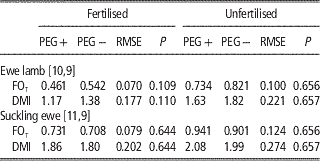
The average total faecal output (FOT) measured with bags on ewe lambs and adults dosed with PEG (PEG+) or not (PEG−), when grazing fertilised or unfertilised pasture and corresponding calculated DMI are presented in Table 2.
Trial2, effect of marker administration (PEG+ or PEG−) on total faecal output (FOT, g/kg DM) measured with faecal bags and dry matter intake (DMI, g/kg DM) calculated from FOT and in vivo dry matter (DM) digestibility (measured indoors, trial 1) of ewe lambs and adult-suckling ewes grazing fertilised or unfertilised pasture

PEG+=animals administrated with polyethylene glycol (PEG); PEG−=animals not administrated with PEG; RMSE=root mean square error; P=P value of the one way ANOVA; [,] number of animal measured in fertilised and unfertilised period.
PEG administration had no effect on FOT and calculated DMI for both ewe lambs and suckling ewes (P>0.05). This confirms that PEG had no measurable effect on DMI as observed in trial 1 and in other experiments with PEG (Teeter and Owens, Reference Teeter and Owens1983; Hassoun et al., Reference Hassoun, Viudes, Autran, Bastianelli and Bocquier2013).
When in vivo DMD measured indoors and FOT are used to calculate DMI at pasture, averaging PEG− and PEG+ animals (because there was no significant difference) of ewe lambs and adult-suckling ewes, the DMI of ewe lambs was lower (P<0.001) than that of adults (1.27 v. 1.83 kg DM/day) on fertilised pasture (P<0.001) and unfertilised pasture (1.73 v. 2.04 kg DM/day, P<0.01). Taking into account the fill value unit of fertilised and unfertilised forage, based on its chemical composition (Beaumont et al., Reference Beaumont, Champciaux, Agabriel, Andrieu, Aufrère, Michalet-Doreau and Demarquilly1999), and the intake capacity of ewe lambs and suckling ewes (Hassoun and Bocquier, Reference Hassoun, Bastianelli, Autran and Bocquier2010), the DMI difference matched expectation (Hassoun and Bocquier, Reference Hassoun, Bastianelli, Autran and Bocquier2010).
Faecal output and dry matter intake assessed with polyethylene glycol at pasture
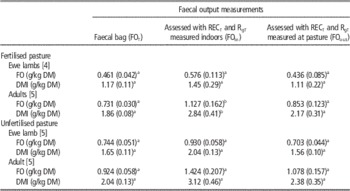
Actual total FO measured with bags (FOT) compared with total FO assessed with PEG using the two factors RECT and RgT measured indoors (FOin) or at pasture (FOout) is presented in Table 3. For ewe lambs grazing fertilised or unfertilised pasture, there was no difference (P>0.05). For adults, FOin was higher than FOT and FOout when grazing fertilised pasture (P<0.05) but no difference was found with unfertilised forage although FOin tended to be higher (P=0.0796). In summary, FOout gives a good estimation of FO of ewe lambs and suckling ewes. Consequently, the DMI calculated with FOout for ewe lambs was close to DMI calculated from FOT with a difference of −0.060 and −0.090 kg DM/day for fertilised and unfertilised pasture, respectively. For adult-suckling ewes, although no difference was observed, FOout tended to overestimate DMI by 0.310 and 0.340 kg DM/day with a high SEM compared with the SEM of ewe lambs. The relative standard deviation of DMI measured with FOT, ranged from 9.3% to 18.2% for both ewe lambs and adult ewes, which was comparable with values (10.6% to 24.6%) observed in a similar study conducted indoors (Andueza et al., Reference Andueza, Picard, Pradel, Egal, Hassoun, Peccatte and Baumont2011). For DMI calculated from FOout, the relative standard deviation was higher for ewe lambs on fertilised pasture (39.0%) but not on unfertilised pasture (11.0%), whereas it was higher in both situations for adult ewes (32.5% to 34.2%). It seems likely that the low daily PEG dose was responsible for such wide variation for adult ewes, which produced large amounts of faeces.
Trial 2, mean and SEM in parenthesis of total faecal output (FO, kg DM/day) of ewe lambs and adult-suckling ewes grazing fertilised or unfertilised pasture, measured at pasture with collection bags (FOT) or assessed with polyethylene glycol (PEG) measured in faeces grab samples using RECT and RgT measured indoors (FOin) or at pasture (FOout) and corresponding dry matter intake (DMI) calculated with in vivo dry matter digestibility (DMD) measured indoors (trial 1)

[]=number of animals; DM=dry matter.
a,bMeans with different letters in the row are significantly different (P<0.05).
Conclusions
This experiment confirms that PEG 6000 is a valuable FO marker when measured with NIRS on sheep consuming rangeland. The DMI directly measured indoors or assessed at pasture with faecal bags are not modified when using PEG; so was the in vivo DMD measured indoors. PEG recovery rate measured indoors with fresh herbage or at pasture was lower than in previous experiments with dry forages. DMI can be assessed at pasture with PEG and using recovery rates measured under the same conditions. It is recommended to use a daily PEG dose of 20 g/day in order to reduce the PEG concentration variability, especially when high intake is expected. Our work shows that PEG as faecal marker measured with NIRS, is a valuable faecal marker to assess DMI at pasture of numerous animals in the same physiological stage (similar expected DMI) but not for individual DMI assessment.
For sheep grazing experiments, we recommend dosing animals once a day in the morning with PEG 6000 at a daily level of no lower than 1% of expected DMI and collecting grab faeces samples at the same time for at least 4 days. Moreover, PEG recovery rate should be previously measured in the same pasture conditions for a more accurate assessment. Before being widely used, such recommendation should be validated under different grazing conditions.
Acknowledgements
This experiment was partially funded by the High Council for Scientific and Technological Cooperation between France and Israel and the French INRA-EcoGer project, DivHerbe, coordinated by P. Cruz. The authors are grateful to S. Douls and J.M. Capron (UMR SELMET), C. Racine (INRA La Fage), C. Moulin and L. Ndiaye (students from the Université Paul Sabatier, IUT A, Auch) for their technical assistance and animal care. The authors would also like to thank Gail Wagman for revising the English and the reviewers for their constructive comments for improving this article.