Short QT syndrome is a malignant repolarisation disorder characterised by short QT intervals, atrial and ventricular arrhythmias, and a risk of syncope to sudden cardiac death.Reference Pereira, Campuzano and Sarquella-Brugada1 A QTc ≤ 330 ms on the electrocardiogram is diagnostic for short QT syndrome, usually with characteristic tall, peaked T-waves.Reference Saenen, Van Craenenbroeck and Proost2 It has a prevalence of 0.02–0.1% and 0.05% in the adult and in the paediatric population, respectively.Reference Guerrier, Kwiatkowski, Czosek, Spar, Anderson and Knilans3 Here, a patient who suffered a sudden cardiac arrest while playing basketball and diagnosed with short QT syndrome is presented. To the best of our knowledge, this is the first children reported with an aborted sudden cardiac arrest during sport activity in a previously asymptomatic short QT syndrome patient with negative family history.
Case report
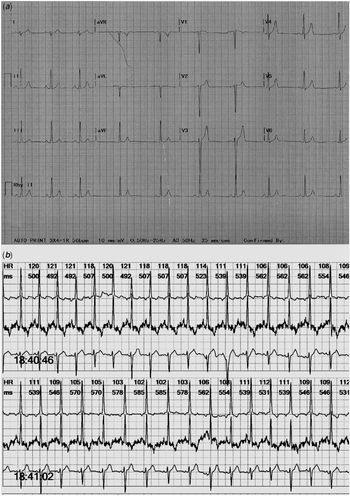
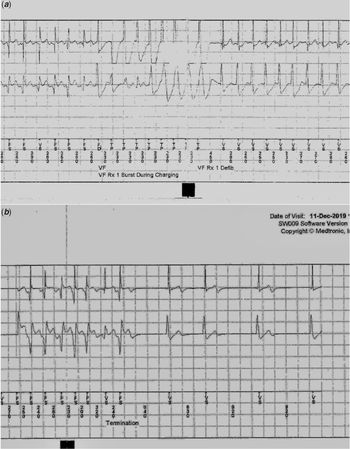
A 14-year-old male patient with no significant past medical history lost his consciousness while playing basketball. He was brought to emergency service with cardiac arrest and was resuscitated for 15 minutes. Cardiac defibrillation was performed two times due to ventricular fibrillation. After successful resuscitation, the patient was transferred to ICU. Physical examination findings and all the laboratory tests except troponin I, which was markedly elevated (265.3 pg/ml; normal range < 19.8 pg/ml), were within the normal range. The electrocardiogram showed a sinus rhythm with a rate of 56 beats/minute and a QTc duration of 320 ms. JP-JT interval was 120 ms and there was no depression of PQ segment (Fig 1a). Echocardiography revealed a structurally and functionally normal heart. 24-hour ECG Holter monitoring that was performed with diagnosis of short QT syndrome revealed a minimum and maximum heart rate of 39 and 146 beats/minute, respectively, and an episode of atrial ectopic tachycardia with a rate of 120–130 beats/minute which lasted for 1 minute (Fig 1b). Genetic analysis (screening for mutations in KCNH2, KCNQ1, and KCNJ2) and family screening were normal. An implantable cardioverter defibrillator was implanted for secondary prevention. The day after the implantation, the patient had an episode of ventricular tachycardia with a rate of 230 beats/minute and it was ceased by anti-tachycardia pacing (Fig 2a). The patient had no syncope since the implantable cardioverter defibrillator implantation but had a total of four ventricular tachycardia episodes with a rate of 200–250 beats/minute and of maximum length of seven beats (Fig 2b) throughout 1 year of follow-up. All of the episodes were ceased on its own and there was no inappropriate shock. Because our patient had non-sustained ventricular tachycardia episodes, quinidine, which is a class I anti-arrhythmic agent with QT prolonging effect, was administered at the first year of follow-up.
(a) 12-lead electrocardiogram of the patient: Sinus rhythm with a rate of 56 beats/min, a QTc duration of 320 ms and a JP-JT interval of 120 ms. (b) Holter recording of atrial ectopic tachycardia with a rate of 120-130 beats/min which lasted for 1 min.

(a) Recording of ventricular tachycardia (with a rate of 230 beats/min) ceased antitachycardia pacing. (b) The longest episode of ventricular tachycardia recorded ICD with a rate of 200-250 beats/min.

Discussion
The short QT syndrome is a recently defined gene-related arrhythmogenic syndrome, which was described as a new electrocardiographic pattern associated with atrial and ventricular tachyarrhythmias in structurally normal heart due to pathological shortening of duration of action potential. The age of onset of the disease is highly variable like the clinical manifestations which ranges from asymptomatic to recurrent syncope and sudden cardiac death which may be the first symptom of the disease. Electrocardiography is the primary tool for diagnosis but electrocardiogram findings may be easily ignored especially among children because the shortness of the QT interval becomes apparent only at heart rates less than 80 beats/minute. The diagnostic criteria for short QT syndrome are a QTc ≤ 330 ms usually accompanied by characteristic tall, peaked T-waves and with an interval from J point to T wave peak (Jp-Tp) measured in the precordial lead with the T wave of greatest amplitude <120 ms.Reference Campuzano, Sarquella-Brugada, Cesar, Arbelo, Brugada and Brugada4 Besides a short QT interval, a PQ depression of more than 0.5 mm was recently determined to be a novel marker for short QT syndrome because it rarely appears in healthy patients.Reference Wakatsuki, Iso and Mase5
The annual risk of cardiac arrest among patients in the largest short QT syndrome cohort to date was approximately 1%, and most of the cardiac arrests reported in this cohort occurred during rest or sleep. On the other hand, unlike long QT syndrome, patients with short QT syndrome rarely experience cardiac arrest during emotional stress or physical effort.Reference Hammond-Haley, Patel, Providencia and Lambiase6 The prevalence of a QTc < 320 ms was reported as 0.1% in a diverse young British population including athletes and among the few individuals who did have a QTc of <320 ms, none experienced any adverse events, syncope, or sudden death over a mean follow-up period of 5.3 years.Reference Dhutia, Malhotra and Parpia7 To the best of our knowledge, this is the first children reported with an aborted sudden cardiac arrest during sport activity in a previously asymptomatic short QT syndrome patient with negative family history. The first and only reported case of sudden cardiac arrest during exercise in a previously asymptomatic short QT syndrome patient with negative family history was a 22-year-old male who collapsed while running in the early evening after work.Reference Wakatsuki, Iso and Mase5
Although there is no definitive consensus on the treatment of patients with short QT syndrome, the current guidelines recommend an implantable cardiac defibrillator as the first and most effective therapeutic measure in patients who have experienced sustained ventricular tachycardia/ventricular fibrillation episodes or in survivors of an aborted cardiac arrest.Reference Tristani-Firouzi8 Inappropriate shock is a common complication in short QT syndrome patients carrying an implantable cardioverter defibrillator because of tall and peaked T waves. In our case, implantable cardioverter defibrillator was implanted due to aborted cardiac arrest and the day after implantation the patient had an episode of ventricular tachycardia with a rate 230 of beats/minute; it was ceased by anti-tachycardia pacing. Although our patient had a total of four episodes of non-sustained ventricular tachycardia throughout 1 year of follow-up, all of the episodes were ceased on its own and there were no inappropriate shocks.
As a conclusion, patients with short QT syndrome rarely experience cardiac arrest during emotional stress or physical effort. Because electrocardiography findings may be easily ignored especially among children due to higher resting heart rates, short QT syndrome should be kept in mind in any cases with palpitation, syncope, aborted cardiac arrest and family history of sudden cardiac death. Increased awareness of short QT syndrome may be lifesaving in these patients.
Acknowledgements
None.
Financial support
This research received no specific grant from any funding agency, commercial or not-for-profit sectors.
Conflicts of interest
None.
Ethical standards
The authors assert that all procedures contributing to this work comply with the ethical standards of the Office for Human Research Protections of the Department of Health and Human Services and with the Helsinki Declaration of 1975, as revised in 2008.