INTRODUCTION
Increasing numbers of patients with cancer use complementary therapies in order to improve their quality of life (Horneber et al., Reference Horneber, Bueschel and Dennert2012; Klafke et al., Reference Klafke, Eliott and Wittert2012). Art therapy can be defined as “the exploitation of the artistic potential of a person with a humanitarian and therapeutic goal” (Forestier, Reference Forestier2009). It includes the patient's characteristics as well as the physical and psychological dimensions of their distress. This is one of the reasons why this type of therapy has been employed with greater frequency over the past two decades (Wood et al., Reference Wood, Molassiotis and Payne2011; Geue et al., Reference Geue, Goetze and Buttstaedt2010).
The scientific literature contains a large number of studies on the effectiveness of art therapy for symptom reduction (Nainis et al., Reference Nainis, Paice and Ratner2006; Rhondali et al., Reference Rhondali, Lasserre and Filbet2013) and as a coping mechanism that enhances the well-being (Bar-Sela et al., Reference Bar-Sela, Atid and Danos2007; Forzoni et al., Reference Forzoni, Perez and Martignetti2010; Lin et al., Reference Lin, Moh and Kuo2012; Oster et al., Reference Oster, Svensk and Magnusson2006; Thyme et al., Reference Thyme, Sundin and Wiberg2009) of patients with cancer.
During a session, three dimensions of the aesthetic feeling, self-assessed by the patient, can contribute to the effect of the art therapy (Forestier, Reference Forestier2009; Reference Forestier2004): the GOOD, which is associated with the pleasure the patient experiences while doing the activity and his/her desire to continue that activity; the WELL, which is associated with the technical satisfaction with creating something; and the BEAUTIFUL, which is associated with the aesthetic satisfaction achieved when carrying out the work.
These three dimensions are the basis for the “harmonic cube,” a self-assessment tool that has been developed over the past 12 years by the school of art therapy in Tours (Forestier, Reference Forestier2009; Reference Forestier2004). These dimensions are a means for analyzing the complex of feelings involved in an art therapy session.
Our self-assessment tool has two objectives: (1) to provide a frame within which to measure how the patient's aesthetic taste evolves, and (2) to allow the patient to self-assess their work in each consecutive session.
The purpose of our study, based on self-assessment by patients of their aesthetic experience, was to look at the impact of one or more art therapy sessions on the symptoms (pain, anxiety, ill-being, sadness, and depression) of inpatients in a palliative care unit.
METHOD
Recruited Patients
The patients were gradually recruited from an acute palliative care unit over a period of 18 months. Among the inclusion criteria were an advanced cancer diagnosis, the ability to communicate in French, an ability to take part in an hour-long art therapy session, and the ability to complete all the self-assessments. Some 28 patients were recruited (21 women and 7 men) for a total of 63 art therapy sessions.
Intervention in Art Therapy
Patients took part in at least one session facilitated by a qualified art therapist. Several days before the session, each patient was invited to choose his/her preferred medium of artwork. The choice of technique and subject depended mainly on the patient's preferences and physical abilities to produce something that was meaningful for them. Different art techniques were employed: painting, drawing, photography, modeling, and sculpture. The session could take place in the patient's room or in a studio outside the unit, depending on the patient's wishes and their physical abilities. The art therapist focused primarily on the technical aspect of the artwork. Depending on the project and the length of the stay of the patient, from 1 to 10 hour-long session(s) were offered.
Symptom Assessment Procedure
The Edmonton Symptom Assessment System (ESAS) is a self-assessment tool that allows patients to document the intensity of nine frequently occurring symptoms (pain, nausea, tiredness, drowsiness, loss of appetite, dyspnea, depression, anxiety, and feelings of ill-being) using a visual scale ranging from 0 (no symptom) to 10 (worst symptom). Use of the ESAS for patients with cancer has shown good test–retest reliability (Bruera et al., Reference Bruera, Kuehn and Miller1991; Reference Bruera, MacMillan and Hanson1989; Chang et al., Reference Chang, Hwang and Feuerman2000; Richardson & Jones, Reference Richardson and Jones2009). We used a modified ESAS to assess the physical and psychological distress of our patients. Our self-assessment tool excluded four symptoms that were not sensitive to art therapy according to various studies (Nainis et al., Reference Nainis, Paice and Ratner2006; Rhondali et al., Reference Rhondali, Lasserre and Filbet2013): nausea, drowsiness, loss of appetite, and dyspnea. We added the “sadness” symptom. Although sadness is not a validated symptom for the ESAS, it seemed more relevant to assess sadness and depression, since depression cannot be relieved in such a short amount of time.
Patients were invited to complete the modified ESAS five minutes before and five minutes after each session.
Aesthetic Dimensions Assessment
Using the same type of visual scale, three dimensions—the GOOD, the WELL, and the BEAUTIFUL—were self-assessed by patients five minutes after the session based on the “harmonic cube” (Forestier, Reference Forestier2009; Reference Forestier2004) model, developed in France. In respect of GOOD, 0 corresponds to “a lot of pleasure” and 10 to “no pleasure at all.” With respect to WELL, 0 corresponds to “very well done” and 10 to “done badly.” As for BEAUTIFUL, 0 corresponds to “I like it a lot” and 10 to “I don't like it.”
Data Analysis
Statistical analyses were carried out with R 2014 software for Mac (R Core Team, 2014).
We employed nonparametric statistical tests in order to eliminate an hypothesis based on our sampling distribution. The Wilcoxon test for paired samples was used to compare data for variables before and after an intervention. The Mann–Whitney test was utilized to compare the effect of the first session on the symptoms and three dimensions of the aesthetic. A Friedman test was also used to compare the three dimensions of the aesthetic. Links between the variables were studied by means of the correlation matrix of Spearman. We used ClustOfVar, an R package for clustering our variables.
In all our statistical evaluations, p values of 0.05 or less were considered statistically significant.
The study was approved by the ethics committee and institutional review board of the Hospices Civils de Lyon.
RESULTS
Of the 28 patients recruited, 22 were included in the analysis, for a total of 53 art therapy sessions. Six patients were excluded because of incomplete self-assessment.
Patient Characteristics
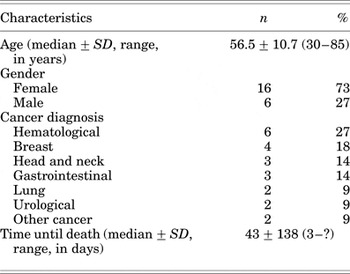
Of the 22 total patients, 16 were women and 6 men (see Table 1). The median age at baseline was 56.5 years, and the median time until death was 43 days, with an exception of 5 patients still living. The diagnoses were split between hematological, breast, head and neck, gastrointestinal, lung, urological, and other cancers. Across all our results, the two genders did not show any significant difference.
Patient characteristics

The Symptoms
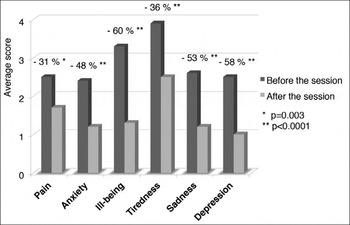
The hour-long art therapy session had a significant effect on global distress (sum of the six symptoms) and on each individual symptom (Figure 1). Global distress was on average reduced by 47% (p < 0.0001). During 53 sessions, only 1 produced an increased distress by 12.3%. Taken individually, the reduction in symptoms strongly varied from one person to another. On average, the standard deviation for the percentage of reduction was 60.8%.
Impact of an art therapy session on symptoms.

Before a session, the self-assessed scores for sadness and depression were not significantly different (p = 0.407) and were the more strongly correlated of all the symptoms (rs = 0.9). After a session, the scores for sadness and depression were significantly different at risk (α = 8%), with a very slight inflexion of the correlation (rs = 0.88). The strongest correlation after a session was observed between depression and anxiety (rs = 0.89).
We noted that all the symptoms before the session were all significantly correlated with each other (0.28 < rs < 0.90, p < 0.05). This situation was the same after a session (0.41 < rs < 0.89, p < 0.05), with an average correlation rate significantly higher than the one obtained before the session (p = 0.002).
The Effect of the First Session
The effects on global distress and individual symptoms for the first and subsequent sessions were not significantly different (p ≥ 0.2). The effect of an art therapy session on symptoms did not depend on the number of sessions.
The Three Dimensions of the Aesthetic
Self-assessment of the three dimensions of the aesthetic after a session revealed significant differences (p = 0.0003). On average, the score for GOOD was higher than that for BEAUTIFUL, which in turn was higher than that for WELL. The standard deviations followed an opposite order.
The GOOD, the WELL and the BEAUTIFUL were linked by significant correlation rates higher than rs = 0.6.
The aesthetic experience was significantly greater for sessions following the first session for the WELL (p = 0.008) and the BEAUTIFUL (p = 0.004). It was significantly greater for the first session for the GOOD (p = 0.039).
Symptoms and the Three Dimensions of the Aesthetic
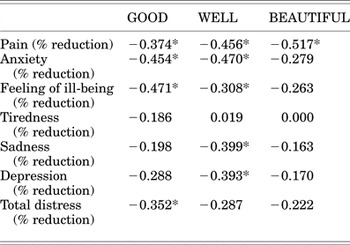
Our analysis of the Spearman correlations matrix (Table 2) indicates that the dimension of the GOOD (pleasure felt by the patient) was significantly correlated (p < 0.05) with the percentage of reduction in global distress. The dimensions of the GOOD and the WELL (a feeling of having done things correctly) were both correlated to the percentage reduction in pain, anxiety, and ill-being (p < 0.05). The dimension of the WELL was also correlated with the percentage reduction in sadness and depression (p < 0.05). The dimension of the BEAUTIFUL was correlated with the percentage reduction in pain (p < 0.05).
Correlations matrix (Spearman) of the three dimensions of the aesthetic and symptomatic reductions

*p < 0.05.
The cluster analysis carried out with the ClustOfVar R package confirmed the data correlations. We found that GOOD was very closely associated with reduction in anxiety and ill-being, WELL showed a very close relationship with reduction in anxiety, while BEAUTIFUL was associated with reduction in pain.
DISCUSSION
According to previously available studies, art therapy sessions mainly focus on the fine arts, last about an hour and a half, and reduce almost by half (−47%) the symptomatology of patients with cancer (Nainis et al., Reference Nainis, Paice and Ratner2006; Rhondali et al., Reference Rhondali, Lasserre and Filbet2013). Even the experience of tiredness, which is the most prevalent of symptoms (average = 3.9), reduces on average by 36% after a person is stimulated for an hour, illustrating the physical and psychological impact of sessions. From a neurophysiological point of view, this beneficial impact can partly be explained by the pleasure the patients experience and self-assess. Numerous studies have revealed that the “aesthetic emotion” that a patient feels after having listened “actively” to music activates dopaminergic circuits (Archie et al., Reference Archie, Bruera and Cohen2013; Zatorre & Salimpoor, Reference Zatorre and Salimpoor2013). Furthermore, if a musical activity takes place, the brain releases endorphins (Dunbar et al., Reference Dunbar, Kaskatis and MacDonald2012). Some correlations could even suggest some comparable neurobiological effects gained from the practice of fine arts. The correlations between pleasure experienced (GOOD) and global distress reduction, as well as between aesthetic emotion (BEAUTIFUL) and pain reduction, seem to underline the same fact. The fact that distress, particularly the experience of pain (Chardon, Reference Chardon and Forestier2010), is quickly reduced (within less than an hour), but for short periods of time (less than 12 hours), seems to be compatible with this neurophysiological hypothesis.
We can infer a psychological explanation that is related to self-confidence and to a feeling of existing independently from the status of an ill person. The dimension of the WELL self-assessed by patients is related in a more or less complex way to their self-confidence (Forestier, Reference Forestier2009; Reference Forestier2004; Reference Forestier2007). The more a patient feels satisfied with their work, the more they will feel confident of succeeding again in the future. We noted that this dimension of the WELL is related in particular to anxiety reduction. The feeling of mastering an artistic technique, even a small one, could result in improved self-confidence and decreased anxiety. The fact that the self-assessed WELL item improved after the first session indeed seems to indicate a positive effect on self-confidence. Studies in the literature dedicated to art therapy omit this dimension of the WELL. Yet it appears that it could play a role in providing a therapeutic effect. Artistic technique is a very important element when considering art therapy, particularly in a palliative situation, where time is limited. Instead of being cared for in a passive way, the patient is able to take a more active role during art therapy. This in turn changes the attitude of family members and professional carers, who no longer perceive the patient as a “person with cancer” (Wood et al., Reference Wood, Molassiotis and Payne2011). The feeling of existing, of being able to do and succeed, could thus contribute to improved symptoms.
We can assume that a patient who enjoyed a session and is aware of the implications of the self-assessment before and after the session might conform to the expectations of the art therapist, that is, to overassess the positive impact of the session, after their first experience of one. The absence of a significant difference between the first and following sessions is a good indicator that leads us to assume that those assessment biases are not too significant. We could also have expected that the initial distress, in the context of various sessions, would be reduced by an anticipatory effect. The data reveal no significant difference in level of initial distress. This anticipatory effect and its positive effect on patients could partly be concealed by a quick deterioration of the patient's health. For the therapist, a single session seems as therapeutic on the symptomatic level as a greater number of sessions. In palliative care patients, where time is short, it could be appropriate to suggest an art therapy session at any stage, even at the end of life.
The art therapy session and its positive effects on well-being could also have an effect on better identification of feelings, as the data relative to pain and sadness suggest, those two symptoms being the most importantly correlated before sessions (rs = 0.9). Before a session, self-assessments of sadness and depression were identical (p = 0.407), whereas they were different after at the risk (α = 8%, p = 0.076). If this hypothesis were proved correct, art therapy could prove to be a useful tool in palliative care, particularly when patients have to make important decisions requiring self-awareness of their situation.
Given the limitations of this work owing to the number of participants (53 sessions and 22 patients), the absence of a control group, and its monocentric nature, generalization of our results cannot be assured. However, the great statistical significance of symptomatic benefits after an art therapy session indicates and confirms very encouraging tendencies for patients and nursing staff. The “harmonic cube” model seems to be interesting and innovative in research and could contribute to better comprehension of the internal processes involved in art therapy. These results are an incentive for us to pursue further studies about the effectiveness of art therapy that would involve a larger number of participants with control groups and at many different centers.
ACKNOWLEDGMENTS
The authors wish to thank Avril Jackson and Léa Monsarrat for their translation and proofreading.