Introduction
Several cross-sectional and longitudinal studies have demonstrated associations between maternal depression symptoms (MDS) and child behavior issues, such as internalizing and externalizing problems (Goodman et al., Reference Goodman, Rouse, Connell, Broth, Hall and Heyward2011). Compared with children of nondepressed mothers, children of depressed mothers are at higher risk for internalizing and externalizing problems during childhood as well as anxiety disorders, major depression, substance dependence, and social impairment in adulthood (Weissman et al., Reference Weissman, Wickramaratne, Nomura, Warner, Pilowsky and Verdeli2006; Weissman et al., Reference Weissman, Wickramaratne, Gameroff, Warner, Pilowsky, Kohad and Talati2016). Yet, many of these studies are limited by focusing on mothers' MDS in relation to child outcome without considering the more dynamic interplay of mothers' symptomatology and children's behavioral difficulties.
Transactional models highlight the mutual influence between the child and their environment (family, parents), which may vary over time depending on the child's age and developmental stage and on the characteristics of the child and the environment (Bell, Reference Bell1968; Sameroff, Reference Sameroff2009). Goodman and Gotlib (Reference Goodman and Gotlib1999) proposed a developmental model that provides an elegant overview of the various mechanisms by which MDS could be associated with child mental health via genetic and different environmental mechanisms, and they explicitly highlighted the possible influence of children's behavior on their mother's depressive symptoms. Thus, a spiral could take place whereby elevated MDS increase risk for child behavior problems, which in turn further increase risk for higher MDS. Some longitudinal research supports this model, highlighting an association between child behavior problems and subsequent MDS and vice versa (Bagner, Pettit, Lewinsohn, Seeley, & Jaccard, Reference Bagner, Pettit, Lewinsohn, Seeley and Jaccard2013; Fanti, Panayiotou, & Fanti, Reference Fanti, Panayiotou and Fanti2013; Gross, Shaw, & Moilanen, Reference Gross, Shaw and Moilanen2008; Hails, Reuben, Shaw, Dishion, & Wilson, Reference Hails, Reuben, Shaw, Dishion and Wilson2018; Kuckertz, Mitchell, & Wiggins, Reference Kuckertz, Mitchell and Wiggins2018; Shaw, Sitnick, Reuben, Dishion, & Wilson, Reference Shaw, Sitnick, Reuben, Dishion and Wilson2016).
Furthermore, the context in which the child and the mother evolve might influence the transactional process between the child and his/her mother (Bronfenbrenner, Reference Bronfenbrenner1979). Children's attendance in formal childcare may reduce exposure to MDS while also providing the child with opportunities to interact with other adults and children (Schindler, Moely, & Frank, Reference Schindler, Moely and Frank1987). As a result, the mutual influence of MDS and child behavior problems might be altered. A few recent studies have reported that attending formal childcare before 5 years old may be associated with reduced internalizing and/or externalizing difficulties for children exposed to elevated MDS (Giles, Davies, Whitrow, Warin, & Moore, Reference Giles, Davies, Whitrow, Warin and Moore2011; Herba et al., Reference Herba, Tremblay, Boivin, Liu, Mongeau, Séguin and Côté2013; Lee, Halpern, Hertz-Picciotto, Martin, & Suchindran, Reference Lee, Halpern, Hertz-Picciotto, Martin and Suchindran2006). However, it is not clear whether those associations are particularly salient for specific ages from infancy to age 5 years. Moreover, these studies did not evaluate whether attending formal childcare is associated with reduced maternal symptoms nor did they consider the longitudinal associations between child behavior problems and MDS. Therefore, it remains unknown whether attending formal childcare might be linked directly with reduced MDS or could reduce the risk of depressive symptoms for mothers with children who manifest behavior problems. If attendance in formal childcare was associated with reduced MDS, we also do not know whether there could be an indirect benefit for the child.
Furthermore, internalizing and externalizing problems are often studied separately. However, they are closely related and tend to co-occur (Gilliom & Shaw, Reference Gilliom and Shaw2004). Some research has highlighted longitudinal associations between child internalizing and child externalizing problems and vice versa, whose strength may vary depending on the child's developmental period: infancy, preschool, transition to school, or adolescence (Fanti et al., Reference Fanti, Panayiotou and Fanti2013; Gilliom & Shaw, Reference Gilliom and Shaw2004; Gromoske & Maguire-Jack, Reference Gromoske and Maguire-Jack2012; Halonen, Aunola, Ahonen, & Nurmi, Reference Halonen, Aunola, Ahonen and Nurmi2006; Timmermans, van Lier, & Koot, Reference Timmermans, van Lier and Koot2010). These results suggest a potential cascading effect from MDS to internalizing problems via externalizing problems or from MDS to externalizing problems via internalizing problems (Flouri et al., Reference Flouri, Papachristou, Midouhas, Ploubidis, Lewis and Joshi2019; Gromoske & Maguire-Jack, Reference Gromoske and Maguire-Jack2012; Hails et al., Reference Hails, Reuben, Shaw, Dishion and Wilson2018; Shaw, Gross, & Moilanen, Reference Shaw, Gross, Moilanen and Sameroff2009). It is thus important to take into consideration the potential co-occurrence and longitudinal associations of child internalizing and externalizing problems.
Our study builds on previous work to generate a more complete understanding of the longitudinal associations between MDS, child internalizing and externalizing behavior, and the role of formal childcare attendance. We use a transactional model across several time points over the full period from infancy to age 5 years.
Transactional Links Between MDS and Externalizing, and Internalizing Problems
Research on the transactional links between MDS and child externalizing problems from infancy through the preschool period has yielded mixed results. Some studies have reported links between MDS and later externalizing problems and between child externalizing problems and later MDS (Hails et al., Reference Hails, Reuben, Shaw, Dishion and Wilson2018; Shaw et al., Reference Shaw, Gross, Moilanen and Sameroff2009), while others found only a unidirectional link between MDS and child externalizing problems (Choe, Sameroff, & McDonough, Reference Choe, Sameroff and McDonough2013; Villodas, Bagner, & Thompson, Reference Villodas, Bagner and Thompson2018). Less research has been done on the transactional relationship between MDS and internalizing problems from infancy to age 5 years. Some studies confirmed a reciprocal association between MDS and internalizing problems (Hails et al., Reference Hails, Reuben, Shaw, Dishion and Wilson2018; Kuckertz et al., Reference Kuckertz, Mitchell and Wiggins2018), while others support only an association from MDS to internalizing problems (Villodas et al., Reference Villodas, Bagner and Thompson2018). Furthermore, the associations are not always present at all developmental time points, suggesting that the timing of MDS and the child's age may play a role.
Studies have also been conducted to evaluate whether associations between MDS and child behavior problems vary as a function of child characteristics such as age and sex. Fanti et al. (Reference Fanti, Panayiotou and Fanti2013) reported, in a large community sample, associations between externalizing problems and later MDS from 4.5 to 15 years old, with this pattern seen for girls but not for boys. However, no sex differences emerged for the associations between MDS and externalizing problems during the same period. Choe et al. (Reference Choe, Sameroff and McDonough2013) reported an association between MDS at 7 months and externalizing problems at 15 months for boys and girls but an association between MDS at 7 months and externalizing problems at 33 months for boys only. Externalizing problems at 15 months were not associated with MDS at 33 months for boys or girls.
The inconsistent results presented above suggest that the associations between MDS and child behavior problems may vary with the age, sex, or socioeconomic composition of the sample, but also in relation to the different time intervals (e.g. number of months/years) used between measurements (Bagner, Pettit, Lewinsohn, & Seeley, Reference Bagner, Pettit, Lewinsohn and Seeley2010; Choe et al., Reference Choe, Sameroff and McDonough2013; Fihrer, McMahon, & Taylor, Reference Fihrer, McMahon and Taylor2009; Goodman et al., Reference Goodman, Rouse, Connell, Broth, Hall and Heyward2011).
The Role of Formal Childcare
Three studies have examined the role of childcare attendance on the association between MDS and child behavior problems. Lee et al. (Reference Lee, Halpern, Hertz-Picciotto, Martin and Suchindran2006) studied the role of childcare (72% using formal care, 28% informal care) on the association between MDS and child behavior problems at 2 and 3 years. They found that the association between MDS and internalizing problems was weaker for children attending childcare than for children not attending childcare. This moderating role was not found for the association between MDS and externalizing problems.
Giles et al. (Reference Giles, Davies, Whitrow, Warin and Moore2011) evaluated the moderating role of childcare attendance on internalizing and externalizing problems at age 5 years for three groups of mother–child dyads: (a) nondepressed mothers, (b) mothers with high MDS at one time point, (c) mothers with high MDS at two time points (recurrent maternal depression). MDS was measured when the child was 2 and 3.5 years old. Children of mothers with recurrent maternal depression were twice as likely to score at a high level for externalizing problems and nearly four times as likely for internalizing problems compared with children of nondepressed mothers. Childcare was categorized as formal (center-based, family-based) or informal (by a relative or a friend). Half a day of formal childcare per week at 2 years old was related to a weaker association between recurrent maternal depression and a combined measure of internalizing and externalizing problems, while formal childcare at 3.5 years old and informal childcare at 2 and 3.5 years old did not moderate this association. These findings suggest that formal childcare may be associated with reduced internalizing and externalizing problems for children exposed to MDS, with earlier attendance being associated with more positive outcomes.
Herba et al. (Reference Herba, Tremblay, Boivin, Liu, Mongeau, Séguin and Côté2013) studied the link between MDS trajectories (elevated vs. low level of symptoms) and child internalizing problems trajectories (emotional problems, separation anxiety, and social withdrawal) for the period spanning from 5 months to 5 years. They evaluated the moderating role of childcare type (formal, informal, no attendance), age at which the child started attending childcare, and the intensity of use. Their results highlighted that attendance in formal childcare was associated with fewer emotional problems for children of mothers with an elevated level of MDS compared with those who did not attend childcare. Age of entry into childcare or intensity of use did not moderate these associations. Some other studies indicate that childcare quality may play a role in moderating the associations between MDS and child behavior problems such that higher childcare quality was associated with better child outcomes (Charrois et al., Reference Charrois, Côté, Japel, Séguin, Paquin, Tremblay and Herba2017; Goelman, Zdaniuk, Boyce, Armstrong, & Essex, Reference Goelman, Zdaniuk, Boyce, Armstrong and Essex2014).
Taken together, the results presented above indicate that attending formal childcare may attenuate the association between MDS and internalizing and/or externalizing problems compared with not attending formal childcare or attending informal childcare. This might be explained in part through parent–child relations. Depressed mothers have been shown to use more hostile and coercive parenting strategies and to express more anger and negative emotions towards their child than mothers with no depressive symptoms (Kiernan & Huerta, Reference Kiernan and Huerta2008; Lovejoy, Graczyk, O'Hare, & Neuman, Reference Lovejoy, Graczyk, O'Hare and Neuman2000). These behaviors have been shown to be related to more child behavior problems (Callender, Olson, Choe, & Sameroff, Reference Callender, Olson, Choe and Sameroff2012; Goodman et al., Reference Goodman, Rouse, Connell, Broth, Hall and Heyward2011; Villodas et al., Reference Villodas, Bagner and Thompson2018). Mothers with depression may also be less inclined to read, play, or sing with their child as well as follow daily routines. They also tend to have a limited social network, and thus their child may have fewer opportunities to interact with other children and develop their social skills (Conners-Burrow et al., Reference Conners-Burrow, Bokony, Whiteside-Mansell, Jarrett, Kraleti, McKelvey and Kyzer2014; Paulson, Dauber, & Leiferman, Reference Paulson, Dauber and Leiferman2006; Zahn-Waxler, Denham, Iannotti, & Cummings, Reference Zahn-Waxler, Denham, Iannotti, Cummings, Parke and Ladd1992). Furthermore, formal childcare is often of higher quality than informal childcare (Fuller, Kagan, Loeb, & Chang, Reference Fuller, Kagan, Loeb and Chang2004; Japel, Tremblay, & Côté, Reference Japel, Côté and Tremblay2005; Vandell, Burchinal, & Pierce, Reference Vandell, Burchinal and Pierce2016). Childcare quality includes various components such as the caregiver–child relationship, daily routines, and structured activities (Japel et al., Reference Japel, Côté and Tremblay2005). Previous research suggests that routines help the child to develop self-regulation and are associated with fewer behavior problems (Bater & Jordan, Reference Bater and Jordan2017; Ren & Fan, Reference Ren and Fan2019).
In these circumstances, children of mothers with MDS might benefit from a formal childcare environment that provides stimulating activities and structured routines, opportunities to interact regularly with other children in a group-based environment, and regular positive interactions with supportive educators. Importantly, and to date unstudied, is whether a child's attendance at formal childcare may also be associated with mother's well-being. Formal childcare might protect mothers of children with a high level of behavior problems through offering the mother respite or reducing the number of potentially frustrating or unpleasant interactions with the child. Further, such transactional links may have indirect benefits over time, such that if formal childcare attendance is associated with reduced MDS, the child is likely to benefit as well.
The Current Study
The objectives of the current study were: (A) to test whether MDS is related longitudinally to more internalizing and externalizing problems or whether internalizing and externalizing problems lead to more MDS (i.e., testing transactional links); (B) to test whether attending formal childcare is associated with MDS and/or child internalizing and externalizing problems; (C) to test whether formal childcare moderates the longitudinal associations between (i) MDS and child internalizing and externalizing problems, and (ii) child internalizing and externalizing problems and MDS; and (D) to test whether child's sex moderates transactional links between MDS and child behavior problems and whether any moderating role of formal childcare may differ for boys and girls.
To address these objectives and to maximize the potential of our longitudinal data, we used a moderated transactional study design including MDS, child internalizing and externalizing problems, and childcare attendance at four time-points from infancy to age 5 years. This design accounted for autoregressive effects as well as concurrent links, including any overlap between child internalizing and externalizing problems. This design is ideal to study the dynamic nature of the potential direct and protective effect of formal childcare—whether the effect of formal childcare changed over time from 5 months to 5 years of age. More specifically, we tested the transactional model and two alternative and potentially complementary moderation models:
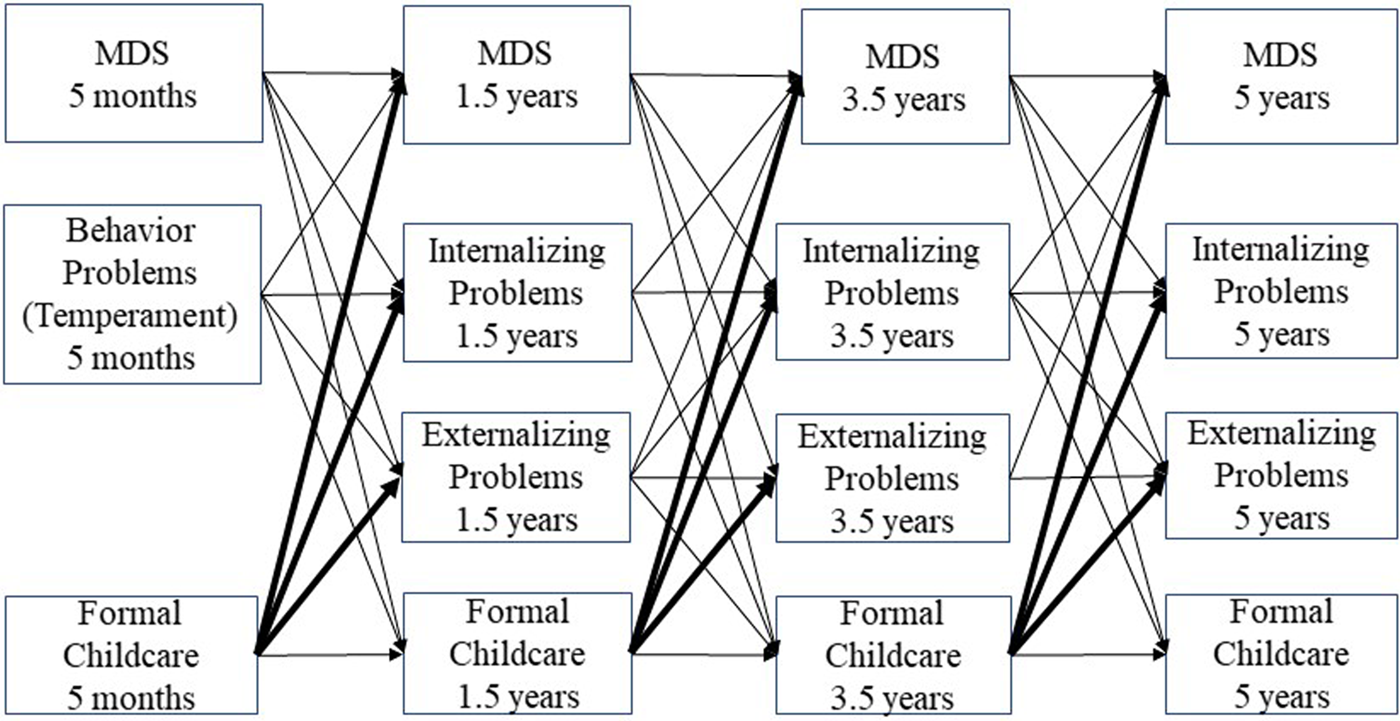
(A) The transactional model tested the reciprocal links between MDS and child internalizing and externalizing problems and the potential association of formal childcare with MDS and child behavior problems (in bold in Figure 1).
Transactional model.

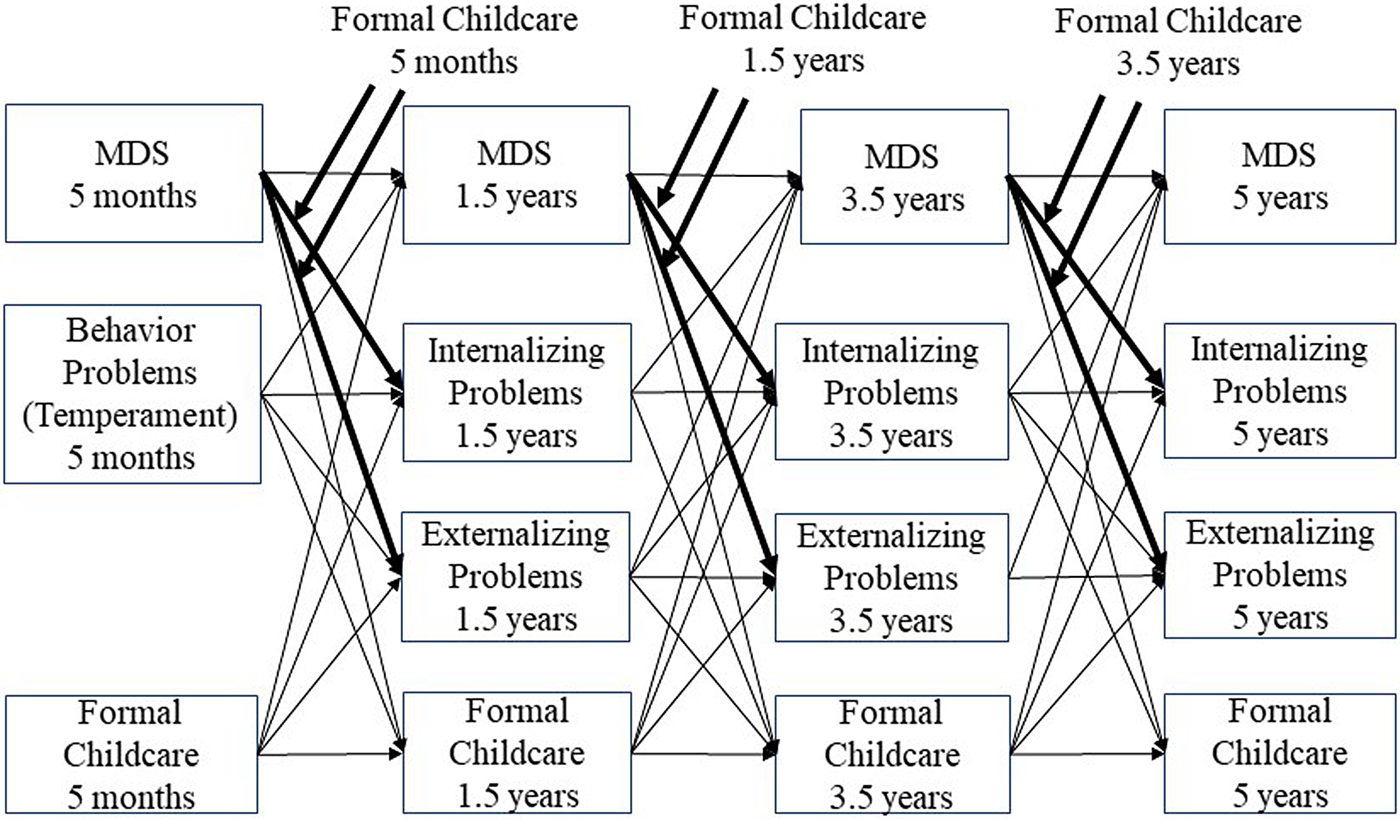
(B) The child protection model tested whether formal childcare moderated the association between MDS and child behavior problems (Figure 2); more specifically, is MDS differentially associated with child behavior problems depending on the child's attendance in formal childcare versus maternal care at different time points from infancy to age 5 years?
Child protection model.

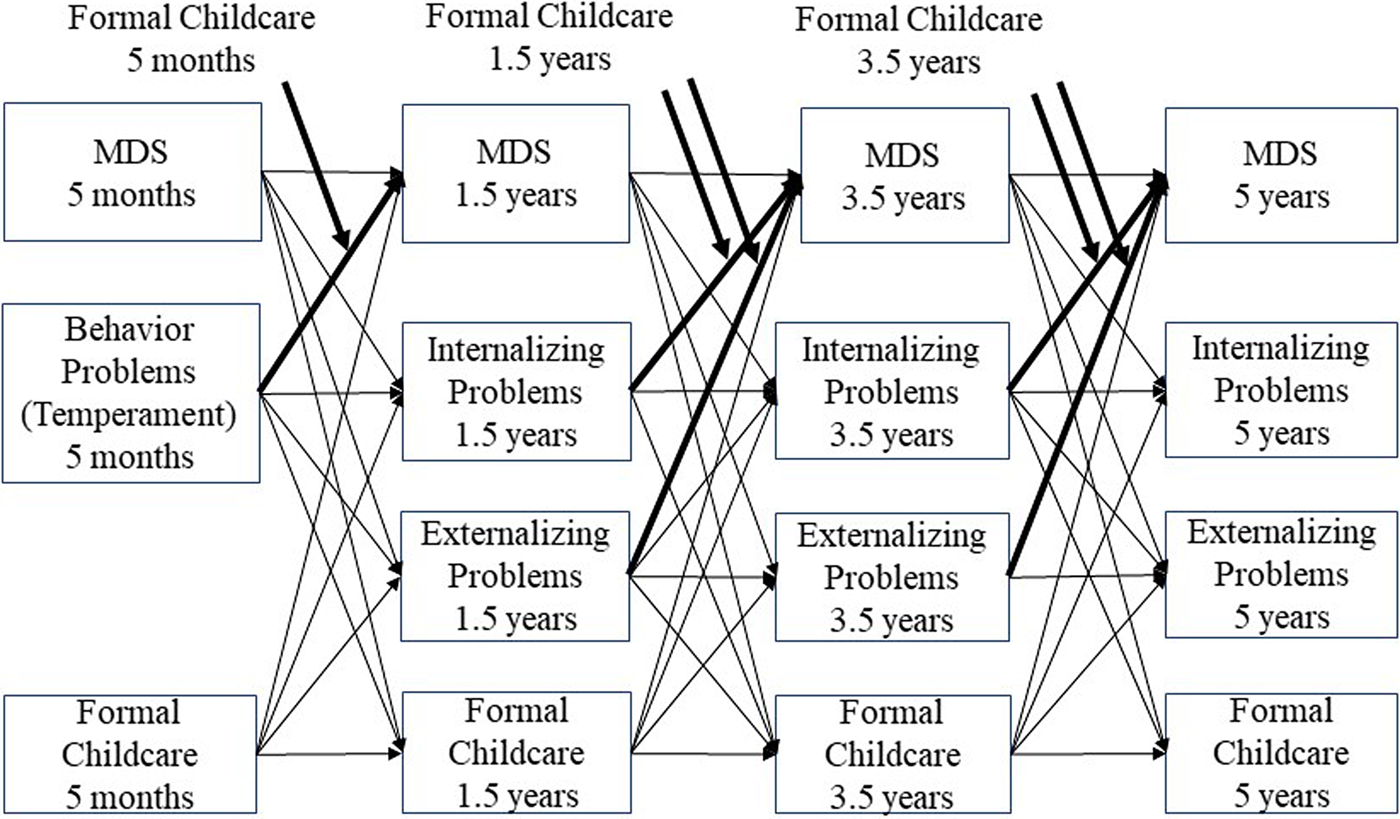
(C) The mother protection model tested whether formal childcare moderated the association between child behavior problems and subsequent MDS (Figure 3). Are child behavior problems differentially associated with subsequent MDS depending on the child's attendance in formal childcare versus maternal care at different time points from infancy to age 5 years?
Mother protection model.

Methods
Participants
Data for this study were drawn from the Québec Longitudinal Study of Child Development (QLSCD) led by the Institut de la statistique du Québec. The QLSCD original sample is representative of singleton births from mothers living in Québec between October 1997 and July 1998 (N = 2120). Information on the biological mother and her child included assessments when the child was aged 5 months, 1.5, 3.5, and 5 years. The person identified as being the most knowledgeable (PMK) about the child was asked to provide information regarding the child. We selected the participants for whom the PMK was the biological mother at each studied time point (5 months, 1.5, 3.5, and 5 years; n = 2052). Since we focused our comparisons on those children attending formal childcare versus maternal care, we excluded from our sample those children who attended informal childcare at any of the four time points (n = 1144).
Our final sample comprised 908 biologically related mother–child dyads at 5 months. Of these 908 dyads, 845 provided information at 1.5 years, 782 at 3.5 years, and 679 at 5 years. We tested whether mother–child dyads with and without data at 5 years differed on sociodemographic characteristics measured at 5 months. Compared with mother–child dyads who provided data at 5 years, those without data at 5 years were more likely at baseline (5 months) to have reported a lower household income, F (1, 889) = 25.34, p < .001, a lower maternal education level (28.8% vs. 20.4% did not finish high school), χ2 (3, N = 908) = 10.06, p = .02, to be a single-mother family (15.4% vs. 9.1%), χ2 (2, N = 908) = 7.54, p = .02, and to be dyads with boys (56.2% vs. 47.1%), χ2 (2, N = 908) = 6.13, p = .01. The two groups were however similar for maternal age at childbirth, MDS, and child temperament at 5 months (all p’s > 0.5).
We also compared the mother–child dyads in our study (n = 908) with those mother–child dyads excluded from the sample because the child attended informal childcare (n = 1144). Mother–child dyads in our study were more likely at 5 months to have reported more MDS, t = 2.87, p < .01, a lower education level, χ2 (3, N = 2051) = 43.08, p < .001, and to be a single mother (11.0% vs. 5.8%), χ2 (1, N = 2047) = 18.26, p < .001. They did not differ with respect to household income, maternal age at childbirth, child temperament, or child's sex (all p’s > .05).
Ethics approval and informed parental consent from mothers were obtained at each time point.
Measures
Maternal depressive symptoms (MDS)
MDS of biological mothers were assessed using a shortened version of the Center for Epidemiologic Studies Depression (CES-D) Scale (Radloff, Reference Radloff1997) when the child was 5 months, 1.5, 3.5, and 5 years. The CES-D is a widely used self-report measure to assess symptoms of depression in the general population (Jenkins & Curwen, Reference Jenkins and Curwen2008). The shortened version shows good psychometric properties (Poulin, Hand, & Boudreau, Reference Poulin, Hand and Boudreau2005). Each item assesses the frequency of a depressive symptom during the past week on a 4-point scale ranging from 0 (none) to 3 (all the time). Measures at 5 months and 1.5 years included 13 and 12 of the 20 items, respectively, for a total varying from 0 to 39 at 5 months and from 0 to 36 at 1.5 years, whereas measures at 3.5 and 5 years used six items for a total varying from 0 to 18. The scores were rescaled to range from 0 to 10 to ensure that all time point measures were comparable even if the number of items used were different. The internal consistency of the MDS scale was good at each time point (Cronbach alphas 5 months/1.5/3.5/5 years = .80/.82/.82/.81), respectively.
Childcare measures
Mothers reported on their use of childcare when the child was 5 months, 1.5, 3.5, and 5 years by indicating the childcare arrangement: none (mother care), cared for in someone else's home by a relative or a nonrelative, cared for in own home by a relative or a nonrelative, or attended a center-based childcare. Furthermore, when the child was cared for in someone else's home by a family member or a nonfamily member, the mother was asked if the person providing the care was licensed by the government or approved by a recognized agency. We considered formal childcare as attendance in a center-based childcare setting or being cared for in someone else's home that was licensed by the government or approved by a recognized agency. Any other childcare arrangements were considered informal childcare. At each time point, we constructed one variable indicating whether the child attended formal childcare (coded 1) or not (mother care, coded 0).
Child behavior problems
The Infant Characteristics Questionnaire (ICQ; Bates, Freeland, & Lounsbury, Reference Bates, Freeland and Lounsbury1979) was used to measure child temperament at 5 months. Temperament is considered a good predictor of later child behavior problems (Bagner, Rodríguez, Blake, Linares, & Carter, Reference Bagner, Rodríguez, Blake, Linares and Carter2012; Lawson & Ruff, Reference Lawson and Ruff2004) and was used as a proxy for early behavior problems. The ICQ contains 19 items evaluated on a 7-point scale ranging from 1 (easy) to 7 (difficult). The shortened version contains seven items and shows good psychometric properties (Cronbach alpha = .77; Japel, Tremblay, McDuff, & Boivin, Reference Japel, Tremblay, McDuff and Boivin2000).
At 1.5, 3.5, and 5 years, child behavior problems were measured using questions drawn from different widely used scales such as the Child Behavior Checklist (Achenbach & Edelbrock, Reference Achenbach and Edelbrock1981), the Preschool Behavior Questionnaire (Tremblay, Desmarais-Gervais, Gagnon, & Charlebois, Reference Tremblay, Desmarais-Gervais, Gagnon and Charlebois1987), and the Revised Ontario Child Health Study Scales (Boyle et al., Reference Boyle, Offord, Racine, Fleming, Szatmari and Sanford1993). For each question, mothers reported on the frequency of specific behaviors in the past 12 months on a 3-point scale ranging from 1 (never) to 3 (often). Only the questions asked at each time point were included in the scales for children's externalizing problems (14 items) and internalizing problems (12 items). We tested the internal consistency of each scale and decided to remove an item to increase the internal consistency of the externalizing scale for a total of 13 items. The externalizing scale was calculated using the mean of a minimum of 7 of 13 items drawn from 4 subscales: opposition-defiance, inattention, hyperactivity, and physical aggression. The internalizing scale was calculated using the mean of a minimum of 6 of 12 items drawn from 4 subscales: anxiety, separation anxiety, timidity/shyness, depressive symptoms. The internal consistencies of the externalizing scale (Cronbach alphas 1.5/3.5/5 years = .77/.80/.82, respectively) and of the internalizing scale (Cronbach alphas 1.5/3.5/5 years = .68/.71/.71, respectively) were good.
Covariates
Child's sex was coded using 1 for boys and 0 for girls. Maternal depression and child behavior problems have been shown to be more frequent in low-income families (Elgar, McGrath, Waschbusch, Stewart, & Curtis, Reference Elgar, McGrath, Waschbusch, Stewart and Curtis2004). We thus adjusted for this variable in our analyses. Household income was provided at 5 months and was coded using an 8-point Likert scale varying from 1 (10,000 dollars and less) to 9 (80,000 dollars and more). Variables identified as differentiating the group of mother–child dyads who left the study by 5 years from the ones who stayed in the study were also included as covariates. These include maternal education and family structure. Maternal education was reported using an ordinal indicator designating mothers without a high school degree or with a high school, post high school, or university degree. Three dummy variables were created for high school, post high school, or university, respectively, with no-high-school serving as the reference. Family structure was reported using a categorical indicator designating single-mother families, families with a biological mother and a stepfather, and families with two biological parents. Two dummy variables were created for single-mother families and families with a biological mother and a stepfather, respectively, with families with two biological parents as the reference.
Data analysis plan
SPSS (Version 25.0) was used for the preliminary analyses. We computed descriptive statistics of the sample at baseline (5 months), distributional properties of main study variables, and correlations between main variables and covariates. We compared the level of child internalizing and externalizing problems at 1.5, 3.5, and 5 years between children who attended formal childcare and those in maternal care using multivariate analysis of variance and controlling, respectively, for externalizing and internalizing problems. We also performed a two-way analysis of variance to compare sociodemographic characteristics of mother–child dyads at 5 years based on mothers’ depression symptomatology and formal childcare attendance. We used a threshold of 2.67 (out of 10) on our rescaled MDS measure to approximate the usual cut-off of 16 (out of 60) on the CES-D to distinguish between depressed vs. nondepressed mothers (Ahun et al., Reference Ahun, Geoffroy, Herba, Brendgen, Séguin, Sutter-Dallay and Côté2017; Vilagut, Forero, Barbaglia, & Alonso, Reference Vilagut, Forero, Barbaglia and Alonso2016).
We tested the cross-lagged models using structural equation modeling in Mplus 6.11. To test the different moderation models presented earlier (child protection and mother protection models), we first standardized the MDS and child behavior problem variables as recommended by Frazier, Tix, and Barron (Reference Frazier, Tix and Barron2004). We then computed interaction terms between formal childcare (dummy coded, 0 and 1) and the standardized child behaviour problems or MDS, depending on the moderation model tested.
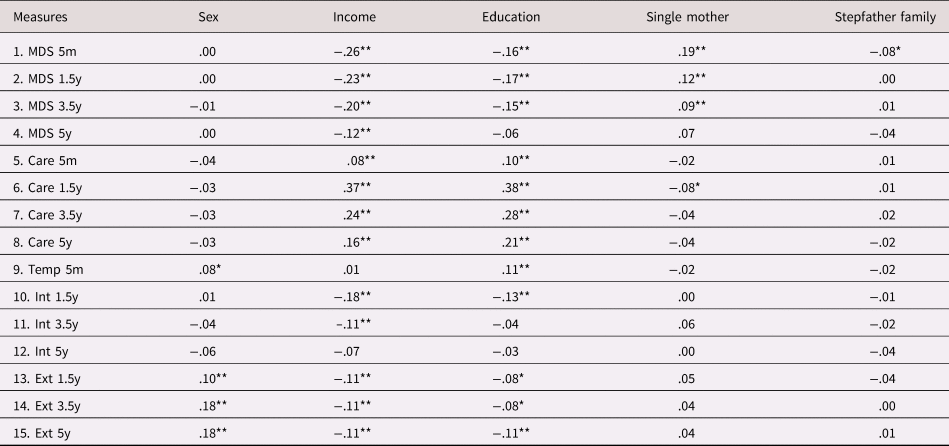
Maximum likelihood with robust standard errors (MLR) and full information maximum likelihood was used in the estimation to accommodate skewed and missing data, respectively. Household income, maternal education, family structure (e.g., single mother or stepfather family with two biological parents as reference), and child's sex were used as covariates and added at each time point where correlations between covariates and the main measures were statistically significant (see Table 4). We evaluated the transactional model without including any interaction terms as illustrated in Figure 1. Next, we tested the child protection and mother protection models. We used a combination of fit indices to evaluate the models (Hu & Bentler, Reference Hu and Bentler1999; Steiger, Reference Steiger2007), with root mean square error of approximation (RMSEA) less than .06, comparative fit index (CFI) greater than .90, and standardized root mean square residual (SRMR) less than .08 indicating a good fit. In a last step, sex was removed as a covariate and we tested potential differences between boys and girls by means of a multigroup analysis. There is little consensus regarding the calculation of power and samples size required for structural equation models (SEM) and testing invariance between groups. We used the single parameter invariance testing (SPIT) method presented by Chin and colleagues (Reference Chin, Mills, Steel and Schwarz2014), for which samples including between 100 and 200 participants for each group is usually considered sufficient. We constrained one path at a time and used the Satorra–Bentler-corrected chi-square difference test (Bryant & Satorra, Reference Bryant and Satorra2012; Satorra & Bentler, Reference Satorra and Bentler2010) to evaluate whether any associations differed significantly by sex. In simulation tests, the Satorra–Bentler-corrected chi-square difference test yielded good power (>90%) in multigroup analysis with a group size of 220 participants (Brace & Savalei, Reference Brace and Savalei2017). Accordingly, we expect our multigroup analyses including a group of 457 girls and another of 451 boys to be powered at more than 90% to detect small effects. Finally, we used simple slope analysis to examine the significant interaction terms found.
Results
Descriptive Statistics
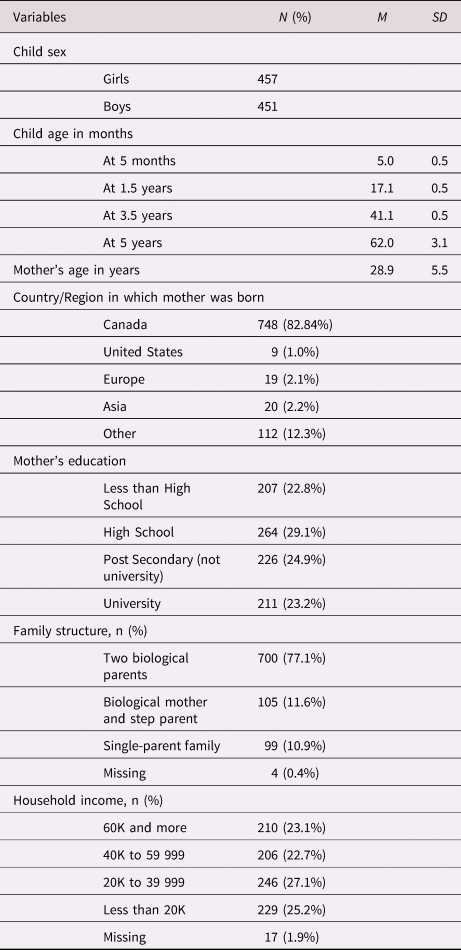
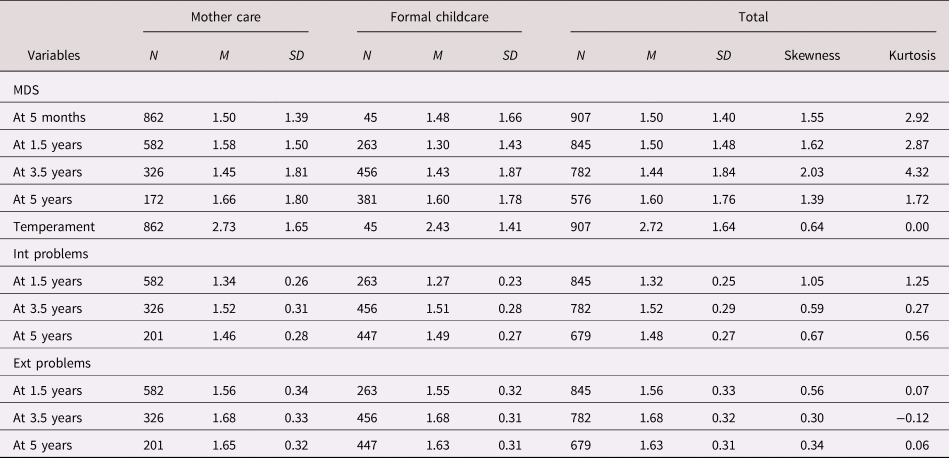
See Table 1 for more detailed information about our sample of 908 biological mother–child dyads. Table 2 presents descriptive statistics of the variables used in the models.
Demographic information about the sample at 5 months (unless otherwise indicated)

Data courtesy of Institut de la statistique du Québec.
Descriptive statistics of main variables

Data courtesy of Institut de la statistique du Québec.
Multivariate analyses of variance were conducted to compare the level of internalizing and externalizing problems of children attending formal childcare vs. maternal care while controlling for concurrent externalizing or internalizing problems, respectively. Results were not statistically significant (all p’s > .05), with one exception. At age 1.5 years, children attending formal childcare had significantly lower levels of internalizing problems than children not attending childcare, F (1, 842) = 16.52, p < .001.
We created four groups of mother–child dyads based on mothers' depression and whether children were attending formal childcare or not, both measured at 5 years. We compared these four groups on a range of characteristics of mother–child dyads reported at baseline (age 5 months). The groups differed with respect to maternal education, χ2 (9, N = 648) = 36.79, p < .001. Post-hoc analyses indicated that the group of nondepressed mothers with a child attending formal childcare reported higher maternal education than the group of nondepressed mothers with a child not attending formal childcare. Groups with children attending formal childcare at 5 years (regardless of mothers’ depression status) were more likely to be from families with higher household income F (1, 641) = 6.61, p = .001. Groups of depressed mothers at 5 years were likely to have reported higher MDS, F (1, 644) = 40.71, p < .001, a more difficult child temperament, F (1, 644) = 5.36, p = .02, and lower household income at 5 months, F (1, 641) = 5.87, p = .02. The groups did not differ with respect to child's sex, age of the mother at childbirth, and family structure at 5 months (all p’s > .05).
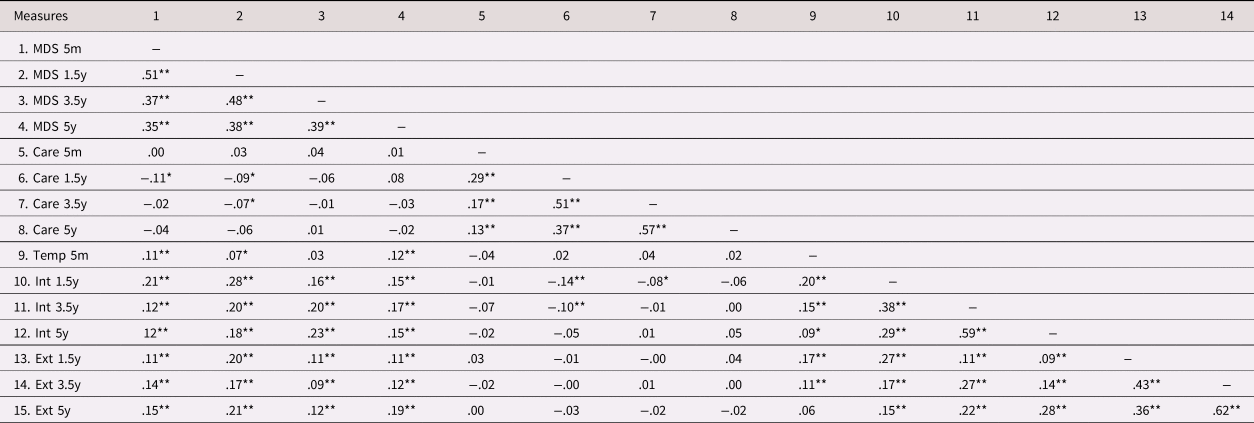
The correlation matrix for the main variables included in the models is presented in Table 3. MDS were significantly associated with child internalizing and externalizing problems concurrently and across adjacent time points. Similarly, child internalizing problems were significantly associated with externalizing problems concurrently and across adjacent time points. Childcare was negatively correlated with MDS and internalizing problems at some concurrent or adjacent time points but not externalizing problems. The correlation matrix between the main variables and the covariates is presented in Table 4.
Correlation matrix

Note: ** Correlation is significant at the .01 level. * Correlation is significant at the .05 level. Care: formal childcare coded 1 vs. mother care coded 0. Source: Data courtesy of Institut de la statistique du Québec.
Correlations between main variables and covariates

Note: ** Correlation is significant at the .01 level. * Correlation is significant at the .05 level. Care: formal childcare coded 1 vs. mother care coded 0. Sex: boys coded 1 vs. girls coded 0. Source: Data courtesy of Institut de la statistique du Québec.
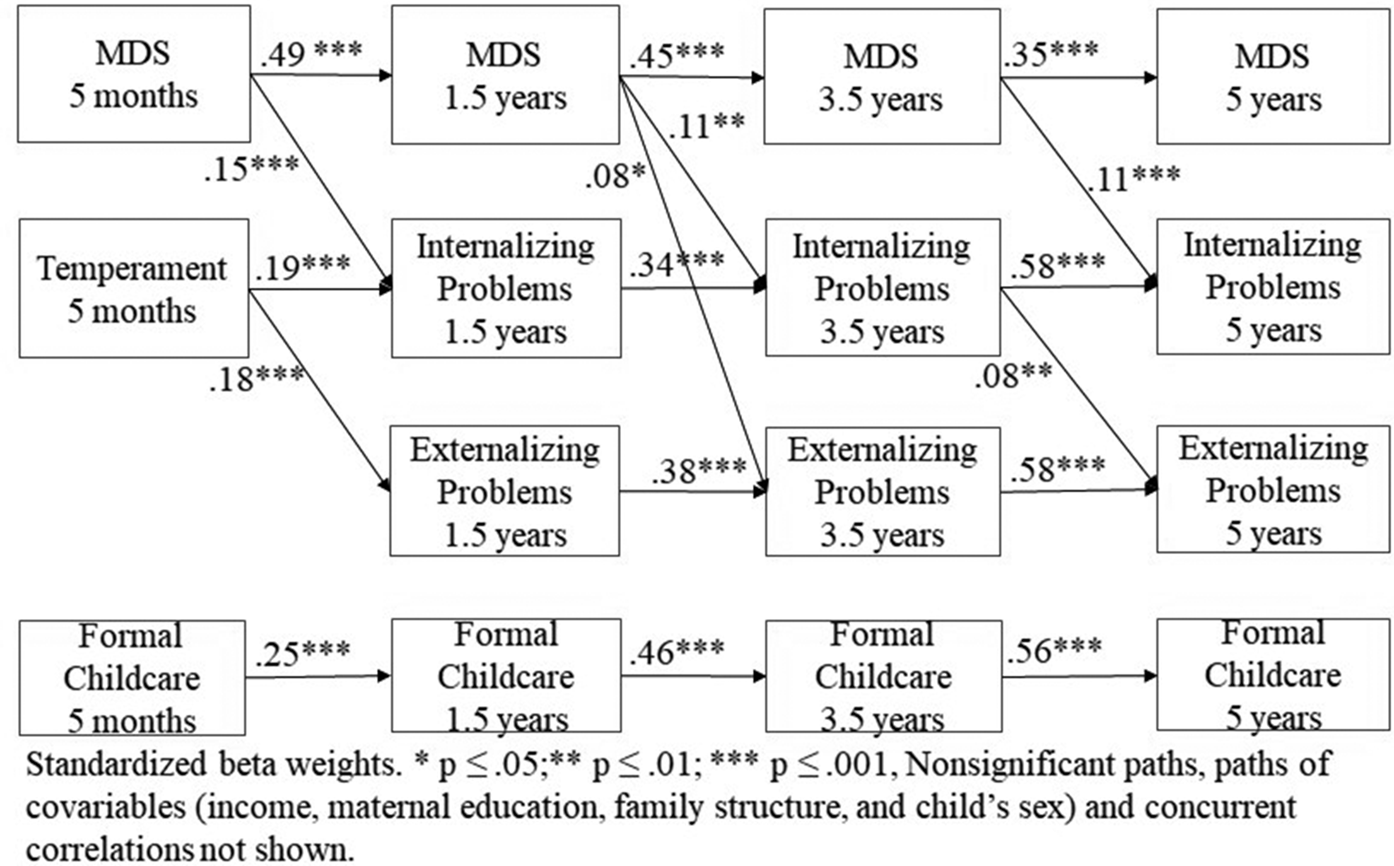
Transactional Model
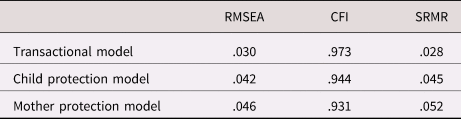
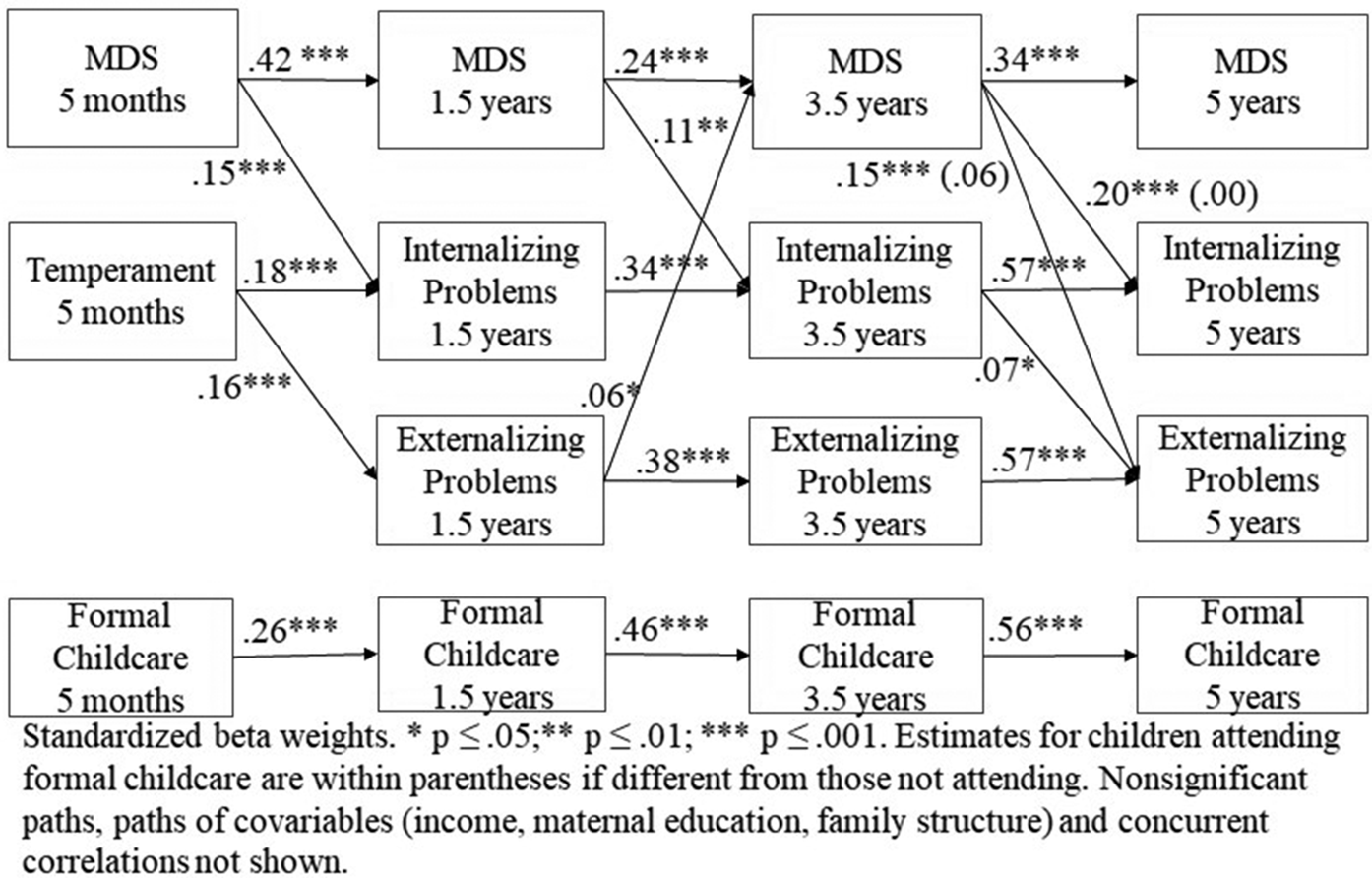
The transactional model yielded a good fit (Table 5). The transactional model is illustrated in Figure 4. The paths between the main variables of the transactional model are documented in the supplementary materials (Table S1). The model showed moderate stability in MDS from 5 months to 5 years and for internalizing and externalizing problems from 1.5 to 5 years, with standardized β ranging from .34 to .58. Attending formal childcare indicated a low to moderate stability, with standardized β ranging from .26 to .56. This was expected since the use of formal childcare and more specifically center-based childcare becomes more common as the child gets older (Desrosiers, Gingras, Neill, & Vachon, Reference Desrosiers, Gingras, Neill and Vachon2004; Early & Burchinal, Reference Early and Burchinal2001).
Transactional model results.

Fit indices of the models

For the cross-lagged paths, we found significant positive associations between MDS and subsequent child internalizing problems at all time points, between MDS and subsequent child externalizing problems from 1.5 to 3.5 years, and between internalizing and subsequent externalizing problems from 3.5 to 5 years. No significant associations were found between formal childcare and MDS or child internalizing or externalizing problems. Concurrent links were statistically significant between MDS and temperament at 5 months, between MDS and internalizing problems at 1.5 and 3.5 years, between MDS and externalizing problems at 1.5 and 5 years, between internalizing and externalizing problems at 1.5, 3.5, and 5 years, and between internalizing problems and childcare at 1.5 years. R-squared values indicated that the model explained between 8% (at 5 months) and 28% (at 1.5 years) of the variance in MDS, between 9% (at 1.5 years) and 37% (at 5 years) of the variance in internalizing problems, and between 6% (at 1.5 years) and 41% (at 5 years) of the variance in externalizing problems.
Child Protection Model
Fit indices for the child protection model were good (Table 5). The paths of the child protection model are documented in the supplementary materials (Table S2). The results supporting the child protection model indicate that formal childcare at 3.5 years significantly moderated the associations between MDS at 3.5 years and child internalizing problems at 5 years, β = −.11, p = .02, and between MDS at 3.5 years and child externalizing problems 5 years, β = −.12, p < .01.
A simple slope analysis indicated that higher MDS at 3.5 years was significantly associated with higher child internalizing and higher externalizing problems at 5 years for those children not attending formal childcare, β = .20, p < .001 and β = .15, p = .001, respectively, while the association was not significant for children who did attend formal childcare at 3.5 years, β = .06, p = .13 and β = .00, p = .88, respectively. The results are illustrated in Figure 5.
Child protection model results.

Mother Protection Model
Fit indices for the mother protection model were good (Table 5). The paths of the mother protection model are documented in Table S3. For the mother protection model, none of the interactions were statistically significant (all p’s > .05), indicating that formal childcare attendance did not moderate associations between child internalizing and subsequent MDS and between externalizing problems and subsequent MDS at any of the time points.
Moderation by Child's Sex
We performed multigroup analyses to evaluate if some paths differed between boys and girls. We first allowed all paths to differ between boys and girls (unconstrained models).
Transactional model
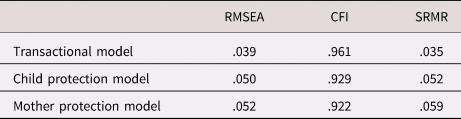
Fit indices for the unconstrained transactional model were good (Table 6). The paths of the transactional model for girls are documented in Table S4 and for boys in Table S5. Differences were found between girls and boys for the associations between MDS at 3.5 years and externalizing problems at 5 years, ΔSB-χ2 (1, N = 908) = 4.30, p = .04, and between externalizing problems at 3.5 years and MDS at 5 years, ΔSB-χ2 (1, N = 908) = 7.50, p < .01. Results demonstrated that higher MDS at 3.5 years was significantly associated with higher child externalizing problems at 5 years for girls, β = .12, p < .01, but not for boys, β = −.04, p > .05. Furthermore, among girls, higher externalizing problems at age 3.5 years were significantly associated with higher MDS at 5 years, β = .14, p < .01, while for boys, externalizing problems were not associated with later MDS, β = −.01, p > .05.
Fit indices of the unconstrained models

Child protection model
Fit indices for the unconstrained child protection model were good (Table 6). The paths of the interaction terms for girls and boys are documented in Table S6. We tested whether the moderating effect of formal childcare on the associations between MDS and child behavior problems differed for boys and girls. Formal childcare at 3.5 years moderated the link between MDS at 3.5 years and child internalizing and externalizing problems at 5 years, with no difference for boys and girls (all p’s > .05). Furthermore, formal childcare at 5 months did not moderate the links between MDS at 5 months and child internalizing and externalizing problems at 1.5 years for boys and girls. Formal childcare at 1.5 years also did not moderate the associations between MDS at 1.5 years and child internalizing and externalizing problems at 3.5 years for boys and girls.
Mother protection model
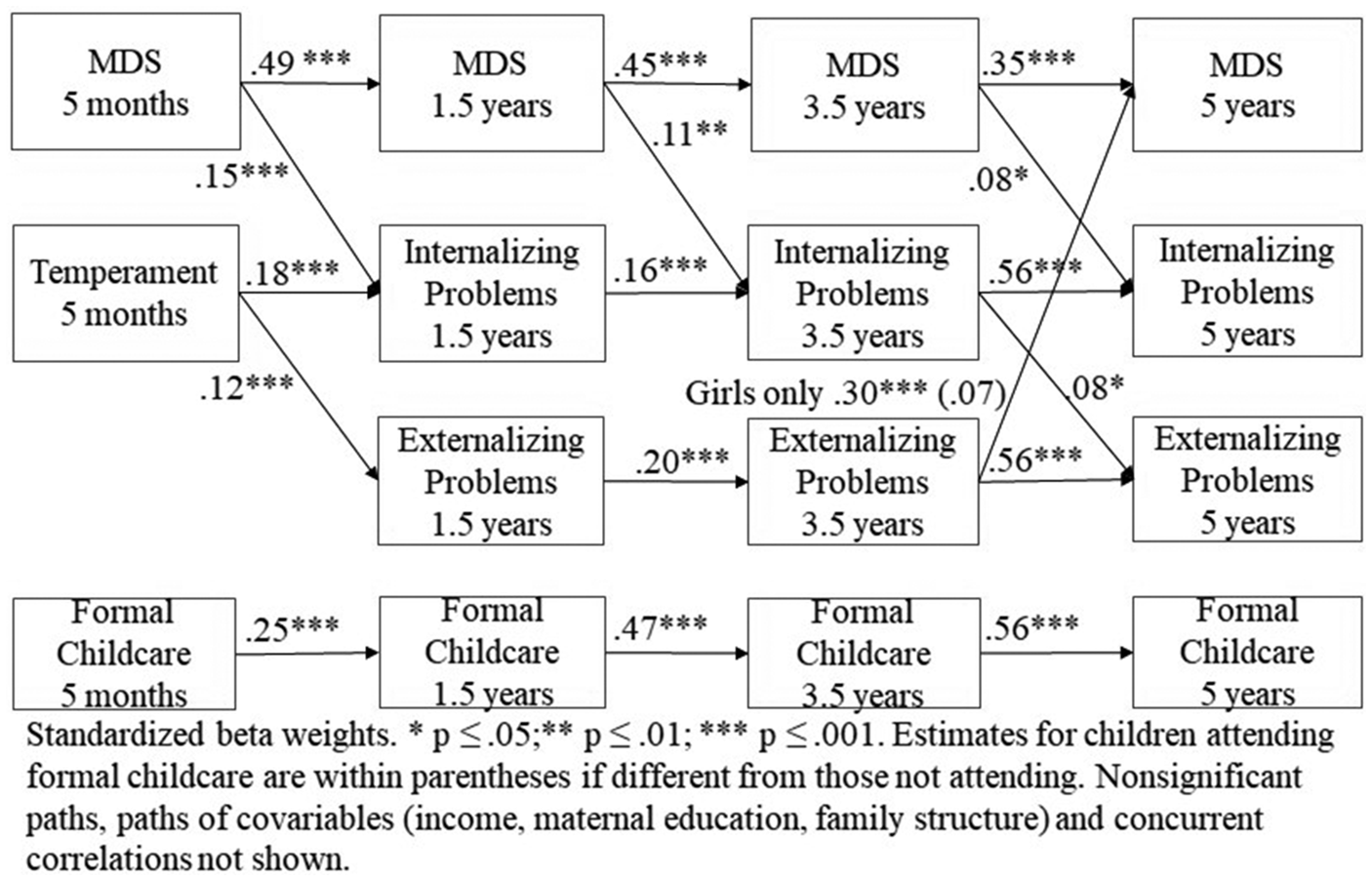
Fit indices for the unconstrained mother protection model were good (Table 6). The paths of the interaction terms for girls and boys are documented in Table S7. We tested whether the moderating effect of formal childcare on the associations between child behavior problems (temperament at 5 months, internalizing and externalizing problems at 1.5 and 3.5 years), and MDS differed for boys and girls. Differences were found between girls and boys between MDS at 3.5 years and externalizing problems at 5 years, ΔSB-χ2 (1, N = 908) = 4.25, p = .04. The mother protection model is illustrated in Figure 6. The results indicated formal childcare at 3.5 years moderates the association between externalizing behavior at 3.5 years and MDS at 5 years for girls, β = −.15, p < .05, but not for boys, β = .07, p = .51. A simple slope analysis indicated that, for girls, externalizing problems at 3.5 years were not significantly associated with MDS at 5 years for those attending formal childcare at 3.5 years, β = .07, p = .37, while the association was significant for those not attending formal childcare at 3.5 years, β = .30, p = .001. Thus, the mother protection model was supported for externalizing problems in girls only.
Mother protection model results.

Discussion
Using data from a large-scale longitudinal study, we sought to probe the longitudinal transactional associations between MDS and child behavior problems and whether attending formal childcare could be associated with MDS and/or child behavior problems or moderate the associations between MDS and child behavior problems. The first objective of this study was to clarify whether MDS is associated with more internalizing and externalizing problems or whether internalizing and externalizing problems may be associated with increased MDS over the period spanning from infancy to age 5 years. We tested a transactional model, which confirmed that MDS was associated with increased child internalizing problems at all time points and with increased externalizing problems between 1.5 and 3.5 years. These associations are consistent with the literature (Conroy et al., Reference Conroy, Pariante, Marks, Davies, Farrelly, Schacht and Moran2012; Goodman et al., Reference Goodman, Rouse, Connell, Broth, Hall and Heyward2011). This also highlights the need to support mothers much beyond the first year after delivery. However, no associations were found between child internalizing problems and MDS. This is also consistent with some previous studies (Fanti et al., Reference Fanti, Panayiotou and Fanti2013; Villodas et al., Reference Villodas, Bagner and Thompson2018). Furthermore, no associations were found between child externalizing problems and MDS before testing for differences between boys and girls. This is also consistent with results from Fanti et al. (Reference Fanti, Panayiotou and Fanti2013). Finally, we also found an association between internalizing problems at 3.5 years and externalizing problems at 5 years. This result contrasts with other studies reporting directional associations between externalizing problems and subsequent internalizing problems (Gromoske & Maguire-Jack, Reference Gromoske and Maguire-Jack2012; Timmermans et al., Reference Timmermans, van Lier and Koot2010; Villodas et al., Reference Villodas, Bagner and Thompson2018) or no association (Fanti et al., Reference Fanti, Panayiotou and Fanti2013) at a similar age. This suggests that more studies are needed to better understand the underlying mechanisms explaining the potential mutual influence between internalizing and externalizing problems.
The second objective was to test whether attending formal childcare was associated with MDS and/or child internalizing or externalizing problems. Attending formal childcare was not associated with MDS. This is consistent with previous research indicating a positive but not significant effect of childcare on maternal depression (Kröll & Borck, Reference Kröll and Borck2013). Furthermore, while some studies have highlighted a positive or negative direct effect of formal childcare on child behavior problems, our results add to the body of research indicating no association of formal childcare attendance with child internalizing and externalizing problems (irrespective of MDS).
The third objective was to test whether formal childcare attendance moderated associations between MDS and subsequent child behavior problems as well as between child behavior problems and subsequent MDS. To address this objective, we empirically tested two different moderation models: the child protection and the mother protection models. The child protection model hypothesized that the association between MDS and child behavior problems would be weaker for children attending formal childcare compared with those not attending childcare. Attending formal childcare moderated longitudinal associations between MDS at 3.5 years and internalizing and externalizing at 5 years but not at other time points, thus indicating a potential timing effect and partial support for the child protection model. This timing effect might indicate that children may benefit more from a formal environment when they reach a certain stage of development. Attending formal childcare increases the opportunities for the child to interact with other adults and peers (Schindler et al., Reference Schindler, Moely and Frank1987) and to learn more socially appropriate behavior. The educator has the opportunity to help an anxious child to initiate contacts and to help a child modify a negative behavior (Coplan & Prakash, Reference Coplan and Prakash2003). Our results are consistent with those of Herba et al. (Reference Herba, Tremblay, Boivin, Liu, Mongeau, Séguin and Côté2013), who found that attending childcare was associated with reduced risk for internalizing problems for children of mothers with elevated MDS, whereas benefits did not differ among children who started attending before or after 1.5 years or who attended more or less intensively. Lee et al. (Reference Lee, Halpern, Hertz-Picciotto, Martin and Suchindran2006) studied the influence of childcare attendance between 2 and 3 years, and consistent with our findings, the association between MDS and externalizing problems was not mitigated by childcare. However, they reported that childcare attendance mitigated the association between MDS and internalizing problems during the same period. According to Gjerde et al. (Reference Gjerde, Eilertsen, Reichborn-Kjennerud, McAdams, Zachrisson, Zambrana and Ystrom2017), the strongest association between MDS and internalizing problems is for MDS measured concurrently with child behavior problems. The difference between our and Lee et al.’s (Reference Lee, Halpern, Hertz-Picciotto, Martin and Suchindran2006) results may be due to the shorter time interval between measurement points used in Lee et al.’s study (2 to 3 years) compared with ours (1.5 years to 3.5 years).
The mother protection model hypothesized that the association between internalizing or externalizing problems and subsequent MDS would be weaker for children attending formal childcare compared with those cared by their mother at home. Our results did not support this hypothesis for the overall model including boys and girls, but there was a sex difference, which is discussed below.
The fourth objective was to test whether child's sex moderated transactional associations between MDS and child behavior problems and whether the moderating role of formal childcare differed for boys and girls. Using the transactional model, we did not find sex differences in transactional links between MDS and child behavior problems, with two exceptions. The first one is the association between MDS at 3.5 years and externalizing problems at 5 years, which was significant only for girls. However, when we tested the child protection model, we found that childcare moderated this association similarly for boys and girls. Thus, the differences between boys and girls in the transactional model are likely because attendance of formal childcare was not considered. The second exception was found for the association between externalizing problems at 3.5 years and MDS at 5 years which was significant for girls but not for boys. Furthermore, when testing the mother protection model, we found that, for girls, externalizing problems at 3.5 years was associated with increased MDS at 5 years for those not attending formal childcare but not for those attending formal childcare. This result suggests that mothers of girls presenting externalizing problems are at greater risk of MDS if their child does not attend formal childcare. This might be because externalizing behavior in girls is less socially acceptable, causing more stress and feelings of incompetence for these mothers, which in turn may be linked to more MDS (Gartstein & Sheeber, Reference Gartstein and Sheeber2004). It also indicates that formal childcare may be associated with benefits for both the mother and the child.
Our study has several strengths, including the use of a large-scale longitudinal study, a cross-lag statistical approach to more carefully examine transactional associations over time, and the use of well-validated measures of the constructs of interest. Information about MDS, child behavior problems, and the use of formal childcare was collected at different time points from infancy to age 5 years allowing for a better understanding of the moderating role of formal childcare over time on the transactional associations between MDS and child internalizing and externalizing problems. Although the study has several strengths, it has the following limitations. First, the magnitude of the associations between MDS and child behavior problems were small. Other variables not included in the model could play a role and conceivably influence the level of MDS and/or child behavior problems over time such as marital dissatisfaction/partner support (Beach, Reference Beach2001; Malik et al., Reference Malik, Boris, Heller, Harden, Squires, Chazan-Cohen and Kaczynski2007), parenting practices (Goodman & Garber, Reference Goodman and Garber2017), stressful life events (Caspi et al., Reference Caspi, Sugden, Moffitt, Taylor, Craig, Harrington and Braithwaite2003; Plieger, Melchers, Montag, Meermann, & Reuter, Reference Plieger, Melchers, Montag, Meermann and Reuter2015), family functioning (Malik et al., Reference Malik, Boris, Heller, Harden, Squires, Chazan-Cohen and Kaczynski2007), the quality of the home environment (Watamura, Phillips, Morrissey, McCartney, & Bub, Reference Watamura, Phillips, Morrissey, McCartney and Bub2011), or of the childcare setting (Charrois et al., Reference Charrois, Côté, Japel, Séguin, Paquin, Tremblay and Herba2017). Furthermore, we were not able to take into consideration genetic influences of MDS on child internalizing and externalizing problems as well as other mental or physical health problems (Carter, Garrity-Rokous, Chazan-Cohen, Little, & Briggs-Gowan, Reference Carter, Garrity-Rokous, Chazan-Cohen, Little and Briggs-Gowan2001; Stein & Newcomb, Reference Stein and Newcomb1994), treatment for MDS such as therapy (Goodman & Garber, Reference Goodman and Garber2017; Reuben, et al., Reference Reuben, Shaw, Brennan, Dishion and Wilson2015), or medication (Weissman et al., Reference Weissman, Wickramaratne, Pilowsky, Poh, Batten, Hernandez and Blier2015). Second, we used mother reports of MDS and child behavior problems, which could create a shared method variance problem. However, this problem was reduced because MDS at one time-point was examined in relation to child behavior at another time point. Furthermore, even though depressed mothers might tend to over-report child behavior problems, it represents only a small contribution to the measure (Goodman et al., Reference Goodman, Rouse, Connell, Broth, Hall and Heyward2011). Third, the current study focused on maternal depression and did not study mechanisms pertaining to other aspects of the mother–child relationship or home environment. Fourth, a selection bias could have affected our results: other variables not included in the study could influence the family's decision to use formal childcare or not. While a selection bias may have influenced our results, we found some interesting patterns corroborating previous research. Furthermore, we controlled for the potential influence of MDS and child behavior problems on the choice to attend formal childcare or not by including childcare in our models. Fifth, we did not examine intensity of attendance such as average number of hours per week. However, previous studies indicated that even low intensity attendance was sufficient to benefit the children of mothers with higher depressive symptoms (Giles et al., Reference Giles, Davies, Whitrow, Warin and Moore2011). Finally, while the study design informs us on the relation between the study variables, it cannot be used to determine causality.
Despite these limitations, the present study builds on prior research showing relations between maternal depression, child behavior problems, and formal childcare attendance from infancy to age 5 years. Further studies are needed to replicate results across different samples (e.g., clinically depressed mothers) and different time intervals to better understand the relations between MDS and child behavior problems and formal childcare.
In conclusion, the study provides partial support for the child protection model and the mother protection model. More specifically, it suggests that formal childcare attendance, particularly around ages 3–4 years, buffers the association between MDS and subsequent internalizing and externalizing problems for boys and girls and between externalizing problems and subsequent MDS for girls. These results are consistent with previous studies suggesting beneficial effects of formal childcare for children from vulnerable environments (multiple risk factors, low income, and low maternal education). Future studies are needed to understand the dynamic interplay of MDS and child behavior problems. Different mechanisms might be at play depending on the specific child difficulty. Furthermore, as our results suggest, attending childcare could influence child development, but little is known about the potential underlying mechanisms explaining this influence such as a better socialization process, including more frequent peer interactions and educator support for children attending formal childcare or improved emotion regulation.
Supplementary material
The supplementary material for this article can be found at https://doi.org/10.1017/S0954579419000956
Acknowledgment
The authors are extremely grateful to the families who took part in this study and the Direction des enquêtes longitudinales et sociales of the Institut de la statistique du Québec. This work was supported by doctoral bursary from the Fonds de Recherche en Santé- Québec (FRQS) to Chantal Paquin and a FRQS salary award to Catherine Herba. The larger Quebec Longitudinal Study of Child Development was also supported by funding from the Quebec provincial government’s ministère de la Famille and ministère de l’Éducation et de l’Enseignement supérieur, the Lucie and André Chagnon Foundation, the CHU Sainte-Justine Research Center and the Institut de la statistique du Québec.