INTRODUCTION
Common bobtail squid Sepietta oweniana (d'Orbigny, 1841) inhabits the eastern Atlantic Ocean and the Mediterranean Sea. The biology of S. oweniana is well known and summarized in Reid & Jereb (Reference Reid, Jereb, Jereb and Roper2005). Despite several papers on this species' reproductive biology (Bello & Deickert, Reference Bello and Deickert2003; Deickert & Bello, Reference Deickert and Bello2005; Cuccu et al., Reference Cuccu, Mereu, Cannas, Marcias, Cau and Jereb2010; Czudaj et al., Reference Czudaj, Pereira, Moreno, Costa, Saint-Paul and Rosa2012) and feeding (Bergstrøm, Reference Bergstrøm1985; Orsi Relini & Massi, Reference Orsi Relini and Massi1988), these aspects are still insufficiently studied, especially in northern parts of its range. The northern border of the species range is ~70°N on the Norwegian shelf (Grimpe, Reference Grimpe1933; Bergstrøm & Summers, Reference Bergstrøm, Summers and Boyle1983). The ongoing warming of the Arctic (Walther et al., Reference Walther, Post, Convey, Menzel, Parmessan, Beebee, Fromentin, Hoegh-Guldberg and Bairlein2002; Walczowski & Piechura, Reference Walczowski and Piechura2006; Walsh, Reference Walsh2008) induces the subsequent spreading of boreal and boreo-subtropical Atlantic species of fish and invertebrates into this area (Berge et al., Reference Berge, Johnsen, Nilsen, Gulliksen and Slagstad2005; Johannesen et al., Reference Johannesen, Høines, Dolgov and Fossheim2012; Nekhaev, Reference Nekhaev2013). A northward expansion of North Atlantic cephalopods into the Arctic might be expected, and it is already described for some species of squid (Sabirov et al., Reference Sabirov, Golikov, Nigmatullin and Lubin2012; Golikov et al., Reference Golikov, Sabirov, Lubin and Jørgensen2013).
The main purpose of this paper is to report the northernmost record of S. oweniana, to describe its reproductive system and feeding in the new area of distribution. The occurrence of this species in the Barents Sea and the ongoing processes of the Arctic warming are also discussed.
MATERIALS AND METHODS
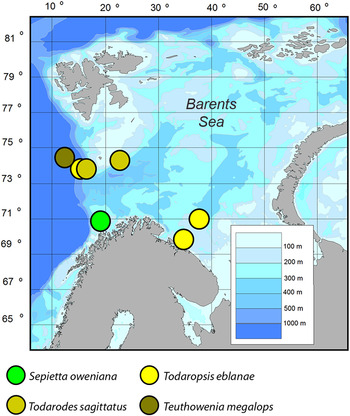
A single specimen of Sepietta oweniana was captured in the Tromsø Bank (70°54′N 19°46.8′E; depth 175 m) (Figure 1) by a demersal trawl on-board RV ‘G.O. Sars’ on 17 September 2013 at about 2:30 a.m. Species identification was performed according to the criteria of Nesis (Reference Nesis1987) and Reid & Jereb (Reference Reid, Jereb, Jereb and Roper2005). The specimen is kept in the Zoological Museum of Kazan Federal University (Kazan, Russia). Mantle length (ML), total body length (TBL) and body weight (BW) were measured, maturity stage and stomach fullness were determined, followed by the detailed analysis of reproductive system as well as measuring and examination of some parts of digestive system. The relative length and weight were calculated for the most of the measurements taken. The scale of maturity stages was modified from Lipinski & Underhill (Reference Lipinski and Underhill1995) and the scale of stomach fullness was used from Breiby & Jobling (Reference Breiby and Jobling1985). The analysis of the stomach content was performed, and prey remains were determined to the nearest possible taxonomic group.
The occurrence of boreo-subtropical species of cephalopods in the Barents Sea and adjacent areas.

RESULTS
The new record of Sepietta oweniana was located at the Tromsø Bank, which is ~100 km north-east of the recent known northern border of the species range. This area is influenced by the North Cape Current, and the mean annual bottom temperature exceeds here +6°С (Jakobsen & Ozhigin, Reference Jakobsen and Ozhigin2012).
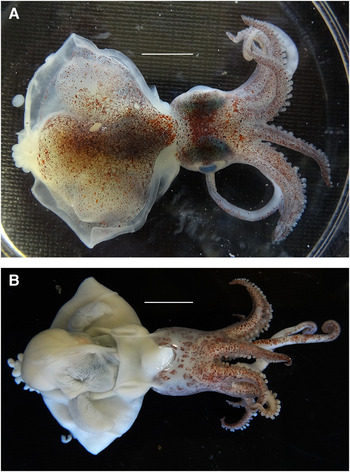
The specimen had ML 28 mm, TBL 59 mm and BW 3.7 g. Its arms had biserial suckers. Tentacular clubs were with 32 tiny uniform-sized suckers in transverse rows. Bursa copulatrix was almost square with sizes 10 × 8.5 mm, covering most of the left side of the mantle cavity (Figure 2). The specimen was a maturing female at maturity stage IV. The relative weight of the whole reproductive system was 11.73% BW and the relative weight of the ovary was 2.51% BW. In the ovary, 408 oocytes were found, over 95% of them at a previtellogenetic phase. Among vitellogenetic oocytes, the largest ones were 3.3 mm in diameter (1.2% ML). No atretic oocytes were observed. No spermatangia were found in the bursa copulatrix.
Sepietta oweniana, maturing female, mantle dissected: (A) dorsal view; (B) ventral view. Scale bar: 1 mm.

Stomach fullness was at the stage ‘1–2’ (almost half full). Stomach length was 9.4 mm and its weight was 0.044 g. The relative weight of the stomach content was 0.76% BW, and consisted of unidentifiable organic matter (50%), and fatty substance and drops (8%). The remaining 42% were fragments of Crustacea making up more than 150 pieces of shell and appendages. Mysids (order Mysida) were identified by the shape and structure of mandibles (one pair), antennal scale (one piece) and uropods (one pair). Nine cycloid scales were found; mean diameter 0.7 mm. They were identified to a juvenile ling fish (family Lotidae) with body length in the range of 10 to 15 mm. It is less than 25% TBL of sampled S. oweniana. Fish eating has never been recorded for the bobtail squid of the Sepiolinae subfamily previously (Boletzky et al., Reference Boletzky, Boletzky, Frosch and Gatzi1971; Reid & Jereb, Reference Reid, Jereb, Jereb and Roper2005). Caecum length was 10.9 mm and its weight was 0.076 g. Unidentifiable organic matter, making up twice as much weight as the whole stomach content, was recorded inside the caecum. Sepiolinae feed at night (Boletzky et al., Reference Boletzky, Boletzky, Frosch and Gatzi1971; Bergstrøm, Reference Bergstrøm1985; Orsi Relini & Massi, Reference Orsi Relini and Massi1988) and have fast digestion rates (Bidder, Reference Bidder, Wilbur and Yonge1966). So the caecum content must have been eaten the same night that the sepioline squid was captured. Therefore, its last meal consisted of 2–3 mysids and one juvenile ling fish. The active feeding of the S. oweniana specimen at the Tromsø Bank was also indicated by a large relative weight of liver (8.73% BW).
DISCUSSION
Sepietta oweniana was recorded in the south-western part of the Barents Sea for the first time. This area is influenced by the incoming Atlantic waters. Their warming was confirmed by many evidences (Walther et al., Reference Walther, Post, Convey, Menzel, Parmessan, Beebee, Fromentin, Hoegh-Guldberg and Bairlein2002; Walczowski & Piechura, Reference Walczowski and Piechura2006; Walsh, Reference Walsh2008). In the same area of the Barents Sea, three boreal-subtropical species of squid were recorded (Figure 1). Two of them, Teuthowenia megalops (Prosch, 1847) and Todaropsis eblanae (Ball, 1841), are not active nekton swimmers, and their occurrence in this northern area must include diffuse spreading due to warming. The observed abnormalities within the maturation process indicate that new parts of their ranges are the zones of non-reproductive spreading (Sabirov et al., Reference Sabirov, Golikov, Nigmatullin and Lubin2012; Golikov et al., Reference Golikov, Sabirov, Lubin and Jørgensen2013). The hydrological preferences of Todarodes sagittatus (Lamarck, 1798) migrations into the Arctic are not reported. Foraging shoals of immature squid occur quite regularly within intervals from 1 to 27 years (Wiborg et al., Reference Wiborg, Gjøsaeter and Beck1982; Golikov et al., Reference Golikov, Sabirov, Lubin and Jørgensen2013).
The occurrence of S. oweniana in the Tromsø Bank is connected mainly with warming, and is supposed to have happened quite often during the last decade. The food preference of S. oweniana can also be changed in the new northern area. In particular, it included ling fish, as shown by scales in its stomach. Sepiolinae are known to capture only alive prey (Boletzky et al., Reference Boletzky, Boletzky, Frosch and Gatzi1971; Reid & Jereb, Reference Reid, Jereb, Jereb and Roper2005). However laboratory studies showed that, even in low prey abundance, S. oweniana did not attack offered fish with body length about 2/3 TBL (Bergstrøm, Reference Bergstrøm1985). Nevertheless our specimen of S. oweniana captured the juvenile ling fish with a body length about 1/4 TBL (fish size had been estimated according to the diameter of fish scales).
No abnormalities were recorded in the reproductive system structure of the captured specimen. Its ML corresponded to ML of maturing females in the North Sea. Fecundity also lay within known values recorded for S. oweniana, varying from 106 to 1613 eggs (Bergstrøm & Summers, Reference Bergstrøm, Summers and Boyle1983; Bello & Deickert, Reference Bello and Deickert2003; Reid & Jereb, Reference Reid, Jereb, Jereb and Roper2005; Cuccu et al., Reference Cuccu, Mereu, Cannas, Marcias, Cau and Jereb2010; Czudaj et al., Reference Czudaj, Pereira, Moreno, Costa, Saint-Paul and Rosa2012). Considering short duration of the life cycle of S. oweniana (no more than 9 months) (Reid & Jereb, Reference Reid, Jereb, Jereb and Roper2005), our specimen could reach the maturation in late autumn, during the period of low mean annual bottom temperatures (less than +5°С) (Jakobsen & Ozhigin, Reference Jakobsen and Ozhigin2012). It seems unlikely that sepioline can realize their reproductive efforts in such environmental conditions.
Thus, all the reported records of boreo-subtropical cephalopods in the Arctic can be divided into two groups:
-
1. Foraging migrations happening regularly and take place during an unknown period of and without any connection with the warming (T. sagittatus).
-
2. Expansions induced by the ongoing Arctic warming have taken place during the current decade (S. oweniana, T. megalops and T. eblanae). These Atlantic species of cephalopods are carried by warm currents into the Arctic, where they either lose the reproductive functions or cannot realize them.
ACKNOWLEDGEMENTS
We thank scientific group and crew of RV ‘G.O. Sars’ during the ecosystem cruise in September 2013, for their assistance on-board. Also we are grateful to Dr R. Burukovsky for his advices on stomach content analysis and Dr F. Gizatullin for improving the English language. The valuable comments of two anonymous referees are gratefully acknowledged. This research was partly supported by the Norwegian–Russian Program of the Barents Sea ecosystem survey.