INTRODUCTION
It is well known that the successful second-language (L2) acquisition is a function of diverse factors across linguistic, cognitive, and affective domains. In particular, linguistic factors have long been a major topic of L2 research because of their direct influence on the process of L2 acquisition. In this regard, noteworthy is the relationship between L1 and L2 skills, and accordingly, issues regarding the L1-L2 relationship have received substantial attention from researchers as early as 1970s. The linguistic interdependence hypothesis (LIH), which was proposed by Cummins (Reference Cummins1979) in the context of bilingual education, is the first systematic theorizing about the L1-L2 relation. This theory is based on the idea that the level of L2 competence reached by an L2 learner is a function of the type of competence the learner develops in L1 (Cummins, Reference Cummins1979), suggesting that L1 and L2 skills are shared and interdependent at some fundamental level (Bernhardt & Kamil, Reference Bernhardt and Kamil1995; Cummins, Reference Cummins1991).
Since the initial conceptualization of the LIH, the possibility that the relation between L1 and L2 skills may be moderated by a third confounding variable has also attracted attention from researchers. The linguistic threshold hypothesis (LTH), for instance, notes learner’s L2 proficiency as a variable moderating the relationship between L1 and L2 skills. Specifically, the LTH posits that the strength of the relationship between L1 and L2 varies as a function of the learner’s current level of L2 proficiency, which implies the presence of a linguistic threshold below which the successful transfer of L1 skills to L2 performance cannot occur or is “short-circuited” (Alderson, Reference Alderson, Alderson and Urquhart1984; Bernhardt & Kamil, Reference Bernhardt and Kamil1995; Clarke, Reference Clarke1979; Cummins, Reference Cummins1979). This hypothesis has motivated studies focusing on identifying a threshold in L2 acquisition typically in the context of L2 reading (e.g., Bossers, Reference Bossers1991; Lee & Schallert, Reference Lee and Schallert1997; Taillefer, Reference Taillefer1996). It merits attention, however, that previous studies on the LTH have tended to focus on comparing the correlation between L1 and L2 (e.g., Lee & Schallert, Reference Lee and Schallert1997) or the R 2 value (e.g., Bossers, Reference Bossers1991; Taillefer, Reference Taillefer1996) between low- and high-L2-proficiency groups to empirically test the validity of the LTH, which fails to provide a statistical evidence for the causal relationships among variables (Takakuwa, Reference Takakuwa, Cohen, McAlister, Rolstad and MacSwan2005).
More recently, researchers have shifted attention to the presence of other moderating variables, such as different types of language skills or contextual factors (e.g., language use). Existing evidences suggest that the strength of the L1-L2 relation differs according to different types of language skills, such as word-level skills or oral skills (Proctor, August, Snow, & Barr, Reference Proctor, August, Snow and Barr2010; Verhoeven, Reference Verhoeven1994) and the amount of language use (Prevoo, Malda, Emmen, Yeniad, & Mesman, Reference Prevoo, Malda, Emmen, Yeniad and Mesman2015), hence clearly indicating a moderating role played by these variables. Effect of tasks with different cognitive demands is another potential moderator because it makes an intuitive sense that the strength of the relationship between L1 and L2 skills may differ for tasks with different cognitive complexity (Pae, Reference Pae2011; Skehan & Foster, Reference Skehan and Foster1997; Vandergrift, Reference Vandergrift2006). However, few studies have been done to empirically test this possibility and, accordingly, it still remains unanswered whether or not the strength of the relation between L1 and L2 is invariant according to the level of L2 proficiency across tasks with different cognitive loads, despite the theoretical and pedagogical importance attached to this research question. The main purpose of the present study is to systematically examine the moderating effects of task type and L2 proficiency on the relation between L1 and L2 simultaneously for reading and writing in the context of English as a foreign language (EFL) learning using a more advanced method of moderator analysis through structural equation modeling (SEM).
RESEARCH BACKGROUND
As noted earlier, the LIH has been the main theory that has guided the relationship between L1 and L2. With respect to the bivariate relationship between L1 skills and L2 performance, previous studies have consistently pointed to significant main effects of L1 skills on successful L2 performance for diverse samples with different L1 backgrounds and age ranges (e.g., Bossers, Reference Bossers1991; Brisbois, Reference Brisbois1992; Carrell, Reference Carrell1991; Cziko, Reference Cziko1976; Greaney, Reference Greaney and Greaney1977; Lee & Schallert, Reference Lee and Schallert1997; Tucker, Reference Tucker, Smiley and Towner1975) across various measures of L2 outcomes from general language proficiency to individual language skills, such as vocabulary or reading (e.g., Cziko, Reference Cziko1976; Greaney, Reference Greaney and Greaney1977; Proctor, August, Carlo, & Snow, Reference Proctor, August, Carlo and Snow2006; Tucker, Reference Tucker, Smiley and Towner1975; van Gelderen, Schoonen, Stoel, Glopper, & Hulstijn, Reference Van Gelderen, Schoonen, Stoel, Glopper and Hulstijn2007), suggesting that better L1 skills can foster successful L2 performance. These findings form the basis of the belief that L1 and L2 skills are intertwined and develop in an interdependent manner (Bernhardt & Kamil, Reference Bernhardt and Kamil1995; Cummins, Reference Cummins1979). From the field of special education, based on the idea that both L1 and L2 share a similar basic language learning mechanism (Sparks, Reference Sparks1995), Sparks and colleagues also observed a strong linkage between L1 skills and L2 performance. More recently, they reported that high school or college L2 learners with a higher level of L2 proficiency and classroom achievement have stronger L1 skills than their counterparts with a weaker level of L2 proficiency and accomplishment (e.g., Ganschow & Sparks, Reference Ganschow and Sparks2001; Sparks, Patton, Ganschow, & Humbach, Reference Sparks, Patton, Ganschow and Humbach2009; Sparks, Patton, Ganschow, Humbach, & Javorsky, Reference Sparks, Patton, Ganschow, Humbach and Javorsky2008).
At the same time, the relationship between L1 and L2 skills has been reported to be moderated by the level of the learner’s L2 proficiency, indicating that the strength of the relationship between L1 and L2 skills varies according to the level of L2 proficiency. A moderating effect occurs when the direction or strength of the relationship between an independent variable and the dependent variable is changed by a third variable or a moderator (Baron & Kenny, Reference Baron and Kenny1986; Holmbeck, Reference Holmbeck1997). Using the instructional level or combined index of the learner’s L2 knowledge of vocabulary and grammar as a measure of L2 proficiency, previous studies (e.g., Bossers, Reference Bossers1991; Lee & Schallert, Reference Lee and Schallert1997; Taillefer, Reference Taillefer1996) have reported that the strength of the relationship between L1 and L2 reading comprehension is significantly stronger for learners in the high-L2-proficiency group than those in the low-L2-proficiency group, verifying L2 proficiency as a variable moderating the relationship between L1 and L2 and providing further support for the validity of the LTH in the context of reading.
Existence of other moderators has also been actively researched in an effort to complement the traditional proficiency-based LTH. For example, Verhoeven (Reference Verhoeven1994) found that L1-L2 transfer was differentially made depending on the type of language skills; at the level of vocabulary and syntax L1 transfer was limited, whereas positive interdependence between L1 and L2 was observed at the level of pragmatic, phonological, and literacy skills. In a similar vein, Proctor et al. (Reference Proctor, August, Snow and Barr2010) suggested that the strength of the relationship between L1 and L2 varies as a function of the type of language skills (i.e., stronger for word-level skills and weaker for oral language) and the degree of resemblance between the two languages of interest (i.e., stronger for languages with more resemblance and weaker for languages with less resemblance), thus setting up an interdependence continuum based on type of language skills and the degree of resemblance. More recently, Prevoo et al. (Reference Prevoo, Malda, Emmen, Yeniad and Mesman2015) tested whether the relationship between L1 vocabulary and growth in L2 vocabulary is moderated by contextual factors such as the amount of child’s language use and her parents’ socioeconomic status (SES) using young bilingual children in the Netherlands. This study detected a significant moderating effect of L1 use, indicating that the effect of L1-L2 transfer in vocabulary was significant only for children using L1 more than L2.
Despite the conceptual link between task types and L1-L2 transfer (e.g., Vandergrift, Reference Vandergrift2006), effects of task type have separately been examined largely without subsuming them under the relevant theories of L1-L2 relation, which certainly raises a need to integrate task-type effects into the current research database on L1-L2 relationships. Previous studies on task types have focused on the types of questions such as global (i.e., inferential) and local (i.e., literal) questions in relation to measures of L2 performance. It is known that L2 learners have more difficulty answering inferential questions than literal questions and that, by the level of proficiency, learners in the low-ability group are more likely to have difficulty processing inferential information (Fincher-Kiefer, Reference Fincher-Kiefer1992; Johnson, Reference Johnson1981; Park, Reference Park2004). However, conflicting results have been reported on the relative difficulty of inferential versus literal listening questions (Park, Reference Park2004; Shohamy & Inbar, Reference Shohamy and Inbar1991; Tsui & Fullilove, Reference Tsui and Fullilove1998). Regarding the effects of task type on L2 writing, task type has been operationally defined in terms of the type of text, including descriptive, narrative, expository, and argumentative or persuasive writing (Conor, Reference Conor1996), in accordance with the contrastive rhetoric tradition, and it is generally agreed that argumentative or persuasive writing entails greater cognitive complexity than descriptive or narrative writing (Sasaki & Hirose, Reference Sasaki and Hirose1996). Previous studies of effects of task types with different levels of cognitive complexity on the quality of L2 production have produced mixed results. Empirical studies by Skehan and colleagues (Foster & Skehan, Reference Foster and Skehan1996; Skehan & Foster, Reference Skehan and Foster1997; Skehan, Foster, & Mehnert, Reference Skehan, Foster, Mehnert, Renandya and Jacobs1997) have reported the presence of differential task-type effect on measures of L2 production, indicating that the higher the complexity, the lower the complexity and accuracy of the linguistic output. However, it is also documented that writing tasks with higher cognitive complexity does not necessarily worsen the qualities of L2 writing performance; rather it was found that more cognitively demanding (MCD) writing tasks produce better L2 writing performance in terms of accuracy than less cognitively demanding (LCD) tasks (Hamp-Lyons & Mathias, Reference Hamp-Lyons and Mathias1994; Kuiken & Vedder, Reference Kuiken and Vedder2008; Robinson, Reference Robinson2001).
In terms of moderating effects of task or question type on the relation between L1 and L2, the authors have located only a couple of studies with direct relevance to the context of present study. For example, Taillefer (Reference Taillefer1996) reported that the transfer of L1 reading skills to the L2 reading process may be moderated by the nature of the targeted reading task (i.e., scanning and receptive skills). Elsewhere, in a study on the relationships between L1 listening, L2 proficiency, and L2 listening across two listening task types with different levels of cognitive complexity, Vandergrift (Reference Vandergrift2006) showed that L1 literal listening comprehension ability accounted for a significant percentage of the variance in L2 literal listening comprehension ability, whereas L1 inferential listening comprehension ability made no significant contribution to L2 inferential listening comprehension performance, which implies the moderating effect of task type on the transfer of L1 listening skills to L2 listening.
Task-type effects in relation to the LIH have also received very limited attention from writing researchers, and no studies have directly analyzed the relationships between L1 writing skills and L2 writing performance in tasks with different cognitive loads. Instead, studies have investigated the effects of these variables separately, and it is generally reported that L2 knowledge of grammar and vocabulary has a significant effect on L2 writing (e.g., Engber, Reference Engber1995; Grabe & Kaplan, Reference Grabe and Kaplan1996; Laufer & Nation, Reference Laufer and Nation1995). In terms of effects of L1 writing skills on L2 writing performance, however, studies have produced mixed results (e.g., Carson, Carrell, Silberstein, Kroll, & Kuehn, Reference Carson, Carrell, Silberstein, Kroll and Kuehn1990; Pae, Reference Pae2008; Pennington & So, Reference Pennington and So1993; Sasaki & Hirose, Reference Sasaki and Hirose1996; Schoonen et al., Reference Schoonen, van Gelderen, de Glopper, Hulstijn, Simis, Snellings and Stevenson2003).
Given the gap in the literature, this study investigates the effects of tasks with different cognitive complexity and L2 proficiency on the relationship between L1 skills and corresponding L2 performance simultaneously for reading and writing in the context of the LIH and the LTH using an EFL sample. The present study will significantly extend the current research database on the L1-L2 relations by addressing the research question of whether the strength of the L1-L2 relationship is invariant to the level of the learner’s L2 proficiency for reading and writing tasks with different levels of cognitive complexity. The results of this study are expected to shed more light on complex relationships between factors influencing the L1-L2 relationship and provide more balanced and updated implications on L2 learning and teaching. More specifically, a total of six research questions were formulated to systematically examine the relationships among L1 skills, L2 proficiency, and L2 performance between two sets of reading and writing tasks with different levels of cognitive complexity:
RQ1. What is the relative contribution of L1 reading to L2 reading in two reading tasks with different levels of cognitive complexity?
RQ2. What is the relative contribution of L1 writing to L2 writing in two writing tasks with different levels of cognitive complexity?
RQ3. What is the relative contribution of L2 proficiency to L2 reading performance across reading tasks with different levels of cognitive complexity?
RQ4. What is the relative contribution of L2 proficiency to L2 writing performance across writing tasks with different levels of cognitive complexity?
RQ5. Does the relationship between L1 and L2 reading vary according to the student’s L2 proficiency in reading tasks with different levels of cognitive complexity?
RQ6. Does the relationship between L1 and L2 writing vary according to the student’s L2 proficiency in writing tasks with different levels of cognitive complexity?
METHODS
Participants
The analysis was based on a total of 305 Korean second-year (equivalent to eleventh grade in the United States) high school students learning EFL. These participants were sampled from two coeducational high schools in a large city in Korea and were learning English for at least eight years both in the regular classroom setting and in afterschool classes offered by private institutions because English was an obligatory subject from the third year in elementary school in Korea. In terms of demographic characteristics, 58% of the participants (N = 177) were male, and the average parental SES was about middle.
Participants were selected using a two-step sampling procedure. First, the author explained the purpose of the present study in a school administrator program, which aims to provide local high school principals with opportunities for career development in the university where the author is currently teaching, and two high school principals agreed to participate in the present study. Then, the authors visited the two participating local high schools and explained the purpose of the present research again, this time to the English teachers. With the permission from the English teachers in the participating high schools, 10 intact second-year classes were randomly selected, five classes from each of the two participating high schools. Consent form was obtained from all the participants.
Instruments
The instruments included a total of five measures: an L1 reading comprehension test for LCD and MCD tasks, an L2 reading comprehension test for LCD and MCD tasks, an L1 writing test for LCD and MCD tasks, an L2 writing test for LCD and MCD tasks, and an L2 proficiency test. In the present study, cognitive complexity refers to the cognitive demand associated with a reading or writing test item. Specifically, in the case of reading, MCD tasks were operationally defined as higher level of inference tasks measuring test takers’ ability to infer various information or to evaluate a written text, hence tapping into reader’s global or inferential reading skills, whereas LCD tasks referred to lower level of inference or literal tasks requiring the test taker to process global information such as main ideas, or to understand factual information such as locating details and finding true or false statements about a given passage, thus measuring reader’s local or literal reading skills, as recommended by previous researchers (e.g., Alptekin & Erçetin, Reference Alptekin and Erçetin2011; Shohamy & Inbar, Reference Shohamy and Inbar1991; Walker, Munro, & Rickards, Reference Walker, Munro and Rickards1998). As for the writing tasks, MCD tasks in the present study were operationally defined as writing prompts requiring argumentative writing skills, whereas LCD tasks assessed narrative writing skills, as in accordance with Conor (Reference Conor1996) and Sasaki and Hirose (Reference Sasaki and Hirose1996).
L2 Reading Comprehension Test.
The English subtest of the Korean College Scholastic Aptitude Test (KCSAT) was used to measure English as an L2 reading ability. The English subtest of the KCSAT was a nationwide standardized test designed to measure the test taker’s English ability necessary for the successful completion of tertiary education. This test was annually developed by the Korean Institution for Curriculum and Evaluation (KICE) for the sole use that academic year. The development of the KCSAT was guided by a compulsory common test blueprint to minimize form-to-form variations. The English subtest of the KCSAT was composed of two main parts: listening comprehension and reading comprehension. The reading comprehension part, which is the focus of the present study, claimed to measure Korean college-bound students’ English reading ability through several item types, such as (a) the mood, tone, impression, and purpose of the passage; (b) the topic, main idea, and title of the passage; (c) paragraph inferences (e.g., what can be inferred from the given reading passage?); (d) specific information; (e) agreement or disagreement with the passage; (f) fill-in-the-blank questions; (g) vocabulary and grammar; (h) contextual meaning; and (i) indirect writing (Pae, Reference Pae2012).
Among these item types, to maximize the effect of cognitive complexity on two reading tasks, those items measuring the test taker’s ability (a) to infer the best words, phrases, or sentences in the given blank (fill-in-the-blank questions); (b) to choose what could be inferred from the given passage; (c) to infer a passage that could come before or after the given reading passage (paragraph inferences); and (d) to infer the best location where a given sentence could best fit (indirect writing) or the best order of scrambled sentences (sentence unscrambling) were classified as higher level of inference tasks (MCD), whereas those items measuring the test taker’s ability (a) to locate specific information; (b) to find statements agreeing or disagreeing with the given passage; and (c) to identify that the mood, purpose, topic, or main idea of a given passage were classified as lower level of inference or literal tasks (LCD). This classification scheme was further justified, given that the KCSAT test manual developed by the KICE stipulated that all English reading items be grouped into four major item groups or modules (e.g., [a] inferences; [b] indirect writing; [c] mood, main idea, and topic; and [d] specific information, agreement or disagreement), and the manual further classified the first two modules as more challenging tasks requiring higher levels of cognitive function and the last two modules as easier tasks with lower levels of cognitive complexity (KICE, 2010; Kim & Kwon, Reference Kim and Kwon2014).
To control for effects of specific item modules, a total of 20 items were constructed after necessary modifications from previous retired forms of the English subtest of the KCSAT for each of the two reading tasks, with 10 items for each of the two modules in LCD and MCD tasks.Footnote 1 All items were reviewed by two Korean teachers of English with sufficient teaching experience for content relevance. The internal consistency of the 20-item English reading comprehension test was measured using Cronbach’s alpha, and the values were 0.92 and 0.91 for MCD and LCD tasks, respectively.
L1 Reading Comprehension Test.
The Korean subtest of the High School Graduation Certificate Test (HGCT) for self-study students was selected as a measure of Korean as L1 reading comprehension ability because item types included in this test were similar to the measures of English reading comprehension in the present study. This nationwide standardized test was also annually developed by the KICE. The HGCT was designed to assess Korean self-study students’ eligibility for the high school diploma certificate in several content areas. More specifically, the Korean subtest of the HGCT measured the student’s Korean reading comprehension in macroprocessing skills (e.g., evaluating literary texts; paragraph inferences; fill-in-the-blank questions; indirect writing; and the tone, purpose, and main idea of the passage) as well as in microprocessing skills (e.g., the meaning of underlined parts, specific information, and agreement/disagreement with the passage). To maximize the similarity between L1 and L2 reading comprehension measures, item types such as evaluating literary texts, paragraph inferences, fill-in-the blank questions, and indirect writing were classified as MCD L1 reading tasks, whereas LCD tasks included item types such as the mood, topic, and purpose of the passage; the meaning of underlined parts; specific information; and agreement/disagreement. Again, as in the case of measures of English L2 reading comprehension, a test including a total of 20 items was constructed from previously administered forms of the Korean subtest of the HGCT for each of the two reading tasks, with roughly the same number of items for each item type. The content validity of the Korean reading comprehension test was evaluated by two expert Korean teachers. Cronbach’s alpha of the 20-item test was 0.81 and 0.79, respectively, for the more and LCD tasks.
Measure of L2 Proficiency.
L2 proficiency was assessed using two independent measures of the learner’s English vocabulary and grammar knowledge, as in previous research (e.g., Lee & Schallert, Reference Lee and Schallert1997; Zhang, Reference Zhang2012). English vocabulary knowledge was assessed using a total of 30 multiple-choice vocabulary items, out of which 15 items were selected from 3,000- and 5,000-word levels of the Vocabulary Levels Test (VLT; Nation, Reference Nation1990) and another 15 items were chosen from vocabulary parts of the regular national-level English achievement test administered by the KICE. The items from the VLT asked the test takers to match a given word to the meaning explanations without an accompanying reading passage. By contrast, the second set of the 15 vocabulary items from the retired forms of the Korean national achievement tests asked the test taker to choose a synonym to the underlined word in a given reading passage, thereby testing the contextual meaning of a given word. Finally, as a measure for English grammar knowledge, a total of 30 multiple-choice items were selected from grammar parts of past forms of the English subtest of the KCSAT after necessary modifications.Footnote 2 These grammar items asked the test takers to choose a grammatically correct or incorrect expression or a set of expressions from the five underlined parts in a given reading passage. Internal consistency was measured using Cronbach’s alpha, and the values were 0.93 for the English vocabulary test and 0.87 for the English grammar test.
L2 and L1 Writing.
A total of four writing prompts for two writing tasks requiring different levels of cognitive complexity were used to measure the student’s narrative (LCD) and argumentative (MCD) writing skills in both L1 and L2. All these writing prompts were selected based on topic familiarity and potential cultural differences. Each student was given 30 minutes to complete each writing task. More specifically, for narrative writing, the following two prompts were selected: “Tell me about your future dreams” (L2 narrative writing) and “If you could choose any place in the world to live, where would you choose?” (L1 narrative writing). Argumentative writing was also measured by two writing prompts:
L2 argumentative writing: “Some high schools require all students to wear school uniforms. Other high schools permit students to decide what to wear to school. Which of these two school policies do you think is better? Use specific reasons and examples to support your opinion.”
L1 argumentative writing: “Some people say that physical exercise should be a required part of every school day. Other people believe that students should spend the whole school day on academic studies. Which opinion do you agree with? Use specific reasons and details to support your answer.”
Two groups of independent raters (L2 and L1), with each group consisting of two raters, evaluated English and Korean essays for LCD and MCD writing tasks. All raters were teachers of English and Korean with sufficient teaching experience. These essays were rated based on the two-step scoring procedure recommended in Lee (Reference Lee2005) and Pae (Reference Pae2008). The first step required the rater to evaluate the student’s writing by using a holistic scoring system with a value ranging from 1 (poor) to 6 (excellent). Then the second step implemented an analytic scoring system in which the rater was asked to assign a score from 1 to 9 for the essay mainly in terms of vocabulary, grammar, and mechanics. Scores from the two-step scoring procedure were combined to form a final two-digit writing score for the essay. For instance, if a student’s essay received a score of 2 from the first holistic step and 9 from the second analytical step, then his or her final writing score was 29. Therefore, the possible value ranged for L1 and L2 writing scores from 11 to 69. The interrater reliability was 0.91 and 0.92 for the English narrative and argumentative writing, and 0.90 and 0.89 for the Korean narrative and argumentative writing, respectively.
As a final step, two independent panels of content experts consisting of three members (i.e., one cognitive psychologist and two experienced high school teachers), one team for L1 tasks and the other for L2 tasks, evaluated the adequacy of test materials for the MCD and LCD task. All the panel members agreed that the MCD reading and writing tasks require a substantially higher level of cognitive complexity than those of the LCD tasks, thereby providing independent evidence for the task validity.
DATA ANALYSIS
To address RQ1 through RQ4, SEM was employed. The SEM analysis was selected because this analytic technique has a substantial advantage over traditional analytic methods such as correlations and the multiple regression analysis method (Bollen, Reference Bollen1989; Jöreskog & Sörbom, Reference Jöreskog and Sörbom2001; Pae, Reference Pae2008; Zhang, Reference Zhang2012). First, the SEM technique enables the researcher to examine structural relationships between L1 skills, L2 proficiency, and L2 performance simultaneously in reading and writing. A multiple regression analysis of this type requires the researcher to conduct two separate analyses for each dependent variable (in this study, L2 reading and writing), making it not possible to directly compare the strength of the relationship between L1 and L2 for reading and writing. Second, the SEM technique can accurately gauge structural relationships between several unobserved or latent variables, which are measured through corresponding observed or indicator variables, in the presence of multiple measurement error, and thus offers a very efficient tool for hypothesis testing for hypothesized structural or causal relationships between target variables. Finally, the SEM technique also provides a highly scientific method for testing moderating effects through a multigroup analysis, which is necessary for investigating this study’s RQ5 and RQ6.
The analysis was based on a total of five latent variables (L1 reading, L2 reading, L1 writing, L2 writing, and L2 proficiency) and corresponding 10 indicator variables. More specifically, the L1 reading comprehension test consisting of a total of 20 items was divided into two parallel subtests with a total of 10 reading items each, and scores from these two subtests served as indicator variables for the latent variable for L1 reading. The same procedure was applied to create two indicator variables for the latent variable for L2 reading. For latent variables for L1 and L2 writing, essay scores from two independent raters served as two indicators of L1 and L2 writing. Finally, the latent variable for L2 proficiency was assessed using two independent observed variables for L2 vocabulary knowledge and L2 grammar knowledge. Figure 1 shows the schematic representation of the SEM model. The SEM model in Figure 1 was separately analyzed for two sets of reading and writing tasks for LCD and MCD tasks. All variables were standardized, and parameters of the SEM model were calibrated using covariance as the input matrix. All SEM analyses were conducted based on LISREL 8.9.
A schematic representation of the SEM model.
Note. L1R: L1 reading; L2R: L2 reading; L1W: L1 writing; L2W: L2 writing; L2P: L2 proficiency; L1_R1: L1 reading subtest 1; L1_R2: L1 reading subtest 2; L2_VOCA: L2 vocabulary knowledge; L2_Gram: L2 grammar knowledge; L2_R1: L2 reading subtest 1; L2_R2: L2 reading subtest 2; L1_W1: L1 writing score for rater 1; L1_W2: L1 writing score for rater 2; L2_W1: L2 writing score for rater 1; L2_W2: L2 writing score for rater 2.

A multigroup analysis was conducted to test the hypothesis that the strength of the relationship between L1 reading and L2 reading (and between L1 writing and L2 writing) would vary according to the level of the learner’s L2 proficiency (i.e., RQs 5 and 6). The level of L2 proficiency was operationally defined as two proficiency groups (lower and higher) by using the median split of combined scores for L2 vocabulary and L2 grammar knowledge, as in previous multigroup analyses (e.g., Walsh, et al., Reference Walsh, Evanschitzky and Wunderlich2008). A multigroup analysis is typically conducted based on the framework of the chi-square difference test, which statistically compares the difference or invariance in chi-square values for two nested SEM models (Pae, Reference Pae2013; Pae & Park, Reference Pae and Park2006). Because differences in chi-square values of two nested models also take the form of a chi-square distribution with a degree of freedom equal to the difference in the degree of freedom for two nested models (Anderson & Gerbing, Reference Anderson and Gerbing1988; Reise, Widaman, & Pugh, Reference Reise, Widaman and Pugh1993), a significant chi-square increase in a nested model from the baseline or null model demonstrates the fit of the nested model to be significantly worse than that of the baseline model. For example, if a baseline SEM model freely estimates all parameters in the model for low- and high-proficiency learner groups and a nested model constrains a relationship between two latent variables in the model to be equal for two learner groups, then a significant chi-square difference between two nested models indicates the strength of the relationship in question to be statistically different between the two groups, thereby verifying the strength of the relationship in question to be moderated by the learner’s proficiency level. A comparison of path coefficients between two learner groups is facilitated by a completely standardized solution, as suggested in Jöreskog and Sörbom (Reference Jöreskog and Sörbom2001).
RESULTS
Descriptive Statistics and Bivariate Correlations
Descriptive statistics including means, standard deviations, maximum/minimum values, and skewness and kurtosis indices were reported in the Appendix. As indicated by the acceptable range of skewness and kurtosis values (i.e., from -1.5 to +1.5), it is inferred that the measures of all the studied variables satisfied the normality assumption for performing a parametric analysis.
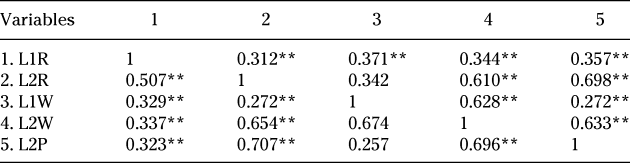
Table 1 shows the bivariate correlations between five latent variables for two types of tasks with different levels of cognitive complexity. For LCD tasks, the correlation between L2 skills (e.g., L2 reading and writing) was stronger than that between L1 skills (e.g., L1 reading and L1 writing). For the relationship in the same skill between the two languages (e.g., L1 reading and L2 reading), correlations between L1 writing and L2 writing were much higher than those between L1 reading and L2 reading. As expected, L2 proficiency showed a stronger relationship with L2 skills than with L1 skills. A similar pattern of correlations was observed for MCD tasks. All correlations were significant at the 0.01 alpha level.
An intercorrelation matrix of latent variables

Notes. Correlations for LCD tasks are shown below the diagonal, and those for MCD tasks are shown above the diagonal. ** p < 0.01.
Main Effects in LCD and MCD Tasks
The SEM analysis for LCD tasks produced a chi-square value of 39.25 with 28 degrees of freedom (p = 0.07, χ2/d.f. = 1.402), indicating a satisfactory fit of the SEM model to the data. Auxiliary fit indices also suggested a good fit (GFI = 0.95, NFI = 0.98, NNFI = 0.99, SRMR = 0.043, RMSEA = 0.051), as explained by Hu and Bentler (Reference Hu and Bentler1999) and Bentler and Bonett (Reference Bentler and Bonett1980). Similarly, the SEM analysis for MCD tasks produced a chi-square value of 30.73 with 28 degrees of freedom (p = 0.48, χ2/d.f. = 1.097), indicating that the SEM model successfully represented the sample covariance in the data, as verified by acceptable complementary fit indices (e.g., GFI = 0.97, NFI = 0.98, NNFI = 0.99, CFI = 0.99, SRMR = 0.041, RMSEA = 0.032).
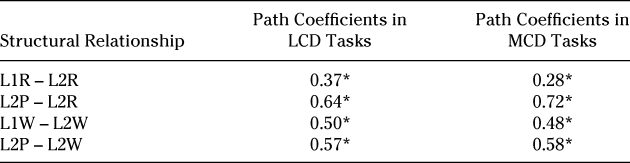
Main effects for structural relationships between five latent variables for LCD and MCD tasks (RQ1 through RQ4) are shown in Table 2. As shown in Table 2, the relationship between L1 reading and L2 reading was positive and significant (ß = 0.37), indicating that better L1 reading comprehension ability in LCD tasks leads to a higher L2 reading comprehension score in LCD tasks when the effects of other latent variables were statistically controlled for. This result indicates a significant effect of L1 transfer to L2 reading. In addition, L2 proficiency was a significant positive predictor of L2 reading (ß = 0.64), verifying a stronger link between L2 proficiency and L2 reading than that between L1 and L2 reading, as consistent with Jeon and Yamashita (Reference Jeon and Yamashita2014). With respect to the relationship for writing in LCD tasks, both L1 narrative writing and L2 proficiency made significant independent contributions to L2 narrative writing when effects of other latent variables in the SEM model were held constant, indicating that L2 writers with better L1 narrative writing skills and better L2 proficiency in terms of vocabulary and grammar knowledge achieved better L2 narrative writing performance. As in the case of reading, the relationship between L2 proficiency and L2 writing (ß = 0.57) was stronger than that between L1 writing and L2 writing (ß = 0.50), highlighting the critical role of L2 proficiency in L2 reading as well as in L2 writing in LCD tasks.
Main effects in LCD and MCD tasks

Note. * p < 0.05.
MCD reading and writing tasks showed a similar structural pattern. More specifically, L1 reading in MCD tasks accounted for a significant percentage of the variance in L2 reading performance (ß = 0.28) for MCD reading tasks when effects of other latent variables were held constant, thereby verifying a significant effect of L1-L2 transfer in MCD tasks. L2 proficiency was a significant positive predictor of L2 reading performance (ß = 0.72). The explanatory power of L2 proficiency in L2 MCD reading comprehension was much higher than that of L1 reading skills. This indicates that L2 learners with a high level of L2 proficiency in terms of vocabulary and grammar reached a high level of L2 reading comprehension in both LCD and MCD reading tasks. The learner’s performance in L2 argumentative writing was significantly influenced by his or her L1 argumentative writing skill (ß = 0.48), providing support for the L1-L2 writing relationship. Finally, L2 writers’ knowledge of vocabulary and grammar made a significant contribution to L2 argumentative writing performance (ß = 0.58), indicating L2 knowledge of vocabulary and grammar to be a key variable in L2 argumentative writing.
Moderating Effects in LCD and MCD Tasks
Tables 3 through 6 show the results of the SEM multigroup analysis for empirical answers to the hypotheses that the strength of relation between L1 and L2 skills is moderated by the level of L2 proficiency in reading and writing skills for LCD and MCD tasks (i.e., RQ5 and RQ6). More specifically, the invariance of the strength of the relationship in L1 and L2 reading skills and in L1 and L2 writing skills between the low- and high-L2-proficiency groups was examined based on 1 degree of freedom chi-square difference statistics.
Results of a multigroup analysis by L2 proficiency in LCD tasks

Note. d.f.diff = Difference in the degrees of freedom between the free model and each corresponding model. χ 2diff = Difference in the chi-square values between the free model and each corresponding model. * p < 0.05.
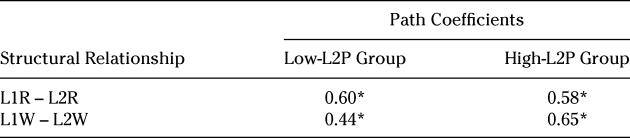
Moderating effects in LCD tasks

Note. * p < 0.05.
Results of a multigroup analysis by L2 proficiency in MCD tasks

Note. * p < 0.05
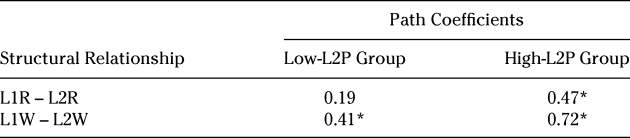
Moderating effects in MCD tasks

Note. * p < 0.05
Tables 3 and 4 show the results of the multigroup analysis for LCD tasks. First, the least constrained model (i.e., the baseline model), which estimated freely all the parameters across the two L2 proficiency groups, produced a chi-square of 73.58 with 43 degrees of freedom. The next model (Model 1 in Table 3) imposed an equality constraint on the structural path between L1 reading and L2 reading for the two L2 proficiency groups, while allowing the remaining path in the model (i.e., L1 writing and L2 writing) to be freely estimated. This model resulted in a chi-square value of 75.48 with 44 degrees of freedom. The chi-square difference between this model and the baseline model was 1.9 (i.e., 75.48 – 73.58 = 1.9) at 1 degree of freedom and was not significant at the 0.05 alpha level. This implies that constraining the path between L1 and L2 reading skills to be equal for the two L2 proficiency groups did not make the fit of the model significantly worse, further indicating that the strength of the relationship between L1 and L2 reading skills in LCD tasks did not vary significantly across the two L2 proficiency groups. Table 4 shows the path coefficients between L1 and L2 reading skills in the baseline model, which were freely estimated with no equality constraint for the two proficiency groups. It is notable that the path between L1 and L2 reading skills for the low-proficiency group (ß = 0.60) was slightly stronger than that for the high-proficiency group (ß = 0.58), although the difference was not significant.
Similarly, Model 2 in Table 3 constrained the path between L1 and L2 writing skills to be equal for the two L2 proficiency groups, while allowing the structural path between L1 and L2 reading skills to be free. This model produced a chi-square value of 81.99, and the difference in chi-square values between the baseline model and Model 2 was 8.41 at 1 degree of freedom difference, which was significant at the 0.05 alpha level. This demonstrates that imposing an equality constraint on the path between L1 and L2 writing skills for the two L2 proficiency groups significantly worsened the fit of the model, indicating that the strength of the relationship between L1 and L2 writing skills in LCD tasks was significantly different between the two L2 proficiency groups. Table 4 shows the freely estimated path coefficients for the baseline model. As shown in Table 4, the path coefficient between L1 and L2 writing skills in the high-proficiency group (ß = 0.65) was significantly higher than that in the low-proficiency group (ß = 0.44), although the two path coefficients were equally significant.
Tables 5 and 6 show the results of a multigroup analysis with MCD tasks. As shown in Table 5, the baseline model, which freely estimated all parameters in the model with no equality constraint, produced a chi-square value of 77.93 with 43 degrees of freedom. Model 1 in Table 5 constrained the path between L1 and L2 reading skills to be equal for the two L2 proficiency groups while allowing the path between L1 and L2 writing skills to be freely estimated. This more restricted model produced a chi-square value of 81.95 with 44 degrees of freedom, and the difference between the baseline model and the Model 1 was 4.02 (i.e., 81.95 – 77.93 = 4.02), which was significant at the 0.05 alpha level. This indicates that the strength of the relation between L1 and L2 inferential reading comprehension was statistically different across the two proficiency groups. Table 6 shows all the parameters estimated freely in the baseline model. According to the results, the relationship between L1 and L2 reading skills in the low-proficiency group was not significant (ß = 0.19), whereas it was significant in the high-proficiency group (ß = 0.47). This further suggests no significant relationship between L1 and L2 reading skills in inferential tasks for L2 learners with a low level of L2 proficiency, thereby providing no support for a significant effect of L1-L2 transfer on inferential reading for learners with a low level of L2 proficiency.
For the relationship between L1 and L2 writing skills, constraining the path between L1 and L2 writing skills to be equal for the two L2 proficiency groups (i.e., Model 2 in Table 5) increased the chi-square value from 77.93 (baseline model) to 83.61 at 1 degree of freedom difference, and the difference in chi-square values between the two models (83.61 – 77.93 = 5.68) was significant at the 0.05 alpha level. This again indicates that imposing an equality constraint on the path between L1 and L2 writing skills made the fit of the restricted model (i.e., Model 2) significantly worse than the baseline model, which statistically verifies that the strength of the relationship between L1 and L2 argumentative writing skills varied significantly for learners with different levels of L2 proficiency, although the relationship between L1 and L2 argumentative writing skills was equally significant for the low-proficiency (ß = 0.41) and high-proficiency (ß = 0.72) groups, as shown in Table 6.
DISCUSSION
This study is guided by a total of six research questions about relationships between L1 skills, L2 proficiency, and L2 performance in the theoretical context of the LIH and the LTH for both LCD and MCD tasks for reading and writing skills. The SEM results demonstrate that both L1 reading comprehension and L2 proficiency were significant independent predictors of L2 reading performance for both local and global reading skills measured based on LCD and MCD reading tasks. The results are consistent with the findings of previous studies (e.g., Bernhardt & Kamil, Reference Bernhardt and Kamil1995; Bossers, Reference Bossers1991; Brisbois, Reference Brisbois1992; Jeon & Yamashita, Reference Jeon and Yamashita2014; Lee & Schallert, Reference Lee and Schallert1997) but not with those of Vandergrift (Reference Vandergrift2006). The results provide empirical support for the idea that L1 and L2 reading skills are shared and intertwined (Bernhardt & Kamil, Reference Bernhardt and Kamil1995; Cummins, Reference Cummins1979, Reference Cummins1991), thereby validating the LIH for both LCD and MCD reading tasks. At the same time, the result that the LIH operated consistently for the two types of reading tasks provides no support for effects of the type of reading task in the context of the relationship between L1 and L2 reading skills, which complements and extends the database on the effect of task type on L2 reading (e.g., Alptekin & Erçetin, Reference Alptekin and Erçetin2011; Fincher-Kiefer, Reference Fincher-Kiefer1992; Johnson, Reference Johnson1981; Park, Reference Park2004; Shohamy & Inbar, Reference Shohamy and Inbar1991; Tsui & Fullilove, Reference Tsui and Fullilove1998). The result that the relative prediction of L2 proficiency was substantially greater than that of L1 reading in reference to L2 reading comprehension implies that L2 proficiency, which was operationally defined as a combined index of L2 knowledge of vocabulary and grammar, played a more important role in L2 reading comprehension regardless of task complexity, which is consistent with the findings of Vandergrift (Reference Vandergrift2006) but not with Taillefer (Reference Taillefer1996).
The results also provide support for the LIH in the skill area of writing. As in the case of reading, both L1 writing and L2 proficiency were significant independent predictors of L2 writing performance in narrative as well as argumentative tasks, thereby verifying a strong interdependent relationship between L1 and L2 writing skills, on the one hand, and a close relationship between L2 proficiency and L2 writing, on the other, in writing tasks with different levels of cognitive complexity. In particular, the significant relationship between L1 and L2 writing skills suggests that the LIH may predict relationships between productive language skills such as writing regardless of the level of cognitive complexity of target tasks, thereby providing support for the LIH in writing. From the perspective of effects of task type, the present study’s finding that the LIH is supported in two writing task types with different levels of cognitive complexity verifies the nonsignificant effect of task type on the relationship between L1 and L2 writing skills, thereby extending the literature on effects of writing tasks on L2 writing performance (e.g., Hamp-Lyons & Mathias, Reference Hamp-Lyons and Mathias1994; Kuiken & Vedder, Reference Kuiken and Vedder2008). Significant effects of L1 writing and L2 proficiency on L2 writing are consistent with the findings of previous studies reporting significant effects of L2 proficiency (e.g., Engber, Reference Engber1995; Grabe & Kaplan, Reference Grabe and Kaplan1996; Laufer & Nation, Reference Laufer and Nation1995) and L1 writing skills (e.g., Pae, Reference Pae2008; Sasaki & Hirose, Reference Sasaki and Hirose1996; Schoonen et al., Reference Schoonen, van Gelderen, de Glopper, Hulstijn, Simis, Snellings and Stevenson2003) on L2 writing performance.
A comparison of the same skills for different languages reveals the relationship between L1 and L2 writing skills to be much stronger than that between L1 and L2 reading skills for both LCD and MCD tasks, as shown in Table 2. On the one hand, the differential strength of the L1-L2 relationship for receptive and productive skills suggests the possibility that the LIH may work better in explicating the relationship between productive language skills than that between receptive language skills. The generalization of this possibility, however, requires follow-up replication studies using different samples and combinations of receptive and productive language skills (e.g., listening and speaking). On the other hand, the stronger relationship between L1 and L2 writing skills for narrative and argumentative tasks may reflect the difference in the nature of the two language skills in that reading comprehension requires more diverse processing skills relevant to the local context of a given reading passage across a wider range of topics, whereas L2 writing is typically approached by applying some preestablished patterns of idea development (e.g., cause-effect, process, and comparison/contrast) through stages of process writing (e.g., planning, formulating, and revising), as explained in previous studies of L2 writing (e.g., Ferris & Hedgcock, Reference Ferris and Hedgcock1998; Silva, Reference Silva1993). Alternatively, the differential strength of the L1-L2 relationship in reading and writing may reflect methodological differences in the measurement of reading and writing skills. In the present study, measures of L1 reading comprehension in LCD and MCD tasks tapped more diverse reading skills across different content areas (e.g., literary interpretations and the identification of contextual meanings) than those of L2 reading comprehension, a typical pattern commonly observed in the findings of previous studies (e.g., Lee & Schallert, Reference Lee and Schallert1997; Vandergrift, Reference Vandergrift2006), as indicated by lower coefficients of internal consistency for measures of L1 comprehension (0.79 and 0.81 for LCD and MCD tasks, respectively) than for those of L2 reading (0.91 and 0.92 for LCD and MCD tasks, respectively), thereby attenuating the strength of the relationship between L1 and L2 reading skills. Similarly, given the fact that each of the LCD and MCD reading tasks in the present study consisted of a total of 20 parallel reading items distributed across a wide range of passage topics, whereas the writing task was composed of a single writing prompt for each of the two writing tasks with different levels of cognitive complexity, it is equally possible that the differential measurement schemes employed in the assessment of reading and writing could have amplified the difference in the level of internal consistency between the two language skills.
For the moderating effect of L2 proficiency on the relationship between L1 and L2 reading skills (RQ 5), the results of a multigroup analysis indicate no significant difference in the strength of the relationship between L1 and L2 reading skills in LCD tasks for the two proficiency groups of Korean EFL learners. This result provides no support for the LTH in the context of LCD reading and is inconsistent with the findings of previous studies supporting the LTH (Bossers, Reference Bossers1991; Lee & Schallert, Reference Lee and Schallert1997; Taillefer, Reference Taillefer1996). However, it should be noted that that these previous studies did not examine the validity of the LTH separately for LCD and MCD reading tasks. A comparison of the strength of the path between L1 and L2 reading skills in LCD tasks for the two L2 proficiency groups reveals that the low-proficiency group (ß = 0.60) showed a stronger path than the high-proficiency group (ß = 0.58), although the difference in path coefficients between the two proficiency groups was not significant. This unexpected result may be explained by the possibility that learners with low levels of L2 proficiency may overgeneralize L1 literal reading skills because overgeneralization is a type of cognitive function typically associated with L2 learners with low levels of interlanguage development (e.g., Brown, Reference Brown2007; Lightbown & Spada, Reference Lightbown and Spada2011).
However, there were significant differences in the strength of the relationship between L1 and L2 reading skills in MCD tasks according to the level of L2 proficiency. A comparison of the path between L1 and L2 reading skills for the two proficiency groups demonstrates that the strength of the relation between L1 and L2 MCD reading was not significant for the learners in the low-proficiency group (ß = 0.19), whereas the strength of the same relationship in the high-proficiency group was significant (ß = 0.47). These results indicate that learners in the low-proficiency group did not successfully transfer L1 inferential reading skills to the L2 inferential reading process, whereas those in the high-proficiency group did. This result provides support for the LTH in the context of MCD reading tasks in accordance with the classical definition of the LTH, which posits that the efficient transfer of L1 skills to L2 cannot occur or is “short-circuited” below a certain proficiency level or threshold (Alderson, Reference Alderson, Alderson and Urquhart1984; Bernhardt & Kamil, Reference Bernhardt and Kamil1995; Cummins, Reference Cummins1979). The result that the validity of the LTH is significantly influenced by task-type effects provides more enlightened and illuminating insights into relationships between L1 skills, L2 proficiency, and L2 performance, thereby making a unique contribution to the research on the LIH and the LTH.
The results for the moderating effect of L2 proficiency on the relationship between L1 and L2 writing skills (RQ 6) show a significant difference in the strength of the relationship for the two L2 proficiency groups of Korean L2 learners for LCD and MCD writing tasks. More specifically, for the narrative writing task, a comparison of the path between L1 and L2 writing tasks for the low- and high-proficiency groups reveals the path coefficient to be significantly higher in the high-proficiency group (ß = 0.65) than in the low-proficiency group (ß = 0.44), although both coefficients were significant. A similar pattern was observed for the relationship between L1 and L2 argumentative writing tasks, with the path coefficient significantly higher in the high-proficiency group (ß= 0.72) than in the low-proficiency group (ß= 0.41). On the one hand, these results provide no support for the LTH in the context of writing in that Korean EFL learners in both proficiency groups made an equally successful transfer of L1 writing skills to L2 writing in narrative as well as argumentative tasks, as evidenced by a significant relationship between L1 and L2 writing skills for both groups for LCD and MCD tasks. This result provides no support for the traditional definition of the LTH, which posits a linguistic threshold below which no successful L1-L2 transfer can be made (Alderson, Reference Alderson, Alderson and Urquhart1984; Bernhardt & Kamil, Reference Bernhardt and Kamil1995; Cummins, Reference Cummins1979). Nonetheless, the present study’s results provide support for the LTH in that those learners in the high-proficiency group were more successful in the efficient transfer of L1 writing skills to the L2 writing process, as indicated by a significantly stronger relationship between L1 and L2 writing skills for these learners in LCD and MCD writing tasks. This interpretation of the LTH parallels the conceptualization of the LTH, which was originally proposed in Toukomaa and Skutnabb-Kangas (Reference Toukomaa and Skutnabb-Kangas1977) and later adapted by Cummins (Reference Cummins1979). More specifically, Cummins (Reference Cummins1979, Reference Cummins2000) proposed two thresholds of bilingual proficiency (lower and higher). Cummins (Reference Cummins2000) posits that the lower levels of bilingual competence “limit children’s ability to benefit cognitively and academically from interaction with their environment through those languages” (p. 175), and attainment of a lower threshold level is necessary to avoid any negative cognitive and academic effects. On the other hand, the higher level of threshold enables children to enjoy the additive form of bilingualism with high levels of proficiency in L1 and L2, which makes a positive impact on cognitive functioning and thus facilitates “accelerated cognitive growth” (Cummins, Reference Cummins1979, p. 230). The conceptualization of the LTH as consisting of two different thresholds helps to account for the gaps in the cognitive and academic development of bilingual students, and it also provides a nice theoretical framework for comparing academic and cognitive outcomes of students learning English as a second language (ESL) with those learning English as a native language, as pointed by Ardasheva, Tretter, and Kinny (Reference Ardasheva, Tretter and Kinny2012). However, applying the idea of two thresholds to the present study, which considers a Korean EFL context, is challenging and warrants a more sophisticated theoretical elaboration because Cummins’s theory is proposed to explain the disparity in academic success between minority and majority bilingual students in the context of ESL learning. Regardless, it is expected that in an EFL context, the idea of two or more thresholds provides researchers with not only testable hypotheses making it possible to empirically examine multiple levels of thresholds, below and above which the strength of the relationships between L1 and L2 would significantly differ, but also pedagogical interventions suitable for the EFL learners in each threshold group to strengthen the connection between L1 and L2 skills. In this regard, future research should test the LTH by considering multiple thresholds in EFL settings across diverse samples.
IMPLICATIONS
Findings of the present study have several important implications for L2 educators and practitioners. First, given the significant positive relationship between L2 proficiency and L2 performance in reading and writing, it is evident that L2 learners with high levels of L2 proficiency are likely to reach high levels of L2 performance in reading and writing regardless of the level of the task’s cognitive complexity. This signals the importance of L2 training in the form of grammar and vocabulary, and accordingly, instructions in L2 grammar and vocabulary cannot be overemphasized. Second, the significant relationship between L1 and L2 skills in reading and writing underscores the importance of L1 reading and writing experience. Therefore, L2 learners are encouraged to bring their own experience in L1 reading and writing to L2 reading and writing processes in the form of schema or background knowledge activation. Third, and more importantly, given the significant difference between the low- and high-L2-proficiency groups of learners in their ability to transfer L1 inferential reading skills to the L2 inferential reading process, L2 educators should make balanced instructional efforts to reduce the gap in the transfer of L1 inferential reading skills between the two L2 proficiency groups. In this regard, strategy training may help less proficient learners to compensate for their shortcomings. For instance, training learners to infer some meaning from the context or use background knowledge to make up for any gap in processing a given text (e.g., Alptekin & Erçetin, Reference Alptekin and Erçetin2011) may be useful. This strategy instruction should be based on a nonthreatening class environment because poor readers may be afraid of taking some risk in inferring what is not directly stated in the text. In this way, L2 learners can develop meta-cognitive knowledge of reading, which in turn can enable them to change what they read, as discussed in Vandergrift (Reference Vandergrift2006) and Taillefer (Reference Taillefer1996). Similarly, given the significant difference in the strength of the relationships between L1 and L2 writing for the low- and high-proficiency group both in LCD and in MCD writing tasks, more pedagogical efforts should be directed to the EFL learners in the low-proficiency group so that EFL writers in this group can transfer their L1 writing experiences in narrative as well as argumentative writing to the L2 writing processes as successfully as their more proficient peers do.
Finally, it should be noted that the present multigroup analysis operationally defined the level of L2 proficiency into two groups (low and high) based on previous SEM-based moderator analyses (e.g., Homburg & Giering, Reference Homburg and Giering2001; Walsh, Evanschitzky, & Wunderlich, Reference Walsh, Evanschitzky and Wunderlich2008), thereby simplifying the L2 proficiency level. In this regard, future multigroup analysis based on more than two L2 proficiency levels is expected to complement the present study’s findings and may provide more informative results.
APPENDIX
DESCRIPTIVE STATISTICS