INTRODUCTION
In many agroecosystems, drought is a primary constraint to crop production. On farmlands, topsoil dries before the subsoil as drought progresses. Because roots are primarily limited to the topsoil, crops are prone to stress from soil water deficits, even in the humid areas of sub-tropical China, where seasonal or intermittent drought occurs frequently. As soil dries, the soil strength or penetration resistance (PR) increases rapidly; consequently, the crop is usually under the coupled stress of soil drought and increased PR. Soil tillage is an important practice that primarily influences moisture and PR in topsoil. For example, large agricultural implementation of tilling can notably increase surface soil PR, whereas deep ploughing can loosen soil and decrease soil PR, thereby influencing crop root growth. Hence, crop root growth and its morphological characteristics are the result of a number of confounding factors in the agroecosystem. However, root responses in the soil are poorly understood under combined conditions (Tracy et al. Reference Tracy, Black, Roberts and Mooney2011; Gao et al. Reference Gao, Watts, Ren and Whalley2012; Arvidsson & Håkansson Reference Arvidsson and Håkansson2014; Olmo et al. Reference Olmo, Lopez-Iglesias and Villar2014).
Crop responses to drought stress have been investigated by a number of researchers; however, few studies have reported the effects of combined stresses on roots (Mirreh & Ketcheson Reference Mirreh and Ketcheson1973; Veen & Boone Reference Veen and Boone1990; Hodge Reference Hodge2009; Rich & Watt Reference Rich and Watt2013). Furthermore, conflicting results evaluating drought stress on crop roots have been reported (Whitmore & Whalley Reference Whitmore and Whalley2009). Soil water deficits have been found to stimulate fine root growth in maize (Adiku et al. Reference Adiku, Ozier-Lafontaine and Bajazet2001), whereas Singh & Sale (Reference Singh and Sale2000) reported that the fine roots of white clover did not change in dry soil. Conversely, Konôpka et al. (Reference Konôpka, Noguchi, Sakata, Takahashi and Konôpková2007) reported that drought stress decreased fine root biomass and root tip number in Japanese cedar; furthermore, fine roots of <1 mm in diameter were affected more severely than 1–2-mm roots.
Most researchers evaluating root trait changes have conducted research on soil samples prepared with different soil water content, without considering changes in soil PR. The values of soil PR are usually quite different under the same moisture levels across different soil types, resulting in a variation in crop responses to drought stress. Soil PR should be regarded as a property that has a general influence on root elongation, rather than as a limiting condition encountered in unusual soils (Barley et al. Reference Barley, Farrell and Greacen1965). To understand crop root responses to drought stress, it is essential to investigate simultaneously the effects of soil moisture and PR because soil PR varies with drought level and tillage management.
The PR value largely depends on soil compaction (SC) and moisture; it increases rapidly as soil dries. The PR value is an extremely important factor with regard to the ability of roots to penetrate soils (Tracy et al. Reference Tracy, Black, Roberts and Mooney2011). A root may change its architecture and anatomy in response to below-ground environmental conditions (Richter et al. Reference Richter, Monshausen, Krol and Gilroy2009). Whalley et al. (Reference Whalley, Dumitru and Dexter1995) demonstrated a conceptual model for estimating the elongation of impeded roots in soil. The model regards a root as a metal wedge penetrating soil; however, a root behaves differently from a metal wedge because the root is characterized by elasticity, plasticity, lubricity and growth in size. Notably, the root tip is flexible, so it can change its shape and size when it meets resistance, and the root cap may fall off. This flexibility may help the root elongate in soil with high PR. For example, Voorhees et al. (Reference Voorhees, Farrell and Larson1975) suggested that friction between the root cap and soil may be negligible. Results from the literature indicate that increased SC results in a lower elongation rate, accompanied by thickening of the roots (Materechera et al. Reference Materechera, Dexter and Alston1991; Bengough et al. Reference Bengough, McKenzie, Hallett and Valentine2011). However, most research on root elongation and anatomy has been performed on soil samples prepared by static compaction, without considering soil changes and water content. There is a lack of information focusing on root growth and anatomy as influenced by joint changes in SC and moisture by tillage and drought.
In sub-tropical China, there are large areas covered by red soil (classified as Ultisols by Soil Survey Staff 1999). Clayey red soil has poor physical properties, such as low available water content due to a low permanent wilting point, very low water conductivity as soil dries and a strong soil layer with high PR due to the presence of a clayey horizon in the profile. The climate of red soil areas is characterized as humid and monsoonal; therefore, a distinct wet season occurs from April to June and a hot, dry season occurs from August to October. Consequently, the local crops (rape, maize, peanut, soybean, etc.) in the area are usually constrained by seasonal drought and by the poor soil physical properties. It is very important to evaluate the role of soil tillage management on crop root growth to prevent drought stress.
The objectives of the current study were (1) to investigate the morphological characteristics of maize root in response to tillage under different soil moisture conditions and (2) to determine how soil factors, i.e., moisture and PR, result in morphological changes of maize roots. Therefore, a 2-year experiment was performed in field plots with four tillage treatments under three drought stress levels and the morphological changes of maize roots (length, diameter, root tip cortex and cell size) investigated. The aim was to demonstrate how soil tillage regulates maize root growth and to determine which tillage method would help relieve drought stress on crops in this area.
MATERIALS & METHODS
Site and soil description
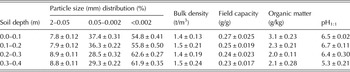
The field study was conducted at the red soil experimental station affiliated with Huazhong Agricultural University, located in Xianning, China (114°21′E, 30°01′N, 40 m asl). It is characterized by a sub-tropical humid monsoon climate. The climate supports two crops per year, but the crops are prone to water stress during the dry season, when less than the average rainfall of 277 mm and an open pan evaporation of 518 mm occurs from August to October. Seasonal drought is one of the primary factors that limit the yield of local crops (maize, soybean, peanut, oilseed rape, etc.). The zonal soil is a clayey red Ultisol (Soil Survey Staff 1999) developed from a quaternary red clay and is characterized by poor physical properties. The high clay content and hard layer in the soil profile is a physical limitation to crop growth. Selected soil properties are shown in Table 1. The soil water characteristic curve was tested using a high-speed refrigerated centrifuge (CR21GIII, Hitachi, Japan), following the process described by Reatto et al. (Reference Reatto, da Silva, Bruand, Martins and Lima2008) and Bassouny & Chen (Reference Bassouny and Chen2016); the curve was employed to estimate the soil water suction using the measured soil water content as presented in Table 2.
Selected soil properties at different depths collected and measured before the start of the experiment

The results are presented as the mean ± s.d. (n = 3).
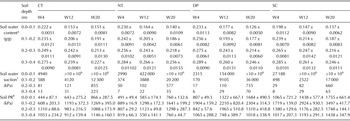
Soil water content, water suction and PR in the V10–V16 growth stage

* Soil water content is presented as mean ± s.d. (n = 3).
† The soil suction is roughly estimated by the SWCC of the soil using the average water content that listed in the above row; and for this reason, the s.d. of the estimated value is not presented.
‡ The soil PR is presented as mean ± s.d. (n = 5).
Experimental design and treatments
In 2004, the field was divided into multiple plots by waterproof aluminium-plastic compound plates, which were installed vertically in the field to 1.1 m below and 0.1 m above the soil surface. Each plot was an independent soil unit of 2.7 × 1.2 m with no water exchange between plots. A rain shelter was installed over the plots to control drought stress with irrigation provided during the experiment. The air temperature under the shelter was usually higher than that of ambient air although the shelter was ventilated by opening the two sides on sunny days. Maize (Zea mays L., Zhengdan 958) was planted at a crop density of 55 000 plant/ha in June and harvested in September each year since 2004. Each plot received the same fertilization when crops were planted: nitrogen (N) as urea (N 46%), provided at a rate of 138 kg N/ha; phosphorous (P) as superphosphate (P2O5 12%), applied at a rate of 120 kg P/ha; and potassium (K) as potassium sulphate (K2O 40%), applied at a rate of 60 kg K/ha.
Four tillage treatments have been conducted on the respective plots since 2009, including (1) deep plough (DP), in which the soil was turned over to a depth of 0.3 m with a shovel; (2) conventional tillage (CT), in which the soil was turned over to a depth of 0.18 m; (3) no-till (NT), in which maize was drilled directly without disturbing the soil and (4) SC, in which the soil surface was vibrated and compacted by a slab oscillator (model ZW, Xinxiang, China) to simulate SC by farm machinery. All tillage treatments were performed before maize crop sowing. The field experiment was a randomized complete block design with six replicates in each tillage treatment.
Three drought treatments were conducted in each tillage treatment from 2013 to 2014. The maize was well watered until growth stage V10 (tenth leaf, approximately 35 days after emergence) (Ritchie et al. Reference Ritchie, Hanway and Benson1993); thereafter drought treatments were employed by not watering for 4, 12 and 20 days, representing slight, moderate and severe drought stress, respectively. The drought treatments are denoted as W4, W12 and W20, respectively. With this method, the maize crops were under three drought stress levels from no water limitation to severe drought stress from V10 to V16 (16th leaf, approximately 55 days after emergence). After the designated time, the maize was re-watered as before. The soil water content, soil PR and maize root morphological traits were observed during the drought treatment.
Measurement of soil moisture and soil penetration resistance
To measure the water content, the soil samples were collected with a soil corer in each plot from a depth of 0.0–0.1, 0.1–0.2, 0.2–0.3 and 0.3–0.4 m. Soil sampling was performed on the designated day before re-watering, i.e. at 39, 47 and 55 days after emergence. The soil samples were then dried at 105 °C and weighed to calculate the mass water content. On the same day as soil sampling, soil PR was measured in situ using a digital penetrometer (FieldScout SC 900, Spectrum Technologies, USA) that was slowly inserted into the soil to a depth of 0.45 m with readings taken at 25-mm increments. The PR measurements were performed in five replicates in each plot, and the average was calculated. The values of PR at the depth of 0.0–0.1, 0.1–0.2, 0.2–0.3 and 0.3–0.4 m were used for regression analysis with root morphology traits and grain yield.
Maize root collection and morphology measurement
To collect maize roots and measure their morphology, three plants in the middle of each plot were selected for root sampling. The root-zone soil unit surrounding each plant was extracted with a shovel to a depth of 0.3 m in a 0.4 × 0.4 m2. The plant was in the centre of the square, and almost all of its roots were distributed within the soil unit. Root samples were then collected from the soil unit. Firstly, five fresh root tips from the secondary lateral root were cut from each plant with scissors for cortex cell measurements, as described below. The soil removed was immersed in water for half an hour and then washed repeatedly in a 1-mm sieve, to separate the roots from the soil. Finally, all of the first-, second- and third-order roots of each plant were collected, and the root length and average diameter were measured with a root image analysis system (WinRHIZO Pro 2004c, Regent Instruments Inc., Canada). The roots were sampled at 39, 47 and 55 days after emergence (between growth stages V10 and V16); the effect of sampling time did not factor into the analysis.
Only five fresh individual root tips cut from the secondary lateral roots of each plant were used for the cortex cell measurements. The secondary root was selected because it is sensitive to soil PR and moisture, it is not too fine for cortex measuring, and can be compared between treatments. The measurements were performed according to the following process: the fresh cut root tips were stored immediately in 4% paraformaldehyde, transported to the laboratory, sliced at 5 mm behind the tip, enveloped in resin, dyed with Safranin and Fast Green staining, and photographed under a microscope at 100× and 200× (2 and 4 pixels/μm, respectively). Images photographed under 200× were used to observe cell changes (not reported here), and images photographed under 100× were used to measure cell size, which was analysed using ImageJ software (Ver 1.47). The root cortex thickness was determined by measuring the distance from the epidermis to the endodermis; the cortical cell file number (CCFN) was measured by counting the cell layers from the epidermis to the endodermis; the cortical cell size (CCS) was determined by measuring the radial diameter of the cells. The measurements were performed on orthogonal diametrical directions in each root image, and approximately 50% of the cells in each image were involved in the CCS measurement. Because only the cross-sectional root image was captured, information on cell length was not available. Possible changes in cell dimensions due to resin impregnation were not taken into account in the analysis.
Statistical analyses
The soil water content in each plot was measured as the average of three soil samples. Soil PR was the average of five measurements in each plot. Root length was the average of three plants, whereas root diameter was the average of all roots in the removed soil sample. Root cortex thickness and CCFN were the average of ten root tip segments, and CCS was the average of approximately 100 cells in the root image. The significance test, equation regression and analysis of variance (ANOVA) were performed in SPSS 19.0 for Windows (SPSS Inc., Chicago, USA).
RESULTS
Soil penetration resistance and soil moisture
Soil PR varied with drought stress level, tillage treatment and soil depth. The largest PR was mostly observed at a depth of 0.1–0.2 m (Table 2), which reflected changes in the soil profile. Under no water limitation (W4), soil PR was relatively low, with an average of 1280 kPa across the four tillage treatments to a depth of 0.1–0.2 m. Soil PR increased significantly (P < 0.01) under moderate drought stress (W12), with an average of 1245 kPa in DP and CT, and 2567 kPa in NT and SC. Under severe drought stress (W20), the average PR reached 1468 kPa in DP and CT, and 2900 kPa in NT and SC. The highest soil PR was mostly observed in the SC treatment under all conditions.
Similar to PR, soil water content changed between the tillage treatments. For example, at a depth of 0.1–0.2 m under no water limitation conditions (W4), the average soil water content in the four tillage treatments was 0.2428 ± 0.00818 g/g; however, under severe drought stress conditions, the mean soil water content was 0.1850 ± 0.00492 g/g. The highest soil moisture was mostly observed in the DP treatment under the same drought level.
Root length
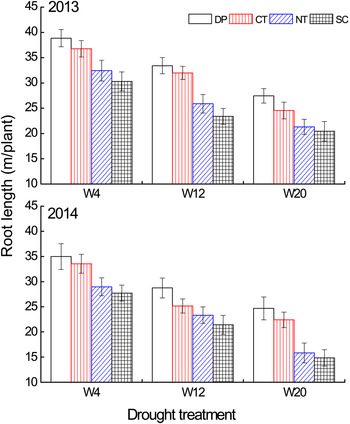
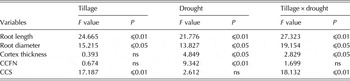
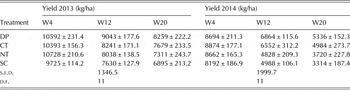
Maize root lengths were significantly (P < 0.05) different between tillage treatments (Fig. 1 and Table 3), of which DP was the largest and SC the lowest. The SC and NT treatments impeded root elongation significantly (P < 0.05). This reveals that maize root growth was limited significantly by soil PR, regardless of whether the crop was subjected to drought stress. As a result, the grain yields of maize were different under the tillage and drought treatments (Table 4).
Maize root length under drought and tillage treatments. Root samples (W4–W20) were collected from a depth of 0–0.3 m during the V10–V16 growth stages of maize. The column presents mean values ± s.d. (n = 3). Colour online.

The effect of tillage, drought and their interaction (tillage × drought) on maize root morphology

ns, not significant.
The results are the F values by ANOVA and the significance level P.
Grain yields of maize under the tillage and drought treatments for 2013 and 2014

The results are means ± s.d. (n = 3).
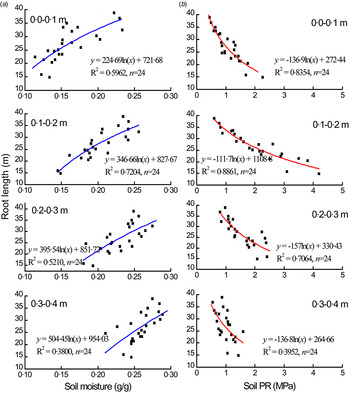
Drought stress inhibited maize root elongation significantly (P < 0.05). Under all tillage treatments, root length under no or lighter drought stress was shorter than that under drought stress (Fig. 1). As the soil dried from no water limitation (W4) to moderate drought stress (W12), the root length decreased significantly (P < 0.01). Average root length of the four tillage treatments in W20 decreased to 56.19% of that in W4. A regression analysis indicates that maize root length was correlated positively with soil water content (Fig. 2). Logarithmic equations fit root length and soil moisture well, with the highest correlation coefficient at a depth of 0.1–0.2 m (r = 0.8488, n = 24, P < 0.01). Similarly, maize root length was correlated negatively with soil PR; the regression equation was also fitted as a logarithmic equation with the highest correlation coefficient at a depth of 0.1–0.2 m (r = 0.9413, n = 24, P < 0.01).
Relationship between maize root length and soil moisture (a) or soil PR (b) at depths of 0.0–0.1, 0.1–0.2, 0.2–0.3 and 0.3–0.4 m. The curves were fitted with the data from 2013 and 2014. Note that the soil moisture and PR depend on drought and tillage treatments. Colour online.

Root diameter
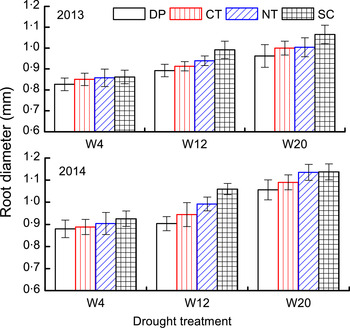
As with root length, root diameter changed with soil moisture and PR (Fig. 3 and Table 3). Under drought stress (W12 and W20), root diameter increased significantly (P < 0.05), at different increments in the four tillage treatments. This indicates that roots became more prone to thickening under drought stress. When the soil was well watered (W4), root diameter exhibited no significant difference between the four tillage treatments because soil PR was rather low due to the high soil water content (Table 2). However, in W12 and W20, maize root diameter showed significant differences (P < 0.05) between tillage treatments, related to the higher soil PR and larger PR difference. Tillage treatment influenced maize root diameter significantly (P < 0.05), particularly under drought stress conditions. The highest root diameters were mostly observed in SC because it had the highest soil PR.
Maize root thickness (diameter) under drought and tillage treatments. Root samples were collected from a depth of 0–0.3 m during the growth stage from V10 to V16. The column presents means ± s.d. (n = 5). Note that in the same drought treatment, the soil water contents were different between the tillage treatments. Colour online.

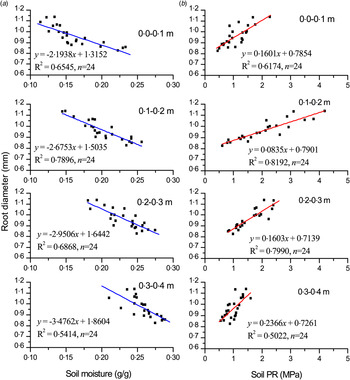
Maize root diameters were correlated strongly (P < 0.01) with soil moisture and soil PR. After a regression analysis was performed, a linear equation was chosen as the best method to quantify the relationship between root diameter with soil moisture (r = 0.7358 to 0.8886, n = 24) and soil PR (r = 0.7087 to 0.9051, n = 24) (Fig. 4) where the highest correlation coefficient occurred at a depth of 0.1–0.2 m, which was similar to that of root length.
Relationship between maize root diameter and (a) soil moisture or (b) soil PR at depths of 0.0–0.1, 0.1–0.2, 0.2–0.3 and 0.3–0.4 m. The curves were fitted with the data from 2013 and 2014. Note that the soil moisture and PR depended on the drought and tillage treatment. Colour online.

Root cortex thickness and cortical cell size
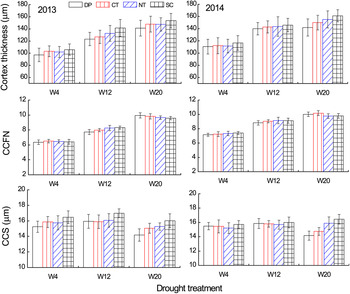
Root cortex thickness (distance from the endodermis to the exodermis), CCS (radial diameter) and CCFN were measured under drought and tillage treatments. Root cortex thickness varied between tillage and drought treatments (Fig. 5(a)), with similar trends to those of the root diameter (Fig. 3). A linear equation, y = 408.3 + 4.2x (P < 0.01), was able to demonstrate the relationship between root cortex thickness (x, μm) and root diameter (y, μm).
Maize root cortex thickness, CCFN and CCS 5 mm behind the root tip. The maize root samples were collected from a depth of 0–0.3 m during the growth stage from V10 to V16. Results are means ± s.d. Colour online.

From W4 to W20, cortex thickness increased as the soil dried (Fig. 5). At the same time, cortex thickness was significantly (P < 0.05) different between tillage treatments. Specifically, under drought stress conditions, cortex thickness was highest in SC, indicating a descending order of SC > NT > CT > DP; whereas, under no water stress, no significant difference was observed between tillage treatments. This indicates that the tillage measure, which can enhance soil PR, is prone to thickening of the maize root.
Interestingly, cortex thickening was accompanied by an increase in CCFN but not by an increase in CCS (Fig. 5). As soil dried, CCFN increased significantly (P < 0.05), simultaneously with cortex thickening. At the same time, CCS did not increase with soil drying; conversely, it decreased in DP and CT treatments under severe drought stress (W20). The result reveals that soil PR and drought stress played different roles in changing maize root anatomy.
DISCUSSION
Tillage had a large impact on soil properties and on crop yield (Bescansa et al. Reference Bescansa, Imaz, Virto, Enrique and Hoogmoed2006). The current study demonstrated that tillage treatment not only changed the soil PR but also soil moisture, thus affecting maize grain yield significantly. In particular, for clayey red soil in the humid sub-tropical region, DP and CT treatments increased soil water content in the severe drought treatments: they were helpful in relieving drought stress impacts on the maize crop in favour of maintaining yield. This result is inconsistent with that in semi-arid soils, where shallow-till or NT rather than deep-till has been reported to increase soil moisture (Castellini & Ventrella Reference Castellini and Ventrella2012; Kahlon et al. Reference Kahlon, Fausey and Lal2012). Nevertheless, this result has been supported in recent studies. A similar result was reported in a temperate loamy soil, in which reduced tillage instead of NT was suggested to improve soil structure and hydraulic conductivity (Bottinelli et al. Reference Bottinelli, Menasseri-Aubry, Cluzeau and Hallaire2013). Martínez et al. (Reference Martínez, Chervet, Weisskopf, Sturny, Rek and Keller2016) reported that the soil pore system exhibited slightly higher specific diffusivity in the topsoil of mouldboard ploughing than in NT. Sağlam et al. (Reference Sagğlam, Selvi, Dengiz and Gürsoy2015) also reported that for heavy clayey soils, reduced tillage practices that included ploughing improved physical soil qualities for root development and water movement. It is believed that the inconsistent results arise from differences in climate, soil type and soil moisture level between humid and semi-arid regions. Hence, in practice, appropriate tillage strategy should be evaluated for a specific soil in a certain region. The current result is limited to clayey soil in a sub-tropical monsoon climate, and the effect of tillage is still to be evaluated over a longer term.
Tillage treatment influenced maize root morphology significantly due to changes in soil PR and moisture content. In the current study, tillage treatment always had a strong effect on root length, regardless of the drought stress conditions. This result suggests that root length is more sensitive to soil PR than to soil moisture. As evidence, the correlation coefficient between root length and soil PR was found to be higher than that with soil moisture. Meanwhile, tillage treatment did not change the root diameter significantly when water was not limiting because the values of soil PR were relatively low at this soil moisture level. However, tillage treatment changed the root diameter significantly under drought stress conditions because the values of soil PR were relatively high under these dry conditions. Compared with soil moisture, soil PR is a more integrated index and thus more suitable for reflecting soil environmental conditions and root growth. This can partly explain the inconsistences of root response to drought stress that have been reported in the literature (Singh & Sale Reference Singh and Sale2000; Adiku et al. Reference Adiku, Ozier-Lafontaine and Bajazet2001; Konôpka et al. Reference Konôpka, Noguchi, Sakata, Takahashi and Konôpková2007; Whitmore & Whalley Reference Whitmore and Whalley2009) because under different study conditions soil PR may have varied in different soil types, tillage or bulk density conditions, even at the same drought level (another explanation is plant variety). Hence, roots in different soils can, to some extent, show different responses to drought stress.
The current work, along with earlier studies, indicates that crop root diameter increased with soil PR (Materechera & Mloza-Banda Reference Materechera and Mloza-Banda1997; Wilson et al. Reference Wilson, Robards and Goss1977; Liu et al. Reference Liu, Shan and Deng2001; Bengough et al. Reference Bengough, McKenzie, Hallett and Valentine2011; Lipiec et al. Reference Lipiec, Horn, Pietrusiewicz and Siczek2012; Valentine et al. Reference Valentine, Hallett, Binnie, Young, Squire, Hawes and Bengough2012). Root thickening in response to mechanical impedance was attributed to a larger root CCFN (Atwell Reference Atwell1993; Grzesiak et al. Reference Grzesiak, Rzepka, Hura, Hura and Skoczowski2007) and larger root CCS (Atwell Reference Atwell1993; Croser et al. Reference Croser, Bengough and Pritchard2000; Clark et al. Reference Clark, Ferraris, Price and Whalley2008). As expected, in the current study radial thickening of the cortex and larger CCFN were observed under dry and high soil PR conditions. However, the CCS did not constantly increase with soil drying; instead, it decreased under severe drought stress conditions. At first glance, this result appears to be inconsistent with early reports that reported root thickening was caused by a larger CCS under drought stress (Atwell Reference Atwell1993; Croser et al. Reference Croser, Bengough and Pritchard2000; Clark et al. Reference Clark, Ferraris, Price and Whalley2008). In fact, the apparent inconsistency is only at the surface; this result did not negate early reports but rather adds to them. It has been noted that CCS increased under higher soil PR conditions. The present results reveal that CCS may be enlarged due to a high soil PR but not by drought stress. As a result, the apparent changes in root morphology appears to depend on the combined effects of soil PR and moisture. Similar results were reported in maize and lupin in sandy loam soil (Schmidt et al. Reference Schmidt, Gregory, Grinev and Bengough2013).
Because few researchers have investigated the effects of combined stresses on crop roots (Hodge Reference Hodge2009; Schmidt et al. Reference Schmidt, Gregory, Grinev and Bengough2013), this issue is explored further here. On one hand, soil drying can result in a smaller CCS; furthermore, drought stress may also decrease root diameter. On the other hand, soil drying can enhance soil PR, thus resulting in a larger CCS; with further enhanced drought stress leading to an increase in root diameter. As a result, the real effect of drought stress on root diameter depends primarily on the soil conditions, such as soil type, quantitative relationship between soil PR and soil moisture, drought stress level, tillage or soil bulk density. This is the reason for the inconsistent results from the different studies on crop root responses to drought stress. It is worth noting that the role of soil PR can be obscured by soil drying, because high soil PR and drying tend to occur together and it has proven difficult to separate the effects of soil PR and water stress (Whalley et al. Reference Whalley, Clark, Gowing, Cope, Lodge and Leeds-Harrison2006). It is therefore important to consider soil PR when studying the soil–plant relationship, especially in screening drought-resistant varieties and root growth responses to drought stress.
An early laboratory study showed that mechanical impedance increased the number of cells in the transverse section and the diameter of the outer cells (Wilson et al. Reference Wilson, Robards and Goss1977). Under the current field experimental conditions, both drought and PR stress increased the thickness of the cortex and CCFN. Consequently, these changes in root morphology might provide feedback to the crop under drought stress. In general, with a larger CCFN and wider cortex, the root would consume more crop assimilates and as a result, yield may be reduced. It has been reported that thickening of the root diameter increased the radial resistance to transporting soil water in the cortex, thus undermining water transportation in roots (Rieger & Litvin Reference Rieger and Litvin1999). Recently, Chimungu et al. (Reference Chimungu, Brown and Lynch2014a , Reference Chimungu, Brown and Lynch b ) demonstrated that a maize species with reduced root CCFN and large root CCS could have improved drought tolerance. The present study indicated that CCFN increased and CCS decreased under PR stress conditions. In other words, the maize crop might reduce its drought tolerance due to a high PR. This finding suggests that a large soil PR (which can be a result of NT or mechanical compaction), which will thicken the root, may damage crop drought tolerance.
Despite this disadvantage, root thickening could have positive impacts under drought and PR stress conditions. This is considered to be an adaptive trait of roots to penetrate strong soil more effectively. From a physiological point of view, root thickening can induce more meristem tissue of root hairs and stimulate its growth, thereby compensating for the reduced absorption area by a shorter root length. For example, root length density increased as soil PR increased due to enhanced production of first-order laterals and decreased rooting depth (Voorhees et al. Reference Voorhees, Farrell and Larson1975). From a physical point of view, root thickening can improve its absorbing and penetrating abilities in strong soil in several ways. Firstly, dried soil will shrink and thus loosen the soil–root interface. The thickening of the root can improve root contact with soil, thereby helping the root by improving its absorption ability. Secondly, the root strength can be improved by thickening the diameter, thereby helping the root to penetrate soil. Lastly, but most importantly, soil particles (or aggregations) that block the root tip can be pushed aside by thickening of the root. Thus, the soil pores in front of the root tip can be enlarged. This will decrease the resistance and help roots to penetrate the soil. The current study emphasizes the importance of the root morphological responses to soil PR and drought stress in crop–soil relationship research and in crop management practices.
CONCLUSIONS
For maize crops grown in clayey soil in the sub-tropical region, tillage and drought treatments had significant effects on root morphological characteristics. Tillage treatments not only changed soil PR but also changed soil moisture; furthermore, DP and CT increased soil moisture and decreased soil PR. Maize root length and diameter were significantly correlated with soil moisture and soil PR. Maize root CCFN increased under drought stress, whereas CCS increased under soil resistance stress, revealing that soil moisture and PR play different roles in root diameter. Therefore, maize root thickness depends on the coupling effects of drought and PR stress. CT or deep ploughing are appropriate practices in clayey soil because they could relieve crop drought stress by decreasing soil PR and increasing soil moisture.
This work was supported by the National Natural Science Foundation of China (Grant numbers 41571258 and 41271240). The authors would like to thank the graduate students Ming Luo, Jianwen Zhou and Ping Li for their field and laboratory work in this study.