Introduction
Wolff–Parkinson–White pattern, or ventricular pre-excitation, is used to describe the electrographic manifestation of one or more atrioventricular accessory pathways that predispose that individual to orthodromic re-entrant tachycardia. Reference Benson and Cohen1 With Wolff–Parkinson–White, there is a risk of sudden cardiac death with the risk of rapid antegrade conduction of atrial fibrillation with a rapid ventricular response across the accessory pathway may lead to ventricular fibrillation. 2 The prevalence of Wolff–Parkinson–White pattern is 0.1–0.3%. Reference Hiss and Lamb3 The incidence of sudden cardiac death in asymptomatic Wolff–Parkinson–White is 0.9–2.4 per 1000 patient/year and 0.0025 per patient/year or 3–4% over a lifetime for symptomatic Wolff–Parkinson–White. Reference Munger, Packer and Hammill4–Reference Cain, Irving and Webber7 Guidelines were published in 2012 for guidance of risk stratification of asymptomatic patients with Wolff–Parkinson–White with non-invasive testing with a stress test to evaluate for persistence of manifest ventricular pre-excitation. For those with persistence or unable to perform a stress test, risk-stratification with an intracardiac electrophysiology study is recommended. Intermittent ventricular pre-excitation and/or loss of manifest pre-excitation on stress test are recommended to have close cardiology follow-up with counselling regarding symptom awareness 2 For symptomatic patients with Wolff–Parkinson–White and supraventricular tachycardia, the treatment options are medical therapy or an electrophysiology study with catheter ablation. Reference Benson and Cohen1,Reference Garson, Gillette and McNamara8–Reference Christmyer, Pisupati and Shah10 Medical therapy can affect quality of life due to potential prolonged period of medication use and potential side effects. Reference Wong, Potts and Etheridge11,Reference Mecklin, Linnanmaki and Hiippala12 Catheter ablation has a high success rate of >95%, but is an invasive procedure. Reference Kugler, Danford and Houston13 Since there are both non-invasive and invasive treatment options for Wolff–Parkinson–White management, as well as different risks for symptomatic and asymptomatic Wolff–Parkinson–White, there may be social barriers, both implicit and explicit, that these patients may experience.
Disparities have been previously reported in the treatment of paediatric supraventricular tachycardia. Specifically, lower rates of ablation in younger, female, non-White race, and uninsured patients with paediatric supraventricular tachycardia have been described. Reference Sooy-Mossey, Neufeld and Hughes14 The association of individual measures of socio-economic status and racial disparities with outcomes in paediatric cardiology have been shown by multiple studies. Reference DiBardino, Pasquali and Hirsch15–Reference Peterson, Chen and Nguyen20 Likewise, it is known that social determinants of health impact resource utilisation and that this association has multiple components making this relationship challenging to measure. Reference Beck, Huang and Auger21–Reference Fieldston, Zaniletti and Hall23 An emerging tool to address this problem is the Child Opportunity Index. Reference Acevedo-Garcia, Noelke and McArdle24–Reference Duong, Elfituri and Zaniletti26 The Child Opportunity Index is a validated measure that uses a composite index of 29 indicators of social determinants of health linked to the United States of America Census. 27 Developers of the Child Opportunity Index took the aggregate of the nationally normed, overall index z-scores from the census tract level allowing it to be applied to the ZIP code level. These ZIP code level z-scores are categorised into very low, low, moderate, high, and very high categories. Reference Sengupta, Gauvreau and Bucholz25,Reference Bettenhausen, Noelke and Ressler28 The Child Opportunity Index has been shown to be independently associated with adverse outcomes in children after congenital heart surgery. Reference Sengupta, Gauvreau and Bucholz25,Reference Duong, Elfituri and Zaniletti26,Reference Mayourian, Brown and Javalkar29 However, the association of the Child Opportunity Index and the treatment of paediatric Wolff–Parkinson–White has not been previously investigated.
In this study, we explored if disparities existed in the treatment of paediatric Wolff–Parkinson–White based on the Child Opportunity Index. Our central hypothesis was that Child Opportunity Index z-scores are directly related to ablation utilisation, since it is the definitive treatment of Wolff–Parkinson-–White, and inversely related to resource utilisation (antiarrhythmics, emergency department visitations, and admissions). Secondarily, we aimed to evaluate if there were treatment variations and disease burden of Wolff–Parkinson–White based on the Child Opportunity Index. We hypothesised that a lower Child Opportunity Index would be associated with higher disease burden (number of antiarrhythmics, emergency department visitations, number of admissions, and length of admissions) due to a lower socio-economic neighbourhood with less resources leading to lower understanding of symptoms and later or inappropriate presentation.
Materials and methods
Study population
A retrospective, single-centre study was conducted at the University of Pittsburgh Medical Center, Children’s Hospital of Pittsburgh of patients with ICD-9 and ICD-10 codes for supraventricular tachycardia and/or Wolff–Parkinson–White (both inpatient and outpatient) who received care from January 2018 to July 2023. Reference Visweswaran S, Cappella and Morris30 This study was approved by the University of Pittsburgh Institutional Review Board and was conducted in compliance with the Health Insurance Portability and Accountability Act. The requirement for informed consent was waived due to the retrospective nature of the study. A total of 483 patients were identified with a diagnosis of Wolff–Parkinson–White between the ages of 0 and 18 years. Of these, 260 patients met inclusion criteria for this period. Those under 5 years of age were excluded (n = 334) as ablation would not be standard of care for these patients. Additionally, patients were then excluded that had haemodynamically significant CHD (n = 126), or cardiomyopathy/myocarditis (n = 23). Haemodynamically significant CHD was defined as a pathology that requires medical treatment or intervention (by catheterisation or surgery) shortly after diagnosis. Reference Alkhushi31
Child opportunity index
The Child Opportunity Index is a validated measure that uses a composite index of 29 neighbourhood-level indicators of social determinants of health into a single composite measure linked to the United States of America Census. A Child Opportunity Index level was derived based on United States of America Census data from the publicly available Child Opportunity Index 2.0 database. 27 Based on each patient’s zip code they were linked to unique United States Census data provided a scored Child Opportunity Index score based on 29-neighborhood level indicators. All neighbourhoods were ranked by Child Opportunity Index z-score and categorised into 1 of 5 nationally normed, ranked group as follows: very low, low, moderate, high, and very high. Reference Sengupta, Gauvreau and Bucholz25,Reference Duong, Elfituri and Zaniletti26,Reference Bettenhausen, Noelke and Ressler28 Based on the sample size of this study, the categorical groups were re-defined as low Child Opportunity Index (n = 60), which included the very low (n = 20) and low (n = 46) groups, moderate Child Opportunity Index (n = 81), and high Child Opportunity Index (n = 122), which included the high (n = 58) and very high groups (n = 64).
Clinical outcomes
Demographics, clinical characteristics, and long-term outcomes were obtained via chart review. The primary outcomes of interest were type of treatment, ablation utilisation, and timing from diagnosis to ablation. Secondarily, markers of resource utilieation (admissions, total time admitted, emergency room visits) and disease burden (number of unique antiarrhythmics, concomitant medications, ablation success, Wolff-Parkinson-White recurrence) were investigated. For this study, admissions and length of stay did not include procedural admissions for Wolff-Parkinson-White since there was no standard post-procedural admission practiced during the studied period at our centre. Additionally, only emergency room visits and admissions related to supraventricular tachycardia or suspected supraventricular tachycardia (symptomatic Wolff-Parkinson-White) were included.
Statistical analysis
Baseline characteristics are described as frequency and percentage for categorical variables and as medians and interquartile ranges for continuous variables. Characteristics were compared between Child Opportunity Index categories using Kruskal–Wallis tests for continuous variables, and chi-square and Fisher’s exact tests for categorical variables, as appropriate. Days from diagnosis to ablation was highly skewed, so it was log-transformed for analysis to achieve a more normal distribution. Multi-level logistic and log-normal regression models were used to evaluate the relationship between neighbourhood Child Opportunity Index category and key outcomes of interest, with random intercepts included (at the zip code-level) to account for nesting of patients within neighbourhoods. All models were adjusted for patient age at diagnosis, and the referent group for all comparisons was the high Child Opportunity Index category. All tests were two-sided, with an alpha level of 0.05 considered statistically significant. SAS 9.4 (Cary, North Carolina, United States of America) was used for all analyses.
Results
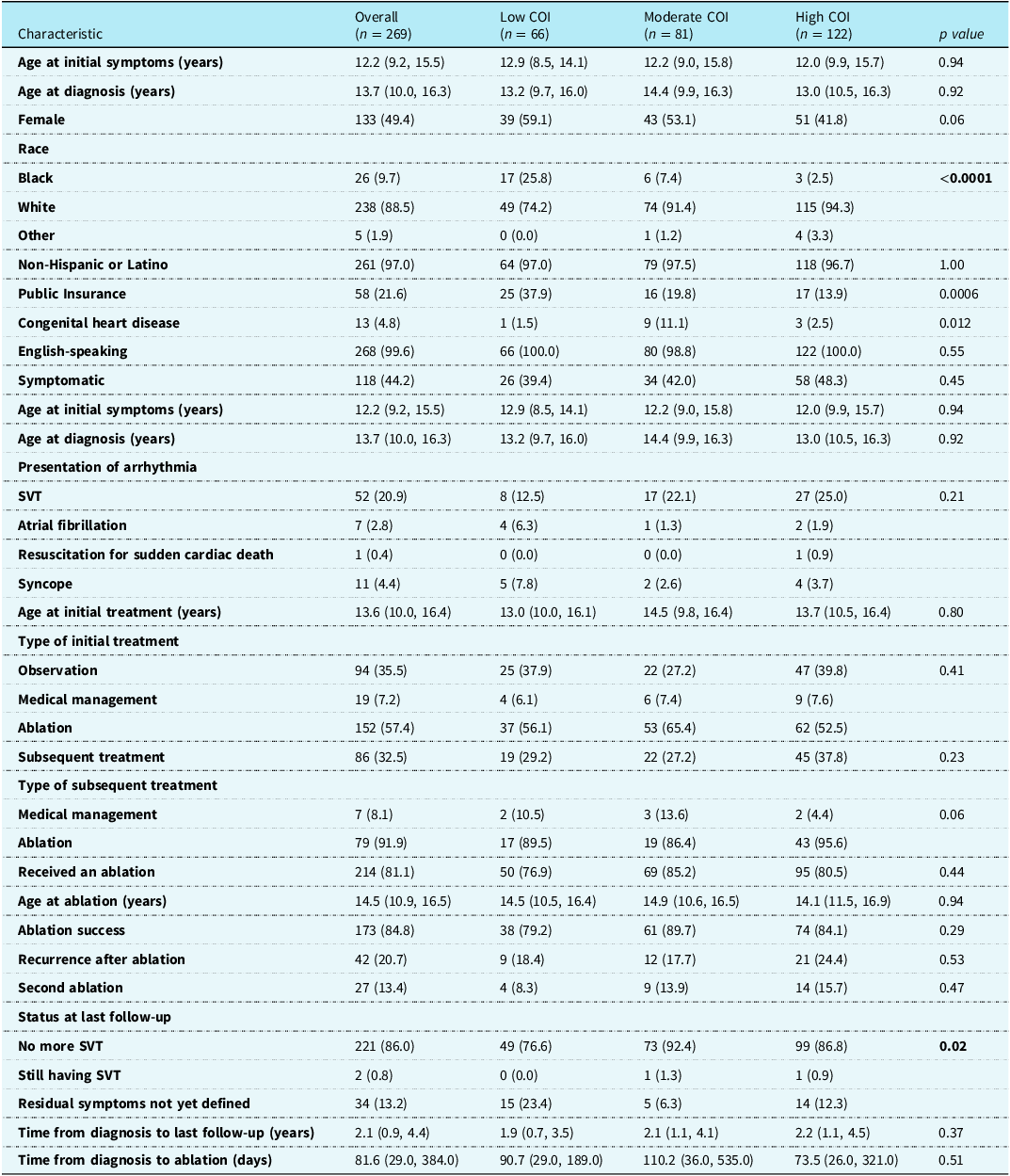
Our cohort consisted of 269 patients that met inclusion criteria, with 25% (n = 66) in the low group, 30% (n = 81) in the moderate group, and 45% (n = 122) with a high Child Opportunity Index. The demographics of each of the groups are detailed in Table 1. There was no difference in female sex among the groups (49% overall, p = 0.06). Race significantly differed between groups, with a greater portion of Black race was noted in the low group (26%) compared to the moderate (7%) and high (3%) groups (p = < 0.0001). Public insurance status varied significantly across the groups (38% low, 20% moderate, 14% high, p = 0.0006). Among the groups, there was a difference in presence of non-haemodynamically significant CHD (2% low versus 11% moderate versus 3% high, p = 0.01). There was no difference in rate of major non-cardiac diagnosis in the cohort (p = 0.85). Supplemental Table 1 and supplemental Table 2 detail the non-haemodynamically significant CHD and major non-cardiac diagnoses, respectively.
Clinical characteristics by COI category

Data are reported as n (%) or median (1st, 3rd quartiles). Missing data values were omitted from the table. COI = Child Opportunity Index; SVT = supraventricular tachycardia.
Clinical characteristics
The clinical characteristics of the groups are detailed in Table 1. Overall, 44% were symptomatic with no significant differences observed amongst the groups (p = 0.45). The median age of initial symptoms (overall: 12.2 years, interquartile range: 9.2–15.5 years) and diagnosis (overall: 13.7 years, interquartile range: 10.0–16.3 years) were not significantly different among the groups (both p > 0.05). The presenting arrhythmia (p = 0.21), type of initial treatment (p = 0.21), median age at initial treatment (p = 0.80), those that received a different subsequent treatment (p = 0.23), and the type of subsequent treatment (p = 0.06) did not differ between the groups.
A high proportion of the cohort received an ablation (81%, n = 214) with no difference by Child Opportunity Index group (77% low versus 85% moderate versus 81% high group; p = 0.44). Median age at ablation (overall: 14.5 years, interquartile range: 10.9–16.5 years) was not significantly different among the groups (p = 0.94). The percent of successful ablations (p = 0.29), recurrence after ablation (p = 0.53), and second ablations (p = 0.47) all were similar across the different groups. Additionally, median time from diagnosis to ablation (overall: 81.6 days, interquartile range: 29.0–384 days) and time from diagnosis to last follow-up (2.1 years, interquartile range: 0.9–4.4 years) did not differ by Child Opportunity Index level (both p > 0.05). Status at last follow-up for the entire cohort differed significantly between groups (no more supraventricular tachycardia: 77% low versus 92% moderate versus 87% high, p = 0.02) (Table 1).
The relationship of resource utilisation by Child Opportunity Index level is depicted in Figure 1. Regarding antiarrhythmic treatment, 12% (n = 31) of the cohort was treated with one or more antiarrhythmics with no difference across the groups (14% low versus 14% moderate versus 9% high group; p = 0.50). Percent of patients with Wolff–Parkinson–White requiring one or more hospitalisations (6% overall; 9% low versus 5% moderate versus 4% high group; p = 0.38) and that were admitted one or more days (6% overall; 6% low versus 1% moderate versus 3% high group; p = 0.27) did not differ significantly. However, the percentage of one or more emergency department visits related to cardiac complaints differed significantly with an inverse relationship with Child Opportunity Index level (40% overall; 55% low versus 41% moderate versus 31% high group; p = 0.01).
Resource utilisation across Child Opportunity Index categories.

Multivariate analysis of clinical outcomes
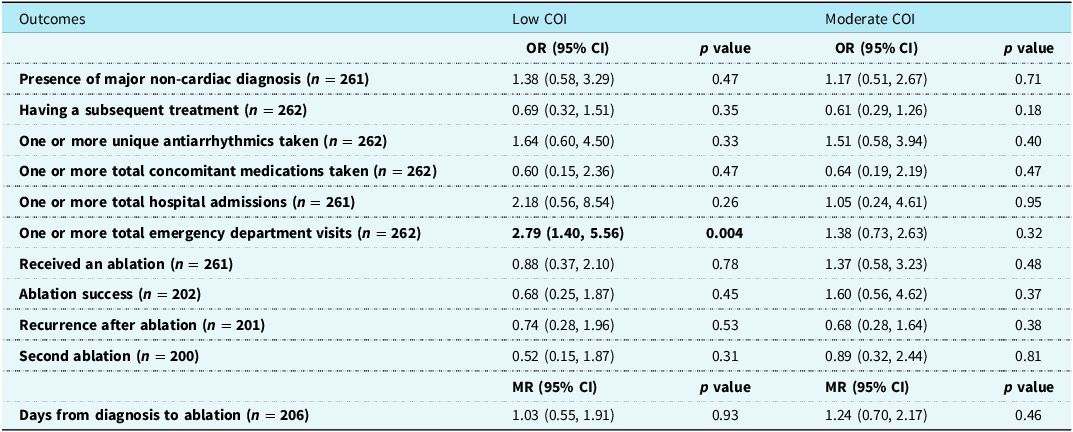
Multivariable associations between COI category and key outcomes of interest are shown in Table 2. Patients in the low group had 2.79 greater odds of one or more total emergency department visits compared to patients in the high group (95% confidence interval: 1.40–5.56, p = 0.004), while the moderate group was found not to have significantly higher odds compared to the high group (p = 0.32). Otherwise, the Child Opportunity Index level was not associated with any other primary outcomes of interest among Wolff–Parkinson–White patients (Table 2).
Multivariable associations between COI category and outcomes of interest

All models adjusted for patient age at diagnosis. High COI category serves as the reference group for all COI comparisons. OR = odds ratio; MR = mean ratio; CI = confidence interval; COI = Childhood Opportunity Index.
Discussion
In this study, we evaluated the association of the Child Opportunity Index and treatment practice in paediatric Wolff–Parkinson–White, as well as resource utilisation. It was demonstrated that a lower Child Opportunity Index level was associated with greater odds of emergency department visitation in patients with Wolff–Parkinson–White but did not differ in rates of ablation or outcomes. Although the association of outcomes in congenital heart surgery with Child Opportunity Index and disparities in the treatment of supraventricular tachycardia have been previously investigated, to our knowledge these findings in the treatment of paediatric Wolff–Parkinson–White have not been described to-date. Reference Sooy-Mossey, Neufeld and Hughes14,Reference Sengupta, Gauvreau and Bucholz25,Reference Duong, Elfituri and Zaniletti26
Clinical characteristics
The demographics of our cohort when comparing by Child Opportunity Index level demonstrated a significant difference in race and public insurance status, which are known markers of disparities in health outcomes in children. Reference Sooy-Mossey, Neufeld and Hughes14–Reference Oster, Strickland and Mahle17,Reference Colvin, Zaniletti and Fieldston22 Specifically, Sooy-Mossey et al. in the treatment of paediatric supraventricular tachycardia with lower rates of ablation in younger, female, non-White race, and uninsured patients have previously been demonstrated. Reference Sooy-Mossey, Neufeld and Hughes14 The association of individual measures of socio-economic status and racial disparities with higher mortality, longer length of stay, increased complication rate, and higher resource utilisation in paediatric cardiology have been shown by multiple studies. Reference DiBardino, Pasquali and Hirsch15–Reference Peterson, Chen and Nguyen20 The findings of a statistical difference in non-haemodynamically significant CHD amongst the groups was suspected to be an incidentally finding based on the overall low rate of CHD in the cohort (5%, n = 13). The two highest known associated forms of CHD with Wolff–Parkinson–White were excluded from this study, hypertrophic cardiomyopathy and Ebstein’s anomaly. Reference Gollob, Green and Tang32–Reference Cabrera, Miranda-Fernandez and Huertas-Quinones34
The median age of initial symptoms, diagnosis, and initial treatment did not vary significantly among the three groups. This was surprising since it would have been hypothesised that patients in the low group may present for diagnosis earlier and more frequently because of suspected educational barriers/limited health literacy that may result in presenting for more benign symptoms not attributable to supraventricular tachycardia. Similarly, the type of initial and subsequent treatment did not vary significantly among the groups. This was reassuring to find considering many factors influence the treatment of asymptomatic and symptomatic Wolff–Parkinson–White, treatment did not differ based on the neighbourhood that they lived in. 2,Reference Garson, Gillette and McNamara8,Reference Sooy-Mossey, Neufeld and Hughes14,Reference Thomas, Garg and Velagapudi35,Reference Escudero, Ceresnak and Collins36 Based on previous patient experiences that may make a family less willing to pursue medical therapy or an invasive procedure like an ablation, which is a definitive treatment for Wolff–Parkinson–White. Reference Thomas, Garg and Velagapudi35,Reference Cabrera Fernandez, Lopez, Bravo-Jaimes and Mackie37,Reference Duke, Muhammad and Song38 For providers, there exist unconscious implicit biases that play a role in how the treatment options may be presented to a family based on the provider’s perspective of the patient and their family. Reference FitzGerald and Hurst39–Reference Amdani, Bhimani and Boyle41 Despite these known barriers, our study did not find any differences in the treatment of Wolff–Parkinson–White by Child Opportunity Index score, which may reflect that treatment selection was not outweighed by patient/provider biases in this particular cohort.
Regarding resource utilisation, our results showed a higher odds of emergency department utilisation for perceived cardiac-related chief complaints in the low group compared to the high group. This inverse relationship of elevated resource utilisation with a lower Child Opportunity Index has been published in multiple paediatric studies looking generalised admissions, Reference Carroll, Hall and Noelke42,Reference Heneghan, Goodman and Ramgopal43 emergency department visitation, Reference Bettenhausen, Noelke and Ressler28,Reference Kaiser, Hall and Bettenhausen44 and more specifically, in patients post-operatively after congenital heart surgery. Reference Mayourian, Brown and Javalkar29 Our findings further support these previous studies and emphasises that the Child Opportunity Index can be a tool to assess for at-risk patients from lower socio-economic neighbourhoods or environments within the paediatric Wolf–Parkinson–White population. By identifying patients that may have lower resources providers may consider a lower threshold to definitively treat Wolff-Parkinson-White with ablation to minimise the risk for unrecognised symptoms and late presentation for arrhythmias.
Catheter ablation
Ablation utilisation, median age at ablation, ablation success, having a second ablation performed, median time from diagnosis to ablation, and length of follow-up all did not differ based on the Child Opportunity Index level. However, status at follow-up did differ across the groups (Table 1). The successful option of “no more supraventricular tachycardia” was lower in the low group (78%) compared to the moderate (92%) and high (87%) groups. This was likely more reflected of follow-up rather than disease burden since recurrence after ablation did not differ (p = 0.53). Additionally, “residual symptoms not yet defined” represented a higher proportion in the low group (23% low versus 6% moderate versus 12% high), which describes a higher proportion of patients with either no follow-up or a short period of follow-up (<2 months from intervention).
These results suggest that despite the likely implicit biases that the medical providers had and previous medical experiences that similar rates of treatment were performed with similar post-intervention outcomes in our cohort. Previous studies extrapolating to adult populations have shown racial disparities in ablation rates and outcomes for atrial fibrillation. Reference Duke, Muhammad and Song38,Reference Kipp, Herzog and Khanna45 To-date, only Sooy-Mossey et al. have reported on a disparity in ablation rates for paediatric supraventricular tachycardia with lower rates of ablation in younger, female, non-White race, and uninsured patients. Reference Sooy-Mossey, Neufeld and Hughes14 Their study looked at single measures of social determinants of health and their associations with supraventricular tachycardia ablation rates and outcomes, whereas our study differed in that Child Opportunity Index scores were evaluated which factor in multiple social determinants of health. Still, it should be noted that this is a single-centre study with a patient population representative of one geographic area (greater Pittsburgh, Pennsylvania) and that these findings would benefit from validation at different centres with different population demographics.
There are some limitations to consider with this study. This was a single centre, retrospective study with limitations to bias secondary to missing data and patients loss to follow-up. Due to the sample size of this single-centre study, there is a risk for type I error. The generalisability of our findings may also be limited given the predominantly White racial profile of the study population, which reflects the greater Pittsburgh population that serves as the main referral network for our quaternary centre. Current zip code was used during data collection which does not account for possible patient relocation. Lastly, there is an unmeasured influence of patient preference for non-invasive versus invasive treatment that may have influenced timing of ablation.
In conclusion, a lower Child Opportunity Index level was associated with greater odds of emergency department visitation in patients with Wolff–Parkinson–White but did not differ in rates of ablation or outcomes. This suggests social factors may affect resource utilisation while having limited impact on specific treatments like ablations. Further research is needed to understand these dynamics and to develop strategies that address these disparities to promote health equity. It would be beneficial to see if these findings would be reproduced across different medical centres that represent different geographic areas other than the one described in this study.
Supplementary material
The supplementary material for this article can be found at https://doi.org/10.1017/S1047951125100802.
Acknowledgements
None.
Financial support
The project described was supported by the National Institutes of Health through Grant Number UL1 TR001857.
Competing interests
The authors declare none.