Introduction
The early and quick identification of dementia is desirable in order to improve overall care for affected persons through the use of chronic disease management strategies. The easiest way to detect significant cognitive impairment as a core component of dementia is the application of “screening tests.” However, there is still a limitation in attitudes and resources leading to an underestimation of cognitive impairment in the clinical setting (McCarten et al., Reference McCarten, Anderson, Kuskowski, McPherson and Borson2011). Thus, a dementia screening tool that is appropriate for a routine bedside test must: (1) be brief, easy to administer and acceptable to older persons; (2) be minimally affected by education, sex, age, and other factors unrelated to dementia; and (3) have a high sensitivity and specificity (Borson et al., Reference Borson, Scanlan, Brush, Vitaliano and Dokmak2000). Given a broad variety of screening tools that promise superior effectiveness in detection, the question of interest remains which “test” to use in daily clinical practice.
In an extensive overview Lorentz and colleagues summarized the most common screening tests for the detection of dementia (Lorentz et al., Reference Lorentz, Scanlan and Borson2002). A “very short” screening tool is the Clock Drawing Test (CDT) which is applied in several administration and scoring forms (Sunderland et al., Reference Sunderland1989; Wolf-Klein et al., Reference Wolf-Klein, Silverstone, Levy and Brod1989; Mendez et al., Reference Mendez, Ala and Underwood1992; Shulman and Gold, Reference Shulman and Gold1993; Manos and Wu, Reference Manos and Wu1994). Due to the lack of a gold standard for administration and scoring, different sensitivities and specificities were reported. In an extensive review of CDTs, Shulman found that most forms achieve sensitivities and specificities of about 85%. Overall, the simpler scoring methods perform best (Shulman, Reference Shulman2000). However, the efficacy of the CDT for detecting dementia depends on the severity of cognitive impairment (Scanlan et al., Reference Scanlan, Brush, Quijano and Borson2002) and the education level (Ainslie and Murden, Reference Ainslie and Murden1993; Lieberman et al., Reference Lieberman, Galinsky, Fried, Grinshpun, Mytlis and Tylis1999), while language status (Borson et al., Reference Borson1999) and sex (Brodaty and Moore, Reference Brodaty and Moore1997) have no direct effect on CDT performance. Further, very short tests are the Time and Change Test (Froehlich et al., Reference Froehlich, Robison and Inouye1998) and the World Test (Leopold and Borson, Reference Leopold and Borson1997), but the trade-offs between sensitivity and specificity for the Time and Change Test were unacceptable, while the World Test has the disadvantage that it is highly constrained by demographic variables.
The group of “short screens” consists of (1) General Practitioner Assessment of Cognition (GPCOG) (Brodaty et al., Reference Brodaty2002), (2) Short Blessed Test (BST) (Katzman et al., Reference Katzman, Brown, Fuld, Peck, Schechter and Schimmel1983) and (3) Memory Impairment Screen (MIS) (Buschke et al., Reference Buschke1999). The mean GPCOG administration time is 5 minutes with a sensitivity of 85% and a specificity of 86%. However, the instrument from which the GPCOG was derived – the Cambridge Cognition Exam (CAMCOG) (Huppert et al., Reference Huppert, Brayne, Gill, Paykel and Beardsall1995) – is significantly biased by sociodemographic factors, requiring caution when interpreting scores. Both the BST and MIS showed either confounding with age and education (Stuss et al., Reference Stuss, Meiran, Guzman, Lafleche and Willmer1996) or lower sensitivity than the CDT (Buschke et al., Reference Buschke1999).
The most commonly used “standard” cognitive screening tool worldwide is the Mini-Mental State Examination (MMSE) (Folstein et al., Reference Folstein, Folstein and McHugh1975). It takes up to 10 minutes and covers orientation, attention, short-term memory, working memory, and visuoconstructional skills. At the traditional cut-off score of ≤ 24 (Folstein et al., Reference Folstein, Folstein and McHugh1975) a sensitivity of 91% and a specificity of 92% in a sample of 249 elderly were reported (Borson et al., Reference Borson, Scanlan, Brush, Vitaliano and Dokmak2000). MMSE scores are affected by age, educational level, cultural background, social class, literacy, and language (Jorm et al., Reference Jorm, Scott, Henderson and Kay1988; Uhlmann and Larson, Reference Uhlmann and Larson1991; Liu et al., Reference Liu1994; Freidl et al., Reference Freidl, Schmidt, Stronegger, Irmler, Reinhart and Koch1996; Mungas et al., Reference Mungas, Marshall, Weldon, Haan and Reed1996; Stuss et al., Reference Stuss, Meiran, Guzman, Lafleche and Willmer1996). Moreover, many physicians find the MMSE too time consuming (Tangalos et al., Reference Tangalos1996). Some physicians do not want to “stress” their patients by asking them about their spatial and temporal orientation. Several attempts have been made to extract the items from the MMSE that best predict dementia in order to shorten the screening process but it still retains its familiar concepts (Magaziner et al., Reference Magaziner, Bassett and Hebel1987; Braekhus et al., Reference Braekhus, Laake and Engedal1992; Wind et al., Reference Wind, Schellevis, van Staveren, Scholten, Jonker and van Eijk1997).
Borson and colleagues sought to enhance the effectiveness of the CDT and the MMSE by combining them and creating a new screening instrument, the Mini-Cog (Borson et al., Reference Borson, Scanlan, Brush, Vitaliano and Dokmak2000). This new screening tool combines two simple cognitive tasks (three-item word memory and clock drawing) with an empirical algorithm for scoring. The Mini-Cog showed high sensitivity (99%) and specificity (93%) in a sample of 129 “probably demented” people (Scanlan and Borson, Reference Scanlan and Borson2001). Its performance was unaffected by education or language and its administration took on average 3.2 minutes (Borson et al., Reference Borson, Scanlan, Brush, Vitaliano and Dokmak2000). Further testing in a population-based sample (N = 1,119 elderly people) revealed that the Mini-Cog, scored by an algorithm as “possibly impaired” or “probably normal,” and the MMSE, at a cut-off point of 25, had similar sensitivity (76% vs. 79%) and specificity (89% vs. 88%) for dementia. The results were comparable to those achieved when using a conventional neuropsychological battery, i.e. the Consortium to Establish a Registry for Alzheimer's Disease (CERAD) (with a sensitivity of 75% and a specificity of 90%) (Borson et al., Reference Borson, Scanlan, Chen and Ganguli2003).
The aim of this study was to compare the screening value of the Mini-Cog, Clock Drawing Test (CDT), Mini-Mental State Examination (MMSE) and the algorithm MMSE and/or CDT to separate elderly people with dementia from healthy depending on test time, type and severity of dementia, and demographic variables in a German Memory Clinic.
Methods
Subjects
Data from 502 participants (308 female, 194 male) with a mean age of 74.8 ± 8.2 years (range: 40.0 – 93.0 years), who were admitted between 2004 and 2009 to the Memory Clinic of the Department of Psychiatry and Psychotherapy of the University Hospital of Tübingen, were retrospectively analyzed. All subjects underwent diagnostic work-up for dementia including physical, neurological, and psychiatric examinations. In addition, electroencephalography and computed tomography or magnetic resonance imaging of the brain were performed. Routine laboratory tests included lues serology, analysis of vitamin B12, folic acid, and thyroid-stimulating hormone levels.
In all subjects, neuropsychological testing was performed using the CERAD test battery (Morris et al., Reference Morris1989) including the Mini-Mental State Examination (MMSE) (Folstein et al., Reference Folstein, Folstein and McHugh1975) and additionally the Clock Drawing Test (CDT) (Shulman and Gold, Reference Shulman and Gold1993). Subjects were classified as having dementia (n = 438) according to the Diagnostic and Statistical Manual of Mental Disorders, fourth edition (DSM-IV) (American Psychiatric Association, 1994), the International Classification of Diseases, Tenth Revision (ICD-10) of Mental and Behavioural Disorders (WHO) (World Health Organization, 1992) and the criteria of the National Institute of Neurological and Communicative Disorders and Stroke and the Alzheimer's Disease and Related Disorders Association (NINCDS-ADRDA) (McKhann et al., Reference McKhann, Drachman, Folstein, Katzman, Price and Stadlan1984). Dementia diagnoses were Alzheimer's disease (AD) in 215 (49.1%), vascular dementia in 37 (8.4%), vascular brain disease in addition to AD in 107 (24.4%), Parkinson's disease dementia (PDD) in 10 (2.3%), frontotemporal lobar degeneration (FTLD) in 6 (1.4%), dementia with Lewy bodies in 6 (1.4%), and other dementias (e.g. Korsakov's syndrome, Huntington's disease, craniocerebral injury) in 57 (13.0%) patients. Sixty-four participants were classified as cognitively not impaired, showing neither abnormal values in the CERAD subtests nor impairments concerning daily life activities. Participants with mild cognitive impairment (MCI) or a depressive episode were excluded from this analysis.
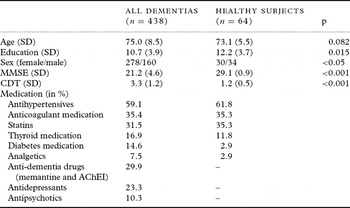
Of the dementia patients, 26.3% were aged between 40 and 70 years (age group I), 45.2% between 71 and 80 years (age group II), while 28.5% were older than 81 years (age group III). Of the dementia patients, 47.7% had attended elementary school (i.e. 8 or less years of education) (educational group I), 26.3% elementary school plus professional education (i.e. 9 – 11 years) (educational group II) and 26.0% had A-levels or a university degree (i.e. ≥ 12 years) (education group III). Table 1 shows demographic data, mean CDT and MMSE scores and medication of the healthy participants and dementia patients.
Demographic data, mean CDT and MMSE scores (standard deviation in parentheses), and medication of the healthy subjects and dementia patients

Note: CDT = Clock Drawing Test (max. 6 points, normal range 1–2 points); MMSE = Mini-Mental State Examination (max. 30 points, conventional cut-off score ≤ 24); SD = standard deviation; AChEI = acetylcholinesterase inhibitor; - not appropriate.
All patients and healthy participants had normal or corrected-to-normal visual acuity and sufficient hearing ability. None of the participants had a severe physical handicap that influenced the ability to perform the required tasks nor any neurological or psychiatric disorders unrelated to their diagnosis.
Instruments
The CDT and MMSE were performed and scored by the two authors S. M. and M. M. Both investigators were blinded to the respective diagnoses at the time they investigated the patients, since diagnostic workup (e.g. physical, neurological, and psychiatric examinations, brain imaging, laboratory tests) had not been completed at the time the testing was performed.
Algorithm Mini-Cog
For the Mini-Cog analysis, the CDT (see below) and the three-item recall from the MMSE of all participants were taken as the basis for the well-established algorithm from Scanlan and Borson (Reference Scanlan and Borson2001). The optimal algorithm had the following three rules: (1) subjects recalling none of the words were classified as having dementia; (2) those recalling all three words were classified as not having dementia, and (3) those with intermediate word recall (1–2) were classified based on the CDT (abnormal = with dementia, normal = no dementia). In the present study we used the three items from the validated German CERAD test-battery, i.e. Zitrone (lemon), Schlüssel (key) and Ball (ball).
CDT
In the original version of the Mini-Cog (Borson et al., Reference Borson1999) the CERAD 4-point system for clock scoring was used. For the CDT evaluation in the present work, the instruction and the scoring system of the modified version of Shulman and Gold were applied (Shulman and Gold, Reference Shulman and Gold1993). The participants were asked to draw the numbers in appropriate positions in a predrawn circle. Then they were asked to place the hands on the clock to indicate “10 past 11 o'clock.” The results were evaluated by scoring from 1 point (= “perfect”) to 6 points (= “not representative of a clock at all”). A score ≥ 3 was considered as impaired.
Algorithm MMSE and/or CDT
For the algorithm MMSE and/or CDT the conventional cut-off score ≤ 24 was used. Patients were stated to be impaired when either the MMSE or the CDT score, or both, were abnormal (i.e. ≤ 24 and ≥ 3, respectively).
Data analysis
Analyses were designed to compare three screening tests in order to detect cognitive impairment. The SPSS-16 statistical package for Windows® (Munich, Germany) was used for data analysis. Differences in education, MMSE, and CDT scores between dementia patients and healthy controls were evaluated with an analysis of covariance (ANCOVA) controlling for age and sex. Independent sample t-tests were chosen to assess group differences for age. χ2 tests were applied for the detection of differences in gender distribution and the discriminatory power of the screening tests in the dementia group. Receiver operating characteristic (ROC) curves were generated in order to determine sensitivities and specificities for the MMSE at a cut-off score ≤ 24 and ≤ 25. Sensitivities and specificities of the CDT and Mini-Cog were determined by the proportion of actual positives and negatives correctly identified. The significance level was set at p < 0.05.
Results
Type of dementia
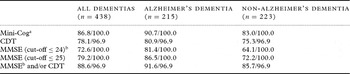
Table 2 shows the sensitivities and specificities for the Mini-Cog, the CDT, the MMSE at a cut-off score ≤ 24 and ≤ 25, the MMSE at a cut-off score ≤ 24, and/or CDT for the whole dementia group in both, AD and non-Alzheimer's dementia.
Sensitivities/specificities in % for the Mini-Cog, CDT, and MMSE

Note: aMini-Cog algorithm of Scanlan and Borson; CDT = Clock Drawing Test (max. 6 points, normal range 1–2 points); bMMSE = Mini-Mental State Examination (max. 30 points, conventional cut-off score ≤ 24); healthy subjects = 64.
Overall accuracy – all dementias
The MMSE alone, with the cut-off score ≤ 24, separated dementia from healthy at a much lower rate (72.6%) than the Mini-Cog (86.8%) considering all dementias (χ2 = 26.35, p < 0.001). A cut-off point of ≤ 25 in the MMSE increased the sensitivity to 79.2%; however this difference was significant (χ2 = 8.33, p < 0.01) too. The sensitivity of the CDT alone (78.1%) was similar to that of the MMSE with a cut-off score ≤ 25 and also differed significantly from that of the Mini-Cog (χ2 = 11.38, p < 0.01). Taking the combination of the MMSE with the conventional cut-off score of ≤ 24 and/or the CDT, a sensitivity of 88.6% was achieved. However, no significant difference between the discriminatory power of the Mini-Cog and the algorithm MMSE and/or the CDT could be detected (χ2 = 0.68, p =0.411).
Specificity
The specificity of the Mini-Cog and the MMSE (i.e. at a cut-off ≤ 24 and 25) in participants clinically judged to be cognitively normal (specificity) was in each case 100.0%; the specificity of the CDT and the algorithm MMSE and/or CDT was 96.9% for both (χ2 = 2.03, p = 0.154).
Alzheimer's dementia
In Alzheimer's dementia the Mini-Cog achieved significantly higher sensitivity (90.7%) than the CDT (80.9%) (χ2 = 8.43, p < 0.01) and the MMSE at a cut-off score ≤ 24 (81.4%) (χ2 = 7.75, p < 0.01). The sensitivity of the MMSE at a cut-off ≤ 25 (86.5%) did not significantly differ from that of the Mini-Cog (χ2 = 1.50, p = 0.221). When applying the algorithm MMSE and/or CDT there was a slight increase in sensitivity (91.6%) for the detection of cognitive impairment compared to the Mini-Cog; however, the difference was not significant (χ2 = 0.12, p = 0.734).
Non-Alzheimer's dementia
In the non-Alzheimer's dementia patients, the Mini-Cog (83.0%) demonstrated significantly higher screening value compared to the CDT (75.3%) (χ2 = 3.93, p < 0.05) and MMSE at a cut-off score ≤ 24 (64.1%) (χ2 = 19.48, p < 0.001). A cut-off score of ≤ 25 in the MMSE led to an increase of sensitivity (72.2%) for the detection of dementia; however, its performance was inferior compared to the Mini-Cog (χ2 = 7.43, p < 0.01). The algorithm MMSE and/or CDT (85.7%) showed a similar screening value as the Mini-Cog (83.0%) (χ2 = 0.61, p = 0.435).
Demographic factors
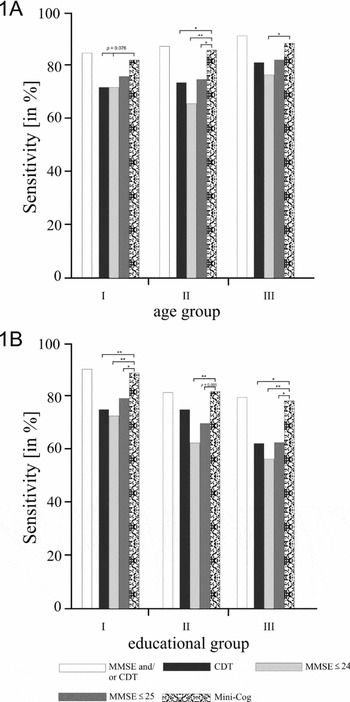
The influence of age and education on classification of participants using the different screening tests were analyzed. Figures 1a and 1b show the relative detection performance of the different screening methods for the respective age and educational groups. Significance is indicated with asterisks.
Relative detection performance of the different screening methods for the respective age groups (A) and educational groups (B), *p < 0.05, **p < 0.01.

Effect of age on sensitivity
Overall, the Mini-Cog apparently showed a higher sensitivity than the CDT and the MMSE for each age group at both cut-off scores (83.5% vs. 73.9% – 78.3% for age group I; 86.9% vs. 68.8% – 77.4% for age group II; and 89.6% vs. 77.6% – 83.2% for age group III). For the screening of patients aged between 40 and 70 years (age group I) the difference between the Mini-Cog and the MMSE ≤ 24, CDT failed marginally to achieve significance (χ2 = 3.14, p = 0.076). In patients aged between 71 and 80 years (age group II) the Mini-Cog significantly exceeded the screening value of the MMSE at both cut-off scores and that of the CDT (each p < 0.05). In age group III (≥ 81 years) the Mini-Cog performed significantly better than the MMSE at a cut-off ≤ 24 (χ2 = 6.56, p < 0.05) and tended to show better sensitivity than the CDT and MMSE at a cut-off ≤ 25. In all three age groups there was no significant difference between the screening value of the algorithm MMSE and/or CDT and the Mini-Cog (each p > 0.05). The variation of screening value between the different age groups was slightly lower for the Mini-Cog (range 6.1%) compared to the MMSE at cut-off ≤ 24 (8.8%) revealing the effect of age on the MMSE.
Effect of educational level on sensitivity
Overall, the Mini-Cog demonstrated for each educational group an obvious higher sensitivity than the CDT and the MMSE at both cut-off scores (89.2% vs. 73.7% – 81.4% for educational group I; 82.6% vs. 63.0% – 76.1% for educational group II and 80.3% vs. 58.2% – 65.9% for educational group III). For the screening of patients in educational group I (≤ 8 years) and group III (≥12 years) the Mini-Cog significantly exceeded the screening value of the MMSE at both cut-off scores and that of the CDT (each p < 0.05). In patients with an educational background of 9 – 11 years (educational group II) the Mini-Cog performed significantly better than the MMSE at a cut-off ≤ 24 (χ2 = 8.04, p < 0.01) and tended to show better sensitivity than the CDT. The difference between the Mini-Cog and the MMSE ≤ 25 marginally failed to achieve significance (χ2 = 3.67, p = 0.055). In all three educational groups the Mini-Cog demonstrated a sensitivity that was comparable to that of the algorithm MMSE and/or CDT (each p > 0.05). The observed variation of screening value between the different educational groups was lowest for the Mini-Cog (range 9.0%) compared to the MMSE at a cut-off ≤ 24 (15.5%) and a cut-off ≤ 25 (15.5%) revealing the effect of education on the MMSE.
Dementia severity
Figure 2 displays the proportion of subjects correctly classified by the Mini-Cog and CDT within each MMSE score. The CDT seems to be more susceptible to the dementia stage than the Mini-Cog. The sensitivities to detect patients from an MMSE score ≥ 23 (representing mild dementia stages) were between 54.3% and 69.2%, while the Mini-Cog showed sensitivities from 73.5% up to 85.4%.
Sensitivities for the Mini-Cog and Clock Drawing Test in relation to the respective Mini-Mental State Examination Score (n = 438).

Discussion
The initial issue, whether preference should be given to the Mini-Cog as a short screening tool, can clearly be stated positively. The results of our study suggest that the Mini-Cog is a valid and appropriate screening method in geriatric settings, such as memory clinics. A variety of screening tests has been developed and proposed in recent years (Katzman et al., Reference Katzman, Brown, Fuld, Peck, Schechter and Schimmel1983; Leopold and Borson, Reference Leopold and Borson1997; Froehlich et al., Reference Froehlich, Robison and Inouye1998; Buschke et al., Reference Buschke1999; Brodaty et al., Reference Brodaty2002); however, several confounding variables (language, cultural background, educational level) were reported.
In 2000 Borson and colleagues introduced a new and brief method, the Mini-Cog (Borson et al., Reference Borson, Scanlan, Brush, Vitaliano and Dokmak2000), which was constructed by combining the Clock Drawing Test (CDT) scored with the reference to CERAD templates (decribed in Borson et al., Reference Borson1999) with the uncued three-word recall derived from the Cognitive Abilities Screening Instrument (CASI) (Teng et al., Reference Teng1994). By means of the algorithm from Scanlan and Borson, sensitivities ranging from 76% to 99% and specificities ranging from 89% to 93% were achieved (Scanlan and Borson, Reference Scanlan and Borson2001; Borson et al., Reference Borson, Scanlan, Chen and Ganguli2003). A lower sensitivity of the Mini-Cog (69%) was recently reported in the work of Dougherty and colleagues in their sample of 84 AD patients (Dougherty et al., Reference Dougherty2010). Overall, while some studies accentuate the superior screening properties of the Mini-Cog compared to that of the MMSE (Borson et al., Reference Borson, Scanlan, Brush, Vitaliano and Dokmak2000; Reference Borson, Scanlan, Watanabe, Tu and Lessig2005), others report similar screening effectiveness (Borson et al., Reference Borson, Scanlan, Chen and Ganguli2003; Dougherty et al., Reference Dougherty2010).
In order to evaluate the screening value of the Mini-Cog in a memory clinic, for each participant included in this study, we retrospectively extracted the three items of the MMSE and the CDT. Other than Borson and colleagues (Borson et al., Reference Borson1999) the CDT had been evaluated by the scoring system of Shulman and Gold (Reference Shulman and Gold1993) and not according to the CERAD 4-point system as in the Mini-Cog original version. However, this may not alter the results or the conclusions of the paper. In our sample of 438 patients with dementia and 64 participants without dementia, we found an overall sensitivity of 86.8% and a specificity of 100.0 % for the Mini-Cog. Both the MMSE at two cut-off scores and the CDT achieved significantly lower sensitivities than the Mini-Cog. Although the algorithm MMSE and/or CDT demonstrated a minimally higher rate of “hits” than the Mini-Cog, the difference was statistically not significant. The Mini-Cog outmatched the MMSE and CDT also when subdividing the dementia sample into AD and non-AD.
For each age group the Mini-Cog showed higher and, in general, significantly superior sensitivities to detect dementia than the CDT and the MMSE. Overall, the older the patients the more probable the detection of dementia, a tendency that is observable in the relative performance of all performed screening tools. The screening value of the MMSE tended to be more affected by age than that of the Mini-Cog as already reported in previous studies (Uhlmann and Larson, Reference Uhlmann and Larson1991; Mungas et al., Reference Mungas, Marshall, Weldon, Haan and Reed1996; Stuss et al., Reference Stuss, Meiran, Guzman, Lafleche and Willmer1996). We also found lower sensitivity values for the MMSE in patients with higher educational background, explainable by initially better compensatory mechanisms at occurrence of dementia. This effect was not similarly pronounced when using the Mini-Cog.
In our sample of patients with dementia, the CDT achieved a sensitivity of 78.1% and a specificity of 98.1%, which is consistent with a previous study (Leyhe et al., Reference Leyhe, Milian, Muller, Eschweiler and Saur2009). In the present study, we did not find a significant effect of education and age on the screening value of the CDT. However, it is well known that the CDT performance strongly depends on dementia state as reported by significant correlations between the MMSE and CDT (Shulman et al., Reference Shulman, Shedletsky and Silver1986; Brodaty and Moore, Reference Brodaty and Moore1997; Juby, Reference Juby1999; Shulman, Reference Shulman2000; Kitabayashi et al., Reference Kitabayashi, Ueda, Narumoto, Nakamura, Kita and Fukui2001; Schramm et al., Reference Schramm, Berger, Muller, Kratzsch, Peters and Frolich2002). We could replicate this finding by showing that the effectiveness of the CDT clearly declined with the increase of the MMSE scores that represented dementia stage.
In a newly published work, McCarten and colleagues highlighted that the Mini-Cog was quickly and well accepted by older veterans (McCarten et al., Reference McCarten, Anderson, Kuskowski, McPherson and Borson2011). Furthermore, the authors aimed to test the results using different versions of the Mini-Cog and generated five alternate three-word lists and three different clock times. The 15 new versions were compared with the original published Mini-Cog (Borson et al., Reference Borson, Scanlan, Brush, Vitaliano and Dokmak2000). Of the 8,063 patients screened, 25.8% failed the screen. The Mini-Cog failure rates varied substantially depending on word list choice, so this analysis may have implications for clinicians in geriatric assessment. However, the authors did not recommend a definite word list or clock time due to the missing validation of “cognitive impairment” in their sample.
Limitations of the present study include the retrospective data acquisition, i.e. the CDT was not performed between naming and recalling the three items; however, all data were collected in the same assessment. A further limitation was the relatively small sample size of the normal subjects (i.e. N = 64), which might be responsible for the high specificity of the Mini-Cog that we found. A higher cohort size of normal subjects would probably lead to a lower specificity with a more realistic specificity of about 90% as reported in previous studies (Borson et al., Reference Borson, Scanlan, Chen and Ganguli2003).
Conclusions
The present study analyzed the screening value of the Mini-Cog in a large sample of memory clinic patients. The Mini-Cog was equal or exceeded significantly the performance of the MMSE and CDT in accuracy of screening for dementia in all education and age groups but required less time than the MMSE. Moreover, this study could show the susceptibilities of MMSE and CDT to age and education, respectively, depending on stage of dementia.
Conflict of interest
None.
Description of authors' roles
Monika Milian designed the study, undertook the statistical analysis, and wrote the first draft of the paper. Anna-Maria Leiherr collected the data and was responsible for data entry. Monika Milian and Stephan Müller performed the neuropsychological tests in the memory clinic; Gerhard W. Eschweiler, Guido Straten, and Thomas Leyhe were part of the medical expert group for dementia clarification in the memory clinic. All authors gave helpful advice for analysis and interpretation of the data, critically revised the paper and have approved the final version.