Introduction
The prostate is a movable target and there has been extensive research into accurate localisation with and without markers. Markers in prostate cancer patients are renowned as the ‘gold standard’ recommendation for the treatment and verification.Reference Schallenkamp, Herman, Kruse and Pisansky1 Given the prevalent use of fiducial markers in prostate patients and the considerable amount of evidence in literature about the use of markers, little has been documented about the stability of prostatic seed.Reference Kupelian, Willoughby and Meeks2 The aim of this literature review is to summarise the evidence on seed migration and loss in prostate cases and provide an overview of clinical implications of seed migration and loss.
Background
Prostate cancer treatment with three-dimensional conformal radiation therapy (3DCRT), intensity modulated radiation therapy (IMRT) and volumetric modulated arc therapy has been shown to assist in symptom control, provide improved survival, quality of life and tumour control progression.Reference Bujold, Craig, Jaffray and Dawson3 In order to achieve these dosimetric benefits, accurate localisation of the treatment target is required.Reference Schallenkamp, Herman, Kruse and Pisansky1
Historically, bony anatomy was used to position patients and verify prostate location.Reference McNair, Hansen, Parker, Evans, Norman and Miles4 Later studies found that bony anatomy was not optimal as a surrogate for the prostate position owing to its independent movement in relation to bones.Reference Schallenkamp, Herman, Kruse and Pisansky1 Given the prostate is located between the rectal wall and bladder, changes in either of these two volumes may lead to prostate displacement and/or set-up error.Reference Nederveen, Van Der Heide, Dehnad, Moorselaar, Hofman and Lagendijk5
Over time fiducial markers have progressively been considered ‘the bench mark standard’ in the localisation accuracy of the prostate.Reference Middleton, See and Rolfo6 Currently, most literature reports the insertion of seeds by a urologist under transrectal ultrasound guided implantation. Van den Heuvel et al.Reference Van den Heuvel, Fugazzi, Seppi and Forman7 proved that implanting a larger number of seeds did not provide increased accuracy in prostate localisation.Reference Van den Heuvel, Fugazzi, Seppi and Forman7 In current practice described by Rimmer et al.,Reference Rimmer, Burnet and Routsis8 three seeds are inserted using the following seed positions/locations: one seed at the base of the prostate, one at the apex and one in the left lateral position of the prostate.Reference Rimmer, Burnet and Routsis8 The use of seeds in prostate cases is based on the assumption that the markers are fixed within the prostate, however, this is not always the case.Reference Schallenkamp, Herman, Kruse and Pisansky1 In prostate cancer patients, possible reasons for seed migration include the time taken for seeds to lock into a stable position within the prostate, the prostate swelling post insertion or because of bathing in a pool of blood post implantation.Reference Delouya, Beliveau-Nadeau, Carrier, Donath and Taussky9 The current protocol to avoid seed migration and seed position variation involves waiting for 3 or more days after insertion before the patient undergoes computed tomography (CT) simulation to allow any swelling to subside. Multiple studies have looked at fiducial markers and their role in acting as a prostate surrogate. There has been little investigation into marker migration or loss.Reference Schallenkamp, Herman, Kruse and Pisansky1, Reference Kupelian, Willoughby and Meeks2, Reference Delouya, Beliveau-Nadeau, Carrier, Donath and Taussky9 Therefore, through exploring seed migration and loss, it will be assessed how this affects current practice protocols and decision making.
Methods
Given the large quantity of research on fiducial markers for prostate cases, literature was only included if it investigated fiducial markers in prostate cases for external beam. Information regarding seed migration and loss was accumulated by reviewing both randomised studies as well as review articles. Literature was included by reviewing the title and abstracts of each article. If the titles of abstracts contained the words seed migration and/or loss, the paper was used in this systematic review. The flow chart summarises how the search was conducted with the inclusion and exclusion criteria applied to obtain appropriate literature.
Results
Seed migration
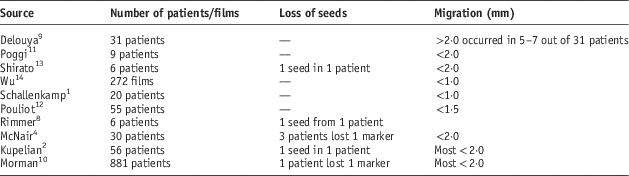
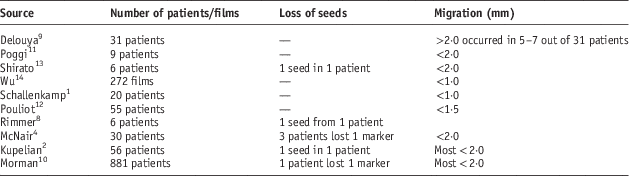
Table 1 presents a summary of the seed migration and loss data for prostate patients for the literature reviewed. The data presented in this table indicates that most literature with the exception of Delouya et al.Reference Delouya, Beliveau-Nadeau, Carrier, Donath and Taussky9 supports the use of gold seeds as a surrogate prostate motion owing to the minimal migration of seeds. Most authors reported that a migration of <2·0 mm was an acceptable threshold and was not clinically significant.Reference Schallenkamp, Herman, Kruse and Pisansky1, Reference Kupelian, Willoughby and Meeks2, Reference McNair, Hansen, Parker, Evans, Norman and Miles4, Reference Delouya, Beliveau-Nadeau, Carrier, Donath and Taussky9–Reference Wu, Haycocks and Alasti14 Contrary to this, Delouya et al.Reference Delouya, Beliveau-Nadeau, Carrier, Donath and Taussky9 conducted a small study (n=31) that claimed gold seeds in 16–23% of cases had migration >2·0 mm making the seeds an inadequate surrogate for prostate motion. Across the literature reviewed there was a small per cent of patients where significant migration occurred, but this was not the norm. The maximum migration recorded was of 10·2 mm.Reference Dehnad, Nederveen and Van Der Heide15
Studies on seed migration and loss for prostate cases
Seed loss
From the literature reviewed, minimal marker loss was reported, with a maximum loss of one marker per patient.Reference Kupelian, Willoughby and Meeks2, Reference Moman, Van der Heide and Kotte10, Reference Poggi, Gant, Sewchand and Warlick11, Reference Shirato, Harada and Harabayashi13, Reference Wu, Haycocks and Alasti14 Marker loss was reported to occur either between the implantation time and simulation appointment or shortly after treatment had commenced. This was dependent on the duration of time between the seed implantation and simulation or treatment.
Discussion
Seed migration
A majority of literatureReference Schallenkamp, Herman, Kruse and Pisansky1, Reference Kupelian, Willoughby and Meeks2, Reference McNair, Hansen, Parker, Evans, Norman and Miles4, Reference Delouya, Beliveau-Nadeau, Carrier, Donath and Taussky9–Reference Wu, Haycocks and Alasti14 validates that there was minimal significant seed migration with Delouya et al.Reference Delouya, Beliveau-Nadeau, Carrier, Donath and Taussky9 the only exception. Different authors have reported marker migration by looking at inter-marker distances between the three markers. Momen et al.Reference Moman, Van der Heide and Kotte10 reported a migration of <2·0 mm in patients; however, patients with migration >2·0 mm were excluded if random migrations between two markers exceeded the 2·0 mm threshold.Reference Moman, Van der Heide and Kotte10 Kupelian et al.Reference Kupelian, Willoughby and Meeks2 investigated prostate patients inter-marker distances during the course of treatment, reporting a mean of 1·4 mm with a standard deviation of 0·3 mm. In 47 out of the 56 patients, it was found that markers stayed in a consistent position throughout treatment. There were, however, instances when seeds showed >2·0 mm migration.Reference Kupelian, Willoughby and Meeks2 Kupelian et al.Reference Kupelian, Willoughby and Meeks2 reported the greatest inter-marker distance as 3·0–5·0 mm. The 3·0 mm migration occurred in 23 patients, 4·0 mm in ten patients and 5·0 mm in three patients. Only one of the three markers had a relative change in position that was consistent through the patient’s entire treatment.Reference Kupelian, Willoughby and Meeks2 From a clinical perspective, two conclusions were drawn from Kupelian et al’s.Reference Kupelian, Willoughby and Meeks2 study: first, out of 168 markers examined there was no significant increase or decrease in inter-marker distances over a patient’s treatment course. Two cases had significant migration with no consistency. Although stability was indicated by the mean and standard deviation in this study, Kupelian et al.Reference Kupelian, Willoughby and Meeks2 stated that many patients have significant inter-marker migration, at least once during their treatment course.Reference Kupelian, Willoughby and Meeks2
Litzenberg et al.Reference Litzenberg, Dawson and Sandler16 examined ten patients with three markers and also found patients had migration of <2·0 mm with a mean variance of 0·7–1·7 mm. A total of 79% of these cases varied <1·0 mm, with 96% varying <1·5 mm, indicating no trend with the inter-marker migration over a treatment course.Reference Litzenberg, Dawson and Sandler16 Dehnad et al.Reference Dehnad, Nederveen and Van Der Heide15 examined a small cohort of nine patients with 19 markers. The data had a mean of 1·0 mm with a standard deviation of 0·5 mm, also conforming to the 2·0 mm threshold. However, Dehnad et al.Reference Dehnad, Nederveen and Van Der Heide15 had one case with a maximum migration of 10·2 mm that was the largest migration documented in literature to date.Reference Dehnad, Nederveen and Van Der Heide15 An earlier study by Poggi et al.Reference Poggi, Gant, Sewchand and Warlick11 examined patients who had five prostatic seeds for their radiotherapy treatment. The average migration of all seeds was 1·2 mm with a standard deviation of 0·2 mm. The greatest average movement of any single seed in a patient relative to the simulation position was 1·9 mm over the entire 7 weeks of treatment. The smallest average movement relative to initial simulation position in a single patient was 0·6 mm.Reference Poggi, Gant, Sewchand and Warlick11 Van den Huren et al.Reference Van den Heuvel, Fugazzi, Seppi and Forman7 investigated inter-marker distances of six seeds implanted in each patient. A large migration occurred in two out of the ten patients. Large migration was considered a migration of >10·0 mm and referred to by Van den Huren et al.Reference Van den Heuvel, Fugazzi, Seppi and Forman7 as a ‘catastrophic migration’. A total of 20% of cases in this study had a ‘catastrophic migration’, but this only occurred in the period between simulation and the patient’s first treatment. No significant ‘catastrophic’ migrations were reported during the course of treatment.Reference Van den Heuvel, Fugazzi, Seppi and Forman7 Similarly, Schallenkamp et al.Reference Schallenkamp, Herman, Kruse and Pisansky1 obtained data from 79 inter-marker distances and found the average inter-marker movement was <1·0 mm with a mean of 0·8 mm and standard deviation of 0·1 mm.Reference Schallenkamp, Herman, Kruse and Pisansky1
Pouliot et al.Reference Pouliot, Aubin and Langen12 reported inter-marker distances of ten alignments per patient with a mean of 1·3 mm with a standard deviation of 0·44 mm. Inter-marker distances were examined by looking at orthogonal image pairs in all patients. Results of ten image pairs were taken over a 6 week course of radiotherapy.Reference Pouliot, Aubin and Langen12 The standard deviation of measured distances over the course of treatment was computed for each patient by using the average of the first 3 days as a difference.Reference Pouliot, Aubin and Langen12 The average mean was 1·3 mm with a standard deviation variance of 0·4–3·0 mm. Three patients indicated a standard deviation >2·0 mm for at least one of the measurements over the treatments period.Reference Pouliot, Aubin and Langen12 Distances were shown to reduce over the 52 days of radiotherapy treatment.Reference Pouliot, Aubin and Langen12 Further to this, Shirato et al.Reference Shirato, Harada and Harabayashi13 agreed that seed migration occurs over time, but stated migration was within the 2·0 mm threshold. Shirato et al.Reference Shirato, Harada and Harabayashi13 also acknowledged that patients that had migrations greater than the 2·0 mm threshold that this needs to be accounted for in the treatment processes. Reference Shirato, Harada and Harabayashi13
Although most migrations were within the 2·0 mm threshold, there were individual cases reported in literature with greater migration. Poggi et al.Reference Poggi, Gant, Sewchand and Warlick11 reported a maximum migration of 6·6 mm in one case, and Dehand et al.Reference Dehnad, Nederveen and Van Der Heide15 recorded one patient with a maximum migration of 10·2 mm.Reference Delouya, Beliveau-Nadeau, Carrier, Donath and Taussky9, Reference Poggi, Gant, Sewchand and Warlick11 McNair et al.Reference McNair, Hansen, Parker, Evans, Norman and Miles4 looked at the inter-marker distances for different fractions during each patient’s treatment. The inter-marker distances were looked at the first, second, half way and towards the end of the patients treatment. A total of 10% of the patients had migrations of >2·0 mm between the three markers with no increase or decrease in inter-marker distance between markers with time.Reference McNair, Hansen, Parker, Evans, Norman and Miles4 Delouya et al.Reference Delouya, Beliveau-Nadeau, Carrier, Donath and Taussky9 was the only author that documented patients also had migration under the 2·0 mm, however, 16–23%cases had migrations >2·0 mm and this study considered this to be significant number of patients. Delouya et al.Reference Delouya, Beliveau-Nadeau, Carrier, Donath and Taussky9 stated, relying on fiducial markers as surrogate for the prostate was not the ‘perfect solution’. It was highlighted that migration >2·0 mm may have clinical significance owing to potential challenges with image matching accuracy as a result of significant seed migration.Reference Delouya, Beliveau-Nadeau, Carrier, Donath and Taussky9 From this data it is important to recognise that in the case of significant migration, an individual protocol needs to be designed in order to accurately verify prostate location in order to deliver accurate treatment.
Seed loss
There has been minimal data on the loss of seeds in prostate patients undergoing external beam radiation therapy reported. Moman et al.Reference Moman, Van der Heide and Kotte10 claimed that seed loss occurred only in a small per cent of their 881 patients.Reference Moman, Van der Heide and Kotte10 Kupelian et al.Reference Kupelian, Willoughby and Meeks2 reported the loss of one seed in an individual case at the beginning of treatment. Most seed loss occurred before 28 days post implantation and rare losses occurring after 6 days. It was assumed that the seed lost in the individual case in Kupelian et al.Reference Kupelian, Willoughby and Meeks2 data was eliminated through the genitourinary tract. The most plausible explanation for this event is that the seed failed to embed at the time of initial placement becoming dislodged.Reference Kupelian, Willoughby and Meeks2 McNair et al.Reference McNair, Hansen, Parker, Evans, Norman and Miles4 investigated 30 patients with three seeds each. From the time of CT to the time that the patients underwent treatment, 3 out of the 30 patents only had two seeds (losing one seed)Reference McNair, Hansen, Parker, Evans, Norman and Miles4. The time variation from the time of seed insertion until the time of the CT scan varied between 3 and 145 days.Reference McNair, Hansen, Parker, Evans, Norman and Miles4 Finally, Rimmer et al.Reference Rimmer, Burnet and Routsis8 and Shirato et al.Reference Shirato, Harada and Harabayashi13 also found a loss of one seed in one patient, however, a small sample size of six patients in each study limits the use of their findings to the wider external beam prostate population.Reference Rimmer, Burnet and Routsis8, Reference Shirato, Harada and Harabayashi13 Given the evidence the published literature documenting the potential loss of seeds in prostate patients, clinical centres need to have protocols that can be used to decide what verification method will be used in the case of loss. There is a question of whether bony anatomy should be used taking into account intra- and inter-fraction motion and whether it is a clinically acceptable method of verification for prostate cancer patients.Reference McNair, Hansen, Parker, Evans, Norman and Miles4
Implications of Migration
When intraprostatic fiducial markers are inserted it is important to know whether these markers migrate or change position from the initial simulation until the completion of the radiotherapy course. In the case of inter-marker migration of individual seeds, the use of seeds as a surrogate was questionable and has clinical implications in regards to imaging accuracy and matching.Reference Schallenkamp, Herman, Kruse and Pisansky1 In clinical practice, accurate seed matching will not only assist in accurate couch movements but also in accurate dose escalation.Reference Dehnad, Nederveen and Van Der Heide15 Studies by Delouya et al.Reference Delouya, Beliveau-Nadeau, Carrier, Donath and Taussky9 and Chung et al.Reference Chung, Haycocks and Brown17 indicated that if a significant migration or loss of markers occurred within an individual patient, radiation therapists have greater difficulty in matching seeds on images, introducing a greater degree of observer bias when matching.Reference Delouya, Beliveau-Nadeau, Carrier, Donath and Taussky9, Reference Chung, Haycocks and Brown17 After surveying radiation therapists on their ability to match, Chung et al.Reference Chung, Haycocks and Brown17 reported the varying difficulty for radiation therapist to image match with 8% very simple, 80% simple, 9% difficult and 3% very difficult. Radiation therapists reporting difficult and very difficult found matches challenging as a result of individual marker migration.Reference Chung, Haycocks and Brown17 A recent study by Deegan et al.Reference Deegan, Owen, Holt, Roberts, Biggs and McCarthy18 highlighted there was a small variation in matching agreement between radiation therapist in both online and offline imaging for prostate cases. Furthermore, Deegan et al.Reference Deegan, Owen, Holt, Roberts, Biggs and McCarthy18 agreed with Chung et al.Reference Chung, Haycocks and Brown17 in regards to matching as long as fiducial migration was <2·0 mm. Thus, gold seeds were considered to accurately mimic the prostate when matching with three seeds.Reference Chung, Haycocks and Brown17
Furthermore in instances of significant migration or loss, there is also limited literature on the protocols that should be followed when making decisions about image matching during significant migration and loss. As it stands, only Thompson et al.Reference Thompson, Fox and Foroudi19 and Duffton et al.Reference Duffton, McNee, Muirhead and Alhasso20 have mentioned in their literature what actions should be taken if this occurs. Thompson et al. stated that in the case where there is difficulty to accurately verify a particular marker, the remaining two markers should to be used for matching. This, however, raises the question of how accurate the remaining two markers are. If only one marker was remaining post implantation, then the radiation oncologist should be consulted on whether bony anatomy should be used in matching when treating prostate cancer patients. Further to this Duffton et al.Reference Duffton, McNee, Muirhead and Alhasso20 recognised that infrequent seed migration occurs, stating that in the case of seed loss once again the matching should be done depending on the position of the remaining two seeds or actually match the best fit of the three seeds. This, however, will introduce interobserver variability in the way each radiation therapist matches.Reference Duffton, McNee, Muirhead and Alhasso20 More literature is needed to clarify what decisions radiation oncologist will make in different instances of seed loss and seed migration.Reference Thompson, Fox and Foroudi19
All Reference Schallenkamp, Herman, Kruse and Pisansky1, Reference Kupelian, Willoughby and Meeks2, Reference McNair, Hansen, Parker, Evans, Norman and Miles4, Reference Rimmer, Burnet and Routsis8, Reference Moman, Van der Heide and Kotte10–Reference Wu, Haycocks and Alasti14 but one author Reference Delouya, Beliveau-Nadeau, Carrier, Donath and Taussky9 indicated that seeds are a viable surrogate for prostate motion. Delouya et al.Reference Delouya, Beliveau-Nadeau, Carrier, Donath and Taussky9 documented that most patients had a migration of <2·0 mm, 16–23% of the patients in this study had a migration <2·0 mm. From this Delouya et al.Reference Delouya, Beliveau-Nadeau, Carrier, Donath and Taussky9 concluded that given the significant migration in these cases being >2·0 mm, fiducial markers were not the ‘perfect solution’ as a surrogate for the prostate. They concluded that in cases with significant migration, a repeat simulation was required to adapt the correct planning treatment volume.Reference Delouya, Beliveau-Nadeau, Carrier, Donath and Taussky9, Reference Gauthier, Carrier, Beliveau-Nadeau, Fortin and Taussky21 Furthermore, Momen et al’s.Reference Moman, Van der Heide and Kotte10 study treated cases with IMRT, and as such required migration tolerances of <2 mm were required owing to the tight planning margins in these cases. Patients that showed inter-marker distances ranging from 3·0 to 4·0 mm only occurred in three patients and should be treated with conformal radiotherapy owing to larger margins assigned for these patents.Reference Moman, Van der Heide and Kotte10
In cases of significant migration or loss, cone beam computed tomography (CBCT) could be used to assist in accurate pre-treatment positioning of the prostate, rather than prostatic seeds. Not only does CBCT have the ability to account for prostate location, but also shows the location of the organs at risk, such as the bladder and rectum.Reference Button and Staffurth22 However, CBCT is time consuming and more difficult for radiation therapist to match compared with kilovoltage or megavoltage imaging using gold seeds.Reference Barney, Lee, Handrahan, Welsh, Cook and Sause23
Limitations
This study was limited to non-surgical prostate patients and did not consider post-prostatectomy patients. Given post-prostatectomy patients have had their prostate removed; seed migration may be more significant in these patients and needs to be investigated further. Only patients who were undergoing either 3DCRT or IMRT were considered and brachytherapy cases were excluded. Finally, there was no consistency across the literature on reporting the use or absence of androgen deprivation hormone therapy (ADHT). This is an important consideration because ADHT decreases the size of the prostate, and thus could impact on the degrees of seed migration.Reference Litzenberg, Dawson and Sandler16
Conclusion
Through summarising the literature it is clear that gold seeds are considered to be stable with most migrations within a 2·0 mm threshold and with a maximum loss of one seed per patient. This indicates that as practitioners we can be confident that gold seeds are an accurate surrogate for prostate position.Reference Deegan, Owen, Holt, Roberts, Biggs and McCarthy18 Although individual cases can have significant migration and loss, each patient case must be considered individually if marker migration exceeds the 2·0 mm threshold. Given the possible implications of seed migration and loss each clinic needs to have protocols in place to deal with both non-significant and significant migration when it occurs. Further research and analysis of the impact of different matching protocols in cases of significant seed migration and loss needs to be documented in the literature. Detailed analysis of different matching processes will further inform clinical practice and improve evidence-based practice decision making.
Acknowledgements
None.
Financial Support
This research received no specific grant from any funding agency, commercial or not-for-profit sectors.
Conflicts of Interest
None.