1. Introduction
Negation is a primitive component of human language and thought (Horn, Reference Horn1989 [2001]), and has long been the subject of intense scrutiny and debate by philosophers, linguists, and psychologists alike (e.g., Plato’s Sophist, Reference Phillips, Wagers, Lau and Runner1937 [c.360 bc]; Jespersen, Reference Jespersen1917; Wason, Reference Vasishth, Brüssow, Lewis and Drenhaus1959). Despite this long history of study, many questions remain open. This paper investigates an aspect of natural language negation which has been central to debates in linguistics (e.g., Giannakidou, Reference Giannakidou2000; Haegeman & Zanuttini, Reference Haegeman, Zanuttini, Belletti and Rizzi1996; Zeijlstra, Reference Zanuttini2004), but which has thus far received little attention in the psycholinguistic literature: a potential ambiguity of certain sentences containing two negative elements. To illustrate, consider the following sentence:
(1) I didn’t eat nothing this morning.
- (2)
a. I ate nothing.
b. It is not the case that I ate nothing. (= I ate something.)
Without context, sentence (1) is ambiguous between two readings. In the first, paraphrased in (2a) and known as Negative Concord (henceforth NC), the two negative elements (didn’t and nothing) contribute to a single semantic negation. Someone who has skipped breakfast might use (1) on the NC reading to express to a friend why she is so eager for lunch. In the second, paraphrased in (2b) and known as Double Negation (DN), each negative element contributes an independent semantic negation. A person who habitually skips breakfast, but happens to have made time for a meal one morning might use (1) on this reading to correct a friend’s assumption that she has not yet eaten, perhaps emphasizing one or both of the negative elements.
Not all sentences with two negations are ambiguous. For instance, the fact that the two negations in the DN reading of (1) can cancel each other out semantically to yield a logical affirmative, shown in (2b), is due to the structural relationship between the negative elements. In other structures, DN does not have a canceling effect, as illustrated by the following:
(3) The woman who didn’t get to breakfast on time ate nothing this morning.
In (3), each negation contributes to the sentence’s meaning, but the sentence is still logically negative: the woman did not eat anything. Sentences such as (3) are not ambiguous between NC and DN in the way that (1) is, and have only a DN reading.
The NC reading of (1) is not typically considered part of standardized or ‘Standard’ English varieties. In these varieties, the most common way to express the meaning paraphrased in (2a) is to replace nothing with anything, a Negative Polarity Item (NPI). In English, NC is generally associated with varieties such as Appalachian (Wolfram & Christian, Reference Wason1976) and African American English (Green, Reference Green2002), and many others.
The phenomenon of NC is found in a diverse array of human languages including throughout Romance (Zanuttini, Reference Xiang, Grove and Giannakidou1997), in Afrikaans (Biberauer & Zeijlstra, Reference Biberauer and Zeijlstra2012), in Modern Hebrew (Keren, Reference Kaup, Yaxley, Madden, Zwaan and Lüdtke2015), in Hungarian (Puskás, Reference Prieto, Borràs-Comes, Tubau and Espinal2012), and in many others. Despite (or perhaps because of) its status as a hallmark feature of American English vernacular speech (Wolfram & Fasold, Reference Wolfram and Christian1974), the use of NC carries a heavy social stigma in many English-speaking societies (Blanchette, Reference Blanchette2013; Horn, Reference Horn and Horn2010; Nevalainen, Reference Matuschek, Kliegl, Vasishth, Baayen and Bates1998). English DN, on the other hand, is less colloquial, and more heavily pragmatically conditioned than NC, appearing, for example, when a speaker wishes to deny something previously asserted or presupposed (Geurts, Reference Geurts1998; Horn, Reference Horn1989 [2001]).
This paper seeks to contribute to our understanding of NC and DN in a standardized form of adult American English. Using eye-tracking while reading, which provides insight into how speakers process text from moment to moment (Rayner, 1994, Reference Rayner, Ygge and Lennerstrand2009), we investigate how NC and DN sentences with identical surface structure are processed following a single context sentence. Online reading times reveal an interaction between syntax and pragmatic context previously observed only in offline measures. This interaction suggests that adults can have specialized and perhaps even native-like knowledge of construction types that do not appear in their own language varieties.
1.1. background
1.1.1. Negative Concord and Double Negation
A current question in linguistic theory and language acquisition pertains to the status of NC in the grammars of ‘Standard English’ (SE) speakers, who, though difficult to classify in linguistic terms (Lippi-Green, Reference Ladusaw1997, p. 53), do not typically use NC in spontaneous speech, and would likely consider it unacceptable in both formal and informal social contexts. A recent experimental study shows that, despite their limited exposure to NC, three- to six-year-olds acquiring Standard English readily generate NC interpretations of sentences with two negatives given an appropriate context. These children behave differently from their adult counterparts, who prefer DN interpretations over NC (Thornton, Notley, Moscati, & Crain, Reference Tettamanti, Manenti, Della Rosa, Falini, Perani, Cappa and Moro2016). Based on discontinuities between child and adult performance, these researchers hypothesize that children “expunge” NC from their grammars during the course of acquisition (p. 23). Under this hypothesis, transitioning from a child to an adult SE grammar may involve switching from an NC to a DN grammar.
The hypothesis that children switch grammars during the course of acquisition is in line with predominant linguistic theories which model NC and DN as reflecting distinct underlying systems for encoding negation. In so-called ‘NC languages’, negative words such as nothing are not inherently negative, but instead carry a formal feature that specifies that they must agree with a semantically negative element elsewhere in the clause. NC thus instantiates a syntactic dependency between a morphologically negative but semantically non-negative word, and a semantically negative element elsewhere in the structure (which may be phonologically null). In ‘DN languages’, however, negative words are inherently negative and therefore form no syntactic dependency. In these languages, overtly negative elements correspond in a one-to-one ratio with semantic negations (Zeijlstra, Reference Zanuttini2004, Reference Zeijlstra2008).
Recent experimental work on ‘NC languages’ such as Spanish, Catalan, and French has demonstrated that, in fact, adult speakers readily generate both NC and DN interpretations given the appropriate pragmatic context and set of prosodic cues or gestures (Déprez, Tubau, Cheylus, & Espinal, Reference Déprez, Tubau, Cheylus and Espinal2015; Espinal & Prieto Reference Espinal and Prieto2011; Espinal, Tubau, Borrás-Comes, & Prieto, Reference Espinal, Tubau, Borrás-Comes, Prieto, Larrivée and Lee2016; Prieto, Borràs-Comes, Tubau, & Espinal, Reference Plato and Jowett.2013). That is, in these languages, variation between NC and DN readings of sentences with two syntactic negations is predicted by the discourse context in which the sentence is encountered, not by the individual speaker or listener’s language.
It is logically possible under theories such as the one in Zeijlstra (Reference Zanuttini2004, Reference Zeijlstra2008) for NC languages to produce DN readings. However, it is unexpected that ‘DN languages’ such as Standard German, Standard Dutch, and Standard English, in which each overtly negative element is assumed to necessarily contribute a semantic negation, would be able to generate NC readings. Thus, if evidence for NC is found in a language thought to be DN, then this suggests that the language’s system for encoding negation may be underlyingly NC. Extending beyond these theories, evidence for NC in a DN language might further suggest that the putative divide between NC and DN languages is only superficial, and that, cross-linguistically, systems for encoding negation are more similar than previously thought.
1.1.1.1. NC in ‘Standard English’.
Blanchette (Reference Blanchette2017) provides experimental evidence supporting the hypothesis that adult speakers of Standard English, thought to be a DN language, have NC grammars. A series of experiments collected Likert scale acceptability judgments of sentences like (4) through (6) following a single context sentence, which biased readers toward either an NC or a DN interpretation.
(4) Lucy didn’t see nobody at the basketball game last night. (Object NC/DN)
(5) Nobody didn’t see that basketball game last night. (Subject NC/DN)
(6) Didn’t nobody see that basketball game last night. (NC only)Footnote 1
Sentences (4) through (6) each contain the negated auxiliary didn’t and the negative phrase nobody, in different syntactic configurations. In (4) nobody resides in object position following the negated auxiliary and the verb; in (5) it resides in canonical subject position preceding the auxiliary; and in (6) it sits in a subject position following the auxiliary. In the simplest terms, the precedence of the negated auxiliary in (4) and (6) can be characterized syntactically in terms of a c-command relation (Reinhart, Reference Rayner1976), in that the preferred NC constructions involve the negated auxiliary c-commanding the negative phrase.
The participants in Blanchette’s (Reference Blanchette2017) study report that they do not produce NC as in (4) through (6), and their mean judgments of these sentences are invariably below the median acceptability level (i.e., below 4 on a scale of 1 to 7) in both NC and DN contexts. Nevertheless, their judgments reflect a reliable acceptability preference for NC contexts when the negated auxiliary c-commands the negative phrase (as in (4) and (6)), and for DN contexts when it does not (as in (5)). The syntactic preference for a c-commanding negated auxiliary in NC constructions is in line with corpus observations for the distribution of NC construction types (Smith, Reference Schiller, van Lenteren, Witteman, Ouwehand, Band and Verhagen2001), in which NC constructions with the structure in (4) occur in more varieties than those with the structure in (5) (p. 123). This suggests that speakers who do not use NC are nevertheless sensitive to its distribution frequencies, and perhaps even to its core syntactic properties.
It is worth noting that the pattern of c-command preference between negated auxiliaries and negative phrases observed in Blanchette’s work on NC in SE bears resemblance to the distribution of NPI constructions such as I didn’t eat anything this morning. NPI constructions have been characterized by a constraint that requires them to be in the c-command domain of a downward entailing element (Ladusaw, Reference Keren1979), the prototype of which is syntactic negation. The following pair of sentences illustrates this for the NPI anybody:
(7) Lucy didn’t see anybody at the basketball game last night.
(8) *Anybody didn’t see Lucy at the basketball game last night. (cf. Nobody saw Lucy…)
Sentence (8) can be characterized as ungrammatical (*) because, in canonical subject position, the NPI is not c-commanded by a negation. Note that sentence (7) has the same single negative meaning as the object NC construction in (4). It is therefore plausible that participants’ preference for NC interpretations where the negated auxiliary c-commands the negative phrase reflects a structural analogy to NPI constructions. We return to this in the ‘Discussion’ section.
Returning to NC, on the basis of gradient acceptability judgment data, Blanchette (Reference Blanchette2017) suggests that Standard English speakers have not completely “expunged” their NC knowledge during the course of acquisition, and rather, they have retained at least some grammatical knowledge of the construction, whether on analogy to the grammar of NPI constructions, or as a grammatical construction on its own. Reliable judgments of meaning and use of acoustic cues distinguishing NC and DN readings provide further support for this hypothesis, robustly replicating the syntactic patterns for NC observed in Blanchette (Reference Blanchette2017) (Blanchette & Nadeu, Reference Blanchette and Nadeu2018; Blanchette, Nadeu, Yeaton, & Déprez, Reference Blanchette, Nadeu, Yeaton and Déprez2018).
Why would Standard English-speaking adults display reliable syntactic preferences for certain types of NC constructions, but appear generally unable to access NC meanings in a truth value judgment paradigm? We submit that the discrepancy is due to the difference in methodologies employed in data collection. In completing Thornton et al.’s (Reference Tettamanti, Manenti, Della Rosa, Falini, Perani, Cappa and Moro2016) untimed, pencil and paper truth value judgment task, adult participants had time to reflect on prescriptive norms, and this reflection may have shaped their responses. It is therefore possible that their response patterns were not a reflex of their underlying grammatical representations, but rather, of prescriptive judgments.
Blanchette (Reference Blanchette2017) and Blanchette et al. (Reference Blanchette, Nadeu, Yeaton and Déprez2018) obtained different results by varying the syntactic position of the negative phrase relative to the negated auxiliary, and by examining both gradient acceptability and binary meaning judgment data on acoustic (not written) stimuli. However, these tasks were also untimed, and are also metalinguistic in nature, hence subject to the same criticisms: participants’ judgments could have been based on frequency observations that are unrelated to any underlying grammatical processes. Given the heavy stigma associated with English NC and the conflicting results from different metalinguistic tasks, online observations of the processes underlying these judgments are necessary in order to understand its status in standardized varieties of English.
1.2. the current study
This paper examines the processing of both NC and DN using eye-tracking while reading. We employ eye-tracking while reading in order to observe the moment-to-moment processing of sentences with two negative elements, because this is known to reveal information about the processes underlying metalinguistic tasks (Gordon, Hendrick, Johnson, & Lee, Reference Gordon, Hendrick, Johnson and Lee2006, p. 1308). Furthermore, by examining participants’ processing of sentences with two negative elements, rather than their subsequent metalinguistic judgments, we potentially mitigate at least some of the effects of prescriptive pressure. Our results demonstrate that speakers’ reading of both context and critical sentences reflects the same interactions between syntactic structure and pragmatic context found in Blanchette and colleagues’ previous work, presenting further support for the hypothesis that grammatical mechanisms are at play in Standard English speakers’ judgments of both NC and DN sentences.
1.2.1. Predictions
This study seeks to understand whether Standard English speakers generate NC structures during the course of online processing. The results bear on theories of negation in English, and more generally, the question of whether there exists a grammatical divide between NC and DN languages (as proposed in Zeijlstra Reference Zanuttini2004, Reference Zeijlstra2008, discussed above). We employ a two by two design, varying the presentation of sentences with two syntactic negations by pragmatic context type (NC vs. DN) and syntactic structure (object vs. canonical subject). We predict that reading times will reflect the interaction between location of negation and pragmatic condition found in previous work. On the basis of previous eye-tracking while reading work on negation, we further expect this interaction to be revealed not during participants’ first pass through the context and critical sentences, but rather in measures of late processing such as rereading time and total reading time (Ferguson, Sanford, & Leuthold, Reference Ferguson, Sanford and Leuthold2008). Specifically, we predict that participants will spend more time rereading contexts to determine the correct interpretation for object items in the DN condition, and for subject items in the NC condition.
In order to understand the role of pragmatic ambiguity, we include a condition with an embedded negation in which DN is unambiguously the correct interpretation, as in example (3) above. These are similar to a control condition in Thornton et al. (Reference Tettamanti, Manenti, Della Rosa, Falini, Perani, Cappa and Moro2016), in which adults and children performed similarly well in accessing the DN interpretation (p. 18). We predict that these will be easier to interpret in context than mono-clausal items which, removed from context, may be ambiguous between NC and DN readings. This greater ease of processing should also be reflected in lower context rereading times overall relative to the potentially ambiguous items.
2. Methods
The current study was designed to test whether and to what extent previously observed metalinguistic judgments on NC and DN by adult Standard English speakers can be replicated in online measures. This section details our methods.
2.1. participants
Thirty participants (23 women, 7 men) were recruited in State College, Pennsylvania, a college town in the mid-Atlantic region of the United States. Participants’ ages ranged from 18 to 68 (mean = 26), and most had spent their childhood in the mid-Atlantic (exceptions: 1 in Florida, 1 in Illinois). All were native speakers of American English, as determined by demographic information reported in a post-task questionnaire. All reported English as their first language, with age of exposure beginning at birth, and four participants reported early concurrent exposure to another language (2 Mandarin, 1 Greek, 1 Spanish). All 30 participants reported that they did not use English NC.Footnote 2 The majority were university undergraduates, with relatively high levels of formal education. Participation, including consent, eye-tracking, and the post-task language questionnaire, took approximately 45 minutes, and participants were paid $20 for their time.
2.2. materials and design
Stimuli were 32 sentences, 16 of each type shown in (9). For a full list of stimuli, see the ‘Appendix’.
- (9)
a. He didn’t beat nobody at poker. Negative Object
b. Nobody didn’t watch the game last night. Negative Subject
Sentences were counterbalanced for negative NP type (nobody, nothing, no [animate], no [inanimate]). The head nouns of negative noun phrases (e.g., kid in no kid) were controlled for frequency using the SUBTLEX corpus (Brysbaert & New, Reference Brysbaert and New2009), such that the mean frequency of the head nouns across conditions was similar (frequency per million words: M subj = 209, M obj = 132; t(14) = –0.97, p = .35).Footnote 3
For each critical sentence, we created two context sentences: one that biased readers to interpret the two negatives in the critical sentence as NC, and one that biased readers to interpret them as DN. Context sentences corresponding to (9a) and (9b) are shown below. To avoid potential confounds, we used no syntactic negation in the context sentences.
(10) Negative Concord
a. Greg had terrible luck at the casino last night.
He didn’t beat nobody at poker. (= he beat no one)
b. The fans were distracted by the news about the presidential election.
Nobody didn’t watch the game last night. (= no one watched)
(11) Double Negation
a. Greg lost most of his blackjack games, but he did great at the poker table.
He didn’t beat nobody at poker. (= he beat somebody)
b. The fans were excited to see their favorite team play.
Nobody didn’t watch the game last night. (= everyone watched)
For these sentences, two lists were created. On each list, half of the negative subject and half of the negative object sentences appeared with NC biasing context sentences, and the other half appeared with DN biasing context sentences. Across lists, each critical sentence appeared in both contexts. Following each item, participants were asked to verify a statement as True or False. The same statement was used for a given critical sentence, regardless of which context it appeared in. As in the context sentences, we also avoided using syntactic negation in the verification statements. The verification statements for (9a) and (9b) were as follows:
- (12)
a. Greg lost all of his poker games.
b. Everyone watched last night’s game.
Note that each statement specifically targets the negative dependency, or lack thereof, in the critical sentence. Because the NC and DN interpretations have opposing truth conditions, the truth or falsity of the statement depends on its status as NC or DN, and participants’ answers allowed us to probe their interpretation of the critical sentence. For example, endorsing (12a) as True indicates that the participant interpreted the critical sentence as Negative Concord, and concluded that Greg beat no one at poker, while responding False indicates that the participant got the DN reading, and concluded that Greg beat someone. Conversely, endorsing (12b) as True indicates a DN reading, i.e., that there was no one who did not watch the game, and responding False indicates an NC reading, i.e., that no one watched. Thus, participants’ responses could be used to determine whether they interpreted the negations as intended by the context manipulation. Verification questions were balanced, such that half were true on the NC reading and half were true on the DN reading. All verification questions can be found with their corresponding items in the ‘Appendix’.
For comparison, we also included 8 sentences of the type shown in (13) (cf. Thornton et al., Reference Tettamanti, Manenti, Della Rosa, Falini, Perani, Cappa and Moro2016). In these sentences, the negative auxiliary is embedded inside a relative clause (as part of the subject), which blocks it from entering into a concord relation with the negative object, and only the double negation reading is available. Recall that these are classified as DN in that each syntactic negation contributes a semantic negation, but they are distinct from monoclausal DN in that they still receive a logically negative (as opposed to a logically affirmative) interpretation. We call these Syntactic Double Negation because the NC reading is blocked for syntactic reasons.
(13) The boy that didn’t have a partner hugged nobody.
Syntactic Double Negation
As with the Negative Object and Negative Subject sentences, Syntactic DN sentences were also preceded by a context sentence.
(14) The camp counselor told all the kids to give their partners a hug.
The boy that didn’t have a partner hugged nobody.
In addition to the 40 sentences with two syntactic negations, 64 filler sentences of similar complexity were created, 8 of each of 8 types. Examples of each type of filler sentence are shown in (15). These sentence types were chosen to include features common in casual speech, including some features that, like English NC, are considered prescriptively incorrect. The full set of critical and filler sentences with their context sentences can be found in the ‘Appendix’.
- (15)
a. The printer didn’t work when she needed it. simple negation
b. The kid that liked spinach ate all the salad. subject relative clause
c. Katherine said that she got a good grade on the midterm. reported speech
d. Me and Jake have three papers to finish before Monday. accusative subject
e. Many people often go for walks on Sundays. double quantifierFootnote 4
f. Luke told Jen that soon that he would be ready to leave for dinner. double that
g. There are a lot of things that Marcus wonders why he does them. resumptive pronoun
h. The paper that the teacher that the student likes assigned was hard. center embedding
All stimuli were presented in 25-point Times New Roman font. One en-width subtended .3° visual angle, and no sentence ran to more than one line. Sentences were presented left-aligned, with approximately 3 inches of vertical space between the context and critical sentence.
The eye-tracking portion of the study was run using an SR Research Eye-link 1000+ eye-tracker in head-stabilized mode. Sampling rate was 1000 Hz. Stimuli were presented in black text on a white background, on a 24-inch monitor. Participants’ eye-to-screen distance was 90 cm, and head movements were minimized with chin and forehead rests.
2.3. procedure
The eye-tracking portion of the experiment took approximately 30 minutes. Calibration was conducted on a 9-point grid. Following successful calibration, participants completed 4 practice trials with feedback, and then 104 test trials without feedback. On every trial, participants read the context and test sentence pair on one screen, then responded to the verification question on a second screen. They were instructed to press a green sticker (on the ‘d’ key) if true, and a red sticker (on the ‘k’ key) if false. The four practice trials preceding the experimental trials had complexity similar to the test trials. Participants proceeded through the trials at their own pace, and were prompted to take a break halfway through the experiment.
Trials were randomized with restrictions. For the first three participants, there could be no more than two trials in a row of the same test condition or filler type (e.g., Syntactic DN, Object NC, Double Quantifier, etc.). After the third participant, a software update allowed us to use a more restrictive criterion: items of the same test condition or filler type never appeared consecutively.Footnote 5
2.4. data preparation and exclusions
Fixations less than 80 ms that were within .5° of visual angle of the preceding or following fixation (about 1.5 characters, and the spatial resolution of our eye-tracker) were merged with that fixation. Any remaining fixations shorter than 40 ms were removed from the data, as were any fixations longer than 1200 ms. Such fixations are outside the typical range for reading (Rayner, Reference Rayner, Ygge and Lennerstrand2009), and are commonly removed before analysis (see, e.g., Juhasz, White, Liversedge, & Rayner, Reference Juhasz, White, Liversedge and Rayner2008). This resulted in the removal of 413 fixations, or 1.2% of the data.
After data cleaning, trials were eliminated from the dataset (N = 20, 1.7% of 1200 possible trials) if they contained no data (n = 13; one participant stopped early), if the critical sentence was never fixated (n = 2), or if only one critical sentence interest area (IA) was fixated (n = 5). No participants were excluded for failing to meet the inclusion criteria: all contributed more than half of the possible trials in each critical sentence condition (i.e., 4 of 8), and all had >75% accuracy on filler sentence verification questions.
3. Results
The study aimed to test whether interactions between pragmatic context (NC vs. DN) and syntactic location (object vs. subject) previously observed in metalinguistic tasks could be replicated and better understood via the online measure of eye-tracking while reading. We conducted analyses of the accuracy of participants’ responses to verification questions, and analyses of context sentence (re)reading and critical sentence reading to compare difficulty of negative object and negative subject sentences in DN and NC contexts.
3.1. pragmatic context and the location of the negative argument
We first examined the relationship between pragmatic context (DN vs. NC) and negative argument location (subject vs. object) by analyzing participants’ verification question responses and eye-movements while reading the negative subject and negative object critical trials. We report the analyses of verification question responses, and then the analyses of reading patterns for trials in which participants’ verification question answers correctly reflected the biasing pragmatic context.
3.1.1. Verification question accuracy
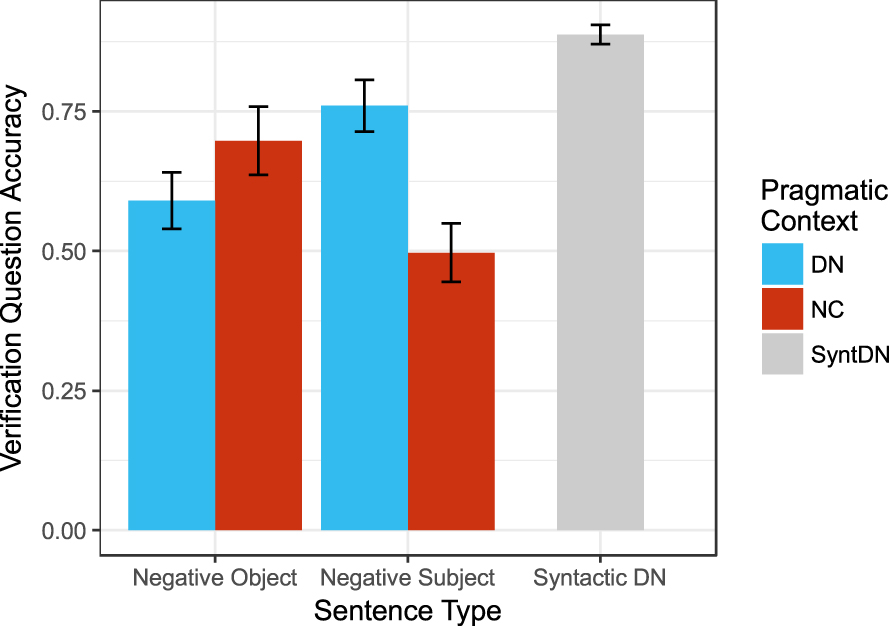
As shown in Figure 1, participants provided more correct responses in NC than in DN contexts for negative object sentences, and more correct responses in DN contexts for negative-subject sentences.
Verification question accuracy, means and standard error.

To test this pattern, we fit a binomial generalized linear mixed effects model of verification question accuracy using the glmer() function of the lme4 package (version 1.1.15; Bates, Maechler, Bolker, & Walker, Reference Bates, Maechler, Bolker and Walker2015) in R (version 3.3.3; R Core Team, 2017). Predictor variables, entered into the model using mean-centered effects coding, were the within-participants factors pragmatic context (DN, contrast code: –0.50 vs. NC, contrast code: 0.50), negative location (object, –0.50 vs. subject, 0.50), and their interaction. We included random intercepts for participant and sentence, and used a forward best path algorithm (Barr, Levy, Scheepers, & Tily, Reference Barr, Levy, Scheepers and Tily2013, p. 276; α = .2; see also Matuschek, Kliegl, Vasishth, Baayen, & Bates, Reference Lippi-Green2017) to determine which random slopes to include. This led to the inclusion of the random slope of pragmatic context by participant.
This analysis revealed the predicted interaction of pragmatic context and negative location (N trials = 943, b = –2.27, se = 0.33, z = –6.85, χ Footnote 2(1) = 49.48, p < .0001). Neither of the main effects were reliable (|z| < 1, χ Footnote 2(1) < 1, p > .5). Planned comparisons showed that accuracy was reliably higher in DN contexts for the subject-negation sentences (b = –1.39, se = 0.51, z = –2.73, χ Footnote 2(1) = 6.66, p = .01) and was marginally lower in DN contexts for the object-negation sentences (b = 0.87, se = 0.51, z = 1.72, χ Footnote 2(1) = 2.88, p = .09). This provides our first support for the patterns that have been observed previously in acceptability judgment tasks (Blanchette, Reference Blanchette2017) and judgments of meaning (Blanchette et al., Reference Blanchette, Nadeu, Yeaton and Déprez2018). In sum, participants arrived at the intended interpretation more often in the object NC and the subject DN sentences, as measured by their responses to the verification question.
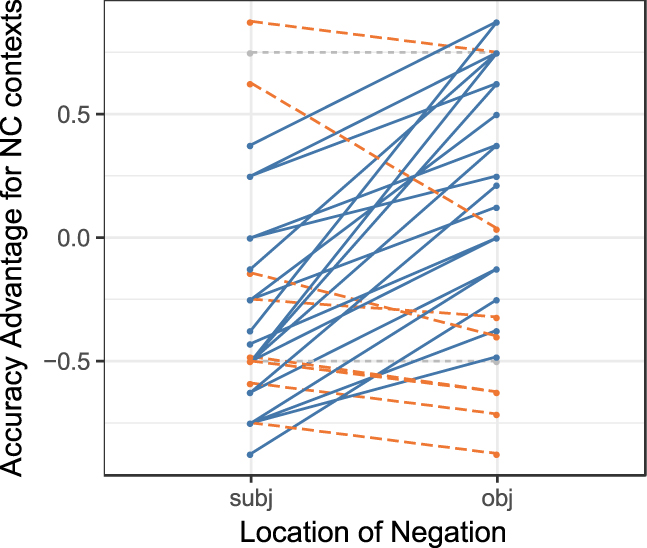
This pattern of interaction held not just in the aggregate, but for the majority of individuals in the sample. Figure 2 shows participants’ NC accuracy advantage scores for sentences with subject-negation and object-negation. Scores were calculated by subtracting the participant’s DN accuracy from their NC accuracy for each negation location. If the value is above zero, this means they were more accurate in NC contexts, and if it is below zero they were more accurate in DN contexts. The majority of participants (n = 20, 67%) had higher NC advantage scores in negative object sentences than in negative subject sentences. Of the participants who did not, 2 had equal NC advantage scores and only 8 had lower NC advantage scores in negative object than in negative subject sentences.
Verification question accuracy individual patterns. Points above 0 indicate higher accuracy in NC than in DN contexts, points below 0 indicate the reverse. The majority of participants (20 of 30) show a greater advantage for NC contexts in negative object sentences than in negative subject sentences (solid lines), a minority show differences in the opposite direction (n = 8, dashed lines) or no difference (n = 2, dotted lines).
Note that the verification question responses are still a metalinguistic measure, and that all experimental measures incorporate a certain amount of measurement error. Thus, we do not believe these results should be interpreted as veridical reflections of whether an individual participant has an NC or a DN grammar. However, the fact that the majority of our sample patterned in the predicted direction at the individual level provides strong evidence that the pattern is characteristic of this population. Participants’ lower accuracy in NC contexts in negative subject sentences relative to negative object sentences is consistent with the asymmetries found in previous acceptability judgment tasks (Blanchette, Reference Blanchette2017) and judgments of meaning (Blanchette et al., Reference Blanchette, Nadeu, Yeaton and Déprez2018). This suggests that the current population and items are sufficiently similar for our analyses of the eye-tracking measures to provide information on the online processes underlying these observed behaviors. Further analyses consider only the trials in which participants answered the verification question accurately.
3.1.2. Context sentence measures
We next asked whether, in trials in which the verification question was answered accurately (N = 600, of 943 included trials, 64%), participants spent more time reading or rereading the context sentence in certain conditions. We examined two measures of context sentence reading: First Pass Reading Time (FPRT), defined as the sum of all fixations on the context sentence before it is exited to the right (i.e., before the critical sentence is first fixated) and Rereading time (RRT), defined as the sum of all fixations on the context sentence after it is exited to the right (i.e., after the critical sentence has been fixated).Footnote 6 We expect FPRT to be similar across conditions, as no category of context sentence should be easier or harder to read on its own. In contrast, we expect RRTs to differ across conditions, as interpreting certain critical sentences is more difficult in some contexts than others. Difficulty should drive eye-movements back to the context sentence during or after critical sentence reading, and therefore result in longer context sentence RRTs.
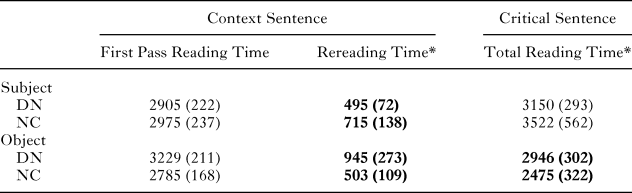
Mean context sentence FPRTs and RRTs are shown in Table 1. As predicted, FPRTs were similar across conditions, but RRTs were longer in Subject NC than in Subject DN trials, and longer in Object DN than in Object NC trials. That is, participants spent more time rereading the context sentence when the sentence was in a dispreferred context.
Full Sentence Reading Times, mean and standard error

notes: * indicates that the interaction of pragmatic context and negative location was reliable for that measure; bold font indicates that the simple main effect of pragmatic context was either reliable or marginal in that cell.
To test these patterns, we fit two linear mixed effects models, using the lmer() function of the lme4 package in R. Predictor variables were the within-participants factors of pragmatic context (DN, –0.47 vs. NC, 0.53), and negative location (object, –0.50 vs. subject, 0.50), and their interaction, as well as the continuous variable character count to control for differences in context sentence length. Random intercepts were included for participant and sentence, and a forward best path algorithm (α = .2) was used to determine which random slopes to include.
For FPRT, the model included the random slopes of negative location and pragmatic context by participant and of pragmatic context by sentence. This analysis revealed a reliable effect only of character count (N trials = 600, b = 36.7, se = 6.40, t = 5.58, χ Footnote 2(1) = 26.23, p < .0001), all other |t| < 1. Planned comparisons revealed no reliable effect of pragmatic context type in either negative subject or negative object trials (both |t| < 1, p > .5). Once context sentence length is taken into account, no category of context sentence is consistently more difficult to read than any other.
For RRT, the model included the random slope of negative location by participant. This analysis revealed the predicted reliable interaction of pragmatic context and negative location (N trials = 600, b = 681, se = 183, t = 3.73, χ Footnote 2(1) = 13.69, p = .0002). As in verification question accuracy, neither the main effect of pragmatic context (t = –1.30, χ Footnote 2(1) = 1.70, p = .19) nor the main effect of negative location (t = –0.04, χ Footnote 2(1) = 0.002, p = .96) was reliable. There was no reliable effect of character count on RRT (t = –1.25, χ Footnote 2(1) = 1.58, p = .21). Planned comparisons revealed that the simple main effect of pragmatic context was marginal in subject-negation sentences (b = 220, se = 120, t = 1.83, χ Footnote 2(1) = 3.34, p = .068) and reliable for negative object sentences (b = –461, se = 141, t = –3.28, χ Footnote 2(1) = 10.50, p = .001). Participants spent more time rereading DN context sentences than NC context sentences when the critical sentence contained a negative object, and spent marginally more time rereading NC than DN context sentences when the critical sentence contained a negative subject.
In sum, even in trials in which participants answered the verification question accurately, longer RRTs indicate that the correct interpretation is more difficult to achieve for negative object sentences in DN contexts and for negative subject sentences in NC contexts, echoing the patterns found in the verification question analysis and in previous studies.
3.1.3. Critical sentence total reading time
Difficulty interpreting a sentence in context may also be reflected in reading time on the critical sentence itself. We therefore also examined total reading time on the critical sentence.Footnote 7 Total time (TT) was defined as the sum of all fixations to the critical sentence. Means are shown in the rightmost column of Table 1. We again see the familiar, predicted, cross-over interaction:Footnote 8 TT was longer for negative subject sentences in NC contexts than in DN contexts, and for negative object sentences in DN contexts than in NC contexts.
As before, we tested this pattern with a linear mixed effects model. Predictor variables were pragmatic context (DN, –0.47 vs. NC, 0.53), and negative location (object, –0.50 vs. subject, 0.50) and their interaction, and character count. Random intercepts for participant and sentence were included, and a forward best path algorithm led to the inclusion of random slopes for negative location and pragmatic context by participant. This analysis revealed the predicted interaction (N trials = 600, b = 989, se = 361, t = 2.74, χ Footnote 2(1) = 7.00, p = .008), a reliable effect of character count (b = 65, se = 22.7, t = 2.87, χ Footnote 2(1) = 7.72, p = .005), a marginal main effect of negative location (b = 423, se = 222, t = 1.91, χ Footnote 2(1) = 3.63, p = .057), and no main effect of pragmatic context (b = –166, se = 270, t = –0.62, χ Footnote 2(1) = 0.40, p = .53). Planned comparisons revealed that the simple main effect of pragmatic context was reliable in negative object sentences (b = –655, se = 318, t = –2.06, χ Footnote 2(1) = 4.10, p = .04), but not in negative subject sentences (b = 331, se = 327, t = 1.01, χ Footnote 2(1) = 1.00, p = .32). Critical sentence reading times were marginally longer in negative subject than in negative object sentences, and the reliable, predicted interaction of pragmatic context and negative location indicated that the effect of pragmatic context differed reliably in the two sentence types.
3.1.4. Summary
Overall, our analysis of the critical experimental conditions revealed the predicted interaction between pragmatic context and the location of the negative argument to be reliable in both the offline, metalinguistic measure of verification question accuracy, and in the online measures of processing provided by context sentence RRT and critical sentence TT. Participants were less accurate and slower in Object DN than in Object NC, and in Subject NC than in Subject DN. This study thus provides the first online support for the effects previously observed in metalinguistic judgment tasks. Our results suggest that participants expect sentences with a negative auxiliary and negative object to express NC meanings, and sentences with a negative subject and negative auxiliary to express DN meanings. When these expectations are not met, they are slower and more reliant on revisiting context information to construct the target interpretation.
3.2. syntactic vs. pragmatic DN
In addition to our investigation of pragmatic context and negation location, we were also interested in the relationship between pragmatically driven DN interpretations and syntactically driven ones such as (13). The latter have a negative phrase in object position, but require a DN interpretation because of the structural distance between the negative auxiliary and the negative object. Analyzing these sentences in comparison with context-dependent DN interpretations allows us to begin disentangling the effect of having two negations from the effect of having to use pragmatic constraints to disambiguate between two potential readings. The Syntactic DN sentences have two negations, but only one possible reading.
To ask whether the critical sentence’s reliance on context for disambiguation made processing of DN meanings more difficult, we compared question response accuracy, context sentence FPRT and RRT, and critical sentence TT in the three DN trial types: syntactic DN, negative subjects in DN context, and negative objects in DN context.Footnote 9 The sentence reading times for Syntactic DN sentences are shown in Table 2, and those for Subject and Object DN sentences are shown in Table 1. For all analyses, we constructed two orthogonal contrasts for sentence type: one that compared syntactic to pragmatic DN (Syntactic DN vs. Subject and Object DN) and one that compared Subject to Object DN within the pragmatically ambiguous condition. We focus on the former comparison, as the latter largely duplicates the simple effects analyses in the previous section.
Full sentence reading times for Syntactic DN, mean and standard error

Note that these analyses differ in two ways from the analyses of pragmatic context and negation location in the previous section: first, they include a different subset of trials (the Subject and Object DN and the Syntactic DN trials, but not any of the NC trials). Second, there is one three-level factor of interest (DN type), rather than two two-level factors (pragmatic context and negation location). We test this three-level factor using the two orthogonal contrasts described above.
3.2.1. Verification question accuracy
We fit a binomial mixed effects model of verification question response accuracy with DN sentence type as a predictor. Because DN type had three levels (Syntactic DN, Subject DN, Object DN), we used two orthogonal, weighted, Helmert-coded contrasts.Footnote 10 The first contrast (constraint type) compared syntactic DN (contrast code: 0.67) to the two pragmatic DN sentence types (contrast code for each: –0.33). The second contrast (negation location) compared Object DN (contrast code: –0.50) to Subject DN sentences (contrast code: 0.50). The model included random intercepts for participant and sentence, and revealed the predicted reliable effect of constraint type (N trials = 710, b = 1.75, se = 0.43, z = 4.08, χ Footnote 2(1) = 15.14, p < .001) and the expected effect of negation location (b = 1.03, se = 0.37, z = 2.78, χ Footnote 2(1) = 7.10, p = .008). This means that participants were more accurate in their responses with Syntactic DN than with the pragmatically constrained critical sentences, and, as reported above, they were more accurate with Subject DN than with Object DN.
3.2.2. Reading times
We also examined participants’ reading patterns on the context and critical sentences in trials with accurate verification question responses across DN types (N trials = 528, of 710 included trials, 74%). We fit linear mixed effects models of context sentence FPRT and RRT and critical sentence TT using the same Helmert-coded DN sentence type predictor as above, and with character count as a continuous measure of sentence length. The first contrast compared Syntactic DN (0.60) to the two Pragmatic DN sentence types (both –0.40), and the second compared negative object (–0.54) to negative subject sentences (0.46).
The model for FPRT included random intercepts for participant and sentence. It revealed a reliable effect of character count (N trials = 528, b = 39, se = 8, t = 4.65, χ Footnote 2(1) = 17.72, p < .001) and constraint type (b = 465, se = 145, t = 3.21, χ Footnote 2(1) = 9.38, p = .002), but not of negation location (t = –0.22, χ Footnote 2(1) = 0.04, p = .84). This suggests that the context sentences preceding syntactic DN sentences were more difficult to read on the first pass than those preceding pragmatic DN critical sentences.
The model for RRT included the random intercepts for participant and sentence and the random slope of DN sentence type by participant. For rereading times, we found no reliable effects of DN type for either contrast (syntactic vs. pragmatic, t = –0.49, χ Footnote 2(1) = 0.26, p = .61; object vs. subject, t = –1.89, χ Footnote 2(1) = 3.62, p = .06) or for character count (t = –1.03, χ Footnote 2(1) = 1.06, p = .30). However, in light of the apparent baseline differences in context sentence difficulty revealed by the FPRT analysis, the lack of difference in RRT should be interpreted with caution: participants spent longer reading the context sentences preceding syntactic DN critical sentences even on the first pass, which suggests that they were more difficult to read, and may therefore have also required more rereading time independently of any effect of the critical sentence.
A linear mixed effects model of TT on the critical sentence in each of these DN conditions, with predictors and random effects as for RRT, above, revealed reliable effects of character count (N trials = 528, b = 55, se = 24, t = 2.26, χ Footnote 2(1) = 5.11, p = .02) and constraint type (b = –1242, se = 638, t = –1.95, χ Footnote 2(1) = 3.91, p = .05), but not negation location (t = –0.11, χ Footnote 2(1) = 0.01, p = .91). Participants spent reliably more time reading pragmatically constrained DN critical sentences than they did syntactically constrained ones. This is most likely because the pragmatically constrained sentences are ambiguous, while the syntactically constrained ones are not. This result strongly suggests that critical sentence ambiguity slowed processing for a subset of our negative sentences.
In short, differences in verification question accuracy and critical sentence total time suggest that there is added complexity involved in correctly determining the meaning of the pragmatically constrained double negation sentences. The lack of consistent differences between pragmatically and syntactically constrained DN in context sentence RRT suggests either that this added complexity does not drive stronger reliance on the context, or that the differences in context rereading are subtle enough that the current set of sentence pairs, intended for exploratory analysis of DN, is not well-enough matched to reveal them. Future work that focuses on examining different types of DN in context (cf. Noh, Choo, & Koh, Reference Nieuwland and Kuperberg2013) could shed further light on this issue.
4. Discussion
This study aimed to contribute to our understanding of whether and how NC and DN are represented in the minds of adult Standard English speakers. The results from our 30 native American English-speaking adults, all of whom report being non-NC-users, reveal a reliable preference for, and relative ease with, Object NC over Object DN. In the context of previous work on this topic (Blanchette, Reference Blanchette2017; Blanchette et al., Reference Blanchette, Nadeu, Yeaton and Déprez2018), the interaction we found between pragmatic context (NC vs. DN) and negative location (subject vs. object) in participants’ verification question accuracy is unsurprising. However, replicating this effect with an online measure allows us to draw broader generalizations from our reading time data to the population of SE speakers. We note further that this interaction is unexpected under theories that assume NC and DN to belong to different types of grammars (e.g., Zeijlstra, Reference Zanuttini2004), and that it contrasts with the results in Thornton et al. (Reference Tettamanti, Manenti, Della Rosa, Falini, Perani, Cappa and Moro2016), in which SE-speaking adults reliably resisted NC interpretations of sentences with negative objects. In the online reading time measures, the interaction between pragmatic context and negative location can be understood as a clash between expected interpretation, perhaps driven by participants’ initial structural representations (cf. Dussias, Reference Dussias2010, p. 151), and the intended interpretation, as shaped by the preceding linguistic context. Participants spent more time reading the critical sentence and rereading the preceding context when the target interpretation did not match their expected one (i.e., Subject NC or Object DN).
Note that the two reading time measures, critical sentence total reading time and context sentence rereading time, which bore out the predicted interaction, are relatively late measures of processing (Gordon et al., Reference Gordon, Hendrick, Johnson and Lee2006). Previous psycholinguistic studies can help us to understand why our effects were revealed in relatively coarse-grained, late measures. While these have not specifically explored NC, there is a large body of work examining sentences with a single syntactic negation, such as there was no eagle in the sky (Kaup, Yaxley, Madden, Zwaan, & Lüdtke, Reference Kaup, Lüdtke, Zwaan, Schmalhofer and Perretti2007), and a robin is not a tree (Fischler, Bloom, Childers, Roucos, & Perry, Reference Fischler, Bloom, Childers, Roucos and Perry1983). Studies comparing negative sentences like these to affirmative ones have revealed a “negation effect” (Kaup, Lüdtke, & Zwaan, Reference Kaup, Lüdtke, Zwaan, Schmalhofer and Perretti2007, p. 260), in which negative sentences take longer to process than matched affirmatives. The effect has been replicated in numerous studies, and it is typically elicited in paradigms in which little or no facilitating context is provided. Where limited clues are provided as to how a sentence is integrated into a discourse, negative sentences are reliably more difficult to process than affirmative ones. (See Tian & Breheny, Reference Thornton, Notley, Moscati and Crain2016, for a recent review.)
Slow, late processing of negation has also been observed in physiological measures including eye-tracking while reading (Ferguson et al., Reference Ferguson, Sanford and Leuthold2008; Noh et al., Reference Nieuwland and Kuperberg2013), eye-tracking in the visual world paradigm (Orenes, Beltrán, & Santamaría, Reference Noh, Choo and Koh2014; Orenes, Moxey, Scheepers, & Santamaría, Reference Orenes, Beltrán and Santamaría2016; Tian, Ferguson, & Breheny, Reference Tian, Breheny, Larrivée and Lee2016), ERP (Ferguson et al., Reference Ferguson, Sanford and Leuthold2008; Fischler et al., Reference Fischler, Bloom, Childers, Roucos and Perry1983; Nieuwland & Kuperberg, Reference Nevalainen, Fisiak and Krygier2008; Schiller, van Lenteren, Witteman, Ouwehand, Band, & Verhagen, Reference Reinhart2017), and fMRI (Tettamanti, Manenti, Della Rosa, Falini, Perani, Cappa, & Moro, Reference Tesan, Johnson and Crain2008). As with behavioral tasks, a relatively consistent effect across all of these different measures is that negative sentences, at least when presented with no facilitating context, are processed more slowly and with more difficulty than affirmatives. The fact that our effects were seen in later measures suggests that this is also true, and perhaps even more so, when there are two syntactic negations (cf. Ferguson et al., Reference Ferguson, Sanford and Leuthold2008).
While negation is clearly difficult to process out of context, the role of pragmatic context has also been shown to play an important role in facilitating negation processing. Previous work has shown that providing a highly naturalistic pragmatic context actually facilitates the processing of a single syntactic negation, effectively nullifying any differences between affirmatives and negatives (Nieuwland & Kuperberg, Reference Nevalainen, Fisiak and Krygier2008). When context sets up the expectation of a negation, this makes the negation easier to process. In our experiment, the contexts in the pragmatically ambiguous critical condition were created to clearly support either an NC or a DN interpretation, and our avoidance of negation in the context sentence may have actually negatively impacted their naturalness. This could have been particularly true for the DN sentences, which seem to more naturally follow a preceding statement with explicit negation (e.g., everybody doesn’t like something, but nobody doesn’t like Sara Lee Footnote 11). We note, however, that the previous work which formed the basis for our predicted interactions included experiments in which the negative sentences were presented with no preceding context at all (Blanchette, Reference Blanchette2017, Experiment 1, and the perception/meaning judgment task in Blanchette et al., Reference Blanchette, Nadeu, Yeaton and Déprez2018), as well as DN sentences which included an explicit negation in the context sentence (Blanchette, Reference Blanchette2017, Experiment 3), and the relevant effects were still present. This suggests that properties of the critical sentences themselves are driving the interaction. Future work that varies the context sentences more systematically, on a par with the critical sentences, may serve to better inform the question of precisely how the context sets up the intended interpretation.
4.1. online measures and prescriptive pressure
Regarding the influence of prescriptive pressure, if this pressure is having an effect on reading times, then we would expect it to amplify the syntactic bias for negation in subject position, making DN much easier than NC. In contrast, we would also expect this pressure to work against the syntactic bias for negation in object position, making Object NC harder than it would be without the prescriptive pressure and therefore reducing or reversing differences between Object NC and Object DN. However, if anything, the results show larger numeric differences in the object condition than in the subject condition. This suggests that prescriptive pressure is either playing little to no role in these measures, or that it is substantially outweighed by the participants’ grammatical knowledge. A study comparing NC processing in English and a language without prescriptive pressure to avoid NC, but with the asymmetry between negative subject and negative object sentences (e.g., Spanish), could give further insight into these processes.
4.2. standard english and negative concord typology
Previous work on NC has revealed an important distinction between ‘Strict’ and ‘Non-Strict’ NC languages (Giannakidou, Reference Giannakidou1998). In Strict NC languages (e.g., Greek; Giannakidou, Reference Giannakidou2000), negative words in NC constructions must always co-occur with a negative marker, regardless of their syntactic position. This includes constructions in which a negative subject co-occurs with, but is not c-commanded by, the negative marker, in a structure analogous to the Subject NC constructions investigated here. Non-Strict NC languages (e.g. Spanish; Herburger, Reference Herburger2001) are distinct from Strict NC languages in that only postverbal negative words require a preceding negative marker. In these languages, negative subjects are not employed in NC constructions with a following negative marker (i.e., Subject NC is not possible), and may occur in clauses with no accompanying negation. If we assume that SE is an NC language, then we can ask whether it should be classified as Strict or Non-Strict. The pattern uncovered by experimental results suggests that it fits best in the Non-Strict category, given SE speakers’ dispreference for Subject NC. The distinction between strict and non-strict NC languages thus reveals an additional reason for comparing SE, by hypothesis a Non-Strict NC language, and Spanish, whose status as Non-Strict is well established. It also suggests that the introduction of a Strict NC language such as Greek into the comparison could reveal further insight into the nature of NC in SE, and the distinction between strict and non-strict NC languages more generally.
4.3. negative concord and negative polarity
We conclude our discussion by returning to the similarity between NC constructions such as those in the current study, and NPI constructions, such as I didn’t eat anything. In SE, the two constructions appear to require, or at least strongly prefer, a c-command relation between the NPI or negative phrase and the preceding negation (cf. *anybody didn’t eat, and the NC interpretation of nobody didn’t eat, which was dispreferred in our experimental paradigm). The similarity of these constructions, and the clear acceptability of the NPI construction in SE, raise the question of whether, in processing NC, SE speakers are making a direct analogy to NPI constructions. The design of the current study did not include NPIs, and therefore cannot directly inform questions about the relationship between NC and NPI constructions in SE. However, our results suggest that further research in this direction would be fruitful. Such a study could not only clarify the status of NC in SE, but also inform theoretical questions about whether NC and NPI constructions are derived by similar syntactic mechanisms (e.g., Collins & Postal, Reference Collins and Postal2014; Blanchette, Reference Blanchette2015), or whether they are the reflex of distinct grammatical processes, either syntactic or semantic (e.g., Herburger, Reference Herburger2001).
It is relevant to note that, while less frequent than Object NC, Subject NC is indeed a feature of numerous English varieties, including Appalachian English (Wolfram & Christian, Reference Wason1976), African American English (Green, Reference Green2002), and others (Smith, Reference Schiller, van Lenteren, Witteman, Ouwehand, Band and Verhagen2001). While these same varieties readily allow both NPIs and negative words in postverbal positions following a negation (e.g., I didn’t eat nothing/anything), only negative words are allowed as canonical subjects, and NPIs are not (e.g., nobody didn’t eat but *anybody didn’t eat; Tortora & Den Dikken, Reference Tian, Ferguson and Breheny2010). The existence of Subject NC in these other varieties, and the impossibility of NPIs in subject position, indicates that NPIs and NC are not always interchangeable, and suggests that comparative work across English varieties using similar forms of online data collection could shed light on the relationship between NC and NPI constructions more generally.
Such further investigations will build on a strong base: unlike NC, English NPI constructions have received substantial attention in the psycholinguistic literature (e.g., Parker & Phillips, Reference Orenes, Moxey, Scheepers and Santamaría2016; Phillips, Wagers, & Lau, Reference Parker and Phillips2011; Tesan, Johnson, & Crain, Reference Terry, Hendrick, Evangelou and Smith2012; Xiang, Dillon, & Phillips, Reference Wolfram and Fasold2009; Xiang, Grove, & Giannakidou, Reference Xiang, Dillon and Phillips2013). Several papers focus on ‘grammatical illusions’, in which NPIs are not licensed by a c-commanding negation, but are linearly preceded by a negative element or ‘potential licensor’ in a non-c-commanding position, yielding higher levels of acceptability than when there is no preceding negation or ‘potential licensor’ in the structure (Drenhaus, Saddy, & Frisch, Reference Drenhaus, Saddy, Frisch, Kepser and Reis2005). An eye-tracking while reading study examining the NPI illusion finds evidence of the effect in the late measures of right bounded reading time and regression path duration, in the region of the NPI (Vasishth, Brüssow, Lewis, & Drenhaus, Reference Tortora and Den Dikken2008, p. 704). Researchers have argued that the effect is due not to speakers’ competence in understanding the linguistic constraints on NPI constructions, but rather, requires a processing explanation (Vasishth et al., Reference Tortora and Den Dikken2008, p. 689). By building on these previous empirical findings, future studies will be able to further explore the relationships between NPIs and NC within and across varieties of English.
4.5. conclusion
NC is found in numerous languages as a means for marking negation (Auwera & Alsenoy, Reference Auwera and Alsenoy2016). We submit that studying how humans process NC constructions is essential to understanding how negation is represented in human language in general. The particular examination of NC in SE which we have presented here has illustrated one way in which the online measure of eye-tracking while reading can reveal processes underlying metalinguistic judgments, which may otherwise be confounded by prescriptive pressure. Our results suggest that NC constructions, which are unacceptable and not typically used by SE speakers, are nevertheless processed in consistent, predictable ways by speakers of this variety. This suggests that these constructions are represented in SE speakers’ grammars, and that their widespread unacceptability may be even more an artifact of prescriptive pressure than previously thought. This finding opens the door for examination of other constructions and features typically thought to be associated only with vernacular varieties. While it is clear that some speakers switch back and forth between markedly different grammatical systems (e.g., Terry, Hendrick, Evangelou, & Smith, Reference Smith2010), using the appropriate language variety in each of several different contexts, our work raises important questions about the grammatical systems of ostensibly mono-dialectal speakers.
Appendix
Items