I. INTRODUCTION
Recently, various non-conventional magnetic systems are being explored for their interesting magnetic characteristics. Reference Mishra, Manivel Raja and Panda1,Reference Prestgard, Siegel and Tiwari2 Some of them include diluted magnetic systems with unusual magnetic properties which may be of technological interest. Reference Prestgard, Siegel and Tiwari2,Reference Slusser, Kumar and Tiwari3 In this regard, magnetic alloy nanoparticles (nps) dispersed in porous matrix have attracted great interest in scientific research because of their unique physical properties. Reference Corrias, Casula, Falqui and Paschina4 The functional properties are derived from the synthesis and processing parameters; such as: controlled nucleation, growth of nanoparticles within the silica matrix, heat treatment using different inert atmosphere etc. These materials have potential applications in various fields; such as: catalysis, Reference Li, Lu, Yao and Ji5 biomedical, Reference Hutten, Sudfeld, Ennen, Reiss, Wojczykowski and Jutzi6 magnetic recording media, Reference Lutz, Estournes and Guille7 microwave absorption materials Reference Li, Hu and Cao8 etc. Alloy nps embedded in silica matrix show altered magnetic properties (M S, H C, K eff etc.). The values of the saturation magnetizations (M S) can be different from that of the bulk materials. Reference de Julian Fernandez, Sangregorio, Mattei, Maurizio, Battaglin, Gonella, Lascialfari, Lo Russo, Gatteschi, Mazzoldi, Gonzalez and Acapito9,Reference Ennas, Falqui, Marras, Sangregorio and Marongiu10 Co, Ni, and their alloys nanoclusters in silica host show an enhancement in the magnetic moment and decrease in coercivity due to the superparamagnetic behavior. Reference Mattei, de Julian Fernandez, Mazzoldi, Sada, De, Battaglin, Sangregorio and Gatteschi11 Significant changes in effective anisotropy constant (K eff) are also reported for metal/alloy nanostructures. Reference de Julian Fernandez, Sangregorio, Mattei, Maurizio, Battaglin, Gonella, Lascialfari, Lo Russo, Gatteschi, Mazzoldi, Gonzalez and Acapito9 These variations in the magnetic properties of nanomaterials embedded in silica matrix have already been attributed to several aspects such as high surface area to volume ratio, electronic structure, interaction between nanomaterials and matrix, or interparticle interactions. Reference Ennas, Falqui, Marras, Sangregorio and Marongiu10,Reference Billas, Chatelain and de Heer12,Reference Dormann, Fiorani and Tronc13
To control size, dispersion, stability, and interparticle interactions among nps, nano-composites of alloys (e.g., Co–Ni, Ni–Cu, Co–Cu, Fe–Co etc.) in silica matrix have been synthesized by various synthesis techniques such as sol–gel method, Reference Ennas, Falqui, Marras, Sangregorio and Marongiu10 high temperature hydrogen reduction method, Reference Casu, Casula, Corrias, Falqui, Loche, Marrasa and Sangregorio14 ion implantation method, Reference de Julian Fernandez, Sangregorio, Mattei, Maurizio, Battaglin, Gonella, Lascialfari, Lo Russo, Gatteschi, Mazzoldi, Gonzalez and Acapito9 mechanical milling Reference Ennas, Marongiu, Maras and Piccaluga15 etc. Amongst various binary alloys, CoNi alloys are more stable with respect to air oxidation and composition. To control the size of CoNi nanocrystals, solution based chemical reduction method will play important role. It should be noted that chemical reduction method using superhydride as reducing agent provide great control on size of alloy nps with the help of capping agent. Reference Dalavi, Manivel Raja and Panda16 Ni nps in silica matrix have been synthesized via superhydride reduction route and enhancement of magnetic moment of Ni embedded in silica matrix has been observed. Reference Dalavi, Manivel Raja and Panda17 As per our knowledge, very less literature are available on the study of magnetic properties of CoNi alloys embedded in silica matrix even though they have immense potential technological applications in the area of microwave absorption and catalysis. Reference Li, Lu, Yao and Ji5,Reference Li, Hu and Cao8,Reference Barakat, Motlak, Lim, El-Newehy and Al-Deyab18 Moreover, Co50Ni50 alloys are more important because of their high values of saturation magnetization and moderate coercivities. Reference de Julian Fernandez, Sangregorio, Mattei, Maurizio, Battaglin, Gonella, Lascialfari, Lo Russo, Gatteschi, Mazzoldi, Gonzalez and Acapito9 Therefore, we have used chemical reduction route using superhydride as reducing agent for the synthesis of Co50Ni50 alloys nps embedded in silica matrix to achieve better functional properties.
In this study, novel solution based method for the synthesis Co50Ni50 alloys nps embedded in silica matrix is being reported. The methodology involved in this report is based on the principle that metal ion solution were dispersed in silica matrix forming colloidal viscous solution and then reduced to CoNi alloy uniformly within porous matrix using superhydride as reducing agent in situ under an inert gas atmosphere. Further, the methodology has been applied for synthesis of various loading of CoNi alloy in silica matrix. Structural characterizations and magnetic properties were investigated with regard to its potential applications.
II. EXPERIMENTAL
For present investigation, we have procured cobalt chloride (CoCl2·6H2O), nickel chloride (NiCl2·6H2O) from Molychem, India; oleic acid, oleylamine from Sigma Aldrich, USA and diphenyl ether, superhydride (LiBEt3H, 1 M in THF) from SpectroChem, India. These chemicals were used without further purification for the synthesis.
A. Synthesis of Co50Ni50 alloy nanoparticles embedded in silica matrix
Initially, we have prepared mesoporous silica matrix (KIT-6) as per the literature reported procedure for obtaining cubically ordered phase using tetraethoxysilane (TEOS) and Pluronic-123. Reference Kleitz, Choi and Ryoo19 In a typical synthesis, 0.5 mmol of cobalt chloride, 0.5 mmol of nickel chloride, and 25 mL diphenyl ether were mixed in a 250 mL flask. 0.32 mL of oleic acid and 0.34 mL of oleylamine were added to the above mentioned suspension and heated at 100 °C to dissolve the metal precursors. Appropriate amount of KIT-6 were added to get 4, 8, and 12 wt% of Co50Ni50 embedded in silica matrix (KIT-6 was not used for synthesis of pure Co50Ni50) and stirred under high purity N2(g) atmosphere for 2 h. The resulting viscous mixture was heated to 200 °C for 10 min and 3 mL superhydride solution (LiBEt3H, 1 M in THF) was dropped uniformly into the hot solution over a period of 5 min. The black solution was stirred at 200 °C for 30 min and at 240 °C for 30 min to remove lower boiling solvents. The reaction mixture was cooled down to room temperature and added 10 mL of ethanol, stirred and centrifuged at 5000 rpm for 5 min to separate the solids. The resulting solids were rinsed two times with ethanol containing 0.05 mL of oleic acid and 0.05 mL of oleylamine and centrifuged. Finally, these samples (as-prepared) were heat treated at 400 °C for 2 h under high purity N2(g) atmosphere and used for further studies.
B. Characterization
Synthetic strategy was monitored by spectroscopic techniques on reaction mixture and as-prepared materials using UV–visible (Model: JASCO V-570, Jasco International Co. Ltd., Tokyo, Japan) and FTIR spectroscopy (Model: SHIMADZU, IRAffinity-1, Shimadzu Corporation, Tokyo, Japan). The synthesized materials i.e., pure Co50Ni50 and Co50Ni50 embedded in silica were characterized by powder x-ray diffraction method (XRD), BET adsorption–desorption studies, transmission electron microscopy (TEM), and magnetic measurements. The XRD patterns were recorded using a powder x-ray diffractometer (Model: Mini Flex II, Rigaku Corporation, Tokyo, Japan) using Cu Kα radiation, (λ = 0.15405 nm) at the scan speed of 3° per minute. Crystallite size was estimated using Scherrer equation, t = 0.9λ/B cos θ, where t is crystallite size, λ is wavelength of the x-ray radiation, B is FWHM in radian and θ is the diffraction angle. Reference Culity20 The BET adsorption–desorption studies were done to calculate surface areas and pore sizes of pure KIT-6 as well as CoNi/silica materials. The size and shape of the materials were examined by TEM (Model: PHILIPS CM200, FEI Company, Hillsboro, Oregon). The magnetic measurements at room temperature and low temperatures (20–300 K) were carried out on solid powder material using vibrating sample magnetometer (Model: Lakeshore VSM 7410, Lake Shore Cryotonics, Westerville, Ohio). Low temperature magnetizations were measured in field cooled (FC) and zero field cooled (ZFC) conditions. The sample was first cooled to 20 K in the absence of external magnetic field and then warmed to 300 K in the presence of external magnetic field and the magnetization was recorded as ZFC. The FC measurements were done after ZFC measurements and the magnetization was recorded while cooling the sample down from 300 K to 20 K with 100 Oe field.
III. RESULTS AND DISCUSSION
A. Materials synthesis: UV–visible and FTIR studies
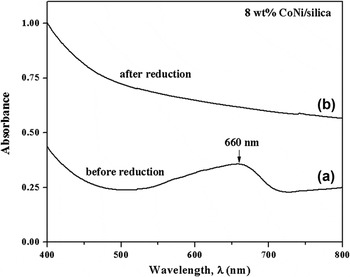
Novelty of the methodology used for the synthesis of pure CoNi nano-structured alloys embedded in silica matrix has been verified in detail with the help of UV–visible spectroscopy and FTIR spectroscopy for a typical sample with 8 wt% CoNi/silica. Reaction mixture samples for UV–visible spectroscopy studies were removed at two stages: (i) after dissolution of metal salts with the help of capping agents and (ii) after completion of reaction (i.e., using superhydride as reducing agent). UV–visible spectra of reaction mixture before and after reduction are shown in Fig. 1. An UV–visible spectrum of reaction mixture before reduction shows broad absorption peak centered at 660 nm which may be assigned to the mixture of chlorides of cobalt and nickel. The absence of absorption peak centered at 660 nm in UV–visible spectrum after reduction confirms the complete reduction of cobalt chlorides and nickel chlorides quantitatively forming the solid phase.
UV–visible spectra of reaction mixtures at two stages, (a) before reduction and (b) after reduction, for 8 wt% CoNi loaded in silica matrix.

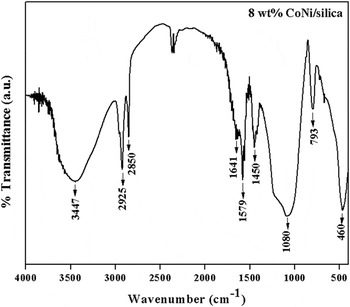
The solid precursors obtained after the synthesis and processing (i.e., as-prepared) were subjected to FTIR spectroscopy to study bonding and chemical interactions in 8 wt% CoNi alloy nanoparticles embedded in silica matrix (Fig. 2). FTIR spectrum for as-prepared materials shows the dominant presence of silica matrix (KIT-6) and capping agents (i.e., oleic acid and oleylamine). The peaks present at 460 and 793 cm−1 are assigned to symmetric stretching vibrations of siloxane group (Si–O–Si). However, the broad peak centered at 1080 cm−1 and its shoulder are corresponding to asymmetric stretching vibrations of siloxane group (Si–O–Si). Reference Mourhly, Khachani, Hamidi, Kacimi, Halim and Arsalane21 In the FTIR spectra of as-prepared materials, peaks at 1641 and 3447 cm−1 are attributed to the presence of bending and stretching vibrations of O–H group, respectively. These results indicate the adsorption of some molecular water on the surface. Reference Mourhly, Khachani, Hamidi, Kacimi, Halim and Arsalane21 The peaks at 2925 and 2850 cm−1 are correspond to oleyl group from capping agents on the surface of nanomaterials. The peaks in the range of 1450–1579 cm−1 can be assigned to carboxylate group (–COO−). The results are quite similar to our earlier report on synthesis of capped nanostructures of Co and Ni metals. Reference Dalavi and Panda22
Typical FTIR spectrum for as-prepared precursor sample for 8 wt% CoNi loaded in silica matrix.

B. XRD, TEM, and sorption studies
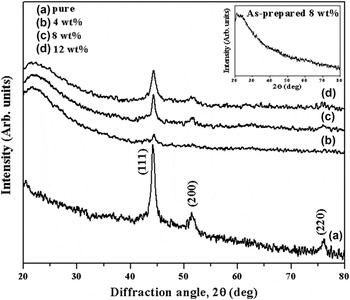
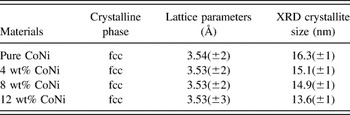
XRD patterns for pure Co50Ni50 alloy and Co50Ni50 nps embedded in silica matrix with various loading percentage (4–12 wt%) are shown in Fig. 3. The XRD study for as-prepared samples of CoNi/silica has been carried out to check the phase purity. The typical XRD pattern for as-prepared sample of 8 wt% CoNi/silica is presented in the inset of Fig. 3. As-prepared material is amorphous in nature with broad peak for silica matrix at 2θ = 22°. Hence as-prepared materials were heat treated in an inert atmosphere at optimum temperature of 400 °C for evolution of crystalline phase. Lattice parameters and crystallite sizes for all CoNi samples are tabulated in Table I. CoNi alloy phase (pure and loaded in silica matrix) crystallizes in face centered cubic (fcc) structure. The diffraction patterns of CoNi solid solution were indexed in accordance with the patterns for fcc structure of Co and Ni. Reference Panday, Daniel and Jeevanandam23 A broad peak, centered on 2θ value of 22° [Figs. 3(b)–3(d)], corresponds to amorphous nature of silica matrix. The estimated values of lattice parameters were found to be 3.54(±2), 3.53(±2), 3.53(±2), and 3.53(±3) Å for pure CoNi, 4, 8 and 12 wt% CoNi in silica, respectively. These values of lattice parameters are in agreement with literature reported values for CoNi alloys, i.e., 3.5343 Å. Reference Panday, Daniel and Jeevanandam23 Estimated average crystallite sizes using Scherrer formula were found to be 16.3(±1), 15.1(±1), 14.9(±1), and 13.6(±1) nm for pure CoNi, 4, 8, and 12 wt% CoNi in silica, respectively.
XRD patterns of (a) pure CoNi, (b) 4 wt%, (c) 8 wt% and (d) 12 wt% CoNi alloys loaded in silica matrix and heat treated at 400 °C for 2 h under N2 atmosphere. Inset shows XRD pattern of as-prepared precursor for 8 wt% CoNi loaded in silica matrix.

Crystalline phase, Lattice parameters and crystallite sizes of CoNi alloy nanoparticles in silica matrix with various loading and heat treated at 400 °C for 2 h.

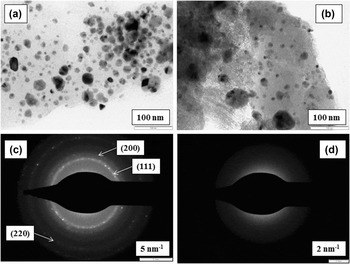
TEM micrographs for pure CoNi and 8 wt% CoNi in silica matrix are shown in Figs. 4(a) and 4(b). SAED patterns for pure CoNi and 8 wt% CoNi in silica matrix are shown in Fig. 4(c) and 4(d). TEM micrographs show nearly spherical shape morphologies and narrow size distributions for CoNi alloy nps with and without silica matrix. TEM particle sizes were estimated to be 13.6 and 8.9 nm for pure CoNi, 8 wt% CoNi in silica matrix, respectively. The estimated TEM particle sizes of 13.6 and 8.9 nm for pure CoNi and 8 wt% CoNi embedded in silica matrix are smaller than the corresponding average crystallite sizes of 16.3 and 14.9 nm, respectively. The plausible reason might be due to the fact that TEM particle size corresponds to local probe while crystallite size corresponds to the average of the whole mass used for diffraction measurements. Similar kind of results indicating a difference of nearly 3 nm has already been reported in metallic ruthenium nanowires and nanotubes. Reference Ponrouch, Bichat, Garbarino, Maunders, Botton, Taberna, Simon and Guay24 SAED pattern of pure CoNi alloy indicates well intense diffraction rings corresponding to various crystal planes with fcc crystal structure and matches well with the results obtained from XRD measurements. However, SAED pattern of 8 wt% CoNi alloy in silica did not show prominent diffraction ring pattern. The observation of the diffused broad rings indicates nearly amorphous structure with the absence of any sharp peak in XRD pattern. The size effect along with the lattice distortion may be the major reason for this finding. In addition, the crystal orientation of the embedded CoNi nanomaterials in silica matrix may result in amorphous ring structures in TEM micrographs. Such kinds of explanations have already been reported in the literature. Reference Suvorova and Buffat25
TEM micrographs of (a) pure CoNi and (b) 8 wt% CoNi/silica. SAED patterns for (c) pure CoNi and (d) 8 wt% CoNi/silica.

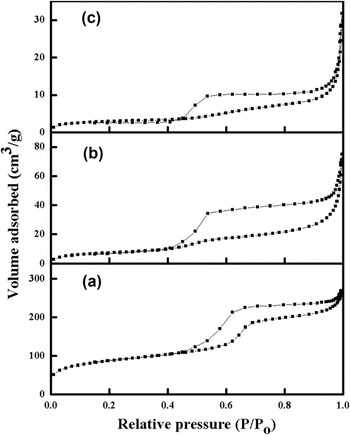
To study the possible incorporation of the CoNi nanoparticles within the silica matrix, we attempted studies on surface areas and pore structures. BET adsorption–desorption isotherms (using N2) for pure silica matrix and CoNi alloy nps (4 and 8 wt%) in silica matrix are shown in Fig. 5. Adsorption–desorption curves for all three samples show Type IV isotherm which is the characteristic of mesoporous materials. The pore diameters were found to be 5.16, 3.61, and 3.13 nm whereas the values of the S BET were found to be 300, 26, and 10 m2/g for pure silica matrix, 4 and 8 wt% CoNi alloy nps in silica matrix, respectively. The decrease of S BET values with increasing loading wt% of CoNi alloy nps in silica matrix confirms the incorporation of CoNi alloy materials in the porous structure of silica matrix. Reference Wu, Zhang, Li and Han26
BET adsorption–desorption isotherms for (a) pure silica matrix, (b) 4 wt% CoNi/silica and (c) 8 wt% CoNi/silica using N2.

C. Magnetic properties
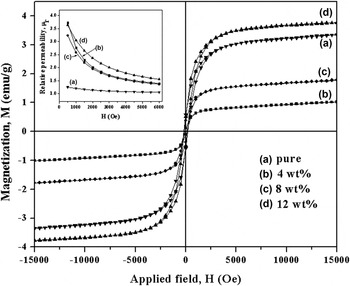
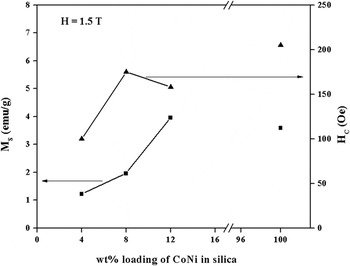
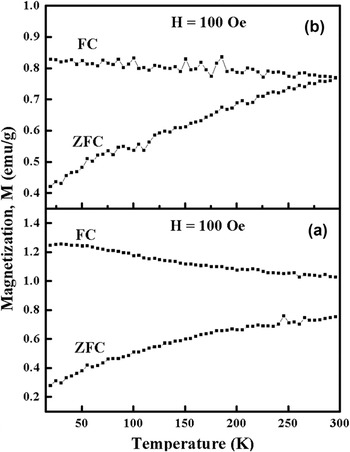
To study magnetic properties of CoNi alloy nps loaded in silica matrix, field dependence and temperature dependence of magnetization measurements using low applied field strength (100 Oe) have been carried out. The magnetization versus applied field (M–H) plots measured at 298 K for pure and CoNi alloy nps loaded in silica matrix are presented in Fig. 6. The values of relative permeability (µr) for all samples were calculated from initial magnetization (M versus H) plots. Reference Culity and Graham27 Variation of µr in the range of applied field (500–6000 Oe) is shown in the inset of Fig. 6. The estimated values of saturation magnetization (M S), coercivity (H C), remanent magnetization (M r), and reduced remanent magnetization (M r/M S) are tabulated in Table II. The variation in M S values and H C values with various wt% loading of CoNi nps is represented in Fig. 7. Various magnetizations versus temperatures plots in FC and ZFC conditions are presented in Fig. 8. The values of the saturation magnetization of the materials were determined by 1/H law which are used for the bulk material and has been reported in the literature. Reference Bean and Jacobs28,Reference Dalavi and Panda29 Saturation magnetization was determined from the intercept on the magnetization axis of M versus 1/H plot. The M S values are found to be 3.59, 1.22, 1.96 and 3.96 emu/g whereas H C values are 205, 100, 175 and 158 Oe for pure, 4, 8 and 12 wt% CoNi loaded in silica matrix, respectively. Further, the values of M r are found to be 0.58, 0.11, 0.37 and 0.50 emu/g for pure, 4, 8 and 12 wt% CoNi loaded in silica matrix, respectively.
Room temperature magnetic hysteresis loops for (a) pure CoNi, (b) 4 wt%, (c) 8 wt% and (d) 12 wt% CoNi alloys loaded in silica matrix and heat treated at 400 °C for 2 h under N2 atmosphere. Inset shows plots for relative permeability versus applied field of corresponding materials.

The values of saturation magnetizations, coercivities, remanent magnetizations, and reduced remanent magnetization of CoNi alloy nps in silica matrix with various loading.

Variation in M S and H C values for CoNi alloys with different loading wt% in silica matrix.

FC and ZFC plots for (a) pure CoNi and (b) 8 wt% CoNi loaded in silica matrix. Applied magnetic field was kept at 100 Oe.

Magnetizations versus applied field characteristics (Fig. 6) confirm the ferromagnetic nature of materials and presence of fine particle size and surface effects. The M S values for CoNi alloys are less than the bulk value (123 emu/g) Reference Liu, Fu and Huang30 reported for the corresponding alloys nanoparticles in the size range of 200–300 nm. The reduction in M S value is attributed to the presence of size, surface effects and weight fraction of organic matter on the surface of the particles. The contribution of organic matter toward reduction in M S has already been studied by us for FeCo alloys synthesized via superhydride route. Reference Dalavi, Manivel Raja and Panda16 The observed M S values for CoNi alloys loaded in silica matrix (i.e., 1.22–3.96 emu/g) increases with increasing loading wt%. After correction for wt fraction of silica matrix, the M S values increases drastically (24.5–33.0 emu/g) when compared with 3.59 emu/g for pure CoNi alloy. These results may be directly related to alteration of exchange interactions assuming size and interparticle separation to be in the order of exchange length. Reference Dalavi, Manivel Raja and Panda17,Reference Peng, Zhou, Hu, Tang and Li31 With the increase of wt% of CoNi in silica matrix, i.e., from 4 to 12 wt%, an increasing trend in the corrected M S has been observed (Table II). These results can be understood as dilution effect of CoNi nps in the nonmagnetic silica matrix along with alteration of nanomaterials dimensions other than spherical inside the porous structure of silica. To be noted, 4 wt% loaded materials exhibit an abrupt enhancement of magnetization compare to materials with higher wt% loading. The inter-grain exchange interactions mediated by the silica matrix may be a dominant factor for enhancement of magnetization in 4 wt% loaded sample. Reference Peng, Zhou, Hu, Tang and Li31 Further, the aforesaid results can be supported well by a similar literature report on enhancement of magnetic moment up to 41% by preparing magnetically diluted systems. Reference Prestgard, Siegel, Ma and Tiwari32 It should be noted that the critical size for CoNi alloys is ∼40 nm. The particles below critical size are known as single domain particles where coercivity will decrease with decrease in particle size after initial maximization. Reference Luna, Morales, Serna and Vazquez33 Further, the maximum coercivity value of 421.8 Oe is reported in the literature for CoNi nps attached on multi-walled carbon nanotubes with particle size of 37 nm. Reference Wu, Cao, Li, Ni, Zhu and Zhang34 In this study, the values of coercivity for CoNi alloy nps i.e., 100–205 Oe are in the regime of single domain CoNi nps. The coercivity values for CoNi alloys nps loaded in silica matrix with various wt% (4–12) start increasing from 100 Oe to 175 Oe even though there is a smaller variation in crystallite sizes i.e., 13.6–15.1 nm (Fig. 7). In addition to size and surface effects in CoNi nanocrystals, one can expect presence of varying lattice strains in the loaded materials. Squareness ratio of magnetic hysteresis loop can be expressed by reduced remanent magnetization, i.e., M r/M S, which is attributed to size and orientation of magnetic particles. It is reported that M r/M S value for CoNi alloys is reported as 0.5 with uniaxial anisotropy and 0.8–0.9 with cubic anisotropy. Reference de Julian Fernandez, Sangregorio, Innocenti, Mattei and Mazzoldi35 In our study, M r/M S value for CoNi alloys lies in the range from 0.09 to 0.19. These reductions in the M r/M S values may be due to the presence of randomly oriented magnetic domains in the nanoparticles which may be assumed to be blocked. Reference Ennas, Falqui, Marras, Sangregorio and Marongiu10
The observed values of µr for pure CoNi sample are found to be nearly constant (i.e., 1.25–1.05) in the range of applied field, 500–6000 Oe (inset Fig. 6). However, the values of µr for CoNi alloys, embedded in silica matrix with different loading percentage (4–12 wt%), were found to increase drastically (i.e., 1.95 to 3.72) at lower applied field, i.e., from 2000 Oe to 500 Oe. These results may be attributed to exchange coupling effects that may exist in the CoNi alloy nanoparticles embedded in silica matrix in addition to materials deformation. These results support the enhancement of saturation magnetizations of the samples embedded in silica matrix. And can be interpreted in terms of alteration of structural parameters thereby changing the magnetic structures. A similar result has already been reported for ferromagnetic Ni in silica matrix by Peng et al. Reference Peng, Zhou, Hu, Tang and Li31
Further, interparticle interactions and blocking temperature have been studied by FC/ZFC magnetizations plots (Fig. 8). Typical FC/ZFC plots for pure CoNi and 8 wt% CoNi/silica show the blocking temperature lies significantly above 300 K for pure CoNi whereas 300 K for 8 wt% CoNi/silica. This may be attributed to the presence of particle size distribution in the materials. The higher values of FC magnetizations than ZFC magnetizations indicate that CoNi alloys are ferromagnetic up to 300 K. An effective magnetic anisotropy constant (K eff) includes contribution from magnetocrystalline anisotropy and shape anisotropy. Assuming the blocking temperature (T B) of for pure CoNi alloy to be 300 K and using the formula K eff = 25k B T B/V, K eff value is found to be 280 kJ/m3. Considering the blocking temperature for 8 wt% of CoNi/silica to be 300 K, the estimated K eff value is found to be 78 kJ/m3. This value is in the comparable range with the magnetocrystalline anisotropy constant (K 1 = 150 kJ/m3) for CoNi alloy nps with 10 nm size. Reference Zhu, Sun, Zhang, Zu, Wang and Ewing36 The decrease of K eff value for loaded CoNi signifies altered size and magnetic structure at the surface. Also one can see from FC/ZFC plots pure CoNi (Fig. 8), the actual T B lays above 300 K remarkably. Therefore, we can expect K eff for pure CoNi sample to be much higher than the value 280 kJ/m Reference Slusser, Kumar and Tiwari3 . These results indicate very strong dipolar interactions arise for deformed magnetic structure for CoNi alloy embedded in silica matrix. Thus, the aforesaid enhancement of the magnetization and alteration of various magnetic parameters may be attributed to size, deformed magnetic structure at the surface and strong dipolar interactions, in addition to usual fine particle size and surface effects.
IV. CONCLUSIONS
In summary, pure and loaded [4–12 wt% in silica (KIT-6) matrix] Co50Ni50 alloy nanoparticles have been synthesized by novel chemical reduction route. The novelty of synthetic procedure adopted for pure CoNi alloys embedded in silica matrix have been established using UV–VIS and FTIR spectroscopy. XRD studies confirm the formation of pure phase CoNi alloys which crystallize in fcc crystal structure. XRD crystallite sizes for pure and embedded CoNi alloys are found to be in the range of 13.6(±1)–16.3(±1) nm. TEM microscopy studies show that CoNi alloys have nearly spherical shape morphologies and narrow size distributions. TEM particle sizes were estimated to be 13.6 and 8.9 nm for pure CoNi and 8 wt% CoNi materials loaded in silica matrix, respectively. The significant decrease in BET surface areas for CoNi alloys loaded in silica matrix compare to the pure silica matrix confirms the incorporation of CoNi alloy materials in the mesoporous structure of silica matrix. The M S value for pure CoNi alloy is 3.59 emu/g whereas the M S values for the CoNi alloys in silica after correction for wt fraction for silica matrix show drastic increase, i.e., in the range of 24.5–33.0 emu/g. The substantial enhancement of relative permeability at lower field strengths (500–2000 Oe) have been attributed to exchange coupling effects in the CoNi alloy nanoparticles embedded in silica matrix. FC/ZFC magnetizations plots show decrease is blocking temperature for CoNi alloys in silica matrix compare to pure CoNi which indicates magnetic structure alteration and supports our magnetic results. The observed enhancement in magnetization with low values of coercivity after loading in silica matrix has been explained on the basis of fine particle size, surface effects, and dipolar interparticle interactions.
ACKNOWLEDGMENTS
For this work, we gratefully acknowledge the financial support from Council of Scientific and Industrial Research (CSIR), New Delhi and Department of Science and Technology (DST), New Delhi. We acknowledge SAIF, IIT Bombay, Mumbai for TEM measurements, and SAIF, IIT Madras for magnetic measurements. We also express our thanks to Prof. Sayan Bhattacharyya, IISER Kolkata for adsorption–desorption measurements.