Introduction
It has been estimated that there are 73 severe brain injury cases per 100 000 people annually worldwide (Dewan et al., Reference Dewan, Rattani, Gupta, Baticulon, Hung, Punchak and Park2018). A severe acquired brain injury (ABI) has a devastating impact on the injured person as well as their significant others. Significant others, who typically have a critical role in the rehabilitation of their loved ones after ABI, are adversely impacted by the experience (Kreutzer et al., Reference Kreutzer, Stejskal, Ketchum, Marwitz, Taylor and Menzel2009). Family members are considered active members of the rehabilitation team; increasing collaboration of family members in the rehabilitation process shows improved therapeutic outcomes (Fisher, Bellon, Lawn, & Lennon, Reference Fisher, Bellon, Lawn and Lennon2020). Family members of those with an ABI typically spend a lot of time in the hospital setting, both acute and rehabilitation, as the person with an ABI recovers (Oyesanya, Reference Oyesanya2017).
Discharge from the hospital setting can be a point of crisis especially for the primary family carer (Oyesanya, Reference Oyesanya2017) and preparations for discharge may leave family carers exhausted, stressed and anxious (Lutz, Ellen Young, Cox, Martz, & Rae Creasy, Reference Lutz, Ellen Young, Cox, Martz and Rae Creasy2011; Manskow et al., Reference Manskow, Arntzen, Damsgård, Braine, Sigurdardottir, Andelic and Anke2018). Family members can feel at discharge that responsibility for care is moved to them either abruptly or without adequate preparation (Holloway, Orr, & Clark-Wilson, Reference Holloway, Orr and Clark-Wilson2019). Families have reported poor experiences related to lack of information, lack of contact if issues arise post discharge and insufficient education regarding long-term effects of brain injury (Manskow et al., Reference Manskow, Arntzen, Damsgård, Braine, Sigurdardottir, Andelic and Anke2018; O’Callaghan, McAllister, & Wilson, Reference O‘Callaghan, McAllister and Wilson2011). It has been recently published that investigation into the experiences of family members, during the hospital stay including at discharge, is lacking and requires further investigation (Manskow et al., Reference Manskow, Arntzen, Damsgård, Braine, Sigurdardottir, Andelic and Anke2018; Oyesanya, Reference Oyesanya2017). It has been recommended that conducting studies exploring the experiences of family members during the discharge transition phase (i.e. when leaving rehabilitation and going home) would enable a deeper understanding of the process and provide a better understanding of which factors influence a family member’s experience (Manskow et al., Reference Manskow, Arntzen, Damsgård, Braine, Sigurdardottir, Andelic and Anke2018). This in turn may assist the shaping of service quality in the future. Checklin, Fernon, Soumilas, and Stephens (Reference Checklin, Fernon, Soumilas and Stephens2020) investigated what it was like for nine significant others to have their loved ones enter a rehabilitation setting using a methodology of in-depth interviews, and the application of the drawing method. The aim of Checklin et al. (Reference Checklin, Fernon, Soumilas and Stephens2020) was to explore ‘What is it like for the significant other of a person with a severe ABI, during the early stages of their loved one’s admission to sub-acute rehabilitation?’ In that study seven themes were identified: Trauma; Relief; Interactions; Change; Grief and loss; Journey and Uncertainty (Checklin et al., Reference Checklin, Fernon, Soumilas and Stephens2020). One of the recommendations for future research in Checklin et al. (Reference Checklin, Fernon, Soumilas and Stephens2020) was to investigate significant others’ experiences across the rehabilitation journey, with a focus on the pre-discharge period. This paper is a follow up to Checklin et al. (Reference Checklin, Fernon, Soumilas and Stephens2020). Qualitative data were gathered from the same participants interviewing them again a short time before their loved ones’ discharge.
The primary aim of this current study is to investigate the experiences of significant others as their loved one prepares to leave inpatient ABI-specific rehabilitation, and to consider this in the context of participants’ earlier experiences. Insights into these experiences may increase the knowledge of healthcare providers on the specific needs of families and carers during and at the end of the inpatient rehabilitation stay. To clarify ‘significant other’ refers to the family member, and ‘loved one’ refers to the person with an ABI in this study.
Methods
Ethics and consent
Local hospital ethics approval was granted, and all participants signed a Participant Information and Consent Form which outlined the study and requested consent to use quotes and pictures for publication.
Setting
Recruitment occurred in a public rehabilitation hospital in Australia, in a unit that specialises in multidisciplinary ABI-specific inpatient rehabilitation which is associated with a level one trauma centre. The unit has 42 single-room inpatient beds, a transitional living unit and an outpatient team. The unit is staffed with medical staff, nurses and a full range of allied health professionals. Additional to the ward the unit has a family room and a discharge preparation area where patients learn to do activities of daily living.
Participants
Participants were known to the research team as they had participated in an earlier study which had investigated what it was like for them when their loved one was admitted to the ABI-specific rehabilitation unit (Checklin et al., Reference Checklin, Fernon, Soumilas and Stephens2020). Participants had been approached by one of the authors in the research team at the beginning of their loved ones’ admission to the rehabilitation setting and were asked to participate in an interview at the beginning and at the end of the inpatient rehabilitation period. Nine participants were recruited. One participant from Checklin et al. (Reference Checklin, Fernon, Soumilas and Stephens2020) was lost to follow up as they were unable to be re-interviewed in a timely manner. Table 1 outlines the demographic data collected of both the loved one and the significant other. Brain injury and demographic data, as well as functional independence measure (FIM; Keith, Reference Keith1987) scores which were obtained from the medical file.
Demographic Information for Significant Others and Loved Ones at Admission and Discharge

a Participant 6 participated in Time 1 interview only.
b Traumatic brain injury.
c Functional independence measure.
Prior to being approached, participants were screened against the inclusion/exclusion criteria by their admitting social worker. Inclusion criteria included having an ongoing relationship with the person (i.e. being primary contact, known to visit frequently, had a continuing relationship prior to and since the ABI), and being able to participate in the drawing and interviewing. Participants were included if the length of stay (in the inpatient ABI unit) was likely to be over a month. Significant others were excluded from recruitment if it were anticipated that their loved one would have a length of stay less than 1 month; if the significant others were perceived by social workers to have a relationship which suggested potential conflict or relationship breakdown or if the significant other were based far away so likely to visit only occasionally. The study was completed in Victoria, Australia, where patients are eligible for compensation if their ABI occurred in a traffic accident or at a workplace. The ABI unit also had non-compensable patients who sustained their ABI from a fall, hypoxia events or stroke. Recruitment into the study did not discriminate between compensable or non-compensable.
A convenience sample approach was taken. All close significant others of patients with an ABI who were admitted were considered reflecting the diversity of the people who undergo rehabilitation at the service. Not all potential participants who were approached were eligible or they declined to participate either due to being overwhelmed, not being available in a timely manner for an interview or declining the opportunity. All participants were provided with a participant information and consent form containing written information about the study.
Data collection and analysis
Two data collection methods were employed: semi-structured interviews and the drawing method. Semi-structured interviews included specific open-ended questions, followed by participants being asked to draw their experience of inpatient rehabilitation. In this study, the researchers intended to gain a deep insight into the experience of the significant others and to understand how the participants interacted with their environment and situation at the time of their loved ones going home. As a result, qualitative research methods were chosen. Semi-structured interviews allowed the participants to elaborate on their experiences but also allowed some consistency of questions across the cohort. In the drawing method, participants could draw whatever they liked and how they wanted to with minimal restrictions, and the participants description of their drawings did not follow a structure therefore allowing participants to use their own words.
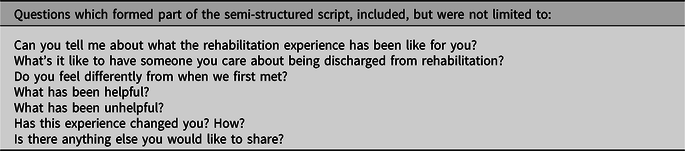
Table 2 includes the questions asked in the interviews as it is recommended that these are included in qualitative publications (Anderson, Reference Anderson2010; Oyesanya, Reference Oyesanya2017). Additionally, Oyesanya (Reference Oyesanya2017) stated it is important to ask family members direct questions about what has been helpful for them, other questions were formulated from consensus between the researchers based on clinical experience. Overall, structured questions focused on asking what the inpatient stay was like, how they felt about their loved one coming home, how the experience may have changed the significant other and what was helpful or not.
Semi-Structured Interview Questions

Interviews were conducted by one of two female social workers experienced in ABI rehabilitation who had received training in research interviewing. The interviewers did not interview participants if they were the treating social worker for the loved one. All interviews were conducted at the ABI unit face to face except for one participant who agreed to be telephoned for their interview as they resided a long way from the ABI unit at the time of discharge. They later posted their picture to the researchers. All interviews were conducted in English. The interviewers did not participate in the analysis.
Interviews were then transcribed by an external transcription company and checked by a member of the research team on return. Two researchers, who had received training in coding and had previous experience in coding, conducted the analysis of the interview transcripts. Thematic analysis was conducted using a six-phase framework to analyse the interview data (Braun & Clarke, Reference Braun and Clarke2006). At first, both researchers independently read and familiarised themselves with the transcribed manuscripts. Second, using line by line coding, codes began to be identified by placing codes describing similar experiences into coding folders, with no specific pre-set questions.
In phase step three the coders organised the codes into themes which were reviewed in phase four. Phase five involved defining, re-defining and labelling each theme. For example, a coding envelope was developed for Feelings when significant others across different interviews spoke about feeling relief, excitement, uncertainty and apprehension about the upcoming discharge. When no clearly dominant theme for one feeling emerged, the overarching theme became Mixed Feelings. In phase six participants’ quotes were extracted to illustrate the themes. Once these phases were completed independently, the two coders met through telecommunications to discuss the analysis, results and thematic titles. Differences were discussed by the two coders who then finalised quotes from participants to best highlight the themes and to ensure representation from all participants. If consensus between the two coders had not been reached, another researcher would have been utilised to resolve differences however that was not required. Member checking was not completed due to the geographical distribution of the participants and the research team, the length of the study and budgetary limitations.
In addition to the interview data, it was decided to also use the drawing method as a form of data collection. The drawing method has been used in healthcare research across a number of populations to investigate various health situations that participants may be experiencing including living with chronic migraine (Palacios-Ceña et al., Reference Palacios-Ceña, Neira-Martín, Silva-Hernández, Mayo-Canalejo, Florencio, Fernández-de-Las-Peñas and Cuadrado2017), living with asthma (Cheung, Saini, & Smith, Reference Cheung, Saini and Smith2018), having a spinal cord injury (Cross, Kabel, & Lysack, Reference Cross, Kabel and Lysack2006), Ebola (Locsin, Barnard, Matua, & Bongomin, Reference Locsin, Barnard, Matua and Bongomin2003), experiencing chronic pain (Phillips, Ogden, & Copland, Reference Phillips, Ogden and Copland2015), postnatal depression (Westall & Liamputtong, Reference Westall and Liamputtong2011) and how patients interact with health services (Eggleton, Kearns, & Neuwelt, Reference Eggleton, Kearns and Neuwelt2017). Research evidence suggests that using visual methods enrich and deepen other data collected and they can encourage reflection and facilitate communication (Rees, Reference Rees2018). Visual methods in healthcare research may be used alone or in combination with other qualitative research methods (Fraser & al Sayah, Reference Fraser and al Sayah2011). Using drawings as a research method extends the multiple and diverse ways in which experiences with health can be understood (Guillemin, Reference Guillemin2004). In this study the drawing method was chosen in adjunct to the interview questions to allow participants to express their experience without the confinements of predetermined questions. Using the drawing method allows participants who are more visual than word orientated a chance to express things that they have not been able to put into words (Guillemin, Reference Guillemin2004; Rees, Reference Rees2018). The intention of including the drawing method in this study was to provide more data to explore the understanding of the significant others’ experience.
Participants were asked at the end of the interview to draw a picture of their experience of having a loved one ‘now’ (i.e. at the point of discharge) in ABI rehabilitation. Participants had a choice of coloured pens or pencils, were given as much time as they required, and completed the drawing in one sitting. The interviewer was absent at the time of drawing but came back into the room after 5 min. Participants were then asked to describe and explain their picture, this part of the interview was also included in the analysis as recommended by Guillemin (Reference Guillemin2004). Image analysis followed the framework by Guillemin (Reference Guillemin2004) which was based on Rose (Reference Rose2001) visual representation interpretation framework. This involved the researcher approaching the pictures by asking themselves a series of internal questions about how the picture was produced, who produced it and the intended image relationship (Guillemin, Reference Guillemin2004). Further questions prompt the researcher to analyse; what is being shown; what are the relationships between the components; what is the use of colour; what is being represented; what knowledges are deployed or excluded, and is this image contradictory to other data (Guillemin, Reference Guillemin2004). This information was then integrated into the thematic analysis data from the interviews augmenting the themes or creating new themes if required.
The research team had many years of experience working in inpatient ABI-specific rehabilitation across different ABI wards therefore providing content expertise. The research design involved multiple researchers (two coders and two interviewers), which allowed reflective dialogue to enable any influence from hidden beliefs or values to be reduced in the project. Documents were maintained by the team to record the research process including minutes of discussions at team meetings, coding notes, analysis and interpretation drafts and notes from the research process.
Results
Eight significant others of loved ones with a severe ABI, from the original nine in Checklin et al. (Reference Checklin, Fernon, Soumilas and Stephens2020), were interviewed 1−5 days prior to their loved ones’ discharge from rehabilitation. From eight interviews at discharge, eight pictures were also completed. All drawings were included for analysis but not all can be published. Figures 1−3 are a sample and are from participants 3, 7 and 8 retrospectively. The characteristics of the eight participants were female (n = 7), parents (n = 3), wives (n = 3), a daughter (n = 1) and an ex-partner (n = 1). The loved ones with ABI had a traumatic brain injury (n = 3), stroke (n = 2), an aneurysm (n = 1), encephalitis (n = 1) or a hypoxic brain injury (n = 1). The loved ones’ mean age was 44.75 (17−76), mean days in acute pre-admission to rehabilitation was 71.38 (27−121) and mean FIM score on admission was 52.63 (24−71). The average length of stay in the inpatient unit (not including the acute stay) was 107 days (37−253) and mean FIM score on discharge was 103 (90−119). All loved one’s destinations were home with family. Given the diversity of our population, subgrouping of any of the data for further analysis was not feasible.
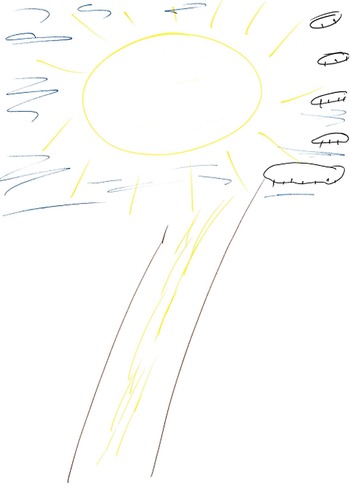
Drawing by participant 3.

Drawing by participant 7.

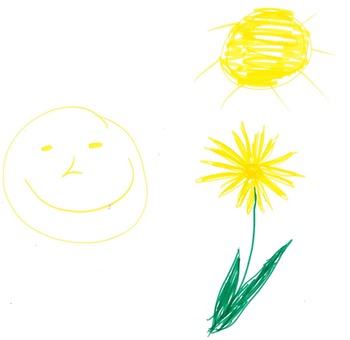
Drawing by participant 8.

Five major themes were constructed from the interview discussions and picture analysis. These themes included: Change; Mixed feelings; Support of family and friends; Staff interactions and Journey. From the discharge interviews, the themes of Change, Support of family and friends and Staff interactions were mostly represented in the interviews but not the drawings. The theme of Mixed feelings was represented in both the pictures and the interviews, while the theme Journey was less evident in the interviews prior to drawing completion and was strongly represented in the pictures and the narration around the meaning of the pictures.
Change − before…I didn‘t know anything
Significant others spoke about how their experience of caring for someone while they were in rehabilitation had been an experience of change. This included a change in their own knowledge and confidence in their roles as a carer and changes in themselves as a person.
A wife reported that she has learned to take the lead in the family but now I have to guide myself, guide others and take the lead role (P1) a mother stated I’m more confident (P7). Another wife described how she has changed her approach based on her experience and learning within the rehabilitation setting. Talking about her loved one, she reports the character hasn‘t but the personality has changed so I‘ve got to learn, re-learn how to deal with him. My stand and fight of old is no good with him now because he cannot reason anymore (P3). Acquiring knowledge was reported as empowering and instilled confidence in the role as a carer I just feel like I‘ve got a lot more knowledge and I‘m aware of everything whereas before I was just − I didn‘t know anything (P5).
From a practical point of view, having the opportunity for overnight leave to ‘practise’ their new roles was valued by carers and assisted them to feel confident with their change in roles; It was good that they do let them go home for that two overnights, because it really does let you know so I need to this and I need to be able to do that. Yeah it was great; (P5) and I‘ve seen him at home when he says that he’s okay in our environment, so I‘m not anxious about that, which is probably a good thing (P5).
Significant others also spoke about personal changes, including feeling stronger, empowered and grateful I think I‘m a bit stronger. A bit stronger and perhaps a little bit better organised (P2) and as a person I think − I guess I do not take life as for granted as much anymore (P9) and I suppose I‘m more grateful…it’s just a shit thing that happened to us (P7). Being more assertive with people was noted as a personal change by one significant other I say no. I say I‘m really sorry but no (P5). This was a big change for that person.
Mixed feelings − Sometimes you‘re a bit unsure
Significant others expressed a range of positive and negative emotions associated with their loved ones’ discharge. These emotions were reflected in the interviews and in the drawings and explanations of the drawings.
These mixed feelings included apprehension; I‘m a little bit apprehensive about bringing him home because of the medical condition (P3); I‘m worried that I won‘t be able to cope because everyone is saying it’s going to be hard on you (P3); the other thing I will be honest that I really am 100% worried about is that I cannot be with him 24/7 (P5). There was also excitement Yeah, it is exciting. Because really, at the start, we just didn‘t know. Actually we didn‘t know he was going to live. So to come from not knowing if he’s going to survive to he’s coming home.(P7); there were smiles, he was happy because he’s going home so it’s good (P8); he’s really looking forward to going home (P5); and relief well it’s a great relief. I know there will be some challenges with him, as I talked about a bit earlier in this narration. But we‘ll get through it.(P2) Some of the feelings of relief were related to an easing of practical issues, Well I know that he will be with me in my house so it’s a lot better. I know what’s happening to him and a lot of stress gone (P8) such as less travel the travelling has been probably one of the hardest things (P3) and no longer having to pay costs, such as parking and mobile phone call costs.
More ambivalent emotions were reflected in the pictures using darker colours and pictures of clouds (P3 and P9) and smiling and unsmiling faces (P5). In the picture where uncertainty seemed dominant a large blue question mark was drawn (P2). The wife reported It’s for me, it is my question mark. This is purely how I perceive − I do not quite know how it will all go with him, but that’s alright. We will see (P2). Other pictures depicted small grey clouds as a symbol of worry (P3) Now the sun is shining, the light is coming through. Still got some clouds on the horizon with his health but by and by its clear blue skies…as far as I can see (P3). In P5’s drawing where small smiling and unsmiling faces are drawn together, the significant other explains most of the time happy. Sometimes you‘re a bit unsure and a couple of times you‘ve been a bit sad (P5). In their picture light bulbs represent knowledge that had been gained and informed the going home process You‘ve got the knowledge and you‘re happy (P5). P8 wrote STRESS in large letters on her picture, approximating the size of the smiling face she also drew. When asked to elaborate she said Just stress (P8).
A common element to four of the seven pictures was a depiction of positivity at the prospect of the loved one coming home. The positivity is reflected in dominant pictures of the sun (P3, P5 and P7), smiling faces (P5, P7 and P8) and a flower (P7). Yellow is used often and seems to reflect a sense of well-being. One mother described the face she had drawn in her picture (this is) my smiley face. Because it’s good, it’s good that he’s coming home and he wants to come home, and he is confident (P7), this mother also noted of her flower picture a daisy to me is a happy flower (P7).
Support of family and friends − I do have a lot of support
At discharge friends and family were appreciated especially when supporting the significant other emotionally by their actions and presence. The importance of these relationships was depicted in the interviews, and in the pictures. A wife commented we found out that so many more people are caring. People we didn‘t realise rang up and just wanted to know how he was, because they‘d heard on the grapevine (P2). Other comments included I guess I’m a little bit more reliant on my friends (P9); and my friends were such a good support throughout (P9); for me it was like it was not only him who is affected, it’s also us (P1).
When describing her picture, P9 referred to the support of family and friends as being a cornerstone of her mother’s recovery at the moment we‘re currently supported by family, friends…to hopefully move forward and reach new goals (stepping stones) (P9). This is depicted by the small people, drawn in each corner of the image of the larger figures (the family unit). One significant other, who had received excellent family support, with their local community preparing meals and offering to fundraise, commented she found it hard to accept help when others might be needier than their family. She realised, however, that people just wanted to − they felt helpless and wanted to do something, and it’s like well, that’s fine (P7).
When help did not come as anticipated, this was a source of disappointment and frustration. Of her sister one participant stated she’s been friggin’ useless… “I’ll be there for you” and as soon as you ask anything of her, she’s “o well, we’ve got this on and I’ve got this on and we’re going away” (P3).
Journey − We are all waiting there. We are going home
While not evident in the interviews, the theme of Journey was strongly depicted in four of the discharge pictures (P1, P3, P5 and P9) represented by pathways, doors and stepping stones. A sense of journey and arrival is evident in P1’s picture with the drawing of a house with a large and dominant pathway, the family gathered nearby we are all waiting there. We are going home (P1). P3’s picture demonstrates progression with a pathway / tunnel leading to a large bright sun Yeah, there does seem to be light at the end of the tunnel. I didn‘t think I‘d ever see it. It’s been a struggle (P3). P5 drew light bulbs and a team discussion. The significant other reported the picture represented progression of knowledge and building capacity for the ongoing journey we had a family meeting. Then we were ready to go and it’s your preparation. You‘ve got the knowledge and you‘re happy…you can see a lot more clearer and you‘re not in the dark anymore. You know what’s going on (P5). P5 also drew a large door, with EXIT annotated on it, representing a way forward I feel that this is what’s going to be happening, that you go through the door that takes you home (P5).
Staff interactions − the team was amazing
Interactions with staff and how their expertise and behaviour supported the discharge process feature in the theme entitled Staff interactions. Staff expertise, strong communication processes and empathy towards the significant other and the loved one were noted by most participants and instilled in them a sense of confidence in their loved ones’ care and facilitation of the loved ones’ recovery; the staff around here, including the doctors, therapists, would understand what I‘m going through and help was always there, whether I used it or not (P2); the staff here have been outstanding. Everybody has been absolutely brilliant. I have to mention the communication, it’s been really good (P3); but the quality of the people doing the communication has been so high that it’s felt very seamless. It’s just been very good (P4); it was amazing the therapy that he’s had. It’s helped him. He’s just got stronger and stronger, and probably more confidence (P7), the social worker’s really cool. She is − anything and she‘ll get down to everything you ask her (P8) and yeah, they were definitely easy and approachable, the team was amazing (P9).
However, not all comments were positive. Disappointment and higher levels of stress were present when participants talked about issues with staff. Two significant others commented on issues with the attitude of staff, one stating one of them doesn‘t even communicate with him at all (P5), and the other it’s not that they‘re not good. I think they‘re over it (P7).
Discussion
Eight significant others of loved ones with a severe ABI were asked about their experiences of having their loved one discharged from an inpatient rehabilitation unit. The interview and drawing data indicate that while significant others experience feelings of trepidation at this stage of the journey, they also report feeling confident and empowered. Overall, significant others’ reported experiences show a significant and positive evolution between interviews at admission and discharge. On admission to ABI-specific rehabilitation, seven themes (Trauma, Relief, Interactions, Change, Grief and loss, Journey and Uncertainty) were identified whereas on discharge five themes were identified (Change, Mixed feelings, Support of family and friends, Journey and Staff interactions) (see Table 3). Consistent themes at admission and discharge were Change, Journey and Interactions. At discharge, the theme of Mixed feelings compares with the feelings and experiences identified as strong and separate themes at admission − those of Trauma, Relief, Grief and loss and Uncertainty. At discharge, Support of family and friends was a separate theme as their role increased in importance; at admission support of family and friends was reported but referred to more in the context of changes in relationships.
Themes from the Admission and Discharge Interviews and Picture Analysis

Many of these themes are consistent with other research findings reported in the literature (Oyesanya, Reference Oyesanya2017) however, compared with the systematic review completed by Oyesanya the experience of ‘journey’ seemed more dominant in this study. This is likely due to the use of the drawing method where the theme associated with journey evolved from. The use of the drawing method in this study deepened the understanding of the experience of the significant others. This finding is consistent with other studies using the drawing method, which found that the drawing method deepened understanding of participants’ experiences (Palacios-Ceña et al., Reference Palacios-Ceña, Neira-Martín, Silva-Hernández, Mayo-Canalejo, Florencio, Fernández-de-Las-Peñas and Cuadrado2017; Cheung et al., Reference Cheung, Saini and Smith2018; Cross et al., Reference Cross, Kabel and Lysack2006; Locsin et al., Reference Locsin, Barnard, Matua and Bongomin2003; Phillips et al., Reference Phillips, Ogden and Copland2015; Westall & Liamputtong, Reference Westall and Liamputtong2011; Eggleton et al., Reference Eggleton, Kearns and Neuwelt2017; Rees, Reference Rees2018).
Participants were asked directly if their experiences as a significant other had changed them, and the answers to this question emerged as a major theme. Change was also a significant theme in the earlier interviews (Checklin et al., Reference Checklin, Fernon, Soumilas and Stephens2020), but was described as experienced in a different way at discharge. At admission interviews, change was a pervasive theme, with change being reported in many aspects of the significant others’ roles in life, with focus on practical changes (e.g., finances; not being able to undertake their usual practical tasks within their family and taking on new roles such as bathing their child). The changes in the loved one, and their new dependency, was a focus during the admission interviews. At discharge however there was a shift from changes in the loved one to changes in the significant other themselves, with significant others speaking about the knowledge, skills and confidence they had acquired, and how they had personally changed to meet the challenge of their situation. Gaining confidence, knowledge and skills are important for significant others to develop in their new role as carers (Oyesanya, Reference Oyesanya2017). Practical experiences seemed to add to the significant others feeling more empowered and capable of taking on a caring role, with overnight ‘practise’ visits home being noted as particularly helpful. Such visits have been described elsewhere as being valuable, however they do not fully prepare the carer for longer-term care responsibilities, unknown to the carer at the time of discharge (Abrahamson, Jensen, Springett, & Sakel, Reference Abrahamson, Jensen, Springett and Sakel2017).
Being prepared and feeling confident are incorporated into the Mixed Feelings theme particularly when compared to the admission interviews. At admission, Grief and loss, Relief, Uncertainty and Trauma were all detailed themes, which represented emotions that were quite overwhelming for significant others at admission. By discharge however these strong and overwhelming emotions appear to have settled, even though some trepidation was still expressed. The pictures reflect this, compared with pictures drawn at admission; five of the seven pictures drawn at discharge had fewer dark colours, clouds and tunnels and the picture explanations were more positive regarding feelings. However, the discharge images also express some negative emotions such as uncertainty and stress. Fluctuating emotions over the hospital stay is normal (Oyesanya, Reference Oyesanya2017) and were certainly a part of these participants’ experiences.
Family and external support to the significant other was deeply valued and when family members were not perceived as supportive it was a source of increased stress, which is consistent with other reports in the literature (Abrahamson et al., Reference Abrahamson, Jensen, Springett and Sakel2017; Oyesanya, Reference Oyesanya2017). By discharge, the roles of friends and family seemed to be more established and mostly were perceived as sources of major support central to making the journey home possible. The participants stated that support from others was crucial to having a positive discharge experience. Overall, most had positive support; only one participant felt that their needs were partially met, which can occur for carers of people with an ABI (Tverdov, McClure, Brownsberger, & Armstrong, Reference Tverdov, McClure, Brownsberger and Armstrong2016). It was encouraging to see the development of the themes associated with family/friend support as carers’ social support can influence quality of life (Lond & Williamson, Reference Lond and Williamson2018). Compared with admission interviews support of friends and family was constructed as a theme in its own right during the discharge interviews and was depicted strongly in three of the discharge pictures.
Journey was a major theme depicted strongly in the pictures at admission and discharge, but picture and interview data showed there was a difference in the sense of journey at admission compared to discharge. By discharge significant others mostly drew pictures that were positive depictions of their journeys, with fewer uncertainties. Worries were still present in the images at discharge) but seemed less dominating. Within the represented journey theme there is a sense of hope as this stage of recovery reaches its conclusion. Consistent with Oyesanya (Reference Oyesanya2017) it was found that hope for improvement, as part of the journey, is an important component of the significant other’s experience.
Overall, most participants reported a positive experience of their loved one’s rehabilitation. This study was conducted in a centre which specialises in brain injury rehabilitation, and it has been reported that family member’s experiences are better when the rehabilitation is conducted in specialist TBI centres (Manskow et al., Reference Manskow, Arntzen, Damsgård, Braine, Sigurdardottir, Andelic and Anke2018). Factors which contribute to this included specialist staff expertise, strong communication processes between staff and the significant other and empathy shown by professionals. Receiving information to prepare the significant other and the loved one for discharge is considered an important part of the family experience (Manskow et al., Reference Manskow, Arntzen, Damsgård, Braine, Sigurdardottir, Andelic and Anke2018), which was reflected in the experiences of the significant others in this study. Feeling supported by professionals and having time to talk to them has been reported as highly important (De Goumoëns, Didier, Mabire, Shaha, & Diserens, Reference De Goumoëns, Didier, Mabire, Shaha and Diserens2019) and the significant others in this study also valued this to prepare them positively for the discharge experience. Positive interactions with staff, and confidence in their skill and expertise contributed to significant others being confident to proceed with the discharge plan. When poor communication or concerns about staff attitude occurred, this caused stress. Failure to deal with family members humanely and poor communication from the team to the family have been reported as negative influences on the significant others’ experience (Manskow et al., Reference Manskow, Arntzen, Damsgård, Braine, Sigurdardottir, Andelic and Anke2018). This study has shown that staff interactions which were communicative, approachable and compassionate enhanced the significant others’ experience. Positive communication assisted in reducing stress at admission (Checklin et al., Reference Checklin, Fernon, Soumilas and Stephens2020) and at discharge, which is consistent with other reports that good communication is essential between healthcare professionals and significant others (Abrahamson et al., Reference Abrahamson, Jensen, Springett and Sakel2017; De Goumoëns et al., Reference De Goumoëns, Didier, Mabire, Shaha and Diserens2019). Concerns regarding poor professional attitudes were not a big focus for significant others at discharge compared to concerns raised during admission interviews and were not reported to have impacted on discharge progression. It is unclear why these concerns reduced. Perhaps the significant other and staff built relationships over the time in rehabilitation as the staff shared their expertise with the significant other, possibly significant other stress levels decreased or issues at the admission stage were part of difficulties with transiting to a new unit as reported elsewhere (Keenan & Joseph, Reference Keenan and Joseph2010).
Implications for clinical practice
During the period of their loved ones’ rehabilitation significant others reported acquiring the skills and knowledge they needed to feel mostly confident about their loved ones’ discharge. The role of the expert ABI team, reported as central to the discharge process, was perceived by significant others as smoothing the way. As communication is highly valued by significant others internal practices should enable all staff to have the same information about the loved one, and significant others’ family and friends should also be encouraged to participate in home visits to offer support to the significant other (and loved one). Receiving the right information is essential to make the whole experience better for the significant others, consistent with many other studies (Oyesanya, Reference Oyesanya2017). Communication therefore should be a core value and practice of ABI rehabilitation.
In this study significant others reported that team support, communication, discharge preparation and pre-discharge overnight leave were beneficial. Abrahamson et al. (Reference Abrahamson, Jensen, Springett and Sakel2017) suggests there is value in making explicit the lessons of pre-discharge leave to better prepare for discharge especially as family members underestimate the changes in abilities and upcoming impact on home life. As a result, clinicians need to be clear with the family about discharge planning and allow opportunities for significant others to practise their new roles with adequate time to be able to access professional support and guidance. It is known that a lack of early discharge planning can result in crisis for the family (Oyesanya, Reference Oyesanya2017).
Implications for future research
All the participants were admitted with a severe ABI and low FIM scores, with long periods of rehabilitation. This facilitated a longer time period for discharge planning and is likely to be related to the positive experience of discharge reported by the significant others in this study. Shorter rehabilitation stays (whether due to less severe ABI, able to mobilise more easily or patient wish to discharge against medical advice) were not captured. It would be useful to know what can better prepare significant others caring for people with shorter rehabilitation stays. This would be particularly useful given that many significant others report that the loved one being home is harder than anticipated and hasty discharge planning with limited preparation can leave the significant other exhausted (Oyesanya, Reference Oyesanya2017).
Limitations
This study has provided new information on the significant others’ experience of reaching the end of the rehabilitation stay but the study has some limitations. Previous studies have investigated sociodemographic information and needs of the family (Migliorini et al., Reference Migliorini, Callaway, Moore and Simpson2019). This did not occur in this study as it was not the objective. However, it would have been useful to know whether experiences were different based on the loved one having a compensable injury (or not), and to consider the impact on the significant other of where they lived (e.g. metropolitan or regional). This would be useful to investigate in other studies. Additionally, there is a gender bias in the participants with only one significant other being male. However, having an over-representation of female views in this field is not unusual, given that care often falls to the female significant other (De Goumoëns et al., Reference De Goumoëns, Didier, Mabire, Shaha and Diserens2019; Holloway et al., Reference Holloway, Orr and Clark-Wilson2019; Manskow et al., Reference Manskow, Arntzen, Damsgård, Braine, Sigurdardottir, Andelic and Anke2018). As indicated by the FIM scores, the voices of significant others with loved ones who had poorer outcomes or very high care needs physically were not captured. The study was conducted by clinicians either working or who had been working in the setting the research was conducted. It therefore could be argued that the professional perspective could influence the analysis, however, as stated before following of data analysis guidelines were established to avoid potential bias.
Conclusion
Overall, the experience of having a loved one with a severe ABI in rehabilitation is an emotional event. Significant others presented as less traumatised and more accepting of their loved ones’ predicament at discharge than at admission to rehabilitation; perhaps time and preparation ameliorated their concerns along with seeing improvements and a belief that they are on a journey of recovery and hope with their loved one. Compassionate communication, consistency of information and thorough discharge planning practices were cornerstones to enhance the experience of significant others, and to empower them to undertake their new role.
Acknowledgements
We would like to thank the participants in this study for sharing their stories and experiences and acknowledge Ms Fernon and Ms Soumilas for their assistance in Checklin et al. (Reference Checklin, Fernon, Soumilas and Stephens2020).
Financial support
This research was supported by from the Caulfield Hospital Small Grants funding (Grant number 51515).
Conflicts of interest
The authors report no conflicts of interest.
Ethical standards
The authors assert that all procedures contributing to this work comply with the ethical standards of the relevant national and institutional committees on human experimentation and with the Helsinki Declaration of 1975, as revised in 2008.