





1. Introduction
Over the first 2 years of life, children develop rapidly in their ability to recognize referents of highly familiar words. The speed and accuracy of this recognition is influenced by factors such as lexical similarity, input frequency, and linguistic characteristics (Bobb & Mani, Reference Bobb and Mani2013, Borovsky & Peters, Reference Borovsky and Peters2019, Mani & Plunkett, Reference Mani and Plunkett2011). At the same time, children are curious learners and explore their environment in systematic ways (Altmann et al., Reference Altmann, Bazhydai and Westermann2025; Madhavan & Mani, Reference Madhavan and Mani2024). Children learn words more easily when they are interested in the category they belong to (Ackermann et al., Reference Ackermann, Hepach and Mani2020), and their interest-guided attention influences their word referent selection (Ackermann et al., Reference Ackermann, Eiteljoerge, Wasmuth, Johnson and Mani2025). Building on these insights, we investigate whether children’s interests also impact their recognition of familiar word–object associations, specifically examining whether a child’s interest in a particular category (e.g., animals vs. vehicles) affects the speed and accuracy of their recognition of familiar objects within that category.
To be able to recognize a familiar object upon hearing its label, children first have to learn how to identify word boundaries in continuous speech (Saffran et al., Reference Saffran, Aslin and Newport1996), extract those words from the speech stream (Schreiner et al., Reference Schreiner, Altvater-Mackensen and Mani2016), then learn about their referent in the real world, and retain this mapping long-term (Bion et al., Reference Bion, Borovsky and Fernald2013; McMurray, Reference McMurray2016). If a child has established a link between a word and a referent, the child typically looks to the correct target object when presented with the label for this object (see also Jusczyk, Reference Jusczyk1999, for an overview). This behaviour is utilized in the so-called Intermodal Preferential Looking paradigm which has been frequently used to investigate children’s word knowledge: In this paradigm, two objects are typically presented next to each other on a screen. After an initial silent baseline phase in which the child can explore the display freely, one object is labelled and the child’s gaze towards that object upon hearing the label for this object is measured (Golinkoff et al., Reference Golinkoff, Hirsh-Pasek, Cauley and Gordon1987). If children look more towards the labelled object than the unlabelled distractor object upon hearing the label, it is usually assumed that the child is familiar with and recognizes the corresponding word–object association. Thus, word–object recognition involves several processes that need to be mastered before the child might show word–object recognition in a task (Borovsky, Reference Borovsky2022).
Young children’s word recognition develops rapidly but is influenced by various factors. Infants as young as 4.5 months can recognize their own name (Mandel et al., Reference Mandel, Jusczyk and Pisoni1995), and by 6 months, they can associate words like “mommy” and “daddy” with the corresponding people and recognize some body parts and food items (Bergelson & Swingley, Reference Bergelson and Swingley2012; Tincoff & Jusczyk, Reference Tincoff and Jusczyk1999; Tincoff & Jusczyk, Reference Tincoff and Jusczyk2012). However, their word–object recognition is still unstable and dependent on cues like word frequency (Kartushina & Mayor, Reference Kartushina and Mayor2019). By the second year, children’s recognition improves in accuracy and speed, with faster and more precise recognition of familiar words (Bergelson, Reference Bergelson2020; Fernald et al., Reference Fernald, Pinto, Swingley, Weinberg and McRoberts1998, Reference Fernald, Swingley and Pinto2001, Reference Fernald, Perfors and Marchman2006; Fernald & Marchman, Reference Fernald and Marchman2012; Hurtado et al., Reference Hurtado, Marchman and Fernald2008; Mani & Plunkett, Reference Mani and Plunkett2007, Reference Mani and Plunkett2010; Marchman & Fernald, Reference Marchman and Fernald2008; Peter et al., Reference Peter, Durrant, Jessop, Bidgood, Pine and Rowland2019; Ronfard et al., Reference Ronfard, Wei and Rowe2022; Swingley et al., Reference Swingley, Pinto and Fernald1999; Swingley & Aslin, Reference Swingley and Aslin2000). Nonetheless, their recognition remains malleable, influenced by factors like vocabulary growth and category knowledge (Borovsky & Peters, Reference Borovsky and Peters2019; Fernald et al., Reference Fernald, Perfors and Marchman2006).
Studies have examined the factors that influence early word recognition and comprehension and find effects of the frequency of the word in the input, the age when a word was acquired, and the grammatical category the word belongs to impacting the speed and accuracy of word recognition. An analysis using parental questionnaires on children’s word knowledge (CDIs from Wordbank, Frank et al., Reference Frank, Braginsky, Yurovsky and Marchman2017) found that the concreteness and frequency of a word predict the age at which children typically learn this word (Braginsky et al., Reference Braginsky, Yurovsky, Marchman and Frank2019). More recently, eye-tracking studies suggest that children may use the relative frequency of the objects presented on-screen to disambiguate the intended referent of a word in early word learning (Kartushina & Mayor, Reference Kartushina and Mayor2019), and they show improved recognition and processing of more frequent words (Garlock et al., Reference Garlock, Walley and Metsala2001; Potter & Lew-Williams, Reference Potter and Lew-Williams2022).
Similarly, studies have shown that the extent of a child’s knowledge of other semantically related words similarly influences children’s learning and recognition of word–object associations (Ackermann et al., Reference Ackermann, Hepach and Mani2020; Borovsky & Peters, Reference Borovsky and Peters2019). Borovsky and Peters report that 18-month-olds with a large vocabulary showed robust target recognition independent of the number of words they knew in the target word’s category. However, 18-month-olds with a smaller vocabulary showed improved recognition of word–object associations belonging to categories the child knew fewer words in, relative to larger categories. In contrast, from 22 months on, the minimum age of children we tested in the current study, children showed robust target recognition independent of category size. Nonetheless, category size impacted how target looking unfolded over time with children looking more and faster to a target from a larger category compared to a smaller category (Borovsky et al., Reference Borovsky, Ellis, Evans and Elman2016b). Similar results are reported in a range of studies employing a priming paradigm, with target word recognition being influenced by prior presentation of a related prime with many phonological, semantic, or perceptually overlapping neighbours relative to primes with fewer neighbours (Arias-Trejo & Plunkett, Reference Arias-Trejo and Plunkett2010; Bobb et al., Reference Bobb, Huettig and Mani2016; Mani & Plunkett, Reference Mani and Plunkett2010). Thus, while word recognition is robust by 2 years of age, several other factors such as the frequency of the word in the child’s input, the age at which the word was acquired, and the other words known to the child influence the speed and accuracy of target word recognition. This has consequences for speech processing with words that can be processed and accessed faster potentially boosting the speed with which fluent speech is processed in general. This also has consequences for language acquisition since the words that a child knows and is familiar with can, once processed, act as anchors for speech segmentation and word learning (Altvater-Mackensen & Mani, Reference Altvater-Mackensen and Mani2013; Bortfeld et al., Reference Bortfeld, Morgan, Golinkoff and Rathbun2005).
Furthermore, recent research also suggests that at the age of two and beyond, individual interests may lead to further variation in word learning and, potentially, word recognition. Indeed, research in educational psychology has long concerned itself with the role of interest on attention, recognition, recall, information integration, and learning (see Hidi & Renninger, Reference Hidi and Renninger2006, for a comprehensive review). Hidi and Renninger’s four-phase model of interest highlights the role of both situational interest – interest and engagement triggered by input from the environment – and individual interest – the individual’s interest in repeatedly engaging with particular kinds of input – on reading comprehension (Hidi & Baird, Reference Hidi and Baird1988), attention (Hidi, Reference Hidi1995), recognition, and recall (Renninger & Wozniak, Reference Renninger and Wozniak1985). In particular, Renninger and Wozniak (Reference Renninger and Wozniak1985) video-taped preschoolers between 2.9 and 4.2 years and evaluated how their interests influenced their recognition of previously seen objects. They found that children showed better recognition for objects they previously showed interest in and, based on these findings, suggest that interest can reflect the organization of their experiences and memory. Earlier still in development, children’s interests have been shown to influence learning as interest seems to guide their own and their social partner’s attention: From early on, infants point to things of interest to elicit an informative response of the communication partner (Begus & Southgate, Reference Begus and Southgate2012). They also sometimes learn and retain information better when they have elicited the information themselves (Begus et al., Reference Begus, Gliga and Southgate2014; Partridge et al., Reference Partridge, McGovern, Yung and Kidd2015).
Children’s interest in particular categories seems to influence their learning: For example, parent ratings of their 18-month-old child’s interests in different categories is related to children’s vocabulary size at 24 months (Madhavan & Mani, Reference Madhavan and Mani2024). Furthermore, children learn novel word–object associations better when they are interested in the category to which the word belongs (Ackermann et al., Reference Ackermann, Hepach and Mani2020) and also retain this information better (Ackermann et al., Reference Ackermann, Förster, Schaarschmidt, Hepach, Mani and Eiteljoerge2024; Rothwell et al., Reference Rothwell, Westermann and Hartley2024). In other words, a child who is more interested in animals learns and retains a novel animal name more robustly than a child who is more interested in vehicles. The authors suggest that children’s interests may increase the perceived salience of objects of interest to the child and thereby facilitate learning and retention (Horst & Samuelson, Reference Horst and Samuelson2008). Such heightened attention during learning might extend to later recognition and, as suggested above, might be an indicator of children’s organization of their memory. In the context of word processing, words for objects that a child is highly interested in might be accessed faster and more accurately because the child’s interest facilitates processing of words by guiding their attention. This influence might still be observable at 2 to 3 years of age when recognition is rather stable but can still be influenced by factors such as frequency. Against this background, the current study examines whether children’s individual interests also relate to their recognition of familiar word–object associations.
1.1. The current study
The current study examines children’s speed and accuracy to recognize familiar word–object associations and the extent to which both speed and accuracy are related to children’s interest and prior knowledge of the category to which the familiar objects belong. The data presented here are taken from two previous studies by Ackermann et al. (Ackermann et al., Reference Ackermann, Hepach and Mani2020, Reference Ackermann, Förster, Schaarschmidt, Hepach, Mani and Eiteljoerge2024). These two papers addressed how 24-, 30-, and 36-month-old children learn novel words for novel objects that belong to four natural categories (animals, vehicles, drinks, and clothes), the extent to which children’s interest in these categories is associated with their learning performance, and how children retain such mappings. Both papers used a similar experimental design: Parents completed a questionnaire about their children’s curiosity and knowledge of objects in certain categories. During the testing session, children participated in an eye-tracking study that consisted of three or five phases, respectively. In a first category interest phase, they were presented with familiar objects and their labels from the four categories and their pupillary response were measured as one index of their interest in these categories. Children were then shown two interleaved training and test phases. During the training phase, they saw novel objects that belonged to the four different categories and heard the name of each object. During each test phase, children saw four novel test trials and four familiar test trials while their looking behaviour was recorded. Here, images of either two novel or two familiar objects were presented side-by-side, while the child was presented with the label of one of the objects onscreen. Increased fixations to the labelled object, henceforth the target object, were interpreted as successful recognition of either the learned novel or familiar word–object association. In the second paper from Ackermann et al. (Reference Ackermann, Förster, Schaarschmidt, Hepach, Mani and Eiteljoerge2024), two retention phases followed after 5 minutes and 24 hours to evaluate children’s retention of newly learned word–object associations.
Importantly, the two studies by Ackermann et al. focused on novel word learning and retention and not on familiar word recognition. Thus, test trials presenting familiar objects were not analysed further in the two papers because the focus of these papers was on the role of interest in children’s learning of novel word–object mappings. In the current study, the focus is solely on the familiar test trials in these two studies to investigate how children’s interests play a role in online word recognition of familiar words. These trials have not been analysed in the previous two papers.
The current study extends previous research on the influence of children’s interests on word learning by examining the association between children’s interests and familiar word recognition. We used two indices of children’s interests, namely, parental reports of how curious their child was in the different familiar objects, and children’s pupillary dilation to the familiar objects during the category interest phase. We then examined the amount of time children spent looking at the target, namely, the proportion of target looking during familiar test trials as well as the latency to fixate the labelled target object, as indices of children’s word–object recognition. We examined the association between our indices of word recognition and children’s interests to investigate whether children’s interest in a category modulates their recognition of familiar word–object associations from that category. We decided to use only the data from the first time point for the 24- and 36-month-olds (thereby excluded the two retention phases from Ackermann et al., Reference Ackermann, Förster, Schaarschmidt, Hepach, Mani and Eiteljoerge2024) for better comparability with the data from the 30-month-olds who were only tested at one point in time. Given that category size, that is, the number of words that children known in a particular category, has been shown to also influence word recognition at the age of 2 (Borovsky et al., Reference Borovsky, Ellis, Evans and Elman2016b), we controlled for category size across all analyses. We tested the following hypotheses:
-
1. Children’s interest in a category, indexed by their category arousal and their parent-rated curiosity in and familiarity with category members, relates to familiar word–object recognition such that children look a) more and b) faster to an object of a category that they are more interested in compared to an object that belongs to a category they are less interested in.
-
2. The effect of interest on target recognition wanes with age when children’s word–object recognition is robust enough to brave any potential influences from other factors.
-
3. Children’s speed of recognition will increase with age (as in Fernald et al., Reference Fernald, Pinto, Swingley, Weinberg and McRoberts1998).
2. Methods
Both studies from Ackermann et al. (Reference Ackermann, Hepach and Mani2020, Reference Ackermann, Förster, Schaarschmidt, Hepach, Mani and Eiteljoerge202 Reference Ackermann, Hepach and Mani4) which contributed data to this paper followed the same structure. This allowed us to combine the data from the two studies and thereby include children from 22 to 39 months of age in the following analyses.
2.1. Participants
One hundred and twenty-four German monolingual, typically developing children aged 22 to 39 months (M = 30 months 2 days; SD = 38 d; range = 21 m 28 d to 39 m 23 d, female = 59, male = 65), participated in the studies. Forty additional children were excluded due to piloting (n = 7), technical errors (n = 11), preterm birth (n = 1), raised bilingual (n = 4), twins (n = 3), or enough data not provided during the study (n = 14). Children were recruited from the babylab database of the Institute for Psychology. Following a complete briefing, caregivers provided written informed consent for their child to take part in the study. Participation was rewarded with a book at the end of the session. Ethics approval was granted by the ethics committee of the Institute for Psychology.
2.2. Stimuli
Both studies which contributed data to this paper used the same material. Given the focus of the current study on familiar word–object association, we only present further information on the familiar objects presented to children. Details on the novel objects can be found in Ackermann et al. (Reference Ackermann, Hepach and Mani2020). Images of 16 familiar objects with four objects from four familiar semantic categories were used (animals: ant, crocodile, mouse, penguin; clothes: diaper/nappy, pyjamas, scarf, trousers/pants; drinks: beer, coffee, milk, water; vehicles: bus, helicopter, tractor, tricycle). The categories were chosen based on previous research, suggesting an influence of category size on children’s recognition of objects from these categories (Borovsky et al., Reference Borovsky, Ellis, Evans and Elman2016b). The 16 objects were presented to children during the category arousal and the word recognition phase. Note that the pairing of the objects in the recognition phase was not controlled for grammatical gender because the original plan of the study did not include an analysis of the familiar objects. We included all trials in the analysis to maximize data and because the difference in looking behaviour between match and mismatch gender trials seemed small. Furthermore, we provide a plot showing children’s target looking across time when considering match and mismatch gender trials in the Supplementary Material.
The objects were presented as photorealistic images against a light grey background (360 × 360 px). During the category arousal phase, a scrambled version of the image served as the baseline for the pupillary measure to control for luminance across objects. Scrambling was done using the Scramble Filter plugin from Adobe Photoshop and by breaking the picture up into 100 squares of 40 × 40 px that were rearranged randomly.
Auditory stimuli were recorded by a female native speaker of German in infant-directed speech at a sampling rate of 44,100 Hz. Noise was filtered out using Goldwave. For the category arousal phase, recordings consisted of the definite article (der, die, das) and the object label (e.g., das Krokodil; the crocodile). For the word recognition phase, two carrier sentences were used to direct the child’s gaze to the target: Siehst du den/die/das [target]? or Wo ist der/die/ das [target]? (“Do you see the [target]?” or “Where is the [target]?”). The onset of the target word was at 1020 ms into the test trial.
2.3. Parental questionnaires and additional tests
Parents filled out the short version of the FRAKIS with only the words from categories relevant to the current study (German adaptation of the MCDI; Szagun et al., Reference Szagun, Stumper and Schramm2009). These included 45 animals, 14 vehicles, 7 drinks, and 21 clothes. In addition, parents were asked to list additional words their child knows in each of the categories, but these were not analysed further. Furthermore, parents were asked to rate their child’s curiosity about and familiarity with the four familiar objects in each of the four different categories (clothes, vehicles, animals, food) on a 7-point Likert scale (1 = not familiar/curious at all, 7 = very familiar/curious). The questionnaires were sent via mail to the families, and parents were asked to complete them and bring them to their appointment. Thirteen participating families did not provide the parental questionnaires, and for one child, the category size could not be determined.
2.4. Experimental design
Both studies consisted of a category arousal phase, a learning phase, and a recognition phase (see Figure 1). In addition, Ackermann et al. (Reference Ackermann, Förster, Schaarschmidt, Hepach, Mani and Eiteljoerge2024) had a retention phase 5 minutes and 24 hours later. In the category arousal phase, children saw the 16 familiar objects first as scrambled images for 2000 ms and then as unscrambled images for 3000 ms, while their pupillary response was measured. The images were presented in sequences of pairs with two images from the same category being presented one after another (e.g., tractor, bus) followed by two images from a different category and so on. The object presented in the image was labelled at 1000 ms into the unscrambled phase.
Overview of the study design in Ackermann et al. (Reference Ackermann, Hepach and Mani2020) and Ackermann et al. (Reference Ackermann, Förster, Schaarschmidt, Hepach, Mani and Eiteljoerge2024). The second paper included additional retention phases 5 minutes and 24 hours after training. However, the data from those test phases as well as the data from the word learning phases were not analysed in the current study.

Figure 1. Long description
The flowchart consists of five vertical columns representing sequential phases.
1. Category interest phase. Top box lists 16 trials, 1 trial per object, and 8 blocks at 2 trials. Below, a visual shows a scrambled image and a clear image of a mouse with a speech bubble saying ‘The mouse!’. An arrow points down to a box labeled Pupil dilation.
2. Word learning phase 1. Contained in a gray box. Top box lists 4 trials, 2 novel objects, and 2 trials per object. Below, a visual shows a scrambled image and a clear image of a pangolin with a speech bubble saying ‘This is a pango!’.
3. Word recognition phase 1. Top box lists 8 trials, 4 familiar trials, and 4 novel trials. Below, a visual shows green pants and a mouse side-by-side with a text box asking ‘Where is the mouse?’. An arrow points diagonally down to a central box labeled Proportional target looking.
4. Word learning phase 2. Contained in a gray box. Top box lists 4 trials, 2 novel objects, and 2 trials per object. Below, a visual shows a scrambled image and a clear image of a rickshaw with a speech bubble saying ‘This is a rikscha!’.
5. Word recognition phase 2. Top box lists 8 trials, 4 familiar trials, and 4 novel trials. Below, a visual shows green pants and a mouse side-by-side with a text box asking ‘Where is the mouse?’. An arrow points diagonally down to the same central box labeled Proportional target looking.
The category arousal phase was followed by two interleaved training and recognition phases, with two blocks for each phase. In each training block, children saw two of the four novel objects and heard their labels. We do not analyse the data from the training phase in the current study although more detail on this can be found in the original papers (Ackermann et al., Reference Ackermann, Hepach and Mani2020, Reference Ackermann, Förster, Schaarschmidt, Hepach, Mani and Eiteljoerge2024).
In the recognition phases, children saw eight trials consisting of four novel and four familiar trials. The structure of the trial was as follows: images of either two novel or two familiar objects were presented side-by-side for 3000 ms in silence. The objects then disappeared followed by a central attention-getting stimulus. Once the child fixated this stimulus, the two images reappeared on screen for a total of 3520 ms; 1020 ms after the images reappeared on the screen, children were presented with the target label embedded into the carrier phrases described above, such that target word onset at 1020 ms. The pictures remained on-screen for a further 2500 ms following target word onset. The two images presented side-by-side onscreen in familiar trials came from different categories.
2.5. Procedure
Participants sat in a car seat or on their parent’s lap about 65 cm away from a 42-inch screen. A Tobii X 120 eye-tracker positioned underneath the screen recorded children’s gaze at a sampling rate of 120 Hz and a pupil diameter sampling rate of 40 Hz. A loudspeaker located above the screen presented the auditory stimuli. The stimuli were presented using Tobii Pro Studio (version 3.4).
2.6. Preprocessing
Preprocessing was identical to Ackermann et al. (Reference Ackermann, Förster, Schaarschmidt, Hepach, Mani and Eiteljoerge2024), also presented below. A Tobii X3-120 eye tracker provided information about where the child was looking with one data point about every 16 ms (120 Hz). Pupil diameter was sampled at 40 Hz. Time points where both eyes could not be tracked reliably (according to the Tobii scale) were excluded from any further processing. When both eyes could be tracked, the average of both eyes was used for all further analyses.
Proportional target looking. We first calculated where children were looking on the screen (at the target, distractor, or neither of the images) during the entire duration of the trials in the recognition phase. Next, we binned the data into 40 ms bins, with each 40 ms bin coded for where children were looking. Then, we calculated the proportion of time children spent looking at the target relative to the distractor (PTL = T/(T + D)) across two phases of the trial. The baseline phase considered all fixations from when the objects reappeared onscreen to the target word onset at 1020 ms and accounted for any visual preferences before the word onset (Means of ptl.baseline per pairing ranged from .46 to .54). The critical test phase considered all fixations from the onset of the target word to the end of the trial.
Pupillary data. Only pupillometry data from time bins where children were fixating the central image on screen in the category arousal phase were considered for further analyses. The data were filtered using a threshold filter (excluding the top and bottom 10% of differences in pupillary diameter between adjacent time points). Missing data points were interpolated across a moving window of four time points. When both eyes could be tracked and provided reliable data (as indicated by the eye tracker), pupillary data were averaged across both eyes; otherwise only the tracked eye was used.
For the category arousal measure, pupillary arousal during the last 500 ms of the scrambled phase served as baseline. The entire unscrambled phase of 3000 ms was the window of interest. We corrected for baseline by subtracting the pupillary diameter in the baseline phase from the unscrambled phase. Change in pupillary diameter, henceforth pupillary arousal, was calculated for each image separately. We then averaged pupillary arousal across all category members to obtain arousal scores per category. Data were only included if pupillary data from at least two category members could be included (for further information on filtering, interpolation, and loss of data, see Ackermann et al., Reference Ackermann, Hepach and Mani2020).
Latency. Additionally, we calculated the time children took to initiate a shift from the distractor to the target and vice versa after the onset of the target word. First, we extracted trials where children looked either to the target (target-first) or the distractor (distractor-first) at the beginning of the test phase. We then calculated how long children stayed on the distractor before initiating a shift towards the target (distractor-first trials) and vice versa (target-first trials). Note that, similar to Fernald et al. (Reference Fernald, Pinto, Swingley, Weinberg and McRoberts1998), the shift itself was not included in the measure. Trials where children remained on the first image for only one time point were excluded because the latency would be 0 (i.e., the time bin of this first look is the time bin of the word onset).
Category size. We calculated two measures of category size. First, we calculated relative category size (i.e., the proportion of words in a category known to the child relative to the total number of words included in the questionnaire). This measure was related to word learning in Ackermann et al. (Reference Ackermann, Hepach and Mani2020). Second, we also calculated absolute category size, which reflected the total number of words known in that category as reflected in the questionnaire.
Parental data. Data from the parental questionnaires about their child’s familiarity and curiosity about objects from the four categories were highly skewed: Most parents indicated that their child was highly familiar (median = 6) and highly curious (median = 6) about the objects (see Figure 2). Log-transforming did not improve the distribution of the data. We, therefore, continued with the analysis using the original data and urge caution in interpreting analyses including these data. Note that the data in Figure 2 and Table 1 include parental ratings also for children who had to be excluded from the eye-tracking analysis (n = 22) and therefore include more children than the linear models to increase power. When evaluating the results for the whole sample compared to the reduced sample, there were only minor differences.
Parental ratings (n = 132) of children’s curiosity of and familiarity with the four categories.

Figure 2. Long description
The figure consists of two side-by-side bar charts with a shared y-axis labeled count from 0 to 60 and a shared x-axis labeled Rating from 1 to 7. A legend on the right identifies four categories: animals (yellow), clothes (green), drinks (blue), and vehicles (orange).
Left Panel: Curiosity
* Ratings 1 through 5 show relatively low counts across all categories, generally under 30.
* Rating 6 shows a moderate increase, particularly for animals.
* Rating 7 shows a significant peak for animals (approximately 70) and vehicles (approximately 75), while clothes and drinks remain below 20.
Right Panel: Familiarity
* Ratings 1 and 2 have near-zero counts.
* Ratings 3 through 5 show a gradual upward trend for all categories.
* Rating 6 shows counts between 30 and 40 for most categories.
* Rating 7 shows the highest frequency for all categories, with clothes peaking at nearly 70, followed by animals at 65, vehicles at 60, and drinks at approximately 48.
Mean and standard deviation for parental ratings of familiarity, curiosity, and category size per category (animals: 45 items, clothes: 21 items, drinks: 7 items, vehicles: 14 items). The first row presents the whole dataset (n = 132), and the second row presents the data from only those children who were included in the eye-tracking analysis (n = 110)

Table 1. Long description
The table is organized into nine columns. The first column lists the Category. The next four columns are grouped under the heading Mean, covering Familiarity, Curiosity, Size, and Rel size. The final four columns are grouped under the heading S D, covering the same four metrics. Each cell contains two values: the first for the whole dataset n = 132 and the second in parentheses for the eye-tracking subset n = 110.
* Animals: Mean Familiarity 6.28 (6.32), Curiosity 6.29 (6.31), Size 40.89 (40.83), Rel size 90.86 (90.74). S D Familiarity .83 (.81), Curiosity .98 (.92), Size 7.9 (8.06), Rel size 17.55 (17.9).
* Clothes: Mean Familiarity 6.19 (6.19), Curiosity 4.49 (4.51), Size 18.46 (18.51), Rel size 87.92 (88.14). S D Familiarity 1.04 (1.01), Curiosity 1.78 (1.77), Size 3.67 (3.77), Rel size 17.49 (17.95).
* Drinks: Mean Familiarity 5.52 (5.62), Curiosity 4.33 (4.42), Size 6.17 (6.26), Rel size 88.1 (89.48). S D Familiarity 1.44 (1.41), Curiosity 1.76 (1.75), Size 1.32 (1.17), Rel size 18.86 (16.72).
* Vehicles: Mean Familiarity 6.14 (6.22), Curiosity 6.21 (6.25), Size 13.23 (13.28), Rel size 94.48 (94.87). S D Familiarity .99 (.99), Curiosity 1.19 (1.16), Size 2.06 (1.9), Rel size 14.73 (13.59).
2.7. Analysis plan
We ran linear mixed effects models (LMM) to evaluate the association between children’s interests and word recognition while controlling for relative category size. Interest was operationalized as pupillary arousal following exposure to members of a semantic category (category arousal) and parental ratings of their child’s interest in that category (curiosity). Note that relative category size referred to children’s number of words in a certain category given the total number of words in the category on the questionnaire. We fitted a model with children’s age in interaction with their relative category size, category arousal, parent-rated curiosity and familiarity, and the ptl score from the baseline phase outside the interaction as fixed factors. All of these factors were z-transformed. Note that age was entered as a continuous variable into the models but had peaks regarding the number of children around 24, 30, and 38 months since in the previous two papers, age was used categorically. Parent-rated curiosity and familiarity were rated on a 7-point Likert scale (1 = not familiar/curious at all, 7 = very familiar/curious). Note that the effects including parental data run with a reduced sample size and should be interpreted with caution, given the skew of the parental ratings. Random effects were included for participant and trial number to allow for individual intercepts for those factors. Trial number indicated when a trial was presented in the experiment, and this order depended on the list a participant was presented with (two lists were used). Full-null model comparisons were used to establish the extent to which individual predictors predicted children’s target looking overall while considering the number of predictors. This controls for multiple testing and thus the Type 1 error rate (Forstmeier & Schielzeth, Reference Forstmeier and Schielzeth2011). If any of the predictors or any combination of the predictors lead to a significantly better explanation of the data than the null model, the p-value of the comparison is significant. If the p-value is not significant, it is taken to suggest that none of the predictors significantly improved model fit compared to the null model. We report this p-value for each full-null model comparison in the text of the relevant data analysis sections. The provided tables display the results of the corresponding full model to provide the reader with all information, independent of the result of the full-null model comparison. All models were run using lme4’s lmer function in R (Bates et al., Reference Bates, Mächler, Bolker and Walker2014); the mer-utils package was used to check for variance inflation, and deviations from the norm are reported. Data and analysis scripts can be found on OSF (https://osf.io/2dnr4/).


For plotting the data, we used the median split of relative category size, while it was entered as a continuous measure in the models. This obscures the fine-grained response provided by analyses of looking time behaviour, which is more precisely reflected in the linear models. Nonetheless, the plots provide a rough estimate of the effects.
Next, we ran the same models reported above with latency as the dependent measure with only distractor-first trials to analyse children’s latency towards the correct object. Thus, instead of children’s overall word–object recognition, these models now evaluate the link between children’s category interest, familiarity, and relative category size and their speed of recognition of familiar objects upon hearing their labels. In addition, we ran a model with trial start (distractor-first vs. target-first) as a fixed effect and only participant as a random effect to evaluate whether there was an overall difference in latency between trials when a child looked at the distractor first compared to when the child was looking at the target first. Note that children should be faster when looking from the distractor to the target compared to looking from the target to the distractor.

3. Results
3.1. Do children look more to familiar objects from categories they find interesting (including parental measures)?
A model including age in an interaction with relative category size, category arousal, parent-rated curiosity and familiarity, and ptl.baseline as predictors revealed a significant effect on the intercept, β = .062, t = 49.99, p < 0.001, and a significant interaction of age*relative category size, β = .04, t = 2.72, p = 0.007 (see Table 2; Figure 3). A full-null model comparison of a model including all predictors relative to a model including only age, relative category size, and ptl.baseline in the model revealed no significant contribution of category arousal and parent-rated familiarity and curiosity (p = .86). Thus, these predictors did not significantly improve model fit, and therefore, they do not predict children’s target looking significantly. A model with absolute category size instead of relative category size showed a main effect of age ( β = .02, t = 2.09, p = 0.037), indicating that older children looked more to the target than younger children (see Supplementary information). However, also here, the full-null model comparison was not significant. Furthermore, we also analysed the parental reports separately from the category arousal measure in subsequent models. Since these models revealed a very similar pattern of results to the omnibus model above, we do not report them here. A model with absolute category size instead of relative category size revealed a main effect of age with target looking increasing across the age range tested, but no effect of category size (see Supplementary Material). In sum, interest did not significantly influence children’s target recognition (no support for hypothesis 1a), and accordingly, there was also no decrease in the influence of interest across age (no support for hypothesis 2).
Parameter estimates, standard error, confidence intervals, statistic, and p-values for models including relative category size, category arousal, and parent-rated curiosity and familiarity across age

Table 2. Long description
A table with six columns: Predictors, Estimates, Std. Error, C I (Confidence Interval), Statistic, and p. The data rows are as follows:
* Intercept: Estimates 0.62, Std. Error 0.01, C I 0.60 to 0.65, Statistic 49.99, p less than 0.001.
* Age: Estimates 0.01, Std. Error 0.01, C I minus 0.01 to 0.03, Statistic 0.87, p 0.385.
* Rel cat size: Estimates 0.03, Std. Error 0.02, C I 0.00 to 0.07, Statistic 2.00, p 0.046.
* Category arousal: Estimates minus 0.01, Std. Error 0.01, C I minus 0.03 to 0.00, Statistic minus 1.55, p 0.121.
* Curiosity: Estimates 0.00, Std. Error 0.01, C I minus 0.02 to 0.02, Statistic 0.06, p 0.955.
* Familiarity: Estimates 0.01, Std. Error 0.01, C I minus 0.01 to 0.02, Statistic 0.59, p 0.555.
* ptl.baseline: Estimates 0.01, Std. Error 0.02, C I minus 0.02 to 0.05, Statistic 0.81, p 0.417.
* Age asterisk Rel cat size: Estimates 0.04, Std. Error 0.01, C I 0.01 to 0.07, Statistic 2.72, p 0.007.
* Age asterisk Category arousal: Estimates minus 0.01, Std. Error 0.01, C I minus 0.02 to 0.01, Statistic minus 0.66, p 0.513.
* Age asterisk Curiosity: Estimates 0.01, Std. Error 0.01, C I minus 0.01 to 0.03, Statistic 0.96, p 0.335.
* Age asterisk Familiarity: Estimates minus 0.01, Std. Error 0.01, C I minus 0.03 to 0.01, Statistic minus 1.39, p 0.165.
Summary statistics at the bottom include: N sub id 110, N sub trial.no 8, Max V I F 3.47, Observations 780, and Marginal R super 2 / Conditional R super 2 0.035 / N A.
The significance level was set at α = .05.
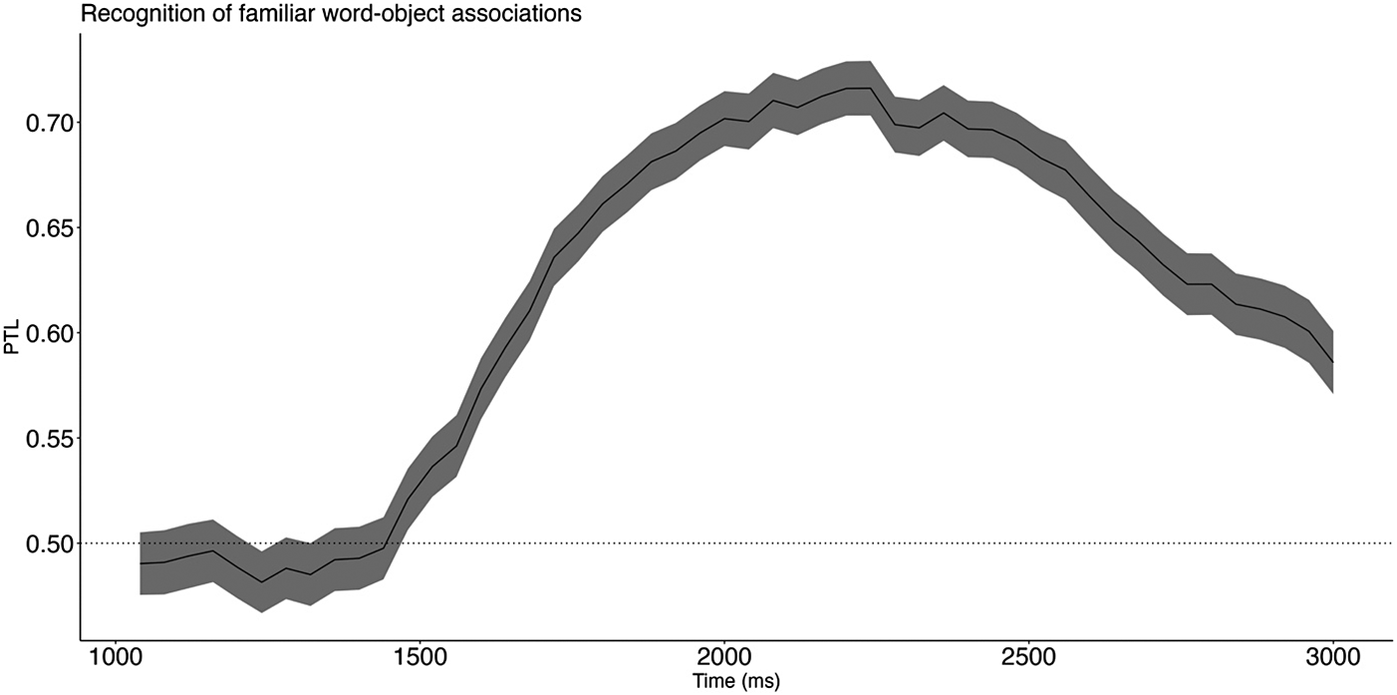
Children’s recognition of a familiar word–object association after the onset of the label at 1200 ms.

Figure 3. Long description
The x-axis represents Time in m s, ranging from 1000 to 3000. The y-axis represents P T L, ranging from 0.50 to 0.70. A horizontal dotted baseline is set at 0.50.
Data flow:
* From 1000 to 1450 m s, the P T L remains stable near the 0.50 baseline with minor fluctuations.
* At approximately 1500 m s, there is a sharp linear increase in P T L.
* The curve reaches a peak of approximately 0.72 P T L between 2000 and 2250 m s.
* After 2250 m s, the curve shows a steady decline, ending at approximately 0.58 P T L at the 3000 m s mark.
A dark gray shaded area surrounds the central black line, representing the margin of error or confidence interval, which maintains a consistent width throughout the time series.
3.2. Do children look more to familiar objects from categories they find interesting (excluding parental measures)?
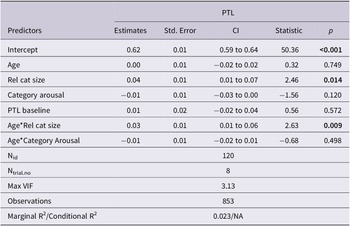
Next, we ran a model with PTL as the dependent variable and the predictors age in an interaction with relative category size and category arousal. Ptl.baseline was included outside of the interaction term. This model lacks the parental measures of curiosity and familiarity to increase the sample size by including children where these measures were not collected. The model revealed a significant effect on the intercept, β = .062, t = 50.36, p < 0.001, and a significant interaction of age*relative category size, β = .03, t = 2.63, p = 0.009 (see Table 3; Figure 4). A full-null model comparison of a model including all predictors relative to a model including only age, relative category size, and ptl.baseline without the interaction was significant (p = .033). Note that the measure of interest category arousal was not significant.
Parameter estimates, standard error, confidence intervals, statistic, and p-values for models including relative category size and category arousal across age

Table 3. Long description
The table presents data for the P T L outcome across six columns: Predictors, Estimates, Std. Error, C I, Statistic, and p.
* Intercept: Estimates 0.62, Std. Error 0.01, C I 0.59 to 0.64, Statistic 50.36, p less than 0.001.
* Age: Estimates 0.00, Std. Error 0.01, C I minus 0.02 to 0.02, Statistic 0.32, p 0.749.
* Rel cat size: Estimates 0.04, Std. Error 0.01, C I 0.01 to 0.07, Statistic 2.46, p 0.014.
* Category arousal: Estimates minus 0.01, Std. Error 0.01, C I minus 0.03 to 0.00, Statistic minus 1.56, p 0.120.
* P T L baseline: Estimates 0.01, Std. Error 0.02, C I minus 0.02 to 0.04, Statistic 0.56, p 0.572.
* Age times Rel cat size: Estimates 0.03, Std. Error 0.01, C I 0.01 to 0.06, Statistic 2.63, p 0.009.
* Age times Category Arousal: Estimates minus 0.01, Std. Error 0.01, C I minus 0.02 to 0.01, Statistic minus 0.68, p 0.498.
Summary statistics at the bottom include:
* N sub id: 120.
* N sub trial dot no: 8.
* Max V I F: 3.13.
* Observations: 853.
* Marginal R super 2 forward slash Conditional R super 2: 0.023 forward slash N A.
The significance level was set at α = .05.
Children’s recognition of a familiar word–object association after the onset of the label, split by relative category size and age as a factor (age was a continuous variable in the model).

Figure 4. Long description
The image consists of three side-by-side line graphs labeled 24, 30, and 36 at the top.
* Axes: The y-axis is labeled Baseline-corrected P T L and ranges from 0.4 to 0.8. A horizontal dotted line is at 0.5. The x-axis is labeled Time in m s and ranges from 1000 to 3000.
* Legend: A legend on the right indicates that yellow lines represent broad category size and blue lines represent narrow category size. Shaded areas around the lines indicate confidence intervals.
* Panel 24: Both lines start near 0.5. The broad category line rises earlier and higher, peaking around 2300 m s at approximately 0.75, while the narrow category peaks slightly later and lower at 0.7.
* Panel 30: Both categories show more fluctuation. The broad category rises steadily to peak at 2100 m s. The narrow category shows a sharp peak at 2100 m s, briefly exceeding the broad category before both decline.
* Panel 36: This panel shows the greatest divergence. The broad category rises sharply to a high peak of over 0.8 at 2100 m s. The narrow category rises more slowly and peaks significantly lower at approximately 0.7 around 2400 m s.
A model with absolute category size instead of relative category size revealed a main effect of age with target looking increasing across the age range tested, but no effect of category size or category arousal (see Supplementary Material). Thus, children’s familiar word recognition was stronger with higher age and larger relative category size, independent of category arousal. However, confirming the results from the previous section, interest did not significantly influence children’s target recognition (no support for hypothesis 1a), and accordingly, there was also no decrease in the influence of interest across age (no support for hypothesis 2).
3.3. Do children look faster to familiar objects from categories they find interesting?
A model with latency (i.e., time of children’s shifts from the distractor to the target image upon hearing the label) as the dependent variable and the predictors relative category size, category arousal, and parent-rated curiosity and familiarity revealed a significant effect at the intercept, β = 493.48, t = 17.76, p < 0.001, and a significant effect of category arousal, β = 47.39, t = 2.52, p = 0.012 (see Table 4). However, a full-null model comparison with the null model excluding all these predictors was not significant (p = 0.11). The maximal variance inflation factor (VIF) was high (>5), which means that estimates should be interpreted with caution. Thus, children’s speed to look at the target seemed to be independent of any predictors included in the model. On a solely descriptive level, children with higher category arousal (compared to children with lower category arousal) showed faster target recognition in distractor-first trials, but given the absence of a significant full-null model comparison, this effect cannot be interpreted as a significant contribution to the model.
Parameter estimates, standard error, confidence intervals, statistic, and p-values for a model including relative category size, category arousal, and parent-rated curiosity and familiarity

Table 4. Long description
The table presents statistical data for Latency across six columns: Predictors, Estimates, Std. Error, C I (Confidence Interval), Statistic, and p.
- Intercept: Estimates 493.48, Std. Error 27.79, C I 438.73 to 548.23, Statistic 17.76, p less than 0.001.
- Age: Estimates minus 45.43, Std. Error 26.80, C I minus 98.24 to 7.37, Statistic minus 1.70, p 0.091.
- Rel cat size: Estimates minus 47.68, Std. Error 54.04, C I minus 154.13 to 58.77, Statistic minus 0.88, p 0.378.
- Category arousal: Estimates 47.39, Std. Error 18.80, C I 10.34 to 84.43, Statistic 2.52, p 0.012.
- Curiosity: Estimates minus 12.73, Std. Error 19.89, C I minus 51.91 to 26.46, Statistic minus 0.64, p 0.523.
- Familiarity: Estimates 1.33, Std. Error 20.46, C I minus 38.99 to 41.64, Statistic 0.06, p 0.948.
- Age times Rel cat size: Estimates minus 17.80, Std. Error 43.66, C I minus 103.81 to 68.20, Statistic minus 0.41, p 0.684.
- Age times Category Arousal: Estimates minus 35.48, Std. Error 19.53, C I minus 73.95 to 2.99, Statistic minus 1.82, p 0.071.
- Age times Curiosity: Estimates minus 20.90, Std. Error 19.55, C I minus 59.40 to 17.61, Statistic minus 1.07, p 0.286.
- Age times Familiarity: Estimates 28.19, Std. Error 21.60, C I minus 14.35 to 70.74, Statistic 1.31, p 0.193.
Summary statistics at the bottom include:
- N sub id: 98.
- N sub trial.no: 8.
- Max V I F: 8.86.
- Observations: 252.
- Marginal R super 2 / Conditional R super 2: 0.099 / N A.
The significance level was set at α = .05.
A model with absolute category size instead of relative category size revealed a main effect of age, with speed increasing across the age range tested, and a significant effect of category arousal and no effect of category size (see Supplementary Material). Note that the full-null model comparison was significant, suggesting that category arousal, as a measure of children’s interest in a category, predicted target recognition. More specifically, children with higher interest in the target category (i.e., stronger pupillary arousal) showed faster recognition of familiar word–object associations compared to children with lower interest in the category, confirming hypothesis 1b. Thus, if we include absolute category size instead of relative category size, the effect of category arousal on children’s latency seems to increase.
3.4. Are there differences in latency between distractor-first and target-first trials?
Children’s accuracy to look to the correct object upon hearing the label is partly contingent on whether they look to the target or the distractor at the onset of the label. To consider this in evaluating children’s accuracy, we compared children’s looks from the distractor to the target and their looks from the target to the distractor (Fernald et al., Reference Fernald, Perfors and Marchman2006). A model with latency as the dependent variable and the predictors age and trial start revealed a significant effect of age, β = −59.81, t = −2.33, p = 0.02, and of trial start, β = 150.11, t = 3.95, p < 0.001 (see Table 5). A full-null model comparison with the null model lacking trial start was significant (p < 0.001). Older children were faster to look at an object across trial types compared to younger children (24 months: M = 635.84, SD = 438.39; 30 months: M = 563.74, SD = 417.05; 36 months: M = 479.54, SD = 364.49; note that age was continuous in the model), which confirms hypothesis 3. Furthermore, children across age were overall faster to look from the distractor to the target (M = 496.86, SD = 299.18) compared to when they looked from the target to the distractor (M = 659.88, SD = 531.81). Thus, children’s looks to the correct object seemed accurate across all ages tested.
Parameter estimates, standard error, confidence intervals, statistic, and p-values for the control model evaluating the effect of trial start on latency

Table 5. Long description
The table consists of six columns: Predictors, Estimates, Std. Error, C I, Statistic, and p.
Row 1: Intercept. Estimates 499.80, Std. Error 25.99, C I 448.73 to 550.88, Statistic 19.23, p less than 0.001.
Row 2: Age. Estimates minus 59.81, Std. Error 25.63, C I minus 110.18 to minus 9.44, Statistic minus 2.33, p 0.020.
Row 3: Trial start Target-first. Estimates 150.11, Std. Error 38.04, C I 75.35 to 224.88, Statistic 3.95, p less than 0.001.
Row 4: Age asterisk Trial start Target-first. Estimates minus 2.04, Std. Error 38.33, C I minus 77.37 to 73.30, Statistic minus 0.05, p 0.958.
Model Summary Statistics:
N sub id: 115.
N sub trial.no: 8.
Max V I F: 1.41.
Observations: 453.
Marginal R super 2 / Conditional R super 2: 0.058 / 0.141.
The significance level was set at α = .05.
4. Discussion
In the current study, we examined the extent to which children’s interest in different kinds of objects in their environment predicts children’s proportional target looking (as an index of overall word–object recognition) and children’s latency (as an index of speed of recognition). Two- to three-year-old children participated in a preferential looking paradigm where they saw two familiar objects from different categories (e.g., a mouse and pants) and heard the label for one of these objects while we examined their fixations to the labelled object. Our indices of children’s interest in the different categories were either their pupillary arousal upon being presented with familiar members of a category or parental ratings of their child’s interest in and familiarity with category members. Children regardless of age looked to the correct object upon hearing its label, thereby showing successful target recognition. Target recognition was higher when children had a higher relative category size for the target object, and this effect got more pronounced as age increased. Target recognition was independent of children’s interest in the category that the target object belonged to with regard to pupillary index of children’s interest and parent-rated curiosity and familiarity. Furthermore, children’s looks towards the target were relatively faster compared to looks towards the not labelled object, and children’s speed to recognize the target increased with age and relative category size. When using absolute category size instead of relative category size, age and category arousal were significant predictors of children’s familiar target recognition. Overall, these results suggest that by around 2 to 3 years of age, children’s recognition of highly familiar objects upon hearing their label is quick and robust and becomes more stable with age, and their interests with the category have at least a small influence on recognition.
The model on proportional target looking revealed that, across age, children looked more to the labelled object compared to the distractor object, and their target looking was above chance level, suggesting that they successfully recognized the correct familiar object upon hearing its label. These results are in line with many studies showing that children at 2 to 3 years reliably recognize familiar objects when hearing the label (Borovsky et al., Reference Borovsky, Ellis, Evans and Elman2016b; Fernald et al., Reference Fernald, Pinto, Swingley, Weinberg and McRoberts1998, Reference Fernald, Perfors and Marchman2006; Hurtado et al., Reference Hurtado, Marchman and Fernald2008; Swingley et al., Reference Swingley, Pinto and Fernald1999).
In addition, we evaluated whether a child’s interest in a category as measured via pupil dilation, and parental reports of their child’s curiosity in and familiarity with a category as rated predicted the robustness of word recognition. Neither the full-null model comparisons nor the models themselves did attest to any links between interest, age, and target recognition (no support for hypothesis 1a or hypothesis 2). Indeed, the parental data were skewed and only allowed analyses of a subset of the data where parent ratings were available, although the model still included data from 110 children. Also a study on different measures of interest suggests that the different measures of interest seem to show little coherence and therefore still need to be considered carefully (Madhavan et al., Reference Madhavan, Malem, Ackermann, Mundry and Mani2024). However, recent attempts to validate parental questionnaires of children’s curiosity seem promising as they suggest that parental ratings of their child’s individual interests may be able to capture some of the individual differences in children (Altmann et al., Reference Altmann, Bazhydai, Karadağ and Westermann2025; Altmann et al., Reference Altmann, de Boer, Eiteljoerge, Bazhydai, Meyer, Braithwaite, Bounia, Karadağ, Hunnius and Westermann2025).
Finally, we found an association between children’s word recognition and their vocabulary knowledge, with regard to the number of words they know related to the word to-be-recognized (Borovsky et al., Reference Borovsky, Ellis, Evans and Elman2016b; Borovsky & Peters, Reference Borovsky and Peters2019). Children showed higher target recognition when knowing relatively more words in a category. This effect disappeared when entering absolute category size in the model. In this case, only age proved to be significant with older children showing higher target recognition. In these two models, relative and absolute category size might tap into different aspects of children’s knowledge: Relative category size reflects the density of the child’s semantic network by capturing the interconnectivity among known words because it reflects the proportion of words they know within a category relative to its total possible size (here defined by the researcher). A higher relative category size then indicates a denser network where the child knows many or even all category members. Absolute category size reflects how many members the child actually knows (and thereby also considers that more animals than clothes items could potentially be known) but provides no information about the connection between items in that category. Children’s higher target recognition might benefit from semantic leverage in dense categories (i.e., categories where children know relatively more category members) where close semantic connections can support word recognition by co-activation of category neighbours (Borovsky et al., Reference Borovsky, Ellis, Evans and Elman2016a). This density is not reflected in absolute category size, which might explain the absence of any significant effect of category size in the second model. The analyses further suggest that age is the most robust predictor of increased target looking across models, likely capturing additional variance not captured by the current predictors.
The latency analyses revealed that children were quick to fixate the target object upon hearing its label and speed of recognition increased with age (support for hypothesis 3). As expected, children were faster to switch from the distractor to the target image upon hearing the target label compared to the latency of switches from targets to distractors. This is in keeping with previous findings that children from as early as 15 months of age show a similar pattern of results, that is, switch faster from distractor to the target image relative to switches from the target to the distractor image (Fernald et al., Reference Fernald, Pinto, Swingley, Weinberg and McRoberts1998; Peter et al., Reference Peter, Durrant, Jessop, Bidgood, Pine and Rowland2019, among others). Furthermore, latency was independent of their relative category size. However, when running the same model with absolute category size, we found that children’s speed of recognition was influenced by their interest, as measured in the category arousal phase, and their age (support for hypothesis 1b). The interaction of category arousal and age was not significant (p = 0.071), Thus, when the density of a category is not taken into account but rather children’s overall knowledge of a category, their heightened interest in a category relates to faster recognition of a member of that category.
Taken together, our results suggest an association between children’s category-specific density and their target recognition but not their speed of recognition. Our findings, therefore, show the opposite pattern of results reported by Borovsky et al. (Reference Borovsky, Ellis, Evans and Elman2016a), who showed that relative category size did not influence overall target fixations (as indexed by the proportion of target looking measure) but did influence the speed of target recognition. It might be that these effects are still strong around 24 months if children have high variance in category sizes. In the current study, knowledge of the categories was relatively high, and thus, the little amount of variance in the data might have led to the absence of any significant interactions in the latency analysis. Nonetheless, taking both studies together, our findings suggest that a child’s vocabulary knowledge in a relevant category can impact both the accuracy and speed of target recognition, albeit under specific circumstances. This highlights the complex interplay between vocabulary development and cognitive processes and underscores the need for further research to evaluate under which conditions a child’s prior word knowledge influences their processing of language.
Across measures and models, we find a small influence of children’s interest in a category on their familiar target recognition. While children’s proportional target looking was independent of the different interest measures, their influence on the speed with which children looked towards the labelled object was mixed. Parent-rated interest did not contribute significantly to any of the models. Parental perception of interest may be more related to how long children occupy themselves with specific objects and how actively they engage with such objects and less with the immediate recognition of labelled objects (see also Madhavan et al., Reference Madhavan, Malem, Ackermann, Mundry and Mani2024). The speed of word recognition was significantly predicted by children’s interest in the category as indexed by increased pupil dilation towards members of the same category. However, this effect was only apparent in a model that included absolute instead of relative category size. Thus, when considering children’s overall knowledge of a category, they looked faster to an object that belonged to a category they found interesting.
Indeed, the current results reveal subtle differences in the role of interest when comparing familiar word recognition and novel word learning: Ackermann et al. (Reference Ackermann, Hepach and Mani2020, Reference Ackermann, Förster, Schaarschmidt, Hepach, Mani and Eiteljoerge202 Reference Ackermann, Hepach and Mani4) found that novel word learning and retention were associated with the child’s interest in a category with children showing better word learning and retention for objects that belong to categories they are interested in, as indexed by their pupillary response to category members and parental ratings of their child’s interest in that category. For word recognition, we did not find any association between the category-specific pupillary response and familiar word recognition, nor did we find evidence for parental ratings of category interest and word recognition. The only influence related to children’s interest was that they fixated the target faster when it belonged to a category the found interesting and when their absolute category size was considered. This might reflect that familiar word knowledge is already well structured and embedded in their lexicon (e.g., Gobbo & Chi, Reference Gobbo and Chi1986) and easy to access without much influence from other factors. Yet, they might orient faster towards a member of a category they find interesting.
The measures of interest and curiosity are still developing in the research community. In their comprehensive analysis, Madhavan et al. (Reference Madhavan, Malem, Ackermann, Mundry and Mani2024) took four measures of interest, that is, parent-rated interest, children’s explicit choice, their looking behaviour towards objects from different categories, and their pupil dilation when looking at these objects. They found weak correlations of parent-rated category size and interest and children’s looking times. Also in the previous studies, Ackermann et al. (Reference Ackermann, Hepach and Mani2020, Reference Ackermann, Förster, Schaarschmidt, Hepach, Mani and Eiteljoerge202 Reference Ackermann, Hepach and Mani4) found only some of the interest measures to be correlated (e.g., object arousal and category arousal were correlated, but parent-rated curiosity was not correlated with the pupil measures). Recent advances in measuring children’s curiosity will hopefully help to identify reliable online measures of children’s curiosity and interests (Altmann et al., Reference Altmann, Bazhydai, Karadağ and Westermann2025).
Thus, early in development, we find some evidence for an influence of interest on the speed of children’s familiar word recognition, when considering children’s overall knowledge of a category. At the same time, familiar target recognition is robust and not influenced by children’s interests. These results complement findings later in development that individual interests may modulate performance in tasks such as reading comprehension (Hidi & Baird, Reference Hidi and Baird1988), attention (Hidi, Reference Hidi1995), recognition, and recall (Renninger & Wozniak, Reference Renninger and Wozniak1985), as well as findings relating interest early in development to learning (Ackermann et al., Reference Ackermann, Hepach and Mani2020, Reference Ackermann, Förster, Schaarschmidt, Hepach, Mani and Eiteljoerge202 Reference Ackermann, Hepach and Mani4). A child’s interests might influence what (and how well) the child wants to learn and support and boost the process of learning and retention. Furthermore, a child’s interests might spark their curiosity about novel items of a category. Once the child has acquired the relevant knowledge, however, the resulting word–object associations appear to be accessible regardless of the child’s interest. Nevertheless, targets that align with a child’s interests continue to capture attention more rapidly than less engaging alternatives. Taken together, these findings suggest that interest plays a central role in exploration, learning, and retention, while its influence becomes less pronounced as knowledge representations consolidate.
Supplementary material
The supplementary material for this article can be found at http://doi.org/10.1017/S0305000926100713.
Acknowledgements
We thank the families and their children for participating in the study and Meike Förster and Juliane Schaarschmidt for their help with data acquisition.
Financial support
This research was funded by the Deutsche Forschungsgemeinschaft (DFG, German Research Foundation) – GRK2906 – project number 502807174. Furthermore, this research was supported by the Leibniz ScienceCampus “Primate Cognition.”
Competing interests
The authors declare no competing interest.




 Open access

