In recent years in studies on peer status, the focus has shifted from low status to also examining high social status. One reason for the interest in high status among peers is that high status adolescents can influence others to engage in health risk behaviours such as smoking and underage drinking (see, e.g., Gerrard, Gibbons, Reis-Bergan, Trudeau, Vande Lune, & Buunk, Reference Gerrard, Gibbons, Reis-Bergan, Trudeau, Vande Lune and Buunk2002; Mayeux, Sandstrom, & Cillessen, Reference Mayeux, Sandstrom and Cillessen2008). In one study on peer influence by high status adolescents, Cohen and Prinstein (Reference Cohen and Prinstein2006) found that adolescent boys imitated a peer's aggressive and risk-taking attitudes when the peer was high in status. Imitation of the high status peer was both public and private, and extended to actual exclusion behaviour, indicating that high status adolescents can change the attitudes and behaviours of their peers. The current study examined whether high status peers are also the most influential peers in emerging adulthood.
Previous research in social and developmental psychology has mainly focused on the status of the influencer as a determinant of conformity and influence. For example, individuals high (versus low) in status are generally more likely to induce emotional convergence (Anderson, Keltner, & John, Reference Anderson, Keltner and John2003), mimicry (Cheng & Chartrand, Reference Cheng and Chartrand2003; Lakin, Chartrand, & Arkin, Reference Lakin, Chartrand and Arkin2008), and conformity to risky health attitudes (Cohen & Prinstein, Reference Cohen and Prinstein2006) in others. Compliance to high status others may be driven by a need to adhere to the group norm and a need for a positive self-concept. Individuals’ behaviour is often guided by social norms, especially during times of uncertainty (Cialdini, Reference Cialdini2001). The norms of a high status subgroup may be even more visible and important in times of uncertainty than the norms of a low status group. People also have a strong need to preserve their self-concept by behaving consistently with their actions, statements, commitments, beliefs, and self-ascribed traits (Cialdini & Trost Reference Cialdini, Trost, Gilbert, Fiske and Lindzey1998). They may believe they are more similar to high status others than low status others and consequently align their behaviour more with the behaviour of high status others.
However, there are multiple ways to have high status. In research on status in peer groups, popularity and likeability are often distinguished as separate status constructs. Popularity is a reputational measure of status, visibility, and impact in the group, derived from direct judgments of popularity. Likeability indicates peer acceptance derived from affective judgments of liking (Cillessen & Marks, Reference Cillessen, Marks, Cillessen, Schwartz and Mayeux2011; Cillessen & Rose, Reference Cillessen and Rose2005). Research has shown that popularity and preference are moderately correlated in adolescence (Cillessen & Mayeux, Reference Cillessen and Mayeux2004; Parkhurst & Hopmeyer, Reference Parkhurst and Hopmeyer1998; Rose, Swenson, & Waller, Reference Rose, Swenson and Waller2004) and emerging adulthood (Lansu & Cillessen, Reference Lansu and Cillessen2012). The distinction is in line with goal theories that describe belonging and acceptance as being different from power and influence (Bakan, Reference Bakan1966; McAdams, Reference McAdams1985; McClelland, Reference McClelland1985). Therefore, the first goal of this study was to separate the effects of popularity and likeability on the peer influence process.
The second goal of this study was to examine peer influence as a dyadic process that depends on characteristics of both the influencer and the person being influenced (the influencee). The effect of one person on another depends on characteristics of both (Hartup, Reference Hartup2005). Influence is most likely to occur when one person scores high on influence factors and the other scores high on susceptibility. A careful examination of the peer influence process should take both sides into account. Our expectations regarding the research goals were that high popularity is an influencer characteristic associated with influence. On the influencee side we expected low status and low self-esteem to be associated with susceptibility to peer influence by a popular peer. Below we explain the rationale behind these expectations.
Influencer Popularity
With respect to influencer characteristics, high status group members are particularly interesting to bond with and thus to conform to. They have access to group resources, and one's own status could improve by being associated with them. Cohen and Prinstein (Reference Cohen and Prinstein2006) indeed found that high status adolescents (who were liked and/or popular) were more influential than low status adolescents. However, when examining the power of social status we should distinguish status based on likeability from status based on prominence or prestige. As popularity is a dimension of power, prestige, or visibility in the peer group, popularity is thus conceptually more closely related to influence than is preference (Sandstrom, Reference Sandstrom, Cillessen, Schwartz and Mayeux2011). On the influencer side, we therefore expect that the locus of peer influence is more likely to reside with high status ‘popular’ peers than with high status ‘likeable’ peers.
This expectation is supported by numerous research findings. A cluster comparison of popular and preferred youth, for example, showed that popular students were indeed perceived as having more social control than preferred students (Lease, Musgrove, & Axelrod, Reference Lease, Musgrove and Axelrod2002). In emerging adulthood, popularity was positively related to getting attention and being central and dominant, whereas preference was not (Lansu & Cillessen, Reference Lansu and Cillessen2012). Moreover, a study determining high status based on likeability found no effects of influencer likeability on peer influence in alcohol consumption among young adults (Bot, Engels, Knibbe, & Meeus, Reference Bot, Engels, Knibbe and Meeus2005).
Influencee Low Status and Low Self-Esteem
The social status of the person being influenced might also affect the peer influence process. It has been shown that adolescents who felt unaccepted by their peers were more likely to adopt the risk behaviours of peers (Prinstein, Boergers, & Spirito, Reference Prinstein, Boergers and Spirito2001). Studies with young adults have also shown that individuals’ mimicry increased after social exclusion (e.g., Lakin & Chartrand, Reference Lakin, Chartrand, Williams, Forgas and von Hippel2005; Lakin et al., Reference Lakin, Chartrand and Arkin2008). Specifically, Anderson, Keltner, and John (Reference Anderson, Keltner and John2003) showed that lower social status students adjusted more to the emotional convergence process of their higher status roommate than vice versa. Cheng and Chartrand (Reference Cheng and Chartrand2003) demonstrated that people who are concerned with their social appearance are more likely to imitate a powerful peer than a relatively powerless peer. Lakin et al. (Reference Lakin, Chartrand and Arkin2008) found that excluded group members are particularly likely to imitate an included rather than an excluded group member.
As behavioural mimicry increases liking by an interaction partner (Chartrand & Bargh, Reference Chartrand and Bargh1999), individuals with low social status who are excluded from a group may use it as a strategy to bond with other group members. This increased liking may then help them improve their position in the group. Therefore, we expected low status group members to be especially likely to mimic the behaviour of influential others. In this study we examined how participants’ own status (popularity as well as likeability) might affect their susceptibility to peer influence by popular peers. As group members who are excluded are often unpreferred and unpopular (Bellmore, Reference Bellmore2011; de Bruyn, Cillessen, & Wissink, Reference de Bruyn, Cillessen and Wissink2010), we expected unpreferred and unpopular students to be more influenced by high status peers than high status students.
Self-esteem may also affect the degree to which a person is susceptible to the influence of others. Self-esteem and trust in one's own abilities are expected to affect students’ tendency to imitate peers. As with anxious students (Cohen & Prinstein, Reference Cohen and Prinstein2006), students who lack confidence in their own skills and judgments may be likely to follow a peer. Students who are both low in peer group status and lack self-esteem may be especially susceptible to peer influence. Thus, we expected to find interactions of peer group status (popularity, preference) with self-esteem in the prediction of susceptibility to peer influence.
‘Popular’ Behaviour
The third goal of this study was to examine the effect of popularity on mundane behaviours that are unrelated to status but that may demonstrate the implicit and pervasive appeal of popularity. Previous research on the role of status in peer influence has focused on low frequency behaviours that play a role in status acquisition or maintenance, such as aggression or risk taking (Mayeux et al., Reference Mayeux, Sandstrom and Cillessen2008; Prinstein, Meade, & Cohen, Reference Prinstein, Meade and Cohen2003). Popular students may model these behaviours to peers and, as a result, their peers may see these behaviours as acceptable and normative. When popular adolescents engage in aggression or risk behaviours, or express positive attitudes about such behaviours, others are likely to copy their behaviour and attitudes (Cohen & Prinstein, Reference Cohen and Prinstein2006; Teunissen et al., Reference Teunissen, Spijkerman, Prinstein, Cohen, Engels and Scholte2012). In the domain of risk taking, popular peers clearly seem to be more influential than less popular peers (Teunissen et al., Reference Teunissen, Spijkerman, Prinstein, Cohen, Engels and Scholte2012). A question is whether their influence is limited to deviant behaviours or extends to normative behaviours. Studies on mimicry have shown that power or group position are related to conformity to others, suggesting a more general process of influence associated with status or position in the group. However, such influence effects have not yet been examined while distinguishing between status based on likeability and status based on power. Further, previous studies have rarely taken multiple characteristics of both the influencer and influencee into account.
It is possible that individuals only imitate the behaviours of popular peers that they believe predicted their popular status. Imitation may also be a more general process and the ‘influence potential’ of popular individuals more pervasive. Therefore, we examined neutral behaviours that do not have an inherent association with popularity. The main dependent variable was performance in an estimation task, a behaviour that has no bearing on popularity. The extent to which popular peers are imitated on such neutral tasks indicates a fundamental quality of influence potential that is not limited to ‘popular behaviours’ such as drinking or drug use.
Gender
Previous work on susceptibility to peer influence by popular peers has mainly examined all-male samples (e.g., Cohen & Prinstein, Reference Cohen and Prinstein2006; Teunissen et al., Reference Teunissen, Spijkerman, Prinstein, Cohen, Engels and Scholte2012) or mixed gender samples (e.g., Choukas-Bradley, Giletta, Widman, Cohen, & Prinstein, Reference Choukas-Bradley, Giletta, Widman, Cohen and Prinstein2014). There is one study on the role of influencer popularity in social influence on (un)healthy eating in girls (Rancourt, Choukas-Bradley, Cohen, & Prinstein, Reference Rancourt, Choukas-Bradley, Cohen and Prinstein2014), but relatively little is known about the role of popularity in social influence among girls. Understanding of social influence processes among girls and young women is as important as understanding these processes among boys and young men. The current study hopes to contribute to the understudied field of social influence among girls and women, and the field of social influence by popular peers in particular.
Current Study
This study examined the effects of influencer and influencee characteristics on emerging adults’ responses to a popular peer. The first goal was to separate the effects of popularity and likeability in the peer influence process. The second goal was to examine peer influence as a dyadic process that depends on characteristics of both the influencer and the influencee. The third goal was to examine these peer influence processes with regard to mundane behaviour in itself unrelated to social status. Participants were young women in a professional college, where peer influence processes are common. They were exposed to experimentally manipulated models who were equally likeable, but differed in popularity. Participants’ own popularity, preference, and self-esteem were measured in advance so that their effects could also be examined. A number-estimation paradigm assessed the effects of popularity on status-unrelated behaviour. Participants estimated the number of dots on a computer screen after they had seen the estimates of popular and average models. Comparisons of participants’ answers to those of the models showed the degree to which they imitated the popular model. Participants also chose one of the models as a future task partner.
Method
Participants
Participants were undergraduate students majoring in arts therapy at a professional college in the Netherlands. In phase 1 of the study, 235 students (M age = 20.5, SD = 2.1) completed sociometric and self-report questions in their classrooms at the college. The students comprised 206 women and 29 men. In phase 2, a subsample of 76 students (67 women, 9 men, M age = 20.5, SD = 1.9) participated in an experimental task in the laboratory at the research institute. Participants in both samples were primarily Caucasian and from lower-middle and middle-class backgrounds.
Classroom Assessment
Procedure
Permission for the classroom assessment was obtained from the professional college. The students in this college spend most of their time in classroom groups with a fixed set of peers. The teachers from 25 classrooms participated, including 296 students, of whom 235 were present and consented to participate on the day of testing. All participants were 18 or older. The questionnaire distributed in the classrooms included a sociometric part and a self-report part.
Preference and popularity
The sociometric questionnaire included 20 questions about peer affiliations and social behaviour. Sociometric nomination methods have been used extensively to measure peer relationships and social status among peers in particular. In most cases, peer nomination procedures are used because of their high reliability and validity (Cillessen & Marks, Reference Cillessen, Marks, Cillessen, Schwartz and Mayeux2011; Terry, Reference Terry2000). Because students spent most of their time with the same classroom peers and knew each other well, classroom was the reference group. Average classroom size was 13 students (range 6–15). The average participation rate was 79% across classrooms. Unlimited sociometric nominations were used; participants could name as many or as few classmates as they wanted for each question.
Students were asked to name their classroom peers whom they thought were most popular, least popular, liked the most, and liked the least. Nominations received were counted for each question and standardised within classrooms. Popularity was computed as the difference between the standardised numbers of most popular and least popular nominations received, again standardising the resulting difference scores within classrooms. Preference was computed as the difference between the standardised numbers of liked most and liked least nominations received, and again standardising the resulting difference scores within classrooms.
State self-esteem
The self-report questionnaire included a three-item scale for state self-esteem: ‘I have a positive view about myself at this moment’, ‘I have a bad feeling about myself at this moment’ (reverse scored), and ‘I am satisfied with myself at this moment’. Participants rated how much each item applied to them on a 7-point scale (1 = not at all; 7 = very much). Cronbach's α was .84.
Experimental Task
Procedure
At the end of the classroom survey, participants could agree to be contacted for a follow-up study and provide contact information; 195 students did so. They received an e-mail invitation for a laboratory study on ‘judgment and decision making’ in which they could win a prize (an iPod). The true nature of the experiment was not revealed at this time. The prize was used in the final task of the experiment (see below).
Of the 195 students who received the invitation, 76 came to the lab. This sample did not differ significantly from the classroom sample in terms of gender, preference, popularity, or self-esteem. In the lab, these participants completed the experiment on a computer in a private cubicle. The experiment included five steps: popularity manipulation, imitation task, model peer ratings (including a manipulation check), choice task, and final task.
Popularity manipulation
The opening computer screen stated that previous participants had found the upcoming tasks challenging. Therefore, answers from two students (A and B) would always be shown as an aid throughout the experiment. The participants were asked to pay attention to these examples.
The first task for the participants was to briefly describe their social lives. They were presented with example descriptions that students A and B gave about their social lives, in which popularity was manipulated. Student A or B was described as popular (popular model) and the other student as average in popularity (average model), but the term ‘popularity’ was never used. The popular peer was described as someone who likes to organise parties, enjoys mingling at social events, and enjoys hanging out on campus with many acquaintances. The average peer had a few good friends but no extensive social life and thought that was fine. This person liked to socialise with a few people, but did not care for big parties. The pairing of popularity status with models A or B was counterbalanced throughout the experiment.
Great care was taken to make sure that the models appeared equally likeable, so that the popularity manipulation was not confounded with preference. Great care was also taken to make the descriptions gender neutral. It was not possible to identify the model peer as male of female. A pretest among a small independent sample of college students demonstrated that the model descriptions were indeed gender neutral, and differed in popularity, but not in likeability. The manipulation check built into the actual experiment (see below) confirmed this.
To make sure that participants remembered the descriptions of the model peers after they had described their own social lives, a memory test was used. In this test, five characteristics of students A and B were presented in a random order. For each characteristic, participants indicated whether they thought it belonged to A or B. After each response, the computer indicated whether or not the answer was correct. This gave the participants immediate feedback and the opportunity to adjust possible mismatches in memory.
Imitation task
In six trials, participants were asked to estimate the number of dots in a complex pattern displayed for 5 seconds. After the 5 seconds the dots disappeared, and the participants had to make a guess while the example estimates by A and B were visible. Each trial had more dots than could be counted in 5 seconds. Trial 1 had 19 dots and got the participants used to the procedure. In trials 2 to 6, the number of dots gradually increased from 19 to 123. In each trial, the absolute difference between the estimates of A and B and the actual number was identical: one model overestimated the same number as the other model underestimated. For example, if the actual number of dots was 64, the popular peer estimated 74, and the average peer estimated 54. To make this pattern harder to detect, in one trial one model overestimated one dot more than the other underestimated, and in another trial one model underestimated one dot more than the other overestimated. Over- or underestimation and popularity status were counterbalanced.
Imitation of the popular peer was scored as a proportion that indicated to what degree a participant answered in the direction of the popular peer's estimate. A positive score indicated that the participant answered in the direction of the popular peer. A negative score indicated that the participant answered in the direction of the average peer. Proportions were computed because the number of dots and deviations varied per trial.
Imitation of the popular peer was the proportional deviation of a participant's estimate from the actual number divided by the popular peer's deviation from the actual number. A participant who guessed 67 in the above example received a popularity imitation score of (67 − 64) / (74 − 64) or .30. This participant went 30% from the accurate answer into the direction of the popular peer. A participant who guessed 63 received a score of (63 − 64) / (74 − 64) or −.10. This participant went 10% from the accurate answer in the direction of the average peer, away from the popular peer. The final popularity imitation score was the mean of the scores in trials 2 to 6.
Model peer ratings
Next, participants rated each peer on three characteristics: well-liked, popular, and intelligent. All ratings were on a 7-point scale (1 = not at all, 7 = very much).
Partner choice
Participants were then asked to choose one of the two models as their partner for a final task in which they could win the announced prize. Participants were told that their success would depend on the performance of their partner. In order to win, both participants should perform well. Details of the task were not yet given. After participants chose peer A or peer B, they rated on a 7-point scale (1 = not at all, 7 = very much) how sure they were of their choice and how satisfied they were with it.
Final task
The computer then indicated that this was the end of the individual test and that the participant could return to the reception area. There, they were asked to guess the number of grains in a jar as the final task. To keep up with the cover story, they were told that their estimate would be averaged with the one from the peer they had chosen, and that the couple that was closest to the actual number would win the prize. The participants made their own guess of the number of grains. They were then thanked for their participation.
After all participants completed the study, they were debriefed with an e-mail message that explained the actual goal of the study and indicated that the prize would in fact be based on each participant's individual grain guess in the final task. The participant whose guess was the closest to the actual number of grains in the jar received the prize.
Results
Data Check
The data were checked for outliers. None were present for the variables included in the analyses, and thus no data-points were removed or recoded.
Manipulation Check
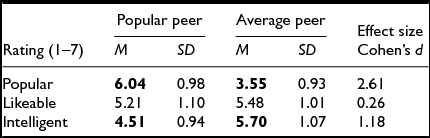
All analyses were conducted using IBM SPSS, including only the female participants; the number of men was too small for gender comparisons. To check the popularity manipulation, the popular and average models were compared on the model ratings with paired t tests (see Table 1). Participants rated the popular peer as more popular but less intelligent than the average peer, consistent with earlier findings (LaFontana & Cillessen, Reference LaFontana and Cillessen1998). As intended, the models did not differ in likeability.
Manipulation Check Ratings of Popular and Average Model Peers

Note: N = 67. Means that are in bold type differed significantly in a paired comparison test.
Effects of Model Popularity
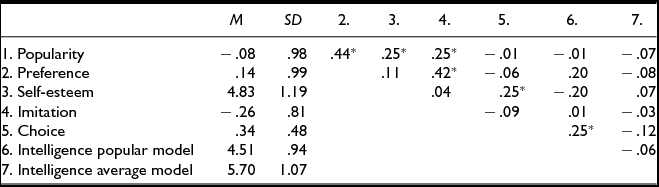
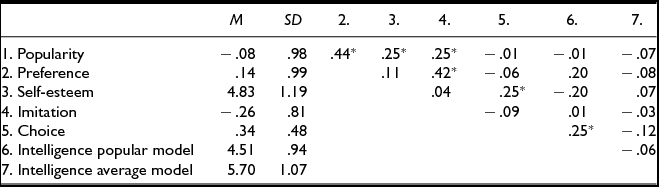
Table 2 shows that when computing bivariate correlations, participants’ popularity correlated positively with their preference and self-esteem. Popularity and preference of the participants also correlated positively with imitation of the popular model. Participants’ self-esteem and the perceived intelligence of the popular model correlated positively with the choice of this person as a task partner.
Means, Standard Deviations, and Correlations of Participant Characteristics, Influence Measures, and Participants’ Ratings of the Models’ Intelligence
Note: 65 ≤ N ≤ 67; *p < .05.
To test the association between model popularity and choice of a task partner, a one-way chi-square test was conducted. There was a significant association between model popularity and choice, χ²(1, 66) = 5.98, p = .014. More participants choose the average peer (66%) than the popular peer (34%) as their task partner.
The average imitation of the popular peer was −.26, which differed significantly from zero, t(66) = −2.61, p = .011, in a one-sample t test. This indicates that participants imitated the average model rather than the popular model. On average, they answered 26% away from the accurate answer in the direction of the average peer.
Thus, participants chose the popular peer less often as a work partner than the average peer. They were also less likely to imitate the guesses of the popular peer than those of the average peer.
Effects of Popularity, Preference, and Self-esteem on Choice
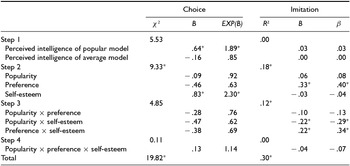
The effects of participants’ popularity, preference, and self-esteem on choice (a dichotomous variable) were examined in a hierarchical logistic regression analysis. Because participants perceived average peers as smarter than popular peers, and perceived intelligence might play a role in task partner choice, the intelligence ratings of both models were included in the analysis. As indicated by the hypotheses, the interactions of popularity, preference, and self-esteem were also tested. The perceived intelligence of the popular and average models was included in Step 1. Step 2 included the main effects of popularity, preference, and self-esteem. The two-way interactions were entered in Step 3 and the three-way interaction in Step 4.
Table 3 shows the results. The overall model was significant. The perceived intelligence of the popular model significantly and positively predicted choice of this peer. A 1-unit increase in perceived intelligence predicted a 1.89 times increase of the odds of choosing the popular peer. Participants were more likely to choose the popular peer as a task partner when they thought this person was smart.
Results from Hierarchical Logistic and Linear Regression Analyses Predicting Choice and Imitation from Participants’ Popularity, Preference, and Self-Esteem

Note: N = 67, * p < .05. All predictors were centered.
Self-esteem also significantly and positively predicted choice of the popular model. A 1-unit increase in self-esteem predicted a 2.30 times increase of the odds of choosing the popular peer. Participants with higher self-esteem were more likely to choose the popular peer as a task partner.
Effects of Popularity, Preference, and Self-Esteem on Imitation
To examine the effects of popularity, preference, and self-esteem on imitation, a hierarchical linear regression was run. As before, the perceived intelligence of the popular and average models was included in Step 1. Step 2 included the main effects of popularity, preference, and self-esteem. The two-way interactions were entered in Step 3 and the three-way interaction in Step 4. The results are shown in Table 3.
The model explained 30% of the variance in imitation. The perceived intelligence of the models did not predict imitation (Step 1). Step 2 explained 18% of the variance and yielded a significant effect of preference. More preferred participants were more likely to imitate the popular peer. Step 3 explained an additional 12% of the variance. The interactions of self-esteem with popularity and preference were significant and plotted following Aiken and West (Reference Aiken and West1991). An imitation score of zero indicates that the participants’ estimates were not influenced by model status. Scores above zero indicate an estimate in the direction of the popular peer. Scores below zero indicate an estimate in the direction of the average peer.
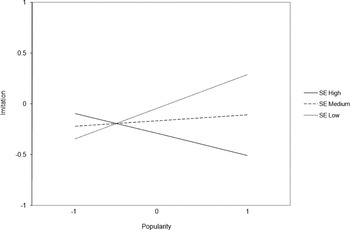
Figure 1 shows the moderator effect of self-esteem on the association between popularity and imitation of the popular peer. The main effect of popularity was not significant but an effect emerged when self-esteem was taken into account. At low levels of popularity, imitation was somewhat in the direction of the average peer and not affected by self-esteem. At high levels of popularity, imitation was affected by self-esteem. Students who were popular and had high self-esteem were not likely to imitate another popular peer. Students who were popular but had low self-esteem did imitate the popular peer.
Self-esteem moderates the effect of popularity on imitation.

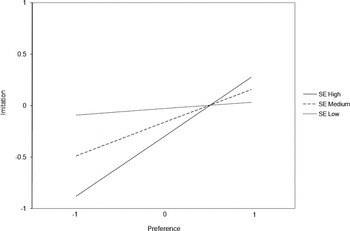
Figure 2 shows the moderating effect of self-esteem on the association between preference and imitation of a popular peer. The overall effect of preference on imitation of the popular peer was positive. Unpreferred students moved in the direction of the average peer and away from the popular peer. This effect was further qualified by self-esteem. At high levels of preference, imitation was not affected by self-esteem. At low levels of preference, self-esteem made a difference. Students who were not preferred and had high self-esteem were very likely to imitate the average peer and very unlikely to imitate the popular peer. Students who were not preferred and low in self-esteem were not influenced by the status of the model peer.
Self-esteem moderates the effect of preference on imitation.

Discussion
Although it is often assumed that popular individuals have influence, the demonstration of this effect is limited in three ways. First, while peer influence effects have frequently been assessed in quasi-experimental and correlational designs, only a few experimental demonstrations exist. Second, in the experimental studies that do exist, popularity and likeability as two forms of status were not separated. Third, the effect of high status has been examined primarily on status-related behaviours. A similar effect on behaviours not immediately related to status would show that the influence of high status peers is not due to the attractiveness of their behaviours, but due to a more fundamental process triggered by status itself. The current study addressed these understudied topics in a sample of emerging adults.
Effects of Model Popularity
As hypothesised, model popularity significantly influenced imitation and choice. Interestingly, this effect was negative rather than positive. Describing a model as popular decreased the imitation and choice of this person. This contrasts with studies showing that (health risk) attitudes and behaviours of high status adolescents are imitated (e.g., Cohen & Prinstein, Reference Cohen and Prinstein2006; Prinstein, Reference Prinstein2007; Rancourt et al., Reference Rancourt, Choukas-Bradley, Cohen and Prinstein2014; Teunissen et al., Reference Teunissen, Spijkerman, Prinstein, Cohen, Engels and Scholte2012). There are several possible explanations for this difference.
First, the positive influence effect of popularity in previous studies may have been driven by the likeability of the model. Individuals are particularly influenced by others they like, accept, and prefer (Cialdini, Reference Cialdini2001). Popular peers may be intimidating, as popular youth are likely to use relational and even physical aggression (Adler & Adler, Reference Adler and Adler1998; Cillessen & Borch, Reference Cillessen and Borch2006; Merten, Reference Merten1997), and to exclude and bully (Lease, Kennedy & Axelrod, Reference Lease, Kennedy and Axelrod2002). It may simply be ‘safer’ to stay away from dominant and high status peers, especially when they are unknown.
Second, the negative effect of peer popularity may have been due to the status-neutral nature of the behaviour in the current study. It is possible that our participants would have been positively influenced by a popular peer if the behaviour of that peer was related to status, such as risk-taking, smoking, and drinking, as in previous studies (e.g. Cohen & Prinstein, Reference Cohen and Prinstein2006; Teunissen et al., Reference Teunissen, Spijkerman, Prinstein, Cohen, Engels and Scholte2012). Perhaps students only follow the lead of a high-status peer when they believe this person has expertise in the behaviour under consideration. Because of the perceived association between health risk behaviours and popularity (Gerrard et al., Reference Gerrard, Gibbons, Reis-Bergan, Trudeau, Vande Lune and Buunk2002; Gibbons & Gerrard, Reference Gibbons and Gerrard1997), students may view popular peers as experts in these behaviours. This may explain why they would follow their lead on these behaviours but not on behaviours that have no inherent association with popularity, such as number estimation.
Third, the discrepancy may be explained by developmental changes in the importance attached to popularity. The perceived importance of popularity increases with age until early adolescence, and then decreases again after that (LaFontana & Cillessen, Reference LaFontana and Cillessen2010). Popularity thus might have been less desirable for the emerging adult women in the current study than for the (early) adolescent boys in middle and high schools in previous studies. If the current participants were less motivated to achieve popularity and even disapproved of it to some extent, this may explain the negative effect of popularity. The question then is whether this effect would be replicated for status-unrelated behaviours in other age groups and when controlling for likeability. In any event, it is too simple to assume that the influence effect of popularity is always positive.
Effects of Actor Popularity, Preference, and Self-Esteem on Imitation and Choice
Characteristics of the participants themselves also affected the influence process. Preferred participants were more susceptible to popular influence, which was further moderated by self-esteem. Self-esteem was strongly negatively related to imitation of the popular peer for unpreferred participants, but not for preferred participants. Unpreferred young women with high self-esteem in particular imitated the average rather than the popular peer.
Similar to Mayeux and colleagues (Reference Mayeux, Sandstrom and Cillessen2008), we found no direct association between own popularity and peer imitation. However, participants’ popularity predicted their susceptibility to popular peers once self-esteem was taken into account. Popular women with high self-esteem did not imitate the popular peer, but popular women with low self-esteem were quite likely to do so. Thus, self-esteem modulated the effect of an individual's own social standing on peer influence. Self-esteem affected imitation by high status (popular) as well as low status (unpreferred) women. Popular young women with low self-esteem were the most likely of all to follow the popular peer. It is possible that insecure popular young women want to affiliate with another popular person to confirm their status, whereas popular young women who are self-secure do not need such affirmation. Unpreferred young women with high self-esteem were the least likely of all participants to follow the popular peer. These unpreferred but confident young women may be aware of their outcast position and derive a new status from it. This might explain why they indirectly chose to be different and chose the less popular option.
The Popularity Effect as a Fundamental and General Process
This study demonstrated effects of participants'and models’ characteristics on peer influence, but also illustrated at what level of awareness peer influence can take place. Cohen and Prinstein (Reference Cohen and Prinstein2006) found that adolescent boys imitated the answers of high status peers when those peers could see their answers and when they could not see them. This suggests that peer imitation is not just a deliberate process aimed at impressing a peer. The effect is more pervasive: it also affects the expression of opinions when others do not see them. The current study replicated this pattern. The choice for a task partner and the estimate were conscious decisions, but the possible influence of the model peer was less obvious in the estimation task. The fact that imitation in the estimation task was affected by popularity suggests that the popularity effect is at least partly implicit and without conscious deliberation.
As indicated, conformity is driven by a need to adhere to the group norm and a need for a positive self-concept (Cialdini & Trost Reference Cialdini, Trost, Gilbert, Fiske and Lindzey1998). We expected that participants would identify most with high status others and therefore conform to them the most. These expectations are consistent with social identity theory (Tajfel & Turner, Reference Tajfel, Turner, Austin and Worchel1979), which states that favouring the ingroup is likely when there is a comparison group that differs in relative and absolute status from the ingroup. Moreover, social identity theory states that individuals are more likely to favour the ingroup when it is central to their self-definition. We expected that participants would see popular others as representatives of their ingroup and therefore would follow their lead.
However, participants were in fact more likely to conform to an average peer rather than the popular peer. If there had been an unpopular comparison group with whom participants definitely would not identify, they indeed might have seen the popular peers as most comparable and relevant to themselves. But as the comparison group was average in popularity, it may have been the closest in status and self-concept to themselves, and therefore the model that was followed. It could also be that popularity status is not an important part of young women's self-definition at this age, which would lead them to not identifying with an ‘ingroup’ based on this group's popularity. In this way, popularity of the model may not have played a defining role in determining who to follow and imitate at this age.
Limitations and Future Directions
Due to the nature of the tasks, it could not be established whether the effects were caused by an attraction to the average peer or a repulsion by the popular peer. Using situations in which participants have only one model peer could help to understand the motivations underlying peer imitation. An example of such a study design was provided by Rancourt and colleagues (Reference Rancourt, Choukas-Bradley, Cohen and Prinstein2014), who showed that the effect of status on maladaptive weight-related behaviours in adolescents is driven more by the responses of average peers than the responses of popular peers.
Although the participants in this study did not consciously favour one peer over the other in their explicit likeability ratings, they may have had implicit preferences or aversions towards the model peers. This could be tested with implicit evaluation measures such as the Implicit Association Task (Greenwald, McGhee, & Schwartz, Reference Greenwald, McGhee and Schwartz1998) or a measure of implicit approach versus avoidance motivation (Rinck & Becker, Reference Rinck and Becker2007). Implicit responses to status also might predict certain social interactions, as automatic social behaviours are more likely to be guided by implicit than by explicit attitudes (Asendorpf, Banse, & Mücke, Reference Asendorpf, Banse and Mücke2002; Dovidio, Kawakami, & Gaertner, Reference Dovidio, Kawakami and Gaertner2002).
To compare the current study to other studies of peer influence, it would have been practical to have information on how participants’ social judgments would have been affected by the model peers. Future work should directly compare the effects of model popularity on ‘neutral’ behaviours (such as the dots estimation task in the current study) versus social behaviours and judgments (such as in rule-breaking or risk-taking).
Finally, this study included only women. Previous work on susceptibility to peer influence by popular peers has usually examined all male samples (e.g., Cohen & Prinstein, Reference Cohen and Prinstein2006; Teunissen et al., Reference Teunissen, Spijkerman, Prinstein, Cohen, Engels and Scholte2012) or mixed gender samples (e.g., Choukas-Bradley et al., Reference Choukas-Bradley, Giletta, Widman, Cohen and Prinstein2014), making it difficult to determine to what extent the gender composition of the current sample affected the results. The peer influence processes of this study may differ for men. Young men may be more affected by peers’ direct verbal or physical behaviour, whereas young women may be more sensitive to accommodating others’ opinions. Future research should replicate the current study with young men.
Conclusion
This study demonstrated a negative social influence effect of popularity among young women. Participants turned away from, rather than towards, a popular peer. This study also highlighted the importance of examining both the influencer and the influencee in peer influence processes. The negative popularity effect was particularly strong for unpreferred participants with high self-esteem: they were the least likely to follow the popular peer. Individuals at the periphery of the peer group but with a strong sense of self were the least likely to follow someone who represents the mainstream to which they may feel no belonging.
The broader perspective of considering both influencer and influencee characteristics could help to identify influential ‘bad examples’, and also those who are most susceptible to them. The current study showed that in a minimal context and with static information, both influencer and influencee status affected the influence process, even in emerging adulthood where the explicit positive evaluation of popularity may have declined. The present findings also suggest that it is important to consider the nature of the behaviour that is being influenced. Although popular peers have the power to increase deviant behaviours in others, there are also conditions when individuals will turn away from them. The current results warn against an oversimplification of the popularity effect in peer influence, and call to study peer influence as a multifaceted process that may go in unique directions at different levels of deliberation, for different behaviours, and in different developmental stages.
Acknowledgments
The authors are grateful to the students who participated in this study. Special thanks are also due to the teachers and administrators of the Hogeschool Arnhem Nijmegen, The Netherlands, who made this project possible.
Financial support
This research received no specific grant from any funding agency, commercial or not-for-profit sectors.
Conflict of Interest
None.
Ethical Standards
The authors assert that all procedures contributing to this work comply with the ethical standards of the relevant national and institutional committees on human experimentation and with the Helsinki Declaration of 1975, as revised in 2008.