Introduction
The worldwide pandemic of Severe Acute Respiratory Syndrome Coronavirus 2 (henceforth Covid-19), beginning in late 2019 and ongoing as of mid 2021, constitutes an unprecedented public health crisis that has disrupted the lifestyles of communities around the world. Despite many commonalities in the pandemic experience across developed nations, a range of demographic, cultural, and sociopolitical factors have shaped the responses and outcomes to Covid-19 in various communities. In the case of Singapore, a highly developed and densely populated city-state in Southeast Asia, the progression and response to Covid-19 has been unusual in a few respects. Singapore identified its first case of Covid-19 relatively early, on January 23, 2020 (Goh & Toh Reference Goh and Toh2020); however, as a result of contact tracing efforts and other public health measures, the country experienced only a gradual increase in cases and therefore did not implement significant restrictions on individual movement or business operations until April 2020, when a wave of travelers returning from overseas triggered a spike in case numbers (Cheong Reference Cheong2020). Thus, in comparison to other countries, Singapore experienced a lengthy period during which the community was aware of the local presence and spread of Covid-19, but businesses were nonetheless open and attempting to attract customers. Our analysis focuses on the discursive strategies employed by businesses to commodify the ongoing pandemic in their advertisements; as we demonstrate in this work, Covid-19 is framed not merely as something to be avoided, but as a challenge that individuals, as neoliberal subjects, must maximally empower themselves to overcome via discerning consumption.
The proposal that neoliberalism assigns to individuals the obligation to maximally enhance their health has been put forward in prior scholarship examining several domains, including obesity (LeBesco Reference LeBesco2011) and sleep (Barbee, Moloney, & Konrad Reference Barbee, Moloney and Konrad2018). LeBesco (Reference LeBesco2011:154) refers to this process as a case of ‘responsibilization’, in which citizens are cast as the primary bearers of responsibility in fighting public health crises. In their work on sleeplessness, Barbee and colleagues (2018:5) identify the commodification of health, the creation of a culture of health enhancement, and the establishment of a ‘productivity imperative’ as three key processes contributing to medicalization under neoliberalism. These same processes, we argue, have played crucial roles in the marketing of products to consumers during the Covid-19 pandemic. Another key phenomenon that has informed marketing strategies is the accelerating globalized discourse of ‘wellness’ (Kickbusch & Payne Reference Kickbusch and Payne2003), which has expanded the scope of products perceived to have health benefits and thus eases the linking of a wide range of consumable goods and experiences, from bubble tea to staycations, to the fight against Covid-19.
In this analysis of Covid-19-themed advertisements in Singapore, we identify five key discourses that frame the virus as (i) a challenge for workers, (ii) a wellness issue, (iii) a threat to home and family, (iv) a challenge for women, and (v) a threat to the Singapore lifestyle. We propose that the processes we observe in the linking of goods to Covid-19 in advertising reflect a framework we dub crisis commodification, meaning the ideological transformation of the experiences surrounding disasters and other societal issues into a set of material consumption practices that are enregistered as a romanticized lifestyle.
Disaster capitalism and crisis commodification
The corporate exploitation of catastrophes has been identified as one aspect of disaster capitalism (Klein Reference Klein2005), in which private interests are advanced via responses to natural and man-made disasters. Schuller & Maldonado (Reference Schuller and Maldonado2016:63) emphasize that disaster capitalism consists not only of profiteering by corporations, but also of institutional use of the ‘window of opportunity’ presented by the catastrophe to implement neoliberal policies, such as the privatization of state-owned enterprises. Critiques of the disaster capitalism framework assert that it paints with too broad a brush in its characterization of corporate interests and focuses too heavily on the impact of major events at the expense of illuminating the long-term structural conditions that give rise to societal vulnerabilities (see Schuller & Maldonado Reference Schuller and Maldonado2016). In the context of the present work, the notion that corporations simply ‘leverage’ disasters elides a more nuanced discursive process that legitimizes consumption as a necessary and justified response to a crisis. As we demonstrate below, the furtherance of private interests during catastrophes is not limited to exploiting windows of little institutional oversight, but also includes the recruitment of crises in metasemiotic practices (Agha Reference Agha2011) that link consumption behaviors to desired meanings.
In exploring how advertising discourse has invoked the Covid-19 pandemic, we take as a starting point Agha's (Reference Agha2011:24) notion of the ‘commodity register’, meaning a register, understood as ‘social regularities of use and construal’, arising from the formulation of commodities as ‘social indexicals’ linked to particular traits and lifestyles. Agha (Reference Agha2011:34–35) gives the example of advertising discourse formulating certain items of clothing as emblems of youth rebellion and linking them together as ‘streetwear’ and other enregistered styles. Park & Wee (Reference Park and Wee2012:126) highlight that such commodity formulations may apply equally to abstract phenomena or systems, such as the English language, as to conventional consumer goods.
The proliferation of novel indexicalities via commodity formulation has been a salient aspect of the Covid-19 pandemic. The crisis has both introduced new goods and behaviors, such as wearing face masks, and imbued existing goods and behaviors, such as working from home, with additional meanings. More than this, we argue, elements of life during pandemic have been discursively transformed into an enregistered ‘pandemic lifestyle’, with which a range of consumption practices have been indexically associated. This phenomenon has striking parallels with the commodification surrounding other crises in recent decades; Bell (Reference Bell2011), for example, explores the commodification of the AIDS pandemic via Bono's Product (RED) campaign, which uses AIDS as a means to resignify conspicuous consumption as a virtuous practice. Similarly, Heller's (Reference Heller2005:2–3) The selling of 9/11 highlights the vast array of products that commemorate and romanticize aspects of the terrorist attack and America's response, as well as the imbuing of pre-existing goods, such as ‘I NY’ T-shirts, with 9/11-linked meanings.
With the aim of bringing together common threads among these cases and unpacking the role of discourse in the consumerist aspects of disaster capitalism, we propose a new framework of crisis commodification. In Agha's (Reference Agha2011) terms, crisis commodification is a metasemiotic practice that imbues goods with novel sign-values, reformulating life under the crisis as a commodity register with an associated set of material consumption practices. Specifically, we identify four discursive processes by which crisis commodification operates:
(i) the romanticization and erasure of unpleasant aspects of the crisis,
(ii) the formulation of indexical links between products and aspects of the crisis,
(iii) the equation of consumption to activism that contributes to resolving or mitigating the crisis, and
(iv) the enregisterment of life amid the crisis as a lifestyle.
The present analysis demonstrates how these processes are realized via the discourses present in Covid-19-themed Singapore advertisements.
Consumerism and commodification in Singapore advertising
Founded in 1819 as a trading port and serving as a site of contact for multiple cultures and economies, Singapore has long been an international hub for trade and shopping tourism (Henderson, Chee, Mun, & Lee Reference Henderson, Chee;, Mun; and Lee2011). Consumerism and status consumption are not only vital to Singapore's economy, but excessive consumerism, particularly in a competitive sense, has become locally enregistered as a feature typical of Singaporean culture (Chua Reference Chua2003); indeed, Singaporeans list ‘materialistic’, ‘competitive’, and ‘kiasu’ (literally ‘afraid to lose’ in Hokkien, meaning excessively self-centered and competitive) as among the top three qualities of Singaporean society (Sim Reference Sim2015). ‘Peace’ and ‘security’ are also identified as central to conceptions of local society, reflecting Singapore's high levels of stability and development relative to the region (Sim Reference Sim2015). The dangers of Covid-19 and the resultant prospects of reduced consumption and societal uncertainty, then, must be understood not only as a threat to economic and social stability, but also as a fundamental challenge to what is perceived as the Singaporean way of life.
As is typical in a highly urbanized, consumerist environment, advertising pervades the physical and digital landscapes of Singapore. The language and discourses employed in Singapore advertising and promotional materials have been subject to considerable scholarly attention, particularly in relation to the glocal articulation of global discourses (C. W. Lee Reference Lee2003; Lazar Reference Lazar2006, Reference Lazar2014; Hiramoto & Teo Reference Hiramoto and Ling Teo2015; Starr & Kapoor Reference Starr and Kapoor2020; Pak & Hiramoto Reference Pak and Hiramoto2020). One prominent glocalized discourse identified in Lazar's (Reference Lazar2006, Reference Lazar2014) work on Singapore advertising is that of ‘power femininity’, in which the consumption of products such as cosmetics is framed as a necessary and integral element in women's realization of an empowered, self-confident identity. The notion of empowerment via consumption is also central to Starr & Kapoor's (Reference Starr and Kapoor2020) analysis of the websites of Mandarin language enrichment centers in Singapore; parents are implied in these materials to have an obligation to maximally prepare their children in order to overcome the challenge of the compulsory ‘mother tongue’ language requirement, a significant source of anxiety for families in Singapore's highly competitive education system. As the latter study suggests, already prominent in the local advertising ecology before Covid-19 was the discourse that smart consumption choices can empower individuals to overcome seemingly overwhelming obstacles in Singapore's competitive, fast-paced society.
Closely related to scholarship on advertising discourse in Singapore, research on Singapore's many national campaigns has included work on the National Courtesy Campaign (Lazar Reference Lazar2003), the Speak Mandarin Campaign (Teo Reference Teo2005), the Speak Good English Movement (Rubdy Reference Rubdy2003), and National Crime Prevention Council campaigns (Mah Reference Mah2015), among others. The impact of Covid-19-related messages in Singapore advertisements is amplified by Singapore's status as a ‘campaign country’ (P. Lee Reference Lee1984) in which public health and hygiene campaigns have long played a significant role. Singaporeans are accustomed to looking to public notices for guidance on appropriate (or compulsory) behaviors used to combat public health dangers, such as instructions for household water disposal to prevent the spread of dengue fever by mosquitoes (see National Environment Agency 2020). In the context of the Covid-19 pandemic, on digital platforms such as Facebook feeds, national public health notices are commingled with hygiene advisory notices created by private businesses, as well as with the commercial advertisements of those businesses. This complex bricolage of advertisements, official advisories, and commercial notices blurs the distinction for consumers between behaviors that are recommended by governmental institutions for the benefit of public health, and behaviors that are advocated for by private advertisements for the purpose of attracting business.
Data collection and method
The window of time we focus on in the present analysis extends from January 23, 2020, when Singapore confirmed its first case of Covid-19, through April 6, 2020, the final day before Singapore put in place significant movement and workplace restrictions in a set of measures referred to as the ‘community circuit breaker’ (CCB) (Cheong Reference Cheong2020). We refer to this span of seventy-five days as the ‘pre-CCB’ period. These particular cut-off dates were selected because government policies regarding the operation of businesses remained relatively stable during this time.Footnote 1 Despite growing concerns over Covid-19, the dominant viewpoint of the pre-CCB period was that Singapore could handle the outbreak via testing, contact tracing, travel restrictions, and limited social distancing measures, without implementing a more significant shutdown of workplaces and schools (Benner Reference Benner2020).
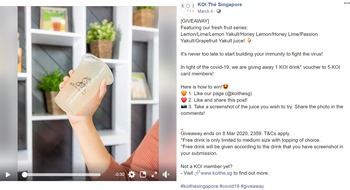
Our analysis focuses on advertising materials posted by businesses and corporate brands on Facebook, one of the most popular social media platforms for Singaporean individuals and businesses; in 2018, Facebook had 4.8 million users in Singapore out of a total national population of 5.64 million (Uy Reference Uy2019). Almost every business searched for in the data collection process had an active Facebook page. Typical businesses in Singapore post on their pages with a frequency ranging from once every few days to multiple times daily, generally with different or updated content in each post, providing a rich source of data. Moreover, in addition to static images and videos that have been professionally prepared, Facebook posts by businesses also generally include a caption written by a social media manager; this caption may be tailored to the situation at the time of posting, making these posts ideal for analysis in the rapidly evolving context of the Covid-19 pandemic. Figure 1 illustrates how businesses add relevance to the pandemic via the captioning of a more generic image or video.
Post on Facebook page of a bubble tea chain illustrating a Covid-19-specific caption combined with generic media. Video shows a cup of tea being shaken back and forth. Text caption (right) has been enlarged relative to accompanying video for legibility (KOI Thé, March 4, 2020).

The compiled corpus includes all advertisements on Covid-19-related themes posted during the pre-CCB period on the commercial Facebook pages of fifty-eight distinct businesses in a range of sectors, encompassing retail and personal care services, food services, and entertainment and hospitality. These sectors were selected because they advertise extensively and predominantly target individual consumers; including a variety of business types also allows for the examination of how businesses that sell different sorts of products, experiences, or events market themselves in relation to the pandemic. Businesses were identified collaboratively among the authors, based upon their familiarity with brands and businesses present in the community. Businesses examined included local shops and chains, as well as multinational franchises, brands, and retail websites with Singapore-specific Facebook pages.
Posts on the Facebook pages of the businesses examined were found to consist of two major classes: advertisements and notices. Advertisements were mainly comprised of a caption plus one static image or a gallery of several images; a minority of posts involved videos rather than images, ranging from brief animations (as in Figure 1) to full-length commercials. During the pre-CCB period, notice-type posts were primarily focused on hygiene measures being undertaken by the business and well-wishes for healthcare workers; some contained general public health and hygiene advice unrelated to the business itself. Posts that did not include any exhortation for customers to visit the business or to buy products were classified as notices rather than advertisements and were therefore excluded from the corpus. As noted in the previous section, however, the presence of these public health notices, interspersed with more conventional advertising, served to blur the distinction between health advice and marketing.
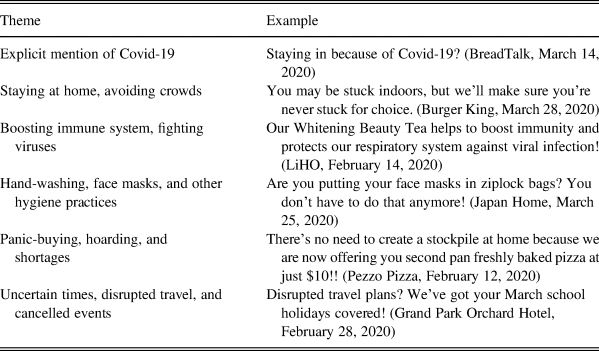
A total of 196 advertisements within the pre-CCB period were collected for analysis.Footnote 2 Advertisements were only included in the corpus if they addressed a Covid-19-related theme, as determined collaboratively by the authors; the themes observed in the corpus are given in Table 1. While most of these advertisements did not make explicit reference to the ongoing pandemic, the salience of the spread of Covid-19 during the pre-CCB period means that even these indirect texts would likely be interpreted by consumers in relation to the virus. Moreover, as illustrated in the examples in Table 1, indirect references to the pandemic were often accompanied by explicit mentions of items and practices strongly associated with the crisis (e.g. face masks, stockpiling), making the intended relevance clear.
Summary of Covid-19-related themes in the advertising corpus. The business and date posted are given in parentheses following each example.

As suggested by Table 1, advertisements in the corpus touch upon a number of aspects of the Covid-19 pandemic, framing the crisis in ways that work to rationalize particular consumer behaviors, from having your child's stroller professionally disinfected to ordering an extra pizza for dinner. This diversity of themes reflects the recruitment of Covid-19 as a resource in the construction of a number of discourses in which certain practices are presented as justified or necessary in light of the pandemic. Our analysis explores the configuration and targets of these discourses, and considers why certain other discourses we might expect to observe in the corpus are relatively absent.
Our approach to investigating this corpus focuses on the discursive strategies (Reisigl & Wodak Reference Reisigl and Wodak2001; Krzyżanowska Reference Krzyżanowska2020) employed in advertising texts that contribute to the process of crisis commodification, as outlined above, in which goods are imbued with novel sign-values and linked to a pandemic lifestyle. In unpacking these strategies, we primarily address the framings and metaphorical mappings of the virus and aspects of life amid the pandemic that are deployed in advertising discourse in order to shape consumers’ understandings of appropriate and necessary consumption behaviors. As observed by Semino, Demjén, & Demmen (Reference Semino, Demjén and Demmen2018:627), ‘framing’ has been used across a number of disciplines to refer to choices in text that present some aspect of the world in such a way as to generate certain understandings and expectations on the part of the receiver. Metaphorical mappings, in which the elements of one domain are figuratively mapped onto another domain (e.g. the home as a fortress), are one means through which framing is realized in text (Lakoff & Johnson Reference Lakoff and Johnson1980; Semino et al. Reference Semino, Demjén and Demmen2018:628). Prior work on public health discourse, including Wallis & Nerlich's (Reference Wallis and Nerlich2005) study of media framing of the 2003 SARS epidemic in contrast to HIV/AIDS, has demonstrated the significance of metaphor in shaping the perception of public health crises.
Informed by multimodal approaches to critical discourse analysis (van Leeuwen Reference van Leeuwen2008; Hansen & Machin Reference Hansen and Machin2019; Ledin & Machin Reference Ledin and Machin2020), we also take note of how visual elements of these advertisements integrate with language in enacting processes of crisis commodification. Visual aspects of the data are particularly highlighted in our analysis of Covid-19 as a challenge for women, where the role of visual semiotic resources is most salient.
Discourses in Covid-19-themed advertising
The following sections examine discursive strategies enacting the processes of crisis commodification within five major discourses present in our corpus of Covid-19-related advertising: Covid-19 as a challenge for workers, a wellness issue, a threat to home and family, a challenge for women, and a threat to the Singapore lifestyle.
Covid-19 as a challenge for workers
Resources across various modalities are employed in the advertisements to frame Covid-19 as a challenge for workers, including captions such as the examples in (1).
(1) a. Have you been working from home lately? Step up your productivity level with stylish stationaries on your desk! A positive work from home environment boots productivity! (Vivocity, March 4, 2020)
b. Working from home? Boost up your productivity with a new ergonomic work chair that doubles up on comfort while maintaining a good working posture. (COURTS, March 30, 2020)
c. Working from home these days? Feel more beautiful and confident with these stay at home beauty hacks that will have you looking amazing at your next WFH conference call! (Guardian, April 3, 2020)
d. Cooking your own meals while working from home? Shop the latest kitchenware at our Kitchen & Dining Fair! Cooking has never been so easy and fun! (Qoo10, April 3, 2020)
e. Take your lunch hour to build immunity! (House of Traditional Javanese Massage, February 24, 2020)
As indicated by these excerpts, advertisements propose a wide range of actions that workers should take to defeat the pandemic or excel under pandemic conditions, from buying beauty products in order to look better on video calls, to squeezing in a massage at lunch to build immunity against the virus. A notable aspect of these work-related advertisements, also observed in the corpus more generally, is a reluctance to explicitly reference Covid-19, or even to suggest that something unusual is occurring. Instead, many begin their captions with a question, as in (1a–d), asking whether the consumer has been working from home ‘lately’ or ‘these days’, for unspecified reasons. Such framing suggests that working from home is an action that the consumer has freely chosen to take, as an empowered career move, as opposed to casting the consumer as reacting out of fear or obligation. This discursive strategy of avoidance reflects the first process of crisis commodification, the erasure of unpleasant aspects of the pandemic and romanticization of the rationale for and implications of working from home.
The framing of these texts also contributes to the enregisterment of certain elements of life amid the pandemic as a ‘pandemic lifestyle’, the fourth process of crisis commodification. In (1c), for example, the phrase ‘your next WFH conference call’ suggests a shared understanding that life amid the pandemic means a work day consisting of a series of remote meetings; the choice to use the initialism ‘WFH’ indicates that working from home is now a familiar status that requires no extensive explanation. As reflected in (1d), this lifestyle includes certain elements that are framed as novel to the consumer, such as cooking for yourself. Thus, these advertisements evoke the persona of a white-collar office worker who is accustomed to eating out every day under normal circumstances, but who is now staying at home having remote meetings. Notably, this framing erases the experiences of employees in the service industry and other sectors who were not in the privileged position of working from home.
Many of the posts in the corpus that reflect worker discourse do so in a way that advances the productivity imperative. Following this imperative, the primary goal of consumption while working from home is not to feel better or improve one's circumstances, but to maximize the amount of work being completed. Example (1a) illustrates this discourse, suggesting to consumers that buying nicer stationery is not done for frivolous, aesthetic reasons, but is ultimately for the purpose of becoming more productive. Similarly, in (1b), an ergonomic chair is not purchased for one's own health, but is a means to the end of boosting productivity. The productivity imperative is also present in (1e), which suggests that consumers should be using their break time more productively by getting a massage to build up the strength of their immune systems (which, ultimately, increases work productivity by avoiding illness). In (1a) and (1b), productivity level is metaphorically mapped to a gauge that can be incrementally added to, with the implication that every minor action a worker can take to ‘boost’ their productivity level is worth doing in order to achieve maximum performance. This metaphor of the gauge, in combination with productivity imperative discourse, enacts crisis commodification processes (ii) and (iii) by linking a wide array of goods to productivity and framing productivity-boosting consumption as the responsibility of a good citizen during the pandemic. The indexical linking of working from home with pleasurable consumption and activities, including cooking for fun, putting on makeup, and buying stylish stationery, contributes further to process (i), the romanticization of life under the pandemic, as well as to process (iv), the enregisterment of a working-from-home lifestyle associated with consumption of these goods.
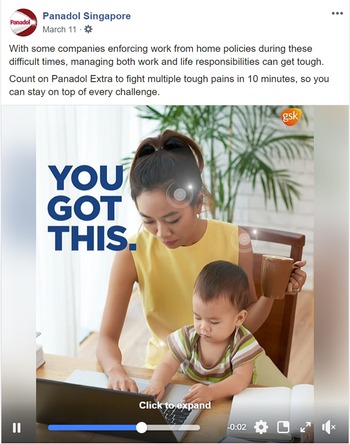
An example that features the discourse of Covid-19 as a challenge for workers is given in Figure 2, an advertisement for Panadol consisting of a caption and a brief video. The video presents a still image of a working-from-home scene; a woman sits in what appears to be a dining room chair at a table populated by open books and a laptop. She holds a mug of coffee in her raised left hand (on which we can see a wedding ring) as she types with her right hand. A baby on the woman's lap is also reaching out to type on the laptop. The woman gazes down calmly at the keyboard, apparently unconcerned by the baby's ongoing contributions. In the animation, while the image of the woman and the baby is static, red concentric circles resembling targets appear around the woman's forehead, shoulder, and hip, presumably representing areas of pain; these circles then transform from red to white, while the slogan ‘YOU GOT THIS’. appears in blue to the left of the woman's head. The caption above the video, as shown in Figure 2, notes that companies have been implementing compulsory work from home policies during ‘these difficult times’, and acknowledges the difficulty of ‘managing work and life responsibilities’. Panadol Extra, it promises, will enable you to ‘stay on top of every challenge’.
Advertisement for Panadol, a pain-relieving medication (Panadol Singapore, March 11, 2020).

The framing of the work from home experience as a challenge is unambiguous here. Although the woman in the scene is portrayed as calm and well put-together, the various elements of the scene—the typing baby, the precarious coffee cup—represent a nightmare scenario in which the woman's limbs and lap are being consumed by the competing demands of childcare, sustenance, and work. Her body, similarly, is failing her in multiple areas, but she has no time to slow down; luckily for her, Panadol Extra is there as a substitute for rest and proper self-care. Following from the framing of working from home as a challenge is the notion that workers have a personal responsibility to prepare for issues that will inevitably arise as a result of working from home. A responsible worker, in this case, will stock up on Panadol; to do otherwise would be shirking home and career responsibilities.
Also salient in the Panadol advertisement is the discourse of ‘lean in’ (Sandberg Reference Sandberg2013), which proposes that women can succeed in the family and career arenas by simply ‘powering through’ and embracing challenges. In the context of Covid-19, this advertisement implies that the pandemic and its associated inconveniences must similarly be overcome by women through leaning in. The ‘you got this’ slogan, echoing the encouraging words of a coach, suggests that an empowered woman can conquer the crisis with a cup of coffee and a few painkillers. We revisit this topic in the analysis below of Covid-19 framed as a challenge for women.
This Panadol advertisement illustrates the simultaneous enactment of several component processes of crisis commodification: the romanticization of the experience of working mothers during the pandemic through its portrayal of a neatly dressed woman calmly holding her coffee as her baby has its way with her laptop; the juxtaposition of semiotic elements indexing the work-from-home pandemic lifestyle; and the formulation of links between Panadol and life amid the pandemic, so that stocking up on this product becomes the action of a responsible citizen. Aside from the Panadol example, as illustrated in the other excerpts above, the advertisements relevant to Covid-19 as a challenge for workers frame working during the pandemic as the adoption of a new lifestyle that requires an array of novel accoutrements, from make up to ergonomic chairs, discursively transforming shifting working conditions into an imperative to consume.
Covid-19 as a wellness issue
The notion of ‘wellness’, a view of health that focuses on the active pursuit of holistic good health rather than the treatment of disease, first popularized in the West in the late twentieth century and has subsequently expanded into global markets (Global Wellness Institute 2020). Wellness as a movement is deeply rooted in capitalist systems and is inseparable from the multi-trillion-dollar wellness industry (Pilzer Reference Pilzer2002; Rubinstein Reference Rubinstein2020), which consists of businesses marketing diets, vitamin supplements, exercise programs, spa treatments, tourism, and other related ventures. Kickbusch & Payne (Reference Kickbusch and Payne2003:275) argue that public health campaigns must account for key societal changes prompted by the wellness industry, including a rise in commercial messaging related to health and an increasing ambiguity between pharmaceutical products, food, and dietary supplements. Although originating in the United States, the wellness industry is characterized by the appropriation and reinterpretation of Asian cultural practices and beliefs, including yoga and traditional Chinese medicine (Global Wellness Institute 2020). In Singapore, discourses, practices, and products from these Asian traditions co-exist and interface with the globalized wellness industry, resulting in a particularly complex semiotic landscape in which aspects of wellness are at once trendy and traditional.
Examples of advertising language in the corpus relating to wellness are given in (2). The mix of health traditions present in Singapore is evident in these extracts, with some advertisements referencing Western frameworks and terms, such as Vitamin C (2b,c), and others focusing on traditional Asian medicinal products and concepts, such as ‘tonifying’ (2e). Particularly prominent is the framing of a nutritious diet as a central aspect of health, a key tenet of the wellness industry as well as Asian traditions. In the present corpus, this notion has evidently been extended to include foods that are not particularly known for their nutritional value; even fruit jelly (‘Jell-O’ in US English) is marketed as a health product, as in (2c).
(2) a. Souper Soups: To Build Immunity & Keep Viruses Away! (Crystal Jade, February 24, 2020)
b. Did you know? Honey can help to boost your immunity! Strawberries, lemons and avocados are also great sources of Vitamin C. Get these drinks to enjoy while adding a boost to your immunity! Stay healthy everyone. (LiHo, February 5, 2020)
c. Give yourself the immunity boost you need with MARIGOLD Fruit Jelly. Full of fruit chunks and Vitamin C, these delicious delights are the perfect after meal treat. (Marigold, March 1, 2020)
d. Choose Tea Tree Massage Oil. Build Immunity, Detoxify, Stay Healthy, Have a Massage. Well known for its anti-inflammatory, anti-bacterial and anti-viral benefits, now is the best time to have a massage with our Tea Tree Massage Oil. (House of Traditional Javanese Massage, March 5, 2020)
e. Boost immunity and tonify your health with 100% Pure Essence of Chicken with no caramel colouring! (Eu Yan Sang, February 15, 2020)
Within this discourse, two primary metaphors that encourage consumption are employed with regard to immunity: ‘building’ immunity, which is done through regular consumption over time, and ‘boosting’ immunity, which is done through one-time consumption for a temporary increase in immune defenses. Using these metaphorical mappings, food and beverage vendors cast themselves as pharmacies, transforming the purchase of a snack or drink into a wellness practice. The caption of the KOI Thé post in Figure 1 gives an example of the language used to support this framing; the lines ‘It's never too late to start building your immunity to fight the virus!’ and ‘In light of the covid-19, we are giving away…’ present this bubble tea chain as a savior in the battle against Covid-19, rescuing a public that has been too negligent about the regular consumption of fruit tea.
Through their enregisterment of snacks and spa products as wellness items, these advertisements play a key role in the various processes of crisis commodification: regarding the first process, a discourse of ‘leisure wellness’ paints a romanticized picture of maintaining one's health during the pandemic via pleasant consumption; within the second process, goods ranging from soup to fruit jelly are imbued with immunity-boosting and other wellness-linked properties; in the third, consumers are exhorted to consume these goods to responsibly maintain health; and in the fourth, we observe the enregisterment of a wellness-based Covid-19-fighting lifestyle, in which the virus is defeated via discerning consumption of food and other wellness products.
Covid-19 as a threat to home and family
Examples of discourse that frames Covid-19 as a threat to home and family are shown in (3). While some advertisements integrated elements of this discourse with the wellness discourse discussed above, the metaphors used for Covid-19 as a threat to home and family are quite distinct, with living space envisioned as a fortress that must be reinforced to keep family safe from invading viruses and bacteria (3a–c) and the process of keeping the family healthy framed as ‘upgrading’ (3a). The activity of disinfecting via cleaning is presented here as something that requires extraordinary measures and products: ‘a simple scrub down isn't going to cut it’ (3e). This discourse serves to justify consumption practices that are arguably counterproductive to limiting the spread of Covid-19, such as traveling to a business to have a car seat cleaned.
(3) a. Upgrade your family's health today. Create a hygienic living environment with Samsung Home Appliances. (Best Denki, March 7, 2020)
b. Protect your family today, use E'scential VIRUSHIELD Disinfectant sprays that work as a shield to protect your family and friends! (BHG, February 17, 2020)
c. Get ready to Fight The Virus together. Protect your family and health. (Japan Home Singapore, March 16, 2020)
d. Keep Calm and Parent On! Worry less for your kids as you create the perfect environment for your little ones! (Qoo10, February 19, 2020)
e. When was the last time you got your baby gear (stroller/car seat) professionally cleaned? As much as we sanitize our hands and practice personal hygiene, we should also take care of essentials like strollers and car seats which are used often. A simple scrub-down isn't going to cut it! Let the experts from @pramwashsg take care of the mess. Come on down with your strollers and car seats to Waka Waka for Pramwashsg's first-ever pop-up booth with us on the 21st of March. (Waka Waka, February 27, 2020; emphasis in original)
f. Stay Safe, to all shoppers! Cleansing the bacteria and dirt beneath the surface have never been that convenient and easy! (Robinsons, March 16, 2020).
Example (3d) illustrates one of many intertextual references in the corpus to ‘Keep Calm and Carry On’, a slogan originally developed as part of a poster campaign in the United Kingdom during World War II that is now associated in globalized discourse with the stoic, ‘stiff upper lip’ spirit of the Blitz, the sustained bombing of the UK during the war (Hatherley Reference Hatherley2016). These references, along with the use of battle metaphors (3b,c), contribute to the framing of the pandemic as a war—a common metaphorical framing used in disease discourse (Wallis & Nerlich Reference Wallis and Nerlich2005:2632). Notably, the original World War II ‘Keep Calm and Carry On’ campaign was scrapped before it was circulated, in part over doubts that the slogan sent the appropriate message to the British public (Irving Reference Irving2014); these same issues with the slogan are evident in the way that it is exploited in the present corpus, as an exhortation to Singaporeans to ignore the risks of the pandemic and carry on consuming.
Processes of crisis commodification enacted via discourse in these home and family-focused advertisements include the formulation of goods such as home appliances as indexically linked to hygiene; consuming these goods is then equated to fighting the virus, with the experience of staying at home enregistered as a lifestyle in which such consumption is necessary to build proper fortifications and construct an ideal environment for one's family. Moreover, as suggested in (3d), advertisements frame consumption as a cure for worry and panic, evoking a romanticized stoic wartime spirit. The significance of this point is returned to in the discussion of advertisements that frame Covid-19 as a threat to the Singapore lifestyle.
Covid-19 as a challenge for women
The framing of Covid-19 as a challenge for women was primarily accomplished via visual elements in the corpus. First, images of women were significantly more common than men in the corpus overall (Χ 2(1) = 9.163, p = 0.0025): 23% (45/196) of posts included a female-presenting figure, with only 9.2% (18/196) featuring a male-presenting figure (and only 3.1% (6/196) including only male-presenting figures). The dominance of women is not surprising in itself, as women are often used as decorative elements in advertising, in Singapore and elsewhere (C. W. Lee Reference Lee2003). In the case of this corpus, however, the function of women was not primarily decorative. Rather, as in the Panadol advertisement in Figure 2, advertisements suggested that women were the primary bearers of responsibility for handling pandemic-related challenges, ranging from balancing childcare and work to actively defending the family. In the image accompanying caption (3c) above, for example, a cartoon woman dressed as a masked superhero wearing boxing gloves is shown in a punching stance, evidently in the process of ‘fighting’ the virus. This portrayal of women as the performers of concrete and productive actions is notable; as observed by Hansen & Machin (Reference Hansen and Machin2019:185–86), using Halliday's (Reference Halliday1978) framework of process types, women are more typically depicted in media as the agents of mental, existential, or behavioral rather than material processes, meaning they are more often shown as thinking, feeling, existing, and engaging in activities such as watching that produce no material outcome.
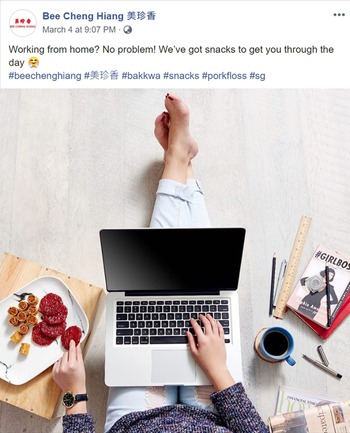
Figure 3 provides another illustration of the centering of empowered women in the corpus. This advertisement, posted by Bee Cheng Hiang, a producer of traditional Chinese Singaporean foods, features a point-of-view shot of a woman sitting on the floor with an open laptop. She is dressed in stylish ripped jeans and a long-sleeved sweater—a diacritic (Agha Reference Agha2011) of luxury in tropical Singapore, where typical families do not run their air conditioners during the day. On the floor are copies of the Financial Times, writing implements, a ruler, a notebook, and the 2014 book #Girlboss by CEO Sophia Amoruso, a memoir and self-help book for women entrepreneurs. This woman, then, is perhaps not merely an employee working from home, but an entrepreneur working on developing her business. Also arranged around her are a cup of coffee and a plate with Bee Cheng Hiang snacks: coin-shaped bak kwa (pork jerky) and pork floss rolls.
Advertisement for bak kwa (barbecued pork jerky) and pork floss rolls (Bee Cheng Hiang, March 4, 2020).

The evocation of power femininity in Figure 3 is made particularly salient with the inclusion of #GirlBoss (Amoruso Reference Amoruso2014), a book promoting the social movement of the same name; its associated networking platform describes its mission as, ‘to redefine success for millennial women by providing the tools and connections they need to own their futures’ (Girlboss 2020). In Banet-Weiser's (Reference Banet-Weiser2018) analysis of popular feminism as emergent from postfeminism, she argues that, in recent movements such as Girl Boss and Lean In, ‘neoliberal values such as entrepreneurialism, individualism, and the expansion of capitalist markets are embraced and adopted by girls and women as a way to craft their selves’ (Banet-Weiser Reference Banet-Weiser2018:19). Through the neoliberal discourse of power femininity, the post in Figure 3 reframes the Covid-19 crisis as an opportunity for entrepreneurial women to get ahead; now is the ideal time to work on that business idea (and purchase some pork jerky).
Although both men and women have been required to work at home during the pandemic, advertisements in the corpus that depicted working from home almost exclusively featured women. Due to the association of women with the home domain, it may be that working at home is perceived as an emasculating situation for men. Also, as suggested in the Panadol advertisement in Figure 2, traditional gender norms dictate that working from home increases family and childcare responsibilities for women rather than men, putting women in a vulnerable position that makes them a more appealing target for advertisers. Thus, consistent with Lazar's (Reference Lazar2014:207) observation that power femininity in advertising often reinforces traditional norms, the centering of women and the evocation of power femininity in the corpus perpetuates the discourse that remaining at home during the pandemic is not normatively masculine.
As suggested in the earlier Panadol example, the intersection of discourses of power femininity and crisis commodification in the advertisements highlighted here gives rise to the enregisterment of a gendered pandemic lifestyle, in which the struggles of women are romanticized and reframed via popular feminist tropes as empowering. These advertisements speak at once to multiple domains, imbuing goods such as pork jerky with indexical meanings of female empowerment, entrepreneurial spirit, and battling through Covid-19.
Covid-19 as a threat to the Singapore lifestyle
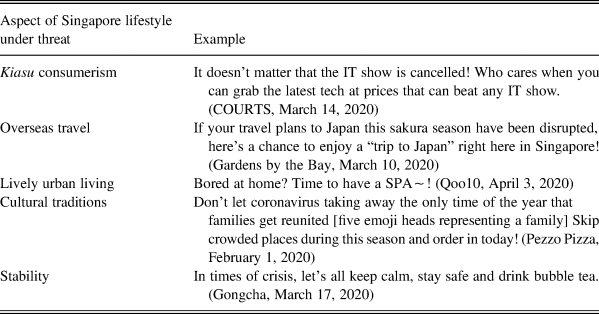
The final discourse we highlight in the corpus is multifaceted in nature and relates to ideologies regarding the characteristics of Singaporeans and the Singapore lifestyle. Covid-19 is framed as a threat to five key aspects of the Singapore lifestyle (Table 2): kiasu consumerism, overseas travel, lively urban living, cultural traditions, and stability.
Examples of captions relating to Covid-19 as a threat to aspects of the Singapore lifestyle.

As discussed in Consumerism and commodification in Singapore advertising above, ‘kiasuism’, meaning a spirit of excessive competitiveness, and its realization in competitive consumerism are the traits Singaporeans associate most strongly with the national character. Expos, shows, and annual sales have a prominent place in local culture; the cancellation of such events was therefore perceived as more than an economic danger, but also as a threat to national identity. Advertisements in the corpus exhorted Singaporeans to rise above these setbacks and continue to consume and find deals, thus linking consumerist practices with defeating Covid-19. Another facet of the Singapore lifestyle evoked in the corpus is frequent overseas travel. As in the Gardens by the Bay example in Table 2, which promotes their cherry blossom (sakura) exhibit as a substitute for canceled trips to Japan, advertisements suggested a range of solutions to simulate holiday travel, including staycations, getting spa treatments to recreate the resort experience, and buying potato chips to get a taste of a visit to the United States. The third theme, lively urban living, refers to advertisements that framed navigating daily life while avoiding the hustle and bustle of the city as a challenge, including the difficulty of avoiding crowds and the boredom of staying at home. Suggested solutions to these problems included ordering new clothes, learning to cook, ordering food for delivery, and setting up an at-home cocktail bar. Much like the holiday discourse above, advertisements urged consumers to recreate the experience of going out through consumption behaviors they may not have considered before.
In all three classes of advertisement above, Covid-19 is framed as inconvenient to cosmopolitan living: events are canceled, your plans are disrupted, you are stuck at home instead of out having fun. This ‘Covid-19 as buzzkill’ framing contributes to the first process of crisis commodification, erasure of the unpleasant aspects of the pandemic, while also legitimizing commodified solutions, so that solving the pandemic becomes a matter of buying new goods and experiences to entertain oneself. These advertisements enregister a modified, Covid-19-friendly cosmopolitan lifestyle, centered around home-based leisure activities and local staycations.
The corpus also included a few instances of discourse framing Covid-19 as a threat to Singapore's cultural traditions. In Singapore, Chinese New Year is generally celebrated via a family ‘reunion dinner’ and visits to the homes of extended family. The Pezzo Pizza advertisement in Table 2 references these traditions, urging consumers not to let Covid-19 ‘take away’ their family reunion. The metaphorical framing employed in this example features an agentive, malevolent Covid-19 that wants to steal valued traditions and damage family ties; by buying pizza, the consumer is defying the evil desires of the virus. Thus, in this example, we observe the enactment of process (ii) of crisis commodification, the formulation of pizza as connected to life amid the pandemic, and process (iii), equating consumption of pizza to positive action that mitigates the crisis.
The final theme we observe in relation to the Singapore lifestyle concerns the centrality of societal stability to national identity. Singapore is an exceptionally safe and stable country, but crucially, as a country founded amid race riots in the 1960s, today's social cohesion is seen as the outcome of public policy that has actively worked to bring disparate groups together (Clammer Reference Clammer1997). Institutional and popular rhetoric often characterizes Singapore as ‘a First World country with Third World people’ (Lai Reference Lai2019); under this view, Singaporeans require careful control and guidance to behave in a ‘civilized’ way. The belief that the public must be explicitly encouraged to remain calm in the event of a crisis is reflected in the recent national anti-terrorism campaign SGSecure, which models appropriate behavior in the event of a terrorist attack, using the slogan, ‘Our Response Matters’ (Cheow Reference Cheow2017). This same discourse is evident in the frequent exhortations to keep calm in the Covid-19 advertising corpus, as also noted in the analysis of Covid-19 as a threat to home and family.
These repeated calls for calm raise the question of what consumer behaviors are being constructed as ‘not calm’. One likely behavior being targeted here is the phenomenon of panic-buying. Although panic-buying was quite limited in Singapore compared to other countries, the notion that Singaporeans were queuing up to stockpile goods they did not need was prominently circulated in local mainstream and social media (Bouffanais & Lim Reference Bouffanais and Lim2020); this narrative was fed by discourses that kiasu consumerism is a distinctive Singaporean trait. The contrasting of calm, model behavior with panic-buying is illustrated clearly in this caption from a Chinese medicine retailer: ‘As others rush out to stock up their essential supplies, stay calm and celebration [sic] the last day of Lunar Chinese New Year with some delicious tang yuan’ (Eu Yan Sang, February 8, 2020). On the opposite end of the spectrum, another behavior businesses may be trying to discourage is staying at home and not consuming, in order to avoid Covid-19. Many of the captions adapted from the ‘Keep Calm and Carry On’ slogan imply this meaning, including the example from Gongcha in Table 2, ‘keep calm, stay safe and drink bubble tea’. In other words, whatever you do, don't stop buying things.
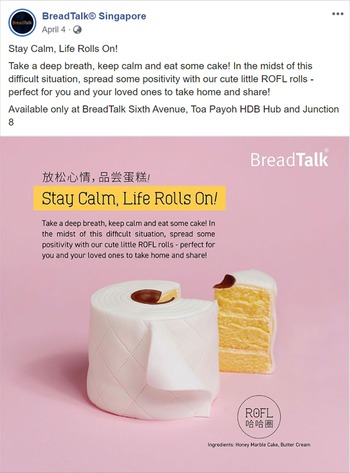
Another case of ‘keep calm’ discourse that references panic-buying is given in Figure 4, a post by BreadTalk, a large Singapore-based bakery chain. This advertisement promotes a cake decorated to resemble a roll of toilet paper, famously in short supply during occasional bouts of panic-buying in Singapore and elsewhere around the world over the course of the Covid-19 pandemic (Bouffanais & Lim Reference Bouffanais and Lim2020). The image is dominated by rose pink and yellow, colors that are prominent in the traditional Peranakan ceramics of the region (Chinese Antique Porcelain 2020) and thus associated with Singaporean-ness, framing the product as a celebration of local culture. The cake is called a ‘ROFL roll’ in English, a reference to the common internet slang for ‘rolling on the floor laughing’; its Chinese name is 哈哈卷 ha ha juan ‘haha [laughter] roll’. The names of the cake are the only aspect of the post that indicate the product is meant to be humorous, with the text in the image and the caption instead referencing ‘Keep Calm and Carry On’, advising consumers in both English and Chinese to stay calm and eat cake. There are also no explicit references to the fact that the cake is shaped like a roll of toilet paper, or that the product is a reference to toilet paper shortages due to panic-buying; this winking indirectness serves to enhance the humor of the post.
Advertisement for toilet-paper-roll-themed cake (BreadTalk, April 4, 2020).

Like other advertisements that frame Covid-19 as a challenge to the Singapore lifestyle, the BreadTalk ad highlights a phenomenon that is perceived by locals to be typically Singaporean;Footnote 3 crucially, however, what is being referenced here is the negative practice of irrational panic-buying. The humor of framing the panic-buying of toilet paper as a cultural tradition worthy of celebration is particularly salient to consumers in the context of a BreadTalk cake; this company often produces seasonal special collections with baked goods representing culturally significant items, such as buns shaped like Mandarin oranges for Chinese New Year. Underlying this presentation of a toilet paper roll as a cake, then, is the celebration of the Singaporean way in which locals have responded to Covid-19. Panic-buying is thus reframed, no longer as a national embarrassment or threat to the community, but as a romanticized local characteristic that is worthy of joking celebration, thus enacting the first process of crisis commodification by constructing a lighthearted view of life amid the pandemic. Regarding the second process, the consumption of the ROFL roll becomes indexically linked to staying calm and ‘spreading positivity’; thus, via process (iii), consumption of this product is equated to positive action against the pandemic. Finally, the Singaporean cultural semiotic elements of the advertisement contribute to its enregisterment of a pandemic lifestyle as one that is distinctly local in character.
Discussion
In this analysis of Covid-19-themed advertisements, we have identified five discourses that draw upon multimodal semiotic resources to frame Covid-19 as a challenge to workers, wellness, family, women, and the Singapore lifestyle. Via these discourses, a variety of consumption behaviors were reimagined in the corpus as the moral duty of a good citizen in the fight against the virus. We emphasize ‘reimagined’ here—most, if not virtually all of the behaviors being advocated for had little apparent connection to preventing the spread of Covid-19; many were arguably counterproductive to that effort. Due to the absence of a treatment or vaccine for Covid-19 at the time of data collection, the encroachment of private interests into public-health messaging via the wellness movement, and the neoliberal process of individual responsibilization, corporations were easily able to leverage the public's fears, transforming them into an imperative to consume. Through these discourses, consumption practices (e.g. buying bubble tea) were placed on par with necessary public health behaviors, such as hand-washing; a good citizen must engage in these practices to maximize their productivity, protect their home, and preserve the Singaporean way of life. The validation of consumption was also furthered via the metaphorical mappings employed in advertisements, including the notions of productivity and immunity as gauges that can be incrementally increased or temporarily boosted, the home as a fortress that must be defended, the pandemic as a war, and the virus as a malevolent force seeking to destroy the consumer's way of life.
One notable aspect of Covid-19-related advertisements in Singapore during the pre-CCB period is the low degree of nationalistic or togetherness discourse. We found only a handful of advertisements that included statements to the effect of ‘we're in this together’. National symbols and references to Singapore or the community fighting the virus were also virtually absent. While this omission may have been influenced by a reluctance to emphasize the scale of the crisis, the lack of overt positive nationalist sentiment is also characteristic of Singapore's popular discourse more generally (Ortmann Reference Ortmann2009). Moreover, as discussed in the analysis of Covid-19 as a threat to the Singapore lifestyle, we argue that the evocation of national identity is implicit in discourse regarding consumerism, travel, and other aspects of local life that are perceived as integral to Singaporean-ness. Thus, an exhortation to not let the pandemic keep you from shopping is, at another level, a call to not let Covid-19 destroy what it means to be Singaporean.
Advertisements were also noteworthy in their centering of women. In the analysis above, we proposed that the supposedly empowering portrayal of women in the corpus emerges in part from a desire to avoid the emasculation of men that would result from depicting them as restricted by the pandemic to the domestic sphere, and the assumption that balancing the responsibilities of work and family is a woman's role. As illustrated by other events during the pandemic, such as the refusal of various male world leaders to wear masks and obey social distancing restrictions, discourses of toxic masculinity have proven detrimental to public health measures during the pandemic. In this sense, the seemingly progressive evocation of power femininity in advertising reproduces ideologies that harm the entire community in times of crisis.
Although the discourses we have identified have certain distinct causes and implications, they share a common neoliberal ideology and the capitalist imperative of commodification. On the whole, what we see in this corpus is the commodification of a Covid-19 pandemic lifestyle, with diverse consumption practices, from buying make up to getting a massage, indexically linked to this newly enregistered commodity register. In the corpus, we observe the enacting of all four processes proposed in the crisis commodification framework, including (i) the romanticization of pandemic experiences and behaviors and avoidance of the explicit mention of dangers posed by the virus, (ii) a wide range of goods linked to combating or surviving the pandemic, (iii) discourse suggesting that consumption is equivalent to positive action, including building immunity and not letting the virus win, and (iv) the semiotic construction of a stay-at-home, wellness-focused lifestyle that is put forward as the ideal way to live amid the pandemic.
Our analysis underscores the utility of a framework for crisis commodification that digs deeper into the discursive processes that accompany certain forms of disaster capitalism. While the phenomenon of businesses leveraging the pandemic in advertising may fall under the broad umbrella of disaster capitalism, equating these discourses to the exploitation of catastrophes to implement neoliberal agendas with little public oversight overlooks how processes of commodification legitimize themselves through their imbrication with discourses of productivity, wellness, power femininity, and national identity. Building upon Agha's (Reference Agha2011) notions of the commodity register and commodity formulations, crisis commodification illustrates how the capitalist leveraging of disasters goes well beyond the realm of the awarding of corrupt contracts and hasty implementation of policies.
Concluding remarks
The Covid-19 pandemic is an extraordinary global event during which many individuals around the world have shared common experiences, even as their situations are shaped by local circumstances and concerns. At the same time, as worldwide protests regarding Black Lives Matter in 2020 have demonstrated, the pandemic may not be as unique in its reach as it may seem; the accelerating pace of transnational flows of people and ideas means that even local crises have the potential for transmission and reinterpretation on a global scale. Similarly, commodified memes and movements, such as Girl Boss and ‘Keep Calm and Carry On’, originated in the West but resonate with Singaporean consumers on the other side of the world. The increasing globalization of the experience of crises suggests a significant capitalist potential for crisis commodification. The generation of products celebrating toilet paper shortages during Covid-19, for example, has not been limited to Singapore; toilet-paper-roll earrings, pendants, charms, soft toys, and other products are all hot sellers on global retail sites at the time of writing. While this sort of commodity reformulation is relatively innocuous, the linking of commodities to a particular crisis can hold more serious consequences, as in the case of the medication hydroxychloroquine, which became less available to patients who rely on it for established medical uses after sales soared following the suggestion that the drug might be used to treat Covid-19 (Alltucker Reference Alltucker2020).
The commodification of crises is not only impressive in terms of geographic reach, but also longevity. The commodification of the Blitz is alive and well eight decades after it occurred, not only in its globalized slogans, but also in British understandings of Brexit and the government's handling of Covid-19; 9/11 continues to serve as a tool in the justification of arming police forces with military gear in the United States. Thus, the meaning-making surrounding the Covid-19 pandemic today, as constructed by governments, private interests, and popular discourse, is likely to resonate well into the future. Just as millennials hung ‘Keep Calm and Carry On’ propaganda posters on their walls, future generations may be making memes of advertisements for toilet-paper-roll cakes.