Introduction
With the advent of technology, cochlear implantation has become the standard treatment for patients with bilateral severe to profound sensorineural hearing loss. Suitable candidates provide us with gratifying results; however, when a patient has poor results, it can be upsetting for the patient and the surgeon. Cochleovestibular malformation is one pre-operative predictor of outcome.
Inner-ear malformations are found in 10–30 per cent of patients with congenital sensorineural deafness on high-resolution computed tomography (CT) scans of the temporal bone,Reference Jackler, Luxford and House1,Reference Papsin2 made possible with advances in imaging. Identifying these malformations is important pre-operatively as it has a significant impact on surgical technique, electrode array choice, surgical complications and cochlear implantation results.Reference Sennaroglu and Bajin3 Therefore, proper consent is also needed.
Various classifications for cochleovestibular malformations have been put forward. The accepted ones include those of Jackler et al.Reference Jackler, Luxford and House1 and Sennaroglu et al.Reference Sennaroglu and Bajin3–Reference Sennaroglu and Saatci5 Prior to these classifications, almost all malformations were labelled as Mondini dysplasia. Jackler et al.Reference Jackler, Luxford and House1 outlined the terms used for malformations as: complete labyrinthine aplasia, cochlear aplasia, cochlear hypoplasia, incomplete partition and common cavity. However, as there was no detailed description of the terms and as it was based on the development of the inner ear, the clinical significance of this classification gradually declined. Sennaroglu and colleagues revised this classification in 2002,Reference Sennaroglu and Saatci5 and then again in 20104 and 2017.Reference Sennaroglu and Bajin3 They gave detailed descriptions of these terms, and incorporated newer terms like rudimentary otocyst. In addition, they sub-classified incomplete partition into types I, II and III, and cochlear hypoplasia into types I, II, III and IV. All these classifications are based on embryological development and pathogenesis.Reference Jackler, Luxford and House1–Reference Sennaroglu and Bajin3 A number of the terms used have been described on the basis of arrests at various steps during embryogenesis of the inner ear.
Classifications in general, and specifically those relevant to cochleovestibular malformations, are required for a few basic reasons and can make things easier. The problem with the Sennaroglu et al. classificationReference Sennaroglu and Bajin3 is that overlapping or intermediate forms exist, which creates confusion. This confusion is worsened by the fact that diagnosis of cochlear hypoplasia is very subjective. There is currently no literature describing how to radiologically measure the length of a malformed cochlea. Thus, there can be overlapping between various types of incomplete partition and cochlear hypoplasia. For example, it is sometimes difficult to differentiate between incomplete partition type II and cochlear hypoplasia type III, and incomplete partition type I and cochlear hypoplasia type II. Furthermore, the many additions to the definitions of these terms make it difficult for people to remember and follow this classification.
This also leads to problems with uniformity, which is another reason why we need a standard classification. The complex nature of this classification makes it tough for surgeons, audiologists, and speech and language pathologists to understand. Uniformity can be lost even while communicating within the team, which leads to problems in reporting the results.
Another major reason why we need a new classification is for treatment planning and predicting complications. The Sennaroglu et al. classificationReference Sennaroglu and Bajin3 can indicate this information, but in a complex manner. For example, if we were to examine various types of cochlear hypoplasia and incomplete partition, and predict which of these have a higher chance of a cerebrospinal fluid (CSF) ‘gusher’, then it would be cochlear hypoplasia type II, and incomplete partition types I and III. A CSF gusher is given much consideration during cochlear implant surgery, and treatment planning is conducted as for cases of malformations. For any surgeon, a classification that immediately indicates that particular terminology is associated with higher chances of CSF gusher would make more sense and be easier to remember. If not one term, then at least the terms should be in a sequence and not haphazardly placed.
Another major reason for a new classification is for predicting prognosis. The terms used in all classifications, be they for angiofibroma or malignancy, or any other disease, usually go from good to bad prognosis, or vice versa. However, this is not seen in this classification. For example, prognosis of incomplete partition type II is better than incomplete partition types I and III. Furthermore, it is difficult to prognosticate various types of cochlear hypoplasia and incomplete partition.
In short, the present classification systems are not adequate for five major reasons. Classification should: make things easier for user, provide uniformity, enable treatment planning (including electrode selection), and allow the prediction of complications and prognosis. Thus, a new, simpler and more clinical classification, with well delineated types and definitions, is needed.
Materials and methods
A retrospective study of 436 patients, who underwent cochlear implantation at SMS (Sawai Man Singh) Medical College, Jaipur, Sardar Patel Medical College, Bikaner, and All India Institute of Medical Sciences, Bhubhaneswar, India, between December 2010 and February 2016, was carried out. Only children aged less than eight years were included in the study. The radiology findings of these patients were studied in detail. This included both high-resolution CT and magnetic resonance imaging of the temporal bone. Patients with cochleovestibular malformations were included in the study, while those with normal anatomy of the inner ear were excluded.
SMS classification
The SMS classification of cochleovestibular malformations took into consideration three features of cochlear anatomy, namely cochlear morphology, the modiolus and the lamina cribrosa. Inner-ear anomalies other than cochlear anomalies, for example an enlarged vestibular aqueduct or vestibular dysplasia, were kept in the ‘others’ category. Internal acoustic canal anomalies or cochlear nerve anomalies were dealt with separately, and were therefore not made a part of this classification. Table 1 outlines the details of this classification.
SMS classification of cochleovestibular malformations

The primary reason for this new classification was to make things more understandable and clinically oriented, and easier for surgeons, audiologists, and speech and language pathologists, thereby enhancing uniformity. It is important to remember that this classification does not include cochlear nerve anomalies (hypoplasia or aplasia), and therefore internal acoustic meatus stenosis was not considered.
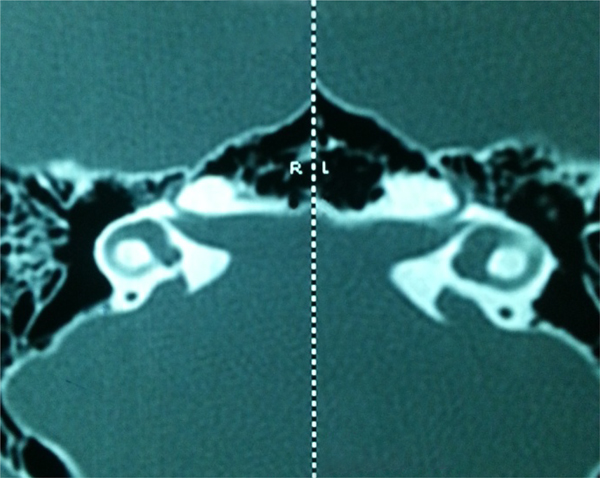
Cochleovestibular malformation type I (Figure 1) includes all those malformations of the inner ear that have no direct bearing on cochlear implantation. The cochlea itself is normal. Malformation is limited to other inner structures, and includes semicircular canal dysplasia or agenesis, a dysplastic vestibule, or an enlarged vestibular aqueduct. With the exception of a vestibular aqueduct anomaly, the surgery will not be any different to that conducted in a patient with normal cochlear anatomy. Even in a patient with an enlarged vestibular aqueduct, the only difference will be a minor pulsatile CSF leak during cochleostomy, with no significant egress of fluid. This will not have any effect on electrode insertion and therefore any electrode can be used.
Computed tomography axial section of cochleovestibular malformation type I. R = right; L = left.

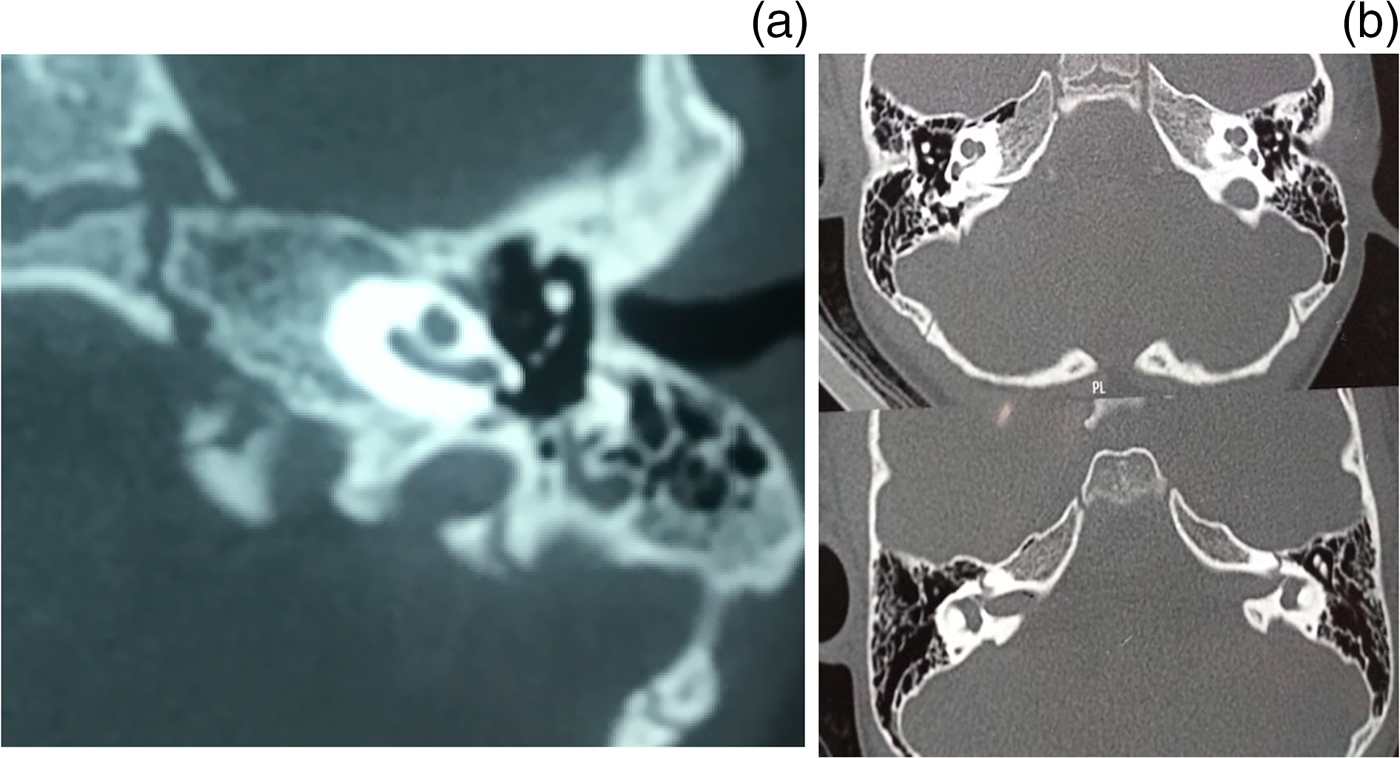
Cochleovestibular malformation type II (Figure 2) represents abnormal cochlear morphology, but the modiolus is present and the lamina cribrosa is normal. Abnormal morphology would mean either a short cochlea, or a decreased number of turns or fused turns. This type is subdivided into two: type IIa, when the modiolus is complete but smaller, and type IIb, when the modiolus is partially defective. In both types, the basal turn will be normal with the modiolus. Hence, surgery aims to cover the whole of the basal turn but not provide complete cochlear coverage. The surgery will be as for a normal cochlea. However, as mentioned, longer electrodes should not be used. Both straight or pre-curved modiolus-hugging electrodes can be used. Usually, there is no CSF gusher.
Computed tomography axial section of cochleovestibular malformation types (a) IIa and (b) IIb. Type IIb with a large vestibular aqueduct and dysplastic vestibule, as seen here, is Mondini dysplasia.

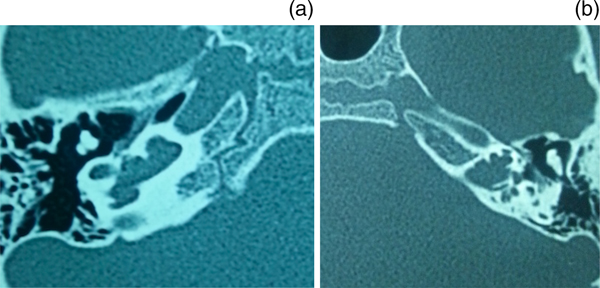
Cochleovestibular malformation type III (Figure 3) reflects abnormal cochlear morphology and a completely absent modiolus. As the modiolus is absent, the lamina cribrosa may also be absent, and that is the differentiating feature between types IIIa and IIIb. Type IIIa has a normal lamina cribrosa, while type IIIb has a deficient lamina. As the modiolus is absent, so the cochlea is shorter. In both types, a straight electrode array will be required. Pre-curved electrodes cannot be used, as the modiolus is absent. Full-band electrodes will be needed, as the nerve endings will be along the lateral wall of the cochlea. As type IIIa involves a normal lamina cribrosa, the chances of a CSF gusher are relatively low.
Computed tomography axial section of cochleovestibular malformation types (a) IIIa and (b) IIIb.

In type IIIb, the lamina cribrosa is deficient, and so communication between the internal acoustic meatus and malformed inner ear is greater. This leads to a higher chance of a CSF gusher when performing a cochleostomy. In such cases, it is advisable to conduct a larger cochleostomy, so that the peri-electrode space at the level of cochleostomy can be packed with soft tissues much more easily after electrode insertion. A few authors have advised using ‘Form’ electrodes.Reference Sennaroglu, Atay and Bajin6 The senior author has found these electrodes to be an effective and convenient way to handle a CSF gusher. The Form electrodes, specific to Med-El (Innsbruck, Austria), have a cork-like stopper, instead of the usual silicon ring, to stop the CSF gusher. Tissue glue must be kept in the operating theatre and used in cases where the soft tissue packing does not appropriately stop the leak. In the worst case scenario, subtotal petrosectomy, with cul de sac closure of the external auditory canal, may be required.
The deficient lamina cribrosa in cochleovestibular malformation type IIIb also means that the electrode array may get misdirected into the internal acoustic canal. Therefore, after electrode insertion, intra-operative C-arm imaging should be conducted to confirm correct placement of the array. If the electrode array is going into the internal acoustic meatus, it will not show any coiling and will be seen as going straight towards the intracranial region.
Cochleovestibular malformation type IV (Figure 4) is considered a contraindication for cochlear implantation and an auditory brainstem implant is instead required. It is important to correctly identify this by confirming the absence of any inner-ear structure anterior to the internal acoustic canal.
Computed tomography axial section of cochleovestibular malformation type IV.

Relation between previous and SMS classifications
As per the SMS classification, an enlarged vestibular aqueduct, dysplastic vestibules and semicircular canal anomalies are included in the cochleovestibular malformation type I classification.
Cochleovestibular malformation type II includes an abnormal cochlea, with either a short complete modiolus (IIa) or a partially defective modiolus (IIb). Therefore, cochleovestibular malformation type IIa includes cochlear hypoplasia types III and IV, and cochleovestibular malformation type IIb includes the incomplete partition type II of the Sennaroglu et al. classification.Reference Sennaroglu and Bajin3
Cochleovestibular malformation type III was defined as abnormal cochlear morphology, an absent modiolus, and either normal (IIIa) or deficient lamina cribrosa (IIIb). Hence, cochleovestibular malformation type IIIa includes incomplete partition type I, and cochleovestibular malformation type IIIb includes incomplete partition type III. A common cavity and cochlear hypoplasia types I and II could be a part of either cochleovestibular malformation types IIIa or IIIb, depending on the lamina cribrosa of that particular patient.
Cochleovestibular malformation type IV reflects an absent cochlea, and therefore an absent modiolus and absent lamina cribrosa. This includes complete labyrinthine aplasia, a rudimentary otocyst and cochlear aplasia.
SMS classification and prognosis
It is important for a classification system to be able to prognosticate between various classes, types and stages in a sequential manner. This helps clinicians to understand the various types in a better manner, and makes the classification more usable. This is one of the most important shortcomings of already existing classifications.
If we consider the Sennaroglu et al. classification,Reference Sennaroglu and Bajin3 various types of cochlear hypoplasia and incomplete partitions have a different prognosis; however, their grouping makes it tough to prognosticate these different anomalies. Even within the incomplete partitions, prognosis does not follow a sequence (incomplete partition types I to III, or vice versa). Prognosis of incomplete partition type II is better than that of incomplete partition types I and III; hence, the grouping has not been carried out in a sequential manner as per prognosis.
In this proposed new classification, care has been taken to maintain the sequence based on prognosis. The results of surgery progressively decrease from type 1 to type 4.
SMS classification and implantation outcome
Pre-operative and post-operative Meaningful Auditory Integration Scale scores were used to assess the outcomes of various cochleovestibular malformation types. Scores at two years post-implantation were used for comparison.
The Meaningful Auditory Integration Scale, developed at the Indiana University School of Medicine, is a parent-reported scale, which allows the examiner to evaluate the child's skills in a meaningful, real-world situation. It has 10 questions, with minimum and maximum scores of 0 and 40 respectively.
A total of 382 children had a normal inner ear and were excluded from the study. Although the mean age in those with a normal inner ear and in other groups did not differ greatly, analysis of covariance was used to adjust the scores for age at the time of implantation because ages were not identical. The age-adjusted mean post-implantation Meaningful Auditory Integration Scale scores were compared between the groups of different cochleovestibular malformation types using the Friedman test. P-values of less than 0.05 were considered significant. Analysis was conducted using SPSS® statistical software, version 24.0.
Results
Intra-operative issues
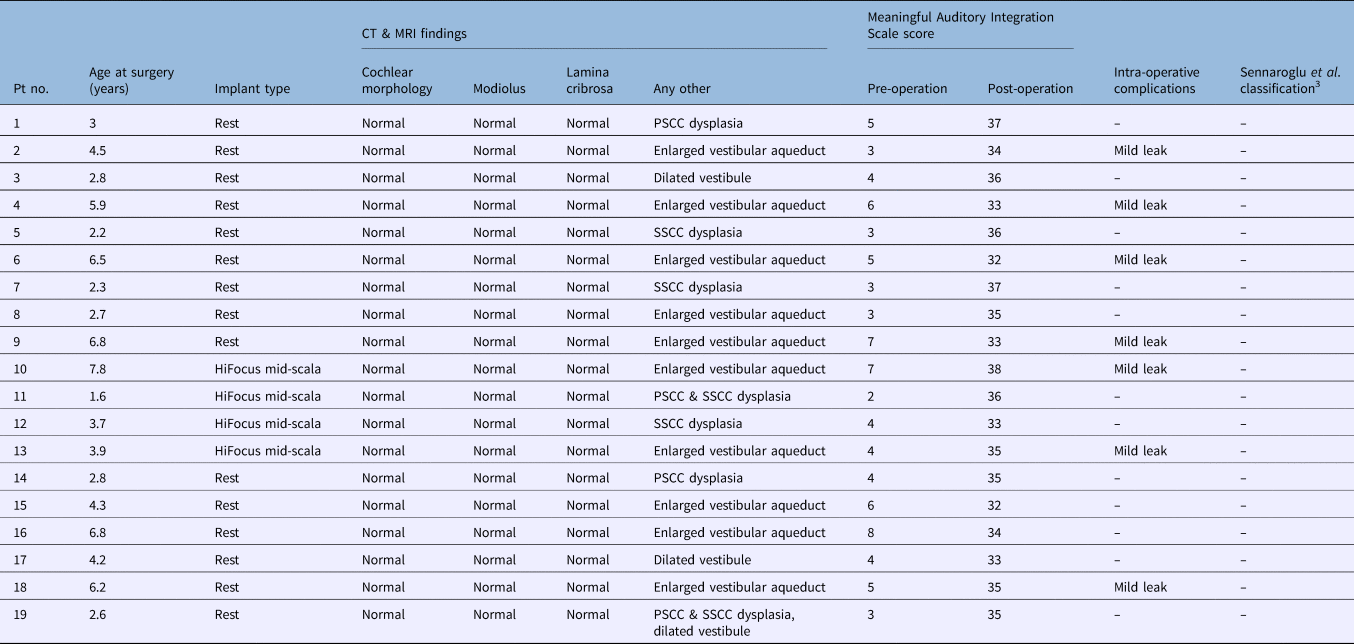
Various types of electrode arrays were used for patients with cochleovestibular malformation type I. Seven out of 19 patients had a perilymph or CSF leak during cochleostomy (Table 2). However, this egress of fluid was not significant, and was basically transmitted pulsations. All seven patients had a large vestibular aqueduct. Electrode insertion was conducted with ease in all seven patients. None of the patients had a persistent CSF leak after surgery. Facial anomaly was not found in any patient.
Patient profile of children with cochleovestibular malformation type I

‘Rest’ electrodes (Cochlear, Sydney, Australia) are full-banded, straight electrodes. HiFocus mid-scala electrodes (Advanced Bionics, Valencia, California) are half-banded, partially curved electrodes. Pt no. = patient number; CT = computed tomography; MRI = magnetic resonance imaging; PSCC = posterior semicircular canal; SSCC = superior semicircular canal
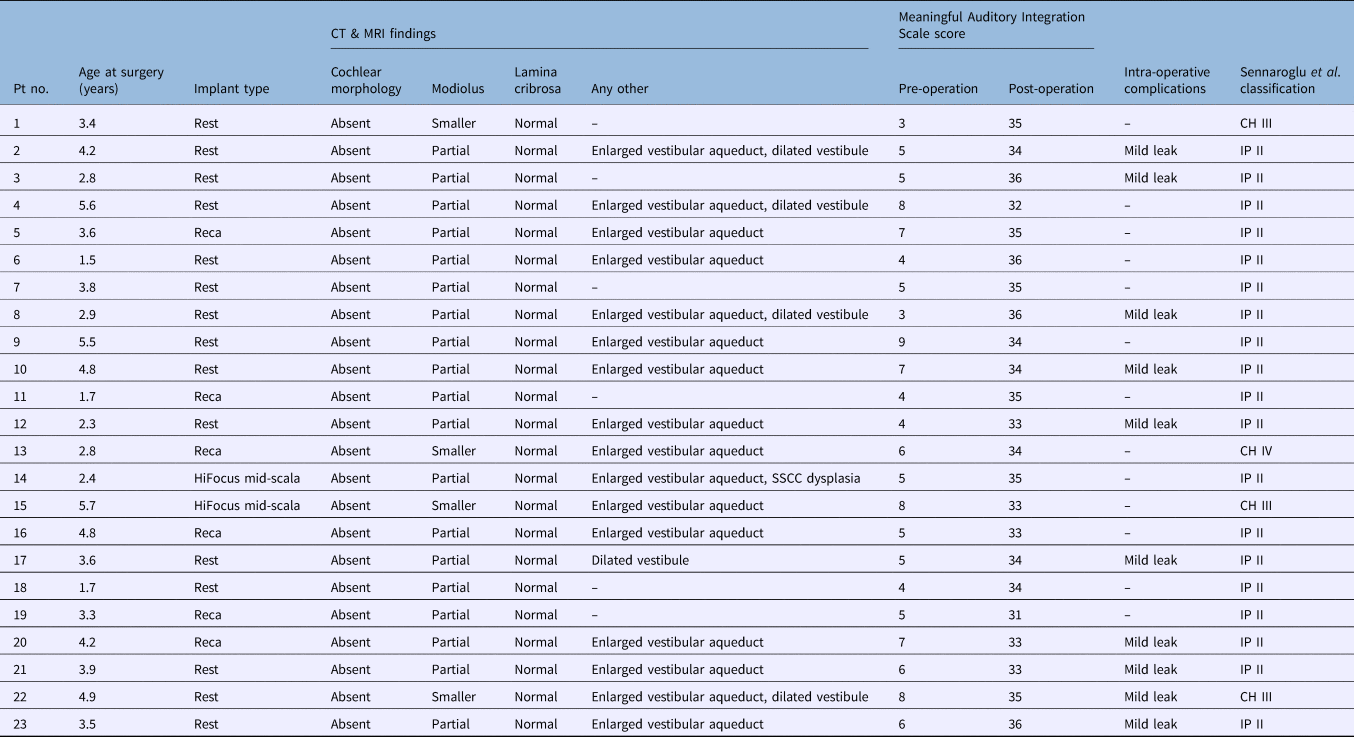
Ten out of 23 patients with cochleovestibular malformation type II had a perilymph or CSF leak (Table 3). As with the cochleovestibular malformation type I group, there were no major issues with electrode insertion and none of the patients had a persistent CSF leak.
Patient profile of children with cochleovestibular malformation type II

‘Rest’ electrodes (Cochlear, Sydney, Australia) are full-banded, straight electrodes. ‘Reca’ electrodes (Cochlear, Sydney, Australia) are half-banded, modiolus-hugging electrodes. HiFocus mid-scala electrodes (Advanced Bionics, Valencia, California) are half-banded, partially curved electrodes. Pt no. = patient number; CT = computed tomography; MRI = magnetic resonance imaging; CH = cochlear hypoplasia; IP = incomplete partition; SSCC = superior semicircular canal
In patients with cochleovestibular malformation type III, we recommend using straight, full-banded electrode arrays because of the absent modiolus. A modiolus-hugging electrode array would coil on itself in such cases, and therefore should not be used. In addition, in such cases the nerve endings would be along the lateral wall, and so medially placed (half-banded) electrodes would not be appropriate. This is why full-banded electrode arrays are required here.
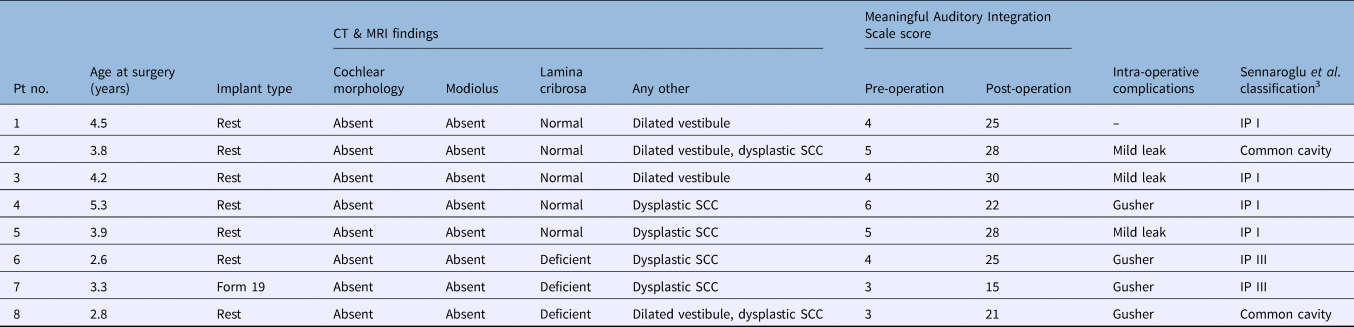
We used straight, full-banded electrode arrays for all cochleovestibular malformation type III patients. Four out of eight patients had a significant CSF gusher (Table 4). A larger cochleostomy was performed in all these patients, so that the peri-electrode area could be sealed easily with soft tissues, as recommended in earlier studies too.Reference Cooper and Craddock7 Of the remaining four patients, three had a mild perilymph leak. All three patients with a deficient lamina cribrosa had a CSF gusher. In one of these patients, we had used the ‘Form 19’ electrode array (Med-El), which has a funnel-shaped, cork-like structure at the proximal end of the electrodes, to plug the cochleostomy site. Two of these patients continued to have CSF gusher in the post-operative period, which was managed conservatively. Re-exploration was not required in any case. Although we had fibrin glue at the ready, it was not used in any patient. None of the patients required a lumbar drain. The maximum length of the electrode array used in these patients was 25 mm. Electrode insertion was incomplete in one patient.
Patient profile of children with cochleovestibular malformation type III

‘Rest’ electrodes (Cochlear, Sydney, Australia) are full-banded, straight electrodes. ‘Form 19’ electrodes (Med-El, Innsbruck, Austria), have a funnel-shaped, cork-like structure at their proximal end, used to plug the cochleostomy site. Pt no. = patient number; CT = computed tomography; MRI = magnetic resonance imaging; IP = incomplete partition; SSC = semicircular canal
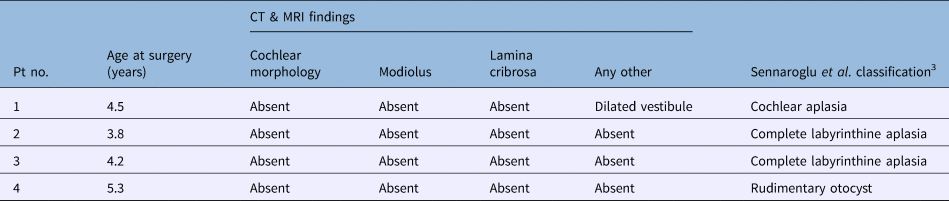
Patients with a type IV anomaly (Table 5) did not undergo cochlear implantation and were scheduled to undergo auditory brainstem implantation.
Patient profile of children with cochleovestibular malformation type IV*

* None of these patients underwent cochlear implantation. Pt no. = patient number; CT = computed tomography; MRI = magnetic resonance imaging
Outcomes
All patients showed improvement in auditory perception after cochlear implantation.
Mean pre-operative Meaningful Auditory Integration Scale scores were 7.4, 7.2 and 6.8 in cochleovestibular malformation types I, II and III, respectively, and there was no statistically significant difference between these scores.
The Meaningful Auditory Integration Scale scores at two years after surgery were 34.6, 34.1 and 24.2 for cochleovestibular malformation types I, II and III, respectively. The age-adjusted mean scores did not show any significant difference between children with cochleovestibular malformation types I and II; however, scores were significantly better in children with cochleovestibular malformation types I or II compared to children with cochleovestibular malformation type III (p < 0.05).
Although the mean Meaningful Auditory Integration Scale score for cochleovestibular malformation type IIIb (mean score of 20.3) was lower than for type IIIa (mean score of 26.6), we cannot comment on the significance of this difference given the small sample size.
Discussion
Even before cochlear implantations were introduced, cochleovestibular malformations had been observed. Carlo Mondini first reported deafness in a patient with a malformed cochlea with 1.5 turns which had a normal basal turn.Reference Mondini8 Though a major breakthrough at the time, the term Mondini dysplasia has been used injudiciously for all types of cochleovestibular malformations. Following the advent of cochlear implants, various histopathological and radiological studies have been conducted. Initial case reports on cochlear implantation in Mondini dysplasia cases were published in the 1980s.Reference Mangabeira-Albernaz9,Reference Miyamoto, Robbins, Myres and Pope10
Jackler et al.Reference Jackler, Luxford and House1 developed the first classification system for these malformations, dividing them into complete aplasia, common cavity deformity, hypoplastic cochlea and incomplete partition. This classification system was based on a linear developmental model, which led to many malformations being left out.
PhelpsReference Phelps11 subsequently proposed a classification system based on the appearance of the basal turn, considering this the most important factor. Those with an abnormal cochlea and without a normal basal turn were labelled as having ‘severe labyrinthine dysplasia’, and those with a normal basal turn were labelled as having ‘Mondini dysplasia’. There was also a subgroup of patients referred to as having ‘Mondini-like dysplasia’, in which the cochlea was short and the basal turn was normal. Though this was a good anatomical classification, it again failed to cover all types of anomalies.
The Sennaroglu et al. classificationReference Sennaroglu and Bajin3 is a very exhaustive classification. However, in order to cover all types of anomalies, and at the same time continue using the old terminologies (e.g. hypoplastic cochlea, incomplete partition), their classification lost the simplicity and has outcome predictability issues, making its practical usability a problem.
We have proposed a new classification system for cochleovestibular malformations. It is based on decision-making, outcomes and prognosis. Furthermore, it is simpler and has a good working classification. This enhances uniformity, without any overlap or confusion between various malformations. Previous classificationsReference Jackler, Luxford and House1,Reference Papsin2,Reference Sennaroglu and Bajin3,Reference Mangabeira-Albernaz9 have been based primarily on embryological development, while this one is based on morphology of the cochlea, modiolus and lamina cribrosa.
The SMS classification has various merits. As it has only four types, it is easy to understand and apply, thereby providing more uniformity. The confusions between different terminologies, such as the various types of cochlear hypoplasia and incomplete partitions, can easily be overcome using this classification. Malformations increase in severity from type I to type IV, with complete absence of cochlear structures in cochleovestibular malformation type IV.
This classification also helps us to choose the type of electrode array. For example, in cochleovestibular malformation types I and II, any type of electrode can be used. However, in cochleovestibular malformation type III, only straight and full-banded electrode arrays should be used. Moreover, the electrode array length should be planned based on the length of the cochlea. As per our experience, electrodes longer than 25 mm should not be used in any patient with cochleovestibular malformation type III.
• Of patients with congenital sensorineural deafness, 10–30 per cent have cochleovestibular anomalies
• Many classifications are used; most have an embryological basis and are not practical
• The SMS classification considers three cochlear anatomy features: cochlear morphology, modiolus and lamina cribrosa
• The SMS system classifies cochleovestibular malformations into types I, II, III and IV
• The two-year post-operative Meaningful Auditory Integration Scale scores were statistically analysed
• The SMS classification is a simpler, more practical, outcome-oriented system, with no overlap of terminologies or radiological features
Conclusion
The SMS classification is a new system for classifying cochleovestibular anomalies. It is simple and practical, covering all malformation types. This means it can be used universally without any confusion. It can also be utilised to predict outcomes without any overlap of terminologies.
Competing interests
None declared