Introduction
For more than a decade, the largest group of immigrants entering the United States each year has come from countries in Asia. Further, Asian Americans are the only racial group in the United States that is predominantly foreign-born.Footnote 1 About 60% of all Asian Americans in the United States are immigrants and the share of foreign-born rises to over 70% among adult Asian Americans (Budiman and Ruiz, Reference Budiman and Ruiz2021). Despite the dominant media image of migration flows over the U.S. southern border, less than 35% of Latinos in the United States are foreign-born (Batalova et al., Reference Batalova, Hanna and Lavesque2021). Today, the fastest growing groups of undocumented immigrants in the United States come from Asia and demographers estimate that one out of every seven Asian immigrants is undocumented (Ramakrishnan and Shah, Reference Ramarkrishnan and Shah2017). Undocumented Asian Americans account for a growing share of the unauthorized immigrant population in the United States (13%), as well (Passel and Cohn, Reference Passel and Cohn2019).
Although the numbers of foreign-born people identifying as Black has increased over time, most of the Black population in the United States is native-born. About 10% of Black Americans in the United States are foreign-born (Tamir Reference Tamir2021). The proportion (about 14%) of undocumented immigrants among foreign-born Asian Americans and Black Americans is quite similar, but because there are many fewer Black immigrants in the United States, undocumented Black immigrants make up less than 4% of the total undocumented population (Table 1).
Comparison of immigration trends in Black American and Asian American populations in the U.S.

Sources: Budiman and Ruiz, Reference Budiman and Ruiz2021; Tamir Reference Tamir2021; Batalova et al., Reference Batalova, Hanna and Lavesque2021
This paper compares attitudes toward immigration among these two non-White groups, Black Americans and Asian Americans in 2016, at a historical moment of particular salience for immigration related issues (Miao Reference Miao2020). We argue that the 2016 election cycle is important to study because of both the centrality of immigration to the Presidential campaign and because data were collected before Donald Trump became the most polarizing figure in U.S. politics during a Presidential term fueled by incendiary rhetoric that many viewed as anti-immigrant and the promotion of hard line policies on both legal and undocumented immigration (Eady et al., Reference Eady, Vaughn and Rottinghaus2018). That is, attitudes about immigration were less likely contaminated by feelings about Trump in 2016 compared to 2020.
Why focus on a comparison between Asian Americans and Black Americans when analyzing attitudes toward immigration? Although most past research on immigration attitudes has focused on White Americans’ attitudes toward immigration (Hainmueller and Hopkins, Reference Hainmueller and Hopkins2014), we believe there is value in comparing two non-White groups (see Brader et al., Reference Brader, Valentino, Jardina and Ryan2010 for a comparison of Black and White attitudes toward immigration). New insights may be gained by a close cross-racial comparative analysis of two groups that share non-White status but differ in terms of foreign-born population, racialization, and group economic indicators. Recent scholarship on public opinion and immigration encourages this approach to better account for “theoretical premises of a racial hierarchy and its structural influence on the context of racial-group identification” (Masuoka and Junn, Reference Masuoka and Junn2013, p. 18). Further, the histories of Black and Asian Americans have often intersected in critical respects around immigration issues (Carter Reference Carter2019).
The majority of Asian Americans support both a path to citizenship for undocumented immigrants and increasing legal immigration through the provision of additional family- and work-based visas (Shah and Wong, Reference Shah and Wong2019; Wong Reference Wong2017). This general support for facilitating a path to citizenship is to be expected as people in the United States generally support creating a path to citizenship for undocumented immigrants and Asian Americans are the fastest growing group of undocumented immigrants (though Latinx remain the largest group). Furthermore, Asians in the United States have been the most obvious direct beneficiaries of both family-based and work-based visas, especially since the late 1990s (Junn Reference Junn2007). It may come as a surprise, however, that Black Americans, despite encompassing a much smaller proportion of immigrants than their Asian counterparts, exhibit even more supportive attitudes toward regularizing the status of undocumented immigrants and increasing legal immigration than do Asian Americans.
We first establish a pattern related to immigration attitudes among Black Americans and Asian Americans. Asian Americans demonstrate strong support for a variety of pro-immigrant policies, but Black Americans, despite their lower likelihood of being foreign-born, are even more supportive. We rely on different surveys and examine a range of policies to confirm this pattern. We then move to explain this pattern with attention to two dominant theories used to explain attitudes toward immigration: 1) material and economic interests and 2) shared racialization. These themes figure prominently in explanations of immigration attitudes. Natalie Masuoka and Jane Junn’s (Reference Masuoka and Junn2013) comprehensive treatment of race and immigration attitudes identifies both economic factors and “racialized status” as potential influences on immigration attitudes. We briefly outline these themes below.
Theme 1: Economic Interests
A consistent explanation for variations in attitudes toward immigration has to do with group perceptions of labor market competition and economic anxiety. Masuoka and Junn (Reference Masuoka and Junn2013) explain that
In terms of public opinion, a key hypothesis is that negative attitudes toward immigrants are rooted in more general concerns about national economic health. Although data demonstrating immigrants hurt the economy is mixed, it is a common American perception that immigrants are detrimental to the national economy. Those who feel that the economy is faltering are more likely to have negative perceptions about new immigrants. Economists such as [George J.] Borjas suggest that groups who struggle the most economically are most likely to support restrictive immigration policies
(pp. 142-143).Narratives of Latino immigrant/Black labor competition, like those underscored by Donald Trump during the 2016 and 2020 campaigns, abound. At an Ohio rally in August 2016, Trump justified immigration restrictions by claiming “Poor Hispanics and African American citizens are the first to lose a job or see a pay cut when we don’t control our borders” (DelReal Reference DelReal2016). But this narrative of intra-minority conflict predates the Trump campaign. In 2004, a news story in The New York Times, titled “Black People and Latinos Try to Find Balance in Touchy New Math,” zeroed-in on Black Americans’ reactions to demographic change, noting that by 2002, “Latinos had surpassed Black people as the country’s largest minority, with Black people making up 13.1 percent of the population in 2002, and Hispanics 13.4 percent” (Navarro Reference Navarro2004). The story featured the following quote from Keith Murphy, the host of a call-in radio show with a mostly Black audience: “It’s still a matter of distrust,” he said. “It’s a feeling among African-Americans that Latinos are coming in and getting the jobs and are getting preferential treatment” (Navarro Reference Navarro2004). Groups favoring restrictive immigration policies have not hesitated to capitalize on perceptions of Black-immigrant conflict (Camarota Reference Camarota2008).
Beyond media narratives, scholarship from prominent economists like Harvard’s George Borjas, showing that immigration rates drive down Black wages and employment (Borjas and Freeman, Reference Borjas and Freeman1992; Borjas et al., Reference Borjas, Grogger and Hanson2010), fuels the assumption that immigration attitudes will be tied to perceived labor market competition.
Although most Latinos are U.S.-born, Latinos still comprise the largest numbers of immigrants in the country as a result of historical immigration patterns (recall Asians are the fastest growing). As such, research on Black-Latino relations may provide some insights into how Black Americans in the United States may react to immigrants more generally. In a seminal paper on exploring intra-minority conflict, political scientist Claudine Gay suggests that “decades of immigration from Latin America” into major metropolitan areas have been felt most acutely by long-term Black residents. She identifies “competition over scarce resources as a central force in black-Latino relations” (Gay Reference Gay2006, p. 982). This observation is common in the literature on intragroup relations (Vaca Reference Vaca2004). For example, Paula McClain and colleagues (Reference McClain, Lyle, Carter, DeFrancesco Soto, Lackey, Cotton, Nunnally, Scotto, Grynaviski and Kendrick2007) identify job-competition between Blacks and Latinos in “new immigrant destinations” and link intergroup tensions to these real economic dynamics.
More generally and recently “economic anxiety” was floated as a potential explanation for President Trump’s anti-immigrant agenda. This idea underlies the assumption that support for Trump and his restrictive immigration platform were driven by White American voters “left behind” in the country’s economic growth (Porter Reference Porter2016). The fact that lower-income Black voters, who ostensibly face the most direct competition from immigrant labor (Borjas et al., Reference Borjas, Grogger and Hanson2006; Carter and King-Meadows, Reference Carter and King-Meadows2019), exhibit low levels of support for Trump should cast some doubt on this thesis. Nonetheless, theories of economic competition suggest that economic anxiety and perceived labor market competition should help to explain variations between Black Americans and Asian Americans regarding immigration policies. That is, these theories suggest that Black Americans will be less open to immigrants than Asian Americans, especially since the latter’s growth in the United States is largely the result of current immigration policies.
Theme 2: Shared Racialization
According to Masuoka and Junn (Reference Masuoka and Junn2013), “one’s recognition of his or her racial categorization and that group’s position in the racial hierarchy are salient factors for determining how individuals perceive and make judgments about U.S. immigration and naturalization policy” (p. 18). That is, immigration attitudes will be highly dependent on group racial position. Along these lines, we hypothesize that a sense of shared racial status and linked fate with the country’s largest immigrant group, Latinx, will lead to pro-immigration attitudes among Black and Asian Americans. At the same time, dual casting as “forever foreigners” might comprise a basis for linked fate among Asian Americans and Latinx (C. J. Kim Reference Kim1999). The Trump Administration’s aggressive policies aimed at restricting immigration at the southern border and racialized rhetoric related to the pandemic (“China Virus” and “Kung Flu”) may have also served to reinforce a sense of foreignness among both Latinos (Wray-Lake et al., Reference Wray-Lake, Wells, Alvis, Delgado, Syvertsen and Metzger2018) and Asian Americans (Darling-Hammond Reference Darling-Hammond, Michaels, Allen, Chae, Thomas, Nguyen, Mujahid and Johnson2020; Hua and Junn, Reference Hua and Junn2021).
Hana Brown and Jennifer A. Jones (Reference Brown and Jones2015) make a strong case for approaching the racialization of Blacks and Latinx (as well as other non-White American groups) as part of an overall process of “ethnoracialization.” Brown and colleagues (Reference Brown, Jones and Becker2018) make a particularly forceful argument for the racialization of Latinos in the South as overlapping with the racialization of Black Americans in the South in terms of assumed criminality and other stereotypes.
Indeed, political convergence based on shared minority status is a familiar theme in U.S. politics, and especially in the urban politics literature. After the achievements of the Civil Rights Movement and other similar social justice campaigns, a cadre of researchers began their work from the belief that experience with racial prejudice and discrimination would bring groups of color together. Familiarity with the joint practices of discrimination and exclusion among groups of color was considered a necessary adhesive for minority electoral coalitions (Fong Reference Fong1998). Because none of the groups were numerically powerful enough to wrest power from the ruling White elite, they needed to coordinate their efforts to achieve greater political incorporation in America cities, particularly depending on the racial composition of the setting (Hero and Tolbert, Reference Hero and Tolbert1996).
In some instances, coalitions seemed to be the preferred electoral strategy of minority groups (Browning et al., Reference Browning, Marshall and Tabb2002). In local political contests, for example, minority groups coordinated their efforts to achieve greater socio-political incorporation. The 1973 election of Tom Bradley as mayor of Los Angeles was the result of a successful minority coalition. Elected with the help of Latino, Asian American, African American, as well as liberal Jewish communities, Bradley demonstrated the possibilities of inter-minority cooperation (Sonenshein Reference Sonenshein1993). And in cities as diverse as Denver, Philadelphia, Chicago, and San Antonio, minority electoral coalitions were decisive (Munoz and Henry, Reference Muñoz and Henry1986, Reference Munoz, Henry, Browning, Marshall and Tabb1990; Perry Reference Perry, Browning, Marshall and Tabb2003).
The appeal of coalitions was to come from a sense of shared minority status. A critical oversight of this theory was that it did not account for the highly contextual and uneven nature of America’s racial project (Jacobson Reference Jacobson2001; C. J. Kim Reference Kim1999, Reference Kim2018; Omi and Winant, Reference Omi and Winant1994). Racial groups were sorted differently in the racial hierarchy with respect to White Americans as well as one another (J.Y. Kim Reference Kim1999; Kim Reference Kim2018; Saito Reference Saito1998; Song Reference Song2004). Nonetheless, Karen M. Kaufmann (Reference Kaufmann2003) found “to the extent Latinos saw their social, economic and political opportunities tied to the status of minorities generally in the United States, the more likely they are to participate in minority led political coalitions” (p. 200). A sense of commonality enabled unity amidst diversity in these communities and is indicative of the potential for mass-based coalitions between Black and Latino residents. This finding is reinforced by Gabriel R. Sanchez (Reference Sanchez2008) who finds those Latinos with a high degree of consciousness (as measured by notions of intragroup commonality with other Latino subgroups, recognition of discrimination, and endorsement of Latino collective action) feel they have more in common with Black Americans. Although this does not necessarily mean automatic coalitions will form, it provides the raw material for these coalitions. While there were significant sub-national differences with respect to Latino feelings of commonality with Black Americans, Black Americans consistently express feelings of closeness toward Latinos and other non-White immigrant groups (Sanchez and Masuoka, Reference Sanchez and Mausoka2010; Thornton and Mizuno, Reference Thornton and Mizuno1999). A sense of shared racial fate may drive Black Americans’ positive views toward policies that seek greater inclusion of immigrants, particularly since the immigration debate is itself highly racialized regarding Latinos.
Junn and Masuoka (Reference Junn and Masuoka2008) contend that the racial position of Asian Americans vis-à-vis Latinos and other non-White groups is harder to read. Like Claire Kim’s (Reference Kim1999) work, they identify common economic status between White and Asian Americans, but shared interests on immigration policy between Asian Americans and Latinos.
In this paper, similar to Masuoka and Junn (Reference Masuoka and Junn2013) we examine the ways in which experiences and attitudes associated with racialization, such as linked fate with immigrants, linked fate with racial minorities, contact with Latinx people, beliefs about discrimination against different groups, and personal experiences with discrimination influence attitudes toward immigration.
Description of Survey Data
This study relies on two surveys, both of which include large Black and Asian American samples, the 2016 National Asian American Survey (Post-election) and the 2016 Collaborative Multiracial Post-Election Survey. These two surveys were conducted at around the same time, immediately after the 2016 election, and employ different methodologies.
The 2016 National Asian American Survey (NAAS) includes telephone (landline and cell) interviews of 4362 Asian American and 115 Pacific Islander adults and was conducted between November 10, 2016 and March 2, 2017. The sample was obtained from a vendor using registered voter and commercial lists. Potential respondents were initially identified by name, self-identified race where applicable, as well as tract level ethnic concentration. Racial and ethnic identity were based on self-identification. The survey includes ten different national-origin groups and was conducted in multiple Asian languages. Data are weighted by ethnicity and gender, age, state of residence, education, and nativity. Registered and non-registered voters were included, as well as citizens and non-citizens.
The 2016 Collaborative Multiracial Post-Election Survey (CMPS) includes 10,145 respondents. Data were collected online in a respondent self-administered format from December 3, 2016 to February 15, 2017. The survey was available to respondents in English, Spanish, Chinese (simplified), Chinese (traditional), Korean, and Vietnamese. Because of the primary interest in the 2016 election, the project started with large sample of registered voters. The data also include an adult sample of non-registered voters, including non-citizens. Listed and geographic density sampling were employed. The survey methodology is detailed in Barreto et al. (Reference Barreto, Frasure-Yokley, Vargas and Wong2018).
It is important to note that although these are not random samples, they rely on methodology that is considered defensible for “hard-to-reach” groups for which traditional RDD methods are impractical and cost-prohibitive.
Black and Asian American Attitudes Toward Policies Benefitting Immigrants: A Persistent Racial Gap
The 2016 NAAS and the 2016 CMPS both included similar questions about the government creating a path to citizenship for undocumented immigrants. Providing a path to citizenship for more than eleven million undocumented immigrants in the United States, along with increased border security, has been at the heart of bipartisan proposals for comprehensive immigration reform over the past fifteen years (Gamboa Reference Gamboa2018). Support for such reforms tends to be high across the U.S. public generally. When asked “Which statement comes closest to your view about how the immigration system should deal with immigrants who are currently living in the U.S. illegally?” for example, a consistent majority (60-66%) of the U.S. general public supports allowing undocumented immigrants to “become citizens provided they meet certain requirements” (Cox et al., Reference Cox, Lienesch and Jones2017). The 2016 NAAS included several other immigration-related policy questions:
-
• Attitudes toward for the “DREAMer Movement,” which is a movement to improve immigrant rights led by young undocumented immigrants
-
• Attitudes toward a policy that would allow undocumented immigrants to receive driver’s licenses from their state
-
• Attitudes towards increasing spending for border security to prevent undocumented/illegal immigrationFootnote 2
-
• Attitudes towards increasing the number of work-based immigration visas the U.S. government issues each year
-
• Attitudes towards increasing the number of family-based immigration visas the U.S. government issues each year
Note that while most public attention has been on policies to address undocumented immigrants in recent years, the latter two policies are focused on increasing the numbers of legal immigrants able to enter the United States via either work or family-based sponsorship.
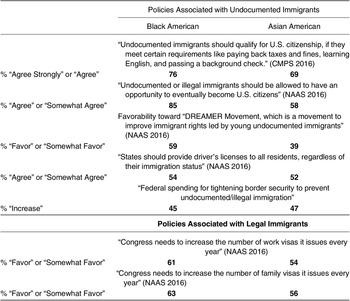
The findings in Table 2 are striking. Across every policy included in the table, Black Americans are as supportive or often much more supportive than Asian Americans. The findings are consistent across different types of policies and different surveys. For example, among 2016 CMPS respondents, more than 75% of Black Americans support a path to citizenship for undocumented immigrants, if they meet certain requirements, compared to 69% of Asian Americans. The 2016 NAAS included a similar question about a path to citizenship for undocumented immigrants, but without mention of meeting “certain requirements.” In that case, too, one observes that Black Americans (85%) are more supportive of a policy to regularize the status of undocumented immigrants than Asian Americans (58%). Recall that the CMPS was an internet-based survey and the NAAS was a more traditional telephone-based survey. And, although the questions are slightly different across surveys, the overall pattern is clear.
Black Americans more liberal on immigration policy attitudes, two different surveys

Sources: 2016 CMPS, 2016 NAAS
On other issues, similar results obtain. Black Americans favor the DREAMer movement by twenty percentage points over Asian Americans. The higher levels of support stem to some degree from less familiarity with the movement among Asian Americans compared with Black Americans. About 24% of Asian American respondents had “never heard of” the DREAMer movement, compared to about 13% of Black respondents. At the same time, Black Americans favor state provision of driver’s licenses to undocumented immigrants and increasing federal spending to prevent undocumented immigration at almost the same rate as Asian Americans.
The policies described thus far pertain to undocumented immigrants. But Black Americans are also more liberal than Asian Americans when it comes to policies that affect legal immigrants. Though work-based and family-based visas have fueled the tremendous growth of the Asian American community for decades (Wong Reference Wong2018), Black Americans demonstrate higher levels of support for increasing the numbers of immigrants able to enter the United States through these visa categories than Asian Americans.
It is important to contextualize the patterns one sees in Table 3. On the one hand, Black Americans consistently show as high or even higher levels of support than Asian Americans for policies that benefit and increase immigration in the United States, whether those policies are aimed at undocumented or authorized immigrants. On the other hand, we are not suggesting that Asian Americans are “anti-immigrant” because they demonstrate lower levels of support for these policies than Black Americans. In terms of the creation of a path to citizenship for undocumented immigrants, providing driver’s licenses to undocumented immigrants, and increasing the numbers of visas extended to immigrants, a majority of both Black and Asian Americans show support. Further, in most, but not all cases, Asian Americans exhibit more liberal attitudes toward policies designed to support undocumented immigrants than White Americans. For example, among 2016 CMPS respondents, nearly 27% of White Americans versus 16% of Asian Americans say undocumented immigrants already living and working in the United States should be immediately deported. Similar statistics characterize White American and Asian American attitudes about whether immigration “has an overall negative effect on the economy” in their state. More than 60% of White American respondents, versus about 45% of Black American or Asian American respondents favor increasing federal spending to tighten border security to prevent undocumented immigration. It is also worth noting that all racial groups demonstrate very strong levels of support for the creation of a path to citizenship. About 70% of White Americans and Asian Americans in the 2016 CMPS agree with this policy proposal. Again, this pattern is consistent with polling that has shown Americans support a path to citizenship over deporting undocumented immigrants living and working in the United States (Economist/YouGov 2018).
Concerns over deportation among non-citizens

Although data including large samples of both Asian American and Black respondents is uncommon, several past studies allow for a comparison of the two groups on key immigration issues. For example, Masuoka and Junn (Reference Masuoka and Junn2013) report that when asked about their concerns over rising levels of immigration in the United States, 57% of both Black and Asian Americans respondents in a 2006 survey with large samples of both groups claimed to be “somewhat” or “very” concerned (the survey was not offered in any Asian languages). The same survey revealed that Black respondents held positive views of both Asian and Latino immigrants, while Asian American respondents were much more likely to express positive views of Asian immigrants compared with Latino immigrants. For example, in that 2006 survey, Black respondents (21%) were less likely than Latinos (36%), Asian Americans (38%) or White American respondents (41%) to say that Latino immigrants “often end up on welfare.” When asked about Asian immigrants, just 3% of Black respondents claimed that foreign-born Asians “often end up on welfare” compared to 8% of Asian American respondents. When asked about whether they agreed with a path to citizenship for undocumented immigrants in the 2008 Collaborative Multiracial Post-election Survey, 71% of Asian American respondents “somewhat” or “strongly” agreed, but an even higher proportion of Black respondents agreed (85%).Footnote 3
The hallmark of the Asian American community is diversity. As the Asian American community has increased in numbers, it has also become more internally diverse in terms of national origin (Wong et al., Reference Wong, Ramakrishnan, Lee and Junn2011). As an indicator of this diversity, for example, a recent Pew research report on the population included nineteen different national-origin groups (Budiman and Ruiz, Reference Budiman and Ruiz2021). As such, it is important to examine variation across Asian national origin on immigration related attitudes. And, in fact, Chinese, Korean, and Vietnamese respondents are less likely to support the creation of a path to citizenship for undocumented immigrants compared with Indian and Filipino respondents (Phippen Reference Phippen2015). In addition, about one out of five Chinese respondents claim not to have a position on this policy, the highest of any of the national-origin groups queried (see Appendix). That Indians and Chinese seem to diverge on issues of immigration is intriguing since both communities demonstrate higher levels of education and income than the U.S. average. Although it is true that Indians are more likely to identify as Democrats than Chinese, both groups lean more Democratic than Republican as a whole. We return to this pattern of intra-Asian diversity below.
Explaining the Black-Asian Gap
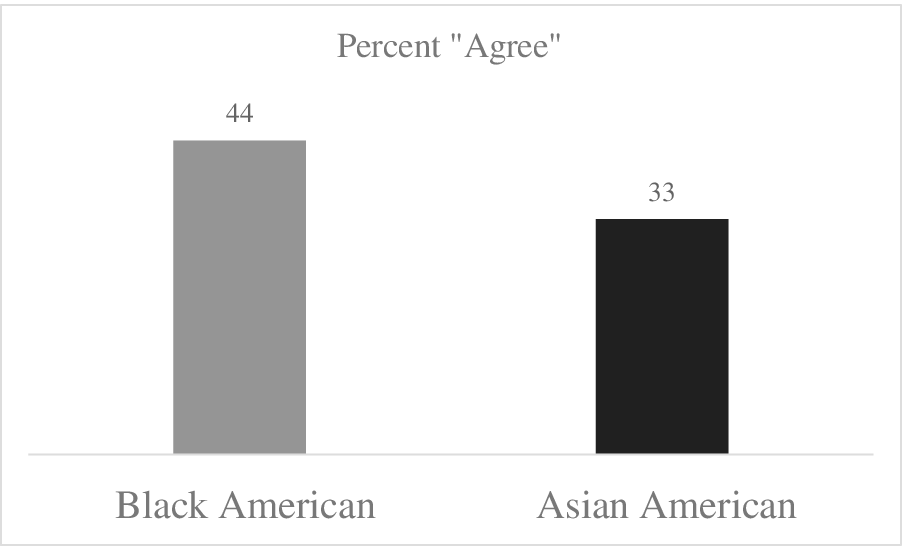
Figure 1, which draws on the 2016 CMPS, shows that in the aggregate, Black Americans are more likely than Asian Americans to “agree” that immigrants take jobs, housing, and healthcare away from people in the United States. About 44% of Black Americans and 33% of Asian Americans express this sentiment. This pattern maintains even if the sample is restricted to the highest income earners (those living in households earning $100k plus), though the proportions drop to 35% versus 29%, respectively. That is, regardless of household income level, Black Americans express a stronger sense of economic competition with immigrants than do Asian Americans.
Economic competition with immigrants: “Immigrants take jobs, housing, and healthcare away from people who were born in the U.S.”
Source: 2016 CMPS, full sample

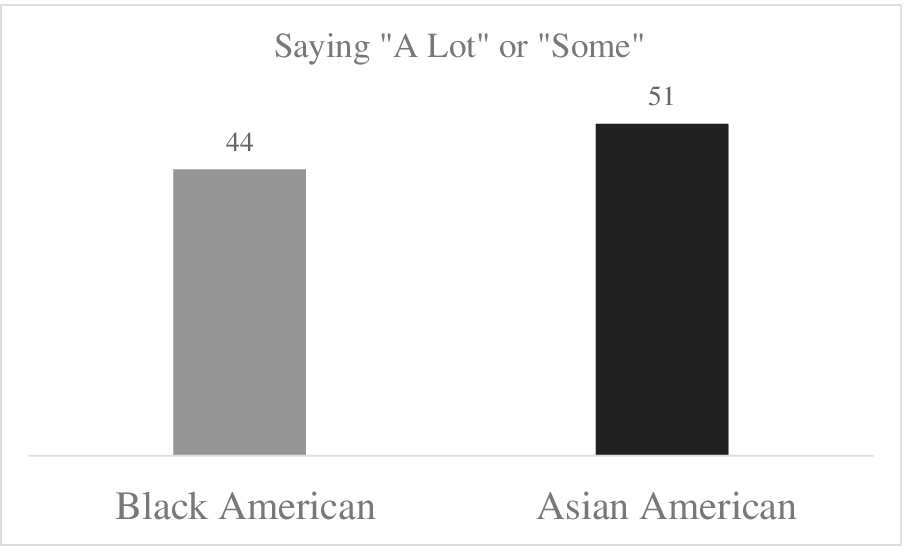
Figure 2, also using data from the 2016 CMPS, shows that, perhaps not surprisingly, Asian Americans, as a predominantly immigrant group, are more likely than Black Americans, a predominantly U.S.-born group, to signal a sense of “linked fate” (Dawson Reference Dawson1994) with immigrants. Just over half of the Asian American respondents claim that “what happens generally to immigrants in this country will have something to do with” their own lives. At the same time, nearly 45% of Black Americans make the same claim. This is certainly not a small proportion, but it is slightly lower than among Asian Americans.
Perceptions of linked fate with immigrants: “What happens generally to immigrants in this country will have something to do with what happens in your life?”
Source: 2016 CMPS, full sample

That Black Americans express a greater sense of competition over jobs, housing, and healthcare and lower levels of “linked fate” with immigrants might lead one to conclude that, in general, Black Americans will favor more restrictive immigration policies than Asian Americans. Yet, according to the analysis above this is not the case.
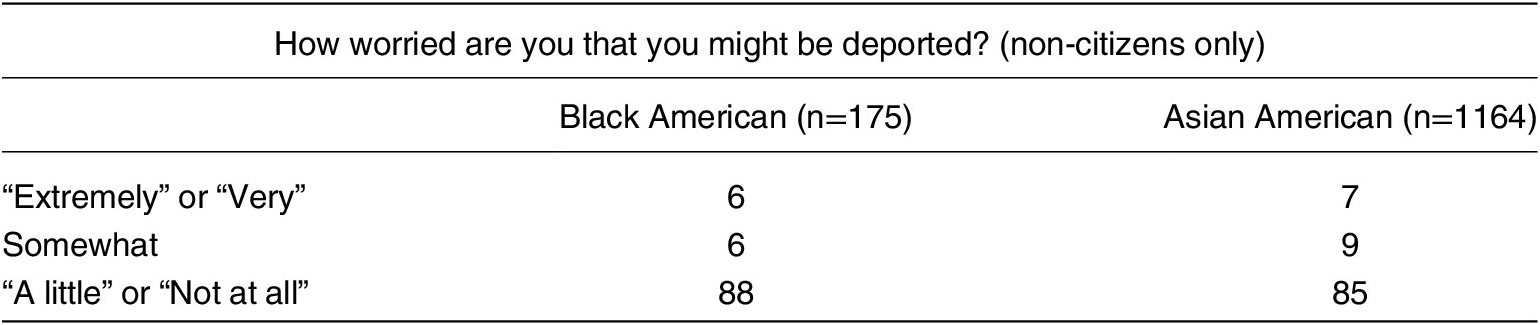
Notably, among both groups, Black and Asian, relatively few non-citizens express direct concerns about being deported themselves (Table 3).
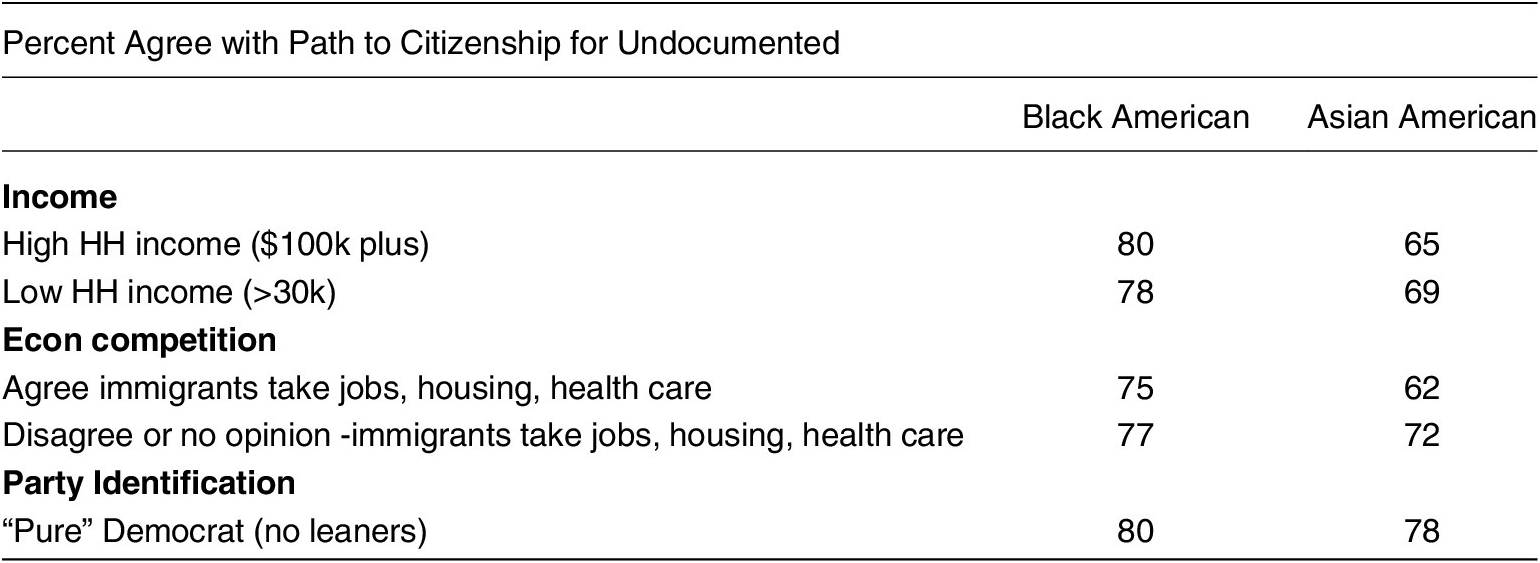
In addition, the data in Table 4 show that differences in economic status are not likely to account for the distinct levels in support for policies designed to benefit immigrants among Black and Asian Americans. In fact, the data in Table 4 show that Black Americans who report household earnings of less than $30k are more supportive of a path to citizenship for undocumented immigrants than Asian Americans whose households earn more than $100k. This challenges the notion that low-income African Americans, who many argue face acute levels of economic competition from undocumented immigrants (Catanzarite Reference Catanzarite and Shulman2017), will be the most opposed to policies that might benefit the latter groupFootnote 4 (Table 4).
Economics and Party Identification

Source: 2016 CMPS
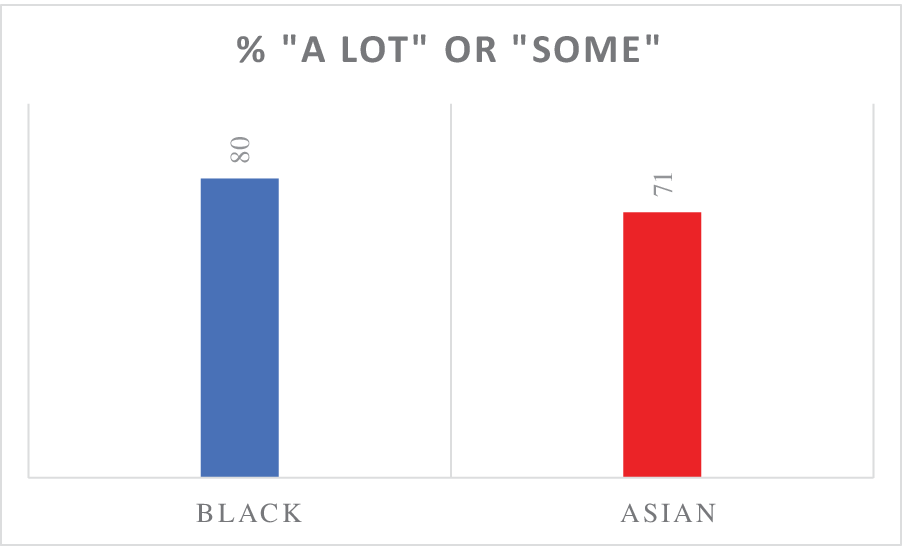
The last row in Table 4 shows that among those who identify as Democrats, support for a path to citizenship for undocumented immigrants is very similar among Black and Asian Americans. In other words, differences in party identification could explain part of the gap in attitudes. The data also show that Black respondents were more likely than Asian Americans to believe that immigrants face “a lot” or “some” discrimination (Figure 3). They were also more likely to perceive a strong sense of linked fate with other minorities than Asian Americans (belief that what happens to other minorities has “a lot” do to with one’s own life) (Table 5).
Believe immigrants face “a lot” or “some” discrimination
CMPS 2016, full sample

Perceptions of linked fate with other minorities: “What happens generally to other minorities in this country will have something to do with what happens in your life.”

Source: 2016 CMPS; full Black, Asian, and Latino samples
To summarize these preliminary analyses, there is little immediate evidence that being part of a majority immigrant community (Asian Americans), material interests, or economic competition will exert a major influence on immigration attitudes among Black Americans and Asian Americans. Party identification and shared racialization (linked fate) appear more likely explanations for the Black-Asian American gap in immigration attitudes.
Multivariate Analysis to Test Competing Explanations for the Black-Asian Gap in Attitudes Toward Immigration
Data from the NAAS 2016 and CMPS 2016 allow for some purchase in terms of exploring the role of material/economic interests and racialization on Black and Asian American attitudes toward immigration. We are also able to examine the extent to which partisanship explains these gaps. We first look at attitudes toward the creation of a path to citizenship for undocumented immigrants. Next, we take a closer look at policies that affect legal immigration. In all of the multivariate analysis, the sample consists of Black and Asian American respondents only and Asian Americans are the “excluded” category.
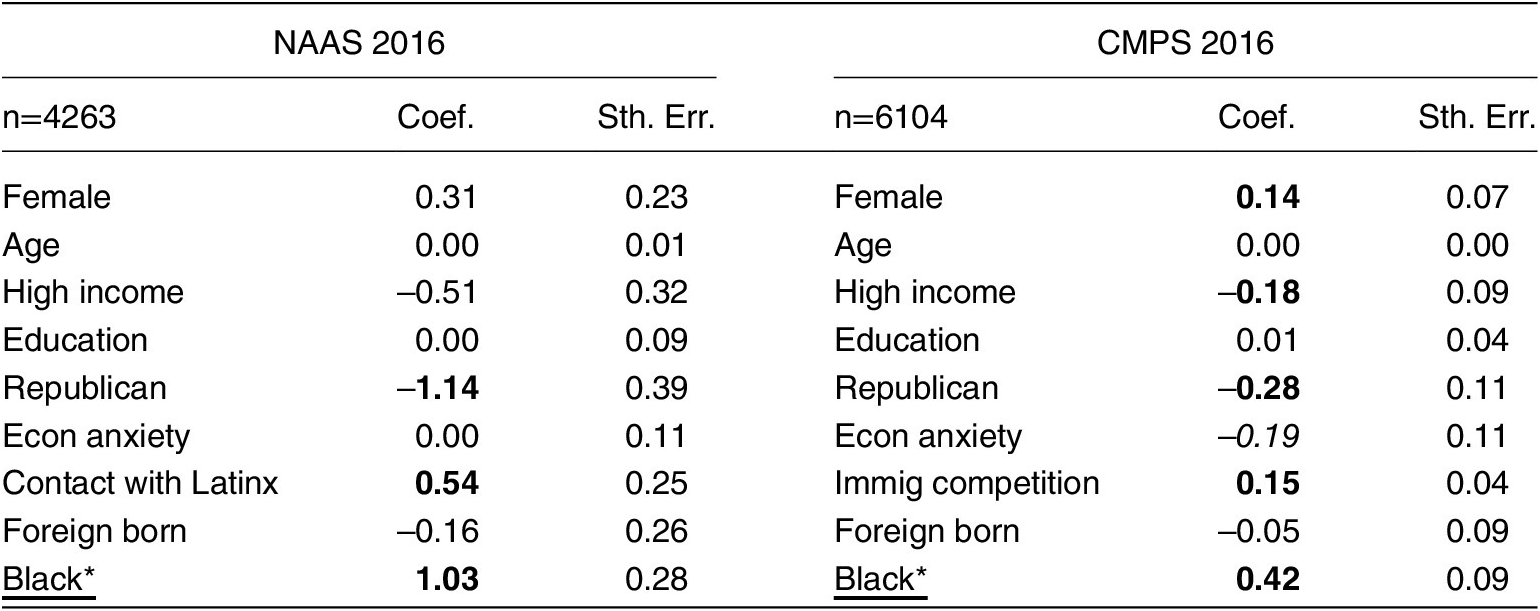
The results in Table 6 show that differences between Black Americans and Asian Americans persist even when taking into account basic demographic variables, socioeconomic status, party identification, and measures related to economic competition, contact with Latinx people, and economic anxiety. And, this is the case for data from both the NAAS 2016 and the CMPS 2016. This is not to say that some of these factors don’t influence attitudes toward immigration. Republican identity is associated negatively with support for creating a path to citizenship. Contact with Latinx people (only measured in NAAS 2016) is associated positively with this policy. Perceived competition with immigrants (“immigrants take jobs,” only measured in CMPS 2016) is associated positively with support for regularizing the status of undocumented immigrants via a path to citizenship. This makes some sense, as regularizing the status of undocumented immigrants could raise immigrant wages to the benefit of native-born workers as well. But the bottom line here is that even when controlling for these factors, the variable for Black identity remains strong and powerful. That is, differences in support for more progressive immigration policies between Black Americans and Asian Americans are not explained away by partisanship, economic factors, socioeconomic status, or contact with Latinx.
Support for Path to Citizenship; Multivariate (ordered logit) Black-Asian American differences not just a function of economic interests, contact with Latinx, or party identification

* excluded category is Asian
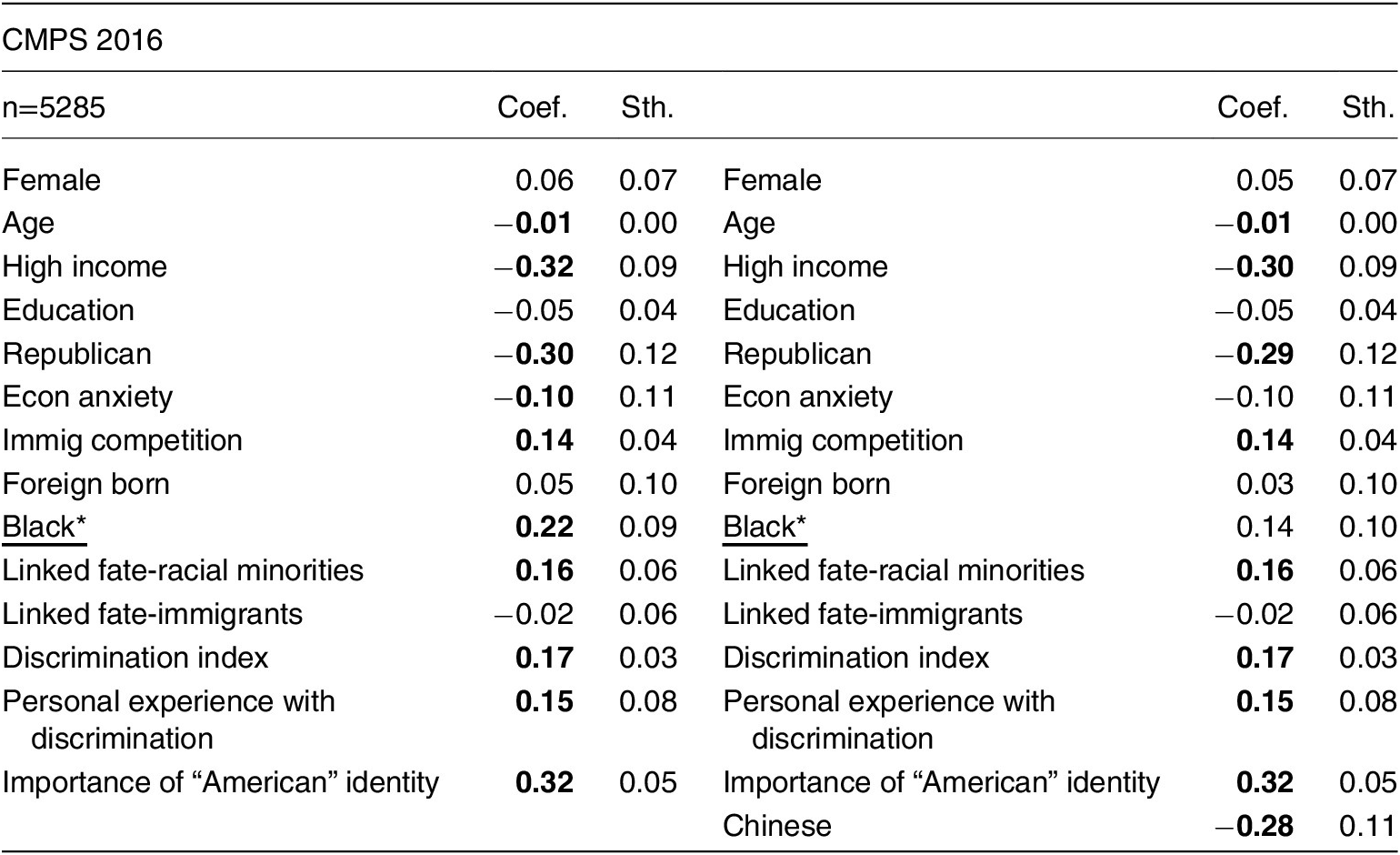
The results in the first column of findings in Table 7 provide strong evidence that we must look beyond material interests and economic competition/anxiety to understand the factors that drive attitudes toward policies designed to help undocumented immigrants among Asian American and Black American populations. If anything, economic anxiety and perceived economic competition are associated positively with support for creating a path to citizenship. This is exactly the opposite of what labor-market competition theories would assume, but consistent with the perspective of individuals who hope to decrease labor market competition by limiting the exploitation of undocumented workers.
Racialization, not material interests, key to support for a path to citizenship

* excluded category is Asian
Surprisingly, exhibiting linked fate with “immigrants” has little to do with support for a path to citizenship among these samples. However, possessing a strong sense of linked fate with “racial and ethnic minorities;” stronger beliefs that Blacks, Asians, Latinx, and Muslims face discrimination (“discrimination index”); and personal experience with racial discrimination are all important predictors of more liberal views toward a path to citizenship. Interestingly, those who believe their identity as “American” is very important are more, not less, likely to support a more liberal position on this policy. That is, “American identity” for Black and Asian Americans is not necessarily an indicator of anti-immigrant nativism as it is among White Americans. We underscore here the importance of moving beyond analysis centered around White Americans to gain new insights. Including these variables related to racial and national identity and discrimination in the model partially, but not fully, explains the gap between Black Americans and Asian Americans. In short, we see that the coefficient associated with Black identity starts to shrink with the addition of these variables.
In the second set of findings in Table 7 (column 2), we show that along with the variables associated with racialization above, accounting for “Chinese” identity more fully helps to explain the gap between Asian Americans and Black Americans when it comes to attitudes toward the creation of a path to citizenship for undocumented immigrants. This is likely because Chinese are among the most hardline of Asian American groups on issues of undocumented immigration. However, simply accounting for Chinese identity does not close the Asian-Black gap in attitudes toward this policy—racialization variables must be considered as well. More conservative attitudes toward immigrants among Chinese-identified respondents (Shah and Wong, Reference Shah and Wong2019) does not account for the broader differences between Asian American and Black respondents observed in the data.
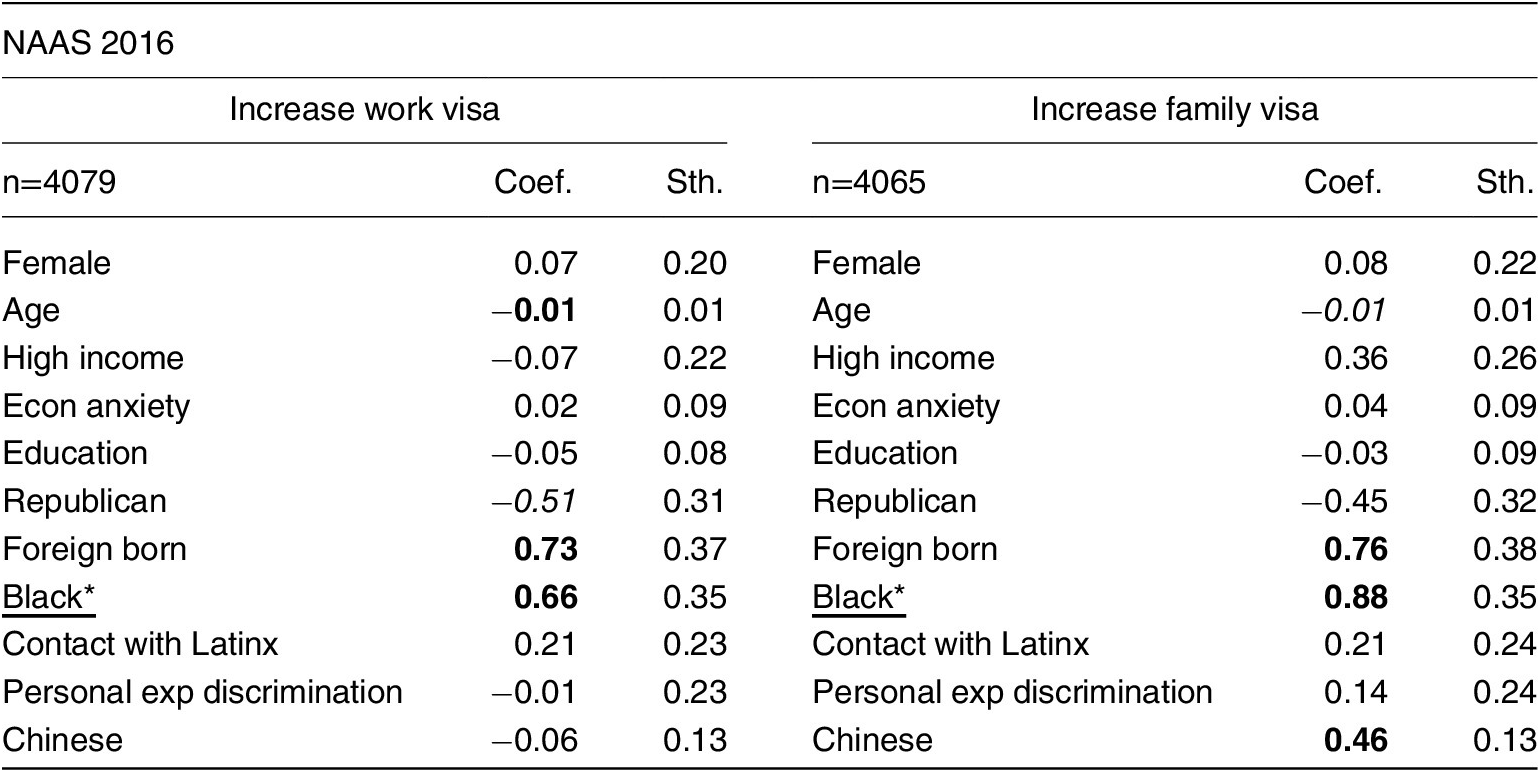
Turning to policies that affect legal immigration in Table 8, we find that gaps between Black Americans and Asian Americans persist and cannot be explained easily in terms of material interests or racialization. Questions on legal immigration were only available in the NAAS 2016, so explanatory variables are more limited (the NAAS 2016 did not include variables measuring economic competition with immigrants or beliefs about how much discrimination different groups face). The take-home point with this set of analyses on legal immigration is that even after accounting for economic anxiety, party identification, contact with Latinx, and personal experience with discrimination, Black Americans appear to exhibit more progressive attitudes toward legal immigration than do Asian Americans. This finding is unexpected given that Asian Americans have been the primary beneficiary of legal paths to U.S. immigration over the past two decades.
Black-Asian differences persist in terms of support for legal immigration, not easily explained (work and family-based visas should be increased)

* Excluded category is Asian
Conclusion
This article presents an exploratory analysis of the ways in which race matters for attitudes related to immigration policy by comparing two non-White groups that, at first glance, appear to reap very different benefits from more liberal immigration policies. The study context is the 2016 election cycle, when immigration issues were salient, but when attitudes toward immigration were perhaps less likely to be associated with the polarizing figure of Donald Trump than in 2020. Asian Americans are among the greatest beneficiaries of liberal immigration policies as they pertain to both undocumented and legal immigrants. Black Americans are less likely to directly benefit from these policies. While both groups show strong support for more liberal immigration policies, Black Americans are even more supportive in this arena than Asian Americans.
We use datasets that include large samples of both Black and Asian American respondents to highlight racial differences in support for policies that benefit immigrants among two non-White groups, one predominantly foreign-born, and one predominantly U.S.-born. Although they are less likely to be foreign-born, express a greater sense of economic competition with immigrants, and report lower levels of perceived linked-fate with those who are foreign-born, Black Americans are as, or more supportive, of policies designed to help both undocumented and authorized immigrants in the United States compared to Asian Americans. This is not to suggest that Asian Americans are “anti-immigrant” or conservative ideologically in their orientation toward immigration. Rather, Asian Americans demonstrate strong support for policies designed to benefit immigrants and increase immigration. However, Black Americans show even higher levels of support for these policies. Preliminary analysis shows that the explanation for this racial gap in support is much more likely to be rooted in political connections to racial minority groups in the United States rather than in direct economic calculations. Because of their own group history, defined by centuries of state sanctioned oppression, Black Americans are loathe to endorse legal restrictions that disproportionately affect any racialized group. This is true, even when Black Americans express economic anxieties related to other racial groups. Perceptions of group competition do not translate into punitive immigration policies. As such, we argue for a reconsideration of “group interest” that takes racialization as its starting point.
To state the implications of these findings another way, an important “take-home” from this paper is that measures of “economic anxiety” and strong “American identity” do not perform in the same way among non-White samples. As such, decentering White Americans in studies such as the current project reveal that many assumptions about how these variables might perform should take variations across racial groups into account.
Appendix
Variation in attitudes toward immigration by Asian national-origin group

Source: 2016 NAAS