Introduction
Horseweed is an annual plant, a member of the Asteraceae family, that emerges in the fall or early spring, and flowers during early summer or late fall. Upon emergence in the fall, horseweed forms a rosette; this rosette will overwinter and grow rapidly in the spring (Buhler and Owen Reference Buhler and Owen1997). Horseweed plants can attain up to 2 m in height and produce more than 200,000 seeds per plant (Weaver Reference Weaver2001). Horseweed is predominately self-pollinated, although a small amount of outcrossing may occur (Smisek Reference Smisek1995). The small seed (1 to 2 mm) has a pappus that facilitates seed dispersal by wind and water (Royer and Dickson Reference Royer and Dickson1999; Weaver Reference Weaver2001). The majority of the seeds fall within less than 100 m around the mother plant, although seeds have also been found in the Planetary Boundary Layer and have shown potential to move considerable distances (≥500 km; Shields et al. Reference Shields, Dauer, VanGessel and Neumann2006). The seed of horseweed has no dormancy requirement and can germinate immediately after release into the environment. No-till production creates an ideal environment for horseweed because germination and emergence is most successful in seeds located on the surface to a depth of 0.5 cm into soil. Horseweed has evolved resistance to four different herbicide sites of action globally, and several populations have been reported with resistance to multiple sites of action (Heap Reference Heap2020). In Canada, horseweed populations have been documented with resistance to 5-enolpyruvylshikimate-3-phosphate synthase (EPSPS)-inhibiting and acetolactate synthase (ALS)-inhibiting herbicides. The earliest record of glyphosate-resistant (GR) horseweed in Ontario was confirmed from seed collected in 2010 in Essex County (Byker et al. Reference Byker, Soltani, Robinson, Tardif, Lawton and Sikkema2013a, 2013b). Following this first report, GR horseweed has spread rapidly across southern Ontario. By 2015, GR horseweed populations were documented in 30 counties, with some populations detected more than 800 km away from the initial site.
Giant ragweed is a large annual weed in the Asteraceae family. Giant ragweed was historically found in roadside ditches and along river banks, but has evolved to thrive in agronomic fields (Bassett and Crompton Reference Bassett and Crompton1982). Emergence commences in early spring and continues throughout the summer followed by rapid vegetative growth (Abul-Fatih and Bazzaz Reference Abul-Fatih and Bazzaz1979). In 2008, seeds collected near Windsor, Ontario, were confirmed to be GR, making giant ragweed the first reported GR weed in Canada (Vink et al. Reference Vink, Soltani, Robinson, Tardif, Lawton and Sikkema2012b). Following the first report, Follings et al. (Reference Follings2013) confirmed GR biotypes in Chatham-Kent, Elgin, Huron, Lambton, Lennox and Addington, and Middlesex counties.
The presence of weeds, specifically broadleaf weeds, can have a substantial impact on soybean yield (Hartman et al. Reference Hartman, West and Herman2011; Stoller et al. Reference Stoller, Harrison, Wax, Regnier and Nafziger1987; Weaver Reference Weaver2018). If weed management strategies are omitted, it is estimated that soybean yield in North America would be reduced 52% from weed interference (Soltani et al. Reference Soltani, Dille, Burke, Everman, VanGessel, Vince and Sikkema2017). At a density of 162 plants m−2, GR horseweed interference has been reported to reduce soybean biomass up to 87% (Byker et al. Reference Byker, Soltani, Robinson, Tardif, Lawton and Sikkema2013b). Baysinger and Sims (Reference Baysinger and Sims1991) noted a 92% soybean yield reduction with giant ragweed density of two plants per meter of row. Similarily, Webster et al. (Reference Webster, Loux, Regnier and Harrison1994) reported 77% reduction in soybean yield when there was one giant ragweed plant per square meter. The critical weed-free period of soybean has been reported to range from emergence to the V4 growth stage and when weeds were controlled during this period, soybean yield loss was <2.5% (Van Acker et al. Reference Van Acker, Swanton and Weise1993).
Halauxifen-methyl is a part of the arylpicolinate family within the synthetic auxin class of herbicides (group 4). Halauxifen-methyl is an active ingredient in several commercial products registered globally for the control of broadleaf weeds. Halauxifen-methyl used at 5 g ai ha−1 is registered for applications at least 7 d prior to soybean seeding in no-till production for control of broadleaf weeds at the 1- to 8-leaf stage (Dow Agrosciences 2017). Halauxifen-methyl primarily provides control of annual broadleaf weeds, although control of perennial broadleaf weeds can also be achieved.
In Canada, halauxifen-methyl is registered for use as a burndown herbicide in no-till soybean systems for broadleaf weed control. GR giant ragweed is not listed on the current halauxifen-methyl label in Canada, and although GR horseweed is listed, variable control of GR horseweed has been observed in past studies (McCauley et al. Reference McCauley, Johnsome and Young2018; Zimmer et al. Reference Zimmer, Young and Johnson2018b). Consequently, there is a need to determine the most effective tank-mixes with halauxifen-methyl for the control of GR horseweed and giant ragweed. Field studies were conducted with the objective of evaluating the efficacy of halauxifen-methyl applied alone, and tank-mixed to control GR horseweed and GR giant ragweed in glyphosate and dicamba-resistant (GDR) soybean.
Materials and Methods
Experimental Methods
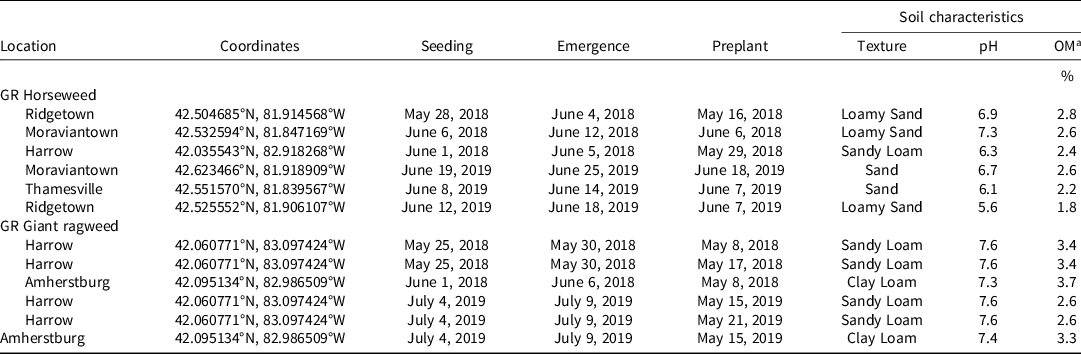
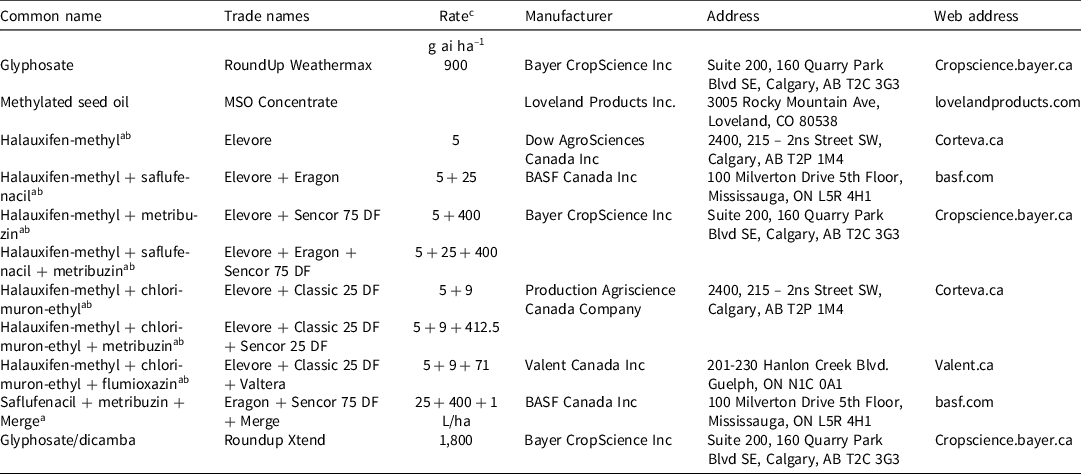
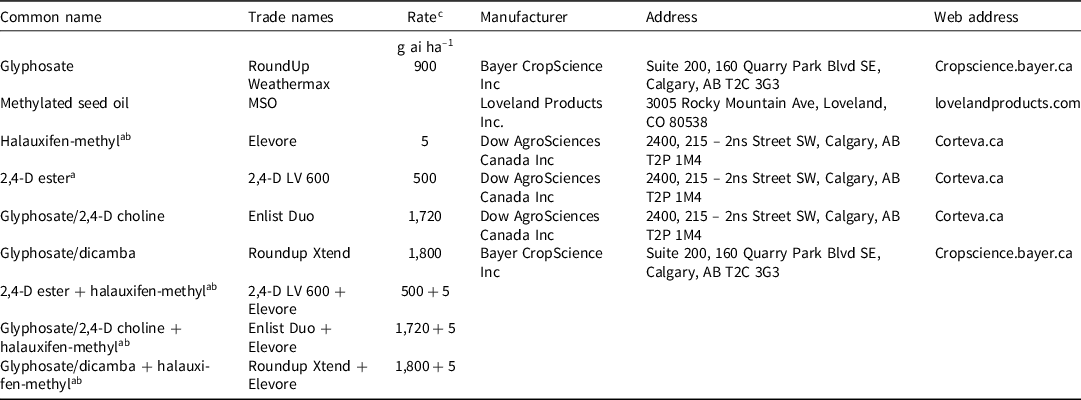
Two separate studies were conducted in 2018 and 2019 to investigate GR horseweed or GR giant ragweed control in GDR soybean. Each study consisted of six field trials located in southwestern Ontario (Table 1). To ensure that the weed populations present were GR, each trial received a glyphosate cover spray prior to treatment application. When trials were located at the same site, the trial application dates were separated in time. Treatments were randomized across four replications as a randomized complete block design and treatment plots were 2-m by 8-m. The GR horseweed study consisted of 11 treatments and the GR giant ragweed study consisted of nine treatments. Herbicide treatments for each study are described in Tables 2 and 3. Treatments were applied preplant (PP) to GDR soybean when majority of weeds were less than 10 cm tall. Weed-free control treatments received an application of saflufenacil (25 g a.i. ha−1) + metribuzin (400 g a.i. ha−1) + glyphosate (1,800 g a.e. ha−1) + Merge (nonionic surfactant, 1.0 L ha−1) PP in the GR horseweed study and glyphosate (1,800 g a.e. ha−1) + 2,4-D ester (528 a.e. g ha−1) PP in the GR giant ragweed study; hand-weeding was conducted when needed. Each experiment was subjected to a cover spray of glyphosate (450 g a.e. ha−1) in-season to eliminate other weed species. A CO2-pressurized backpack sprayer was calibrated to deliver 200 L ha−1 at 275 kPa and fitted with a 1.5-m boom equipped with four Turbo Teejet Induction (TTI-11003) nozzles (TeeJet Technologies, Wheaton, IL).
Seeding and emergence dates of soybean, and application dates and soil characteristics for the studies on pre-plant control of glyphosate-resistant horseweed and giant ragweed in Ontario in 2018 and 2019.

a Abbreviation: OM, organic matter.
Herbicide treatments applied preplant for control of glyphosate-resistant horseweed across six experiments conducted in Ontario, Canada, during 2018 and 2019.

a Treatment contains glyphosate, 900 g ae ha−1.
b Tank-mix included methylated seed oil at a rate of 1% vol/vol.
c Methylated seed oil rate was 1% vol/vol.
Herbicide treatments applied preplant for control of glyphosate-resistant giant ragweed across six experiments conducted in Ontario, Canada, during 2018 and 2019.

a Treatment contains glyphosate, 900 g ae ha−1.
b Tank-mix included MSO at a rate of 1% vol/vol.
c Methylated seed oil rate was 1% vol/vol.
Crop injury was evaluated at 1, 2, and 4 wk after emergence (WAE) using a zero-to-100 scale, with 0 representing no soybean injury and 100 indicating total plant death. Percent visible control ratings were recorded at 2, 4, and 8 wk after application (WAA) using a 0–100 scale with 0 indicating no weed control and 100 complete weed control. Weed biomass and density was determined at 8 WAA from two randomly arranged quadrats (0.25 m2) in each plot. Weeds within each quadrat were cut at the soil surface, bagged, dried in an oven maintained at 60 C for 3 wk, and then weighed when dry. In 2018, the soybean crop for the GR giant ragweed study at the Harrow location was hand-harvested (2 × 1-m of soybean row) and threshed. All other trials were mechanically harvested at maturity. At harvest, grain moisture and weight were recorded. Moisture was adjusted to 13% for yield calculations.
Statistical Analysis
The PROC GLIMMIX procedure in SAS v. 9.4 (SAS Institute Inc., Cary, NC) was used to analyze the data. The model random effects were block and site, within year by site, and the fixed effect was herbicide treatment. All sites were combined for each study. Normality assumptions were assessed using the PROC UNIVARIATE procedure. For weed control data analysis at 2, 4, and 8 WAA, a normal distribution was used, excluding the untreated and weed-free controls. Data for GR horseweed and giant ragweed density and biomass were fit to a lognormal distribution to fulfill the normality assumptions and then back transformed in SAS. The weed-free control was excluded from these analyses. Weed control, density, and biomass means were independently compared to the value of 0 (α = 0.05). Yield data were fit to a normal distribution. Means were calculated and compared using a Fisher’s protected LSD with a Tukey-Kramer adjustment (α = 0.05).
Results and Discussion
Soybean injury was ≤10% at 1, 2, and 4 WAA at all site and year combinations (data not shown).
Glyphosate-Resistant Horseweed
Weed Control
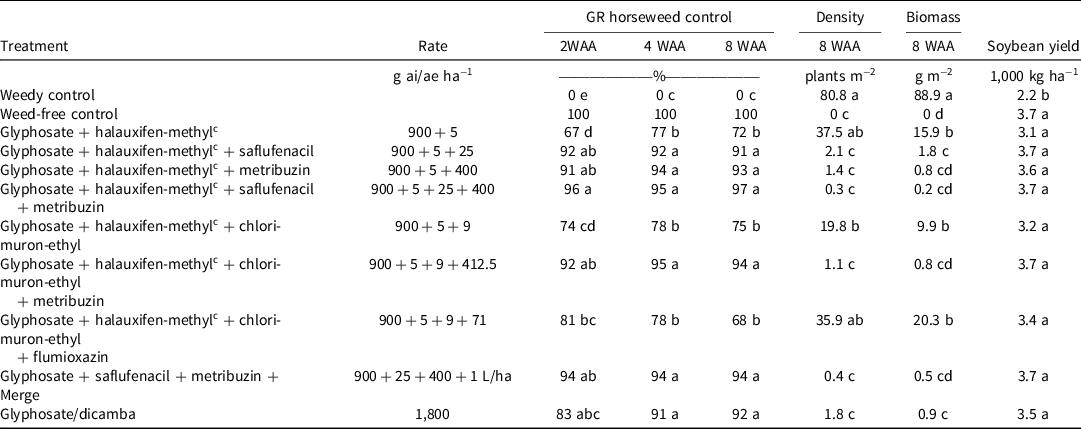
Halauxifen-methyl applied alone provided 67% control of GR horseweed at 2 WAA (Table 4). Halauxifen-methyl + chlorimuron-ethyl, alone or mixed with flumioxazin, provided 74% and 81% control of GR horseweed, respectively. Halauxifen-methyl tank-mixed with metribuzin, saflufenacil, chlorimuron-ethyl + metribuzin, or saflufenacil + metribuzin provided 91% to 96% control. Glyphosate/dicamba and glyphosate + saflufenacil + metribuzin provided, respectively, 83% and 94% control of GR horseweed.
Glyphosate-resistant horseweed control 2, 4, and 8 WAA, density and biomass 8 WAA, and soybean yield with herbicides applied preplant from 6 trials conducted in Ontario, Canada, in 2018 and 2019.a,b

a Values within column followed by a different letter indicate a statistically significant difference (P < 0.05).
b Abbreviations: GR, glyphosate-resistant; WAA, weeks after application.
c Tank-mix included methylated seed oil at a rate of 1% vol/vol.
Herbicide treatments differed for the control of GR horseweed at 4 and 8 WAA. At 4 and 8 WAA, GR horseweed was controlled by 77% to 78% when halauxifen-methyl was used alone and by 68% to 75% when it was tank-mixed with chlorimuron-ethyl or chlorimuron-ethyl + flumioxazin (Table 4). In comparison, all other halauxifen-methyl-based tank-mixes improved GR horseweed control to 91% to 97%. While there was a benefit to adding saflufenacil, metribuzin, saflufenacil + metribuzin or chlorimuron-ethyl + metribuzin to halauxifen-methyl, there was no benefit of adding chlorimuron-ethyl alone or mixed with flumioxazin. Glyphosate/dicamba and glyphosate + saflufenacil + metribuzin controlled GR horseweed by 91% to 94% at 4 and 8 WAA. The results of this study are similar to those reported by McCauley et al. (Reference McCauley, Johnsome and Young2018), who found that halauxifen-methyl applied alone provided 80% control of GR horseweed at 4 WAA. In contrast, Zimmer et al. (Reference Zimmer, Young and Johnson2018b) reported that halauxifen-methyl alone provided 90% control of GR horseweed at 5 WAA; in the aforementioned study, herbicide treatments were applied later in the season when weeds were approaching 20 cm. Zimmer et al. (Reference Zimmer, Young and Johnson2018b) reported similar control of GR horseweed at 5 WAA when using halauxifen-methyl + chlorimuron-ethyl + flumioxazin (75%), saflufenacil (98%), and dicamba (89%). Budd et al. (Reference Budd, Soltani, Robinson, Hooker, Miller and Sikkema2018) observed comparable control of GR horseweed with saflufenacil: saflufenacil (25 g ai ha−1) and saflufenacil (25 g ai ha−1) + metribuzin (400 g ai ha−1) provided 88% and 96% control of GR horseweed, respectively at 8 WAA. The addition of halauxifen-methyl to the saflufenacil + metribuzin mix did not result in any benefit; however, when halauxifen-methyl was included in the tank there was an additional effective mode of action. This should be taken into consideration by producers when developing a resistance management program (HRAC 2020).
Density, Biomass, and Yield
At 8 WAA, halauxifen-methyl, halauxifen-methyl + chlorimuron-ethyl + flumioxazin, and halauxifen-methyl + chlorimuron-ethyl reduced GR horseweed density from 80.8 plants m−2 to 37.5, 35.9, and 19.8 plants m−2, respectively (54% to 75% reduction) (Table 4). In comparison, all other halauxifen tank-mixes reduced the density of GR horseweed to between 0.3 and 2.1 plants m−2 (97% to 99% reduction). Glyphosate/dicamba and glyphosate + saflufenacil + metribuzin reduced the density of GR horseweed to 1.8 and 0.4 plants m−2, respectively (98% and 99% reduction), at 8 WAA. Zimmer et al (Reference Zimmer, Young and Johnson2018b) reported a similar reduction in GR horseweed density 5 WAA when saflufenacil was applied alone (96%), although density reduction in that study differed when halauxifen-methyl (76%), halauxifen-methyl + chlorimuron-ethyl + flumioxazin (91%), and dicamba (71%) were used. This difference in density can be attributed to the increased weed control observed in the study conducted by Zimmer et al. (Reference Zimmer, Young and Johnson2018b).
At 8 WAA, halauxifen-methyl reduced the biomass of GR horseweed from 88.9 g m−2 to 15.9 g m−2 (82% reduction). There was no benefit to the addition of chlorimuron-ethyl or chlorimuron-ethyl + flumioxazin. All remaining herbicide tank-mixes reduced the biomass of GR horseweed between 1.8 g m−2 and 0.2 g m−2 (98% to 99% reduction). These biomass reductions were consistent with the control ratings. Budd et al. (Reference Budd, Soltani, Robinson, Hooker, Miller and Sikkema2018) reported a lower biomass reduction of GR horseweed 8 WAA with the use of saflufenacil (92%) or saflufenacil + metribuzin (89%). This difference could be a result of varying factors, including biotype sensitivity.
When left uncontrolled, the presence of GR horseweed reduced the yield of soybean by 41% (Table 4). All herbicides evaluated reduced GR horseweed interference with soybean, which resulted in soybean yields being statistically similar to the weed-free control. Although yield was not impacted by the presence of horseweed when an herbicide treatment was applied, there are many other factors that must be considered. Herbicide resistance is an evolving issue for producers; a tank-mix that includes multiple effective modes of action can delay the evolution of herbicide resistance in various weed species, including horseweed (HRAC 2020).
Glyphosate-Resistant Giant Ragweed
Visual Control
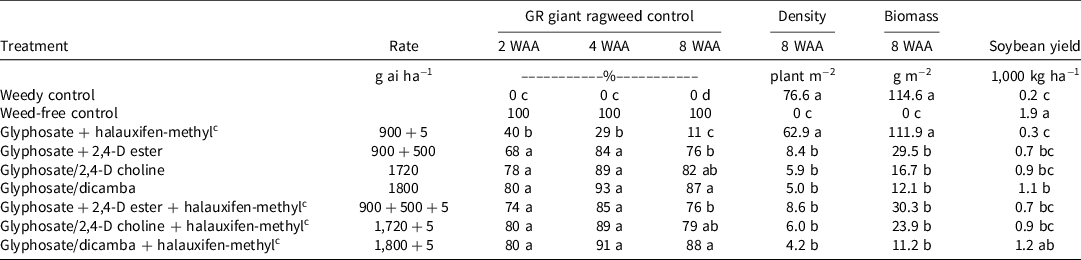
Halauxifen-methyl alone provided only 40% and 29% control of GR giant ragweed at 2 and 4 WAA, respectively (Table 5). Glyphosate + 2,4-D ester, a premix of glyphosate/2,4-D choline, and a premix of glyphosate/dicamba alone and in combination with halauxifen-methyl controlled GR giant ragweed 68% to 80% at 2 WAA, and 84% to 91% at 4 WAA. The inclusion of halauxifen-methyl with glyphosate + 2,4-D ester, glyphosate/2,4-D choline, and glyphosate/dicamba did not improve GR giant ragweed control. In contrast, Zimmer et al. (Reference Zimmer, Young and Johnson2018a) observed higher giant ragweed control 3 WAA, when halauxifen-methyl provided 73% control of GR giant ragweed. Vink et al. (Reference Vink, Soltani, Robinson, Tardif, Lawton and Sikkema2012a) observed that GR giant ragweed was controlled by at least 97% at 4 WAA when 2,4-D ester was used. It was unknown why this current study showed lower control of GR giant ragweed with 2,4-D applications compared with those reported by Vink et al. (Reference Vink, Soltani, Robinson, Tardif, Lawton and Sikkema2012a).
Glyphosate-resistant giant ragweed control 2, 4, and 8 WAA, density and biomass 8 WAA, and soybean yield with herbicides applied preplant from 6 experiments conducted in Ontario, Canada, in 2018 and 2019.a,b

a Values within column followed by a different letter indicate a statistically significant difference (P < 0.05).
b Abbreviations: GR, glyphosate-resistant; WAA, weeks after application.
c Included methylated seed oil at a rate of 1% vol/vol.
GR giant ragweed was controlled by 11% at 8 WAA when halauxifen-methyl was used alone (Table 5). Glyphosate + 2,4-D ester and glyphosate/2,4-D choline provided 76% and 82% control of GR giant ragweed, respectively; the inclusion of halauxifen-methyl did not further increase GR giant ragweed control. Glyphosate/dicamba provided 87% control at 8 WAA. The inclusion of halauxifen-methyl with glyphosate/dicamba did not increase the control of GR giant ragweed. In contrast, Zimmer et al. (Reference Zimmer, Young and Johnson2018a) reported 65% control of giant ragweed with halauxifen-methyl at 5 WAA, which is much higher than we found in this study. However, they reported that 2,4-D ester, dicamba, halauxifen-methyl + 2,4-D ester, and halauxifen-methyl + dicamba provided 80% to 93% control of giant ragweed, which is similar to what we report here.
Density, Biomass, and Soybean Yield
Halauxifen-methyl did not reduce GR giant ragweed density at 8 WAA (Table 5). Treatments with glyphosate + 2,4-D ester, glyphosate/2,4-D choline, glyphosate/dicamba, alone and tank-mixed with halauxifen-methyl reduced the density of GR giant ragweed from 76.6 plants m−2 to between 4.2 and 8.6 plants m−2 (89% to 95% reduction). The inclusion of halauxifen-methyl to glyphosate + 2,4-D ester, glyphosate/2,4-D choline or glyphosate/dicamba did not further reduce GR giant ragweed density. In contrast, Zimmer et al. (Reference Zimmer, Young and Johnson2018b) observed a 30% reduction in giant ragweed density when halauxifen-methyl was used compared to the untreated control. The aforementioned study examined broad spectrum weed control and did not focus on GR giant ragweed specifically; therefore, overall species density and biotype sensitivity could explain the large difference in giant ragweed density reduction. The same study reported that use of 2,4-D ester, dicamba, halauxifen-methyl + 2,4-D ester, and dicamba + 2,4-D ester resulted in a 44% to 75% reduction in the density of giant ragweed at 5 WAA.
Halauxifen-methyl did not reduce GR giant ragweed biomass at 8 WAA (Table 5). Glyphosate + 2,4-D ester, glyphosate/2,4-D choline, glyphosate/dicamba, glyphosate + 2,4-D ester + halauxifen-methyl, glyphosate/2,4-D choline + halauxifen-methyl, and glyphosate/dicamba + halauxifen-methyl reduced GR giant ragweed biomass from 114.6 g m−2 to between 12.1 g m−2 and 21.5 g m−2 (74% to 90% reduction). There was no evidence that adding halauxifen-methyl to glyphosate + 2,4-D ester, glyphosate/2,4-D choline or glyphosate/dicamba further reduced GR giant ragweed biomass.
GR giant ragweed presence in the untreated control resulted in a reduction of 89% in soybean yield compared to the weed-free control (Table 5). The magnitude of this interference is similar to that reported by Baysinger and Sims (Reference Baysinger and Sims1991) and Webster et al. (Reference Webster, Loux, Regnier and Harrison1994). GR giant ragweed interference in plots treated with glyphosate + halauxifen-methyl, glyphosate + 2,4-D ester, glyphosate/2,4-D choline, glyphosate + 2,4-D ester + halauxifen-methyl, and glyphosate/2,4-D choline + halauxifen methyl resulted in yields that were similar to those of the untreated control. In contrast, reduced GR giant ragweed interference with glyphosate/dicamba + halauxifen-methyl resulted in yield that was comparable to the weed-free control.
In conclusion, results from these two studies showed that halauxifen-methyl applied alone provided suppression of GR horseweed but did not adequately control GR giant ragweed. Excellent control of GR horseweed was obtained when halauxifen-methyl was applied as a mix partner with saflufenacil, metribuzin, saflufenacil + metribuzin, or chlorimuron-ethyl + metribuzin. Similar GR horseweed control was observed when saflufenacil + metribuzin and glyphosate/dicamba were used. The presence of GR horseweed reduced crop yield substantially; crop yield was comparable to that of the untreated control with all the halauxifen-methyl tank-mixes evaluated. Glyphosate + 2,4-D, glyphosate/2,4-D choline, and glyphosate/dicamba provided >80% control of GR giant ragweed. Halauxifen-methyl included as a tank-mix partner with glyphosate + 2,4-D, glyphosate/2,4-D choline, and glyphosate/dicamba did not improve GR giant ragweed control. The presence of GR giant ragweed reduced crop yield with all the herbicide treatments evaluated, except the glyphosate/dicamba + halauxifen-methyl treatment. These studies emphasize the importance of GR horseweed and GR giant ragweed control to minimize soybean yield loss. Season-long weed control is encouraged to reduce/eliminate weed seed return to the soil and improve harvestability. In summary, these studies demonstrated that halauxifen-methyl added to a tank-mix is efficacious for the control of GR horseweed and GR giant ragweed. Herbicide programs with at least two effective modes of action are important to reduce the potential for the development of herbicide-resistant biotypes (HRAC 2020). Halauxifen-methyl will provide growers with an additional herbicide option in their integrated weed management programs.
Acknowledgments
Funding for this project was provided by Corteva Agriscience Inc. No conflicts of interest have been declared.