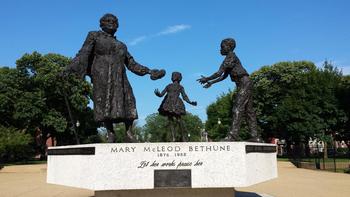
On 10 July 1974, a crowd of about 18,000 gathered in Lincoln Park, Washington, DC, to see the unveiling of a memorial to Mary McLeod Bethune (Figure 1). On the stage were those who had led the campaign, including Dorothy Height, president of the National Council of Negro Women, the organization founded by Bethune; dignitaries from local and national government; and veterans of the civil rights movement. “Ma is in the Park,” exclaimed a supporter.Footnote 1 Her appearance in the residential area of Capitol Hill was the result of a long campaign and it was an important moment. Her arrival marked two significant firsts: it was the first monument to an African American and the first to a woman of any race on federal land in the nation's capital. Erecting a statue to a black female civil rights leader disrupted the otherwise white and masculine memorial landscape of Washington. In so doing, it challenged dominant historical narratives in important ways. Through its form, its symbolism, its placement, and its accompanying discourse, the Bethune Memorial demanded a place for black women within America's national memory.
The Bethune Memorial, Lincoln Park, Washington, DC.

Mary McLeod Bethune was a civil rights leader, political adviser and educator. She founded a school (later to become Bethune-Cookman College), served as an adviser to four Presidents (most notably as the leading figure in Roosevelt's “Black Cabinet”), was president of the National Association of Colored Women, and founded and led the National Council of Negro Women (NCNW). She was a forceful advocate for black women; she wanted to ensure they were on the national agenda. She was committed to “improving the economic and political clout of black women” through her “female-centered activism.”Footnote 2 Bethune was a complex figure; a pragmatist who was an astute political operator, with a message that could be conciliatory and at other times assertive. She “blended militancy with accommodation.”Footnote 3 From unlikely beginnings she forged a career for herself as a national figure and a race leader. She and her supporters held up her life as an example of what African American women could achieve; it was a “metaphor for black success.”Footnote 4 Both her representativeness and her uniqueness made her the ideal subject for a memorial.
Three years after Mary McLeod Bethune's death in 1955, the NCNW began to discuss ways to commemorate her life.Footnote 5 Initial ideas envisaged a project which would raise money for both a new headquarters and a memorial, possibly to be built on the same site. When it was realized that this was not feasible, plans were made for a memorial which would include a space for community activity. Lincoln Park, in eastern Washington, DC, was identified as a suitable site for their monument and work began securing the necessary approval.Footnote 6 This included securing a Joint Resolution in Congress, the first of which was signed in June 1960.Footnote 7 It gave the NCNW five years to secure the necessary funds, a target it failed to meet. This delay was in large part due to the demands, both financial and in terms of time, of increased civil rights activism during the 1960s. Indeed, the project needed extensions to federal approval in 1967 and again in 1971. The project, or more specifically the design for the sculpture and the park relandscaping, also needed to be approved by the National Capital Planning Commission, the Department of the Interior, and the Commission of Fine Arts. The final sum required for the memorial was $400,000. This money, which took fourteen years to raise, came from individual donors, a series of fund-raising events (which ranged from society balls to fashion shows to calendar sales), and some large sponsors. The largest single donation of $100,000 came in 1971 from the United Methodist Church.Footnote 8
A House joint resolution for a memorial to Bethune was first introduced by Frances Bolton of Ohio in 1959.Footnote 9 Shirley Chisholm (Congresswoman for New York) took up the campaign after she became the first black woman elected to Congress in 1968. There was considerable bipartisan support for the Bethune Memorial, and Congressional debates included endorsements from, amongst others, liberal Republican Senator Jacob Javits of New York.Footnote 10 There was also opposition, mainly from southern members of Congress. For example, when the resolution to extend the authority for the monument was passed in 1971, there were ninety dissenters. These included five of South Carolina's six Congressmen.Footnote 11 The most vocal opponent was staunch segregationist and conservative Louisiana Congressman John R. Rarick. He quoted from HUAC reports alleging that Bethune was a member of communist-front organizations. These claims were challenged by others in the House and the majority of speakers praised Bethune as an outstanding example of American achievement.Footnote 12 She was a seemingly uncontroversial figure, whom many could support for memorialization. Nevertheless, opposition such as Rarick's and that of some southern politicians, including those from Bethune's home state, suggest the symbolic power of a monument in the capital erected to honour an African American.
The sculptor selected to design and build the sculpture was Robert Berks. His best-known work at the time was a bust of Abraham Lincoln.Footnote 13 During the commissioning process, the NCNW contacted the Fine Arts Commission with a three-person shortlist.Footnote 14 The commission replied to say all three would be “competent” but suggested that “in honoring an outstanding Negro educator, there would be a unique opportunity to commission a Negro sculptor to do the work.” They proposed Richmond Barthé, the experienced African American sculptor.Footnote 15 There is no recorded reply to this suggestion, nor any evidence for why the NCNW did not consider a black sculptor. Berks later claimed that the NCNW approached him after “a very thorough search in this country first of all to find a negro sculptor” but that “unfortunately, no negro has had the experience of making monuments in this country.”Footnote 16
The memorial by Robert Berks consists of three figures in bronze. The dominant figure of Mary McLeod Bethune holds a scroll, her Last Will and Testament, in one hand and a cane in the other. She is presenting the scroll to two black children. Bethune herself is not looking at the children but is gazing into the distance, a slight smile on her lips as if the future that she sees there pleases her. The large pedestal, on which the figures stand, is engraved with words from Bethune's Last Will and Testament. The Bethune Memorial is visually similar to two earlier paintings of the civil rights leader, which depict her in a similar posture: standing tall, cane in hand.Footnote 17 Berks's Bethune, however, is more expressive and expansive, more dynamic in her posture; with her arms thrown open wide, her gesture is more inclusive. It is striking that the monument is made from bronze, rather than white marble.Footnote 18
The Bethune Memorial, despite its historical significance, has been largely forgotten by both academics and a wider public. While Lincoln Park is a popular neighbourhood recreation area, and although an annual ceremony is still held there each summer, it does not feature on the itinerary of most tourists. A handful of scholars refer to the memorial, often in passing, but there has been no academic study of its creation or meaning. Just as Mary McLeod Bethune herself does not fit into the Montgomery-to-Selma narrative of the civil rights movement, neither does her statue feature in discussions of civil rights memorialization.Footnote 19 James Young explains why it is important to tell the story of how and why a monument is created. “As an inert piece of stone, the monument keeps its own past a tightly held secret,” so it is the role of historians to uncover that past. In so doing, “we remind ourselves of the memorial's essential fragility, its dependence on others for its life; that it was made by human hands in human times and places.”Footnote 20 The aim of this article is to discover those human hands, times and places. It will explore the creation of the memorial and consider its meanings. A number of scholars have identified conflict at the heart of commemorative processes.Footnote 21 The story of the Bethune Memorial is not one of conflict (indeed, on the surface, it appeared to be a relatively smooth, though prolonged, process). But a close reading of the memorial suggests tensions in its meaning. Bethune meant more than one thing to the same people, at the same time. The nature of these tensions and how they are resolved suggests much about the ways in which memory is constructed and how this can be used to shape a shared, collective identity. Furthermore, this article asks how this statue of a black woman in the nation's capital could fit into an African American, and a wider American, past.
The Bethune Memorial is on the (albeit forgotten) eastern side of an important monumental axis. Lincoln Park was part of L'Enfant's original plan for the capital and is significant for another statue, placed there almost a hundred years before Bethune's. The Freedmen's Memorial, or the Emancipation Group, as it became known, was dedicated in 1876.Footnote 22 The money for the memorial to the martyred Lincoln was raised by African Americans, principally black Union veterans, though the commission and design were overseen by whites. Thomas Ball's statue shows Lincoln, dressed in suit and frockcoat, with a scroll – the Emancipation Proclamation – in one hand, and the other raised in blessing. At his feet is a black man – kneeling or beginning to rise, depending on your interpretation – dressed only in the rags of slavery. The black figure's fist is clenched, an alteration Ball made in response to the commissioners’ request that the black figure be more “representative” – in others words, less passive. One reading of the sculpture, therefore, is that the slave has broken his own chains, and so was responsible for his own freedom, rather than relying on the actions of Lincoln. However, the positioning of the two figures (along with their relative states of dress or undress) is clearly problematic. Art historian Kirk Savage is critical of its message:
Ball's design was a failure to imagine emancipation at the most fundamental level, in the language of the human body and its interaction with other bodies … Instead of representing a new order, it reasserted the old racial structure and power relations of slavery … It held no future promise of emancipation for the black man at all.Footnote 23
According to the NCNW, Lincoln Park was chosen as the home for its memorial because of the existing statuary and because it was already an important site of African American commemoration. Dorothy Height told the crowd at the dedication that the newly unveiled Bethune Memorial was “inspired by the memorial that is already here.” On the day of its dedication in 1876, she went on, “thousands of the newly emancipated citizens came to this place. Lincoln Park therefore is a very special place.”Footnote 24 The council consciously drew on the park's significance and meaning for African Americans. It largely ignored the troubling symbolism of the Emancipation Group. Instead, the emphasis was placed on a message of self-emancipation. At the dedication, Dorothy Height claimed that a reading of the original monument in Lincoln Park made it “very clear that the emancipation proclamation followed because the slave broke his own chain. He set himself free.”Footnote 25 However, there are suggestions that she was uncomfortable with Ball's depiction of race relations. A newspaper quoted Height as commenting, “This park has a different context now. It's no longer just Lincoln and a slave.”Footnote 26
As part of the redesign of Lincoln Park and in anticipation of the arrival of Bethune, the Emancipation Group was turned 180 degrees, so that Lincoln faced the NCNW founder.Footnote 27 Dorothy Height quipped that this was so “that his back will not be to our gracious lady.”Footnote 28 More than this, though, the two statues are clearly in dialogue. As the NCNW explained it, the Lincoln statue was repositioned to face Bethune “to convey the message that the children of slaves had progressed from servitude.”Footnote 29 Mary McLeod Bethune symbolized that progress. She was the fifteenth child of former slaves, born in a sharecroppers’ hut in South Carolina in 1875, who went on to found a school, to serve as a political adviser, and to establish and lead a national organization. The NCNW literature boasted of the many remarkable achievements of this “daughter of slaves.”Footnote 30 Berks explained that he “tried very closely to show the fulfilment … of the slave breaking his bonds … a hundred years later.”Footnote 31 The council had originally planned to erect the memorial to coincide with the centenary of the Emancipation Proclamation in 1963. The timing was intended as a deliberate convergence of commemorations, in order to emphasize the great strides that the race had made since freedom. While it failed to meet its fund-raising target and therefore missed the anniversary, the finished monument remained a symbol of racial advancement.
Interestingly, the statue of Bethune echoes the figure of Lincoln, not that of the kneeling freedman. As Savage comments, both clasp a scroll and stand with their arm outstretched, “raising up a still-unformed generation.”Footnote 32 Comparisons with the slain President were emphasized during the dedication of the Bethune Memorial in 1974. At the ceremony in Lincoln Park, the actor Roscoe Lee Brown read extracts from the speech Frederick Douglass had made at the Freedmen's Memorial over a hundred years earlier. In Brown's speech the name Lincoln was replaced with Bethune. So, for example, he read, “we are here to express as best we may … our grateful sense of the vast and preeminent service rendered by Mary McLeod Bethune to ourselves, to our race, to our country, and to the whole world.”Footnote 33 Douglass was, as David Blight explains, acutely aware of the need for African Americans to create a “usable past.” His speech in Lincoln Park was so important because it was a concerted effort “to forge a place for blacks in the national memory, to assert their citizenship and nationhood.”Footnote 34 At the Bethune Memorial ceremony, Brown repeated one of Douglass's most important lines in this regard: “We stand today at the national center, to perform something like a national act.”Footnote 35 Bethune was hardly the national figure that Lincoln was, and, significant though it was, her work did not equal the importance of Emancipation. Nevertheless, by using Douglass's words, the organizers of the 1974 event appropriated his sense of the politically useful role of remembering and his understanding that racial equality meant, in part, securing a place for African Americans in the national memory.
More prosaically, comparing Bethune with one of the most popular Presidents in American history elevated her status.Footnote 36 Furthermore, by the 1960s Lincoln was remembered as a “champion of racial justice.”Footnote 37 It was strategically useful for civil rights activists to remember Lincoln not just as the Great Emancipator, but also as an advocate for racial equality, even if this belied the historical reality. Linking the memories of Lincoln and Bethune gave legitimacy and moral power to the latter's work and therefore to the NCNW's continued campaign for racial justice. A statement issued by the Joint Committee on Landmarks of the National Capital at the time of the dedication said that the two memorials were “mutually supportive … with their common themes of struggle and accomplishment.”Footnote 38 Presenting Bethune as a Lincoln-like figure also gives her a universal appeal, because it suggests that she embodies American values. By comparing Bethune to a white, male President, the monument elides her gender and race. Here is a great American, rather than a great black American woman. There were pragmatic reasons for the NCNW to frame their memorial in such a way. At an early planning meeting in 1958, it was noted, “The granting of funds for the erection would be made easier by the universality of its appeal to the people of both sexes, all races, creeds and nationalities.”Footnote 39 Two years later, Dorothy Height made this case to Congress. Speaking before the Committee on House Administration in support of the Joint Resolution, she said that the proposed memorial would “have significance for people in every segment of American life and in every section of our country.” Bethune, she argued, “meets every ideal as a focus for the recognition of the finest and best in our democracy.”Footnote 40
The finished monument depicts Bethune as a “unifying figure.”Footnote 41 Words from Bethune's Last Will and Testament, a meditation on her life and a message to her race, published in Ebony in 1955, are engraved on the base of the memorial. They read,
I leave you love. I leave you hope. I leave you the challenge of developing confidence in one another. I leave you respect for the use of power. I leave you faith. I leave you racial dignity. I leave you also a desire to live harmoniously with your fellow man. I leave you finally a responsibility to our young people.
The full text of the Last Will expands on these tenets, to offer advice to African Americans and a vision of how to achieve racial equality.Footnote 42 This abbreviated form, however, while clearly necessary given the restrictions of space, also has the effect of presenting a far more universal legacy. It could be read as message not just to African Americans but to all people about how to live their lives. There is an emphasis on humanity and moral values, rather than explicitly on civil rights. In this way the tone of the engraving is conciliatory rather than assertive. Roger Baldwin of the ACLU, who lent his support to the memorial project, wrote of Bethune's “universal” qualities; she “belongs to us all.”Footnote 43
Bethune as a universal, unifying figure was appealing to politicians. At a ceremony on the steps of the Capitol which followed the dedication, Speaker of the House Carl Albert claimed that
it's a day when all of us regardless of sex, regardless of race, regardless of national origin, regardless of geography … come to pay tribute not just to a great woman, but to a great American, not to just a great and leading black but a great human being.
They were there, he said, to honour, “one who showed that under the American way, all people can rise from poverty; all people regardless of origin can enjoy the fruits of liberty expressed in the Declaration of Independence, the Constitution, the Bill of Rights. Here we salute a great American.”Footnote 44 Bethune is commemorated not as an activist who overcame the obstacles of racial discrimination and sexism and worked to break down those barriers for others, but as the embodiment of the American Dream; not as someone who fought to overcome the betrayal of the supposed founding principles, but as the beneficiary of them. The effect of this universalizing is that any message either of a unique black contribution or of continued racial agitation is lost. Supporting the memorial allowed politicians to demonstrate racial tolerance without needing to engage with continuing issues of racial inequality. Critics of the project from within the NCNW membership complained about this “hypocrisy.” One wrote to say that the monument would be “something for the racist, warring administration to show off as indication of a good will, which truly does not exist.”Footnote 45 The political support for the monument may have reflected, at least in part, the hope that a symbolic gesture would replace the need for substantive change.
However, while a “universal” figure was celebrated by some, the Bethune of the memorial was identifiably and proudly black. She represented the specific achievements and contributions of African Americans. Berks's sculpture clearly depicts a woman of African descent. As Elaine Smith explains, Bethune looked like many other black women, with her “kinky-textured hair, flaring nose, full lips, and a coal-black complexion.”Footnote 46 Berks produced a lifelike replica, which avoided racial caricature but which did not hide her racial identity. The literature used to promote the project emphasized Bethune's accomplishments as an African American and her work on behalf of her race. The memorial, the NCNW claimed, would be a “symbol of the black struggle in, and contribution to America.”Footnote 47 An article in Look magazine explained that, while “some people might ask [why] pick an obscure lady educator who was probably just another token, ineffective and innocuous enough to be accepted by the white establishment,” Bethune was “no Uncle Tom.” She worked on black voter registration and refused to be intimidated by the Klan. The article quoted Congresswoman Shirley Chisholm, who said, “At a time in our history when the black man's protest was still a whisper, Mrs. Bethune was in the vanguard of the fight for dignity, justice and equality.”Footnote 48 For Dorothy Height and her fellow NCNW members, Mary McLeod Bethune was the perfect symbol of civil rights activism. Indeed, the theme of the memorial's dedication in July 1974 was “Living the Legacy,” and the council used the publicity generated by the event to draw attention to the work yet to be done to secure full racial equality.
When understood in this context, the Bethune Memorial should not be read as having a conciliatory message about resolved racial problems. Rather, it suggested that the struggle, in which Bethune had played such an important part, was ongoing. The task force which organized the dedication agreed that the emphasis should be on the Last Will and Testament and on how its lessons could help inform solutions to current problems and the next decade's worth of activism.Footnote 49 One of the key events during the three days of celebration was the Black Women's Institute Bethune Memorial Symposia. This was intended to “respond to [Bethune's] appeal to Black people everywhere to recognize their common problems and unite to solve them.” The panels covered topics from the black family, through international dimensions of racism, to education and economics.Footnote 50 The NCNW wanted to use the arrival of the Bethune Memorial to reinvigorate civil rights activism and to refocus on the issues faced by black people in 1970s America. A press release claimed that “it will serve as the beginning of a new commitment to the freedom, justice, and equality for which Mrs. Bethune so ardently fought.”Footnote 51 The memorial was thus a statement both of black activism and of universal American values. In this way it spoke to a tension in African American identity. This was W. E. B. Du Bois's double-consciousness; his “two-ness” as “an American, a Negro.”Footnote 52 Bethune was remembered as both a black American and an American; she was both the freedman and the Great Emancipator.Footnote 53 The memorial also reflected Bethune's own, often pragmatic, stance on racial issues in the first half of the twentieth century. Audrey McCluskey writes of the black leader's “duality,” her appeal to both African Americans and white progressives.Footnote 54 Bethune's work was often a careful balancing act to secure the support of both constituencies (though always for the benefit of the former).
A particular story of American history is told through the monuments of Washington. Its memorial landscape in the 1970s was white. In white marble, the nation commemorated the deeds of dead white men. These monuments evoke “an abiding sense of national identity.”Footnote 55 It was one which did not include racial minorities. The NCNW frequently pointed out that its statue to Bethune would be the first memorial to a black American in the capital. This is not to say there were no depictions of black people. After all, there is a black man in the Freedmen's Memorial. But he is there to highlight the magnificence of Lincoln, rather than as a historical figure with agency. The vision of black history offered by the Freedmen's Memorial is that the race's contribution, and its history, stopped at this point: on the cusp of freedom but still kneeling.
The NCNW was aware of, and concerned by, the pernicious effect on contemporary race relations of this negation of black history. Walter E. Washington, an African American who in 1967 became Washington's first mayor-commissioner, told an early planning meeting for the Bethune Memorial that when thousands of young people “come from all over the country to see the great edifices … there is no place where they can go to learn about the Negro.” An NCNW publication asked why “black visitors to the National shrines seemed to be dwindling.” The answer was that “they do not feel these things belong to them. They live in the United States but no one seems to care about what they have done for it.” It was particularly important that such a memorial be constructed in the capital, with federal approval, because the “black child … needs tangible evidence that his people have achieved greatness and that the National government, to whom he owes allegiance, recognizes this truth.”Footnote 56 The only part of black history which was remembered, the NCNW believed, was slavery. A fund-raising letter argued that “national recognition of the black man's heritage and contribution to America's way of life is long overdue. Particularly, since slavery as a facet of American history is understood – while the black man's role in helping this nation to achieve greatness has been passed over.”Footnote 57 This was the story of African Americans as represented by the Freedmen's Memorial. The NCNW wanted its monument to “Update History.”Footnote 58
The Bethune Memorial was to be a symbol of what African Americans had achieved and what they had done for the country. For Height and her colleagues, this was so important because this story of black contribution was missing from the capital's monumental landscape and therefore from the nation's history. They understood that in order to achieve true equality, African Americans had to be included in the national memory.Footnote 59 The black women of the NCNW needed to have their version of the past accepted by the larger society. The memorial's location was so important in this regard. While it did not require any federal money (indeed, this was made a stipulation of Congressional approval), the Bethune Memorial is on federal land and is looked after by a federal agency (the National Park Service). It is close to the seats of political power and is part of the national landscape. If a nation's monuments reflect its story and identity, then a monument to a black woman suggests that the group thus represented can be included in that national narrative and identity. Furthermore, this desire to incorporate black history into American memory helps to explain how and why the Bethune Memorial could be universally American and specifically African American at the same time. The monument remembered a story which was both unique to black people and representative of the nation. It was a pluralistic vision of history, a way of finding a space for black people within the American narrative.
The council's desire to widen the understanding of black history reflected broader changes in both popular memory and academic history. As Robert Harris notes, by the end of the 1960s there was a “groundswell of interest” in the African American past. There was pressure at national and state level to acknowledge the “black historical experience”; some states began including lessons on black history in public schools, and hundreds of books and textbooks were published which chronicled African American history.Footnote 60 This history was one which emphasized the place and contribution of black people in the American story. The Bethune Memorial – a statue to a black woman in the capital's monumental heart – fits within this broader discourse of including African Americans into the national narrative; black history was American history.
The decision to create a monument, rather than some other form of commemoration, was significant in this context. Dwyer explains that the “formal and public situation” of monuments “confirms the status of their narratives as ‘real’ history,” in part because “they must pass a higher threshold of public scrutiny and capital investment.”Footnote 61 If the council wanted to stake a claim for black people in the national historical consciousness then it needed to use a mode of commemoration which echoed other markers of the national story. A large, bronze statue gave this commemorative project gravitas and legitimacy. The African Americans who instigated the Bethune Memorial used the language of official and national commemoration to assert their place in American memory. This sense of validity came at a cost, and the decision to spend hundreds of thousands of dollars and to dedicate considerable time and effort to erecting a bronze sculpture was criticized by some within the organization. In response to appeals for money, some disgruntled members sent replies complaining that there were other, more pressing, needs for those funds. For example, one wrote, “These thousands of dollars are needed not for stone and bronze monuments but for food, education, housing, medical care, and political organizing.” Another argued that Bethune herself would never have approved wasting money “assembling dead stones.”Footnote 62 The NCNW, in response to criticism of its project, acknowledged that its priorities remained hunger, housing, education and health. However, it defended its decision to build a memorial. Congresswoman Chisholm explained, “The Memorial will serve as a manifesto that black Americans have not only earned the right to the necessities of daily living, but to their heritage as well.”Footnote 63 The suggestion here is that racial equality meant more than political and social rights; it necessitated cultural recognition too. A fund-raising leaflet from 1962 explained,
As an American, your dignity and the dignity of your children is dependent upon the feelings of self-respect and self-acceptance that can only grow out of a knowledge and understanding of the cultural, educational and spiritual heritage of the Negro's contribution to the richness of American life.Footnote 64
The Bethune Memorial was erected not just to show white Americans that black people had a history which was part of America's; it was also to show black people that they had a history of which they should be proud.
In a number of ways, then, the NCNW believed that the memorial would serve the needs of the black community (both locally, in terms of the immediate community of Capitol Hill and the District of Columbia, and also a national black community). Height and her fellow organizers saw the monument as something more than just a statue. Early plans included a theatre and a meeting room, and although these were abandoned because of cost implications, the council continued to talk about it as a “living memorial.”Footnote 65 The organizers wanted it to be a place for cultural and intellectual exchange, and a community meeting place. The project's architect, Hilyard Robinson, hoped the Bethune Memorial would be “above the usual ‘run of the mill’ practice of placing a piece of sculpture on a pedestal in a park … and forgetting it.”Footnote 66 A letter from Dorothy Height explained that they wanted to make it a “living memorial, not only through the use of the monument site for concerts, dramas and forums, but also as a symbol of the continuing participation of all of us in the struggles which engaged Mrs. Bethune.”Footnote 67
Washington, DC was a significant site for the Bethune Memorial not only because it was the nation's capital but also because it was a centre of national black life. The “Chocolate City,” as it was known, became the country's first majority black city in the 1960 census and by 1968 nearly 70 percent of its population were African American.Footnote 68 Lincoln Park was located in what one NCNW leader referred to as “an area that includes low-income families who lack recreational facilities and cultural activities for their children and themselves.”Footnote 69 This neighbourhood included a sizeable black population, largely on the north side of the park. Indeed, Lincoln Park was the economic and racial dividing line between two communities: to the north lived “young, black families of home-renters. South of the park are primarily white, middle-aged home owners.”Footnote 70 During the 1960s many inner-city areas of DC had been blighted by economic underdevelopment and the tax drain of middle-class flight, a process exacerbated by the 1968 riots.Footnote 71 In the Lincoln Park area of what is now known as Capitol Hill local residents complained of an increase in crime, violence and vandalism, and that the park itself had fallen into disrepair. Writing in 1967, a group of local residents outlined some of their concerns with the current state of Lincoln Park: “The present condition of the Park is deplorable: derelicts inhabit it; broken glass is everywhere; unleashed dogs roam freely; the park is poorly lighted; and unlawful incidents are common.”Footnote 72 The project to install the Bethune Memorial included refurbishing Lincoln Park. It was tidied and relandscaped, with new walkways, lighting, children's play areas and seating installed.Footnote 73
The NCNW played a central role in this wider beautification project. It campaigned against a proposed eight-lane freeway in the area and worked with the National Park Service and neighbourhood organizations to help rehabilitate the park, for the benefit of locals.Footnote 74 A letter was sent to local residents, condemning acts of vandalism in the park, and trying to create a sense of ownership. “These statues belong to us. The park belongs to us,” the letter affirmed. It was sent by the NCNW and Operation COPE, a council project which helped low-income black mothers in public housing communities in Washington, DC. The Bethune Memorial project was thus part of a wider intervention in the black urban experience. The NCNW believed that its memorial project served a larger civic and community purpose. It claimed that the redevelopment of the park “brought a new sense of pride to the neighborhood.”Footnote 75 A number of events were arranged during the dedication celebrations to specifically include local people. A harambee (from the East African tradition of community activities) was held, to “encourage family participation,” “develop local talent” and “project Lincoln Park as a truly public facility.”Footnote 76 There was also a twenty-four hour vigil in the park, to allow people “to think, to pray, to reflect, [and] to stand silently for a moment to remember the struggle of Black Americans and the leadership and contribution of Black Women in that struggle.”Footnote 77 When engaging with the black community, the NCNW emphasized an “activist” memory of Bethune.
Local people also were amongst those who turned out on 10 July to see the memorial's unveiling. They included a twelve-year-old boy who praised the statue because it “shows that black people can be heroic” and a young girl who commented that “a lot of black people” had come to the ceremony.Footnote 78 In fact, a number of black residents held their own informal welcome for the Bethune Memorial the night before the official dedication. The Washington Post reported that around 150 people, mostly “young, black and residents of the area,” gathered round the statue in the evening. They told the reporter that the official ceremony, with a “symphony orchestra” and everybody “all dressed up,” was not for them, and so they decided “to welcome Mrs. Bethune in our own way.” A number brought instruments – something they often did in the park on hot summer nights – and played. Some expressed ambivalence about the timing of the statue's arrival, explaining that “Black people are leaving this neighborhood everyday” because they could no longer afford the house prices.Footnote 79 This comment raises questions about the relevance of the memorial to a rapidly declining black community and whether it succeeded in the NCNW's aims of inspiring racial pride in the wider African American population. It is unclear whether black residents of Washington shared the memory of Bethune which was constructed by the monument's sponsors.Footnote 80 The park is still used as a site of memorialization, with the National Park Service and NCNW holding an annual event on Mary McLeod Bethune's birthday. However, the space has primarily become a local community park for dog walkers, families and joggers. An NPS report found that the reconstruction of the park in the 1970s altered the relationship between its dual uses as a memorial site and a neighbourhood park, which had previously been “physically integrated.” Now there is “a separation between the stark memorial space of the central plaza area, and the shaded, landscaped outer areas most often used by runners, sunbathers, strollers, and dog walkers.”Footnote 81
When the Bethune Memorial appeared in 1974, there were few other monuments to individual, named African Americans anywhere in the nation.Footnote 82 One example was the statue of Booker T. Washington at the Tuskegee Institute. The Booker T. Washington Monument, or Lifting the Veil of Ignorance, as it is also known, was dedicated in April 1922. It shows Washington, dressed in three-piece suit, standing over the seated figure of a black man; the Tuskegeean is raising a cloth from over the head of his charge. As the inscription explains, “He lifted the veil of ignorance from his people and pointed the way to progress through education and industry.”Footnote 83 The composition is reminiscent of Ball's Freedmen's Memorial, with Washington in the Lincoln role of “emancipator”; the lower figure is unclothed and muscular like the slave in Lincoln Park. As both Charles Keck, Washington's sculptor, and Berks echoed Ball's Lincoln in their creations, there are aesthetic similarities between the Washington and Bethune statues. This is apt, as comparisons between the two educators have often been made. Bethune was influenced by Washington, taking inspiration both from his ideas about industrial education and from his ability to raise funds amongst whites.Footnote 84 The two statues present their principal subjects in authoritative postures, with both leaders gazing into the distance. However, Bethune's gesture is more inclusive; it is figuratively and literally more open (Washington is presenting; Bethune is inviting). Furthermore, their relation to the other figure(s) in their memorials, and the agency of these other figures, suggest a different philosophy and power dynamic. Washington's dominance over the “ignorant” labourer is clear, and, as Ralph Ellison's narrator in Invisible Man memorably noted, there is an ambiguity in his gesture: “I am standing puzzled, unable to decide whether the veil is really being lifted, or lowered more firmly in place.”Footnote 85 Bethune is the clear figure of authority in the sculpture but the children are also active participants. She is educating and raising leaders.
When Berks was designing his sculpture, in 1961, children had already become important actors in and images of the civil rights movement. The fight for school desegregation had children at its heart: evidence in the Brown case centred on the damaging impact of racial discrimination on African American children, and young people were on the front line in the school desegregation cases, most famously during the confrontation at Little Rock. As Rebecca de Schweinitz notes, by the mid-1950s it was strategically useful to link the rights of childhood to civil rights.Footnote 86 Children were active participants in the civil rights movement. This understanding of children as activists is reflected in the Bethune Memorial. Bethune, explained Berks, “says, ‘Here is my legacy,’ and she is not looking at the children but is looking at you because the children are her legacy.” Berks used the younger daughter of Harry Belafonte, Shari, as his model for the girl in the Bethune Memorial.Footnote 87 Shari Belafonte was seven when Berks was commissioned to begin work on his sculpture; a similar age to Ruby Bridges, the six-year-old who integrated William Frantz Elementary School, Louisiana in 1960. Berks's sculpture is reminiscent of photographs of the young Bridges, with her braided hair and full skirt.Footnote 88 She was a tiny figure, who symbolized both childhood innocence, with its associated demand for protection, and brave resilience. Both Bridges and the girl of the Bethune Memorial represent the responsibility placed on a blameless young black girl's shoulders – a burden met with dignity and strength.
The inclusion of children in the Bethune Memorial makes a powerful statement about the continuing fight for racial equality. However, it could also be read as undermining the monument's political impact. Schweinitz explains that focussing on the rights of childhood meant that “the federal government never seriously addressed many of the African American community's other concerns.” Furthermore, childhood, like gender, “signifies relationships of power.”Footnote 89 The children of the Bethune Memorial are non-threatening and lack meaningful (political) power. In this regard they are like the slave of Thomas Ball's sculpture. Though a grown man, he has been infantilized by his inferior positioning. As the black art historian, Freeman Henry Morris Murray, writing in 1916, said of the kneeling man, “his attitude and expression indicate no … apparent appreciation of the duties and responsibilities of his new position and little if any conception of the dignity and power of his own personality and manhood.”Footnote 90 Both the children and the slave represent potential but lack potency. There is a danger that the Bethune Memorial could be read as simply a call for black educational opportunities (a demand white society could claim to have met through school desegregation). However, the NCNW did its best to reframe its monument; through the discourse created as part of the memorialization, the wider concerns of the black community were articulated.
The Bethune Memorial was notable not just because it was the first monument to an African American on federal ground, but also because it was the first to a woman, of any race. Washington, DC's memorial landscape was dominated by memorials to dead politicians and military leaders; that is, to men. The female form did appear, of course, but she was there as an allegory.Footnote 91 Janice Monk argues that in the public art of the urban landscape “women are largely invisible, present occasionally if they enter the male sphere of politics or militarism.” Bethune, she points out, is one of the only women commemorated in Washington; she is there “in her own right as a black educator, though she too served as a political appointee.”Footnote 92 Monk is correct that Bethune had a career in politics and that this was celebrated by the women who remembered her. However, it is not acknowledged explicitly in the memorial. The only hint is the fact that she is holding a cane, said to have been given to her by her closest presidential ally, Franklin D. Roosevelt.Footnote 93 This connection, however, is not obvious to the uninformed viewer. Instead, the representation of Bethune celebrates her role as educator, as someone who worked to raise up the next generation of the race. Thus Bethune is presented in a particularly feminine role. In the segregated schools of the twentieth-century South, education was “the special province of African American women.”Footnote 94 Furthermore, in her positioning next to two children Bethune is presented in a maternal role. This is “Ma” or “Mother Bethune,” as she was known. Berks spoke of Bethune's “fantastically warm motherliness.” He saw her as a “symbol of what the mother does”: “prepares her children to go out into the world.”Footnote 95 However, while the sculpture might have fulfilled some gender expectations (by emphasizing Bethune's work in the feminine sphere), it also challenged gendered racial stereotypes in powerful ways. The female figure on show in Lincoln Park was not the black woman of popular imagination; Bethune was presented as neither the hyper-sexualized jezebel nor the loyal Mammy.Footnote 96 Instead it was a public image of a respectable, dignified, non-sexualized and educated black woman. Bethune placed great emphasis on maintaining her physical appearance, often having beauty treatments, such as getting her hair “rolled.” This, Joyce Ann Hanson explains, was not just vanity; it was a way to “undermine negative perceptions of black womanhood.” Berks's sculpture reflects Bethune's own “model of studied femininity” and is thus a powerful symbol of black female pride.Footnote 97
What is particularly interesting about how gender is expressed in the memorial is the contrast between the subject and the form. The very utilization of statuary, of a monument as a form of commemoration, is arguably masculine. It was men who commissioned monuments and those monuments were to men. Sabine Marschall argues that “the genre of official commemoration through public monuments was historically a male reserve.” Furthermore, “the genre of bronze-statue-on-pedestal is historically tainted as a patriarchal formula.”Footnote 98 So not only the fact that it was a monument, but also its size, material and form made the Bethune Memorial a particularly masculine form of commemoration. It is made of bronze and the figure of Bethune rises twelve feet. Landscaping work carried out in preparation for the statue lowered the area where Bethune stood, so that she would not tower over the President at the other side of the park.Footnote 99 For all the comparisons with Lincoln and the masculine language of the commemoration, this speaks to a seemingly fixed gender and power dynamic: a black woman could never dominate a white male.
Gender relations are played out in another interesting (and somewhat perplexing) way in the statue. The figure of Bethune is holding out her “legacy” to two black children. The boy is reaching toward it, but the girl appears to be leaning back, as if shying away.Footnote 100 The NCNW's own literature on the memorial refers to Bethune passing on her legacy to two children, making no distinction between the boy and girl. Furthermore, Robert Berks, describing his plans for the memorial, said it would show “Mrs. Bethune offering her legacy to a young boy and girl … She will offer a parchment to their outstretched hands.”Footnote 101 However, other observers described her as passing it on to the boy. A special commemorative issue of Time describes Bethune “looking into the distant future as she passes on her legacy to the male child as the little girl shares this moment in time with them.”Footnote 102 An editorial in the Baltimore Afro-American offered a potential meaning behind this positioning. John H. Murphy III, the newspaper's editor, wrote that “Mrs. Bethune, who grew up in a predominantly matriarchal society, purposely passed the legacy to the boy instead of the girl, as she wanted to create in the black male the image of leadership in both the family and in society.”Footnote 103 However, it was not the case that Bethune's focus was on black male leaders; much of her work was designed to nurture, encourage, promote and find opportunities for black women. Hanson describes her as a “‘race woman’ with a womanist consciousness,” whose multifaceted work “allowed black women to create a positive self-image.”Footnote 104 Therefore it might seem surprising that the organization she left behind would commission a design suggesting that the boy was the one to receive it.
The editor's comments should be placed in the context of a wider discussion about black women, matriarchy and civil rights in the 1960s and early 1970s. In his controversial 1965 report on the black family, Daniel Moynihan claimed that segregation and racism had affected black women less than it had men, and that the resulting “matriarchy” further hindered black men. The solution, Moynihan suggested, was to raise the status of African American men, even if it was at the expense of black women. You might have expected an organization like the NCNW to challenge this attack on black women, as some black activists and writers did at the time. However, the council remained silent.Footnote 105 Indeed, Height appeared to support the notion that the black father should be prioritized; she is quoted in the report as saying,
If the Negro woman has a major underlying concern, it is the status of the Negro man and his position in the community and his need for feeling himself an important person, free and able to make his contribution in the whole society in order that he may strengthen his home.Footnote 106
As White notes, this stance “put the Council in the camp of those who, like Moynihan, believed that the race would rise only when its men did.”Footnote 107 This position suggests that Height might have supported the privileging of the black boy in the Bethune Memorial in order to symbolize raising up black males.
However, the Bethune Memorial's seeming reinforcement of the message that the race rises with its men is in contrast with the wider symbolism of the statue. After all, the figure which dominates is not the young African American male, but the towering black woman. In this way the monument could actually be read as a refutation of the Moynihan report. It was a way of saying that black women were not ashamed of what they had achieved; they were not going to apologize for the figure of a strong black woman, a figure that Moynihan (in exaggerated claims of black women's status) had attacked. Comedian and activist Dick Gregory, who attended the Bethune Memorial concert at the Kennedy Center, said, “She represented that beautiful, powerful black lady that kept the family together and made ends meet – when there were no ends.”Footnote 108 The three days of events for the dedication were a celebration of black women. Moreover, the statue taken as a whole challenges the idea which underpinned the report and much of the wider discourse of the period: that the race would only rise when its men did. Instead, by presenting a heroic Mary McLeod Bethune, passing on her wisdom to the next generation, it offered a different message about how the race could be lifted: by its women. Indeed, the girl statue's stance, arms held aloft and apart, echoes that of Bethune's, suggesting that she would follow in the older woman's footsteps and might one day be a leader of her race. Furthermore, the fact that she was modelled on the daughter of a well-known civil rights activist (and the likeness of a young heroine of the movement, Ruby Bridges) indicates the young girl's potential. Berks said that when he found out the identity of his model (she had been brought to the studio by her uncle, Hilyard Robinson), he felt it “personifie[d] the pride and hope of the future.”Footnote 109
The National Council of Negro Women had, as the name suggests, always been an organization which was concerned about the experiences of black women. However, in the 1960s these concerns were largely subsumed by a focus on racial equality. This was in keeping with a broader trend during this decade. As White explains, the NCNW's
work privileged race over gender such that black women's needs were perceived to be met when the race was served. By the middle of the 1960s, therefore, the Council, indeed, black America in general, had supplanted the principle that a race could rise no higher than its women with the idea that women could rise no higher than the race.Footnote 110
The needs of black women had to take a backseat while the wider issues of racial equality were addressed. This changed as the end of the decade saw an increasing momentum to focus on the problems faced specifically by black women. “When many black women began to voice feminist critiques of American society in the late 1960s and 1970s, the NCNW shifted its focus from primarily black issues to problems encountered by women in general, and by minority women in particular.”Footnote 111 The Bethune Memorial was therefore unveiled when the NCNW was taking an increasingly feminist position. The task force which arranged the Lincoln Park ceremony and accompanying events “agreed that this dedication gives an opportunity to thrust into the American scene something about women, especially Black women – their achievements, accomplishments, their gains in a whole range of fields.”Footnote 112
The Bethune Memorial was notable not just for who it commemorated but because of who did the commemorating. There had long been a sense that black women had a particular role or duty to preserve their race's history. Black women were at the “front line” of the “struggle to preserve various versions of the past.”Footnote 113 This can be seen in the efforts of Bethune herself in helping to establish an archive of black women's history.Footnote 114 Fund raising for the Bethune Memorial frequently told the story of Charlotte Scott, the former slave who started the fund for the Freedmen's Memorial. Her story is immortalized on the monument's plaque: when she heard of President Lincoln's death, she gave the first five dollars she earned “in freedom” to “build a monument to his memory.” The NCNW was self-consciously following her lead (only with greater control of their funds than Scott ever had). It recounted her story in much of its fund-raising literature and called on its members to follow the example of “those emancipated citizens” who gave “the first money earned in their freedom” to erect the monument to Lincoln.Footnote 115
Monuments are usually the province of the powerful. Yet this was a memorial of, for and by black women. It was black women who led the efforts to erect the monument – from Dorothy Height, who was the driving force, to Congresswoman Shirley Chisholm, who championed it in the House; to black celebrities like Lena Horne, who put their name to fund-raising campaigns; to the thousands of black women who contributed dollars and time to reach their goal. Shirley Chisholm told Congress,
For many years the black women of this Nation have been attempting to erect this statue… and have actually made collections of pennies, nickels, dimes, and dollars in order to be able to build a statue that means something to black women, that is an image for black women in this Nation.Footnote 116
The stories that emerged during the NCNW's three days of celebration to mark the unveiling are testament to what Mary McLeod Bethune and her memory meant to many black women. They came from all over the country, from Texas to New York, New Orleans to California, and converged on Washington, DC. Many knew Bethune; they had worked with her or had seen her speak. She was one of them; she had come into their communities and she shared their concerns. As a young woman commented at the memorial concert, “a lot of these women identify with her.” The black women who gathered in the capital shared their personal memories of Bethune, and spoke fondly of her “wisdom” and her “talents with youth.” Dr Anne Walker, one of the first five graduates of Bethune's training school for girls, remembered, “She stressed black heritage – even then (the 1930s) … She taught us to celebrate our own heroines and heroes.”Footnote 117 Now, in 1974, these women convened to commemorate their own black heroine and the black heritage that she represented.
The fact that the commemoration was led by black women was particularly significant when this group's marginalized status in 1970s America is considered. There had been improvements in black women's educational attainment and increases in income since the 1950s; but by the start of the 1970s, they still had a lower median income than any other group and a disproportionate number of black female-headed families lived in poverty. Black women, particularly poor women in an urban environment such as Washington, DC, were frequently portrayed as immoral, lazy and welfare-dependent.Footnote 118 The Bethune Memorial offered a corrective to this discourse about African American women. The statue itself offered an image of a proud, accomplished, dignified black woman. As a young woman attending the July 1974 celebrations said of the memorial, “It's an assertion of the strength of women. She was a strong black woman.”Footnote 119
John Gillis explains that memory and identity are dependent on each other: “The core meaning of any individual or group identity … is sustained by remembering; and what is remembered is defined by the assumed identity.”Footnote 120 In the Bethune Memorial, a particular past was constructed, one which reflected and reinforced a shared black identity. Gender was paradoxically both incidental and central to this past (and therefore to the identity which it sustained). Bethune represented all African Americans, regardless of gender. At the same time, she was remembered as specifically symbolizing the achievements of African American women. By the 1970s the Bethune Memorial was discussed as embodying “the unique contribution of black women” and the “power of women.”Footnote 121 At the dedication, Height explained that the “memorial converges two very important streams in American life”: the “appreciation of the heritage and impact of racial minorities,” and the “tremendous new awakening and recognition of the contribution of women in society.” This could be best represented by “a woman who is also Black.”Footnote 122 It seems that as the dedication in 1974 neared, there was increasing weight placed on her status as a woman. This perhaps reflected a return to a woman-centred or feminist outlook, as discussed earlier. Certainly, if, as Gillis maintains, memory and identity are codependent, then this emphasis is not surprising, given that those who took the most active role in her commemoration were women.Footnote 123
These women were also predominantly middle-class, though the memorial itself did not necessarily reflect this aspect of their identity. Bethune herself came from a humble background and although she “attempted to cross the invisible line that marked entry into the social elite, she was not able to do so.”Footnote 124 In her activism and organizing, Bethune was opposed to class divisions; she wanted the NCNW to represent all women regardless of class, and her work often addressed issues directly affecting the black working class.Footnote 125 White argues that the NCNW had been dominated by middle-class organizations and therefore “spoke for and defined” black people with the “voice of the black middle class.” While by the 1970s it was taking steps to recruit women from poorer backgrounds, it was still dominated by the middle class.Footnote 126 Therefore the women of the NCNW who helped to fund and campaign for the memorial were predominantly better off. Furthermore, Bethune is presented in the memorial in a professional occupation, as an educator. But McCluskey explains that the race leader “maintained an identification with rural folks” and developed a following “among everyday blacks, who saw her as a mother figure and their advocate.”Footnote 127 In her “motherliness” and her “everywoman” status (seen in the memorial itself and its nurturing, open gesture, and in the discourse which stressed her impoverished background and rural roots) is a Bethune who transcended class. Arguably, then, the memory of Bethune was more inclusive, allowing for a black identity which straddled working- and middle-class black America.
Rosenzweig and Thelen, in their study of people's attitudes towards the past, found that African Americans frequently used “the past to affirm and build ties to their communities” and that they employed this sense of a “collective past” to construct a “progressive narrative.”Footnote 128 Such a narrative is presented by the Bethune Memorial. It tells a story in which an African American rose from the constraints of the post-Emancipation South to become a national figure and a race leader. Here was a celebration of triumph over adversity, and a remembrance of that adversity. Bethune's achievements and the obstacles she faced were not hers alone; in this commemoration they were shared by the whole race. Bethune's history reinforced a collective identity of struggle and progress. Furthermore, she was remembered as both an American and an African American. There is a tension here (as there is in her gender and class identity), which reflects the multiple meanings of the collective memory of Bethune. It was not that different groups held conflicting understandings of the civil rights leader, rather that she could mean different things to the same people. The ways in which these tensions were resolved indicate some of the important memory work carried out by the monument. Its duality helped sustain an African American identity which could be black and American.
The context of the Bethune Memorial's creation is also important for understanding its pluralistic vision of American history. Plans for the monument were made while the most sustained period of black civil rights activism in American history was taking place. In some ways, this context made the NCNW's task more difficult because it was harder to raise funds or to convince people that a statue should be of interest. Dorothy Height admitted that “once the Civil Rights Movement was underway, it was very clear that the [mood] of the times did not permit placing before people the choice of helping Martin Luther King and others against completing the monument.”Footnote 129 The civil rights movement of the 1960s was therefore a key reason for the long delay in getting the memorial built. But it also made the monument more necessary and important. In 1965 Height claimed that the “significance of this memorial is greater now than ever before.” She argued that the struggle to “achieve full rights” also meant “creating a symbol of the contribution of the Negro in American life.”Footnote 130 Mary McLeod Bethune died before this era of black resistance had reached its climax. But she was symbolic of the longer struggle for racial equality of which it was indisputably a part. At a time when civil rights activists were writing a new chapter in that history, the Bethune Memorial insisted on the centrality of the black past to the American historical consciousness.
It might be tempting to see black women's commemorative projects as motivated simply by nostalgia, to believe that these actions were apolitical, nonconfrontational, a conservative preoccupation with glorifying the past, a looking back. But this was important work. As scholars of memory agree, remembering the past has significant meaning for the present. Michael Kammen explains that “societies … reconstruct their pasts rather than faithfully record them, and that they do so with the needs of contemporary culture clearly in mind – manipulating the past in order to mold the present.”Footnote 131 The NCNW did not “manipulate” the past, but rather attempted to retell it, so it included an otherwise forgotten story. Its purpose in doing so was to help reinvigorate the contemporary struggle for racial equality. Commemoration, particularly when carried out by minority groups, can be activism. Certainly raising a statue to a black, female civil rights leader in Washington, DC should be seen as a political act. When these women gathered in Lincoln Park in 1974, they were not simply remembering an inspirational leader, they were staking a claim for black women in contemporary America. By placing the memorial at the heart of the capital's memorial landscape, a mile from the centre of political power, the women who commissioned, funded and celebrated the memorial were demanding to be recognized by the government and by their fellow citizens. The Bethune Memorial was a celebration and a defence of black women – and of their place in the nation's past – in bronze.